
Black Rock City Map & City Guide 2026: Streets, Layout & Navigation Explained
Black Rock City is carefully planned to help participants explore safely and efficiently. This guide explains the city’s map, radial street system, neighborhoods, major landmarks, and practical navigation tips for first-time and returning Burners.
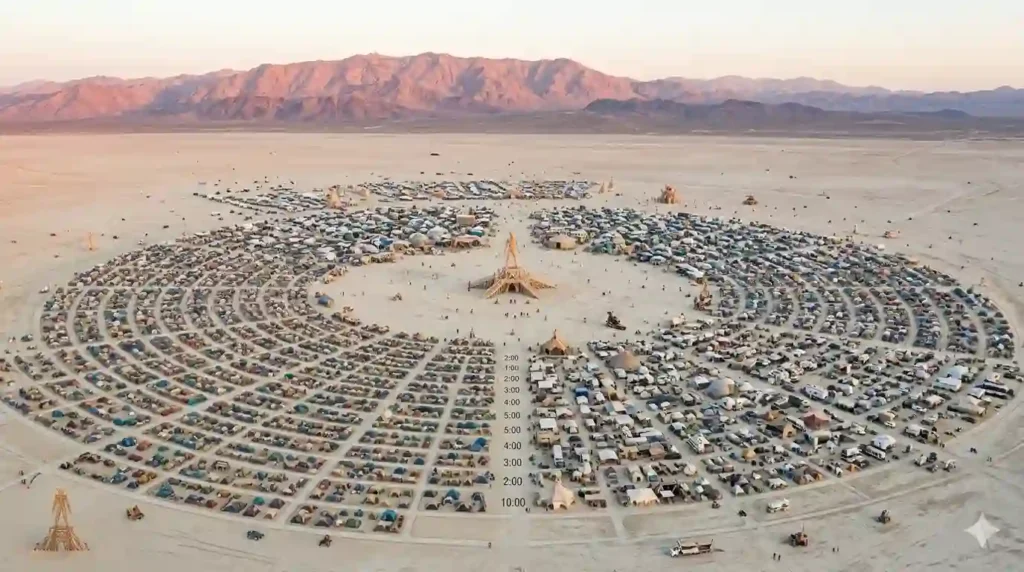
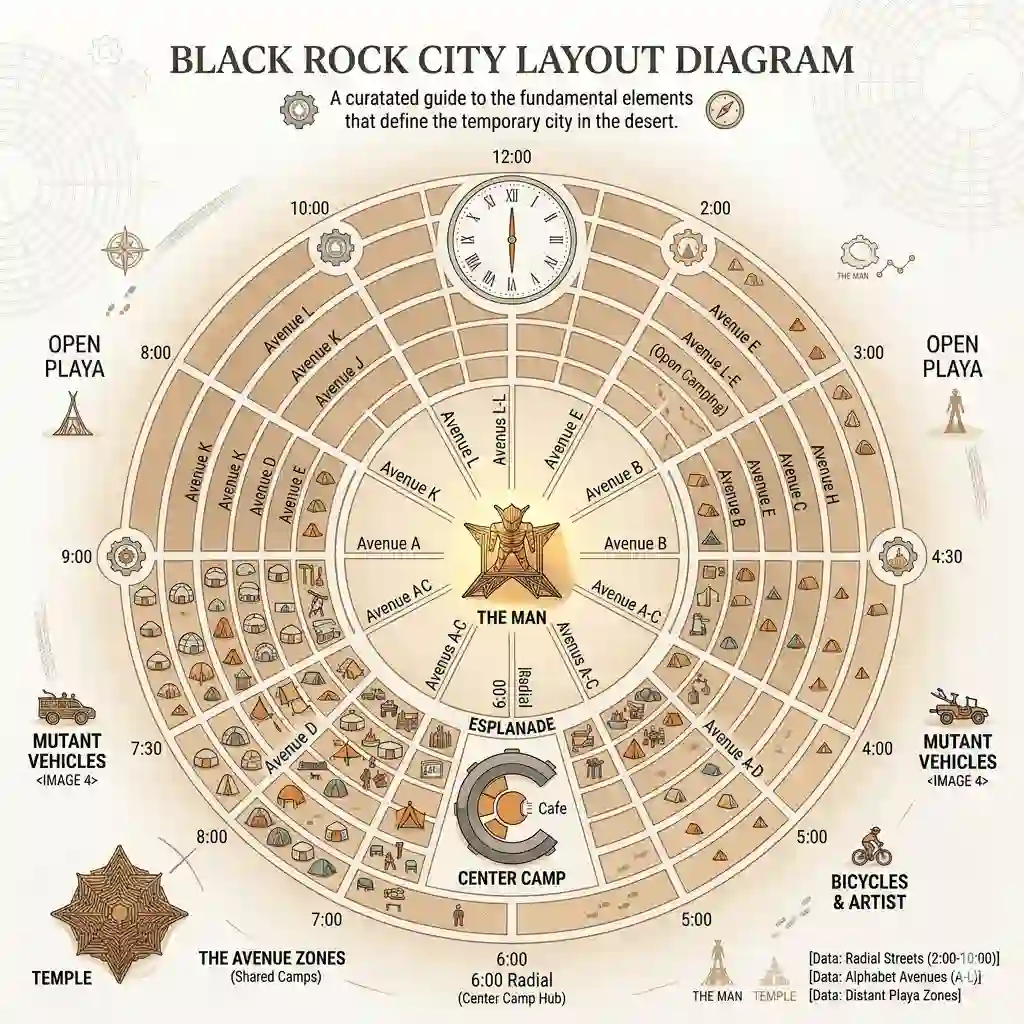
Although Black Rock City rises from an apparently empty desert each year, its layout follows a carefully engineered urban plan rather than organic sprawl. The city is arranged in a semicircular, radial grid: streets running like spokes are labeled by clock position (2:00 through 10:00, with The Man at the center and deep playa occupying the open space beyond), while concentric arc streets are typically named alphabetically or thematically depending on the year’s theme. An address like “7:30 & E Plaza” tells you both your radial position and your distance from center — once it clicks, it becomes one of the most logical city layouts most participants have ever navigated.
This guide walks through reading the official Black Rock City map before you arrive, understanding how clock and arc addressing works together, locating major landmarks and plazas relative to your own camp, and practical night navigation tips — since the same street grid looks dramatically different after dark, when landmarks are identified more by light and sound than daytime silhouette. It also covers common beginner mistakes, like underestimating walking or biking distances across a city that can span several miles from end to end.
Rather than listing every camp or landmark individually, this guide focuses on the navigation system itself. For specific landmarks like The Man, the Temple, and Center Camp, see the Landmarks & Iconic Places guide; for getting around once you understand the layout, see the Transportation Inside Black Rock City guide.
In This Guide You’ll Learn
- 🏙️ How Black Rock City is designed
- 🗺️ Understanding the official map
- 🕒 Clock positions and radial streets
- 🛣️ Street names and addresses
- 🏕️ Neighborhoods and camping areas
- 🏛️ Major landmarks
- 🚲 Navigation tips
- 📍 Finding camps and services
- 🌅 Exploring the open playa
- 📱 Digital and printed navigation tools
What Is Black Rock City?
Before you can navigate Black Rock City, you need to understand what it actually is because it’s genuinely unlike any other place you’ve ever been.
A Temporary City in the Desert
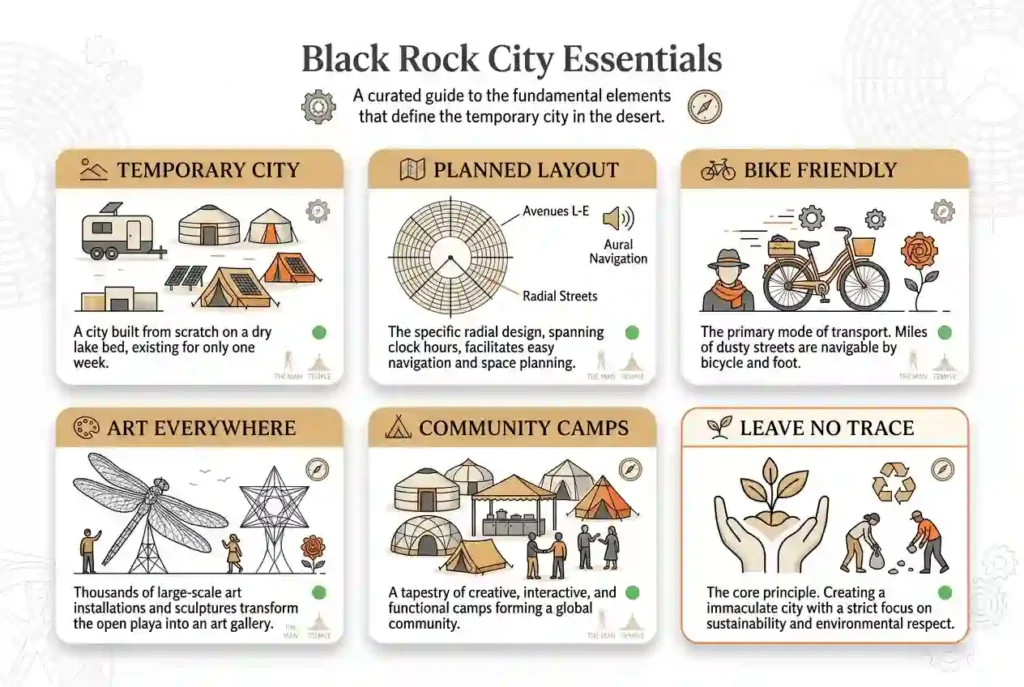
Black Rock City is the name of the temporary city that hosts Burning Man each year. It is not a metaphor or a marketing term. It is a real, functioning city with a radial street grid, named streets and addresses, public infrastructure, organized neighborhoods, medical services, law enforcement presence, and a civic culture built around the event’s ten guiding principles.
What makes Black Rock City extraordinary is that it exists for only about two weeks each year one week for setup, one week for the event itself, and several days for teardown. During the event period, it becomes one of the larger cities in Nevada by population. When the event ends, every structure, every person, and every piece of material leaves the desert floor, and Black Rock City ceases to exist until the following year.
Where Black Rock City Is Located
Black Rock City is built on the Black Rock Desert, a remote high-altitude desert playa in Pershing County, Nevada, approximately 100 miles north of Reno. The playa itself a flat, ancient lakebed covers hundreds of square miles and is one of the flattest surfaces on Earth. Its extreme flatness, remoteness, and hardpan surface make it uniquely suited to hosting a large temporary city.
The Black Rock Desert is a place of extraordinary natural character vast, stark, and beautiful in a way that’s difficult to describe until you’ve experienced it. The playa’s white alkaline surface stretches to distant mountain ranges on all sides, creating a sense of infinite space that profoundly shapes the Burning Man experience. Understanding where you are in one of the most remote and elemental landscapes in North America helps make sense of everything that happens there.
How the City Is Built Each Year
The construction of Black Rock City is a remarkable logistical and community achievement. Weeks before the event opens to the general public, a dedicated crew of workers and volunteers arrives on the playa to begin the process of building the city from nothing.
Streets are surveyed and marked. Infrastructure is installed power lines, water systems for ice and services, communications equipment, temporary road surfaces on key routes. The large-scale art installations that define the deep playa are constructed. Theme camps begin arriving and building their structures. Medical facilities, ranger stations, and service centers are established.
By the time general participants begin arriving, a functional city skeleton is in place. The city then fills in rapidly as thousands of vehicles pour through the gate carrying the materials, art, food, water, and personal gear that complete the city’s character.
Why Black Rock City Is Unique
No other temporary city in the world operates at the scale, complexity, and intentionality of Black Rock City. What makes it genuinely unique isn’t its size it’s the fact that it’s built entirely by its own residents. Every camp, every art installation, every shade structure, every workshop, every performance is created and operated by participants. There is no professional entertainment industry putting on a show for a passive audience. The city and everything in it is built by the people who live there.
This radical self-reliance and collective creativity, combined with a commitment to leaving no trace, produces something that has no real parallel in the world of events or urban planning. Black Rock City is less a festival than an experiment in what a community can create when given space, time, and a shared set of values.
- A real, functioning temporary city built each year on the Black Rock Desert playa for Burning Man.
- Exists for setup, one event week, and teardown — then everything is removed; it’s not permanent.
- Provides urban services during the event: streets, addresses, medical, Rangers, information, and temporary infrastructure.
- Unique because it’s built and run by participants (radical self-reliance + gift economy).
- Quick action tips:
- Treat the city like a functioning urban system — plan logistics (water, shade, waste) accordingly.
- Respect the temporary nature: pack everything in and pack everything out.
The History of Black Rock City
Understanding where Black Rock City came from helps explain why it works the way it does today.
Early Burning Man Gatherings
Burning Man began in 1986 on Baker Beach in San Francisco, when a small group of friends gathered to burn a wooden effigy on the summer solstice. The event was informal, unplanned, and attended by fewer than 20 people. It grew organically through the late 1980s, drawing larger crowds to Baker Beach each year, until the scale of the burn attracted the attention of local authorities and the beach became too small and too regulated for what the event was becoming.
Move to the Black Rock Desert
In 1990, the event relocated to the Black Rock Desert a vast, remote, and legally permissive landscape that could accommodate the gathering’s growing ambitions. The early years in the desert were radically different from today’s Burning Man: no street grid, no city planning, no organized infrastructure. People arrived and set up wherever they chose. The Man was burned in an open desert gathering that resembled a large, chaotic art happening more than a city.
As attendance grew through the early 1990s from hundreds to thousands the need for organization became impossible to ignore. Safety concerns, logistical challenges, and the sheer complexity of managing a large gathering in a remote desert began to demand a more structured approach.
Growth Through the Years
Through the mid-to-late 1990s, Black Rock City took shape as a genuinely planned city. The radial street grid was introduced. Neighborhoods and camp placement systems were developed. Infrastructure — ice sales, medical services, ranger patrols was built out. The event grew from a few thousand participants to tens of thousands, and the city grew with it.
Each decade brought new challenges and new solutions. The 2000s saw Black Rock City reach a scale that required serious municipal-level planning. The 2010s brought increased attention to environmental sustainability, accessibility, and the cultural tensions that come with rapid growth. Through all of it, the fundamental character of Black Rock City a temporary city built by its residents, governed by shared principles remained intact.
Modern Black Rock City
Today, Black Rock City is a city in every meaningful sense. It has a population that regularly exceeds 70,000 participants during peak days. It has a Department of Public Works (DPW) that handles construction and infrastructure. It has its own safety organization (Black Rock Rangers), medical facilities, a post office (during the event), a newspaper (the Black Rock Beacon), and a radio station. It is permitted by the Bureau of Land Management (BLM), which oversees the federal land on which it sits.
Understanding this history helps explain why Black Rock City feels the way it does — not like a festival that grew up, but like a community that built itself from the ground up, year after year, guided by a set of values that predate the city’s organized form.
- Began on Baker Beach (1986) with a small effigy burn; moved to Black Rock Desert in 1990 for space and fewer restrictions.
- Early years were informal; the city evolved a radial grid, placement process, and infrastructure as attendance grew.
- Growth required municipal-style planning (DPW, medical, placement, permits) while retaining participant-driven culture.
- Modern Black Rock City regularly hosts 70,000+ people and operates under BLM permits and formal city teams.
- Quick action tips:
- Learn basic history to appreciate why safety, planning, and LNT matter.
- Read the Burning Man History Guide to understand how current rules evolved.
For a deeper exploration of Burning Man’s origins and evolution, see the Burning Man History Guide.
Understanding the Layout of Black Rock City
The layout of Black Rock City is one of its most distinctive features and one of the most important things to understand before you arrive. Once the layout makes sense, navigating the city becomes intuitive. Before it makes sense, the city can feel genuinely disorienting.
- Temporary urban planning
- Semi-circular layout
- Central gathering areas
- Neighborhood organization
- Participant accessibility
The Semi-Circular Design
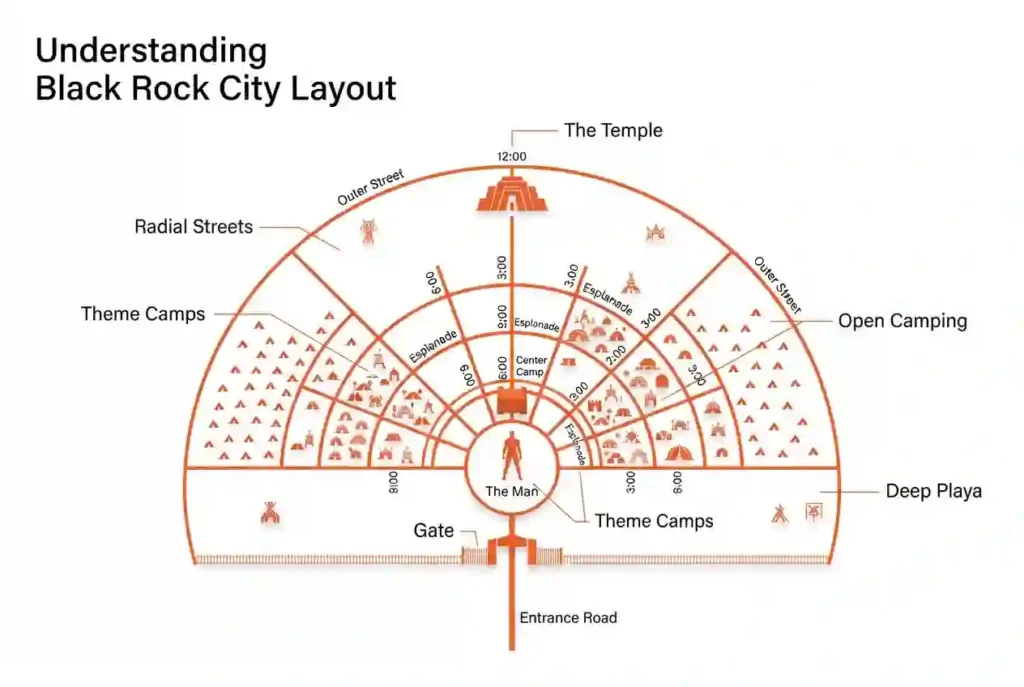
Black Rock City is built in the shape of a large open semicircle, like a letter C or a horseshoe. The open end of the semicircle faces the deep playa the vast, open desert space where large-scale art installations are placed and where The Man and The Temple stand. The closed, outer edge of the semicircle forms the outer boundary of the residential camping areas.
This design creates a natural relationship between the city and the playa: residents live in the semicircular arc, and the open playa is the shared front yard of the entire community. Walking from anywhere in the city toward the center of the open end takes you toward The Man and the deep playa.
- Reading the map
- Symbols
- Color coding
- Landmarks
- Street references
The Clock Layout System
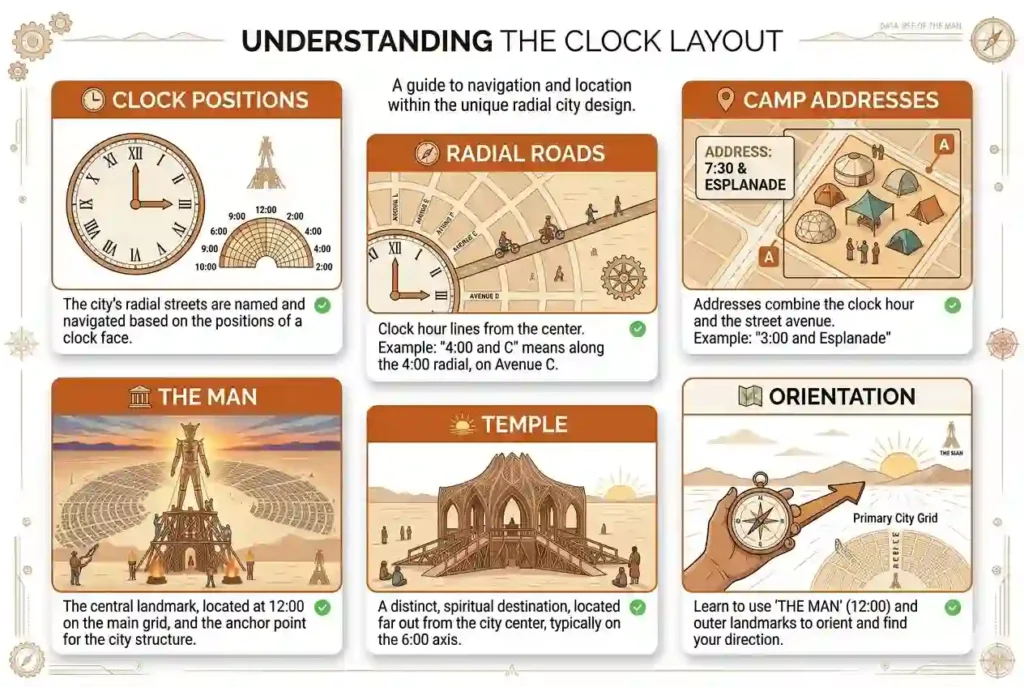
Black Rock City uses a clock face as its primary navigational metaphor, and once you understand this, everything else falls into place. Understand the:
- system
- Orientation Clock-face navigation
- Direction finding
- Addressings
Imagine standing at The Man the central effigy at the heart of the open playa and looking toward the city. The city arc spans from approximately 2 o’clock on your right to 10 o’clock on your left. The bottom of the clock face (6 o’clock) points directly toward the main entrance of Center Camp, which sits on the Esplanade at the city’s central axis.
Every location in Black Rock City can be described in terms of a clock position and a distance from The Man. A camp at “7:30 and Esplanade” is on the innermost road at the 7:30 clock position. A camp at “4:00 and Cougar” is further out, toward the outer edge of the city, at the 4 o’clock position. This system sounds confusing in the abstract but becomes second nature very quickly once you’re on the ground.
Radial Streets
Radial streets run outward from The Man like the spokes of a wheel, cutting through the semicircular arc of the city at intervals that correspond to clock positions. Major radial streets are marked at positions like 2:00, 3:00, 4:30, 6:00, 7:30, 9:00, and 10:00, with additional streets at smaller intervals in between.
These radial streets are your primary cross-city routes the fastest way to move between the inner Esplanade and the outer residential areas, and between one clock position and another.
- Radial streets
- Circular streets
- Camp addresses
- Wayfinding
Concentric Streets
Concentric streets run parallel to the outer curve of the semicircle, forming the arcs that give the city its distinctive shape. These streets are named alphabetically, starting at the innermost road (the Esplanade) and moving outward through names that change each year but follow a consistent alphabetical pattern.
The Esplanade is the innermost and most prominent concentric street the boulevard that runs along the inner edge of the residential city, facing the open playa. Walking the Esplanade from one end to the other gives you a front-row view of the city’s most prominent theme camps and a sense of the full scale of Black Rock City.
Black Rock City Navigation Overview
| Navigation Feature | Purpose |
| Clock Positions | Direction and orientation |
| Radial Streets | Main navigation routes |
| Named Streets | Addresses and neighborhoods |
| Plazas | Gathering spaces |
| Open Playa | Large open exploration area |
| Major Landmarks | Orientation points |
Navigating the City
Navigation in Black Rock City relies on three tools: the clock position (which tells you where you are around the semicircle), the street name (which tells you how far from the center you are), and physical landmarks. The Man is always visible from most of the city and serves as a constant directional reference. Center Camp’s location at 6 o’clock is equally useful.
The most important navigation tip for first-timers: memorize your camp’s address before you leave your campsite. Clock position and street name. Write it on your arm if needed. In a city of 70,000 people and thousands of camps, finding your way home from the deep playa at 3am without knowing your address is a memorable experience for all the wrong reasons.
Understanding Addresses
Addresses in Black Rock City follow the format: [Clock Position] and [Street Name]. For example, “4:30 and Esplanade” or “8:00 and Drum.” The clock position tells you where you are around the city’s arc; the street name tells you which concentric ring you’re on, with the Esplanade being innermost and outer streets being further from the playa.
- Built as a semicircle (C-shape) facing the deep playa; residents live on the arc; the open playa is the communal front yard.
- Navigation uses the clock system (angles from The Man) plus concentric street names (Esplanade = innermost).
- Radial streets are spokes (fast cross-city routes); concentric streets show distance from The Man.
- Memorize and post your camp address; use The Man and Center Camp as core landmarks.
- Quick action tips:
- Write your camp address on your arm and post it at camp entry.
- Ride or walk the Esplanade once on arrival to lock orientation.
For a detailed breakdown of the city’s districts and neighborhoods, see the Districts & Neighborhoods Guide.
Major Areas of Black Rock City
Black Rock City contains several landmark areas that serve as the primary reference points for navigation, culture, and experience. Every participant should know where these are and what they represent.
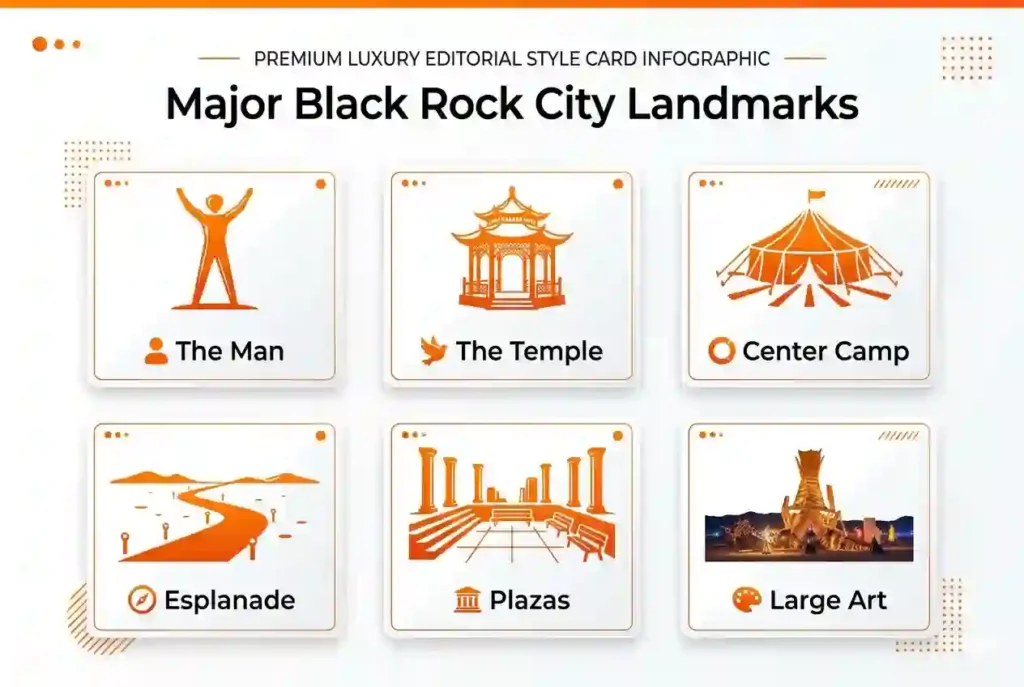
🏛️ Major Orientation Points
- The Man
- Temple
- Center Camp
- Main plazas
- Key intersections
The Man
The Man is the iconic wooden effigy that gives Burning Man its name and stands at the symbolic and geographic center of Black Rock City’s open playa. Each year, The Man is built on a platform or base structure whose design changes with the annual theme, and on Saturday night of the event week, it is ceremonially burned in a massive communal gathering that draws virtually the entire city’s population.
The Man serves as the primary navigation anchor for Black Rock City. It’s visible from most of the city and from miles of open playa. When someone says “walk toward The Man,” they mean walk away from the city and into the open playa toward the center. When they say “walk away from The Man,” they mean walk back into the city.
The burn of The Man on Saturday night is the emotional and cultural centerpiece of Burning Man week a massive fire ceremony surrounded by art cars, fire performers, and tens of thousands of participants that represents the culmination of the week’s creative and communal energy.
Center Camp
Center Camp is the city’s central communal gathering space, located at the 6 o’clock position on the Esplanade directly south of The Man along the city’s main axis. It’s a large, open-air shaded structure that functions as a public square, hosting workshops, performances, conversations, and community gatherings throughout the week.
Center Camp is one of the most important landmarks for first-timers: it’s easy to find, it’s welcoming, and it offers orientation resources, community interaction, and a sense of the city’s social character. It’s also historically the place to find coffee one of the few things sold for money at Burning Man.
For a complete guide to Center Camp, see the Center Camp Guide.
The Temple
The Temple is one of the most profound and emotionally significant structures at Burning Man. Built fresh each year by a dedicated team of artists, the Temple serves as a space for grief, remembrance, reflection, and release. Participants write messages to lost loved ones on the Temple’s walls, attach photographs and mementos, and use the space for personal ceremony throughout the week.
On Sunday night the final night of Burning Man the Temple is burned in a ceremony that is dramatically different from The Man burn. Where The Man burn is loud, celebratory, and festive, the Temple burn is quiet, contemplative, and deeply moving. Tens of thousands of people gather in near-silence as the year’s Temple and everything inside it is consumed by fire.
The Temple typically stands further out in the deep playa than The Man, along the same central axis.
Open Playa
The open playa is the vast, unbuilt desert space between the city’s residential arc and the outer reaches of the playa. This is where the large-scale art installations are placed — the massive sculptures, interactive environments, fire art, and kinetic works that define Burning Man’s visual character. It’s also where art cars roam, where mutant vehicles gather around The Man at night, and where participants wander in search of unexpected encounters.
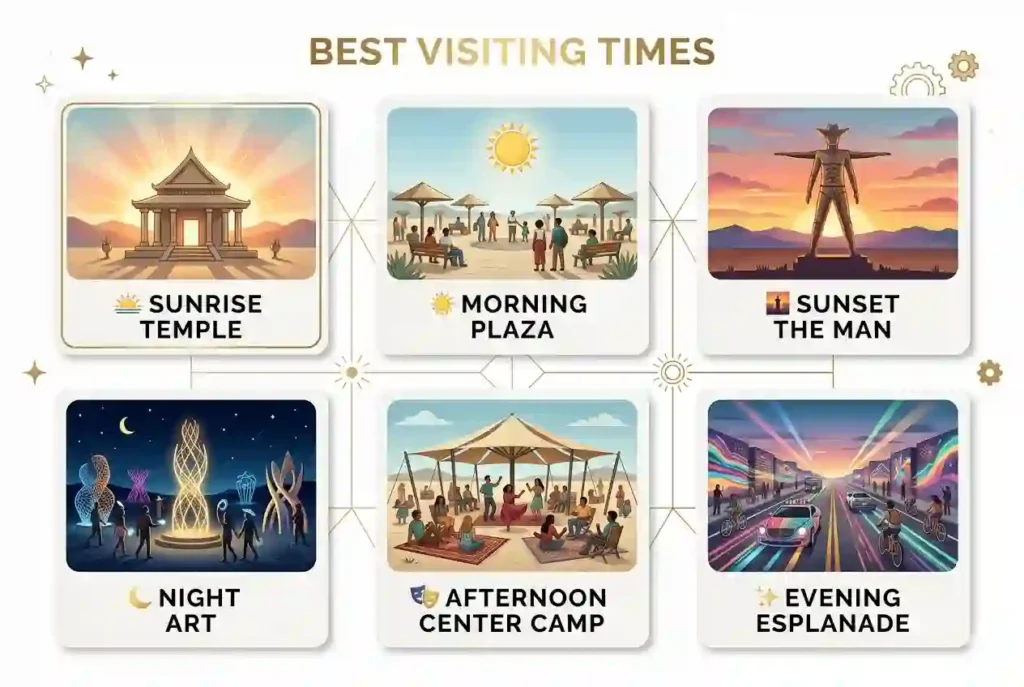
The open playa is at its most magical at night, when art installations light up, fire performers take the stage, and the dark desert becomes an illuminated landscape unlike anything in ordinary life. First-timers should plan at least one long nighttime walk across the open playa it’s one of the defining Burning Man experiences.
📐 Why Black Rock City Uses a Radial Layout
Better access to major landmarks and public services
Easier orientation in an otherwise featureless desert
Efficient emergency response
Logical addressing system
Improved pedestrian and bicycle navigation
Residential Areas
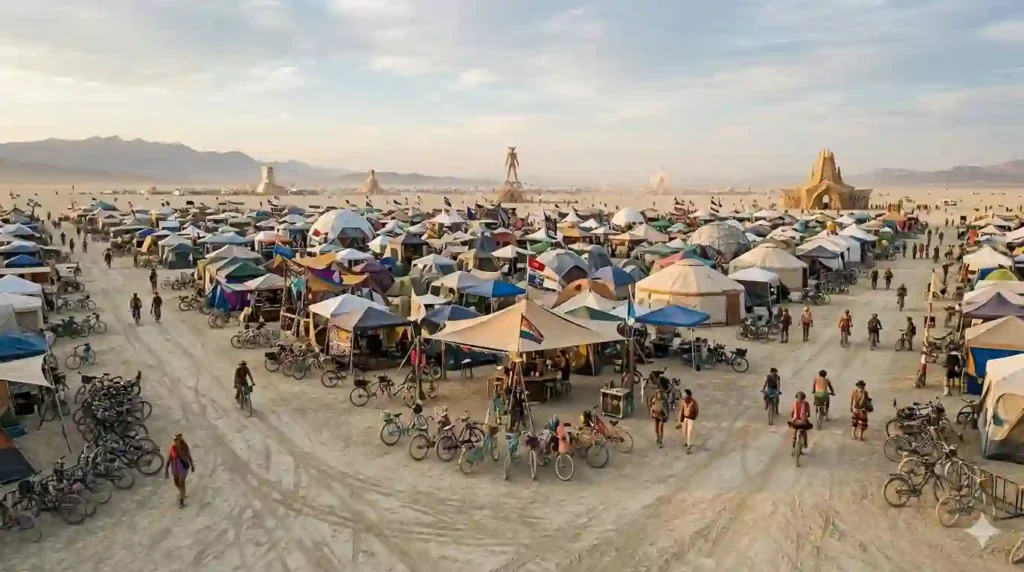
The residential areas of Black Rock City fill the semicircular arc between the Esplanade and the outer streets. This is where participants camp, where theme camps set up their interactive experiences, and where the daily life of the city happens. The residential areas are dense, vibrant, and constantly active a mix of individual campers, small group camps, and large theme camps that create dozens of distinct micro-neighborhoods across the city.
- The Man is the central effigy and primary navigation anchor; burned Saturday night in a large celebratory ceremony.
- Visible from most of the city and deep playa “walk toward The Man” = out to playa.
- The Man burn is a major communal cultural moment; expect crowds and processions.
- Quick action tips:
- Pick a meeting spot well before The Man burn and confirm with your group.
- Scout exit routes and water/medical points before attending the burn.
How Black Rock City Is Organized
Black Rock City doesn’t organize itself it’s the product of an enormous amount of planning, coordination, and community effort that begins months before anyone arrives on the playa.
🏕️ Neighborhoods & Camping Areas
- Theme camp districts
- Open camping
- Villages
- Community organization
City Planning Teams
The organization behind Burning Man Burning Man Project maintains dedicated teams that handle the planning and construction of Black Rock City each year. The Department of Public Works (DPW) is the primary construction crew, responsible for surveying and marking the city’s streets, installing infrastructure, building the Gate and Gerlach road systems, and managing the physical construction of the city.
These teams begin arriving weeks before the event opens and stay until after teardown is complete. Their work is what makes it possible for a city of 70,000+ people to function safely in a remote desert environment.
Placement Process
One of the most important logistical operations at Black Rock City is the placement process — the system by which theme camps are assigned their locations within the city. Theme camps apply to Burning Man’s Placement team months in advance, describing their planned offerings and infrastructure needs. The Placement team reviews these applications and assigns camp locations based on factors including camp size, noise level, power needs, and how their offerings contribute to the city’s overall experience.
This process is what creates the city’s neighborhood character placing music camps near other music camps, quieter and family-friendly camps in less intense areas, and large interactive camps on prominent positions along the Esplanade.
Infrastructure Development
Black Rock City’s infrastructure is more extensive than most people realize. It includes: a managed road network with dust mitigation on key routes; ice distribution through the Arctica stations; medical facilities capable of handling a wide range of emergencies; communications infrastructure; power distribution for service areas; and the Gate and Greeters stations that manage arrival and departure.
This infrastructure is built, operated, and torn down each year by a combination of paid staff, contractors, and dedicated volunteers who make Black Rock City’s temporary existence possible.
Black Rock City Districts at a Glance
| District | What You’ll Find | Best For |
|---|---|---|
| Center Camp | Gathering spaces, activities, information | First-time visitors |
| Esplanade | Major theme camps and art | Day and night exploration |
| Inner Streets | Residential camping | Quieter atmosphere |
| Open Playa | Large-scale art installations | Photography and exploration |
| Outer Streets | Theme camps and support camps | Community participation |
Community Participation
Ultimately, Black Rock City is organized by its own residents as much as by any central authority. Participants build their camps, create their art, run their theme camp programs, and contribute to the city’s services as volunteers. The Burning Man principle of civic responsibility means that participants don’t just consume the city they help create and maintain it. This participatory ethic is one of the things that makes Black Rock City genuinely different from any other large event in the world.
- Burning Man Project coordinates city planning; DPW (Department of Public Works) surveys, marks streets, and builds infrastructure.
- Construction and teardown are staffed by paid crews and many volunteers who arrive weeks before and stay after the event.
- Organization and planning make a temporary, safe city for 70,000+ people possible.
- Quick action tips:
- Respect DPW and staff instructions during setup/teardown.
- Volunteer shifts help the city run — consider signing up pre-event.
For more on how the city operates behind the scenes, see the City Operations Guide.
Theme Camps and Neighborhood Culture
Theme camps are the building blocks of Black Rock City’s neighborhood character and understanding them helps explain why different parts of the city feel so different from one another.
What Theme Camps Do
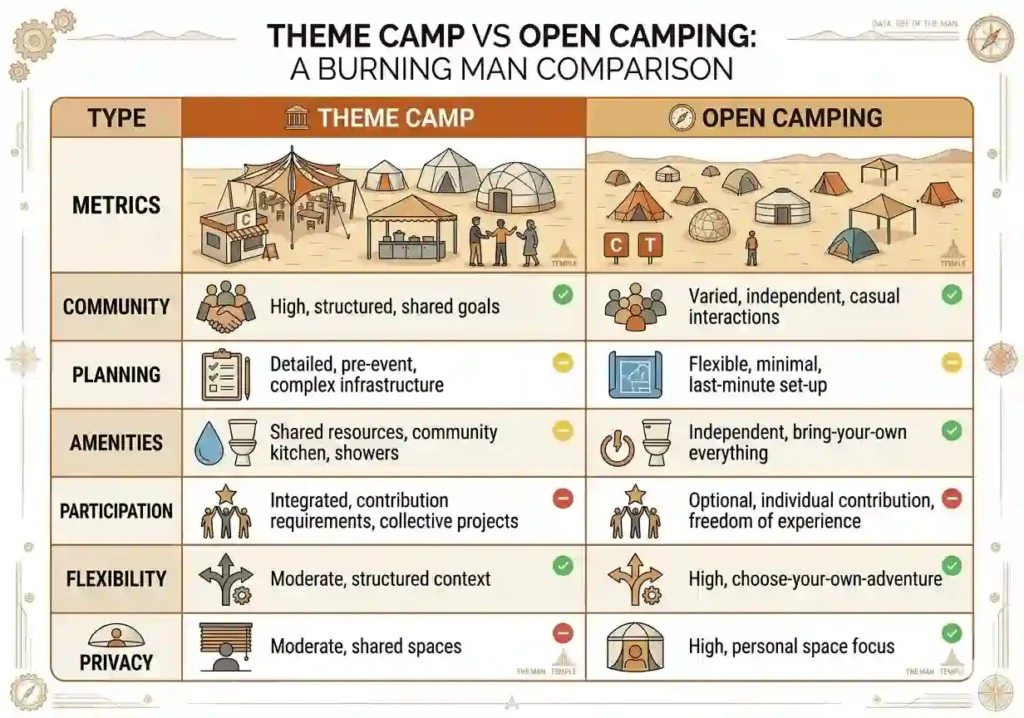
A theme camp is any organized group that sets up a camp with an interactive offering for the broader Burning Man community. Theme camps don’t just camp they create experiences. A theme camp might run a bar that serves free cocktails, host a daily yoga class, operate a sound stage with live music, offer workshops on specific skills, run a sauna, host art installations, or create any number of other interactive environments that participants from across the city can visit and enjoy.
The critical thing about theme camps is that their offerings are free and open to everyone. This is a core expression of Burning Man’s gift economy the principle that gifts are given without expectation of return.
Interactive Experiences
The interactive experiences offered by theme camps are enormously diverse. On any given day at Burning Man, you can find theme camps offering everything from darkroom photography development to amateur radio operation to aerial silks classes to whiskey tastings to philosophical debate series to swing dancing lessons. The range of human knowledge, creativity, and passion represented across Black Rock City’s theme camp landscape is genuinely staggering.
Camp Placement
The placement of theme camps within the city is not random. The Placement team works to create coherent neighborhood experiences by grouping camps with related offerings and managing the sound, size, and character of camps relative to their neighbors. The result is that different areas of Black Rock City have distinctly different characters some blocks feel like lively party streets, others like quiet creative communities, others like wellness retreats.
Building Community
Theme camps are the primary mechanism through which community forms at Black Rock City. They give participants a reason to explore the city, connect with strangers, discover unexpected interests, and return repeatedly to the same spaces. Over the course of a week, the camp you visit every morning for coffee or the sound stage you return to each night becomes a community anchor — a place with familiar faces and a shared sense of belonging.
- Theme camps apply months ahead; Placement assigns locations based on size, noise, power, and contribution.
- Placement shapes neighborhood character music near music, quiet near quiet, high-traffic camps on Esplanade.
- Good placement helps manage sound, safety, and visitor flow.
- Quick action tips:
- If running a theme camp, complete Placement materials early and honestly.
- Study placement feedback and past maps to choose appropriate offerings.
For a complete guide to theme camps, including how to find them and what to expect, see the Theme Camps Guide.
Life Inside Black Rock City
One of the most common questions first-timers ask is: “What do you actually do at Burning Man?” The answer is: almost anything you can imagine. But it helps to understand the rhythm of daily life in Black Rock City.
Daytime Activities
Daytime in Black Rock City is defined by heat, exploration, and community. The morning hours (before the heat peaks around midday) are ideal for visiting theme camps, attending workshops, exploring the art installations near the city, and talking with neighbors and campmates. The midday hours tend toward rest and shade, with participants retreating to their camps or Center Camp to escape the desert sun.
Late afternoon brings renewed energy as the temperature begins to drop. This is one of the best times to bike across the city, visit the art installations in the open playa, and prepare for the evening ahead.
Nighttime Activities
Nighttime is when Black Rock City transforms into something that has to be experienced to be fully understood. As darkness falls, the entire city and playa light up art installations glow, theme camp stages come alive with music and performance, fire art sends flames into the desert sky, and tens of thousands of people in illuminated costumes create a visual experience unlike anything else on Earth.
The nighttime energy of Black Rock City is simultaneously overwhelming and magical. The best approach, especially for first-timers, is to wander with intention pick a general direction, remain open to unexpected encounters, and trust that something worth experiencing is always nearby.
Art Exploration
Art is everywhere in Black Rock City on the deep playa, along the Esplanade, inside theme camps, in the residential areas, and in unexpected corners throughout the city. Daytime art exploration and nighttime art exploration offer completely different experiences. Many installations are interactive, and many change character dramatically when illuminated after dark. Planning at least one dedicated art exploration session with a map of major installations is highly recommended.
Workshops and Gatherings
Burning Man’s commitment to participation means that knowledge sharing happens constantly across the city. At any given hour during the event, dozens of workshops, discussions, classes, and gatherings are happening simultaneously. Topics range from the intensely practical (survival skills, bicycle repair) to the deeply philosophical (consciousness, community, creativity). The What Where When guide lists these events and is an essential planning resource.
Meeting New People
Black Rock City is one of the most socially open environments most people will ever encounter. The culture actively encourages connection between strangers. People talk to each other in the open playa, at theme camps, at workshops, at Center Camp, and everywhere in between. For participants who find social interaction challenging in everyday life, Burning Man’s culture of openness can be genuinely transformative.
Community Participation
Perhaps the most important aspect of daily life in Black Rock City is the understanding that you are not a spectator you are a participant and a contributor. Whether that means volunteering for a shift at a theme camp, helping a neighbor set up their shade structure, picking up MOOP (Matter Out Of Place) as you walk through the city, or simply bringing your full presence and openness to every interaction, participation is the currency of Black Rock City.
- The city encourages connection; be open but always practice consent and respect boundaries.
- Volunteer and contribute participation is the primary currency of Black Rock City.
- Neighbors are key resources for info, tools, and assistance.
- Quick action tips:
- Introduce yourself to immediate neighbors and swap contact/mailing methods.
- Offer help and accept help reciprocity builds trust.
Transportation Within the City
Getting around Black Rock City requires a different mindset than navigating most cities and choosing the right transportation strategy makes a significant difference in your experience.
Walking
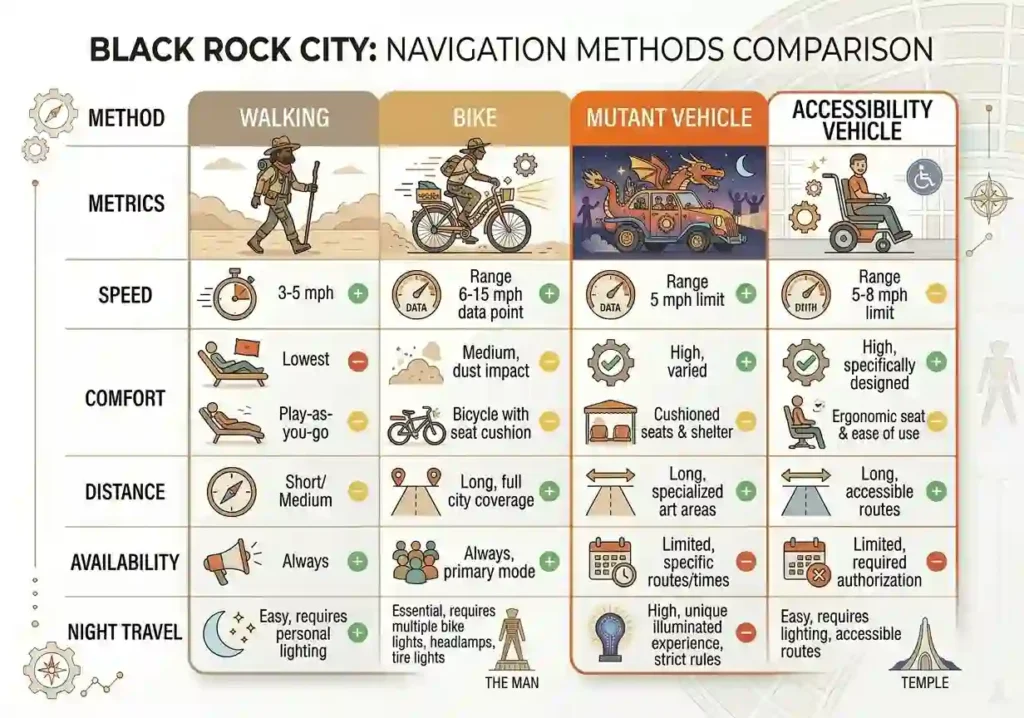
Walking is the most fundamental way to experience Black Rock City, and there are times when it’s the best option. Walking at a slow pace through the residential streets lets you notice camps, art, and encounters that you’d miss on a bike. Walking the deep playa at night, when the art and light are at their most intense, is one of the definitive Burning Man experiences. The limitation is distance the city spans several miles from end to end, and walking everywhere in desert heat can be exhausting.
Bicycles
Bicycles are the primary transportation mode for most Burning Man participants, and for good reason. A bike lets you cover the full extent of the city and playa efficiently, dramatically expanding your range and reducing the physical fatigue of constant walking. At night, bikes must be equipped with lights both for safety and because a dark, fast-moving bike in a crowd of people is genuinely dangerous.
Playa bikes don’t need to be expensive or beautiful. They do need to be functional. The fine alkaline dust of the Black Rock Desert is brutal on bicycle components bearings, chains, cables, and derailleurs all suffer. Simple bikes with fewer components tend to hold up better than complex ones.
Mutant Vehicles
Mutant Vehicles (MVs) are art cars licensed vehicles that have been significantly transformed from their original form into rolling pieces of art that provide transportation across the playa. Riding a mutant vehicle is one of the most uniquely Burning Man experiences available a combination of transportation, performance art, community gathering, and sensory experience that doesn’t exist anywhere else.
Not all mutant vehicles accept passengers some are private, others are open to anyone who asks. The culture around MVs is generally generous, but asking permission before boarding is always the right move.
For a complete guide to mutant vehicles, see the Mutant Vehicles Guide.
Accessibility Considerations
Black Rock City has made significant efforts in recent years to improve accessibility for participants with mobility limitations. Mobility Camp provides resources and assistance for participants with disabilities. Accessible routes and considerations are built into the city’s infrastructure planning. Participants with specific accessibility needs should research available resources before arriving and connect with the Burning Man accessibility team during the event.
- Black Rock City installs a temporary but extensive infrastructure: roads, Arctica ice stations, medical services, communications, and power distribution.
- Infrastructure is built and removed each year by a mix of staff, contractors, and volunteers.
- These systems support safety, health, and basic services across the playa.
- Quick action tips:
- Locate the nearest medical, Arctica (ice), and communications points on arrival.
- Don’t tamper with infrastructure — report issues to staff or DPW.
Essential Resources Available in Black Rock City
Black Rock City is remote, but it’s not without resources. Understanding what’s available and where to find it is an important part of being prepared.
Information Services
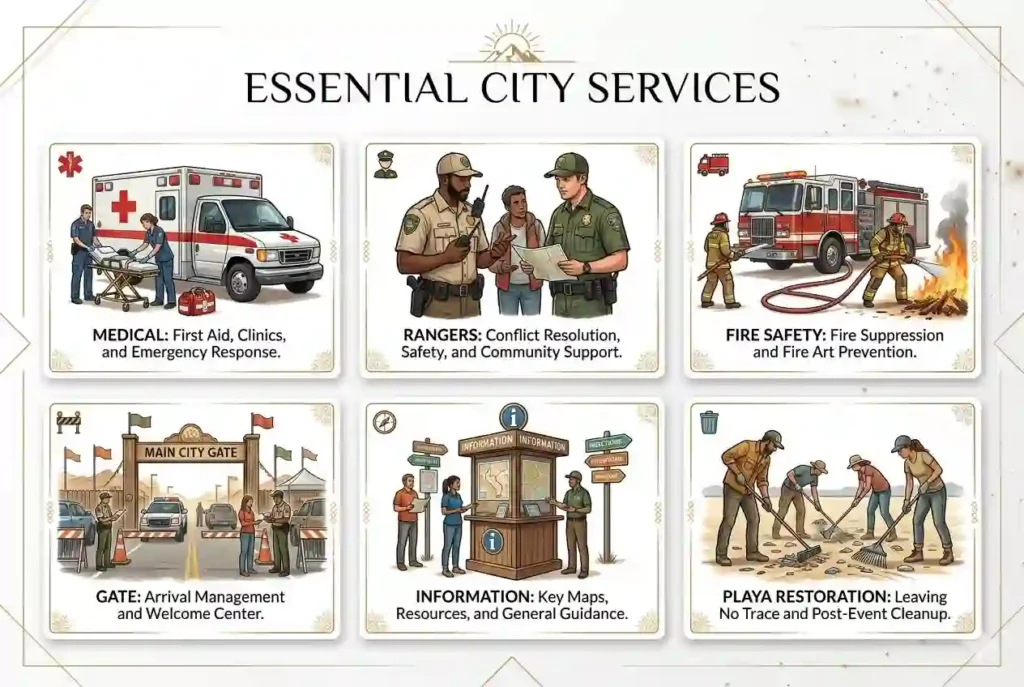
Playa Info is Black Rock City’s official information resource a staffed station near Center Camp where participants can get answers to questions about the city, pick up copies of the What Where When guide, access lost and found services, and find information about events and resources. For first-timers with questions, Playa Info is the best first stop.
Medical Services
Burning Man maintains medical facilities within Black Rock City capable of handling a wide range of health situations from dehydration and minor injuries to more serious emergencies. Medical stations are staffed by licensed medical professionals and are accessible throughout the event. Emergency Medical Technicians (EMTs) and other medical personnel also patrol the city and playa.
Knowing where the nearest medical station is relative to your camp is a practical safety measure worth taking in your first day.
Ranger Support
The Black Rock Rangers are Burning Man’s community safety organization not law enforcement, but trained community members whose role is to help participants navigate difficult situations, mediate conflicts, provide support during challenging experiences, and keep the community safe. Rangers are distinguishable by their khaki uniforms and are present throughout the city and playa.
If you’re in a difficult situation personal crisis, conflict with another participant, concerns about someone else’s wellbeing finding a Ranger is almost always the right first step. They are trained to help without judgment and with genuine care for participants’ wellbeing.
Community Resources
Beyond official services, Black Rock City’s community itself is a resource. The culture of mutual support and radical self-reliance means that experienced participants are generally willing to help when asked. Your neighboring camps are often your most immediate resource for practical needs tools, supplies, information, and human connection.
Emergency Assistance
For serious emergencies medical crises, fires, situations requiring law enforcement Black Rock City has emergency response capabilities including coordination with Pershing County emergency services. Emergency contact protocols are described in the Burning Man Survival Guide distributed at entry and available on the Burning Man website.
- On‑site medical stations with licensed professionals handle everything from dehydration and minor injuries to serious emergencies, and EMTs patrol the city and playa. Knowing the closest medical station to your camp is an important first‑day safety task.
- Black Rock Rangers, in khaki uniforms, are community safety volunteers (not police) who help with conflicts, personal crises, tough situations, and general wellbeing support across the city.
- For emotional, interpersonal, or safety concerns involving other participants, going to a Ranger is recommended because they’re trained to respond with care and without judgment.
- Neighbors and other camps are key community resources for tools, supplies, information, and support, reflecting Burning Man’s culture of mutual aid and radical self‑reliance.
- Major emergencies (serious medical, fires, law‑enforcement issues) are handled through Black Rock City’s emergency response system, described in the Survival Guide and supported by Pershing County services and city operations guides.
For a complete overview of city services, see the Playa Resources Guide and City Operations Guide.
Art and Creativity Across the City
Art is not a feature of Black Rock City — it is Black Rock City’s reason for being. The event was founded as an artistic and communal experiment, and art remains the central organizing principle of everything that happens there.
Large-Scale Art Installations
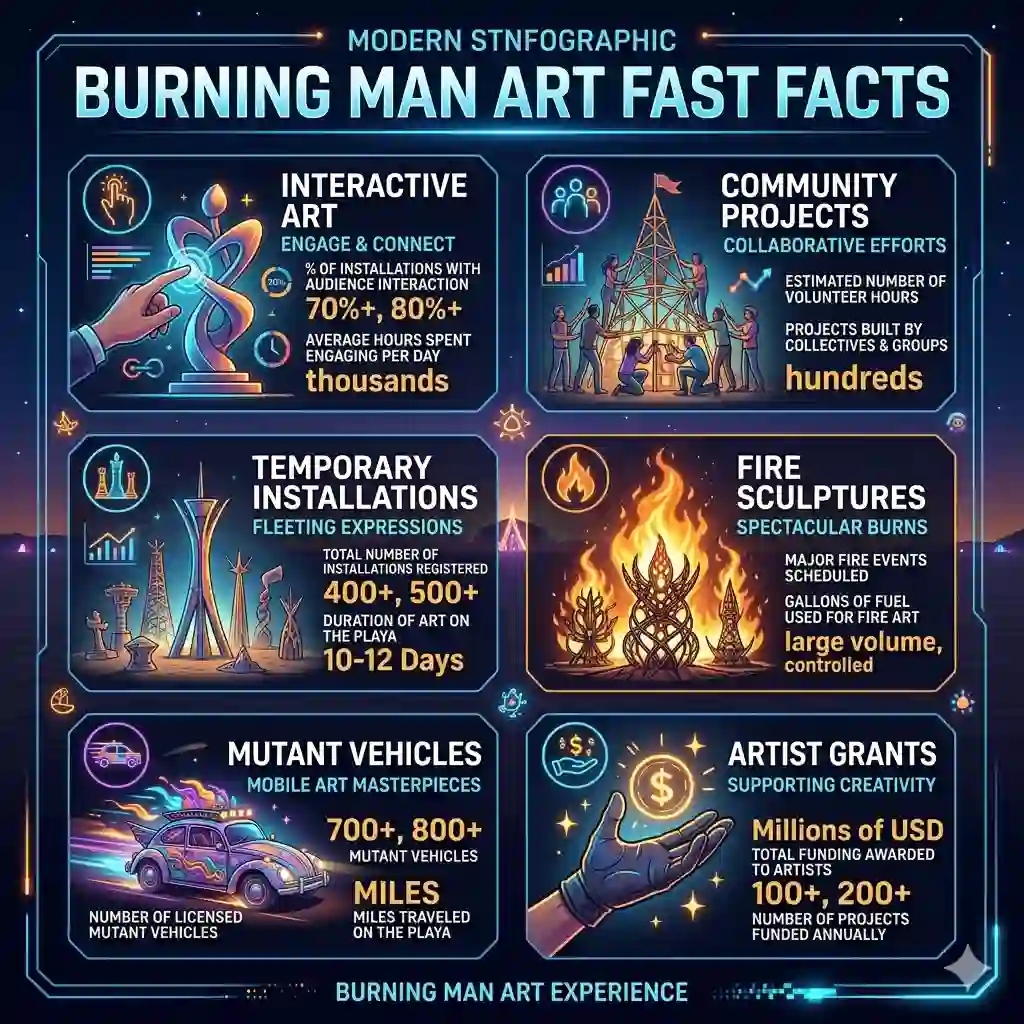
The large-scale art installations of the open playa are among the most visually spectacular things most people will ever encounter. These are not gallery-scale works they are building-sized, city-block-sized, sometimes larger. They include sculptures, architectural environments, kinetic works, fire art, light art, and forms that resist easy categorization. Many are commissioned through Burning Man’s art grant program; others are funded independently by the artists and their communities.
Walking among the large-scale installations by day when their scale and detail are fully visible and returning to them by night when they’re illuminated and transformed is one of the most rewarding ways to experience Black Rock City’s artistic dimension.
Interactive Art
A distinguishing feature of Burning Man art is its emphasis on interaction. Unlike art in traditional gallery or museum contexts, most art at Burning Man is designed to be touched, climbed, entered, activated, and experienced rather than observed from a distance. This creates an entirely different relationship between participant and artwork one of engagement, play, and co-creation.
Temporary Exhibitions
All art at Burning Man is temporary. It exists for one week, and then depending on the individual work’s fate it’s dismantled, burned, or removed from the playa. This temporality is built into the art’s meaning. Works are created knowing they will not last, which liberates artists from the commercial and archival pressures of the mainstream art world and produces art that is made purely to be experienced in the moment.
Community Art Projects
Beyond the major commissioned works, Black Rock City is filled with smaller community art projects theme camp installations, personal creative expressions, collaborative works, and spontaneous creative acts that emerge throughout the week. These unofficial works are often as moving and memorable as the major installations, and they’re everywhere.
- Burning Man exists primarily as an artistic and communal experiment, with art as the core purpose and organizing principle of Black Rock City.
- The open playa features huge, building-sized and even city-block-sized installations (sculpture, architecture, kinetic, fire, and light art), funded either by Burning Man art grants or by artists and their communities.
- Experiencing these large artworks by day for scale and detail, and again at night when they are lit and transformed, is one of the most powerful ways to feel the city’s creative energy.
- Most Burning Man art is interactive: participants are encouraged to touch, climb, enter, and activate pieces, creating a playful, co-created relationship between people and artwork.
- All art is temporary, built to exist for a single week before being burned, dismantled, or removed, which frees artists from commercial pressures and centers art on the present-moment experience.
- Smaller community-driven pieces, from theme camp builds to spontaneous creations, fill the city and can be just as meaningful as the headline installations, with more details available in the Burning Man Art Guide.
For a complete guide to art at Burning Man, see the Burning Man Art Guide.
Sustainability and Environmental Responsibility
Black Rock City’s relationship with the Black Rock Desert is defined by a commitment to leaving no trace one of Burning Man’s ten core principles and a legal requirement of the event’s permit with the Bureau of Land Management.
Leave No Trace
Leave No Trace (LNT) at Burning Man means exactly what it says: when the event ends, every participant is responsible for removing every item they brought to the playa. There is no garbage service, no recycling pickup, no infrastructure for waste management beyond what participants bring and manage themselves. Every camp must leave its footprint as clean as the bare desert floor it was built on.
This standard is not aspirational it is enforced. Camps that leave MOOP (Matter Out Of Place) behind are documented and may face consequences in future years’ placement processes.
MOOP Awareness
MOOP — Matter Out Of Place — is the Burning Man term for any material that shouldn’t be on the playa: trash, scraps, cigarette butts, glitter, feathers, food crumbs, zip ties, anything. The Black Rock Desert’s flat, featureless surface makes MOOP highly visible and its impact on the ecosystem significant.
MOOP awareness is a daily practice at Burning Man, not just an end-of-event activity. Picking up MOOP as you walk through the city, using trash containers that seal completely, and building your camp with MOOP prevention in mind all contribute to a cleaner playa and a better experience for everyone.
Sustainable Camp Practices
Experienced burners have developed a wide range of practices for minimizing environmental impact during the event: using grey water collection systems to capture water runoff, choosing biodegradable and minimal-packaging food supplies, planning camp teardown carefully to ensure nothing is left behind, and using reusable containers rather than disposable ones throughout the week.
Playa Restoration
At the end of each Burning Man, the playa restoration process begins a systematic inspection and cleanup of the entire event footprint that continues until the land meets BLM standards. The Black Rock City DPW leads this effort, and it’s a condition of Burning Man’s continued ability to hold the event in this location.
- Burning Man is legally and culturally committed to “Leave No Trace,” meaning Black Rock City must be returned to the desert as clean as before the event.
- There is no trash or recycling service; every participant and camp must pack out all waste and leave their site as clean as the bare playa, with camps that leave MOOP (Matter Out Of Place) facing consequences later.
- MOOP includes anything that doesn’t belong on the playa (trash, feathers, food bits, zip ties, cigarette butts, etc.), and preventing/picking it up is a daily practice, not just a final cleanup.
- Sustainable camp habits include grey-water collection, low-packaging and biodegradable supplies, careful teardown planning, and using reusable containers instead of disposables.
- After the event, a dedicated playa restoration crew inspects and cleans the entire event footprint until it meets Bureau of Land Management standards, which is essential for Burning Man to keep its permit.
For a complete guide to Leave No Trace practices at Burning Man, see the Leave No Trace & MOOP Guide.
Understanding the Rhythm of the Week
Burning Man has a distinct weekly rhythm and understanding it helps you plan your time in Black Rock City more intentionally.
Arrival Days
The official event typically opens on the last Sunday of August, though some participants with early arrival passes come days before. Arrival days are characterized by the logistics of setup: finding your camp, unpacking, building shade structures, orienting yourself to the city’s layout. The energy is busy and practical. Plan your first day as a setup and orientation day rather than an exploration day — give yourself time to establish your camp before you venture out.
Early Week
The first two or three days of the event (Sunday through Tuesday) tend to be less crowded and more spacious than the peak days. The city isn’t yet at full population, lines at popular camps are shorter, and the open playa has a quieter, more contemplative character. This is an excellent time to explore the art installations, get oriented to the city’s layout, and have longer conversations with the people you meet.
Midweek Activities
By Wednesday and Thursday, the city is at or near full population. The energy intensifies across every dimension more music, more activity, more people, more experiences happening simultaneously. Midweek is when the full diversity of Black Rock City’s offerings becomes apparent, and when the sense of living inside something genuinely extraordinary tends to peak.
Burn Weekend
Saturday and Sunday of Burning Man week are the most intense days of the event. On Saturday night, The Man burns a massive communal ceremony that draws virtually the entire city’s population to the open playa. The lead-up to the burn involves fire performances, art car processions, and the gathering of thousands of people in the space around The Man. The burn itself is a visceral, overwhelming, and deeply moving experience that most participants describe as one of the most powerful things they’ve ever witnessed.
Temple Burn
On Sunday night, the Temple burns. The contrast with Saturday’s Man burn is striking. The Temple burn is quiet, reflective, and emotionally profound a collective ceremony of release and remembrance. Participants gather in silence (or near silence) around the Temple as it catches fire, and many weep. The Temple burn is, for many long-term burners, the most important moment of the entire week.
Departure and Exodus
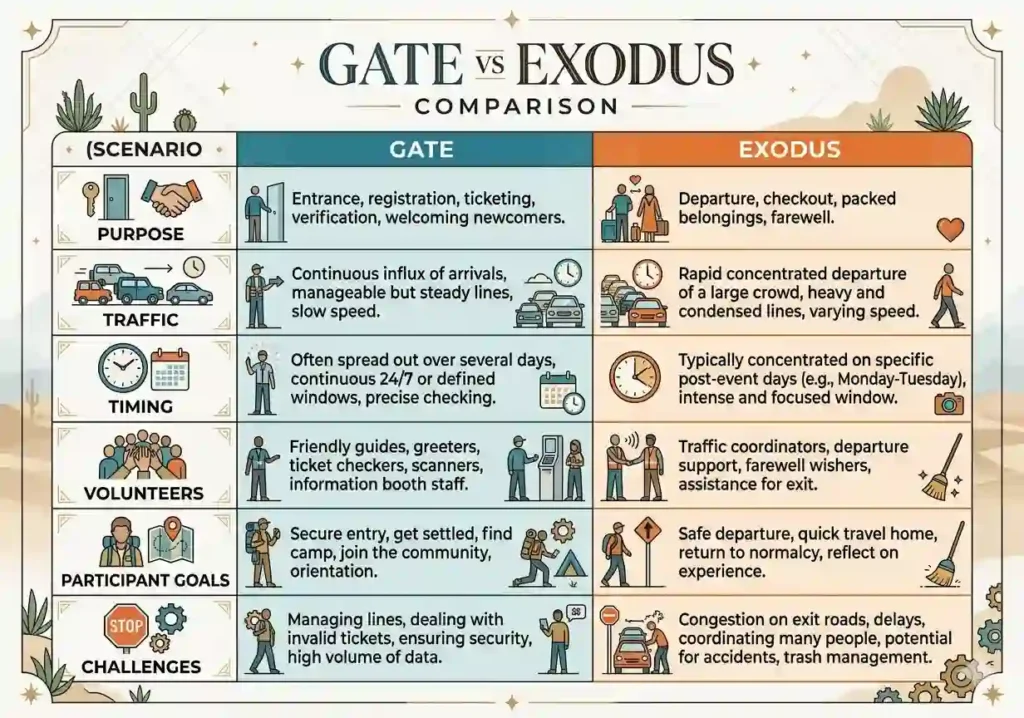
Monday is Exodus the great departure of the city’s population. Tens of thousands of vehicles converge on the Gate road simultaneously, creating traffic lines that can stretch for many miles and many hours. Experienced burners have strategies for managing Exodus: timing departures for the early morning hours (2am to 5am) when traffic is lighter, taking the “reverse commute” that avoids the main Exodus queue, or staying until Monday afternoon when the worst of the rush has cleared.
- The week has a clear flow: early days for setup and orientation, midweek for peak activity, and the final days for major burns and departure planning.
- Arrival (from official opening Sunday) is busy and practical, focused on finding camp, building shade, unpacking, and learning the city, so it’s best treated as a setup day, not a big exploration day.
- Early week (Sunday–Tuesday) is calmer and less crowded, making it ideal for exploring art, learning the city layout, and having deeper, slower conversations.
- By midweek (Wednesday–Thursday), the city reaches full population, with maximum music, events, and activity, and this is when many feel the strongest sense of living in something extraordinary.
- Burn weekend is intense: Saturday night’s Man Burn is a huge, loud, communal spectacle with fire shows and art cars, while Sunday night’s Temple Burn is quiet, emotional, and focused on grief, release, and remembrance.
- Monday’s Exodus brings massive traffic as tens of thousands leave; seasoned burners plan timing carefully (e.g., very early morning or later Monday) or use alternate strategies to avoid the longest waits.
For a complete guide to arrival, departure, and Exodus planning, see the Exodus & Gate Guide.
Black Rock City for First-Timers
First-timers approaching Black Rock City for the first time face a particular kind of challenge: nothing in their prior experience quite prepares them for what they’re about to encounter.
🚲 Navigation Tips for First-Timers
Discuss:
Meeting points
Carrying a map
Using landmarks
Day vs night navigation
Staying oriented
What Usually Surprises New Burners
The scale surprises almost everyone. Black Rock City is much larger than most first-timers expect miles across, with thousands of camps and art installations spread across an area that takes hours to fully explore on a bicycle. The heat surprises people who haven’t experienced a Nevada desert summer. The dust surprises people who thought “desert” meant sand rather than fine alkaline powder that penetrates everything. And the generosity surprises people who weren’t prepared for a city where almost everything is given freely, with genuine warmth.
Common Misconceptions
Many first-timers arrive believing Burning Man is primarily a music festival. It isn’t — though music is abundant. Others believe it’s primarily about the burn of The Man. It isn’t — though that moment is significant. Still others believe it’s a lawless free-for-all. It isn’t — it has its own civic culture, norms, and safety infrastructure.
Perhaps the most common misconception is that Burning Man is something that happens to you. It isn’t. It’s something you participate in. The degree to which you engage, contribute, and open yourself to the experience is the primary determinant of what you get out of it.
Tips for Navigating the City
Memorize your camp address on Day 1. Learn the clock system before you arrive it will make navigation dramatically easier. Carry a city map. Use Center Camp as your primary landmark until you’ve developed your own mental map of the city. Travel with a fully charged phone (for offline maps) or a physical compass. Bike lights are not optional at night.
Building Confidence Quickly
Confidence in Black Rock City comes from exploration. The more you move through the city even without a specific destination the more familiar it becomes. Visit Center Camp early. Bike the Esplanade from end to end. Walk into the open playa and look back at the city from the perspective of the playa. Each of these experiences builds your mental map and your sense of belonging in the temporary city.
- The week follows a natural arc: arrive and set up, settle in and explore, hit peak intensity midweek and burn weekend, then navigate departure and Exodus.
- Arrival day (officially starting Sunday) is all about logistics finding your camp, building shade, unpacking, and orienting, so treating it as a setup day instead of a big adventure day works best.
- Sunday to Tuesday stay relatively spacious and calm, which is ideal for exploring art, mapping the city, and having longer, more relaxed interactions with people.
- By Wednesday and Thursday the city is full, with maximum music, events, and energy, and many participants feel the most intense sense of living inside something truly extraordinary.
- Burn weekend brings emotional extremes: the Man Burn on Saturday is loud, fiery, and celebratory, while the Temple Burn on Sunday is quiet, reflective, and centered on grief, release, and remembrance.
- Monday’s Exodus creates huge traffic as tens of thousands leave at once, so experienced burners time their departures carefully or use alternate strategies to avoid the longest waits.
For comprehensive first-timer preparation, see the First-Timer Guide.
Black Rock City Key Stats & Principals
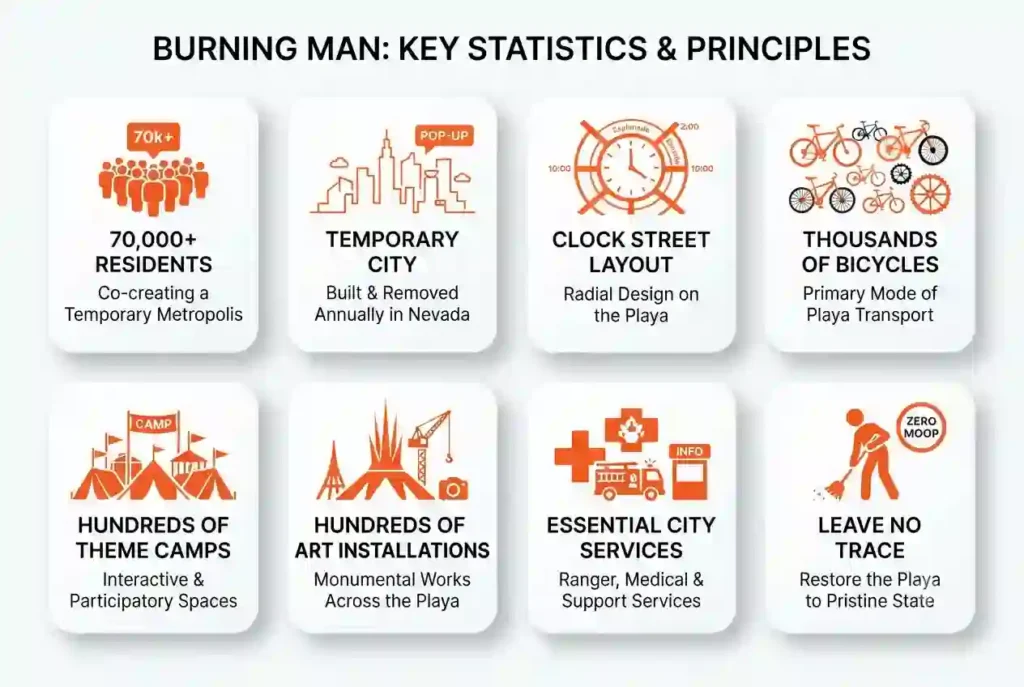
Black Rock City is one of the world’s largest temporary cities, built from scratch each year in Nevada’s Black Rock Desert. These key numbers help illustrate the incredible scale, planning, and infrastructure behind Burning Man.
How Long Does It Take to Walk?
| Destination | Approximate Walking Time* |
| Nearby camp | 2–5 min |
| Center Camp | 10–20 min |
| Major art installation | 15–30 min |
| The Man | 15–25 min |
| Temple | 20–35 min |
*Times vary depending on your camp location and weather conditions.
⚠️ Common Navigation Mistakes
- Depending only on memory
- Forgetting camp addresses
- Ignoring landmarks
- Exploring without lights at night
- Assuming distances are short
- Not carrying a map
Key Numbers
- 🏙️ 70,000+ Residents — Black Rock City becomes one of Nevada’s largest cities during Burning Man week.
- 📅 Built in Weeks, Removed in Days — The city is constructed before the event and dismantled afterward, leaving virtually no trace.
- 🛣️ Concentric Street Layout — Streets are arranged like a clock with alphabetical avenues for easier navigation.
- 🚲 Thousands of Bicycles — Cycling is the primary way participants travel around the city.
- 🎨 Hundreds of Theme Camps — Camps provide art, workshops, performances, and community experiences.
- 🖼️ Hundreds of Art Installations — Monumental artworks are placed across the open playa every year.
- 🚑 Essential City Services — Medical care, Rangers, emergency services, information centers, accessible camps & toilets , support the temporary city.
- 🌍 Leave No Trace Mission — After the event, volunteers remove all MOOP (Matter Out Of Place), restoring the desert.
Quick Guide to Major Black Rock City Landmarks
📱 Navigation Tools
- Printed maps
- Mobile apps
- GPS limitations
- Camp directions
- Offline navigation
The Man — The central wooden effigy of Burning Man, standing at the heart of the open playa. Burned on Saturday night. Primary navigation landmark.
The Temple — A sacred community space for remembrance and reflection, further out in the deep playa along the central axis. Burned on Sunday night in a quiet ceremony of collective release.
Center Camp — The city’s communal hub, at 6 o’clock on the Esplanade. Open-air shade structure hosting workshops, performances, gatherings, and coffee.
The Esplanade — The innermost concentric street of Black Rock City, facing the open playa. Home to the city’s most prominent theme camps and the primary boulevard for city exploration.
Open Playa — The vast, open desert space between the city arc and the outer playa. Location of large-scale art installations and nighttime art experiences.
Theme Camps — Participant-created interactive camps distributed throughout the residential areas, offering free experiences to all participants.
Art Installations — Scattered throughout the city and deep playa; ranging from intimate personal works to massive architectural environments.
Ranger Stations — Staffed by Black Rock Rangers throughout the city and playa; identifiable by khaki uniforms. First stop for community safety needs.
Medical Services — Medical facilities are located within the city; locations are marked on the official Black Rock City map distributed at Gate.
Navigation Checklist
| Before Leaving Camp | ✓ |
| Know your camp address | ☐ |
| Carry a map | ☐ |
| Bring water | ☐ |
| Have lights for night | ☐ |
| Remember nearby landmarks | ☐ |
| Agree on meeting points | ☐ |
Final Thoughts
Understanding the City Makes the Experience Better
Black Rock City is more than an event venue. It’s a proof of concept a demonstration that a community of people, guided by shared values and a commitment to creative participation, can build something genuinely extraordinary from nothing, in the middle of a desert, in less than two weeks.
Every neighborhood, camp, art installation, workshop, performance, and spontaneous human encounter contributes to the city’s character. The city doesn’t exist without the participation of the people who build it and live in it, and that participation is what makes the experience transformative rather than merely entertaining.
Understanding Black Rock City, its layout, its history, its culture, its rhythm doesn’t diminish the wonder of being there. It deepens it. When you know how the clock system works, you navigate confidently. When you understand the placement process, you appreciate the neighborhood you’re in. When you know the history, you feel the weight of everything that came before you.
Come prepared. Come open. Come ready to participate. And come knowing that whatever you bring to Black Rock City, the city will give back in ways you couldn’t have anticipated.
- Black Rock City is more than a festival site; it’s a living experiment showing how people with shared values and creative drive can build an extraordinary city from nothing in the desert.
- Every element—neighborhoods, camps, artworks, workshops, performances, and chance encounters—depends on active participation, which turns the week into a transformative experience rather than simple entertainment.
- Learning the city’s layout, history, culture, and weekly rhythm makes the experience deeper, helping you move confidently and appreciate how intentionally everything is placed and created.
- Understanding things like the clock street system and camp placement process helps you feel more at home in your neighborhood and more connected to the larger story of Black Rock City.
- Arriving prepared, open-hearted, and ready to contribute ensures that what you bring to the city comes back to you in surprising and meaningful ways.
See you on the playa. 🔥
Black Rock City Myths vs Reality
| Myth | Reality |
|---|---|
| Black Rock City is a permanent city. | It is a temporary city built specifically for Burning Man and removed after the event. |
| Everything is free and provided. | Participants practice Radical Self-Reliance and bring their own essential supplies. |
| Cars are the main way to get around. | Most people travel by bicycle or on foot inside Black Rock City. |
| Theme camps are private clubs. | Many camps welcome visitors and offer interactive experiences, workshops, or gifts. |
| Black Rock City has no public services. | Rangers, medical teams, information centers, and emergency services operate throughout the event. |
| You can leave equipment behind after Burning Man. | Every participant is responsible for removing all belongings and MOOP under the Leave No Trace principle. |
Black Rock City Checklist
Before Arriving
✅ Study the city map
✅ Learn the clock-and-letter street system
✅ Save your camp location
✅ Download offline maps
While Exploring
✅ Carry water everywhere
✅ Lock your bicycle
✅ Respect theme camp boundaries
✅ Follow Ranger and volunteer guidance
Daily Habits
✅ Pack out all MOOP
✅ Help fellow participants
✅ Visit Center Camp and major landmarks
✅ Stay aware of weather conditions
Before Leaving
✅ Perform a final camp cleanup
✅ Double-check for MOOP
✅ Return borrowed items
✅ Follow Exodus instructions
Frequently Asked Questions About Black Rock City
Black Rock City is the temporary city built each year in Nevada’s Black Rock Desert for the Burning Man event.
During Burning Man, it becomes one of Nevada’s largest temporary cities, hosting more than 70,000 participants.
The city uses a clock-face layout with alphabetical streets, making navigation easier.
Many theme camps welcome visitors and encourage participation, although some areas may be reserved for camp members.
Most participants travel by bicycle or walk throughout the city.
Yes. Medical teams, Rangers, and emergency services operate throughout the event.
General shopping is not available, so participants should arrive fully prepared with their own supplies.
The city is generally safe when participants prepare properly, follow event guidelines, and watch out for one another.
Many underestimate the city’s size and fail to plan their camp location, navigation, and daily exploration.
Where Should You Go Next?
| If You Want To… | Read This Guide |
| Understand theme camps | → Theme Camps |
| Explore art installations | → Art & Creativity |
| Visit major landmarks | → Landmarks & Iconic Places |
| Find city services | → City Services & Resources |
| Learn transportation tips | → Transportation Guide |
Why Trust This Guide?
✅ Links to detailed city guides throughout this website.
✅ Based on Black Rock City’s official planning concepts.
✅ Updated for the 2026 Burning Man season.
✅ Written for both beginners and returning participants.
✅ Explains navigation without assuming previous experience.
Conclusion
Understanding Black Rock City’s layout transforms your Burning Man experience. Once you become familiar with the city’s streets, clock positions, neighborhoods, and landmarks, navigating becomes intuitive, allowing you to spend less time feeling lost and more time exploring art, meeting people, and participating in the community.
Black Rock City Pro Tips
🏙️ Learn the clock-and-letter street layout before arriving.
🚲 Bring a reliable bicycle with lights and a lock.
📍 Save your camp location offline to avoid getting lost.
💧 Carry water whenever you leave camp.
🧭 Explore different neighborhoods instead of staying in one area.
🤝 Participate in camps, art, and community activities.
🌅 Visit the city at sunrise, daytime, sunset, and night for completely different experiences.
🌱 Leave every place cleaner than you found it to support the Leave No Trace principle.
Final Thoughts
📖 Continue with the Theme Camps Guide to understand how neighborhoods come alive.
🗺️ The city follows a logical radial design.
🕒 Clock positions simplify navigation.
🚲 Walking and bicycles are the easiest ways to explore.
🏕️ Theme camps help define neighborhoods.
🏛️ Landmarks make orientation easier.
🌅 The open playa connects major destinations.
📱 Carry both digital and printed maps whenever possible.