First-Timer Guide to Burning Man: Complete Beginner Roadmap for Your First Burn
Planning your first Burning Man? Learn everything you need to prepare for Black Rock City, including tickets, budgeting, camping, packing, participation, travel, safety, and post-burn recovery in one complete beginner’s guide.
Attending Burning Man for the first time is unlike preparing for any other festival, camping trip, or travel experience. Every year, around 80,000 participants gather in Black Rock City, a temporary community built on Nevada’s Black Rock Desert, where art, creativity, self-reliance, and participation come together for one extraordinary week. Recent Burning Man census reports show that roughly four out of every ten participants are first-time Burners, meaning thousands of people arrive each year with the same questions you’re probably asking now: How do I get tickets? What should I pack? Where do I camp? What happens if I’ve never done anything like this before?
Whether you’re traveling from California, Oregon, Washington, Colorado, Texas, New York, or elsewhere in the United States, or flying in from countries such as Canada, the United Kingdom, Germany, Australia, France, the Netherlands, Japan, Brazil, or South Korea, successful preparation begins long before you reach the playa. Burning Man is built on the principles of Radical Self-Reliance, Participation, Communal Effort, and Leave No Trace, which means every participant is responsible for bringing the supplies, knowledge, and mindset needed to contribute to the city rather than simply consume it. Unlike traditional festivals, there are no commercial vendors for everyday necessities, making preparation one of the most important parts of your experience.
This complete Burning Man First-Timer Guide brings together every essential step in one place—from choosing the right ticket and planning your budget to building your camp, packing efficiently, traveling to Black Rock City, understanding Burner culture, avoiding common beginner mistakes, and returning home successfully after the event. Instead of searching dozens of websites for answers, you’ll find a practical, experience-focused roadmap designed to help you prepare with confidence, avoid costly mistakes, and enjoy your very first Burn from arrival to departure.
📚 In This Guide You’ll Learn
- 👋 Understanding what makes Burning Man different
- 📖 Essential knowledge every first-time Burner should know
- 📝 Planning your first Burn step by step
- 💰 Creating a realistic Burning Man budget
- 🎒 Packing the right gear and survival essentials
- ⛺ Choosing and setting up your first camp
- 🚗 Traveling to Black Rock City with confidence
- 🤝 Participating in Burner culture and community
- ⚠️ Avoiding common first-timer mistakes
- 🌅 Leaving the playa and preparing for life after the Burn
What Is Burning Man and Why Do People Attend?
Burning Man is an annual week-long event in Nevada’s Black Rock Desert where 70,000+ participants create a temporary city called Black Rock City. People attend for community, art, self-expression, and transformation. Unlike traditional festivals, there are no stages or vendors.
Attendees build art installations, host theme camps, and gift experiences. The event emphasizes radical self-reliance everyone brings their own water, food, and shelter. Many describe it as life-changing, connecting them with diverse, creative people worldwide.
Who Attends Burning Man?
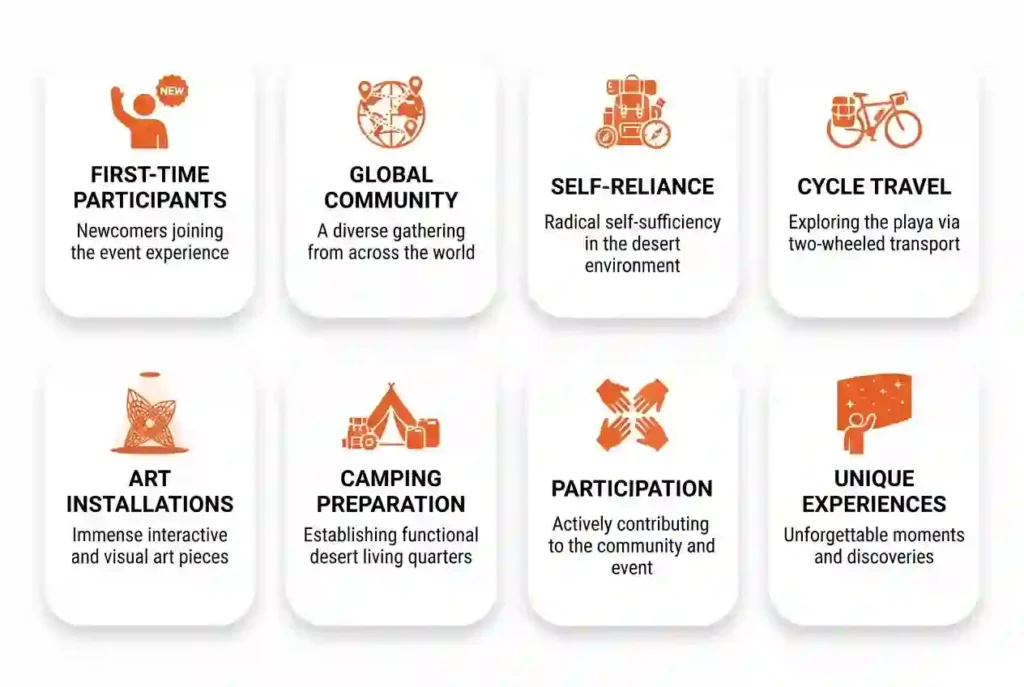
Attendees are wildly diverse artists, tech workers, families, loners, party people, and elders. The common thread is willingness to contribute something: time, art, skills, or presence. You’ll meet folks from all over the world and every background; the shared environment makes conversation easier and connections deeper.
What First-Timers Should Expect
Expect sensory overload, dust, temperature swings, and lots of logistics. You’ll spend time setting up camp, learning bike and night-safety skills, and finding ways to participate. Social norms (gifting, consent, volunteering) may feel unfamiliar but tend to open up new ways of relating.
- Burning Man is participation-based, not spectator-based — 70,000+ attendees create art, camps, and experiences instead of watching performances
- 70,000+ people create a temporary city in Nevada desert — Black Rock City operates for 9 days with zero commercial vendors
- 10 Principles guide culture: inclusion, gifting, self-reliance, leave no trace — These define community behavior and event expectations
- Unique temporary metropolis disappears completely after Exodus — No structures remain; participants remove all MOOP
- Suitable for adventure-loving, creative, community-oriented people — Requires physical stamina and openness to unconventional experiences
Burning Man vs Traditional Music Festivals
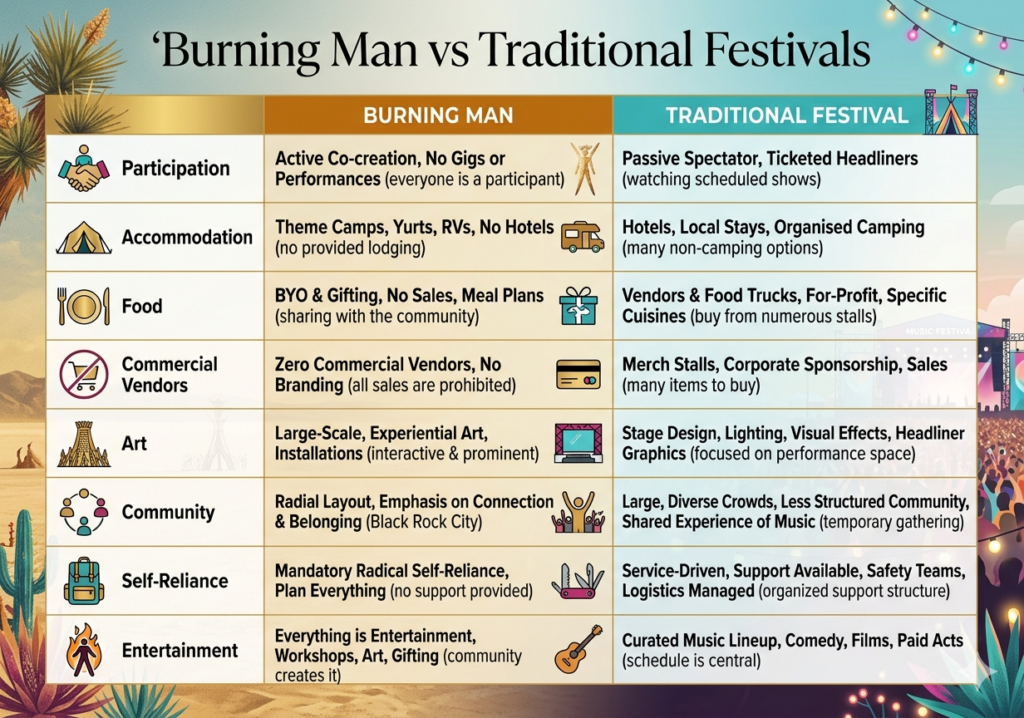
The event is unique because it’s participant-first, economy-less (mostly gifting), and deliberately temporary. The layout and rules emphasize community responsibility: people clean up after themselves, staff volunteer roles, and interactive art is normal. The desert environment adds a physical intensity that separates this from other festivals.
Is Burning Man Right for You?
Ask yourself if you like community-driven projects, unpredictable environments, and active participation. If you enjoy making or sharing rather than just watching, and if you can commit to planning for health and safety, it’s probably a fit. If large crowds, rough terrain, or extended discomfort deter you, planning for a different style of participation (family camp, accessible camp, or day trips) might help.
How is Burning Man different from traditional music festivals?
Burning Man is not a spectator event. Participants create the experience instead of buying tickets for performances. Traditional festivals focus on concerts and commercial vendors. Burning Man focuses on community, art, and self-expression. Traditional festivals charge for food, drinks, and merchandise.
Burning Man has zero commerce everything is gifted. At Burning Man, you’re expected to contribute. At traditional festivals, you’re expected to watch and consume. This core difference shapes every aspect of the experience from camp setup to daily routines.
- Temporary city called Black Rock City in Nevada’s desert — Operates for 9 days with 70,000+ participants
- No commercial sponsors, no stages; everything created by attendees — Playa transforms into metropolis with streets, camps, art, service centers
- City disappears completely after Exodus — Temporary city concept unique worldwide
- Combines art, community, self-reliance, radical self-expression at this scale — No other event matches this combination
- Desert environment adds challenge and beauty — Defines the entire experience uniquely
What makes Burning Man unique as compared to other events?
Burning Man creates a temporary city called Black Rock City in Nevada’s desert. It operates for 9 days with 70,000+ participants. No commercial sponsors. No stages. Everything is created by attendees. The playa transforms into a metropolis with streets, camps, art, and service centers. After Exodus, the city disappears completely.
This temporary city concept is unique worldwide. No other event combines art, community, self-reliance, and radical self-expression at this scale. The desert environment adds another layer of challenge and beauty that defines the experience.
Understanding the Temporary City of Black Rock City
Black Rock City is a temporary metropolis on the Black Rock Desert playa. It has streets, camps, art installations, and service centers. The city disappears completely after Exodus. Participants leave no trace. The layout is a half-circle with radial streets named by letter (A–K) and circumference streets by number (1st–10th).
The Man and Temple sit at the center. Theme camps line the streets. Medical centers, fire stations, and kitchens serve residents. Understanding this layout helps first-timers navigate safely and find resources quickly during their stay.
“Your first burn isn’t about fitting in. It’s about finally giving yourself permission to show up as you are.”
- Temporary metropolis on Black Rock Desert playa — Has streets, camps, art installations, service centers
- City disappears completely after Exodus; participants leave no trace — Half-circle layout with radial streets (A–K) and circumference streets (1st–10th)
- Man and Temple sit at center; theme camps line streets — Medical centers, fire stations, kitchens serve residents
- Understanding layout helps first-timers navigate safely — Find resources quickly during stay
- No permanent structures remain — Complete removal ensures desert protection
Why Burning Man Continues to Attract New and Returning Participants
Burning Man’s enduring appeal lies in its unique combination of radical creativity, community building, and transformative experiences. Despite evolving over decades, the event continues to draw both first-timers and veteran Burners year after year.
Understanding why people are drawn to Black Rock City helps you appreciate what makes the experience so compelling and what keeps participants returning.
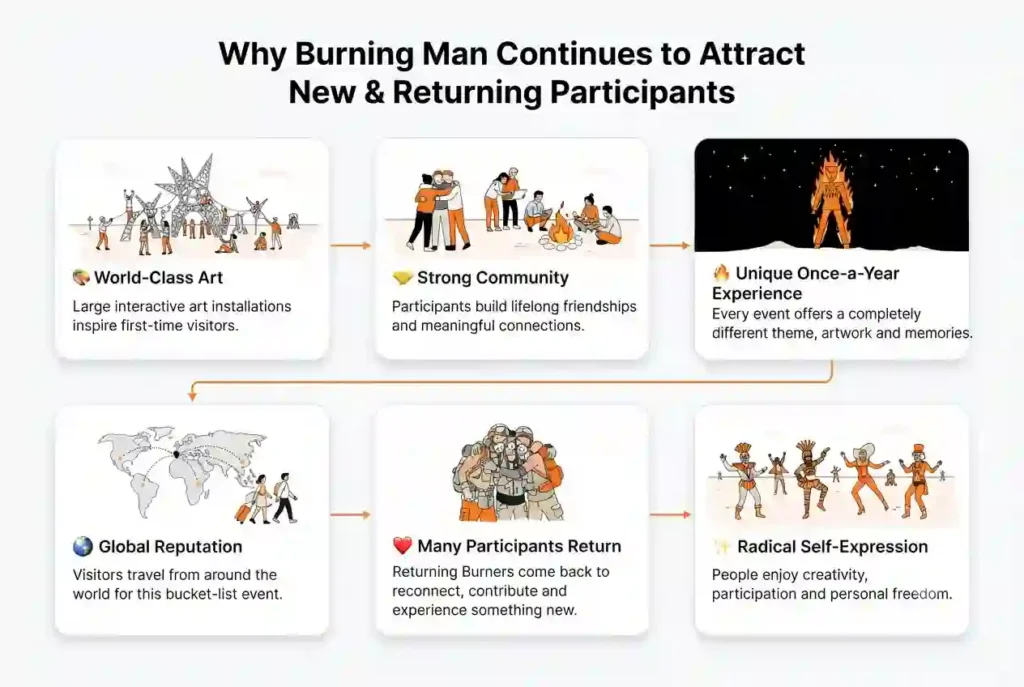
A Bucket-List Experience
Burning Man has achieved global reputation as one of the world’s most unique cultural events, appearing in documentaries, news coverage, and social media worldwide. The event’s reputation as a bucket-list experience draws people from every continent who seek to witness and participate in something truly extraordinary.
The unique temporary city that emerges in Black Rock Desert each year captures imaginations—entire communities, art installations, and infrastructure appear from nothing and vanish without a trace. This ephemeral nature makes each year’s event singular and irreplicable, adding to its mystique and appeal.
Art and creativity are central to the Burning Man experience, with participants creating everything from small interactive pieces to massive installations that push the boundaries of engineering and imagination. The desert becomes an open-air gallery where creativity is celebrated and participation is expected.
Desert adventure attracts people seeking challenge, self-discovery, and the opportunity to test their limits in an extreme environment. The harsh conditions of Black Rock Desert—heat, dust, wind—create a crucible for personal growth and community bonding that many find transformative.
Nearly Half the Crowd Are First-Timers
Recent census data has shown that a large share of Burning Man attendees are first-timers, demonstrating that the event continues to attract new participants every year. This steady influx of newcomers keeps the culture dynamic and evolving, with fresh perspectives and energy joining the community annually.
The presence of so many first-timers means that Burning Man remains accessible and welcoming to newcomers, with established participants often eager to mentor and guide those experiencing Black Rock City for the first time. This culture of inclusion and support helps newcomers navigate the challenges and rewards of the experience.
The mix of experienced and new participants creates a rich tapestry of knowledge, skills, and perspectives that enhances the overall experience. First-timers bring fresh ideas and enthusiasm, while veterans provide continuity, mentorship, and institutional knowledge.
Why Experienced Burners Keep Coming Back
Strong friendships formed at Burning Man often last for years or decades, with participants returning annually to reconnect with their Burner families and communities. These deep relationships, built through shared challenges and creative collaboration, become central reasons for returning.
Annual tradition becomes meaningful for many Burners, with the event serving as a yearly touchstone for personal reflection, creative expression, and community connection. The rhythm of planning, attending, and decompressing becomes part of participants’ life cycles.
New art every year ensures that the experience remains fresh and surprising, with installations and performances that change annually. Even veteran Burners discover new experiences, artworks, and communities with each return visit.
Different theme each year provides new creative frameworks and inspiration, with themes like “The Caravan of Dreams,” “Metamorphoses,” and “Multiverse” offering different lenses through which to experience the event. Themes inspire art, camps, and costumes that reflect the annual concept.
Opportunity to contribute deepens with experience, as veteran Burners take on more complex projects, mentor newcomers, and contribute to community infrastructure. Many experienced Burners find that their role evolves from participant to contributor to community leader over time.
Sense of belonging to a global community that shares values and understands the experience is powerful for many Burners. The connections formed at Burning Man extend beyond the event itself, creating networks of support, collaboration, and friendship that last year-round.
Growth Through Community
Word of mouth remains one of the most powerful drivers of Burning Man’s growth, with participants sharing their experiences and inviting friends, family, and colleagues to join them. Personal recommendations carry significant weight in attracting new participants.
Social media has amplified Burning Man’s reach, with photos, videos, and stories from the event inspiring people worldwide. While the event emphasizes direct experience over documentation, social media has helped spread awareness of Burner culture and the Ten Principles.
Art installations that capture public imagination—whether through media coverage, social sharing, or word of mouth—draw attention to the event and inspire people to experience it firsthand. Iconic installations become cultural touchstones that attract new participants.
Personal recommendations from trusted friends and community members remain among the most effective ways people learn about Burning Man. When someone you trust describes a transformative experience, you’re more likely to consider attending yourself.
Global reputation as a unique cultural phenomenon continues to attract people from around the world who seek meaningful, creative, and community-oriented experiences. Burning Man’s influence extends far beyond Black Rock City, inspiring Regional Burns and Burner communities worldwide.
Attendance Can Fluctuate
Yearly attendance at Burning Man can fluctuate based on various factors, though long-term interest remains strong. Understanding these factors helps set realistic expectations about event dynamics.
Weather conditions significantly impact attendance and experience. Extreme heat, dust storms, or unusual weather patterns can affect participation in any given year. Some years see more challenging conditions than others, influencing who attends and how long they stay.
Ticket demand varies year to year, with some years seeing higher demand and faster sell-outs than others. Ticket availability can be affected by event capacity, pricing, and overall interest levels.
Travel costs fluctuate based on fuel prices, flight availability, and economic conditions. Higher travel costs can affect attendance, particularly for international participants who face significant expenses to reach Black Rock City.
Economic conditions broadly affect people’s ability to attend, with economic downturns potentially reducing participation while economic growth may increase it. Burning Man’s costs—tickets, travel, gear, time off work—mean that economic factors influence attendance patterns.
Despite these fluctuations, long-term interest in Burning Man remains strong, with the event continuing to attract participants from around the world year after year. The core appeal of creative expression, community, and transformative experience endures despite short-term variations.
- Burning Man attracts both first-timers and veteran Burners year after year.
- Strong friendships, annual traditions, and new art keep experienced Burners returning.
- Attendance fluctuates based on weather, costs, and economic conditions, but long-term interest remains strong.
What are the 10 Principles of Burning Man?
Burning man 10 principles guide culture and behavior throughout the event. Radical Inclusion means welcoming everyone. Gifting means giving freely without expectation. Decommodification means no commercial sponsorships. Radical Self-Reliance means bringing your own necessities. Radical Self-Expression means sharing your unique voice.
Communal Effort means working together. Civic Responsibility means following rules and respecting others. Leaving No Trace means removing all trash. Participation means engaging actively. Immediacy means experiencing the moment directly. These principles create the foundation for Burning Man’s unique culture and community.
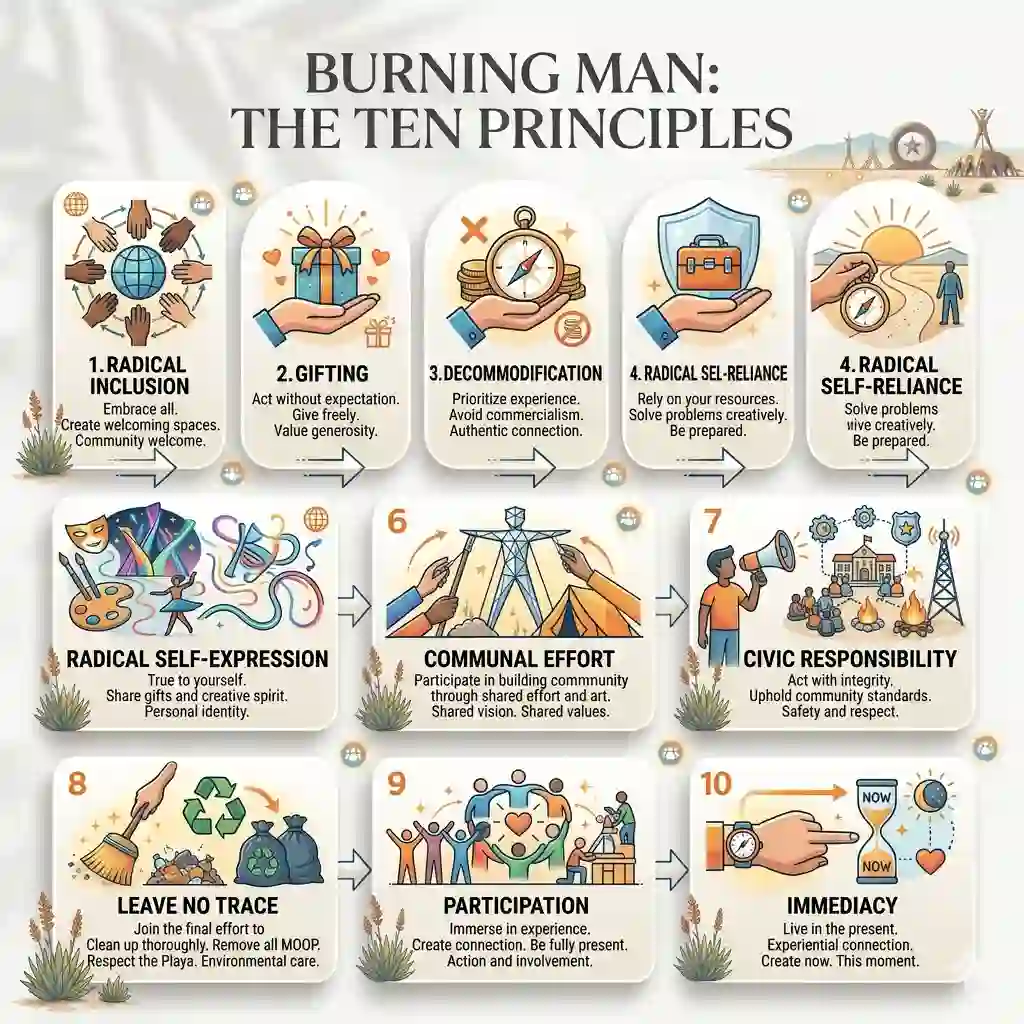
- Principles guide culture and behavior throughout event — Radical Inclusion: welcoming everyone
- Gifting: giving freely without expectation — Decommodification: no commercial sponsorships
- Radical Self-Reliance: bringing own necessities — Radical Self-Expression: sharing unique voice
- Communal Effort: working together — Civic Responsibility: following rules, respecting others
- Leaving No Trace: removing all trash — Participation: engaging actively
- Immediacy: experiencing moment directly — These create foundation for unique culture and community
Is Burning Man Right for You as a First Timer?
Burning Man suits people who enjoy adventure, creativity, and community. It requires physical stamina, self-reliance, and openness to unconventional experiences. If you prefer comfort, scheduled performances, or passive entertainment, it may not fit. First-timers should know their tolerance for heat, dust, and limited sleep.
Consider joining a theme camp for support. Talk to veterans about their experiences. Attend regional burns first to test readiness. If you value transformation over comfort and connection over consumption, Burning Man could be perfect for you.
- Suits people who enjoy adventure, creativity, community — Requires physical stamina, self-reliance, openness to unconventional experiences
- If you prefer comfort, scheduled performances, passive entertainment, it may not fit — First-timers should assess tolerance for heat, dust, limited sleep
- Consider joining theme camp for support — Talk to veterans about experiences
- Attend regional burns first to test readiness — If you value transformation over comfort, connection over consumption, Burning Man could be perfect
- Not for everyone — Requires specific mindset and preparation
What Every First-Timer Should Know Before Planning
Before planning, understand that Burning Man demands serious preparation. You’ll need 12 months to gather tickets, gear, and funds. The desert environment is harsh heat exceeding 100°F, daily dust storms, and alkaline dust that sticks to everything.
Radical self-reliance means no vendors sell water or food. You must bring everything. Many first-timers underestimate these challenges. Research thoroughly, join communities, and talk to veterans. This knowledge prevents costly mistakes and ensures a safe, transformative experience rather than a dangerous or regrettable one.
- Radical self-reliance means bringing everything you need — No vendors sell water, food, or shelter on playa
- Desert conditions are harsh: 100°F heat, daily dust storms, alkaline dust — Requires goggles, masks, SPF 50+, and 1 gallon water/day
- Participation is expected, not optional — Contributing through gifts, art, or help builds community; spectators feel isolated
- 12 months preparation prevents costly mistakes — Early planning secures tickets, gear, and funds
- Research thoroughly and talk to veterans — Prevents underestimating challenges and ensures safe transformation
Why is Burning Man not a spectator event?
Attendees create art, theme camps, and performances. There are no stages or paid performers. Participation is expected. Watching without contributing violates the culture. At traditional festivals, you pay to watch. At Burning Man, you’re expected to give.
Bring something to gift food, art, music, or help. Host a small theme camp activity. Dance, volunteer, or build. This participatory model creates deeper connections and more meaningful experiences. Spectators feel isolated and often regret not contributing. Active participants remember their burn for years.
- Attendees create art, theme camps, performances; no stages or paid performers — Participation expected; watching without contributing violates culture
- Traditional festivals: pay to watch; Burning Man: expected to give — Bring gifts: food, art, music, help
- Host theme camp activity, dance, volunteer, build — Participatory model creates deeper connections, meaningful experiences
- Spectators feel isolated, regret not contributing — Active participants remember burns for years
- Contribution is mandatory, not optional — Defines Burning Man’s core culture
What does “radical self-reliance” mean?
Bring everything you need: water, food, shelter, gear, medicine. No vendors sell these on playa. You’re responsible for your survival. Help others, but don’t expect them to provide your basics. Radical self-reliance means planning ahead for heat, dust, and exhaustion.
Bring 1 gallon water per person daily. Pack sturdy shelter and shade. Carry first aid and electrolytes. This principle ensures everyone survives safely. Veterans emphasize: don’t rely on strangers for essentials. Prepare independently, then share generously when you contribute to something bigger than yourself.
- Bring everything needed: water, food, shelter, gear, medicine — No vendors on playa; responsible for own survival
- Help others, but don’t expect them to provide basics — Plan ahead for heat, dust, exhaustion
- Bring 1 gallon water per person daily — Pack sturdy shelter, shade, first aid, electrolytes
- Principle ensures everyone survives safely — Veterans: don’t rely on strangers for essentials
- Prepare independently, then share generously — Balance self-reliance with community support
How does participation differ from consumption at Burning Man?
Consumption means buying services or watching performances. Participation means creating experiences: hosting a camp, giving gifts, building art, dancing, volunteering. Burning Man rewards giving, not taking. Consumers feel disconnected and often leave disappointed.
Participants build friendships and memories. Bring a guitar and play for camps. Offer to help set up shelters. Gift homemade food. Volunteer at the gate. These actions create lasting connections. Participation transforms Burning Man from an event into a life-changing experience where you contribute to something bigger than yourself.
- Consumption: buying services, watching performances — Participation: creating experiences (hosting camp, giving gifts, building art, dancing, volunteering)
- Burning Man rewards giving, not taking — Consumers feel disconnected, leave disappointed
- Participants build friendships and memories — Bring guitar, play for camps; help set up shelters; gift homemade food; volunteer at gate
- Actions create lasting connections — Transforms event into life-changing experience contributing to something bigger
- Participation is core to Burning Man identity — Consumption violates culture
What weather and dust conditions should first-timers expect?
Daytime temperatures exceed 100°F (38°C). Nights drop to 50°F (10°C). Dust storms create whiteout conditions daily. Alkaline dust sticks to everything. Bring goggles, masks, sunscreen, and extra water. Dust storms can last hours. During whiteouts, stay inside your shelter. Don’t drive—visibility is zero.
Alkaline dust causes skin irritation and respiratory issues. Moisturize daily. Use Neti pots for sinuses. Wear SPF 50+ sunscreen. Temperature swings require layered clothing. Understanding these conditions prevents medical emergencies and ensures comfort throughout your burn.
- Daytime temperatures exceed 100°F (38°C); nights drop to 50°F (10°C) — Dust storms create whiteout conditions daily
- Alkaline dust sticks to everything — Bring goggles, masks, sunscreen, extra water
- Dust storms last hours; during whiteouts, stay inside shelter; don’t drive — Visibility zero; dangerous
- Alkaline dust causes skin irritation, respiratory issues — Moisturize daily; use Neti pots for sinuses; wear SPF 50+
- Temperature swings require layered clothing — Understanding conditions prevents medical emergencies, ensures comfort
What are common myths about Burning Man?
It’s not only a party, not primarily a spectacle for spectators, and not a place to passively consume. It’s also not an anything-goes free-for-all community standards and safety rules matter. Many first-timers overestimate the built-in conveniences (food vendors, easy water access) and underestimate self-reliance needs.
- “It’s just a party” — It’s community-driven art and culture — “You can buy food onsite” — No vendors exist
- “It’s unsafe” — Safety services exist; risks from poor preparation — “Everyone is wild” — Many are calm, creative, family-oriented
- “You need expensive gear” — Sturdy basics work — “Only for rich people” — Low-income tickets exist
- “It’s all drunk people” — Many are sober, mindful — Myths create fear or false expectations
- Research official sources, talk to veterans, attend regional burns — Understand real experience before committing
These myths create fear or false expectations. Research official sources, talk to veterans, and attend regional burns to understand the real experience before committing.
Complete First-Timer Timeline
A complete timeline prevents overwhelm and ensures you hit every critical milestone. Start 12 months early to secure tickets, budget properly, and gather quality gear. Missing ticket sales means relying on expensive STEP exchanges. Skipping gear research leads to buying cheap items that fail in the desert.
Following this timeline builds confidence and reduces stress. Veterans recommend creating a checklist, setting calendar reminders, and joining planning communities for support. Proper timeline adherence transforms a chaotic experience into a smooth, successful first burn.
What should I do 12 months before Burning Man?
Discover the event. Read the culture guide. Join Reddit or Facebook communities. Start saving money. Research gear. Decide if you’re attending solo or with friends. Research ticket sale dates and apply for low-income tickets if eligible.
Watch Burning Man documentaries to understand the experience. Read first-timer blogs for real insights. Calculate your total budget including ticket, vehicle pass, travel, gear, food, and emergency funds. Building a support network early helps you find camp partners and get advice when questions arise.
What should I do 6 months before?
Apply for low-income tickets if eligible. Join theme camps or find hosts. Start gear shopping. Book travel if flying. Set up ticket alerts. Research tent brands, shade structures, and cooling options. Order gear with return policies for testing. Contact theme camps on Reddit asking if they need new members.
Attend local meetups to connect with veterans. If flying, check flight prices to Reno-Tahoe Airport. Set Google Alerts for ticket sale announcements. This preparation ensures you’re ready when main sale opens and prevents last-minute panic.
What should I do 3 months before?
Confirm ticket purchase. Order vehicle pass. Finalize gear list. Book accommodations in Reno/Gerlach. Join camp meetings. Start fitness prep. Test your tent at home to identify issues. Practice setting up shelter quickly. Buy food storage containers and coolers.
Start drinking more water daily to build hydration habits. Exercise to improve stamina for walking on playa. Confirm vehicle maintenance for long desert drive. Join camp Zoom meetings to understand expectations. This phase locks in logistics so you focus on fine-tuning gear and health before departure.
What should I do 1 month before Departure?
Pack gear. Test shelter. Buy food/water supplies. Confirm travel. Print documents. Charge batteries. Label everything. Reorganize your packing list by category. Wash and dry all clothing. Break down cardboard boxes to reduce MOOP. Purchase non-perishable food items.
Fill water containers and test for leaks. Charge all devices including headlamps and bike lights. Print physical copies of tickets, passes, and emergency contacts. Label gear with your name. This final prep ensures you arrive organized, hydrated, and ready without forgetting critical items.
What’s the final week checklist?
Fill water containers. Charge all devices. Pack dust protection. Confirm gate entry time. Review evacuation plans. Load vehicle with gear. Double-check you have ticket, vehicle pass, ID, and insurance. Pack extra goggles and masks. Bring electrolyte packets.
Confirm gas stations along route. Check weather forecasts. Rest well before departure. Stop buying last-minute items to avoid stress. Sleep early. Your mental state matters as much as physical prep. A calm, confident mindset helps you handle gate lines and initial camp setup smoothly.
What happens during arrival week?
Drive to Gerlach. Enter gate. Set up camp. Explore playa. Attend orientation. Meet neighbors. Rest before burn. Arrive with plenty of daylight. Don’t rush gate lines can take hours. Once inside, find your camp zone quickly. Pitch tent first, then build shade.
Arrange water and food immediately. Walk nearby camps to introduce yourself. Find art installations within walking distance. Attend camp orientation to learn rules. Rest 2–5 PM to recover from travel. First day is about settling in, not over-exploring.
- Start planning 12 months ahead — Key milestones: tickets, gear, travel, camp setup
- Final week: pack, test, confirm, charge — Fill water, charge devices, pack dust protection, review evacuation plans
- 12 months: discover event, join communities, save money — Read culture guide, research gear, decide solo or with friends
- 6 months: apply for tickets, join camps, shop gear — Book travel, set ticket alerts, contact theme camps
- 3 months: confirm ticket, order vehicle pass, finalize gear — Book Reno/Gerlach accommodations, start fitness prep
Getting Tickets for Your First Burn
Tickets are the biggest hurdle for first-timers. Main Sale happens in April with limited inventory. Most people miss it and rely on STEP exchange. Low-income tickets are rare and require application. Pricing ranges from $225 (low-income) to $2,750 (FOMO).
Vehicle passes are mandatory for drivers at $150. Never buy from unofficial sellers—scams are rampant. Use only STEP or the official Burning Man site. Plan your budget early and save consistently. Ticket stress is normal, but preparation and patience lead to success.
Understanding Ticket Sales
Sales include Low Income (~$225, limited, application required), Main Sale (~$575, April, most common), and FOMO (~$1,500–$2,750, early access, expensive). Main Sale requires registration months earlier. Low-income tickets support those facing financial hardship.
FOMO tickets offer guaranteed access but cost significantly more. Understand each option’s requirements before applying. Main Sale is the goal for most first-timers. Register early, prepare payment methods, and have multiple devices ready. If you miss Main Sale, STEP becomes your primary option. Don’t wait—ticket windows close quickly.
What is STEP ticket exchange?
STEP is official peer-to-peer exchange. Sellers list tickets at face value. Buyers purchase safely. Avoid unofficial sites. STEP prevents scams. Sellers can’t inflate prices beyond face value plus fees. The platform verifies identities and processes payments securely.
Buyers receive tickets instantly via email. STEP opens after Main Sale closes. Create an account early and set payment preferences. Browse listings daily as new tickets appear. STEP is the safest secondary option. Never trust Venmo, Cash-App, or Craigslist sellers claiming to have tickets.
Do I need a vehicle pass?
Yes, if driving. One pass per vehicle ($150). Required for gate entry. Not needed if flying or using Burner Express. Vehicle passes sell separately from tickets. Order immediately after buying your ticket. Passes are limited and can run out. Without a pass, you can’t drive on playa.
You must park outside and bike in. This adds hours daily. Order early through the official site. Confirm your pass arrives before departure. Keep it with your ticket for gate inspection. Missing this requirement causes major problems.
How do most first-timers get tickets?
Most try Main Sale first. If missed, use STEP. Some join theme camps that guarantee tickets. Low-income tickets are rare. Many register for Main Sale months ahead but still miss out due to high demand. STEP becomes the backup for 60–70% of first-timers.
Theme camp tickets require joining early and contributing actively. Low-income applications face long waitlists. Start with Main Sale registration, then prepare STEP as backup. Join camps immediately to increase chances. Patience and multiple strategies improve success rates significantly.
How do I avoid ticket scams?
Use only STEP or official Burning Man site. Never pay via Venmo/Cash-App without protection. Verify seller identity. Don’t buy from Craigslist or Facebook unauthorized posts. Scammers create fake listings with urgent language. They demand immediate payment. Real sellers use STEP.
If someone insists on direct payment, it’s a scam. Check seller profiles on STEP for reviews. Never send money before receiving ticket confirmation. Official tickets have unique codes verifying authenticity. Report suspicious listings to Burning Man. Trust only verified platforms to protect your investment and avoid losing hundreds of dollars.
- Main Sale tickets: ~$575 + fees = ~$650–$700 — Occurs in April with limited inventory; register months early
- STEP exchange is safest secondary option — Official peer-to-peer platform at face value; avoids scams
- Vehicle pass required for drivers: $150 — One per vehicle; not needed if flying or using Burner Express
- Most first-timers miss Main Sale and use STEP — 60–70% rely on exchange; join camps early for guaranteed tickets
- Use only official platforms to avoid scams — Never pay via Venmo/CashApp; verify seller identity on STEP.
How Much Does Burning Man Cost?
Total costs surprise many first-timers. Beyond the $650 ticket, you need vehicle passes, travel, gear, food, water, and emergency funds. Most spend $2,900–$3,500. Minimal budgets hit $1,500 but require sacrifice. Comfort budgets exceed $4,000 with RVs and flights.
Hidden costs include gear replacement, medical expenses, and post-burn recovery travel. Plan accurately to avoid stress. Save monthly for 12 months. Track expenses weekly. Veterans warn: underestimating costs leads to cutting essential items. Budgeting ensures you bring quality gear and enough water without financial panic during the event.
How much are tickets?
Main Sale: $575 + fees = ~$650–$700. FOMO: $1,500–$2,750. Low-income: $225. Main Sale includes registration fees and processing charges totaling $75–$100. FOMO guarantees access but costs 3–4× more. Low-income tickets require proof of financial hardship and acceptance.
Taxes add 8–10% depending on state. Set aside $750 for Main Sale tickets including all fees. If accepted for low-income, save $250. FOMO buyers budget $2,000–$3,000. Understand total costs before committing to any ticket type to avoid budget surprises.
How much does travel cost?
Driving: gas $150–$300. Flying: $400–$800. Burner Express bus: ~$200. Driving costs vary by distance. From Los Angeles: ~$250 gas. From Chicago: ~$400 gas. Flying includes flights to Reno, rental cars ($50–$100/day), and parking. Burner Express saves car rental but has limited seats.
International travelers face higher flight costs. Budget $500–$800 for flying options. Add $200 for return flights. Consider gas prices rising during event season. Travel costs add significantly to total budget, so plan early and compare options.
How much for camping?
Open camping: free. Theme camp joins: $100–$300. RV rentals: $1,000+. Open camping requires no fees but offers no support. Theme camps charge contributions for shared resources like kitchens, shade, or music. RV rentals include fuel, insurance, and hookups.
Some camps require 50–100 hours volunteer work instead of money. Budget $150–$250 for theme camp joining. RV newcomers should avoid this option—experience matters. Open camping is cheapest but isolating. Theme camps provide community at moderate cost. Choose based on budget and desired support level.
How much for food and water?
Food: $200–$300. Water: 1 gallon/person/day × 9 days = 9 gallons. Cost: $100–$150. Buy non-perishables: oats, nuts, jerky, canned meals. Water costs vary by purchase location. Buy in Reno before entering playa. One 5-gallon jug holds half your needs.
Bring collapsible containers. Add electrolytes for hydration. Food brackets range $30–$50/day. Budget $300 total. Skip costly pre-made meals—packaging creates MOOP. Freeze water bottles overnight for daytime cooling. Water weight adds vehicle load—plan storage space efficiently.
Should I plan an emergency or hidden budget?
Bring $500 extra for gear repairs, medical, or unexpected travel. Emergency funds cover broken tent poles, lost goggles, medical visits, or extended stays. Don’t keep this cash accessible separate it in your wallet. Use only for real emergencies.
Veterans emphasize: underestimating emergencies causes stress. A $500 buffer prevents panic when unexpected costs arise. Medical center visits cost $50–$150. Gear replacements add $100–$200. Extended hotel stays cost $200–$400. Emergency budget ensures safety and peace of mind throughout your burn experience.
What are sample first-timer budgets?
Minimal ($1,500–$2,000): GA ticket, camping, minimal extras. Standard ($2,900–$3,500): Ticket, vehicle, travel, gear, food, emergency. Comfort ($4,000+): RV, better gear, flights, extra funds. Minimal budgets require used gear and driving short distances. Standard budgets cover quality tent, shade, food, and water comfortably.
Comfort budgets include RV rentals, premium gear, and flights.Most first-timers fit standard budgets. Choose based on your financial situation. Stretching beyond comfort causes stress. Underbudgeting risks safety. Calculate totals carefully before committing to any tier.
- Average total: $2,900–$3,500 — Covers ticket, vehicle, travel, gear, food, and emergency budget
- Ticket ~$650, vehicle ~$150, travel $400–$800 — Driving cheapest ($150–$300 gas), flying mid-range ($400–$800)
- Plan $500 emergency budget — Covers gear repairs, medical visits, or unexpected travel
- Food/water: $300–$450 total — Food $200–$300, water $100–$150 (9 gallons minimum)
- Gear: $200–$500 for tent camp — Tent $200–$400, shade $100–$200, sleeping pad $50–$100
Planning Your Transportation
Transportation determines your flexibility, gear capacity, and daily convenience. Driving offers maximum control but requires vehicle prep and gas budgeting. Flying saves time but limits packing and adds rental costs. Burner Express is eco-friendly but seat-limited.
First-timers often drive for gear flexibility. International travelers usually fly. Consider distance, vehicle reliability, and budget. Driving from West Coast: 10–14 hours. Flying: 2–4 hours plus rental. Burner Express: 4–5 hours shuttle. Choose based on priorities—comfort, cost, or convenience—and prepare accordingly.
How do I fly to Burning Man?
Fly to Reno-Tahoe (RNO). Rent car or take Burner Express. Cost: $400–$800. No vehicle pass needed. Book flights 3–6 months early for best prices. Compare airlines: Delta, United, Southwest. Rent compact cars for fuel efficiency. Avoid luxury vehicles—dust damages them.
Reserve pickup at RNO airport. Check return flight times for Exodus delays. Burner Express requires separate booking. Flying saves driving fatigue but adds rental coordination. Budget $600–$900 total including flight, rental, and fuel. This option suits those avoiding long drives.
Should I drive to Burning Man?
Driving is most common. Route: Reno → Gerlach → gate. Cost: gas $150–$300. Need vehicle pass ($150). Bring extra water/gas. Drive飽 full tank from Reno. Gerlach has limited gas. Vehicle must be reliable—no luxury cars. Check tires, brakes, and coolant before departure.
Bring spare water (10 gallons minimum). GPS doesn’t work well on playa—use paper maps. Driving offers gear flexibility and cost savings. West Coast drivers: 10–14 hours. Mid-country: 18–24 hours. Plan rest stops and overnight breaks for safety.
What is Burner Express?
Shuttle bus from Reno to playa. Cost: ~$200. Eco-friendly. No vehicle pass needed. Limited seats. Book early seats fill quickly. Bus departs RNO airport and Gerlach. Pickup times vary daily. Bring all gear in carry-on bags. Weight limits apply. Bus returns during Exodus.
Comfortable but cramped. Ideal for solo travelers without vehicles. Eco-conscious burners prefer this option. Book 2–3 months ahead. Confirm pickup locations and times. This option eliminates driving stress but requires coordination with bus schedules.
Can international visitors attend?
Yes. Need US visa. Fly to RNO. Rent car or use Burner Express. Plan extra time for customs. Apply for B1/B2 tourist visa months early. Some countries require ESTA authorization. Bring proof of return travel and accommodation. Budget extra for international flights ($1,000–$2,500).
Rent vehicles at RNO with international license. Check visa validity for 9+ day stays. Customs may question event purpose explain it’s cultural/artistic. International travelers face higher costs but join the same community. Plan visa timelines carefully to avoid entry issues.
Which transportation is best for first-timers?
Driving is most flexible for gear. Flying is best if budget allows. Burner Express is best for eco-conscious. Driving suits those with reliable vehicles and West Coast proximity. Flying works for long-distance travelers avoiding fatigue. Burner Express appeals to solo, eco-minded participants.
Consider gear volume: driving allows bulky items. Flying limits to carry-on. Budget: driving cheapest, flying mid-range, Burner Express moderate. Choose based on distance, vehicle reliability, budget, and environmental values. First-timers often drive for maximum flexibility and cost control.
- Driving most flexible for gear; flying fastest but costly — Driving allows bulky items; flying limits to carry-on
- Burner Express eco-friendly but seat-limited — ~$200 shuttle from Reno; book 2–3 months early
- International travelers need US visa — Apply B1/B2 months early; budget $1,000–$2,500 for flights
- West Coast driving: 10–14 hours; mid-country: 18–24 hours — Plan rest stops and overnight breaks
- Choose based on distance, vehicle reliability, and budget — Driving suits West Coast; flying for long-distance
Choosing Where and How to Camp
Camping choices shape your entire experience. Open camping is free but isolated. Theme camps offer community and support. RV camping provides comfort but requires experience. First-timers should join existing tent camps for safety and guidance. Open camping works for confident solo travelers.
RVs demand desert driving skills. Consider budget, desired support level, and experience. Theme camps charge $100–$300 contributions. Open camping costs nothing. Choose based on comfort with self-reliance and desire for community connection. Правильный выбор prevents isolation and enhances your burn.
What’s difference between open camping and theme camps?
Open camping: free, solo, no structure. Theme camps: organized, community, may require contribution ($100–$300). Open camping lets you choose any spot but offers no support. Theme camps provide kitchens, shade, music, and shared resources. Open camping requires full self-reliance.
Theme camps share responsibilities. Join camps for first burn—learning from veterans reduces stress. Open camping suits experienced burners. Theme camps cost money but provide community. Decide based on your self-reliance level and desire for connection. Most first-timers choose theme camps.
Should I join an existing camp?
Yes, recommended for first-timers. Provides support, gear sharing, safety. Find camps on Reddit/Facebook. Camps post recruitment on r/Burning Man and Facebook groups. Respond to posts expressing interest. Attend Zoom meetings. Ask about contributions (time, money, gear).
Some camps require 50–100 volunteer hours. Join early—popular camps fill quickly. Existing camps offer mentorship, shared resources, and emergency support. Solo open camping isolates you. Camp communities create lasting friendships. This is the safest first-burn option. Connect with camps 6 months before event.
Can I create my own camp?
Yes, but requires experience, gear, planning. Not recommended for first burn. Creating a camp means recruiting members, securing a spot, building infrastructure (shade, kitchen, music), and handling MOOP. Requires leadership skills and $1,000+ investment.
First-timers lack experience for this responsibility. Wait 1–2 burns before attempting. Join existing camps first to learn camp dynamics. Creating a camp is rewarding but overwhelming for novices. Build experience, network, and save money before attempting leadership. Most veterans recommend 2+ burns before camp creation.
Is RV camping better than tent camping?
RVs provide comfort but cost $1,000+. Tents are cheaper ($200–$500 gear). First-timers often start with tents. RVs offer air conditioning, bedding, and storage. But require desert driving experience, hookups, and fuel. Tents are portable, affordable, and easier to set up.
RV newcomers face challenges: dust infiltration, limited space, fuel costs. Tents suit first-timers learning self-reliance. Budget $300–$500 for quality tent gear. RV rentals cost $1,000–$2,000 plus fuel. Choose tents for affordability and learning. Upgrade to RV after gaining experience.
What camping do you recommend for first-timers?
Join existing tent camp. Avoid RV unless experienced. Bring sturdy shelter, shade, sleeping gear. Select camps with kitchens, shade structures, and experienced leaders. Avoid camps requiring heavy contributions. Bring a quality tent ($200–$400), shade canopy ($100–$200), and sleeping pad ($50–$100).
Test setup at home. Pack gear in waterproof containers. Camp placement matters: closer to center = more activity but dust. Edge camps = quieter but farther. First-timers benefit from mid-range locations. Join camps offering mentorship and shared resources for best first-burn experience.
- Join existing tent camp recommended for first-timers — Provides support, gear sharing, safety, and mentorship
- Open camping free but isolated; theme camps $100–$300 — Open requires full self-reliance; camps share resources
- RV camping $1,000+ but requires experience — Offers AC and storage but demands desert driving skills
- Tent camping $200–$500 gear; best for beginners — Portable, affordable, easier to set up than RV
- Select camps with kitchens, shade, experienced leaders — Avoid camps requiring heavy contributions; join early
What to Pack for Burning Man
Packing determines survival and comfort. Overpacking creates MOOP and storage issues. Under-packing risks safety. Focus on essentials: shelter, water, food, dust protection, lighting, and health supplies. Bring 1 gallon water per person daily.
Pack sturdy tents, shade structures, and layered clothing. Include goggles, masks, SPF 50+, and electrolytes. Label everything. Test gear before departure. Volunteers remove 2,300+ items annually don’t contribute. Pack light, pack smart, and prioritize survival over style. Quality essentials outperform quantity.
What survival gear is essential?
Tent, shade structure, sleeping pad, cooler, flashlight, bike, helmet, goggles, mask. Tent must withstand dust and wind ($200–$400). Shade canopy prevents sunburn ($100–$200). Sleeping pad insulates from cold ground ($50–$100). Cooler preserves food ($50–$100).
Flashlight and bike lights for night navigation. Helmet required for biking. Goggles (clear) block dust. Masks filter particles. Bring extras of all items. Test gear at home before departure. Essential gear prevents medical issues and ensures comfort throughout your burn experience.
What clothing should I bring?
Day: UV shirt, hat, shorts. Night: warm jacket, long pants. Layers for temperature swings. Day clothing protects from sun: UPF 50+ shirts, wide-brim hats, breathable shorts. Night clothing warms against 50°F temperatures: fleece jackets, long pants, closed shoes.
Layers adapt to 50–100°F swings. Bring 5–7 shirts, 3–4 pants, 2 jackets. Avoid cotton—absorbs dust and moisture. Choose synthetic or wool. Pack bandanas for dust. Include swimwear for pool recovery. Color matters: light colors reflect heat. Proper clothing prevents sunburn, cooling, and discomfort.
What dust protection is needed?
Goggles (clear), dust mask/bandana, SPF 50+, moisturizer. Bring extras. Goggles must seal around eyes—regular sunglasses fail. Clear lenses work for night. Masks filter alkaline dust. Bandanas cover nose/mouth. SPF 50+ prevents sunburn.
Moisturizer counteracts dust drying skin. Bring 3–4 goggles, 5–6 masks. Dust causes respiratory and skin issues daily. Neti pots flush sinuses. Lip balm prevents cracking. Dust protection is non-negotiable. Skip it and suffer headaches, irritation, and illness. Invest in quality protection early and replenish throughout your stay.
Which shelter is best?
Sturdy tent + shade canopy. Tape seams. Double tent (small inside large) reduces dust. Sturdy tents withstand wind and dust ($200–$400). Canopies block sun ($100–$200). Tape all seams to prevent dust entry. Double tents: small tent inside large creates dust barrier.
Use tarps underneath. Anchor firmly with stakes and sandbags. Avoid pop-up tents—they fail in wind. Test setup at home. Bring repair kits: tape, poles, stakes. Shade prevents heat exhaustion. Quality shelter ensures rest and protection from harsh desert conditions daily.
What lighting and safety gear?
Headlamp, bike lights, reflectors, whistle, first aid, electrolytes. Headlamps illuminate camps at night. Bike lights with reflectors ensure safe cycling. Whistles signal for help. First aid kits handle minor injuries. Electrolytes prevent dehydration. Bring extra batteries. LED lights conserve power. Reflectors attach to bikes and clothing. Whistles alert neighbors during emergencies.
First aid includes bandages, antiseptic, pain relievers. Electrolyte packets mix with water. Lighting prevents accidents. Safety gear ensures quick response to emergencies. Pack redundancies—broken gear happens. These items protect you and others daily.
What documents to bring?
Ticket, vehicle pass, ID, insurance card, emergency contact list. Keep physical copies in waterproof containers. Digital backups on phone. Ticket and vehicle pass required for gate entry. ID proves identity. Insurance cards cover medical visits.
Emergency contacts include camp leaders, family, and local contacts. Separate copies: one in wallet, one in bag. Lost documents cause major problems. Print extras. Store in sealed bags. BringPen for writing. Phone power banks ensure communication. Document prep prevents gate delays and medical access issues during emergencies.
- Bring 1 gallon water/person/day = 9 gallons minimum — Dehydration causes medical emergencies; bring excess
- Essential gear: tent, shade, cooler, bike, goggles, mask — Tent $200–$400, shade $100–$200, goggles/masks extras
- Dust protection: clear goggles, mask, SPF 50+, moisturizer — Alkaline dust causes respiratory/skin issues daily
- Clothing: UV shirt/hat for day; warm jacket/pants for night — Layers for 50–100°F temperature swings
- Safety gear: headlamp, bike lights, whistle, first aid, electrolytes — Prevent accidents and handle minor injuries
Preparing for Desert Survival
Desert survival requires prioritizing water, shelter, food, sleep, health, then participation. Heat exceeds 100°F daily. Dust storms occur randomly. Alkaline dust irritates skin and lungs. Hydration prevents medical emergencies. Rest during peak heat (2–5 PM). Shelter blocks sun and wind.
Food fuels energy. Sleep restores strength. Health supplies handle injuries. Participation comes last—survive first, then contribute. Veterans emphasize: underestimating desert kills. Prepare thoroughly, respect conditions, and prioritize fundamentals. Survival skills transform fear into confidence and enable full participation safely.
How do I handle heat and hydration?
Drink 1 gallon water/day. Add electrolytes. Rest during peak heat (2–5 PM). Use misters. Dehydration causes headaches, fatigue, and medical emergencies. Drink before feeling thirsty. Electrolytes replace salts lost through sweating. Rest in shade during hottest hours. Misters cool body temporarily.
Hydration stations exist but carry your own water. Track intake: mark bottles. Avoid alcohol increases dehydration. Eat salty foods. Wear light clothing. Heat exhaustion kills. Prioritize hydration constantly. Carry water everywhere. Rest proactively, not reactively. Proper hydration ensures safety and comfort throughout your burn.
How do I prepare for dust storms?
Wear goggles + mask. Stay put if whiteout. Don’t drive. Flush sinuses with neti pot. Dust storms create instant whiteouts. Visibility drops to zero. Goggles seal eyes. Masks filter air. Stay inside shelter until storms pass (15–60 minutes). Never drive accidents happen. neti pots flush alkaline dust from sinuses.
Bring extra goggles and masks. Dust causes respiratory issues daily. Plan storm shelters: your tent. Stay calm. Storms pass quickly. Preparation prevents panic. Quality dust protection saves health. Ignore it and suffer headaches, congestion, and illness daily.
What food to bring?
Non-perishable: oats, nuts, canned meals, jerky. Cooler with ice. Bring salty snacks. Non-perishables survive heat without refrigeration. Oats for breakfast. Nuts and jerky for quick energy. Canned meals heat over campfires. Coolers preserve perishables 2–3 days with ice. Salt snacks replace electrolytes.
Avoid sugary foods increase dehydration. Pack portion-controlled meals. Bring cooking gear: stove, fuel, pots. Freeze water bottles overnight for daytime cooling. Nutrition fuels participation. Skip proper food and suffer fatigue. Plan meals weekly. Stock protein, carbs, and salts for sustained energy.
How do I get enough sleep?
Bring melatonin. Rest 2–5 PM. Sleep in dark tent. Alternate night/day sleep. Burning Man disrupts sleep with noise, light, and activities. Melatonin regulates cycles. Rest during peak heat prevents exhaustion. Dark tents block light for nighttime sleep. Alternate schedules: some sleep nights, others days.
Earplugs reduce noise. Sleeping bags insulate from cold ground. Schedule recovery days. Sleep deprivation causes poor decisions. Prioritize rest even when activities tempt you. Balanced sleep enables full participation safely. Neglect sleep and burn out mid-event.
What health tips for first-timers?
Bring inhaler if asthmatic. SPF 50+. Moisturizer. Probiotics. Vitamin C. Foot care. Asthma worsens with dust inhalers save lives. SPF 50+ prevents sunburn. Moisturizer counters dust drying skin. Probiotics support digestion. Vitamin C boosts immunity.
Foot care prevents blisters: vinegar baths, Gold Bond lotion, insoles. Medical center handles emergencies. Bring personal meds. Hydrate constantly. Rest proactively. Health issues compound quickly in desert. Prevention beats treatment. Pack comprehensive health supplies. Ignoring wellness leads to medical visits or early departure. Prioritize health for full, safe participation.
- Priorities: water > shelter > food > sleep > health — Survival fundamentals before participation
- Drink 1 gallon water/day, rest 2–5 PM — Peak heat causes exhaustion; hydrate constantly
- Dust storm: goggles + mask, stay put — Whiteouts last 15–60 minutes; don’t drive
- Sleep: melatonin, dark tent, alternate night/day — Noise and light disrupt cycles; rest proactively
- Health: inhaler if asthmatic, SPF 50+, foot care — Dust worsens asthma; prevent blisters with vinegar baths
Arriving at Black Rock City
Arrival sets your experience tone. Gate lines reach 4–12 hours. Enter with daylight. Show ticket and vehicle pass. Staff check water and gear. Drive slowly to camp. Set up shelter immediately. Rest before exploring. First-day mistakes include overexertion and poor setup.
Veterans recommend arriving Mon–Wed for shorter lines. Pack water and snacks for gate waits. Follow staff directions. Locate camps quickly. Setup priority: tent, shade, water. First day is settlement, not exploration. Proper arrival prevents stress and enables smooth camp integration.
What happens at the gate?
Staff check ticket + vehicle pass. Ask about water/gear. Direct to camp zone. No entry without passes. Gate staff verify authenticity. Count water gallons (minimum 1 per person). Inspect gear for safety. Ask emergency contacts. Direct vehicles to camp zones. No passes means no entry.
Lines move slowly during peak hours. Arrive early morning or late evening. Bring snacks and water for waits. Staff are helpful but firm. Gate entry is your first bonding moment with community. Follow instructions patiently for smooth entry.
How does gate entry work?
Line up. Show passes. Answer questions. Drive slowly. Follow staff. Arrive early for shorter lines. Queue forms in parking areas. Staff verify passes digitally. Ask water counts and emergency contacts. Drive 15 mph max. Follow directional signs. Staff direct to camp zones.
Early arrival (before 8 AM) reduces waits. Late arrival (after 6 PM) also works. Midday peaks are longest. Bring patience—delays happen. Passes must match ticket names. Staff are friendly but strict. Follow all directions for safe, efficient entry without complications.
How do I set up camp first time?
Pitch tent. Build shade. Arrange cooler. Place water. Mark camp. Test gear. Pitch tent first—critical for rest. Build shade immediately—prevents sunburn. Arrange cooler with ice. Place water containers securely. Mark camp with flags or lights.
Test all gear: lights, stove, bike. Invite camp neighbors to introduce yourself. Set up water stations. Organize food access. Camp setup takes 1–3 hours. Don’t rush—quality matters. Proper setup prevents daily stress. Test gear before leaving home. First setup defines your comfort for entire burn.
What to do first day?
Rest. Explore nearby camps. Find art. Eat. Hydrate. Don’t overdo it. First day fatigue is real from travel and setup. Rest 2–5 PM. Walk nearby camps—introduce yourself. Find art within walking distance. Eat and hydrate constantly. Avoid long bike rides.
Don’t attend night events yet. Gradual acclimation prevents burnout. First day is settlement, not exploration. Meet 3–5 neighbors. Locate water stations. Find kitchen if available. Sleep early. Tomorrow begins full participation. Respect your body’s limits. Patience ensures sustainable energy for remaining days.
What are arrival rituals?
Hydrate. Rest. Meet camp. Explore slowly. Find water station. Read orientation. Hydrate immediately after gate replenish travel loss. Rest 2–5 PM. Meet camp members and leaders. Explore nearby playa slowly. Locate water stations within walking distance. Read camp orientation rules.
Find kitchen and shade. Mark your spot. Test gear. Settle in before night activities. Arrival rituals prevent overwhelm. Rushing causes mistakes. Follow rituals for smooth integration. Veterans emphasize: slow first days prevent mid-burn exhaustion. These rituals establish safety and community connections from day one.
- Gate lines 4–12 hours; arrive Mon–Wed for shorter waits — Early morning or late evening reduces delays
- Show ticket + vehicle pass; staff check water/gear — No passes = no entry; minimum 1 gallon per person
- First day: rest, explore nearby, hydrate, meet camp — Settlement, not exploration; avoid overexertion
- Setup priority: tent, shade, water, food — Pitch tent first; build shade immediately; arrange water securely
- Rest 1–2 hours before gate; bring snacks/water — Prevents fatigue from travel and setup stress
Understanding Burning Man Culture
Culture defines Burning Man’s essence. Based on 10 Principles, it emphasizes community, gifting, self-expression, and responsibility. No commerce exists—everything is gifted. Participation is expected, not optional. Respect boundaries and consent. Leave no trace—remove all MOOP. Culture feels welcoming but demands active involvement.
First-timers often misunderstand: it’s not a party but a transformational community experience. Understanding culture prevents social mistakes and enhances connections. Read principles thoroughly. Observe veterans. Ask questions. Embrace gifting and participation to fully experience Burning Man’s unique community spirit.
What is radical inclusion?
Anyone can join. No discrimination. Welcoming to all backgrounds. Radical Inclusion means welcoming everyone regardless of race, gender, religion, age, or identity. No gatekeeping. New burners, veterans, families, solo travelers all belong. Camps invite strangers. People gift food and help freely. Discrimination violates principles.
This creates safe, diverse community. First-timers feel welcomed immediately. Practice inclusion: greet neighbors, invite strangers to camp, offer help. Inclusion transforms Burning Man from event to family. Respect this principle for positive experiences and meaningful connections with diverse participants worldwide.
What is gifting culture?
Give freely: food, art, help. No exchange expected. Gifts build community. Gifting means offering without expecting returns. Food, art, music, help all gifted. No trades or payments. Gift culture builds trust and connection. Receive gifts graciously. Give when able.
Examples: homemade cookies, guitar performances, water shares, tent repairs. Don’t over-gift balance matters. Receiving creates gratitude. Giving creates joy. Gifting defines Burning Man culture Ignore it and feel isolated. Embrace it and build friendships. This culture transforms strangers into community through shared generosity daily.
What is communal effort?
Camps work together. Build art together. Clean together. Share resources. Communal Effort means collaborative work. Camps share kitchens, shade, music. Build art installations together. Clean playa collectively. Share tools and resources. No one works alone. Veterans mentor new burners. Camps help neighbors set up.
Communal effort creates efficiency and friendship. Participate: help neighbors, share tools, join cleanups. Isolation violates this principle. Collaboration strengthens community. First-timers benefit from shared resources. Embrace communal effort for smoother experiences and deeper connections. This principle makes Burning Man manageable and meaningful.
What is civic responsibility?
Follow rules. Respect others. Report issues. Keep playa safe. Civic Responsibility means respecting laws and community. Follow gate rules. Respect noise boundaries. Report hazards. Keep playa clean. No littering. Yield to bikes. Honor consent. Violations harm community. Staff enforce rules. Report emergencies to medical/fire. respect neighbors’ space.
Civic responsibility ensures safety and harmony. First-timers learn quickly: rules protect everyone. Ignoring them creates risks. Practice responsibility: follow directions, respect boundaries, report issues. This principle maintains Burning Man’s integrity and enables safe, positive experiences for all participants.
What is leave no trace?
Remove all MOOP (matter out of place). Sweep camp. No trash left. Leave No Trace means removing all trash, debris, and MOOP. Volunteers collected 2,304 items after 2025 including lag bolts and rebar. Sweep camps daily. Line sweep during Exodus. Use metal detectors. Bag all trash. No food scraps.
This protects desert environment. Violations risk event cancellation. MOOP sheets catch debris. Bring replacement parts. Clean thoroughly. Leave no trace ensures Burning Man’s future. First-timers often underestimate cleaning. Prioritize it daily. This principle environmental responsibility defines community respect.
- 10 Principles define community: inclusion, gifting, self-reliance — No commerce; everything gifted; participation expected
- Gifting: give freely without expectation — Food, art, music, help all gifted; builds trust and connection
- Leave No Trace: remove all MOOP — Volunteers collected 2,304 items after 2025; sweep camps daily
- Radical inclusion: anyone can join — No discrimination; camps welcome strangers; diverse community
- Civic responsibility: follow rules, respect boundaries — Violations harm community; staff enforce rules
Participating Instead of Spectating
Participation defines Burning Man. Spectators feel isolated and disappointed. Participants build memories and friendships. Create rather than consume. Host activities, give gifts, build art, volunteer, dance. Attend workshops actively. Join camp contributions. Avoid passive watching.
Participation transforms experience from event to transformation. First-timers often spectate initially—mentorship helps shift mindset. Ask veterans: “What did you contribute?” not “What did you see?” Embrace participation for authentic Burning Man experiences. This mindset shift creates lasting impact and meaningful community connections throughout your burn.
How to explore art at burning man?
Walk playa. Touch interactive art. Attend night shows. Ask artists. Walk playa daily art spans miles. Touch interactive pieces many invite participation. Attend night shows lights transform art. Ask artists about inspiration. Photography welcome. Respect boundaries some art limits touching.
Deep playa offers intimate installations. Center playa has large pieces. Night reveals magic art lights up. Explore alone or with groups. Art defines Burning Man’s creativity. Engage actively, not passively. Ask questions, touch safely, and appreciate craftsmanship. This active exploration creates memorable artistic experiences.
How to visit theme camps?
Enter camps. Accept gifts. Join activities. Thank hosts. Camps welcome visitors. Enter openly. Accept giffed food, drinks, or activities. Join workshops, music, or games. Thank hosts generously. Camps range from quiet to loud. Respect boundaries. Some require participation.
Visit camps daily. Camps create community hubs. Interact genuinely don’t just consume. Ask about camp stories. Thank hosts repeatedly. Visiting camps builds connections. Active participation rather than passive visiting enhances experiences. Camp visits define Burning Man’s social fabric.
How to attend workshops?
Find schedule. Register. Participate. Learn. Workshop schedules post daily. Find topics: art, survival, music. Register early some fill. Participate actively ask questions, practice skills. Learn new techniques. Workshops range 30–90 minutes. Some require materials.
Bring notebook. Workshops educate and connect. Passive attendance wastes opportunities. Engage fully. Learn skills for next burns. Workshop participation builds knowledge and community. First-timers gain survival and creative skills. Active participation transforms learning into lasting value.
Can I volunteer?
Yes. Roles: gate, cleanup, art support. Sign up early. Volunteering offers free tickets or discounts. Roles include gate entry, MOOP cleanup, art installation support, kitchen help. Sign up 3–6 months early. Volunteering builds community connections. Learn insider perspectives, gain event access.
Volunteers receive perks: tickets, meals, networking. First-timers volunteer for experience, not just discounts. Commit fully roles require responsibility. Volunteering transforms participation from observer to contributor. This creates deeper Burning Man understanding and lasting friendships.
How to create your own contribution?
Bring art, music, food. Host camp. Give gifts. Create art pieces, play music, serve food, host camp activities. Give gifts freely. Contributions range simple to complex. Guitar performances, cookie baking, tent repairs all valued. Host small camp gatherings. Create without expecting returns.
Contributions define participation. First-timers start small: music, food, help. Scale up next burns. Creating contributions builds confidence and community. Active creation transforms experience from spectator to participant. This mindset shift creates authentic Burning Man memories.
- Participation creates memories; spectators feel isolated — Create rather than consume: host activities, give gifts, build art
- Explore art: walk playa, touch interactive pieces, attend night shows — Art spans miles; lights transform at night
- Visit camps: accept gifts, join activities, thank hosts — Camps welcome visitors; interact genuinely
- Volunteer: gate, cleanup, art support — Offers free tickets/discounts; builds community connections
- Create contributions: art, music, food, camp hosting — Start small; scale up next burns; active creation transforms experience
Must-Experience Moments for First-Timers
Certain moments define Burning Man. Sunrise on playa offers quiet beauty. Sunset gatherings build community. The Man Burn is emotional centerpiece. Temple provides reflection space. Nighttime exploration reveals art magic. Deep playa offers intimacy. These moments create lasting memories. First-timers prioritize them.
Schedule around energy levels. Don’t overcommit—rest matters. Each moment offers unique value. Sunrise: peace. Sunset: community. Man Burn: collective emotion. Temple: personal reflection. Night: wonder. Deep playa: intimacy. Experience all for complete transformation. These moments justify the challenge and cost.
Why is sunrise so special on Playa?
Quiet, golden light, peaceful. Best for photos. Sunrise brings silence—no music, crowds, or noise. Golden light illuminates art beautifully. Peaceful reflection time. Best photography moments. Bike early to center playa. Watch Man illuminate. Sunrise resets energy.
Many attend daily. Quiet mornings balance loud nights. Sunrise teaches Burning Man’s spiritual side. First-timers often miss it—don’t. Wake 30 minutes before. Bike slowly. Sit and observe. Sunrise creates profound peace. This moment defines Burning Man’s transformative power beyond party culture.
What happens at sunset?
Camps gather. Music. Community. Camps host sunset gatherings. Music plays softly. Communities connect. Food shared. Conversations deepen. Sunset marks day transition. Calm before night energy. Gather at central camps. Join circles. Share stories. Sunset builds community bonds.
First-timers meet veterans. Communities form. This ritual grounds participants. Don’t skip—sunset connects you to Burning Man’s heart. Gatherings vary: some quiet, some musical. Attend multiple. Sunset creates lasting friendships.
What is the Man Burn at the Burning man ?
Central sculpture burns night. 100,000+ watch. Emotional. The Man burns final night. 100,000+ gather. Silence precedes ignition. Fire erupts. Crowd cheers. Emotional peak. Tears, hugs, communal catharsis. Central playa fills. Bike early. Arrive hours before.
This is Burning Man’s climax. First-timers feel overwhelmed. Respect the moment—no phones sometimes. The Man Burn defines Burning Man’s spiritual core. Emotional release. Collective transformation. This moment justifies entire experience.
What does meant the Temple experience?
Memorial for losses. Quiet reflection. Candle lighting. The Temple honors losses: deaths, relationships, struggles. Quiet space. Candle lighting. Writing messages. Reflection. Emotional. Temple burns final night after Man. Visit daily. Leave messages. Reflect peacefully.
Temple offers healing. First-timers often underestimate don’t. Temple provides profound closure. Quiet reflection, this space honors vulnerability. Temple experience deepens Burning Man’s meaning beyond party.
Why explore at night?
Art lights up. Music. Dancing. Night reveals art magic. Lights transform installations. Music peaks. Dancing everywhere. Bike with lights. Explore safely. Night is Burning Man’s energy peak. Camps host parties. Art glows. Dance freely. Night exploration defines Burning Man’s vibrant side. First-timers often tire—pace yourself. Night creates unforgettable memories. Embrace the energy.
What is deep playa adventure?
Farthest art. Quiet. Intimate. Deep playa = art far from center. Quiet, intimate installations. Less crowded. Unique experiences. Bike 30–60 minutes. Discover hidden art. Deep playa offers solitude. First-timers skip—don’t. Deep playa reveals Burning Man’s quiet magic. Intimate connections. Unique art. This exploration completes your experience.
- Sunrise: quiet, golden light, peaceful — Best for photos; no music/crowds; resets energy
- Sunset: camps gather, music, community — Calm before night energy; builds friendships
- Man Burn: 100,000+ watch, emotional climax — Central sculpture burns final night; collective catharsis
- Temple: memorial, reflection, candle lighting — Honors losses; quiet space for healing
- Deep playa: farthest art, quiet, intimate — Less crowded; unique installations; completes experience
Safety Tips Every First-Timer Must Know
Safety prevents emergencies. Personal safety: bike with lights, stay with friends. Consent: respect boundaries. Weather: rest during heat, wear dust protection. Emergency services: know locations. Risks: dehydration, dust, exhaustion. Plan proactively. Safety isn’t optional—it’s fundamental. First-timers underestimate risks.
Veterans emphasize: preparation prevents 90% of emergencies. Follow tips, respect conditions, and prioritize health. Safety enables full participation. Ignoring it risks medical visits or early departure. Learn safety deeply before departure. This knowledge protects you and others throughout your burn.
How to stay personally safe at burning man?
Bike with lights. Stick with friends. Know camp location. Bike lights prevent accidents. Friends provide support. Camp location prevents wandering. Night biking requires bright lights. Travel with groups. Mark camp with flags/lights. Carry whistle for emergencies.
Personal safety prevents accidents. First-timers bike alone don’t. Group biking safer. Know routes. Personal safety ensures enjoyable, accident-free burns.
What about consent?
Ask before touching. Respect boundaries. No harassment. Ask before touching people or art. Respect “no.” No harassment tolerated. Boundaries matter. Consent creates safety. Violations reported to staff. First-timers learn quickly: respect boundaries. Consent culture defines Burning Man community. Ignore it and face consequences. Respect ensures positive experiences for all.
What weather hazards should you expected?
Heat >100°F, dust storms. Rest, goggles, stay put. Heat causes dehydration. Dust storms create whiteouts. Rest 2–5 PM. Wear goggles. Stay inside during storms. Weather hazards kill. Respect conditions. First-timers underestimate—don’t. Weather prep prevents emergencies. Safety requires awareness.
Are emergency services available?
Yes. Medical center, fire, police. Know locations. Medical centers handle injuries. Fire responds to emergencies. Police enforce rules. Know locations on map. Call for help. Emergency services save lives. First-timers forget remember. Services exist. Use them when needed. Safety includes knowing help sources.
What risks to must avoid?
Dehydration, dust inhalation, exhaustion. Plan rest. Dehydration causes medical visits. Dust inhalation harms lungs. Exhaustion leads to poor decisions. Plan rest. Hydrate constantly. Wear protection. Rest proactively. Common risks kill. Prevent them. First-timers ignore risks don’t. Prevention ensures safety.
- Personal safety: bike with lights, stick with friends — Night biking requires bright lights; group biking safer
- Consent: ask before touching, respect boundaries — No harassment tolerated; violations reported to staff
- Weather hazards: heat >100°F, dust storms — Rest 2–5 PM; wear goggles; stay inside during storms
- Emergency services: medical, fire, police exist — Know locations on map; call for help when needed
- Avoid risks: dehydration, dust, exhaustion — Plan rest; hydrate constantly; wear protection proactively
Most Common First-Timer Mistakes
Mistakes cause stress, injury, or early departure. Underestimating desert, bringing too little water, overpacking, ignoring LNT, treating like festival, poor exit planning—these are top errors. Veterans warn: preparation prevents 90% of mistakes. Learn from others’ failures.
Pack proper water, rest during heat, pack light, clean MOOP, participate actively, plan Exodus. Mistakes stem from under-preparation. Research thoroughly, ask veterans, and prioritize fundamentals. Avoiding mistakes ensures safe, transformative experiences.
Why is underestimating desert a mistake?
Desert is harsh. Heat, dust, no water. Requires prep. Desert kills through heat, dust, dehydration. Requires serious prep. First-timers underestimate don’t. Research conditions. Prep thoroughly. Underestimation causes emergencies. Respect desert.
Why is too little water a mistake?
Need 1 gallon/day. Dehydration = medical. Water prevents dehydration. 1 gallon/day minimum. Dehydration causes medical emergencies. Bring excess. First-timers under pack water don’t. Water is survival.
Why is overpacking bad?
Space limited. Dust gets everywhere. Pack light. Space limited. Dust infiltrates everything. Pack light essentials. Overpacking creates MOOP. First-timers overpack don’t. Prioritize essentials.
Why is ignoring LNT bad?
Lag bolts, trash left, violates principle. LNT violations risk event cancellation. 2,304 items collected 2025. Clean thoroughly. First-timers neglect don’t. LNT ensures Burning Man’s future.
Why is treating like festival bad?
No spectators. Must participate. Violates culture. Spectators isolate. Participation required. Treating like festival violates culture. First-timers spectate shift mindset. Participate actively.
Why is poor arrival/exodus bad?
Long lines. Exhaustion. Delayed travel home. Arrival/Exodus lines reach 4–12 hours. Exhaustion delays. Plan early arrivals, rest post-Exodus. First-timers rush don’t. Plan properly.
- Underestimating desert: heat, dust, no water — Requires serious prep; underestimation causes emergencies
- Too little water: 1 gallon/day minimum — Dehydration = medical; bring excess
- Overpacking: space limited, dust everywhere — Pack light essentials; overpacking creates MOOP
- Ignoring LNT: 2,304 items collected 2025 — Violates principle; risks event cancellation
- Treating like festival: no spectators, must participate — Spectators isolate; participation required
Leaving Black Rock City
Exodus ends your burn. Plan 4–12 hours for exit lines. Pack out camp completely. Clean all MOOP. Drive home safely. Rest before long drives. Exodus is grueling but necessary. First-timers underestimate wait times patience. Clean thoroughly to honor LNT principle.
Safety matters during exit: fatigue causes accidents. Rest 1 night post-Exodus before long drives. Proper departure ensures safe return and respects community. Exodus completion marks successful burn.
What to know about Exodus?
Plan 4–12 hrs. Rest before. Bring water. Exodus lines 4–12 hours. Rest before. Bring water/snacks. Patiently wait. First-timers underestimate prepare. Exodus ends burn.
How to pack out camp?
Collapse tent. Bag trash. Load vehicle. Collapse tent. Bag all trash. Load vehicle. Clean thoroughly. First-timers rush—don’t. Pack systematically.
How to clean MOOP?
Line sweep. Metal detector. Reacher. Trash bags. Line sweep. Metal detect. Reacher debris. Trash bags. MOOP cleanup ensures LNT. First-timers neglect prioritize.
How to prepare for long exit?
Water, snacks, rest. Patience. Water, snacks, rest. Patience for 4–12 hours. First-timers impatient—prepare mentally.
How to return home safely?
Rest first. Drive calm. Hydrate. Rest before driving. Drive calmly. Hydrate. Fatigue causes accidents. First-timers rush rest first.
- Exodus: plan 4–12 hours for exit lines — Wait times vary; prepare patience, water, snacks
- Pack out camp: collapse tent, bag trash, load vehicle — Clean thoroughly; systematic packing prevents issues
- Clean MOOP: line sweep, metal detect, trash bags — Ensures LNT; first-timers neglect—prioritize
- Rest before long drives; hydrate — Fatigue causes accidents; rest 1 night post-Exodus
- Stay extra night recommended for long-distance — Many benefit from rest before traveling home
Life After Your First Burn
Post-burn life includes recovery, gear cleaning, community connection, reflection, and next burn planning. Recovery takes days rest, hydrate, sleep. Clean gear thoroughly. Reconnect with burners online. Reflect on transformation. Plan next burn early.
Many return yearly. Post-burn depression occurs expect it. Community maintains connection. Regional burns bridge years. First burns change perspectives permanently. Embrace recovery, maintain connections, and plan return. Burning Man becomes annual tradition for most veterans.
How to recover post-burn?
Rest. Hydrate. Sleep. Eat. Rest, hydrate, sleep, eat. Recovery takes days. Post-burn depression common. First-timers expect immediate normalcy don’t. Recover gradually.
How to clean your gear equipment?
Wash tent. Vacuum dust. Sanitize. Wash tent. Vacuum dust. Sanitize everything. Dust infiltrates deeply. Clean thoroughly for storage. First-timers skip don’t.
How to stay connected with Burner Communities?
Reddit, Facebook, regional burns maintain connections. Communities share stories. First-timers isolate—join groups. Connection prevents post-burn depression.
What are regional burns?
Local events. Year-round. Join. Local regional burns occur year-round. Join for continued community. First-timers forget—participate annually. Regional burns maintain connections.
Should I plan next burn?
Yes. Many return. Better prep. Yes—most return. Better prep next time. First-timers hesitate—plan early. Next burns improve experiences.
- Recovery: rest, hydrate, sleep, eat — Takes days; post-burn depression common
- Clean gear: wash tent, vacuum dust, sanitize — Dust infiltrates deeply; clean thoroughly for storage
- Stay connected: Reddit, Facebook, regional burns — Communities share stories; prevents isolation
- Regional burns: local events year-round — Maintain connections; attend annually
- Plan next burn: most return yearly — Better prep next time; improves experiences
First-Timer Arrival & Departure Tips
Arrival and departure tips optimize timing and recovery. Best arrival: Mon–Wed for shorter lines. Best gate time: early morning or late evening. Rest before: Gerlach has motels. Recover after: Reno, Sparks, Lake Tahoe.
Stay extra night: yes, recommended for long-distance travel. Proper timing reduces stress. Recovery prevents accidents. First-timers rush arrival/departure—plan strategically. These tips ensure smooth transitions and safe returns.
What’s best day to arrive?
Earlier = easier setup. Avoid last-minute. Arrive Mon–Wed. Earlier arrival = easier setup. Mon–Wed = shorter lines. Last-minute = stress. First-timers arrive Thu–Sat—avoid. Arrive early.
What’s best gate time?
Wait times vary. Prep matters more than hour. Arrive early. Wait times vary. Prep > exact hour. Arrive early morning or late evening. First-timers overthink timing—focus on preparation.
Where to rest before entry?
Reno, Sparks, Fernley, Nixon, Gerlach. One paragraph: Gerlach has motels. Rest 1–2 hrs before gate. Reno, Sparks, Fernley, Nixon, Gerlach offer rest. Gerlach has motels. Rest 1–2 hours before gate. First-timers drive straight—don’t. Rest prevents fatigue.
Where to recover after Exodus?
Reno, Sparks, Lake Tahoe, Pyramid Lake. Rest 1 night before long drive. Reno, Sparks, Lake Tahoe, Pyramid Lake for recovery. Rest 1 night before long drives. First-timers drive home—don’t. Rest prevents accidents.
Should first-timers stay extra night?
Yes. Many benefit from rest before long travel. Yes—many benefit from rest. Long drives after Exodus dangerous. First-timers rush—stay extra night. Rest ensures safety.
- Best arrival: Mon–Wed for shorter lines — Earlier = easier setup; avoid last-minute rushes
- Best gate time: early morning or late evening — Prep matters more than exact hour
- Rest before: Gerlach has motels; 1–2 hours — Prevents fatigue from travel
- Recover after: Reno, Sparks, Lake Tahoe — Rest 1 night before long drives
- Stay extra night: yes, recommended — Prevents accidents from exhaustion
Final Tip For First Timers
- Can beginners attend? Yes — thousands yearly — Join camps, prep thoroughly
- Average cost: $2,900–$3,500 — Underestimating causes stress; plan accurately
- Safe? Yes, with prep — Services exist; poor prep causes risks
- Join camp? Recommended — Open camping isolates; camps provide support
- Water: 9 gallons minimum (1 gallon/day × 9) — Underpacking = emergencies
- International? Yes, with US visa — Fly RNO; rent car or Burner Express
- Family-friendly? Some areas, not young kids — Teens with prep; families attend selectively
- Dust storm: whiteout, stop, goggles + mask, don’t drive — Storms pass quickly; prep prevents panic
- First day: rest, explore, hydrate, meet camp — Settlement, not overexertion
- What first-timers wish they knew: more water, rest more, join camp, pack light, LNT matters — Veterans share these lessons
First-Time Burners in Numbers
Every year, thousands of people experience Burning Man for the very first time. From planning and budgeting to camping, survival, participation, and departure, first-time Burners quickly discover that preparation is the key to a successful week in Black Rock City. This guide introduces everything beginners need before exploring the detailed first-timer guides.
Key Numbers
- 👋 Thousands of First-Time Burners – Every year, a significant portion of participants are attending Burning Man for the first time.
- 🌍 Participants from Around the World – Burners travel from dozens of countries to experience Black Rock City.
- 🎒 Complete Preparation Required – First-timers must plan transportation, camping, food, water, clothing, and survival before arriving.
- ⛺ Self-Reliance Is Essential – Every participant is responsible for bringing the supplies they need for the entire event.
- 🚲 Bicycles Are the Primary Transportation – Most participants explore Black Rock City by bicycle.
- 🎨 Hundreds of Art Installations – First-timers can experience monumental sculptures, interactive art, and Mutant Vehicles throughout the city.
- 🤝 Participation Creates the Experience – Burning Man is built on active involvement rather than passive entertainment.
- ❤️ Every Burn Is Different – No two Burning Man experiences are exactly alike, making each first visit unique.
First-Time Burner Myths vs Reality
| Myth | Reality |
|---|---|
| Burning Man is just a music festival. | Burning Man is a participatory community built around art, creativity, and self-reliance. |
| Everything can be bought on-site. | Participants are expected to bring almost everything they need. |
| First-timers don’t fit in. | Every experienced Burner attended for the first time once, and newcomers are welcomed into the community. |
| You need expensive camping equipment. | Careful planning matters more than buying the most expensive gear. |
| Burning Man is only about parties. | Art, volunteering, learning, participation, and community are central to the experience. |
| Planning isn’t necessary. | Good preparation greatly improves safety, comfort, and enjoyment. |
First-Time Burner Planning Checklist
Before You Buy Tickets
✅ Learn how Burning Man works
✅ Read the First-Time Ticket Guide
✅ Create your Burner Profile
✅ Estimate your total budget
Before You Travel
✅ Plan transportation
✅ Reserve or prepare camping equipment
✅ Create a packing checklist
✅ Learn desert survival basics
During Burning Man
✅ Drink plenty of water
✅ Participate respectfully
✅ Explore art and theme camps
✅ Follow Leave No Trace principles
Before Heading Home
✅ Pack out everything you brought
✅ Leave your campsite clean
✅ Complete Exodus safely
✅ Reflect on your first Burning Man experience
Frequently Asked Questions About First-Time Burning Man
FAQs address common beginner concerns: eligibility, costs, safety, camp requirements, water needs, international access, family suitability, dust storms, first-day actions, and wisdom from veterans. Answers provide clear, actionable guidance. Beginners search these questions extensively. Professional answers build trust. FAQs reduce pre-burn anxiety. Use FAQs for quick reference. Real questions from search engines and social platforms. Comprehensive answers ensure beginners feel prepared and confident.
Yes. Thousands do yearly. Join camp, prep well. Yes—thousands attend yearly. Join camps, prep thoroughly. Beginners succeed with preparation. First-timers worry—don’t. Thousands succeed annually.
$2,900–$3,500 for USA first-timers. $2,900–$3,500 average. First-timers budget this. Underestimating costs causes stress. Plan accurately.
Yes, with prep. Medical, fire, police exist. Risks come from poor prep. Yes—with prep. Services exist. Poor prep causes risks. First-timers fear—prepare thoroughly.
Recommended. Provides support, safety. Open camping works but isolated. Recommended for support. Open camping isolates. First-timers join camps—best option.
1 gallon/person/day × 9 days = 9 gallons minimum. 1 gallon/day × 9 = 9 gallons minimum. Underpacking water causes emergencies. Bring excess.
Yes. Need US visa. Fly RNO. Rent car or Burner Express. Yes—with US visa. Fly RNO. Rent or Bus. International visitors attend yearly.
Some areas yes. Not for young kids. Teens with prep. Some areas family-friendly. Families attend selectively.
Whiteout. Stop. goggles + mask. Don’t drive. Storms pass quickly. Prep prevents panic.
Rest. Explore. Hydrate. Meet camp. Rest, explore, hydrate, meet camp. First day = settlement. First-timers overexert—rest.
Bring more water. Rest more. Join camp. Pack light. LNT matters. More water. Rest more. Join camp. Pack light. LNT. Veterans share these lessons.
Where Should You Go Next?
Whether you’re preparing months in advance or packing for your first Burn, these detailed guides will help you every step of the way.
| If You Want To… | Read This Guide |
|---|---|
| Plan your first Burn | → First-Time Planning Guide |
| Buy your first ticket | → First-Time Ticket Guide |
| Create your budget | → First-Time Budget Guide |
| Pack everything you need | → First-Time Packing Guide |
| Build your campsite | → First-Time Camping Guide |
| Survive the desert | → Survival Guide |
| Understand Burning Man culture | → Participation Guide |
| Leave Black Rock City smoothly | → Leaving & Post-Burn Guide |
Burning man Pro Tips For First timers
- 🎒 Start planning several months before Burning Man.
- 📅 Complete one planning task each week instead of leaving everything until the last minute.
- 💧 Practice using your camping gear before arriving on the playa.
- 🚲 Learn how to ride and maintain your bicycle before the event.
- 🤝 Participate, volunteer, and meet new people—the experience is richer when you get involved.
- 🎨 Leave time in your schedule for unexpected discoveries and spontaneous adventures.
- 📖 Use this guide as your roadmap, then explore the detailed beginner guides whenever you’re ready to dive deeper.
Key Takeaways
Before attending your first Burning Man, remember these important points:
- 👋 Start with a solid plan rather than trying to learn everything after you arrive.
- 🎟️ Understand tickets, budgeting, and transportation before making travel arrangements.
- 🎒 Pack for complete self-reliance, including food, water, shelter, and personal supplies.
- 🌞 Learn the basics of desert survival before entering Black Rock City.
- 🤝 Participate respectfully and embrace Burning Man’s community values.
- 🧼 Practice Leave No Trace by taking responsibility for your campsite and waste.
- 📖 Use this First-Timer Guide as your roadmap, then continue exploring the specialized beginner guides throughout your planning journey.
Final Thoughts
Your first Burning Man is unlike any other travel experience. The more prepared you are before arriving, the easier it becomes to focus on creativity, community, exploration, and participation. Use this First-Timer Guide as the foundation for your planning, then continue through the specialized guides to build the knowledge and confidence needed for an unforgettable first journey to Black Rock City.
Your first Burning Man is more than a trip—it’s the beginning of a unique journey into creativity, community, and radical self-reliance. Good preparation helps you spend less time solving problems and more time enjoying the art, people, and unforgettable experiences that make Black Rock City special.
As you continue planning your first Burn, keep these final reminders in mind:
- 🌍 Begin planning several months before the event whenever possible.
- 🎟️ Secure your tickets and transportation before focusing on smaller details.
- 💰 Build a realistic budget that includes travel, camping, food, and emergency expenses.
- 🎒 Pack for complete self-reliance rather than relying on others for essential supplies.
- 🌞 Learn the basics of desert survival, hydration, and Leave No Trace before arriving.
- 🤝 Embrace participation, gifting, respect, and community—they’re what truly define Burning Man.
- 🚲 Stay flexible, expect the unexpected, and allow room for spontaneous adventures.
- 📖 Use this First-Timer Guide as your roadmap, then explore the detailed guides to prepare for every stage of your Burning Man journey with confidence.
What’s Next? Continue Planning Your Burning Man Journey
Now that you’ve started planning your first Burn, continue preparing with these essential pillar guides.
| Next Step | Recommended Guide |
|---|---|
| Secure your admission | → Tickets Guide |
| Prepare for desert conditions | → Survival Guide |
| Choose your transportation | → Transportation Guide |
| Explore Black Rock City | → Black Rock City Guide |
| Discover art and creativity | → Art Guide |
| Learn the culture and community | → Culture & Community Guide |