Burning Man Accessibility & Inclusion Guide 2026: Accessible Black Rock City for Every Participant
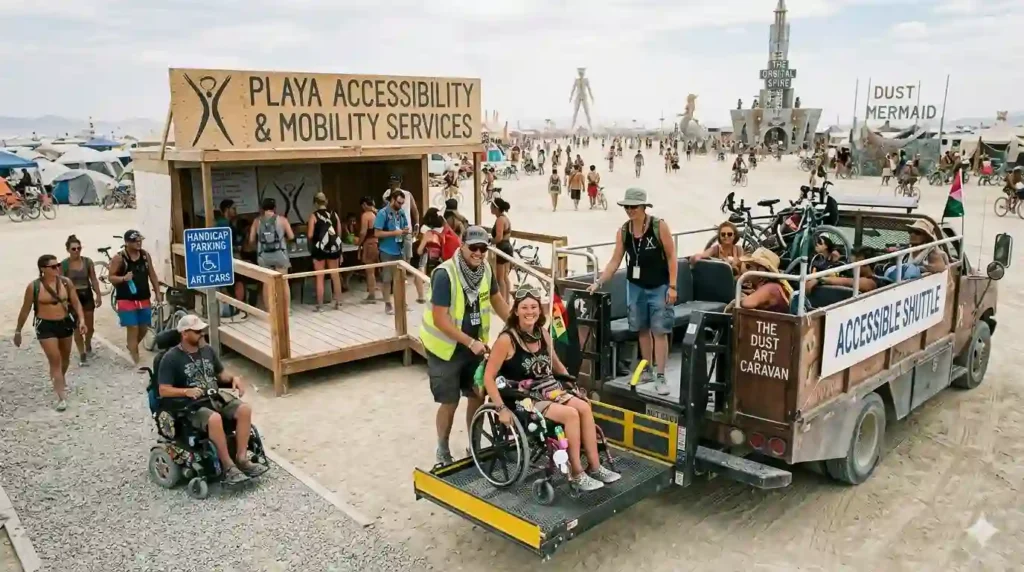
Black Rock City’s desert terrain presents genuine mobility challenges, but a dedicated accessibility infrastructure — including Camp ASL, mobility resources, and ADA-focused services — helps make participation possible for a wide range of needs. This guide explains what’s available and how to plan ahead. Radical Inclusion is a founding principle, not an afterthought.
Radical Inclusion — the principle stating that “anyone may be a part of Burning Man” with no prerequisites for participation — is one of the event’s founding values, and Black Rock City has built accessibility resources specifically to make that principle practical rather than aspirational. Given the desert’s uneven, sometimes deep-playa terrain and the physical demands of a multi-day event, participants with mobility, sensory, or other access needs face real logistical challenges that this guide addresses directly rather than glossing over.
This guide covers the accessibility services generally available on playa: mobility-friendly camping areas and pathways, ASL interpretation resources for deaf and hard-of-hearing participants, accessible transportation support for those who can’t cycle or walk long distances, and camps specifically organized around accessible infrastructure and community support. It also covers practical planning considerations before arrival — bringing your own mobility equipment suited to sand and uneven ground, planning routes that account for distance and terrain, and connecting with accessibility-focused camps or resources ahead of time rather than trying to locate them once on playa.
Because Radical Self-Reliance remains a core expectation for every participant, this guide focuses on realistic planning and available community support rather than promising services equivalent to a fully accessible urban environment. For general first-time planning context, see the Beginner Guide and First-Time Planning Guide.
In This Guide You’ll Learn
- ♿ Accessibility planning
- 🚐 Mobility assistance
- 🏕️ Accessible camping
- 🚻 ADA facilities
- 🚲 Accessible transportation
- 🩺 Medical accessibility
- 🤝 Inclusive participation
- 🧠 Neurodiversity considerations
- 👨👩👧 Family & caregiver support
- ❤️ Building an inclusive community
How Accessible Is Burning Man?
Burning Man is not a polished, fully built, year-round city. It is a temporary desert town made from dust, heat, distance, improvisation, and human will. That means accessibility exists, but it looks different from what most people are used to in permanent urban spaces.
The good news is that radical inclusion is not just a slogan out here. The culture wants more people to participate, not fewer. Still, the playa has real physical challenges, and those challenges ask for planning, patience, and honest expectations.
Burning Man’s Commitment to Radical Inclusion
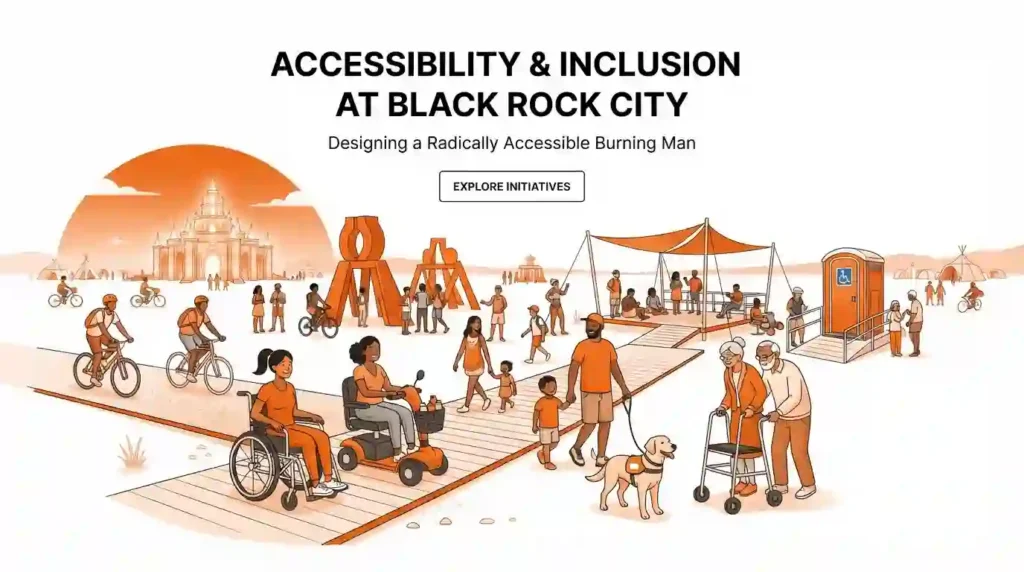
Radical inclusion means the city is meant to welcome people from many walks of life, including people with disabilities and access needs. In practice, that means the event tries to provide information, resources, and support that help more Burners show up and take part. It also means the community is expected to be thoughtful, respectful, and willing to make space for different ways of participating.
Inclusion on playa is not only about infrastructure. It is also about attitude. A camp that makes room at the table, a friend who slows down, or a volunteer who listens carefully can matter just as much as a ramp or restroom.
Accessibility in a Temporary Desert City
Black Rock City is built in harsh conditions, and the layout changes every year. Roads, camp placement, art placement, and wind patterns all affect how easy or hard it is to move around. Even simple tasks like getting to a camp dinner or crossing open playa can take more energy than they would in a normal city.
Because the city is temporary, some comforts and services are limited. That does not mean accessibility is impossible. It just means you have to think ahead, ask questions early, and build your plan around the real desert environment rather than assumptions from other events.
Understanding the Challenges of the Playa Environment
The playa can be unforgiving. Dust gets into everything, heat drains energy fast, and uneven surfaces can make mobility harder than expected. Long distances between destinations can turn a simple outing into a major effort, especially when you are managing fatigue, mobility devices, or sensory load.
Many accessibility barriers on playa are not about one single obstacle. They come from the combination of several small things happening at once. A route that feels fine in daylight may be exhausting at night. A camp that sounds close on the map may feel far after an hour in the wind.
Planning Ahead Makes Accessibility Easier
The earlier you plan, the more choices you have. That includes transportation, camp placement, equipment, communication plans, hydration, rest timing, and backup arrangements. The people who do best often start months before arrival, not days before departure.
Planning ahead also helps with confidence. When you know where to go for help, what your camp can provide, and what you may need to carry yourself, you reduce stress before it starts. That is a big deal on a dusty week where small problems can grow fast.
Why Accessibility Starts Before You Arrive
Burning Man accessibility does not begin at the gate. It starts with the first email, the first camp conversation, the first packing list, and the first honest self-assessment of what you need to thrive. If your needs are clear early, your support system can be clearer too.
This is especially true for people who rely on mobility aids, medical supplies, communication support, or structured routines. The more you prepare before departure, the easier it becomes to focus on participation once you are actually on playa.
- Burning Man supports radical inclusion, but it takes place in a temporary desert city with real physical limits.
- Playa conditions make accessibility more challenging, so planning and preparation matter a lot.
- Accessibility should be planned before arrival, not treated as something to solve on the spot.
What Accessibility Services Are Available?
Burning Man provides accessibility support to help participants navigate the event more safely and with more independence. These services are there to reduce barriers, answer questions, and help people understand what is realistically available in a temporary desert city.
Support is strongest when you know how to reach it and what to ask for. The right question at the right time can save a lot of frustration later. That is why the accessibility program matters so much in the overall planning process.
Accessibility Support Program
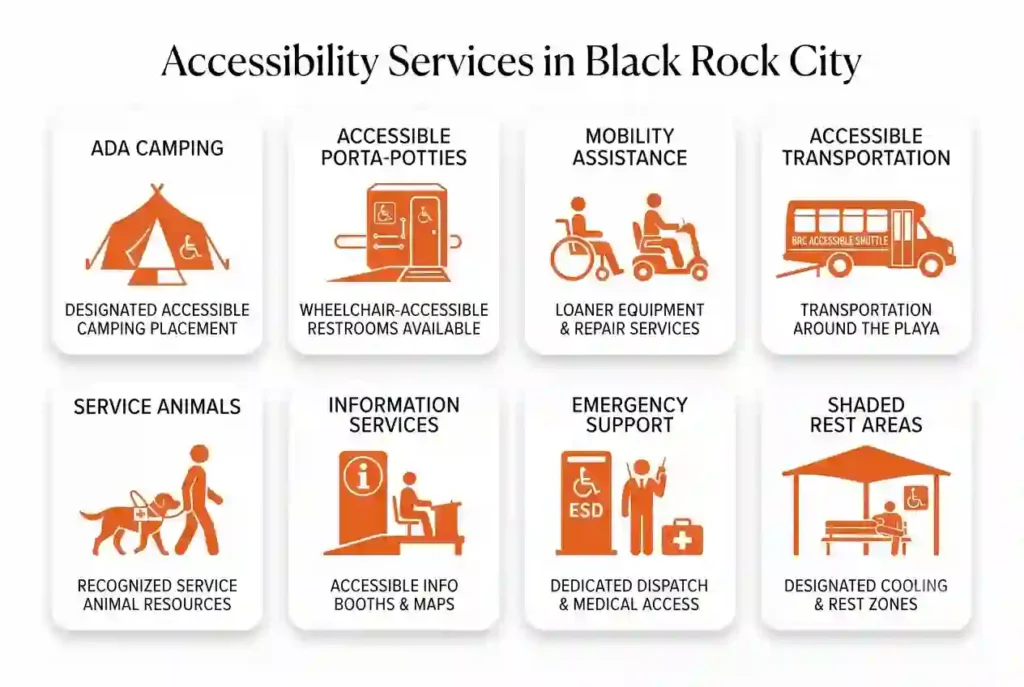
The accessibility support program is the main place people usually start. It exists to provide event-specific information, guidance, and accommodation coordination for participants with access needs. If you need help planning your arrival, your camp setup, or your movement around Black Rock City, this is the kind of support that can make a real difference.
This program is important because it helps translate general event information into practical help. Instead of forcing people to guess, it gives participants a point of contact for access-related questions. That makes the event feel less like a mystery and more like something you can prepare for.
Mobility Assistance Resources
Mobility assistance can include help with movement-related planning, transport support, or event guidance for people who use wheelchairs, scooters, walkers, canes, or other mobility aids. It can also help participants think through route planning, camp layout, and where to conserve energy.
The playa is not flat in the way people imagine it is. Conditions can shift, and what feels manageable one hour may feel heavier the next. Mobility planning is not just about the device itself; it is also about the route, the weather, and how much you can reasonably carry or push.
Accessibility Information Services
Good information is often the most useful accessibility service of all. When you know where accessible restrooms are, how to reach major gathering areas, what support is available, and who to contact when plans change, the whole event becomes easier to navigate. Information reduces uncertainty, and uncertainty is exhausting.
These services are especially helpful for first-time participants. New Burners often do not yet know how much walking, dust exposure, or time management the event requires. Clear information helps people make better decisions before they arrive.
Event Accommodation Options
Accommodation options vary, but the point is the same: Burning Man tries to create more ways for people to participate. That may include planning around accessible facilities, event communication support, transportation considerations, or guidance on inclusive camp practices.
It helps to think of accommodations as participation tools, not special treatment. The purpose is to reduce unnecessary barriers so you can enjoy the event more fully. When accommodations are used well, they make the whole city stronger.
Where to Find Accessibility Help
Accessibility help is usually easiest to find when you know where to look before arrival and once you are on playa. That means checking official event accessibility information, preparing questions in advance, and knowing which support channels to use after you land. Do not wait until you are overwhelmed to start asking.
You will also often get help from your camp, your neighbors, and volunteers who understand the access culture. Burners can be incredibly generous when they know what is needed. The key is being clear, direct, and early.
- Accessibility support exists to guide participants, answer access questions, and help with event accommodations.
- Mobility help, information services, and direct support can make access much easier when arranged early.
- The best approach is to know where to ask and what to request before you arrive.
How Do Accessible Camps Support Participants?
Accessible camps can make the difference between surviving the event and actually enjoying it. A camp that understands access needs can help with rest, movement, communication, layout, and social comfort in ways that a random placement cannot.
Not every camp is designed the same way, and not every camp can meet every need. Still, choosing the right camp and asking the right questions early can make a huge difference in how your week feels.
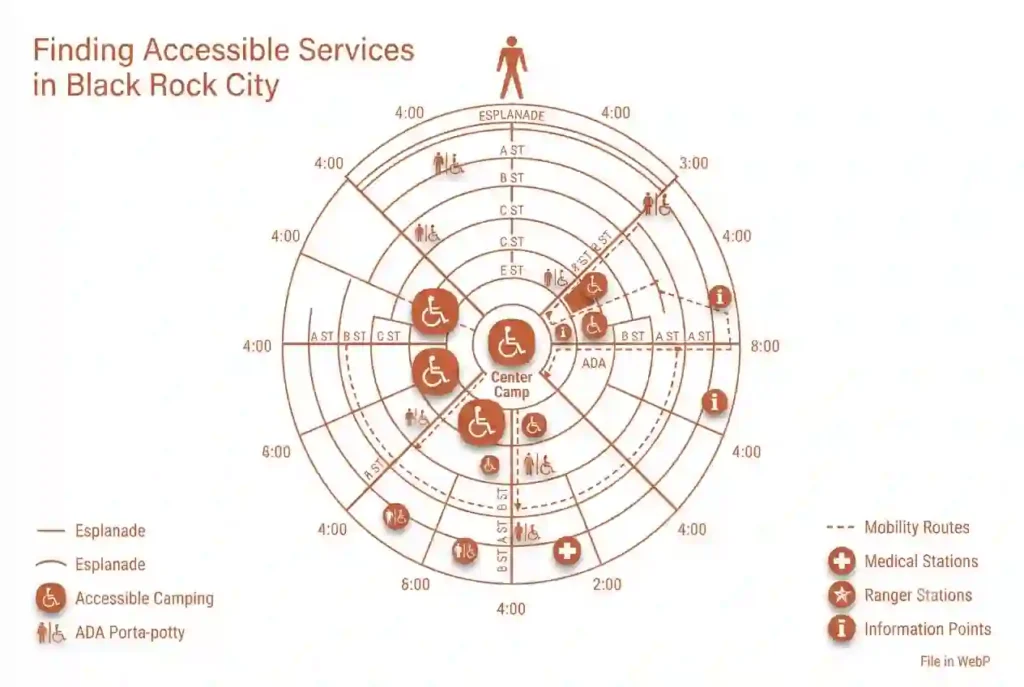
What Are Accessible Camps?
Accessible camps are camps that intentionally think about mobility, communication, sensory needs, and inclusive participation. They may provide wider pathways, easier entry and exit, quiet spaces, flexible schedules, help with unloading, or a culture that respects different access needs.
These camps are often built by people who understand that support is not just physical. A truly accessible camp also considers pace, communication style, and how to make people feel included rather than managed. That part matters more than a lot of newcomers realize.
Choosing the Right Camp for Your Needs
Choosing a camp is not just about theme, music, or friends. If you have access needs, the camp’s layout, location, and culture matter just as much. Ask about distance from central areas, terrain, shade, bathroom access, sound levels, and whether the camp has experience supporting participants with similar needs.
A good camp for you is one that matches your reality, not your wishful thinking. It is better to choose a place that supports your participation than a beautiful camp that quietly makes everything harder.
Mobility-Friendly Camp Features
Some features make camp life easier right away. Wider entrances, clear pathways, low clutter, secure surfaces, shade, seated areas, and easy access to water all support mobility. Even a camp’s willingness to keep MOOP under control can affect how safe and manageable the space feels.
A camp does not need to be fancy to be accessible. Sometimes the smallest details matter most. A well-placed chair, an uncluttered route, or a campmate who keeps paths clear can change your whole day.
Inclusive Community Living
Inclusive camping is not just about the physical setup. It is also about how people talk, ask, wait, listen, and share space. A camp can have excellent infrastructure and still be socially inaccessible if people are rushed, dismissive, or careless with boundaries.
Good camp culture means respecting independence, offering help without hovering, and recognizing that people know their own needs best. That is the Burner way at its best: supportive, practical, and not weird about it.
Planning Accessible Camping Before Arrival
If you need a camp to support your access needs, talk early and be specific. Ask about sleeping arrangements, bathroom distance, power, charging options, vehicles, storage, and any shared responsibilities that may affect you. This avoids surprise stress after you land in Reno and realize the setup is not what you thought.
The more concrete your questions, the better the answers will be. “Is the camp accessible?” is too vague. “How far is the sleeping area from the nearest restroom?” is much more useful.
- Accessible camps are designed to reduce barriers through better layout, mobility support, and inclusive culture.
- The right camp choice depends on your access needs, comfort level, and daily routine.
- Planning camp accessibility before arrival helps avoid stress and unnecessary strain
What Accessible Facilities Can You Expect?
Accessible facilities are part of what makes participation possible, but they are not unlimited. On playa, the event provides some support infrastructure, and people still need to plan around temporary conditions and event scale.
The right expectation is this: accessible facilities exist to improve access, but they do not remove the desert. Think of them as tools that help, not guarantees that everything will be easy.
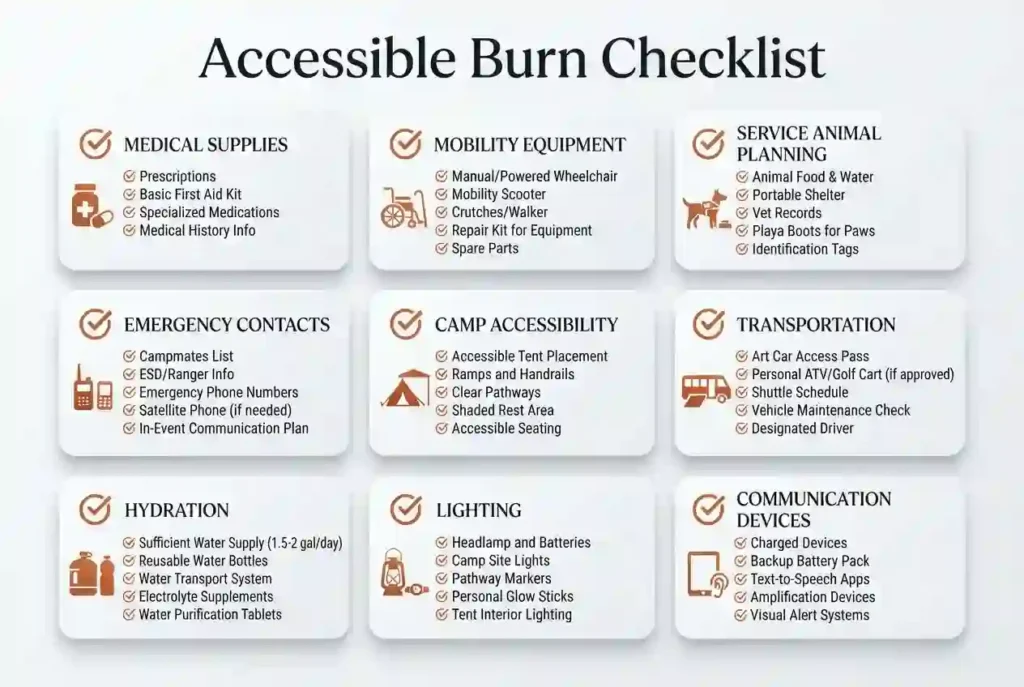
ADA-Accessible Portable Toilets
ADA-accessible portable toilets are an important resource for many participants. They can make a huge difference in dignity, independence, and day-to-day ease. Because restroom access is so basic, getting this piece right affects almost everything else.
Still, it is wise to expect demand, dust, and distance between facilities. Know where the accessible units are, understand how to reach them, and build restroom timing into your daily rhythm.
Accessible Public Spaces
Some public gathering areas are more manageable than others, depending on layout, crowd level, and surface conditions. Wide open spaces may feel easier to navigate, while dense or uneven areas may be tougher, especially at peak times or after weather changes.
Public space accessibility is never static on playa. It changes with traffic, dust, and event rhythm. What matters is choosing your timing carefully and not forcing yourself to move like everyone else if that does not work for you.
Mobility-Friendly Routes
Routes matter. A route that looks short on a map may include rough ground, thick dust, or crowd pressure that makes it harder than expected. Mobility-friendly route planning is about avoiding unnecessary strain and choosing the safest, smoothest way to get where you need to go.
This is why local knowledge and current information matter so much. Ask camps, volunteers, and friends about the easiest paths. The shortest route is not always the best route.
Rest Areas and Shade Resources
Rest and shade are not luxuries on playa. They are part of staying functional. When temperatures rise or your body needs a break, having a shaded, seated place to recover can be the difference between a good day and a shutdown.
Participants with access needs should think about rest as a core part of the schedule, not something extra. A smart day includes breaks. That is not weakness; it is strategy.
Accessibility Around Major Gathering Areas
Major gathering areas can be exciting but exhausting. Crowds, noise, bright light, and uneven movement patterns can make these spaces harder to manage. If you plan to visit them, think ahead about timing, entry, exit, and backup support. It often helps to go earlier or later than peak times when possible. That gives you more room, more calm, and more control over your experience.
Accessibility Resources at a Glance
| Resource | Who It’s For | Purpose |
|---|---|---|
| Accessibility Vehicles (AV) | Participants with qualifying mobility disabilities | On-playa transportation |
| ADA-Accessible Toilets | Wheelchair users and participants with mobility needs | Accessible sanitation facilities |
| ASL Interpretation | Deaf and Hard of Hearing participants | Communication support |
| Playa Info | All participants | Accessibility information and assistance |
| Accessibility-Friendly Camps | Participants needing additional support | Inclusive camping and community |
| Rangers & Medical Services | Anyone needing assistance | Safety, guidance, and emergency support |
- Accessible facilities may include ADA-accessible portable toilets, better routes, rest areas, and shade.
- Public spaces vary in ease of access, so timing and location matter.
- Major gathering areas can be managed more safely when you plan around crowd level and terrain.
How Does Accessible Transportation Work?
Transportation on playa can be one of the biggest access issues, because everything gets spread out and energy gets used up fast. Good transportation planning is not just about getting from one place to another. It is about conserving strength and reducing stress across the whole week.
The event provides different ways to think about movement, but participants still need to make smart choices. You want to avoid waiting until you are already exhausted before figuring out how to move.
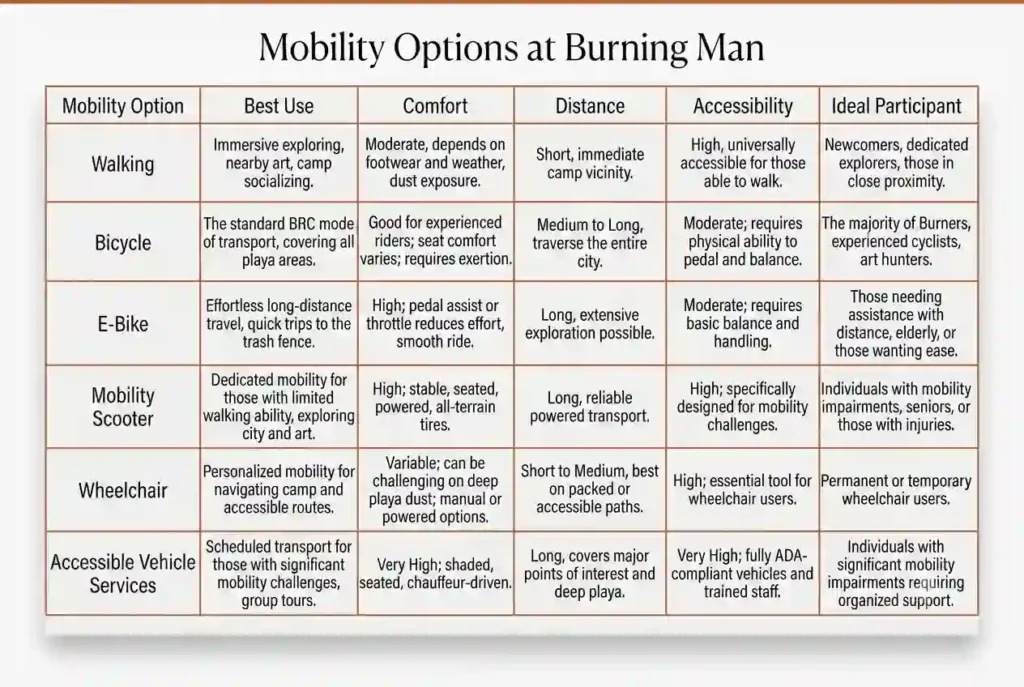
Mobility Assistance Vehicles
Mobility assistance vehicles can support people who need help covering distance or reducing strain. These can be incredibly useful, especially for participants who cannot reasonably travel long stretches on foot. They are part of how access becomes practical instead of theoretical.
If you depend on this kind of support, it helps to learn how it operates before arrival. That way you are not trying to solve a transportation problem while tired, dusty, and already late for something important.
Accessible Transportation Services
Accessible transportation services may help participants move around more efficiently, but they still require planning. The event environment is temporary and rough, so timing, pickup points, and route awareness matter a lot. These services work best when participants know the system before they need it.
Always think in terms of backup. If one way of moving around fails, what is your next option? That question alone can prevent a lot of panic.
Personal Mobility Devices
Many Burners bring their own mobility devices, and that can be a good choice when the device is already familiar and trusted. Scooters, wheelchairs, walkers, canes, and similar tools can all play different roles depending on the person and the route.
The key is to know your device’s limits in dust, heat, and rough ground. Playa is not the place to learn basic equipment behavior for the first time.
Traveling Around Black Rock City Safely
Safety on playa starts with self-awareness. Know how far you can go, how much water you need, when you need rest, and what conditions make movement harder. When in doubt, slow down and choose the safer route.
It also helps to travel with someone who understands your needs without overstepping. Good travel support is calm, observant, and flexible.
Transportation Planning Tips
Plan routes in advance. Know where you are going, where you can stop, and what the fallback is if you get tired or disoriented. Have a realistic sense of how long movement actually takes on playa. Do not pack your schedule too tightly. Accessibility gets harder when you are rushed.. Leaving margin in your day is one of the best decisions you can make.
- Transportation support may include mobility assistance vehicles, accessible services, and personal mobility devices.
- Black Rock City travel can be tiring, so route planning and safety awareness are important.
- Good transportation planning helps conserve energy and reduce unnecessary difficulty.
How Can Deaf and Hard-of-Hearing Participants Prepare?
Deaf and hard-of-hearing Burners can absolutely participate fully, but planning makes the experience smoother. Communication on playa can be chaotic, so having a strategy helps a lot. The event is social, noisy, and visually rich, which can be a strength when communication is prepared well.
The goal is not to force one communication style on everyone. The goal is to create enough clarity that people can connect without friction.
Communication Planning Before Arrival
Before arrival, think about how you prefer to communicate and what your needs are in noisy or crowded settings. You may need text-based coordination, visual cues, lip-reading support, or agreed-upon meeting points. The more you plan ahead, the less you have to improvise under pressure.
It is also useful to tell your camp or close friends what helps and what does not. People often want to help but do not know how. Clear guidance makes everyone better at being useful.
Community Support Resources
The Deaf and hard-of-hearing community on playa can be a valuable source of support and shared understanding. Community often becomes the real accessibility tool when official systems cannot cover everything. One Burner helping another can make a huge difference.
That support works best when it is respectful and not patronizing. People do not need pity. They need communication that actually works.
Participating in Events and Workshops
Workshops, talks, and performances can be more accessible when you know what format they use and what communication support might be needed. It helps to check in early, arrive with enough time, and ask what the setup is like. Some spaces are easier to manage than others.
If a workshop is important to you, do not assume you will be able to wing it. Ask first, prepare second, and then decide whether it is a good fit.
Meeting Other Deaf Burners
Meeting other Deaf Burners can create instant comfort and practical support. Shared experience often means less explanation and more understanding. It can also help you learn which parts of the event are easiest to navigate.
Community is powerful out here. Sometimes one good connection does more than a whole stack of printed information.
Communication Tips for Camps
Camps can support Deaf and hard-of-hearing participants by using visual cues, clear signage, direct face-to-face communication, and simple agreements around important times. A little preparation goes a long way. If a camp expects this kind of inclusion, it should plan for it rather than pretending it will happen naturally.
Also, people should speak clearly without shouting unless asked. Shouting is not the same as communicating well. Burners should remember that.
- Communication planning before arrival makes events, workshops, and camp life easier to navigate.
- Deaf Burners can benefit from community support and camps that use clear visual and written communication.
- Good camp communication should be direct, respectful, and planned in advance.
How Can Blind and Low-Vision Participants Participate?
Blind and low-vision participants bring valuable perspective and can absolutely thrive at Burning Man with the right support. The playa is sensory-rich in ways that can be useful, but it also has navigation challenges that need planning.
What helps most is clear orientation, stable routines, reliable communication, and people who are willing to describe rather than assume.
Navigating Black Rock City
Navigation on playa depends on landmarks, layout familiarity, and good support systems. Blind and low-vision participants often do best when they know the camp map, key routes, and notable landmarks before moving around alone. Familiarity reduces strain.
It is also helpful to have regular check-ins with someone who knows the area. This does not mean giving up independence. It means building a safer framework for it.
Orientation and Mobility Strategies
Good orientation strategies might include counting turns, identifying sound cues, memorizing route anchors, or using guide support on unfamiliar paths. The playa is not a normal city grid, so simple strategies often work better than complicated ones.
The best mobility strategy is the one that fits your habits and keeps you oriented when conditions shift. Dust, darkness, and crowd movement can change how a route feels, so flexibility matters.
Camp Planning Considerations
Camp planning for blind and low-vision participants should focus on layout consistency, hazard reduction, and predictable pathways. That means keeping gear out of walkways, avoiding unnecessary clutter, and making the sleeping and common areas easy to describe.
Campmates can help a lot by not moving things around without warning. Predictability is a real access tool. People should not have to relearn the camp every time they leave and come back.
Working With Sighted Guides
Sighted guides can be extremely helpful when they understand their role properly. They are not there to take over; they are there to support movement, orientation, and safety in a respectful way. Good guiding is collaborative, not controlling.
The best guide is calm, descriptive, and patient. They tell you what is happening instead of making decisions for you unless asked.
Accessibility Resources for Low-Vision Participants
Low-vision participants may benefit from strong verbal descriptions, clear contrast, predictable paths, and help with route planning. Lighting choices also matter, especially at night. What is easy for one person to see may be impossible for another to detect in wind and dust.
If you have low vision, it is worth being very specific about what helps you most. That specificity allows others to support you better.
- Navigation works best with route planning, orientation support, and consistent camp layout.
- Sighted guides and clear mobility strategies can make movement safer and easier.
- Low-vision participation improves when camps use descriptive, predictable, and uncluttered spaces.
How Does Burning Man Support Neurodivergent Participants?
Neurodivergent participants may experience the playa very differently depending on sensory needs, communication style, routine preferences, and social energy. That is completely normal. Burning Man can be intense, but it can also be deeply meaningful when the experience is shaped around your actual needs.
Support here often means reducing overload, protecting rest, and making the environment more predictable when possible.
Managing Sensory Overload
Sensory overload is one of the biggest issues for many neurodivergent Burners. Bright light, loud sound, dust, constant motion, and social intensity can stack up quickly. Having a plan before symptoms spike is much better than waiting until you are overwhelmed.
Some participants benefit from ear protection, eye protection, quiet breaks, or limiting exposure to very intense spaces. The important thing is to know your own threshold and respect it.
Finding Quiet Spaces
Quiet spaces can be lifesavers. Even in a city built for expression, nobody can stay “on” all the time. Knowing where you can step away, sit down, breathe, and reset makes the whole event more sustainable.
Quiet space is not a luxury for many Burners. It is part of staying regulated and present enough to participate.
Creating a Comfortable Daily Routine
Routine can help a lot when everything around you is unusual. A simple schedule for hydration, food, rest, movement, and check-ins may give you enough structure to stay grounded. You do not need to do the event like everyone else to do it well.
This is one of the smartest forms of self-reliance. Build a rhythm that helps your nervous system settle.
Communication and Personal Boundaries
Communication boundaries matter. If you need direct communication, advance warning, written plans, or less social pressure, say so early. People often assume the playa means endless spontaneity, but boundaries are what make spontaneity possible without burnout.
Clear boundaries are not a burden on the community. They are part of how the community becomes safer and kinder.
Self-Care During the Event
Self-care on playa is not soft or optional. It is practical. Eating, hydrating, resting, and stepping away before you crash are all part of having a good experience.
Neurodivergent Burners often do best when they accept that leaving a situation early is a valid choice. You do not have to earn your right to rest.
- Sensory overload, noise, and social intensity can be major challenges, so quiet spaces and routines help.
- Clear communication, personal boundaries, and self-care are important for a sustainable experience.
- The playa can be intense, so managing energy and stress is part of participation.
How Do You Request Accessibility Accommodations?
Requesting accommodations is one of the most important steps in the whole process. If you need support, ask early and be clear about what kind. The more specific you are, the easier it is for the event to respond in a useful way.
This is not about making a fuss. It is about making participation possible.
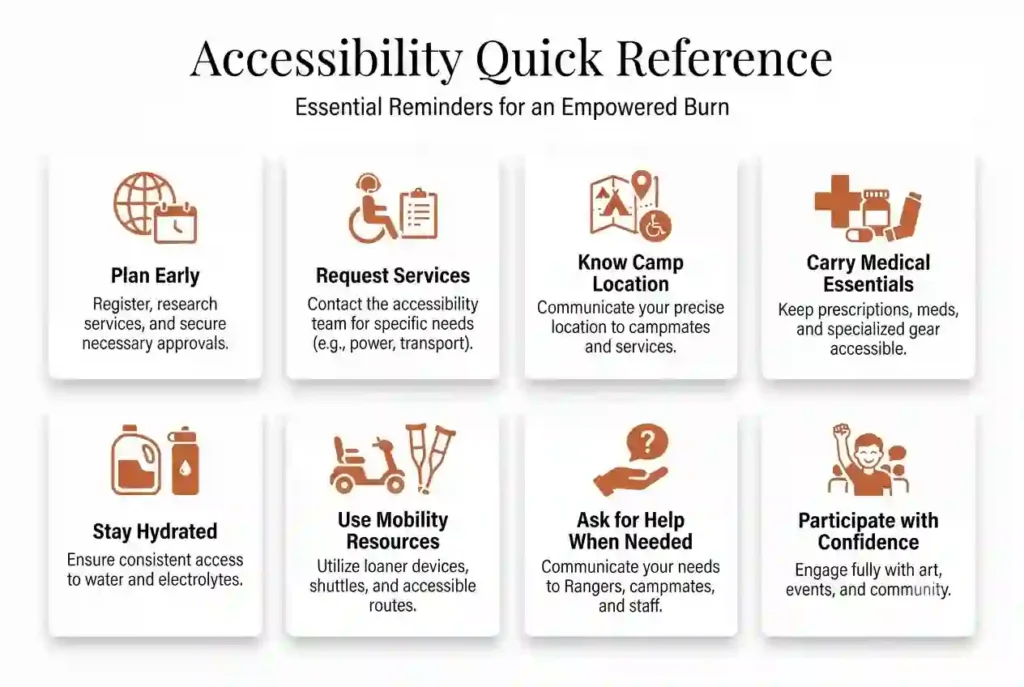
Understanding the Accessibility Application Process
The accessibility application process exists to help the event understand your needs before you arrive. That gives organizers and support teams time to prepare and coordinate. If there is a formal process for accommodations, it is there to reduce chaos later.
Treat it like any other serious planning task. The better the information, the better the outcome tends to be.
Eligibility and Supporting Documentation
Some accommodations may require supporting information so the event can understand your situation and respond appropriately. Documentation helps create clarity. It is not about proving your worth; it is about matching support to real needs.
If paperwork is part of the process, do not let it become an afterthought. Start early enough to gather what is needed without stress.
When to Apply
Apply as early as you can. Early requests give you the best chance of getting clear answers and making changes if needed. Waiting too long can make support harder to arrange.
This is especially important if your travel, lodging, or mobility plan depends on accommodation decisions. Early action protects your options.
Preparing Before Traveling
Before you travel, make sure your plan is actually workable. Check your gear, test your devices, review your route, and confirm your camp setup. Do not assume everything will feel obvious once you arrive.
Preparation also includes emotional readiness. Know what your non-negotiables are and where you can be flexible.
After Your Request Is Approved
Once a request is approved, follow through with any next steps carefully. Save contact information, confirm details, and keep important information accessible while traveling. Approval is helpful, but it is only useful if you know how to use it.
It also helps to keep expectations realistic. Approval may improve access, but the desert still has limits.
- The accommodation process should be started early with clear information about your needs.
- Supporting documentation may be needed, so planning ahead is important.
- After approval, participants should confirm details and prepare carefully before traveling.
How Can Friends, Camps, and Volunteers Support Accessibility?
Accessibility is not only the job of a program or a form. It is a culture. Friends, campmates, and volunteers all play a role in making the event more inclusive and easier to navigate.
A thoughtful person who asks before helping can be worth ten people who rush in with the wrong kind of help.
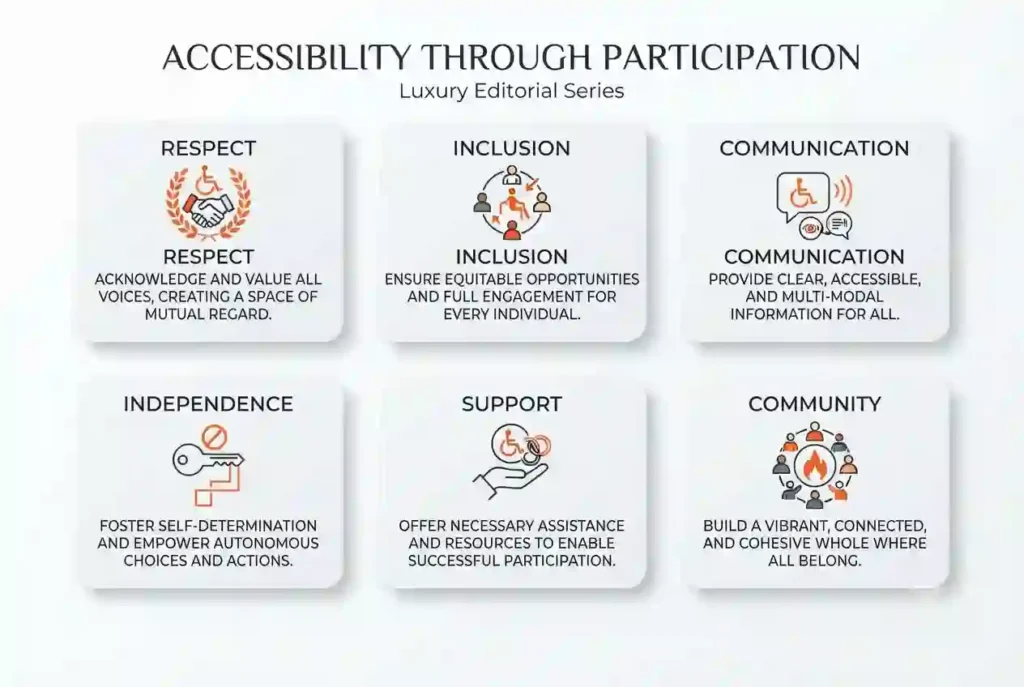
Creating Inclusive Camp Environments
Inclusive camps are built with access in mind from the start. That means thinking about layout, noise, rest, communication, and how people actually move through the space. A camp that says it values inclusion should make it visible in daily practice.
Small acts count. Clear pathways, visible signs, and predictable routines can make a camp feel far more welcoming.
Respecting Independence and Choice
Support should never become control. People with access needs do not need to be managed or spoken for unless they ask. The best support respects independence first.
If someone says they are fine handling something themselves, believe them. Help is useful when it is invited or clearly needed, not when it is assumed.
Communicating Clearly and Respectfully
Clear communication reduces friction. That means speaking plainly, confirming plans, avoiding vague promises, and not being vague about timing or location. On playa, clear communication is a form of care.
Respect also means listening without making someone repeat themselves endlessly. Good communication is efficient and kind.
Helping Without Assuming
Assumptions are one of the fastest ways to make accessibility harder. Do not guess what someone needs based on appearance. Ask. Then listen.
If you are unsure how to help, that is fine. Ask a direct question and follow instructions. That is often better than improvising.
Building an Inclusive Burner Community
An inclusive Burner community is built by habits, not slogans. It grows when people normalize access questions, respect different bodies and minds, and make room for multiple ways of participating. That kind of community is stronger and more interesting too.
Burning Man works best when people remember that inclusion is not extra. It is the point.
- Inclusive support starts with camp design, respectful communication, and a willingness to help without taking over.
- People should respect independence, ask before assisting, and avoid assumptions.
- A stronger Burner community is built when accessibility becomes a shared responsibility.
What Challenges Should Participants Expect?
The playa has a way of testing plans. Even with good preparation, participants should expect environmental and logistical challenges. The key is not to pretend those challenges do not exist.
The smart move is to understand the obstacles and build around them before they become too much.
Dust, Heat, and Weather
Dust and heat are not background details. They are major factors in how accessible the event feels. Wind can change everything quickly, and the body pays attention whether or not the schedule does.
Be ready to protect your breathing, your eyes, your skin, and your energy. Weather on playa is part of the experience, but it should never be ignored.
Uneven Playa Surfaces
The ground can be rough, soft, cracked, or unpredictable. That can affect wheels, feet, balance, and speed. Even short distances can feel like a lot if the surface is bad enough.
This is why route planning matters so much. It is not just about distance. It is about terrain.
Fatigue and Energy Management
Fatigue is one of the biggest hidden barriers on playa. You may be doing more physical work than usual just to move around, stay clean, stay hydrated, and stay organized. That energy cost adds up fast.
The best strategy is to treat rest like part of the plan. If you wait until you are exhausted, you are already behind.
Long Travel Distances
Burning Man is spread out. What looks close on the map may still require time, energy, and coordination. For many people, distance is a real access factor.
That means you need to be realistic about how many places you can reasonably visit in one day. Less can be more when the desert is involved.
Preparing for Unexpected Situations
Even good plans can get disrupted. Someone gets delayed, the wind shifts, a route becomes harder, or you simply run out of steam. Preparation should include backup thinking, not just the main plan.
A flexible mindset is one of the most useful accessibility tools on playa. Things change. The question is whether your plan can bend with them.
- Dust, heat, weather, rough terrain, fatigue, and long distances can all affect access.
- Burners should expect that plans may need adjustment because playa conditions change quickly.
- Flexibility and preparation help participants handle unexpected situations more smoothly.
What Mistakes Do First-Time Participants Make?
New participants often mean well but underestimate how different the desert really is. Accessibility mistakes are usually not about carelessness. They are about not knowing what the environment demands.
Learning from those mistakes early can save a lot of stress and disappointment later.
Waiting Too Long to Plan Accessibility
A common mistake is treating accessibility as something to solve after everything else is booked. By then, options are limited. The earlier you ask questions, the more flexibility you have.
This event rewards early planning. Delaying access planning usually makes everything harder.
Underestimating Playa Conditions
Many first-timers assume they can handle the playa the same way they handle an ordinary festival. That assumption usually breaks down fast. Dust, heat, terrain, and distance all hit harder than expected.
Respecting the environment is not pessimism. It is good judgment.
Not Contacting Accessibility Resources Early
Another mistake is waiting until the last minute to ask for help. If you need accommodations, support, or guidance, earlier contact gives everyone more room to help. Last-minute requests are much harder to fulfill well.
The best time to ask is before the pressure is on.
Bringing Inadequate Mobility Equipment
Some people bring gear that is not suited for the conditions or is unfamiliar to them. That can create avoidable problems once the playa starts working on it. Your equipment should be tested, trusted, and ready for rough use.
If something is essential, it should not be experimental.
Assuming Burning Man Works Like Other Festivals
Burning Man is not a normal festival. It is temporary, decentralized, dusty, and self-organized in ways that can surprise newcomers. If you assume standard festival logic will carry you through, you may get caught off guard.
This is one of the biggest lessons for first-timers: plan like you are entering a real desert city, because you are.
- A common mistake is waiting too long to plan accessibility needs.
- New participants often underestimate playa conditions or assume Burning Man works like a normal festival.
- Bringing the wrong mobility gear or not reaching out early can make the event much harder than necessary.
What Do Experienced Burners Recommend?
Experienced Burners usually get practical fast. They know the event rewards preparation, flexibility, and community connection. Their advice tends to be simple because the environment makes simplicity smart.
When people have done this before, they usually know that the best plans are the ones that survive contact with dust.
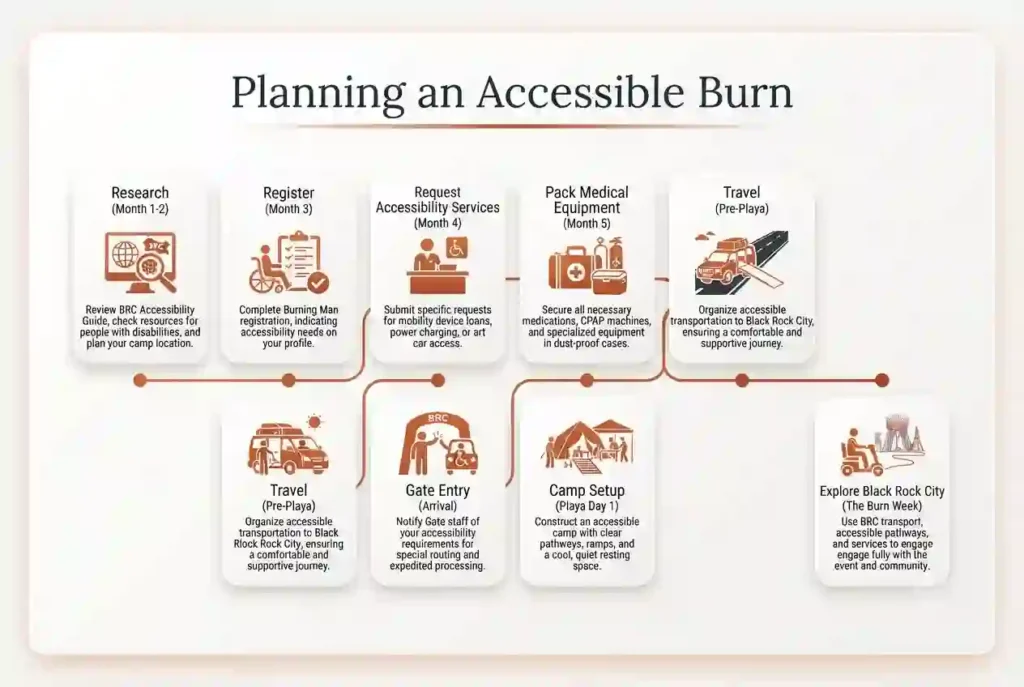
Start Planning Months Before the Event
The earlier you begin, the better your outcome is likely to be. Months give you time to ask questions, adjust gear, find community, and handle forms or approvals without panic.
Accessibility is not something to rush. Slow planning is strong planning.
Connect With the Accessibility Community Early
One of the best things you can do is connect with people who already know the access landscape. That may mean other Burners with similar needs, camps with access experience, or event support contacts. Shared knowledge is gold on playa.
You do not have to solve everything alone. That is not the Burner way either.
Test Equipment Before Arrival
If you depend on gear, test it before you get to the desert. Check batteries, charging, movement, packing, and ease of use. The playa is the wrong place for surprise failures.
Equipment should be familiar enough that you trust it under stress. That trust matters more than looks or brand names.
Build Flexibility Into Your Plans
Experienced Burners know plans change. So they build margin into the schedule, keep backup options, and avoid overcommitting. Flexibility is not a compromise; it is part of the design.
If you can adjust without feeling like the day is ruined, you will enjoy the event more.
Accept Help When You Need It
Some people are too proud to accept help, and that can make things harder than they need to be. Accepting help when it is offered well is not weakness. It is smart participation.
At the same time, good help should still respect your independence. The point is support, not takeover.
Focus on Participation, Not Limitations
The best advice of all is to focus on what you can do and what kind of participation matters most to you. Burning Man is bigger than mobility, hearing, sight, routine, or energy level. People come here to connect, create, and belong.
If you focus only on limitations, you miss the point of the place. If you focus on participation, the event opens up in a different way.
- Experienced Burners usually recommend planning months ahead and connecting with accessibility support early.
- They also stress testing equipment, building flexibility, and accepting help when needed.
- The main focus should stay on participation, not on what feels limiting.
Accessibility Is About Participation
Accessibility is not charity and it is not an afterthought. It is what makes participation possible for more people. That is what gives the event more depth, more humanity, and more real community.
Every Burner Deserves the Opportunity to Participate
Everyone deserves a fair shot at being part of the city. That does not mean every path looks the same. It means the community should take inclusion seriously enough to make room for different bodies, minds, and communication styles.
Participation is the real prize. Access is how we get there.
Inclusion Strengthens Black Rock City
A more inclusive city is a stronger city. When more people can show up, the art gets richer, the community gets wider, and the culture becomes more honest about what it values.
Inclusion is not a side feature. It is part of what makes the experiment meaningful.
Preparation Creates Greater Independence
The better prepared you are, the more independent you can be. That is true for mobility, communication, sensory comfort, transportation, and camp life. Preparation does not remove every challenge, but it makes you less dependent on luck.
That kind of independence is one of the best things the playa can offer.
- Every Burner should have the chance to take part in the event.
- Inclusion makes Black Rock City stronger and more connected.
- Good preparation creates greater independence and confidence.
Common Accessibility Myths vs Reality
Many first-timers worry about accessibility at Burning Man. This section debunks common myths and highlights the real supports, planning steps, and community practices that make participation possible for people with diverse needs.
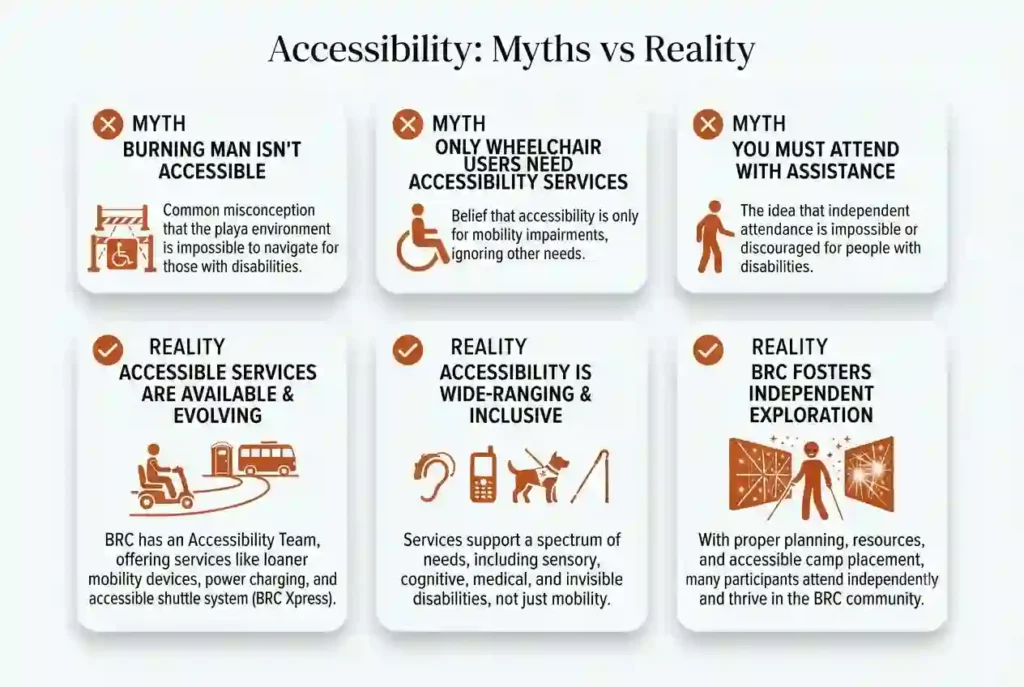
Myth: Burning Man Is Not Accessible for People With Disabilities
Reality: While Black Rock City presents unique challenges, the event offers a range of accessibility services, community support, and planning resources to help participants with disabilities attend and participate meaningfully. Many camps, volunteers, and official services prioritize accessibility; with preparation, disabled participants regularly take part in art, performances, and daily life on the playa.
Myth: Accessibility Services Are Only for Wheelchair Users
Reality: Accessibility covers a wide range of needs—sensory, cognitive, medical, and temporary injuries—not just mobility. Services include sensory-friendly spaces, quiet areas, medical assistance, guide support for low-vision participants, captioning or communication supports where available, and accommodations for neurodiverse needs.
Myth: You Must Attend With a Caregiver or Companion
Reality: Some people come with caregivers, but many participants use a mix of official services, camp support, and assistive devices to attend independently. Early planning, connecting with accessible camps, and using mobility or medical resources can enable solo attendance or participation with minimal outside caregiving.
Myth: Accessible Facilities Are Available Everywhere
Reality: Accessible facilities exist, but they’re not uniformly distributed across Black Rock City. ADA parking, accessible porta‑potties, and accessible camping are provided in specific zones; organizers and camps can help with localized solutions. Plan routes and camp locations with accessibility in mind rather than assuming universal access.
Myth: Accessibility Means Missing the Full Burning Man Experience
Reality: Accessibility is about enabling participation, not limiting it. With proper planning and community support, participants with access needs can enjoy art, theme camps, performances, and communal rituals. Many accessibility adaptations improve the experience for everyone, creating a more inclusive event.
Myth: Planning Ahead Isn’t Necessary for Accessible Participation
Reality: Advance planning matters. Reserving accessible parking, requesting mobility assistance, coordinating with your camp, and packing necessary medical supplies all reduce stress and increase freedom on the playa. Last-minute arrangements are possible but often more difficult.
Myth: Families With Accessibility Needs Cannot Attend Comfortably
Reality: Families can and do attend successfully. Accessible camping options, family-focused camps, child care resources in some communities, and strategies for managing routines and medical needs make family attendance feasible. Early coordination with organizers and camps makes a big difference.
Myth: Asking for Accessibility Support Goes Against Radical Self-Reliance
Reality: Radical Self-Reliance encourages participants to prepare and ask for what they need to participate safely. Using community resources, requesting accommodations, and collaborating with campmates embody the communal principles of Burning Man rather than contradicting them.
| Myth | Reality |
|---|---|
| Burning Man isn’t accessible for people with disabilities. | The event provides accessibility resources, including licensed Accessibility Vehicles, accessible toilets, and communication support. |
| Wheelchair users cannot explore Black Rock City. | Participants can use wheelchairs, powered mobility devices, or approved Accessibility Vehicles, depending on their needs. |
| There are no accessible toilets. | ADA-accessible porta-potties are available throughout Black Rock City. |
| Deaf participants receive no communication support. | ASL interpretation is available through Playa Info during posted hours. |
| Anyone can drive an Accessibility Vehicle. | Only approved participants meeting the eligibility requirements may operate licensed Accessibility Vehicles. |
| Accessibility means VIP treatment. | Burning Man focuses on equal participation and practical accommodations rather than special privileges. |
- Burning Man offers accessibility services and strong community support, so disabilities don’t automatically bar participation.
- Accessibility includes sensory, cognitive, medical, and temporary needs—not just wheelchair access.
- You don’t always need a caregiver; accessible camps, official services, and assistive devices can enable independent participation.
- Accessible facilities are available but not everywhere—plan camp location, routes, and access points ahead of time.
- Early planning (parking, mobility assistance, medical supplies, camp coordination) reduces stress and maximizes engagement.
Accessibility & Inclusion Checklist
Before the Event
✅ Review official accessibility resources
✅ Apply early for an Accessibility Vehicle if needed
✅ Contact your theme camp about accessibility
✅ Pack mobility aids, spare batteries, and repair tools
Before Traveling
✅ Carry disability documentation if required
✅ Plan charging for powered mobility devices
✅ Download offline maps
✅ Arrange transportation that meets your needs
While at Burning Man
✅ Locate accessible toilets on the city map
✅ Visit Playa Info for accessibility assistance
✅ Keep mobility devices protected from dust
✅ Ask Rangers or volunteers for help if needed
Before Leaving
✅ Inspect mobility equipment
✅ Remove all personal items and MOOP
✅ Recharge powered devices before departure
✅ Confirm accessible transportation home
Conclusion
Black Rock City strives to be welcoming and accessible to everyone. This guide outlines the services, planning tips, and community practices that support participants with diverse mobility, sensory, and cognitive needs. Use it to prepare before you arrive so you can focus on connection, art, and participation.
Accessibility Makes Black Rock City Stronger
Accessibility and inclusion are core to the Burning Man community. Black Rock City is designed to welcome participants with diverse physical, sensory, cognitive, and mobility needs through thoughtful planning, community support, and dedicated accessibility services. Knowing about those resources before you arrive helps create a safer, more comfortable, and more enjoyable experience for everyone.
Plan Early and Use Available Accessibility Resources
Review accessibility information well before you travel to the playa. Early planning makes it easier to arrange mobility assistance, accessible camping, ADA parking, accessible porta‑potties, transportation accommodations, and any other supports you need. Preparing in advance reduces stress and lets you focus on participating fully in the event.
Continue Planning Your Burning Man Journey
For next steps, explore these related guides to build a confident, accessible plan:
- 🚲 Transportation Inside Black Rock City
- 🏕️ Amenities & Facilities
- 🚪 Gate Entry & Arrival Guide
- 🌞 Survival Guide
- ⛺ Camping Guide
These resources explain transportation options, daily living needs, camp planning, and navigation strategies that help make your Burn easier and more enjoyable.
Final Thoughts
Accessibility at Burning Man is not about pretending the desert is easy. It is about building enough support, planning, and community care that more people can participate fully. That is a worthy goal, and it fits the spirit of the event better than exclusion ever could.
Accessibility Makes Burning Man Better for Everyone
When Burning Man becomes easier to navigate for people with access needs, it becomes more thoughtful for everybody. Clearer communication, better camp design, safer routes, and more inclusive habits help the whole city run better.
What helps one person often helps many. That is the quiet truth of good accessibility work.
Plan Early, Participate Fully, and Burn With Confidence
The strongest approach is simple: plan early, ask clearly, and stay flexible. Build your support around the real playa, not an imagined one. Then show up ready to participate in your own way.
Confidence does not come from pretending nothing is hard. It comes from knowing you prepared well enough to meet the desert on your own terms.
Radical Inclusion Begins With Every Participant
Radical inclusion is not only a principle for organizers. It is a practice for every Burner. Each time someone listens well, makes space, or adjusts with care, the city becomes more welcoming.
That is how inclusion lives on playa: one decision, one camp, one conversation at a time.
Every Participant Belongs in Black Rock City
Accessibility goes beyond ramps and accessible toilets — it reflects the community’s commitment to participation, respect, and inclusion. Whether you use a mobility device, manage a medical condition, travel with family, or simply need extra support, every participant deserves the chance to experience Burning Man fully.
Preparation Creates Freedom to Participate
The more thoroughly you prepare before arrival, the more freedom you’ll have to focus on art, community, creativity, and the unforgettable moments that make Burning Man unique. Understanding available accessibility resources in advance means less time solving problems and more time enjoying Black Rock City.
- Accessibility improves the event for everyone, not just participants with specific access needs.
- Planning early and participating fully helps people enjoy Burning Man with more confidence.
- Radical inclusion becomes real when every participant treats it as part of the culture.
Accessibility & Inclusion Insights
Burning Man strives to make Black Rock City as inclusive as possible by offering accessibility resources for participants with mobility, hearing, vision, and other disabilities. These numbers highlight the key services available before and during the event.
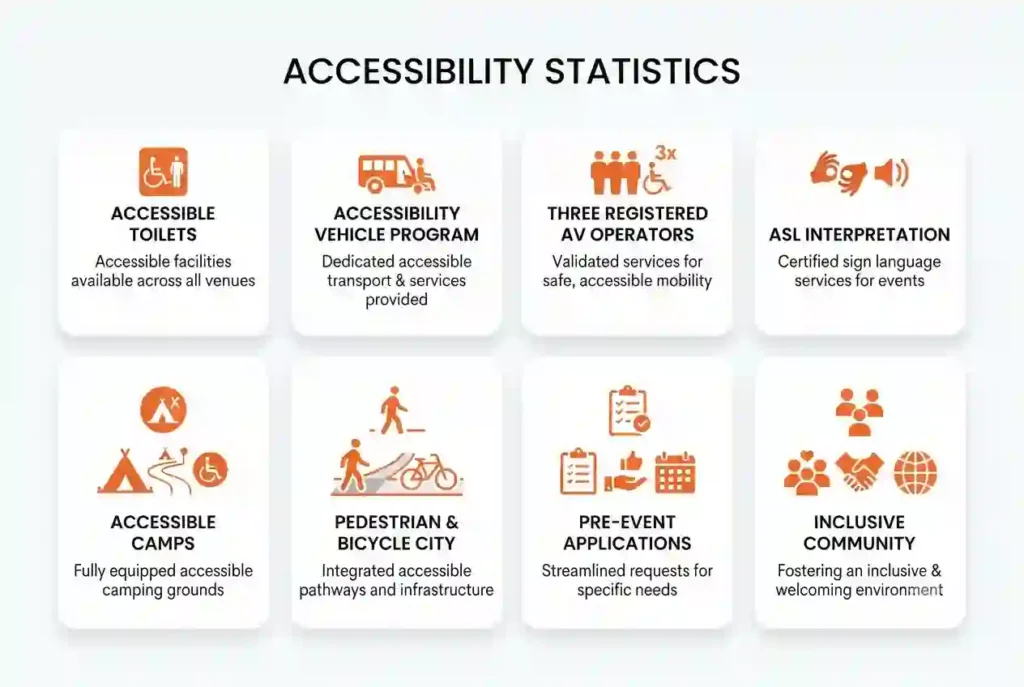
Key Numbers
- ♿ Wheelchair-Accessible Toilets — ADA-accessible porta-potties are distributed throughout Black Rock City and marked on the official city map.
- 🚙 Accessibility Vehicle (AV) Program — Eligible participants can apply to operate licensed Accessibility Vehicles for on-playa mobility.
- 👥 Up to 3 Registered AV Operators — One Accessibility Vehicle may be registered for use by up to three qualified individuals.
- 🤟 ASL Interpretation Available — American Sign Language interpretation is available for Deaf and Hard of Hearing participants through Playa Info at Center Camp.
- 🏕️ Accessible Camps & Community Support — Accessibility-focused camps and volunteer communities help support participants with disabilities.
- 🚲 Pedestrian & Bicycle City — Most participants travel by foot or bicycle, while licensed Accessibility Vehicles provide mobility support when needed.
- 📋 Pre-Event Accessibility Applications — Accessibility Vehicle applications typically open before the event and should be completed in advance.
- ❤️ Community Inclusion — Radical Inclusion encourages participation regardless of physical ability, age, or background.
Frequently Asked Questions About Accessibility at Burning Man
Yes. While the desert environment is challenging, Burning Man provides accessibility resources, including accessible toilets and the Accessibility Vehicle program.
Yes. ADA-accessible porta-potties are located throughout Black Rock City and shown on the official map.
An Accessibility Vehicle is a licensed mobility vehicle approved for participants with qualifying physical disabilities.
Applications are submitted before the event through the official Burning Man participation forms.
Yes. ASL interpretation for Deaf and Hard of Hearing participants is available through Playa Info during scheduled hours.
Yes. Many participants bring manual or powered mobility devices, but they should be prepared for dust, rough terrain, and charging needs.
es. Several camps focus on supporting participants with mobility and accessibility needs.
Only under the official AV program rules, and the qualified participant must meet the licensing requirements.
Deep dust, uneven terrain, and long travel distances make preparation and the right mobility equipment especially important.
Yes. Radical Inclusion is a core principle, and the event offers resources to help participants engage as fully as possible.
Yes. Many participants with limited mobility successfully attend each year by planning ahead, using accessibility resources, and coordinating transportation and camp support.
Where Should You Go Next?
| If You Want To… | Read This Guide |
| Learn city transportation | → Transportation Guide |
| Find accessible facilities | → Amenities & Facilities |
| Prepare medically | → Health & Emergency Guide |
| Understand city services | → City Services & Resources |
| Join a Theme Camp | → Theme Camps |
Why Trust This Guide?
✅ Links to survival, transportation, and city guides for complete preparation.
✅ Updated for the 2026 Burning Man season.
✅ Focuses on accessibility, inclusion, and practical preparation.
✅ Covers both official support resources and participant planning.
✅ Encourages respectful community participation.
Conclusion
Accessibility at Burning Man is built through a combination of personal preparation, community support, and participant collaboration. Understanding available resources before arriving allows participants to experience Black Rock City more confidently while contributing to a welcoming and inclusive environment for everyone.
- ♿ Plan ahead.
- 🚐 Learn available transportation options.
- 🏕️ Choose camps that match your needs.
- 🚻 Know where accessible facilities are located.
- 🤝 Ask for assistance when needed.
- ❤️ Support inclusion throughout the community.
- 🌍 Every participant contributes to accessibility.
- 📖 Continue with the City Services Guide to understand the departments that support Black Rock City.
Accessibility Pro Tips
♿ Apply for Accessibility Vehicle approval well before the event.
🔋 Bring extra batteries, chargers, and repair supplies for powered mobility devices.
🗺️ Mark accessible toilets and important services on your city map.
🏕️ Choose a camp that understands your accessibility requirements.
🤟 Contact Playa Info early if you need ASL interpretation or communication assistance.
🚲 Avoid unnecessary long-distance travel during the hottest part of the day.
🌬️ Protect wheelchairs and mobility equipment from playa dust with covers and regular cleaning.
❤️ Don’t hesitate to ask Rangers, volunteers, or nearby participants for assistance—community support is one of Burning Man’s greatest strengths.
Final Thoughts
Accessibility at Burning Man is not about pretending the desert is easy. It is about building enough support, planning, and community care that more people can participate fully. That is a worthy goal, and it fits the spirit of the event better than exclusion ever could.
Accessibility Makes Burning Man Better for Everyone
When Burning Man becomes easier to navigate for people with access needs, it becomes more thoughtful for everybody. Clearer communication, better camp design, safer routes, and more inclusive habits help the whole city run better.
What helps one person often helps many. That is the quiet truth of good accessibility work.
Plan Early, Participate Fully, and Burn With Confidence
The strongest approach is simple: plan early, ask clearly, and stay flexible. Build your support around the real playa, not an imagined one. Then show up ready to participate in your own way.
Confidence does not come from pretending nothing is hard. It comes from knowing you prepared well enough to meet the desert on your own terms.
Radical Inclusion Begins With Every Participant
Radical inclusion is not only a principle for organizers. It is a practice for every Burner. Each time someone listens well, makes space, or adjusts with care, the city becomes more welcoming.
That is how inclusion lives on playa: one decision, one camp, one conversation at a time.
Every Participant Belongs in Black Rock City
Accessibility goes beyond ramps and accessible toilets — it reflects the community’s commitment to participation, respect, and inclusion. Whether you use a mobility device, manage a medical condition, travel with family, or simply need extra support, every participant deserves the chance to experience Burning Man fully.
Preparation Creates Freedom to Participate
The more thoroughly you prepare before arrival, the more freedom you’ll have to focus on art, community, creativity, and the unforgettable moments that make Burning Man unique. Understanding available accessibility resources in advance means less time solving problems and more time enjoying Black Rock City.
- Accessibility improves the event for everyone, not just participants with specific access needs.
- Planning early and participating fully helps people enjoy Burning Man with more confidence.
- Radical inclusion becomes real when every participant treats it as part of the culture.