
Large-Scale Art Installations Guide 2026: Explore Burning Man’s Monumental Sculptures
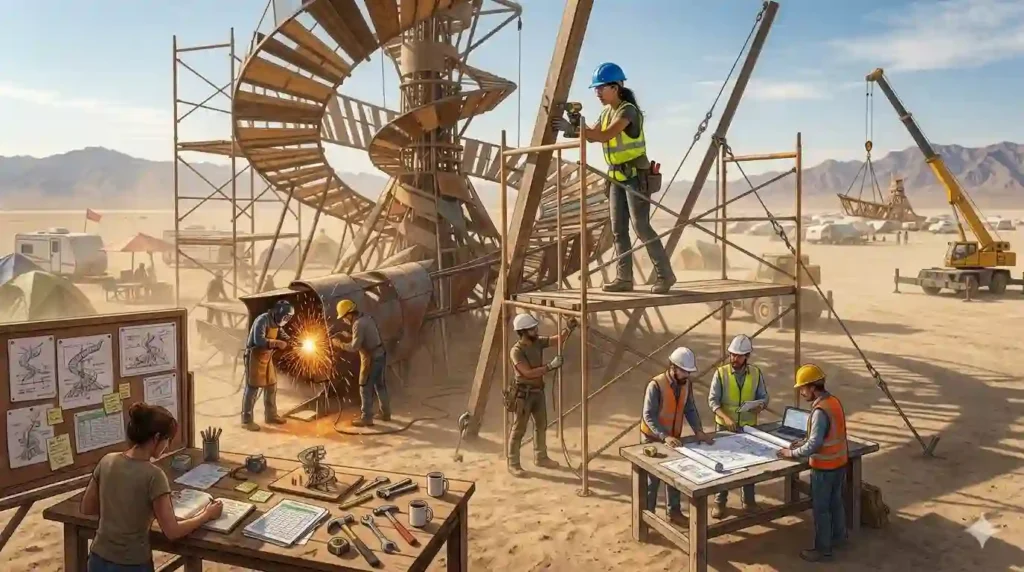
Hundreds of large-scale installations appear across the open playa each year, some rivaling public monuments in scale, before being partially or fully dismantled within a week. This guide explains how these monumental works are conceived, funded, and built. Many go on to be internationally recognized examples of temporary public art.
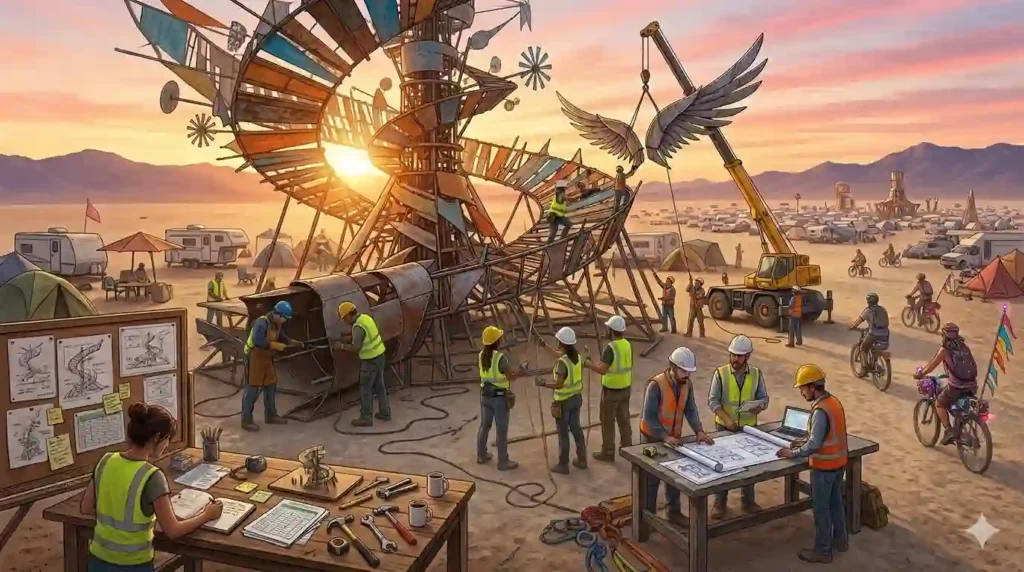
The open playa beyond Black Rock City’s residential arc — often called “deep playa” — becomes a temporary sculpture garden each year, hosting large-scale works that combine engineering, architecture, and collaborative artist labor on a scale rarely attempted outside museum-commissioned public art. Many of these pieces take months of fabrication before ever arriving in Nevada, only to be intentionally burned or otherwise dismantled within days of the event’s close — a deliberate embrace of impermanence central to Burning Man’s artistic culture.
This guide covers how large-scale installations typically come together: artist teams applying through Burning Man Project’s placement and art curation process, fundraising and community support (often supplemented by the Honoraria grant program) that helps bridge the gap between an ambitious concept and a fully realized structure, and the volunteer labor — welders, electricians, riggers, and general crew — that most large projects depend on well beyond what any single artist could build alone. It also touches on how some of Black Rock City’s most iconic past installations have gone on to be exhibited elsewhere, including museum showings, extending their life well beyond a single week in the desert.
For how these projects get funded specifically, see the Art Grants & Honoraria Guide; for the deep-playa area itself relative to the rest of the city, see the Black Rock City Map & City Guide.
In This Guide You’ll Learn
- 🏗️ What are large-scale installations?
- 🎨 Types of monumental artwork
- 👨🎨 The artists behind the sculptures
- ⚙️ Engineering & construction
- 🌅 Exploring the open playa
- 📸 Photography tips
- ❤️ Respectful exploration
- 🌍 Global artistic influence
- ♿ Accessibility considerations
- ⚠️ Visitor etiquette
What Are Art Installations at Burning Man?
Art installations are one of the most important ways Burning Man turns the playa into a living open-air museum. These works can be monumental, intimate, interactive, architectural, or purely atmospheric, but they all share one thing: they transform Black Rock City into an artistic landscape. Some installations invite direct participation, while others are meant to be walked around, photographed, or quietly experienced. Together, they shape the visual identity of the event.
Understanding Playa Art Installations
Playa art installations are large or meaningful creative works placed in the desert for the duration of Burning Man. They may be sculptures, structures, or immersive spaces, but they are always built with the event’s environment in mind. The playa becomes the canvas, and the artwork becomes part of the temporary city. That setting gives the installations their power.
Why Art Installations Define Black Rock City
Art installations help define Black Rock City because they are often the first things people remember about the landscape. They create landmarks, destinations, and shared reference points across the event. Without them, the playa would feel much emptier and less expressive. With them, the city feels like a curated world of discovery.
Temporary Art with Lasting Impact
Even though art installations are temporary, they often leave a lasting impression on visitors. The artwork disappears, but the experience remains vivid. That contrast between impermanence and memory is part of what makes Burning Man so strong as a cultural event. Temporary work can have permanent emotional impact.
Interactive vs Static Installations
Some installations invite interaction, while others are meant to be observed from a distance. Interactive pieces may encourage climbing, walking through, or activating the work, while static pieces focus on form, scale, and atmosphere. Both types matter because they offer different ways of experiencing the playa. Variety keeps the art landscape rich.
Why Every Year Brings New Artwork
Every year brings new artwork because Burning Man is built on renewal and reinvention. Artists return with fresh ideas, new materials, and different responses to the environment. That keeps the event from becoming repetitive. It also means visitors can always discover something they have never seen before.
- Art installations transform the playa into an open-air museum.
- They can be monumental, interactive, or atmospheric.
- Temporary work can still have lasting emotional impact.
- Each year brings new artwork and new experiences.
The History of Art Installations at Burning Man
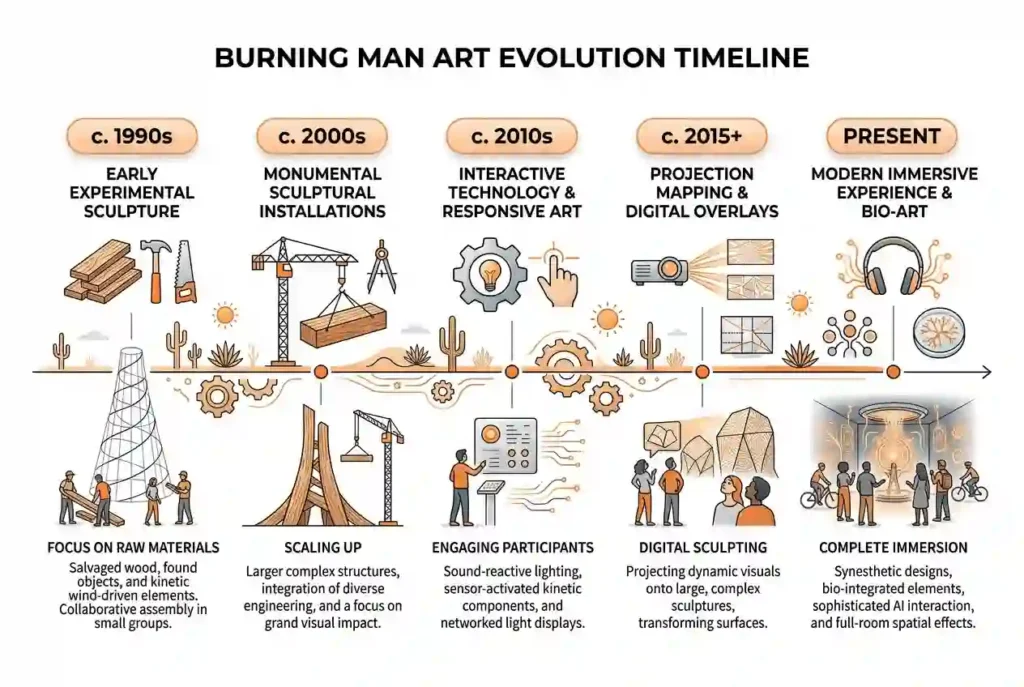
Art installations did not begin as massive landmarks right away. They grew over time as Burning Man expanded and as artists started thinking bigger about what the desert could hold. Early works were often simpler, but they established the idea that the playa could be a place for serious large-scale art. That idea changed the event permanently.
Early Playa Sculptures
Early playa sculptures were often more modest in scale, but they carried the same spirit of experimentation. Artists were testing what could survive in the desert and how people would respond to art outside a gallery. Those early works helped establish a tradition of placing art in a public, temporary environment. They were foundational.
Growth of Monumental Art
As the event grew, so did the ambition of the art. Monumental structures began appearing across the playa, turning the landscape into something much more theatrical. Size alone was not the goal, but scale became part of the experience. Large installations helped shape how people move, gather, and remember the city.
The Rise of Interactive Installations
Once artists realized that visitors could participate in the work, interactive installations became more common. That shift brought more energy into the art landscape and aligned with the event’s participatory culture. Art stopped being something only viewed from afar. It became something people could enter and help complete.
International Artists Join Burning Man
As Burning Man gained global attention, artists from outside the United States began contributing their ideas and practices. That broadened the visual language of the event and introduced new forms of expression. International participation also made the art scene more diverse. The playa became a meeting point for different artistic cultures.
Evolution Into a Global Art Movement
Over time, the scale and influence of Burning Man art installations extended beyond the event itself. The creativity, collaboration, and temporary-build model inspired artists and festivals around the world. Burning Man became part of a larger global conversation about public art and participation. The installations now matter far beyond one week in the desert.
- Early playa sculptures laid the foundation for large-scale art.
- Monumental works grew as the event expanded.
- Interactive installations changed how visitors participate.
- Burning Man art has become influential beyond the playa.
What Types of Art Installations Will You Discover?
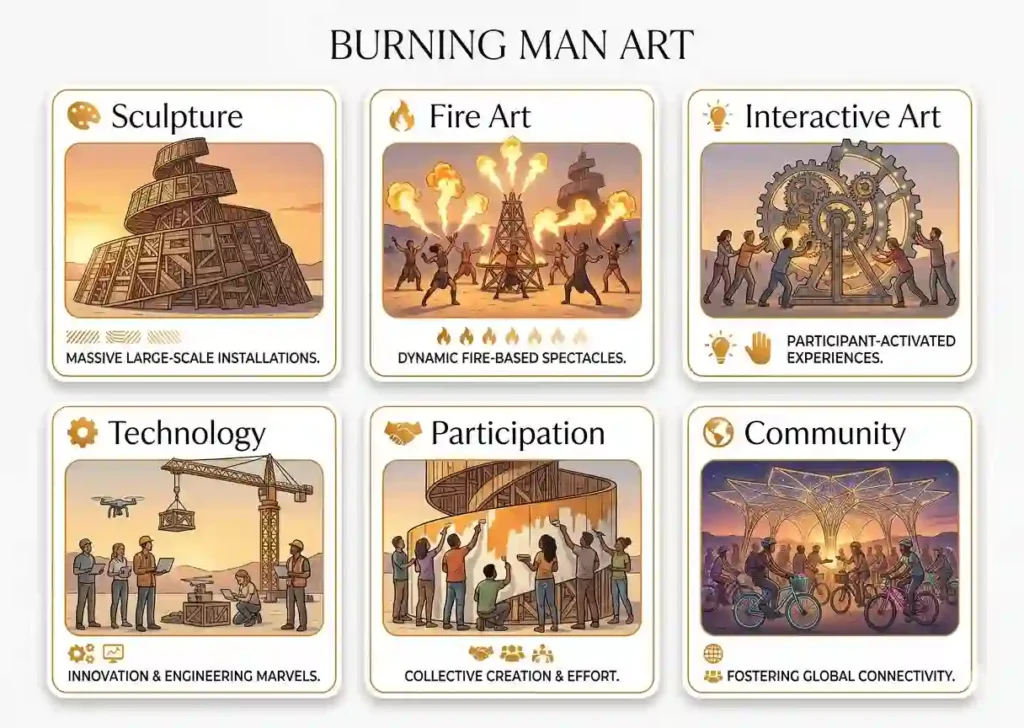
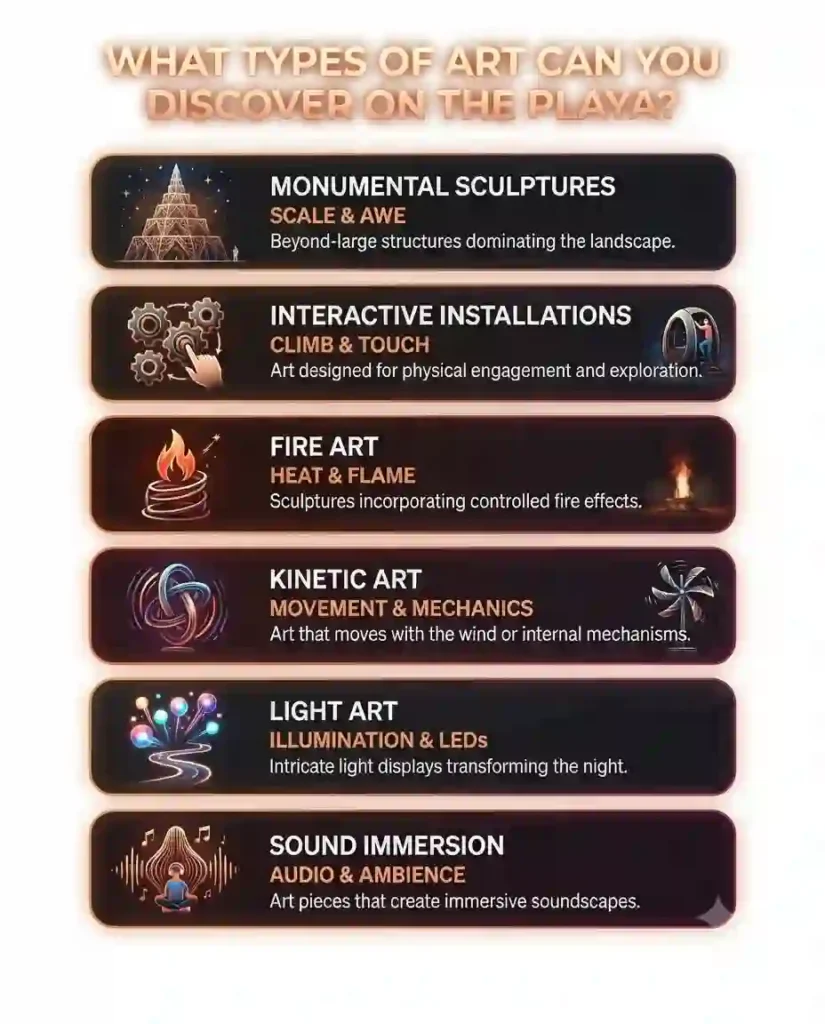
The variety of art installations at Burning Man is one of the most exciting parts of the event. You may encounter towering sculptures, glowing structures, kinetic pieces, or quiet environmental works depending on where you wander. Each type creates a different mood and a different kind of connection with the viewer. That diversity keeps the art landscape alive.
Monumental Sculptures
Monumental sculptures are among the most visually striking works on the playa because they often dominate space and shape how people move around them. They can feel symbolic, architectural, or purely sculptural. These works usually become landmarks because of their size and presence. They are hard to ignore.
Interactive Installations
Interactive installations invite visitors to touch, enter, climb, listen, or otherwise engage with the work. These pieces make the viewer part of the experience rather than just a spectator. They are especially memorable because they respond to human presence. That interaction often becomes the heart of the installation.
Architectural Art
Architectural art blurs the line between building and sculpture. These works may create rooms, passageways, shaded spaces, or entire structures that feel inhabitable. They often change how people use the environment around them. Their artistic value comes from form and function together.
Light Installations
Light installations use illumination to transform the desert after dark. They may glow softly, flash dynamically, or create a large field of visual atmosphere. At Burning Man, light can make a work feel almost otherworldly. Night often reveals a completely different version of the installation.
Sound Installations
Sound installations turn listening into part of the art experience. They may use ambient tones, rhythm, instruments, or layered audio environments to create mood and direction. Sound can make a space feel intimate even when the scale is large. That sensory quality makes these works especially immersive.
Kinetic Art
Kinetic art includes movement as part of the artwork itself. A piece might rotate, sway, shift, or animate through mechanical means or environmental response. Movement adds life to the installation and can make it feel more surprising. It also keeps the work from feeling static.
Environmental Art
Environmental art responds to the desert landscape rather than sitting against it. These works often feel rooted in place, using the playa as part of the artistic statement. They may be subtle or expansive, but they always interact with surroundings. The environment becomes part of the meaning.
Temporary Architectural Spaces
Some installations are designed as temporary spaces people can enter and spend time in. These can feel like shelters, meeting points, meditation spaces, or experiential chambers. They are often memorable because they combine art with use. That dual purpose makes them especially appealing.
- Burning Man installations range from sculptures to immersive spaces.
- Light, sound, movement, and architecture all play a role.
- Interactive works invite direct participation.
- Environmental pieces connect art with the landscape itself.
How Are Art Installations Created?
Art installations at Burning Man are the result of major creative, technical, and logistical effort. They begin as ideas, but they must be engineered to survive the desert and function in a temporary city. The process involves design, volunteers, transport, assembly, and removal. That complexity is part of what makes the finished work so impressive.
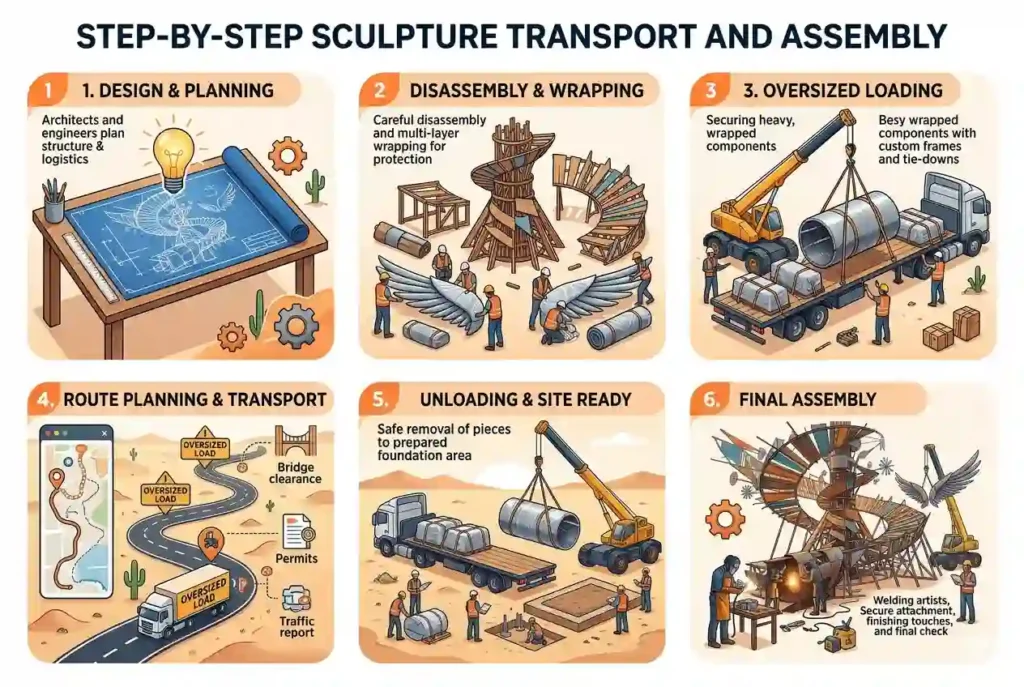
Artist Concepts
Every installation starts with an artistic concept. The artist or team imagines what the piece should express and how people should experience it. This concept drives all later decisions. A clear concept is the foundation of a successful build.
Engineering and Design
Once the concept exists, engineering and design turn the idea into something physically possible. That includes structure, materials, scale, stability, and environmental resilience. The playa is not forgiving, so the design must be realistic. Beauty alone is not enough.
Volunteer Build Teams
Many installations depend on volunteer build teams because large projects need many hands. Volunteers help with fabrication, painting, assembly, and setup. Their labor reflects the collaborative spirit of Burning Man. Without them, many pieces would never reach the playa.
Transportation to the Playa
Getting the installation to the playa can be one of the hardest parts of the process. Pieces may have to be broken into sections, packed carefully, and moved across long distances. Logistics matter because even a beautiful artwork is useless if it cannot arrive intact. Transport is part of the art’s journey.
Assembly in Black Rock City
Once on the playa, the installation must be assembled in difficult conditions. Dust, heat, wind, and time pressure all create challenges. Build crews work quickly and carefully to put everything in place. This stage is often physically demanding and emotionally intense.
Post-Event Removal
After Burning Man ends, the installation must be removed unless it is designed for another life elsewhere. That removal process is part of the event’s temporary nature. It also reflects the Leave No Trace ethic. A good installation respects both creation and cleanup.
- Installations begin as concepts and become engineered projects.
- Volunteer teams are often essential.
- Transport and assembly are major challenges.
- Removal is part of the temporary-art ethic.
How Are Art Installations Funded?
Funding is a major part of bringing art installations to life because materials, labor, transport, and technical systems all cost money. Some projects are supported through grants, while others rely on community effort or personal investment. The funding model often shapes the scale of the work. Bigger dreams usually need bigger support.
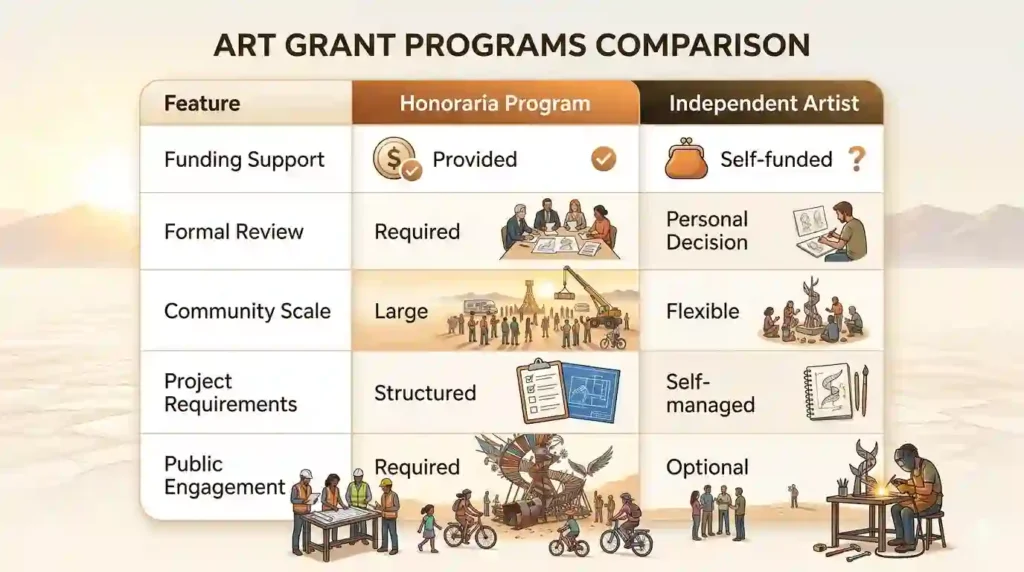
Honoraria Grants
Honoraria grants are one of the most important funding paths for major art projects. They allow selected artists to realize ambitious ideas that would otherwise be difficult to build. This support helps diversify the artwork on the playa. It also strengthens Burning Man’s commitment to public art.
Community Donations
Community donations can help fund projects when artists rely on a wider circle of supporters. Small contributions from many people can add up to something meaningful. This model also helps make the artwork feel shared before it even arrives on the playa. Support becomes part of the story.
Crowdfunding
Crowdfunding gives artists a way to involve the public directly in the creation of the work. It can be especially useful for independent or emerging creators. This approach also helps build awareness before the installation appears. The audience becomes invested in the project early.
Volunteer Contributions
Volunteer contributions matter because labor itself has value. People give time, energy, and skills to help turn a concept into reality. That contribution is often as important as money in large projects. The collaborative effort is a core part of the culture.
Artist Investment
Many artists also invest their own money or resources into the project. That personal commitment shows how much the work matters to them. It can be risky, but it often reflects deep belief in the art. Artist investment is one reason the final result can feel so personal.
- Funding comes from grants, donations, crowdfunding, volunteers, and artists themselves.
- Honoraria grants help support major public works.
- Financial and labor contributions often work together.
- Funding shape affects scale and ambition.
🛠️ Burning Man Technical Requirements Guide
| ⚙️ Requirement | 📋 Specification | 📚 Related Guide | 🎯 Purpose | ⚠️ Important Details |
|---|---|---|---|---|
| 💡 Lighting Visibility | Visible from 300 feet at night | Lighting Safety Guide | Prevent accidents & collisions | LED lighting strongly recommended for bikes, camps & art |
| 🏗️ Structural Safety | Must withstand 50+ mph desert winds | Safe Structures Handbook | Storm & wind protection | Use rebar stakes, guy lines & reinforced frames |
| ♻️ Leave No Trace (LNT) | 100% removal of all materials | Artist LNT Guide | Protect the playa environment | No trash, debris, nails, ash, or gray water left behind |
| 🔥 Fire Safety Zone | 20 ft minimum perimeter required | Fire Perimeter Rules | Prevent uncontrolled fire spread | Fire extinguishers & safety crews required nearby |
| 🔊 Sound Control | Directed speaker systems recommended | Sound Camp Guidelines | Reduce camp noise conflicts | Avoid overpowering neighboring camps late at night |
| ⚡ Generator Placement | 100 ft distance from nearby camps | Generator Safety Rules | Reduce noise & fumes | Quiet generators preferred for residential zones |
| 🚲 Night Visibility | All bikes illuminated after sunset | Bike Safety Guide | Reduce nighttime crashes | Reflective tape & wheel lights highly recommended |
| 🧊 Fuel & Flammables | Stored in sealed approved containers | Fuel Storage Guide | Prevent leaks & fire hazards | Keep fuel away from tents & direct heat |
| 🌪️ Dust Protection | Secure loose fabrics & decorations | Storm Readiness Guide | Prevent flying debris | Unexpected whiteout storms happen frequently |
🔥 Quick Insight: Burning Man technical requirements are designed to keep participants safe while protecting the desert environment and surrounding camps.
Must-See Art Installations
Some installations become especially important because they capture the scale, creativity, and emotional range of Burning Man. These are often the works visitors seek out intentionally or remember most clearly later. They may be giant, intimate, luminous, or hidden, but they all leave a mark. A strong must-see list helps readers navigate the art landscape.
Monumental Sculptures
Monumental sculptures often anchor the visual field because of their size and presence. They can feel dramatic from far away and more intricate up close. These are the kinds of works that make the playa feel vast and curated at the same time. They often become landmarks.
Interactive Landmarks
Interactive landmarks combine strong visual identity with participation. Visitors may climb, walk through, or interact with these pieces in ways that make them memorable. They are often favorites because they blend scale and experience. That combination is powerful.
Illuminated Night Installations
Night installations are especially compelling because they transform the desert after dark. Light changes scale, texture, and mood in ways daylight cannot. Some works are almost made to be discovered at night. They can feel like beacons in the open playa.
Award-Winning Projects
Award-winning projects often stand out because of craftsmanship, originality, or public impact. They may not always be the largest, but they often reveal exceptional thinking. These pieces help set a high standard for the whole art scene. Recognition usually comes from strong artistic vision.
Hidden Playa Gems
Some of the most rewarding installations are the ones people discover unexpectedly. Hidden gems may not be the most famous, but they can feel deeply personal. The surprise itself becomes part of the experience. That kind of discovery is classic Burning Man.
- Must-see installations include monumental, interactive, and illuminated works.
- Award-winning pieces show artistic excellence.
- Hidden gems can be just as memorable as famous landmarks.
- Discovery is a major part of the playa experience.
Art Installations by the Numbers
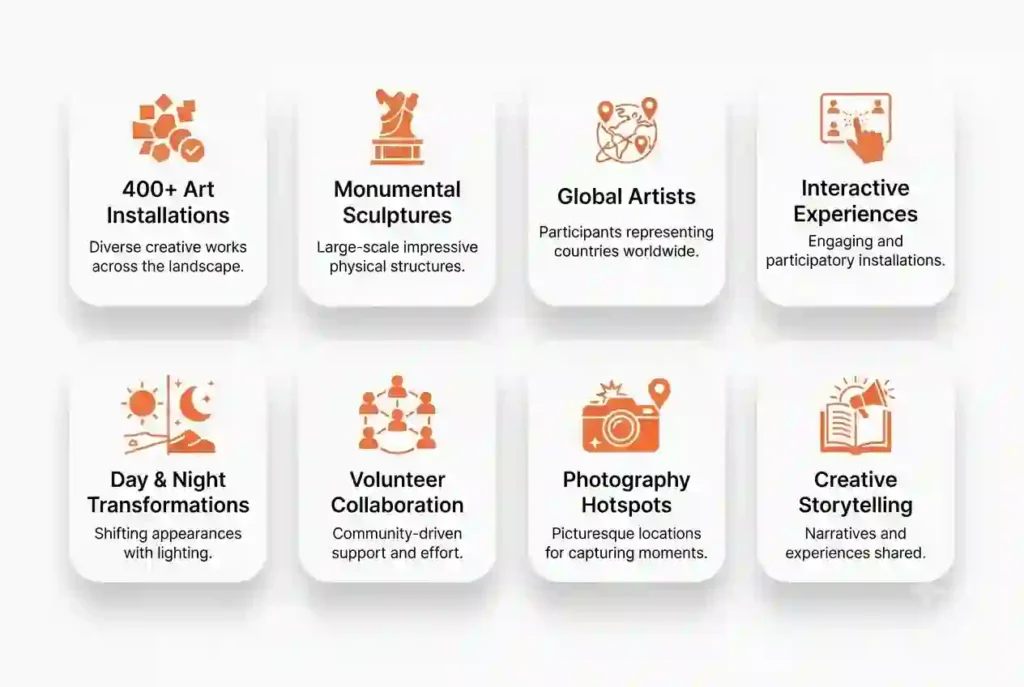
Every year, Black Rock City transforms into one of the world’s largest temporary outdoor art galleries. Monumental sculptures, immersive environments, kinetic creations, and interactive installations appear across the open playa, inviting participants to explore, touch, climb (when permitted), and become part of the artwork itself. More than 400 registered art installations typically appear each year, creating an ever-changing landscape of creativity.
The numbers behind art installations help show how much effort and scale exist behind the visual beauty. Visitors often see the final piece but not the labor, funding, or international collaboration required to build it. A numbers section makes the scope of the work easier to grasp. It also strengthens the page’s authority.
Key Numbers
- 🎨 400+ Registered Art Installations — Hundreds of artworks transform Black Rock City every year.
- 🏗️ Dozens of Monumental Sculptures — Massive works become iconic landmarks across the open playa.
- 🤝 Thousands of Artists & Volunteers — Creative teams collaborate year-round to design, build, transport, and install artworks.
- 🌍 Global Creative Community — Artists from around the world contribute installations every year.
- ⚙️ Many Interactive Experiences — Participants are encouraged to engage with artworks whenever invited by the artist.
- 🌅 New Experiences Day & Night — Sunlight, LEDs, projection, and fire effects completely transform many installations after dark.
- 📸 Countless Photo Opportunities — Art installations are among the most photographed attractions in Black Rock City.
- ❤️ Every Installation Tells a Story — Each artwork reflects unique artistic ideas, engineering, participation, and community collaboration.
How Many Installations Are Displayed Each Year?
The number of installations changes each year depending on submissions, funding, and build readiness. That variation keeps the art landscape fresh. It also means each edition of Burning Man has its own artistic personality. There is no fixed formula, which is part of the appeal.
Artists From Around the World
Burning Man attracts artists from many countries and creative backgrounds. That international participation makes the art scene more diverse and surprising. It also means the playa becomes a meeting place for different artistic traditions. The global range is part of what makes the event distinctive.
Volunteer Hours Behind the Artwork
Volunteer labor can add up to huge numbers of hours across the full build cycle. Those hours represent construction, transportation, installation, and support. They reveal how collective the event really is. The art may look effortless, but it is built through serious human effort.
Build Timelines
Many installations take months to plan and fabricate, while larger ones can require even longer. The timeline depends on scale, complexity, and resources. Long build periods often translate into more refined work. Time is part of the artistic process.
Largest Installation Dimensions
Some installations are notable simply because of their size. Their dimensions can shape sightlines, movement, and crowd behavior across the playa. Large scale is not everything, but it can create unforgettable presence. The biggest works often become orientation points for visitors.
Annual New Creations
A major reason Burning Man stays exciting is the steady stream of new creations every year. New art keeps the landscape from becoming predictable. It also gives returning visitors something fresh to discover. Reinvention is built into the event.
- Installation numbers vary each year.
- Artists come from around the world.
- Volunteer hours and build timelines are substantial.
- New creations keep the playa fresh and evolving.
How to Experience Art Installations Respectfully
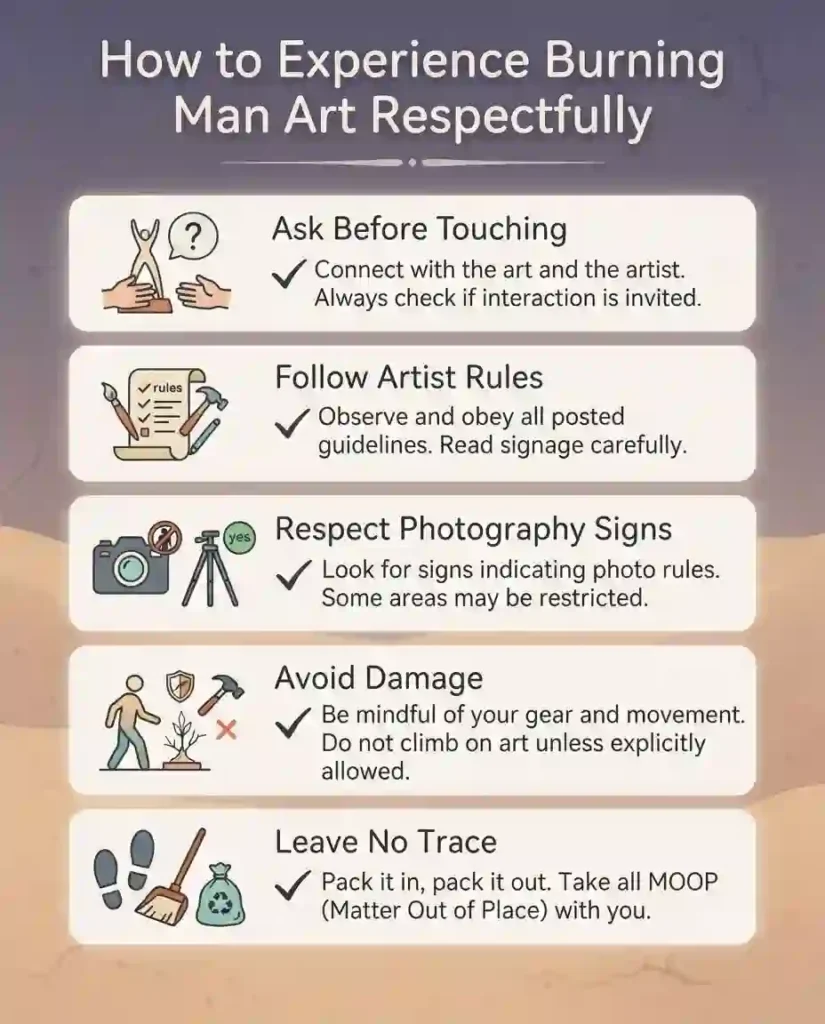
Respect is essential when experiencing art installations because these works are often fragile, temporary, and carefully placed. Visitors have a role in protecting the art, not just viewing it. The more responsibly people behave, the better the experience for everyone. Respect helps preserve the work and the culture.
Read Artist Information
Artist information helps explain what the installation is, how it should be experienced, and whether any interaction is allowed. Reading it is one of the simplest ways to behave well. It also helps you understand the meaning behind the piece. That understanding deepens the experience.
Follow Climbing Guidelines
If a piece allows climbing, there are usually specific guidelines for doing it safely. Not every structure is meant to hold weight or movement in the same way. Following the rules protects both people and the installation. Safe climbing is part of respectful participation.
Respect Safety Barriers
Safety barriers are there to protect visitors and the work itself. Crossing them without permission can create risk or damage. Barriers may seem restrictive, but they are part of the art’s operational reality. Respecting them keeps the whole environment safer.
Leave No Trace
Leave No Trace is central to Burning Man and applies directly to installations. That means not leaving trash, not damaging surfaces, and not altering the work. The goal is to enjoy the installation without harming the environment. Responsibility is part of the experience.
Appreciate Day and Night Experiences
Many installations change dramatically between daylight and night. If you only see one version, you miss part of the work. Returning after sunset often reveals new dimensions. Appreciation deepens when you view the piece more than once.
- Read artist guidance before interacting.
- Follow climbing rules and safety barriers.
- Leave No Trace around all installations.
- Day and night can reveal very different experiences.
How Does Interactive Art Work?
Wait this one seems like a duplicate from the previous guide. Since this page is about art installations, the related concept here is better handled as installation interactivity, but your outline already has the right structure. To keep the page tight, this section should focus on how installations behave physically and visually rather than repeating interactive art theory.
Mechanical and Structural Interaction
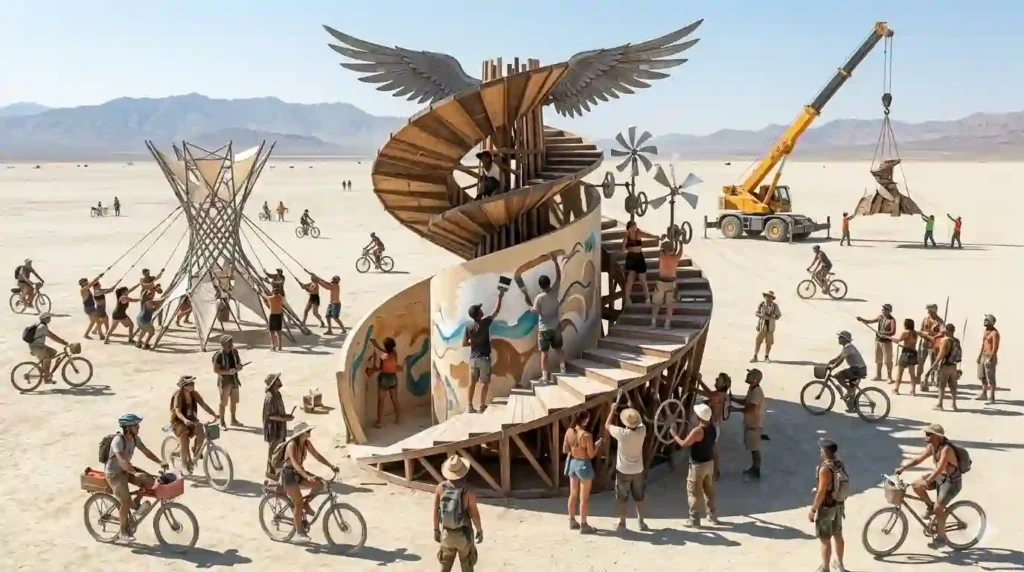
Some installations respond through movement, panels, doors, rotations, or shifting structures. These features make the piece feel active rather than fixed. Even simple mechanical behavior can make an installation memorable. Movement adds presence.
Light and Sound Elements
Light and sound often shape how an installation feels after dark. A sculpture may glow, pulse, or echo in ways that make it seem alive. Those elements can completely transform the experience. They are often the most emotionally powerful parts.
Environmental Response
Some installations change their meaning based on dust, wind, sun, or darkness. That responsiveness makes them feel connected to the playa itself. The environment becomes part of the artwork. That is one of the most compelling qualities of Burning Man art.
- Installations may move, glow, or respond to the environment.
- Light and sound often define the night experience.
- Physical and environmental interaction make the art feel alive.
Common Myths About Art Installations
Art installations are often misunderstood because people assume size or beauty tells the whole story. In reality, these works are more varied and more intentional than they first appear. Clearing up the myths helps visitors appreciate them more accurately. It also prevents false assumptions about how the art works.
H2: Art Installations Myths vs Reality
| Myth | Reality |
|---|---|
| Every artwork is funded by Burning Man. | Most installations are self-funded or community-funded, while only a limited number receive Honoraria grants. |
| Art is only for viewing. | Many installations invite participants to interact, explore, or even help complete the experience. |
| The biggest sculpture is always the best. | Small, intimate installations often leave the strongest emotional impression. |
| All art is located near The Man. | Artwork is distributed throughout the city and deep playa. |
| Art looks the same every year. | Almost every installation is newly created for each event. |
| You can climb every sculpture. | Only installations specifically designed for climbing or interaction should be touched. |
Myth: Every Installation Burns
Not every installation is designed to burn. Many are meant to be experienced, climbed, or viewed only. Burning is just one possible outcome. The category is much broader than fire.
Myth: All Art Is Interactive
Some installations are interactive, but many are static or observational. That variety matters because it gives the playa more depth. Not everything is meant to be touched. Different works ask for different kinds of attention.
Myth: Large Art Is Professionally Funded
Large art may be professionally supported, but not always in the way people assume. Some major works rely on grants, donations, volunteers, or artist investment rather than commercial backing. The funding model is often mixed. Scale does not automatically mean corporate support.
Myth: Visitors Can Modify the Artwork
Visitors should never assume they can change an installation unless the artist explicitly invites participation. These works are carefully designed and often fragile. Unauthorized modification can damage the piece. Respect for the artwork is essential.
Myth: The Biggest Installations Are Always the Best
Size can be impressive, but it does not guarantee the strongest emotional experience. Some smaller works are more thoughtful, poetic, or surprising. The best piece for one visitor may not be the largest one. Quality is more than scale.
- Not every installation burns.
- Not all art is interactive.
- Big does not automatically mean better.
- Visitors should never modify artwork without permission.
Common First-Timer Mistakes
First-time visitors often make mistakes because they try to see too much too quickly. The playa is large, and installation experiences reward patience more than speed. Learning a few common mistakes can help first-timers avoid frustration. It also makes the journey more enjoyable.
Trying to Visit Every Installation
It is tempting to try to see everything, but that often leads to exhaustion and shallow experiences. The playa is better approached with openness than with pressure. Fewer installations seen well is better than many seen in a rush. Quality matters more than quantity.
Missing Deep Playa Art
Deep playa art is easy to miss if you stay near busy routes. But some of the most impressive installations are placed farther out in the open. Not going deep means missing a major part of the event’s art landscape. The extra effort is often worth it.
Visiting Only During Daylight
Some installations only reach their full impact at night. Light changes everything. If you only explore during the day, you miss glow, shadow, and atmosphere. Night transforms the art.
Ignoring Artist Instructions
Artist instructions are there to help visitors experience the work correctly. Ignoring them can damage the installation or create safety issues. A little reading prevents a lot of problems. It also shows respect.
Forgetting Navigation
The playa can be disorienting, so it is easy to lose track of where you are. Forgetting navigation can make the art experience stressful instead of enjoyable. Knowing how to return or orient yourself helps a lot. Simple planning goes a long way.
- Do not try to see everything at once.
- Deep playa holds major discoveries.
- Day and night offer different experiences.
- Navigation and artist guidance matter.
Experienced Burner Tips
Experienced Burners know that art installations reward a slower and more intentional way of exploring. They understand that timing, repetition, and curiosity all matter. The best discoveries often happen when you stop chasing and start noticing. That mindset makes the playa much richer.
| Installation Type | Description | Best Time to Experience |
| Monumental Sculptures | Massive standalone artworks on the open playa | Day & Sunset |
| Interactive Installations | Art that invites participation | Day & Night |
| Kinetic Sculptures | Moving mechanical artworks | Day & Evening |
| Illuminated Art | LED and projection-based installations | Night |
| Fire Art | Flame-based sculptures and performances | Evening & Night |
| Immersive Environments | Walk-through artistic experiences | Any Time |
| Sound Installations | Audio-driven interactive artworks | Evening & Night |
Explore at Sunrise and Sunset
Sunrise and sunset are some of the best times to experience art installations because the light changes the whole landscape. The mood becomes softer, more dramatic, or more surreal depending on the moment. These transitions often reveal the art in a new way. Timing matters more than people realize.
Visit Installations Multiple Times
A single visit can never fully show what an installation offers. Returning at different times helps you see new details and atmospheres. The same work can feel completely different with changing light, dust, or crowd energy. Repetition deepens the experience.
Wander Beyond the Main Roads
Some of the best works are not on the most obvious paths. Wandering away from the main roads often leads to quieter, more surprising discoveries. The playa rewards curiosity. Getting slightly lost is sometimes part of the fun.
Speak With Artists
If artists are present and open to conversation, talking with them can make the installation more meaningful. They can explain the concept, construction, or inspiration behind the piece. Those conversations add human depth to the art. Respectful curiosity is always welcome.
Let Curiosity Guide You
Curiosity helps visitors discover what planning alone cannot. Sometimes the best installation is the one you did not expect to find. Letting the landscape surprise you keeps the experience alive. That is a good Burner habit.
- Sunrise and sunset are prime exploration times.
- Revisiting installations reveals more layers.
- Wandering off the main roads helps with discovery.
- Talking to artists adds depth to the experience.
Can Anyone Create an Art Installation?
Yes, many people can create an art installation if they are ready to plan, collaborate, and build responsibly. You do not need to be famous to make meaningful work. What matters is a strong concept and the willingness to work through the practical challenges. Burning Man welcomes that kind of participation.
Opportunities for First-Time Artists
First-time artists can absolutely create installations, especially if they begin with something realistic. Small or medium-scale work can still be powerful. Starting simple is often the best way to learn. Many important projects begin that way.
Working With Artist Collectives
Artist collectives can make big projects more achievable because they combine skills and effort. They also reduce the pressure on any one person. Collectives can be especially helpful for newcomers. Collaboration strengthens the work.
Finding Volunteers
Volunteers are often necessary for installation builds because the labor can be intense. A good volunteer team helps with setup, fabrication, and maintenance. Their support turns the project into a shared effort. That community aspect is part of the culture.
Funding Your Project
Funding is often the biggest challenge, especially for ambitious pieces. Artists may use grants, donations, crowdfunding, or personal investment. Good funding makes the build more realistic. It also allows for better materials and safer execution.
Applying for Honoraria Support
Honoraria support can help artists bring larger ideas to the playa. The application process exists to identify projects that contribute meaningfully to the event. For creators, this can be a major opportunity. It also strengthens the public art landscape.
- First-time artists can absolutely create installations.
- Collectives and volunteers make projects more achievable.
- Funding is a major part of the process.
- Honoraria support can help ambitious works reach the playa.
How Should You Plan an Art Exploration Route?
Planning an art route can help visitors see more without becoming overwhelmed. The playa is large enough that random wandering alone may miss key installations. A thoughtful route gives structure without taking away the sense of discovery. It makes the experience smoother and more rewarding.
How to Explore Burning Man Art Like a Pro
| Strategy | Why It Helps |
| Explore by bicycle | Reach more installations across the open playa |
| Visit at different times | Lighting and atmosphere change dramatically throughout the day |
| Read artist descriptions | Understand the story and purpose behind each piece |
| Interact respectfully | Many artworks become complete only through participant involvement |
| Venture into deep playa | Discover large-scale installations beyond the city’s central areas |
| Slow down | Some of the most meaningful artworks reveal themselves through careful observation |
Exploring by Bicycle
Bicycles are one of the best ways to explore because they let you cover more ground while still moving at a human pace. They also make it easier to stop and look closely. A bike route can connect major installations without feeling rushed. It is a very practical choice.
Daytime vs Nighttime Routes
Some installations are better during the day, while others are more powerful at night. Planning routes around both conditions helps you experience more of the art. You may want to revisit the same area twice. That strategy often pays off.
Discovering Deep Playa
Deep playa exploration usually requires more time and effort, but it often leads to some of the biggest artistic rewards. Planning for it helps you avoid missing major pieces. If you are going deep, think about daylight, distance, and energy. Preparation matters.
Finding Hidden Installations
Hidden installations can be some of the most memorable because they feel discovered rather than assigned. A route that leaves room for surprise is often more satisfying than a rigid checklist. Give yourself permission to wander. That is how some of the best moments happen.
Planning Around Events and Weather
Weather and event timing can change how you experience the art landscape. Wind, dust, and other conditions may affect visibility and access. Planning with flexibility helps reduce frustration. A good route still leaves room for change.
- Bicycle exploration is efficient and flexible.
- Day and night routes reveal different art.
- Deep playa requires planning.
- Hidden installations and weather changes reward flexible thinking.
How Art Installations Connect to the Ten Principles
Art installations are deeply connected to the Ten Principles because they are built through participation, shared effort, and public responsibility. They reflect Radical Self-Expression through creative vision and Communal Effort through collaboration. They also depend on Civic Responsibility and Leave No Trace to function in the desert. In that sense, the installations are not separate from the culture — they are one of its clearest expressions.
Radical Self-Expression
Artists use installations to express ideas, emotions, and aesthetics in a very personal way. The playa gives them space to make that expression large and public. That makes the principle visible in physical form. The art becomes a statement.
Participation
Many installations invite the audience to interact, move, or contribute. That participation turns visitors into part of the work. It reflects the principle that Burning Man is something people do together. Art becomes a shared act.
Civic Responsibility
Large public works require safety, access, and care for the surrounding environment. Civic Responsibility shows up in how artists manage those obligations. The best installations are beautiful and responsible at the same time. That balance matters.
Communal Effort
Installations are often built by teams, volunteers, donors, and supporters rather than by a single creator alone. That collective labor is a direct expression of Communal Effort. The artwork becomes a shared achievement. The people behind it are part of the story.
Leave No Trace
Because the playa is fragile, art installation teams must plan for removal and cleanup. Leave No Trace is not optional; it is fundamental. This principle shapes the entire lifecycle of the artwork. The art is temporary, but the ethic lasts.
- Installations express Radical Self-Expression.
- Participation is central to many works.
- Civic Responsibility and Leave No Trace are essential.
- Communal Effort is built into how the art gets made.
Art Installation Explorer Checklist
A checklist helps visitors experience art installations more thoughtfully. It also prevents common mistakes and keeps the journey enjoyable. The goal is to be prepared without becoming rigid. Good exploration is both intentional and open.
Before Exploring
Before you start, decide how you want to explore and what areas you want to prioritize. Make sure your bike, lighting, water, and navigation plan are ready. Preparation keeps the experience smooth. It also frees you to enjoy the art more fully.
During the Day
During daylight, focus on scale, structure, and detail. You can see craftsmanship more clearly and understand the layout of the installation. Daytime is good for orientation and visual study. It is also a smart time to revisit places later at night.
Night Exploration
At night, pay attention to lighting, atmosphere, and crowd flow. The same installation can feel completely transformed after dark. Move carefully and stay visible. Night often reveals the most memorable version of the work.
Photography & Respect
If you take photos, do so without blocking others or disturbing the installation. Respect the artist’s rules, and do not climb or touch for the sake of a shot. Good photos come from thoughtful engagement. Respect matters more than the picture.
- Prepare before exploring.
- Use daylight for structure and night for atmosphere.
- Be careful with photography.
- Respect the installation and the people around it.
Art Installation Checklist
Before Exploring
✅ Download the official art map
✅ Bring plenty of water
✅ Carry a camera or phone
✅ Wear comfortable walking shoes
While Exploring
✅ Read artist information signs
✅ Interact only when invited
✅ Respect artwork boundaries
✅ Ask permission before photographing people
Night Exploration
✅ Equip your bicycle with lights
✅ Carry a flashlight or headlamp
✅ Wear reflective clothing
✅ Explore slowly and safely
Before Leaving
✅ Leave no trace
✅ Never damage artwork
✅ Thank artists if they’re present
✅ Share your experience respectfully
Frequently Asked Questions About Art Installations
More than 400 registered art installations typically appear across Black Rock City each year
No. Some are designed for observation only, while others encourage climbing, touching, or active participation.
Yes. Anyone may register eligible artwork that follows Burning Man’s art installation guidelines.
No. Once you’re at Burning Man, all public art installations are free to experience.
Many monumental artworks are placed on the open playa, while others appear in plazas and throughout Black Rock City.
Only when the artist has designed the installation for interaction or clearly indicates that touching is welcome.
Visit during both daylight and after dark, as many artworks change dramatically with lighting, projection, or fire effects.
Yes. Temporary installations are dismantled after the event, while some artworks later appear in museums, public spaces, or exhibitions.
Only visiting famous landmarks and missing the hundreds of smaller artworks scattered across the playa.
Yes. Many artists recruit volunteers before and during the event to help fabricate, transport, install, and maintain their projects.
They combine large-scale creativity, participant interaction, temporary design, and community collaboration in one of the world’s most unusual outdoor environments.
- Installation counts vary each year.
- Climbing and interaction depend on the artwork.
- Funding comes from multiple sources.
- Most works are temporary and removed after the event.
Where Should You Go Next?
| If You Want To… | Read This Guide |
| Learn how projects are funded | → Art Grants & Honoraria Guide |
| Explore interactive art | → Interactive Art Guide |
| Discover fire sculptures | → Fire Art Guide |
| Learn about creative technology | → Technology & Innovation Guide |
| Explore Burning Man art | → Burning Man Art Guide |
Why Trust This Guide?
✅ Links to related art resources.
✅ Updated for the 2026 Burning Man season.
✅ Focuses specifically on monumental playa installations.
✅ Explains artistic, architectural, and engineering aspects.
✅ Suitable for photographers, artists, and first-time visitors.
Art Installation Pro Tips
🎨 Explore beyond the famous landmarks to discover hidden artistic gems.
🌅 Visit installations at sunrise, sunset, and nighttime for completely different experiences.
🚲 Use your bicycle to reach distant artworks across the open playa.
📸 Photograph both the artwork and the surrounding landscape for dramatic compositions.
🤝 Talk with artists when they’re available—you’ll often gain insights that transform the experience.
🗺️ Follow the official art map but leave time for spontaneous discoveries.
❤️ Some of the most memorable installations are the smallest and least crowded.
🌍 Remember that every installation is a gift created for the community rather than a commercial exhibition.
Conclusion
Art installations make Black Rock City feel like an open-air museum built for discovery, participation, and transformation. Each installation tells a different story, whether it is monumental, intimate, static, or interactive. Together, they show how much creativity lives across the playa. They are one of the clearest reasons Burning Man feels larger than a festival.
Art Installations Make Black Rock City an Open-Air Museum
The playa becomes a gallery without walls because installations shape the landscape all around you. That makes the experience immersive from the moment you arrive. Art is not separate from the city — it is part of it.
Every Installation Tells a Different Story
Some works focus on scale, others on emotion, and others on interaction. That variety keeps the art landscape rich and surprising. No two installations have to do the same job.
Creativity Lives in Every Corner of the Playa
The strength of Burning Man’s art scene is that it spreads creativity across the entire event. You can find meaning in major landmarks and small discoveries alike. That wide presence is what makes the playa feel alive.
Final Thoughts
The best way to experience art installations is to stay curious, move slowly, and let the landscape surprise you. Visit at different times, talk to artists when possible, and keep room for unexpected discoveries. After this, readers can continue into the Burning Man Art Guide, The Man Guide, Temple Guide, Mutant Vehicles Guide, Fire Art Guide, Interactive Art Guide, Art Grants & Honoraria Guide, and Technology & Innovation Guide.
- 🏗️ Explore widely across the playa.
- 🌅 Visit during different times of day.
- ❤️ Respect every installation.
- 📸 Photograph thoughtfully.
- 🤝 Appreciate the artists’ work.
- ♿ Respect accessibility needs.
- 🌱 Leave No Trace.
- 📖 Continue with the Art Grants & Honoraria Guide to learn how many of these incredible projects become reality.
Keep Exploring the Ever-Changing Art of Burning Man
The art installations are only one part of a much larger creative ecosystem. But they are one of the best places to feel how the playa transforms into a living artwork.