
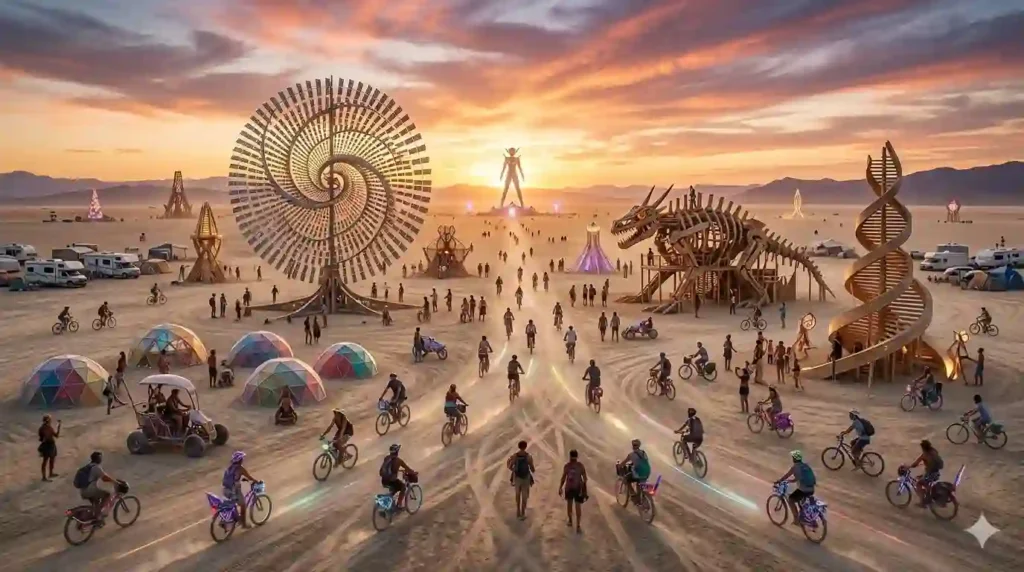
Burning Man Art & Technology Guide 2026: Explore the Creativity, Installations, & Artistic Culture of Black Rock City
Art is the heart of Burning Man, transforming the Black Rock Desert into one of the world’s largest open-air creative exhibitions. This guide introduces the people, installations, sculptures, vehicles, technology, and artistic traditions that make Burning Man one of the most unique cultural events on Earth.
Burning Man is internationally recognized for its art, and the scale is genuinely difficult to grasp secondhand: hundreds of large installations, sculptures, and interactive works appear across the open playa each year, most of them existing for only a single week before being partially or entirely destroyed by fire, weather, or intentional burning. Unlike a museum, where a barrier separates viewer from artwork, Burning Man actively encourages participants to touch, climb into, modify, or otherwise become part of the pieces themselves — a direct expression of the event’s Participation principle.
This guide introduces the major categories you’ll encounter: The Man, the effigy the event is named after and ritually burned near the close of the week; the Temple, a non-denominational space for remembrance built anew each year since artist David Best’s original 2000 structure; mutant vehicles, licensed art cars that serve as the city’s only legal motorized transport; fire art and pyrotechnic performances that transform the playa after dark; interactive and participatory installations; and the large-scale sculptural works that have become some of Burning Man’s most internationally recognized pieces.
Many of these projects receive partial funding through Burning Man Project’s Honoraria grant program, though most rely heavily on artist fundraising, volunteer labor, and community donations.
Rather than covering every artwork in exhaustive detail, this pillar page introduces each category and links to a dedicated guide — on The Man, the Temple, mutant vehicles, fire art, interactive art, large installations, and the grants that help fund them — for readers who want to go deeper into any one topic.
In This Guide You’ll Learn
- 🎨 Burning Man’s artistic culture
- 🔥 The Man
- 🛕 The Temple
- 🚗 Mutant vehicles
- 🔥 Fire art
- 🎭 Interactive experiences
- 🏗️ Large-scale art installations
- 💰 Art grants & artist funding
- 🤖 Technology & innovation
- 🌉 Silicon Valley’s influence on Burning Man
What Makes Burning Man One of the World’s Greatest Outdoor Art Experiences?
A quick look at the defining qualities that set Burning Man apart scale, participation, impermanence, and a non-commercial ethos and how those elements combine to create a unique outdoor art culture.
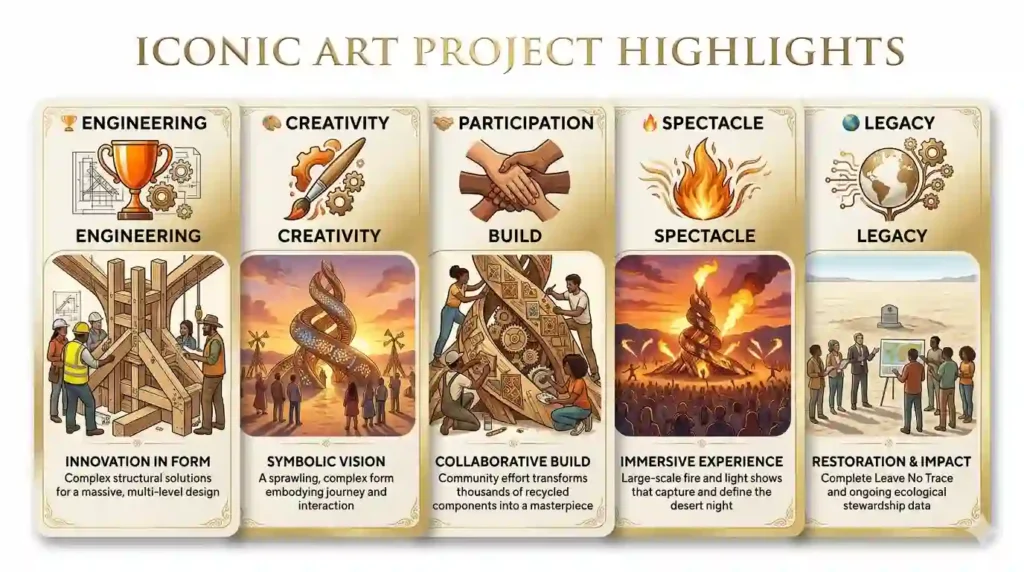
Art Is the Heart of Black Rock City
Art is the single most visible expression of Burning Man’s values; large-scale sculpture, temporary architecture, and interactive installations physically shape both the skyline and the social rhythms of the playa. From the moment you enter the event, art determines sightlines, meeting points, and the flow of movement massive forms anchor the horizon while smaller works create pockets of intimacy between theme camps.
Beyond aesthetics, art serves as a catalyst for conversation, collaboration, and personal transformation: it provides shared experiences that spark storytelling, ritual, and community-making. Artists bring varied intents from political commentary to playful experimentation and the diversity of voices on the playa is one reason visitors describe the event as an art experience like no other.
- Art structures both physical space and social interaction.
- Works range from monumental to intimate and create meeting points.
- Artistic diversity fuels conversation and transformation.
Participation Instead of Spectatorship
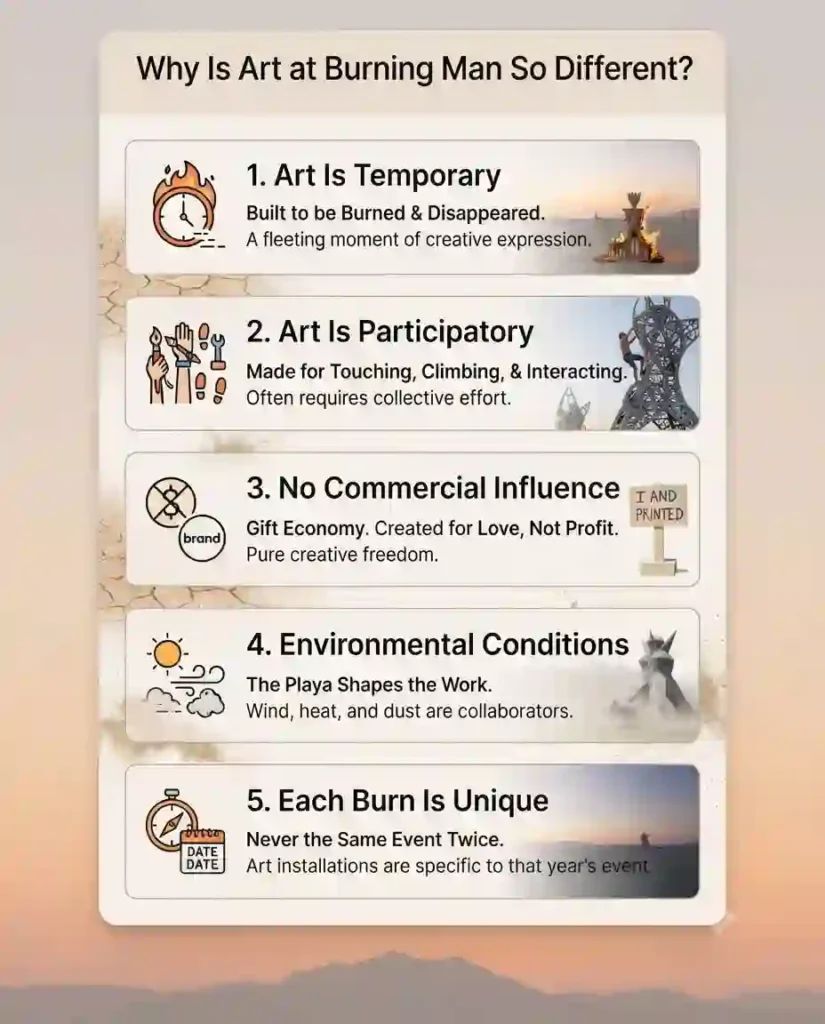
Participation is a deliberate cultural shift away from passive consumption toward active engagement. Many installations are designed to be touched, entered, or altered; artists often expect and plan for audience contributions. This can take many forms: adding a written note to a community shrine, cycling to power a light sculpture, or stepping into a role within a performance piece.
Participation also means responsibility participants are asked to act with care, follow signage, and honor artist guidelines so that co-creation is safe and respectful. This ethos transforms the audience into a co-author of the artwork’s meaning, ensuring that each interaction changes the piece in small or significant ways and that the artwork’s story continues after the event.
- Attendees are invited to actively engage and co-create.
- Interaction ranges from subtle contributions to major participatory roles.
- Participation requires responsibility and respect for boundaries.
Why Almost Every Artwork Is Temporary
Temporality is woven into Burning Man’s artistic logic. Creating temporary works reduces the long-term environmental footprint, encourages daring experimentation, and mirrors rituals of creation and release found in many cultures. Temporary art allows artists to take risks—experimenting with scale, materials, and forms they might not attempt in permanent public contexts.
The knowledge that a piece will be dismantled, recycled, or burned shapes how it’s conceived, constructed, and experienced: there’s an urgency to interact fully in the present moment. Practically, the harsh playa environment dust, wind, temperature swings also makes permanence impractical; materials degrade quickly, and leaving durable structures behind conflicts with Leave No Trace principles.
Section end summary:
- Ephemerality supports experimentation and reduces long-term impact.
- Knowing pieces are temporary encourages present-moment engagement.
- Playa conditions and Leave No Trace enforce practical temporality.
Art Without Commercial Sponsorship
A defining feature of Burning Man art is its separation from commercial interests. The event’s principles explicitly discourage branding, advertising, and corporate sponsorship in ways that would influence creative intent. This constraint protects artistic autonomy and keeps interactions between artists and participants free of commercial exchange.
Funding still exists via honoraria, grants, crowdfunding, and community patronage but it flows through mechanisms that preserve creative control and align with the event’s cultural values. The absence of visible branding allows artists to take conceptual risks and keeps the playa a place where creativity isn’t shaped by marketing metrics or product placement.
Section end summary:
- Commercial branding is discouraged to protect artistic freedom.
- Funding comes from grants, donations, and community support instead.
- Non-commercial rules preserve authenticity and experimental risk-taking.
Creativity as a Community Experience
Creativity at Burning Man is rarely solitary. Even solo projects often rely on volunteers, logistics teams, and camp networks for fabrication, transport, and installation. Theme camps, maker collectives, and volunteers supply skills from welding and carpentry to electronics and rigging so artists can scale their ideas beyond what an individual could manage alone.
This collaborative process builds social capital: contributors gain skills, form relationships, and share the pride of seeing a vision realized on the playa. Community-based creation also broadens access to artmaking by distributing expertise and resources across networks, allowing more experimental and larger-scale works to exist than would be possible in isolation.
Section end summary:
- Most projects rely on collaborative networks and volunteer labor.
- Shared resources make ambitious projects feasible.
- Collaboration produces both artworks and social bonds.
The Burning Man Creative Ecosystem
Caption: Infographic showing relationships among artists, funders, volunteers, theme camps, infrastructure teams, and audiences; useful as a hero visual to frame the guide.
Why Is Art So Important at Burning Man?
This section explains the social, environmental, and experiential reasons art is central to the event, and how the playa’s setting amplifies creative choices.
Is Burning Man an Art Festival?
Burning Man shares surface similarities with art festivals public displays, curated pieces, and timed events but it functions differently in intent and structure. Unlike conventional festivals that often center curated exhibitions and commercial sponsorships, Burning Man emphasizes participant-generated content, civic responsibility, and experimentation as community practice.
While some organized programs and large commissioned works create curated moments, the majority of artistic expression is decentralized and emergent. This makes Burning Man less a festival curated by gatekeepers and more a city-sized co-created exhibition where the line between artist and audience is intentionally porous.
Section end summary:
- Similar to festivals in public art but differs in participation and governance.
- Emphasis is on decentralized creation rather than curated commercial shows.
- The event operates as a temporary social ecosystem rather than a traditional festival.
Why Is Art Created in the Desert?
The physical qualities of the Black Rock Desert wide horizons, flat playa, intense sunlight, and dramatic sunsets encourage boldness in scale and simplicity of form. Artists use the openness to execute works that rely on long sightlines and unencumbered space, producing pieces that read visually from great distances.
The environment imposes constraints too: wind loads, dust infiltration, and thermal shock force pragmatic design choices about materials and anchoring. Many works intentionally respond to the desert’s elemental qualities moving with the wind, reflecting sunlight, or producing sounds that interact with the vast acoustic field. The setting also creates a psychological blank slate: far from urban cues, visitors are more open to wonder and reinterpretation.
Section end summary:
- The playa’s open, stark terrain enables large-scale, long-sightline works.
- Environmentally-driven constraints shape materials and engineering.
- The desert invites psychological openness and sensory recalibration.
Who Pays for the Artwork?
Funding is usually a mix of artist investment, community fundraising, honoraria grants from Burning Man’s art program, and crowdfunding campaigns. Artists often bootstrap early stages prototyping, design, and small fabrication with private funds or maker-space resources before seeking larger funds.
Crowdfunding and community patronage help cover shipping, fabrication materials, and on-playa logistics; many projects run multi-channel campaigns combining Patreon-style support, one-time donations, and benefit events. Burning Man’s honoraria program offers selected grants that reduce risk and validate projects, but most artists still assemble a patchwork budget that relies heavily on volunteer labor and in-kind donations to make ambitious works feasible.
- Funding mixes personal investment, donations, crowdfunding, and honoraria.
- Artists often combine money with volunteer labor and in-kind support.
- Grants help but rarely cover full costs for large projects.
Can Anyone Build Art at Burning Man?
Yes, with conditions. Burning Man’s culture values openness, but safely building and installing art on playa requires planning, registration, and compliance with structural and fire safety rules. Small, non-hazardous pieces can often be brought with minimal bureaucracy, but anything with mass, height, moving parts, or fire requires engineering reviews, permits, and coordination with infrastructure teams.
New artists are encouraged to partner with experienced builders or camps to learn best practices and avoid costly mistakes. The organization provides resources and community forums for first-timers, and many experienced groups welcome mentorship and collaboration to help newcomers succeed.
Section end summary:
- Open to all, but large or hazardous projects need permits and safety compliance.
- Partnering with experienced teams reduces risk.
- Community resources and mentorship support newcomers.
Why Does Burning Man Celebrate Temporary Art?
The celebration of temporary art is both symbolic and practical. Symbolically, burning and dismantling works embody cycles of creation, release, and rebirth that offer communal catharsis. Practically, temporary works allow the playa to renew each year, making space for new ideas and participants.
Temporality also reduces the ethical dilemmas around public ownership and long-term stewardship; instead of expecting communities to maintain public sculptures indefinitely, creators accept the work’s lifecycle and plan for responsible teardown, recycling, or ritualized burning. This cycle reinforces humility and impermanence as cultural values and encourages artistic risk-taking that would be harder to justify for permanent public installations.
- Burning and dismantling hold ritual and renewal value.
- Temporality supports ethical land use and annual renewal.
- It encourages experimentation by lowering permanence obligations.
How Does Art Shape Black Rock City?
Overview of how sculptures, installations, and temporary architecture organize space, movement, and social life across the city and create distinct neighborhood dynamics.
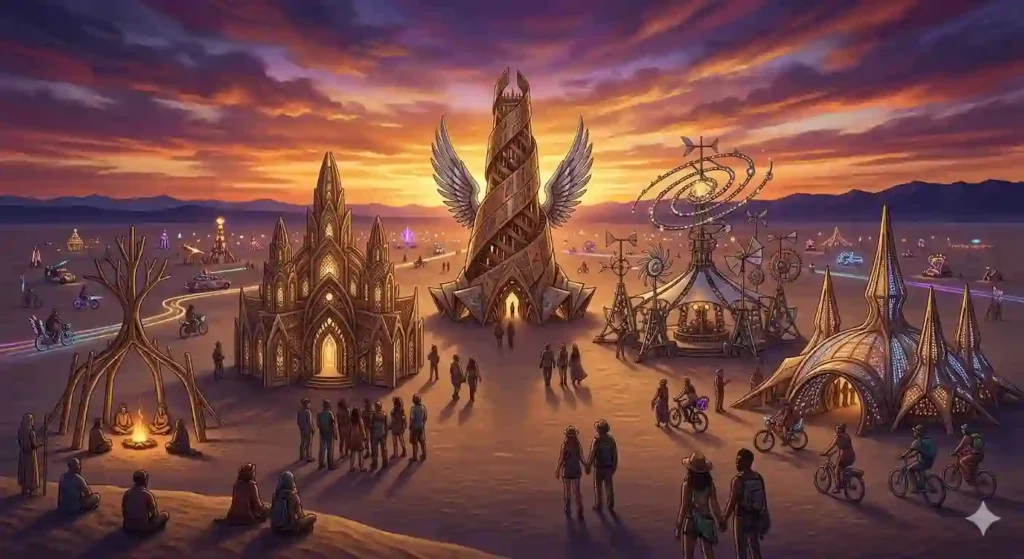
Monumental Sculptures Across the Playa
Monumental sculptures draw crowds, anchor rituals, and serve as visual beacons across the flat playa. These works are often engineered to last a single season while withstanding wind and human interaction; their scale and placement are chosen to create sightlines that can be viewed from multiple axes.
Monumental pieces also function as community hubs—people gather for performances, talks, and impromptu rituals around them. Their sheer size changes how people navigate the city: they provide landmarks, meeting points, and orientation cues, making them integral to both the urban fabric and the festival’s social choreography.
- Large sculptures serve as landmarks and social hubs.
- Engineering ensures stability in extreme conditions.
- Placement shapes navigation and communal gathering.
Interactive Art Experiences
Interactive works range from gentle participatory elements plaque-writing walls and wind-activated chimes to complex, sensor-driven installations that respond to touch, sound, or movement. Some projects require learning a simple ritual to unlock new behaviors; others invite collaboration, such as building a collective sculpture during the event.
The best interactive art balances accessibility (so newcomers can join) with depth (so repeat visits reveal new layers). This dynamic fosters ongoing engagement, as installations evolve with each participant’s actions and the cumulative effect of many small interactions creates emergent behaviors the artist often could not predict.
- Interactivity spans simple contributions to complex sensor-driven systems.
- Successful pieces balance accessibility and depth.
- Participant actions shape the artwork’s evolving behavior.
Temporary Architecture
Temporary architecture includes shade structures, art pavilions, and functional builds (kitchens, stages, camps) that double as aesthetic statements. Designers must meet practical needs—wind resistance, ventilation, and shelter from solar heat—while integrating visual concepts.
Some structures serve purely social functions, like hospitality and workshops; others deliberately blur the line between shelter and sculpture, offering immersive environments that alter social dynamics. Temporary architecture is where engineering, comfort, and play converge, producing sites where people linger, exchange skills, and form micro-communities.
- Temporary architecture provides shelter and social spaces that are also art.
- Design balances comfort, durability, and visual intent.
- These structures foster lingering and micro-community formation.
Neighborhood Creativity
Theme camps and neighborhoods create clusters of activity and identity within Black Rock City. Each camp curates its own vibe through décor, programming, and hospitality contributing to a patchwork of micro-cultures across the city. Some camps center around performing arts; others create interactive galleries, healing spaces, or themed hospitality.
This neighbor-hooded distribution allows visitors to navigate diverse experiences without centralized programming: you can follow a route of tactile workshops one block and encounter a late-night performance the next. Camps often collaborate, forming alliances for larger events and shared infrastructure that amplify creative reach.
Section end summary:
- Camps form creative neighborhoods with distinct identities.
- Neighborhoods enable varied, distributed programming across the city.
- Collaboration across camps supports larger-scale events and infrastructure.
Art During the Day and Night
Art at Burning Man undergoes a rapid metamorphosis between day and night. Daylight reveals form, texture, and engineering details—materials, joints, and shadow play while night illuminates light-based art, projection mapping, and fire performances that transform the same forms into glowing, kinetic spectacles.
Some works are intentionally dual-natured, built to be low-key by day and spectacular by night; others rely exclusively on darkness to activate their effects. For a full appreciation, visitors should plan to see major pieces in both conditions since each reveals different aspects of design intent and participant reaction.
Section end summary:
- Daytime emphasizes form and physical interaction; night emphasizes light and spectacle.
- Many works have distinct day/night personalities.
- Revisit installations at different times for complete experience.
Visual #2
Where Art Lives Across Black Rock City
Caption: Map-style diagram marking core zones—Esplanade, Center Camp, Deep Playa, theme camp rows—with examples of typical art types found in each zone.
Meet the Iconic Symbols of Burning Man
A brief orientation to the event’s most recognizable symbols the Man, the Temple, mutant vehicles, and fire art and what each represents in ritual and community practice.
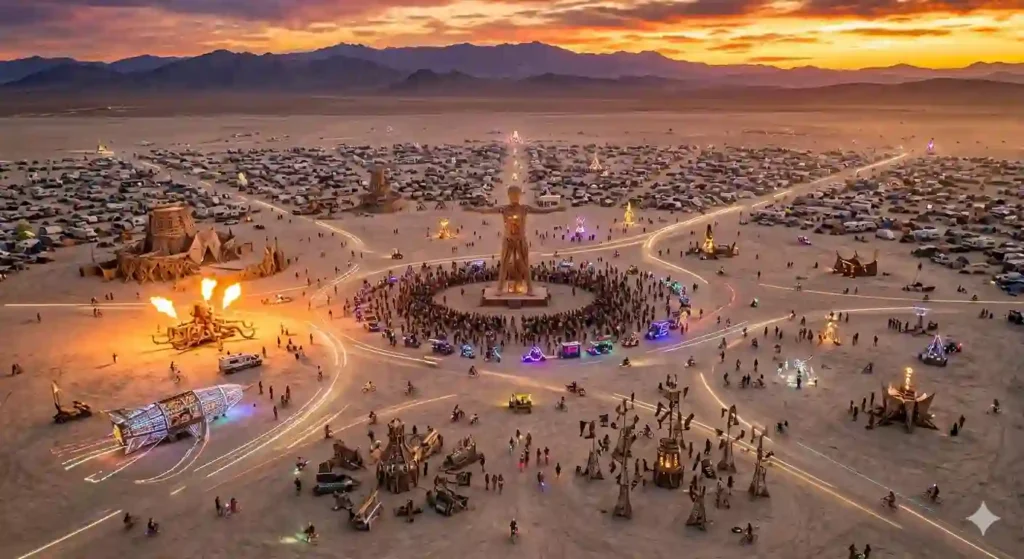
🔥 The Man
The Man is the event’s central icon and ritual focal point; its annual burn is a landmark communal event that combines performance, ritual, and spectacle. While the Man’s form and surrounding programming evolve yearly, its symbolic role as a temporary altar for celebration and release remains constant.
The area around the Man becomes a social and logistical hub stages, performances, and processions radiate outward and the burn night requires careful crowd management and safety protocols. For detailed history, construction techniques, and onsite etiquette, see the dedicated Man Guide.
Section end summary:
- The Man is the central ceremonial symbol and gathering focal point.
- Annual burn involves complex programming and safety coordination.
- See The Man Guide for rituals, design, and viewing tips.
🛕 The Temple
The Temple serves as a quiet counterpoint to the Man: a contemplative, often solemn space where participants memorialize loss, leave offerings, and engage in private rituals. Its architecture emphasizes atmosphere and intimacy, and the Temple burn is typically a more reflective, communal act of closure.
Visitors are expected to treat the Temple with reverence unlike more playful areas of the playa, the Temple often has explicit rules about photography and noise. The Temple Guide covers design considerations, respectful behavior, and personal stories that illustrate its deep emotional resonance for many attendees.
Section end summary:
- The Temple is a reflective space for remembrance and closure.
- Etiquette prioritizes quiet, respect, and often restricted photography.
- Temple Guide explores design, rituals, and etiquette in depth.
🚗 Mutant Vehicles
Mutant vehicles are mobile art vehicles that traverse the playa bringing surprise, performance, and kinetic spectacle. They range from small, weirdly-decorated bicycles to heavily engineered, street-legal-turned-playa artworks that require thorough safety inspections and licensing to operate.
Operators must follow strict rules for speed, headlights, and passenger safety; the Mutant Vehicles Guide explains the permitting process, build tips, and operational etiquette. Mutant vehicles animate the city by creating moving points of interest; encountering one is often a spontaneous highlight of a playa day.
Section end summary:
- Mutant vehicles are mobile sculptures with strict safety and permitting rules.
- They create surprise and activate the streets of Black Rock City.
- The Mutant Vehicles Guide provides build and operation guidance.
🔥 Fire Art
Fire art ranging from sculptural burners to choreographed performances adds primal, high-energy moments to the playa. Fire-based works require rigorous safety planning: designated burn permits, trained flame attendants, fire extinguishers, and perimeter controls.
The dramatic sensory impact of fire heat, light, and sound makes it a powerful symbol and communal focal point, but also a high-risk medium. Artists working with fire balance spectacle with safety protocols and community expectations; the Fire Art Guide details planning, permitting, and how to safely view or participate in flame-based artworks.
- Fire art offers intense spectacle but requires strict safety measures.
- Permits and trained attendants are often mandatory.
- Fire Art Guide covers safety, viewing, and participation rules.
Visual #3
Icons of Burning Man
Caption: Four-card visual featuring The Man, The Temple, Mutant Vehicles, and Fire Art with brief descriptors and links to each guide.
What Types of Art Will You Discover?
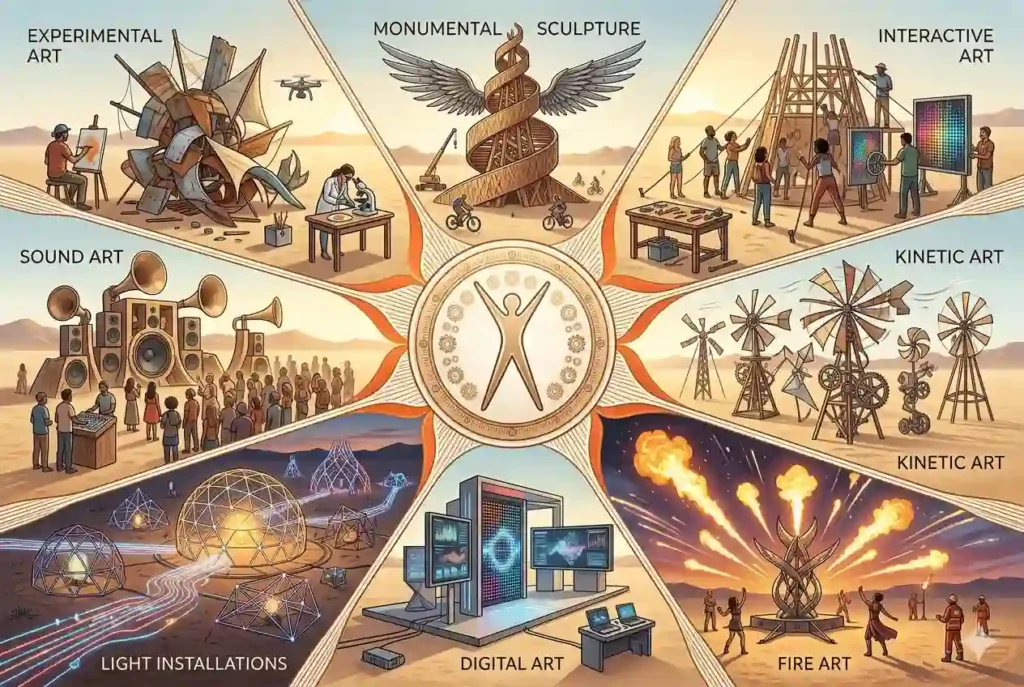
A concise primer on the major art genres you’ll encounter on playa monumental sculpture, interactive works, light and kinetic pieces, performance, and mobile art.
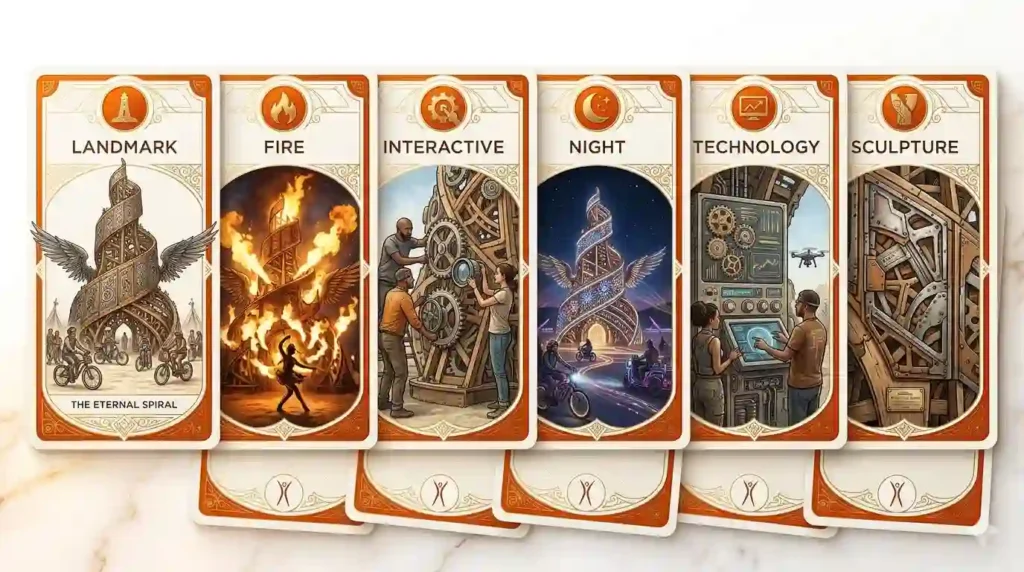
Monumental Sculptures
Monumental sculptures are visually dominant works that define the skyline and invite gatherings. Artists often use steel, wood, and composite materials engineered to withstand harsh weather and repeated interaction.
These pieces can be figurative, abstract, or narrative-driven and are frequently accompanied by programming talks, performances, and participatory events that activate the sculpture beyond its physical presence. Because of their size, monumental works require careful transport and assembly plans and often enlist a network of volunteers and tradespeople to install safely on playa.
Section end summary:
- Monumental pieces dominate sightlines and require careful engineering.
- Materials and assembly plans prioritize durability and safety.
- These works often feature programmed events that enhance engagement.
Interactive Installations
Interactive installations invite visitors to become part of the artwork, sometimes changing the piece’s state or narrative. These installations can be low-tech mechanical puzzles, collaborative mural walls or high-tech sensor arrays, networked lights, and responsive soundscapes.
Successful interactive art provides clear affordances and instructions so newcomers can participate confidently while offering deeper mechanics for repeat visitors. Artists must design for varied audiences, accounting for safety, accessibility, and the unpredictable ways participants might use the work.
Section end summary:
- Interactive works range from tactile to tech-enabled.
- Clear affordances and safety make interaction welcoming.
- Designers anticipate unpredictable use and plan accordingly.
Fire Art
Fire art at Burning Man appears in sculptures, controlled burns, and choreographed performances that combine flame with music and movement. Artists choose fire for its immediate emotional impact and its long history in ritual and celebration. Workable fire art balances spectacle and retention of control proper fuel management, fireproofing, and trained crew are non-negotiable. For spectators, the flame’s draw is visceral; for creators, fire offers a medium that demands respect and meticulous planning.
Section end summary:
- Fire is used for dramatic ritual, sculpture, and performance.
- Fire art requires careful fuel, crew, and containment planning.
- Spectators should follow safety guidance and respect barriers.
Light Art
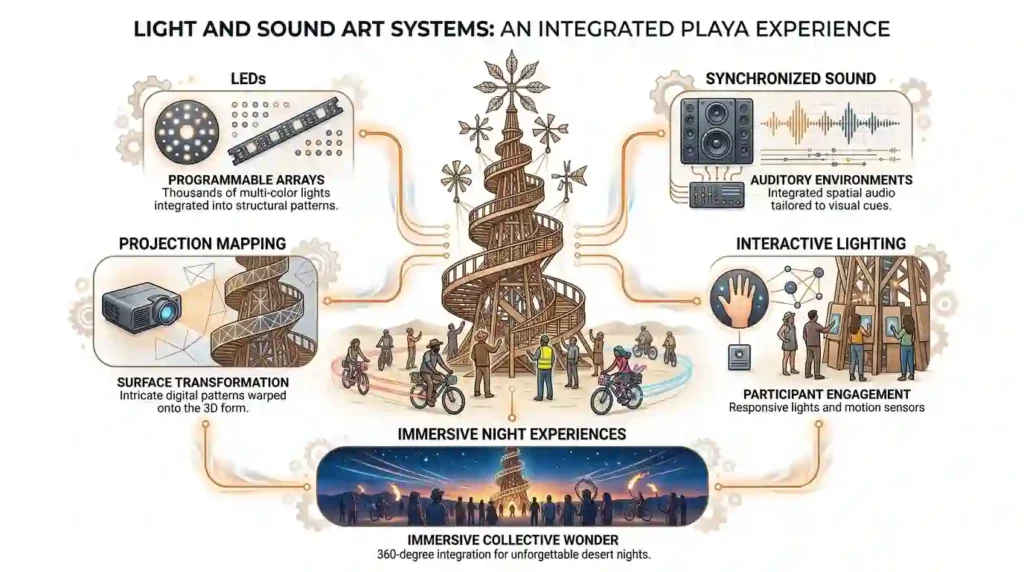
Light art transforms the night into a layered, immersive canvas. Using LEDs, projection mapping, fiber optics, and programmable controllers, artists choreograph color, motion, and intensity to shape emotional and spatial experiences.
Light is often combined with sound, sculpture, and interactive controls to make environments that respond to human presence or remote signals. Because light-based works can affect visibility and sightlines, artists coordinate with nearby camps and infrastructure to minimize interference and ensure safe navigation for nighttime explorers.
- Light art uses LEDs, projections, and control systems to craft night experiences.
- Often integrated with sound and interactivity.
- Coordination prevents visual conflicts and ensures safety.
Kinetic Art
Kinetic works use movement wind, human power, or motors to animate form and create changing relationships between viewer and object. Movement can be subtle (a slowly turning plane catching sunrise) or dramatic (arms swinging, parts rotating), and adds an element of unpredictability and delight.
Designers must account for mechanical wear, balance, and fail-safes to protect participants and the structure. Kinetic art also interacts elegantly with the playa’s wind, sometimes designed to sing, clack, or cast moving shadows that change perception throughout the day.
Section end summary:
- Motion adds dynamism; mechanisms range from wind to motors.
- Safety and mechanical longevity are primary design concerns.
- Wind interactions often become part of the artistic concept.
Performance Art
Performance art at Burning Man includes theater, ritual, dance, spoken word, and improvisational happenings. Often site-specific, performances respond to the sculpture, camp, or moment and can be ephemeral, appearing without advanced notice. Performers create participatory opportunities—inviting audience members into roles or collaborative storytelling.
Because performances can cross into public space, performers coordinate with camps and organizers about timing, sound levels, and audience management to maintain safety and respect other participants’ experiences.
Section end summary:
- Performance art ranges widely and is often site-responsive.
- Performances may invite audience participation and require coordination.
- Timing and sound considerations preserve community harmony.
Mobile Art and Mutant Vehicles
Mobile art adds movement and surprise to Black Rock City, turning streets into performance corridors where encounters can be fleeting and deeply memorable. Mutant vehicles are often the most engineered mobile works and require licensing, safety inspections, and experienced operators.
Other mobile pieces include bicycles and small parade floats that riders decorate and animate. Mobile art expands the city’s experiential geography by bringing artworks into neighborhoods, creating decentralized moments of wonder that can feel personal and ephemeral.
- Mobile art brings surprise and mobility to the playa.
- Mutant vehicles require strict operational safety and permits.
- Parades and roving pieces create decentralized engagement.
Visual #4
Types of Burning Man Art
Caption: Comparison grid showing scale, interaction level, day/night suitability, and typical materials for each art type.
How Does Technology Inspire Burning Man Art?
Short overview of how engineering, lighting, robotics, and renewable power systems expand artists’ capabilities and enable more ambitious, interactive works.
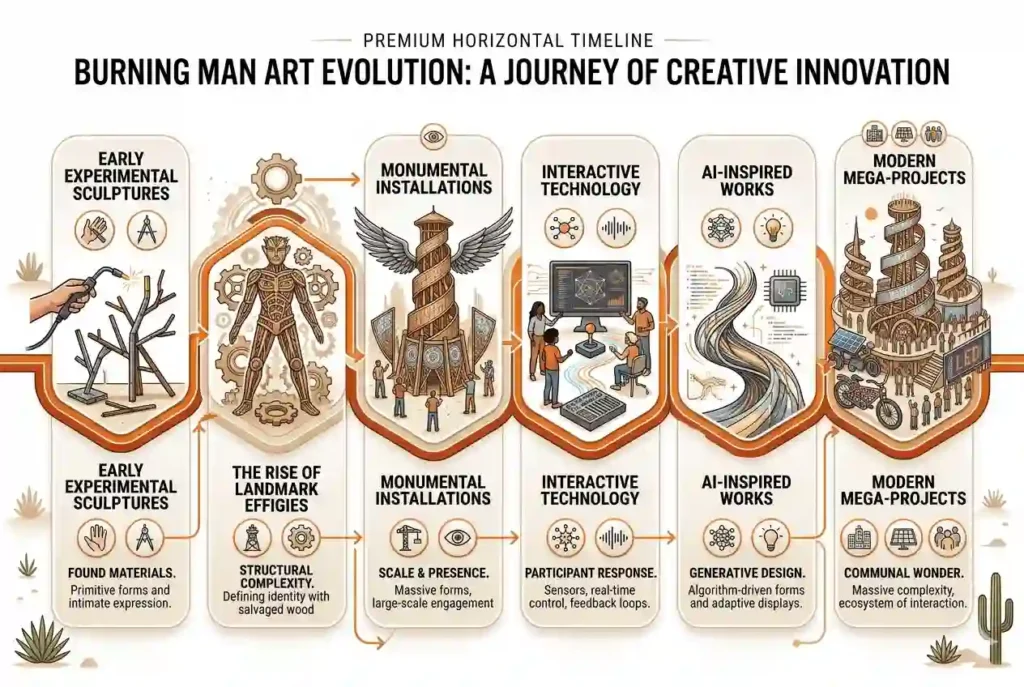
Engineering Meets Creativity
Engineering is the bridge that turns ambitious artistic ideas into safe, real-world structures capable of withstanding the playa’s extremes. Structural analysis, material selection, anchoring systems, and load testing are common engineering tasks for large works.
Artists often collaborate with engineers, fabricators, and maker communities to prototype solutions that balance weight, cost, and durability. This collaboration allows designers to push scale and complexity while maintaining the safety margins required by event regulations and practical considerations.
- Engineering enables safe realization of ambitious art.
- Collaborations between artists and engineers are common.
- Prototyping and testing reduce failure risk on playa.
Robotics and Automation
Robotics and automation introduce movement, reactivity, and sometimes autonomy into artworks. From simple actuators that open panels when touched to complex robotic limbs that perform choreographed sequences, automation creates effects that are difficult to achieve manually.
These systems bring needs for control software, power management, maintenance, and fail-safes; they often require technicians on site to supervise operations. When designed well, robotic elements deepen interactivity and astonishment while requiring robust safety design to handle unexpected behavior in a crowded environment.
- Automation adds sophisticated movement and reactivity.
- Systems need reliable power, control, and on-site maintenance.
- Safety fail-safes are essential in public settings.
LED Lighting and Projection Mapping
LED arrays, DMX controllers, and projection mapping let artists paint structures with dynamic light and imagery, transforming surfaces into shifting canvases. Projection mapping adapts imagery to irregular surfaces, allowing storytelling without permanent alteration.
Control systems permit synchronization with sound or participant input, creating immersive, multi-sensory installations. Artists must account for power supply, mounting, weatherproofing, and line-of-sight issues when deploying these systems on playa, and often design redundant systems to handle dusty conditions.
- Lighting and projections create dynamic night experiences.
- Technical planning includes power, mounting, and weatherproofing.
- Redundancy improves reliability in harsh playa conditions.
Renewable Energy
To power lights, motors, and sound off-grid, many projects adopt solar arrays, battery banks, and efficient inverters that minimize fuel use and logistical burdens. Renewable solutions reduce the need for noisy generators and align with Leave No Trace and sustainability goals.
Energy planning includes production, storage, distribution, and contingency power; teams often stage charging stations and employ power managers who schedule high-load activities to avoid brownouts. Thoughtful energy design makes ambitious technological art feasible without compromising environmental responsibility.
- Solar and battery systems enable off-grid power for installations.
- Energy management includes production, storage, and scheduling.
- Renewable power aligns with sustainability and reduces generator reliance.
Digital Innovation and Emerging Technologies
Emerging tech AR overlays, AI-driven behavior, networked sensors, and IoT devices expands how participants experience and influence art. Augmented reality can layer digital elements onto physical forms, while sensors and machine learning allow installations to adapt to crowd dynamics and environmental cues.
These tools open new possibilities for storytelling and personalization but raise questions about data use, privacy, and durability in dusty, disconnected environments. For more detailed case studies and technical breakdowns, see the Technology & Innovation Guide.
- AR, AI, and sensors enable adaptive, personalized art.
- Technical resilience and privacy are important design considerations.
- The Technology & Innovation Guide provides deeper examples and how-tos.
How Are Burning Man Art Projects Funded?
Quick summary of the mixed funding landscape honoraria, crowdfunding, donations, volunteer labor, and collaborations that makes projects possible.
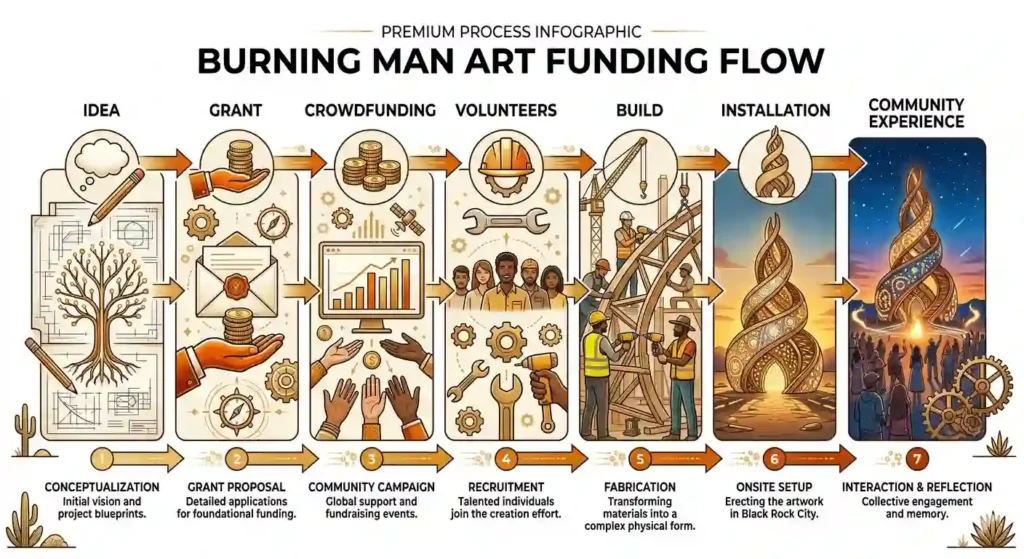
Honoraria Grants
Burning Man’s honoraria program awards grants to selected artists and projects each year, prioritizing works that are site-specific, community-oriented, and aligned with artistic and logistical feasibility. Honoraria reduce financial barriers and signal organizational support, which can help projects attract additional donations or fabrication partners.
However, competition is strong and grants often cover only a portion of total costs; successful recipients typically leverage honoraria to secure matching funds, sponsorships (non-commercial), and volunteer labor to close funding gaps.
- Honoraria provide partial funding and organizational endorsement.
- Grants are competitive and typically supplemented by other funds.
- Recipients often use honoraria to attract additional resources.
Community Fundraising
Many projects succeed through community fundraising crowdfunding campaigns, benefit shows, and donations from friends, family, and the broader Burning Man community. Successful campaigns tell a compelling story, clearly explain the project’s impact, and offer tangible reward tiers or experiences that incentivize support. Community fundraising not only raises money but also builds a base of invested supporters who may volunteer, promote the piece, or help with logistics.
Section end summary:
- Crowdfunding and benefit events raise money and community support.
- Clear storytelling and reward structures improve campaign effectiveness.
- Fundraisers often convert donors into active contributors.
Volunteer Support
Volunteer labor is a massive, often underappreciated currency in the Burning Man art economy. Volunteers help with fabrication, transport, on-playa assembly, crowd management, and teardown. Recruiting, training, and coordinating volunteers demands significant leadership but dramatically reduces project costs and embeds community ownership. Artists who invest in volunteer experiences providing meaningful roles, recognition, and skill-building often see higher retention and better on-playa operations.
- Volunteers supply essential labor across phases of a project.
- Good volunteer management increases project success and retention.
- Volunteer involvement fosters ownership and community ties.
Artist Collaboration
Collaboration among artists, studios, and maker spaces pools skills, tools, and facilities, enabling projects that would be too costly or complex for a single creator. Partnerships can involve shared fabrication facilities, joint fundraising, or co-creation that blends conceptual strengths. Collaborations also expand networks for sourcing materials and technical experts, creating economies of scale that make ambitious installations possible.
- Partnerships leverage shared skills and infrastructure.
- Collaboration enables higher-complexity projects and cost-sharing.
- Networks help source materials and technical expertise.
Bringing Large Projects to Life
Large projects require end-to-end logistical planning: design and prototyping, transport and staging, on-playa assembly, safety checks, and teardown with recycling plans. Teams create detailed schedules, budgets, shipping manifests, and risk assessments; they coordinate with Burning Man’s art and safety teams for permits, inspections, and staging areas.
Successful large-scale builds treat logistics as creative practice design decisions are informed by transport constraints, available fabrication resources, and the human bandwidth required to realize the piece.
Section end summary:
- Logistics include prototyping, transport, assembly, and teardown planning.
- Coordination with art and safety teams is essential for permits and staging.
- Practical constraints often shape creative decisions.
Visual #5
How Burning Man Art Is Funded
Caption: Diagram showing funding flows—honoraria, crowdfunding, in-kind donations, volunteer labor—and where costs concentrate (transport, materials, permits).
How Can You Experience Burning Man Art Like a Participant?
Practical guidance on moving from passive viewing to meaningful participation volunteering, respectful interaction, and exploring beyond main routes.
Participate Instead of Simply Watching
To experience art deeply, actively seek ways to contribute: volunteer on build days, bring useful skills (welding, sewing, sound tech), or participate in interactive works that ask for audience input. Participation can be small leaving a message in a community shrine or large helping choreograph a performance or co-constructing a collaborative sculpture. Approaching artworks with curiosity and willingness to engage creates richer memories and often builds relationships with the artists and other participants who share the experience.
- Volunteer or contribute skills to deepen engagement.
- Interactions can be small or large; both are meaningful.
- Participation fosters community connection and lasting memories.
Respect Artists and Installations
Respect is the baseline for healthy art interactions: follow posted rules, ask before modifying or entering a piece, and avoid removing items left by others. Many artworks include fragile elements or sensitive concepts; even well-meaning interference can damage materials or alter the artist’s intent. Learning and following each artwork’s etiquette, supporting maintenance requests, and giving space for artists to explain or curate interaction ensures the art remains available for others and honors the labor behind it.
- Follow rules, ask before touching, and respect artists’ intentions.
- Avoid altering or removing elements from installations.
- Respect supports longevity and shared access to works.
Explore Beyond the Main Roads
The playa contains countless hidden or peripheral works that reward curiosity. While the Esplanade and center zones host many headline pieces, the deep playa and rows of theme camps hide experimental, intimate, and guerrilla art. Venturing off established arteries requires navigation tools (maps, GPS, compasses), water, shade planning, and a buddy system, but the payoff is discovering art experiences often quieter, more personal, and less crowded than central attractions.
Section end summary:
- Deep playa and side streets host hidden gems.
- Bring navigation, supplies, and travel with others for safety.
- Peripheral exploration often yields unique, quieter experiences.
Experience Art During Day and Night
Plan to revisit installations at different times. A sculpture that looks imposing by day may transform into an immersive light environment after sunset; interactive components may respond differently when cooled overnight or when crowds differ. Some works intentionally stage performances at scheduled times, so check program listings, camp schedules, and artist notes to plan visits. This time-based approach deepens appreciation and uncovers latent features that only appear under certain conditions.
Section end summary:
- Revisit works at different times for fuller understanding.
- Check schedules and artist notes for timed activations.
- Different lighting and crowd dynamics change experience.
Discover Hidden Playa Art
Respect discovery: many small works appear unexpectedly and are curated by artists who prefer low visibility. Approach gently observe signs of fragility or private rituals, and refrain from publicizing exact locations if asked. If you want to support small or anonymous artists, consider leaving a quiet note of appreciation, volunteering help, or contributing materials rather than broadcasting or commercializing their work. The culture of quiet discovery preserves the surprise and intimacy of these pieces.
- Approach hidden works with discretion and respect.
- Offer quiet appreciation or hands-on support rather than publicity.
- Preserve surprise by not disclosing sensitive locations.
Which Art Experiences Should First-Time Burners Never Miss?
Short recommendations for high-impact experiences sunrise walks, sunset gatherings, night circuits, The Temple, The Man, and encounters with mutant vehicles.
Sunrise Art Walks
Sunrise walks offer cooler temperatures, quieter spaces, and the chance to observe installations free from the peak crowds of daytime. Morning light can reveal textures, casting long shadows that accentuate details lost at high noon. Walks at dawn also create opportunities for reflective moments many first-time Burners find the stillness and evolving light to be strikingly intimate, revealing emotional layers that contrast with the festival’s louder hours.
- Dawn provides quiet, cooler conditions and revealing light.
- Sunrise reveals textural details and offers contemplative moments.
- Plan timing and routes to maximize comfort and safety.
Sunset Exploration
Sunset is a transitional moment when the playa shifts from daylight activity into nighttime spectacle. The changing light emphasizes silhouettes and prepares the stage for illuminated works; gathering around key pieces at sunset often becomes a social ritual. Sunset exploration is a sweet spot for photographers and social experiences plan routes that allow you to watch multiple pieces transition as darkness falls.
Section end summary:
- Sunset bridges day and night experiences and enhances silhouettes.
- It’s a prime time for social gatherings and photography.
- Plan routes to catch several installations during the transition.
Nighttime Illuminated Art
Nighttime is when many installations truly come alive light sculptures, projections, and fireworks create immersive environments that redefine space and perception. Traveling at night demands additional safety planning: lights, reflective gear, and an understanding of how to navigate the playa after dark. Respect dark-sky intentions of some works and follow decorum around no-flash or low-light areas where photography can spoil others’ experiences.
Section end summary:
- Night transforms the playa with light-based installations.
- Bring safety gear and respect low-light etiquette.
- Night visits can be the event’s most immersive moments.
Visiting The Temple
The Temple visit offers a solemn, often cathartic experience. People leave notes, mementos, and messages of grief and remembrance; visiting the Temple can be an emotional encounter that contrasts with the event’s playful elements. Maintain silence or low volume, follow any posted rules on photography, and be mindful of people in private moments of mourning. The Temple burn tends toward contemplative closure and is often experienced as deeply meaningful by many participants.
- Temple provides space for grieving, memory, and closure.
- Approach with quietness, sensitivity, and respect for privacy.
- Expect emotional depth and community rituals.
Exploring Around The Man
Visiting around the Man allows you to feel the communal energy of the festival. The Man’s plaza hosts performances, processions, and rituals culminating in the burn event. If you attend the burn, prepare early for crowds, plan safe egress routes, and follow instructions from safety personnel. Observing build-up over several days how people interact with the Man can also reveal evolving cultural rituals and crowd behaviors that make the burn night a unique communal catharsis.
Section end summary:
- The Man area is social, ceremonial, and often crowded at peak moments.
- Prepare for crowds and follow safety guidance during burns.
- Observing pre-burn rituals reveals much about community practice.
H3: Encountering Mutant Vehicles
Mutant vehicles surprise and delight, creating mobile moments of wonder across the playa. Approach vehicles with curiosity but caution: maintain safe distances, follow operator instructions, and be mindful of moving parts and propulsions. If you’d like to ride or volunteer with a vehicle, seek out crew contacts and understand the safety protocols; operators typically require briefing for passengers and helpers to ensure everyone’s safety.
Section end summary:
- Mutant vehicles create spontaneous, mobile interactions.
- Maintain safe distances and follow operator guidance.
- Volunteering offers a closer, regulated way to participate.
Burning Man Art by the Numbers
Art is the heart of Burning Man. Every year, Black Rock City becomes one of the world’s largest temporary outdoor art galleries, featuring monumental sculptures, immersive installations, fire art, interactive experiences, mutant vehicles, and experimental technologies. Created by artists and volunteers from around the world, these works invite participation rather than passive observation, making every visitor part of the creative experience.
Key Numbers
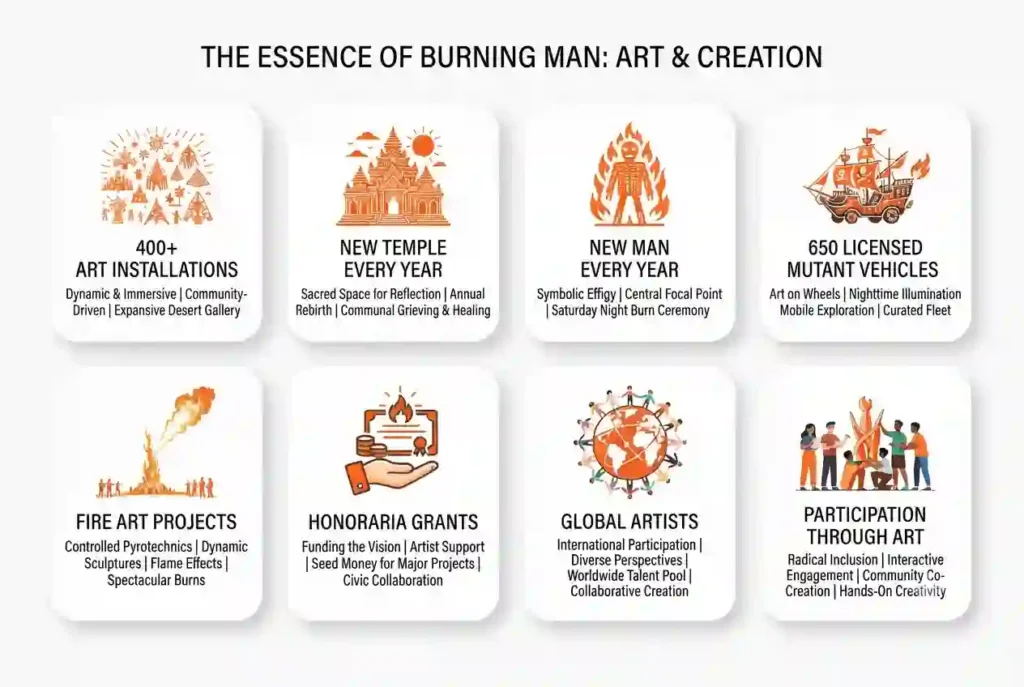
- 🎨 400+ Registered Art Installations — Hundreds of artworks transform the playa into a massive open-air gallery.
- 🏛️ 1 New Temple & 1 New Man Every Year — Two of Burning Man’s most iconic structures are rebuilt annually with unique designs.
- 🚗 Up to 650 Licensed Mutant Vehicles — Radically transformed art cars bring moving creativity to Black Rock City.
- 🔥 Dozens of Fire Art Projects — Flame sculptures and fire performances light up the playa after dark.
- 💰 Dozens of Honoraria Grants — Selected artists receive funding and logistical support for large-scale public art.
- 🌍 Artists from Around the World — Creators from many countries contribute sculptures, installations, performances, and engineering projects.
- 🤝 Thousands of Volunteers — Artists, builders, engineers, welders, programmers, and participants collaborate to create the city.
- ❤️ Participation Is the Art — Many installations become complete only when participants actively engage with them.
Snapshot of scale and scope typical ranges for installations, volunteer involvement, honoraria-funded works, and international artist participation.
Hundreds of Art Projects Transform the Playa
Each year, the playa hosts hundreds of artworks ranging from tiny installations to multi-ton sculptures. While exact totals vary annually, the distribution is heavy on small experiments and community-driven projects, with a smaller subset of high-budget, large-scale commissioned works. This diversity ensures that exploration always yields surprises and that no two years feel exactly the same as new artists and returning groups iterate on concepts.
Section end summary:
- The playa features hundreds of artworks annually across a broad size range.
- Most works are small or medium; a smaller number are monumental.
- Annual variation keeps each year distinct.
Artists From Around the World
Burning Man draws creators from diverse geographies, disciplines, and cultural backgrounds, making the playa a cosmopolitan laboratory of ideas. International artists bring varied practices and materials, which enriches the dialogue around techniques, themes, and cultural meanings. The logistical complexity of international work shipping, customs, and transport adds layers of planning and often reflects in the scope and ambition of certain projects.
- International artists enrich diversity and ideas on playa.
- Logistics for international projects are complex but often lead to ambitious works.
- Cross-cultural exchange expands creative vocabulary.
Honoraria-Funded Installations
A portion of the highest-cost projects receives honoraria to offset fabrication and transport; these projects are often the subject of public programming and curatorial coordination. Presenting honoraria-funded works alongside grassroots projects creates a balanced ecosystem where both emergent and institutionally-supported practices coexist. Because the number funded changes yearly, present counts as ranges and explain how grant decisions reflect curatorial priorities and logistical feasibility.
- Honoraria fund a subset of high-cost, high-impact works.
- Grants are allocated based on artistic merit and feasibility.
- Numbers vary annually; present as ranges for accuracy.
Thousands of Volunteers Support Art
The scale of volunteer labor is immense thousands assist with building, operation, safety, and teardown. Volunteers are the workforce behind many installations and community infrastructure elements: without them, the financial and logistical load on individual artists would be prohibitive. Volunteer mobilization also functions as a training ground for new builders and a way to build community resilience and continuity across projects.
- Thousands volunteer across builds, operations, and teardown.
- Volunteer networks are essential to project feasibility.
- Participation builds skill and community continuity.
A New Outdoor Gallery Every Year
The playa becomes a transient gallery an enormous, open-air exhibition that refreshes yearly with new artists, returning veterans, and iterative projects. This annual renewal supports experimentation, encourages new voices, and ensures the cultural conversation stays dynamic. The ephemeral gallery model also allows for cyclical experimentation where artists take radical, sometimes risky approaches that would be harder to justify in permanent public contexts.
- Annual renewal fosters experimentation and new voices.
- The playa functions as a dynamic, transient gallery each year.
- Ephemerality permits risk-taking uncommon in permanent contexts.
Visual #7
Burning Man Art Statistics
Caption: Stat cards showing ranges for attendance, installations, volunteer numbers, and honoraria-funded projects; present numbers as typical ranges to account for year-to-year variance.
Common Myths About Burning Man Art
A brief myth-busting overview to correct common misunderstandings about what Burning Man is and how its art ecosystem functions.
Burning Man Art Myths vs Reality
| Myth | Reality |
|---|---|
| Burning Man is mainly about burning The Man. | The Man Burn is only one event; hundreds of artworks and creative experiences fill the entire week. |
| All artwork is created by Burning Man organizers. | Most art is created independently by artists, collectives, volunteers, and community fundraising. |
| Art is only meant to be viewed. | Many installations invite visitors to interact, explore, climb, or become part of the artwork. |
| Burning Man only features sculptures. | The event includes fire art, sound art, kinetic engineering, interactive technology, performances, and moving art cars. |
| Technology and art are separate. | Many projects combine engineering, robotics, lighting, renewable energy, and digital technology with artistic expression. |
| Only artists contribute to Burning Man art. | Engineers, architects, welders, programmers, designers, and volunteers all help bring projects to life. |
Myth: Burning Man Is Just an Art Festival
Burning Man resists easy categorization. While art is central, the event also functions as a civic experiment, cultural movement, and temporary city with governance, services, and social norms. Reducing it to “just an art festival” misses its participatory governance, gifting economy, and community infrastructures that make the art meaningful within a broader social ecology.
- Burning Man combines art with civic practices and social experiments.
- The event’s governance and gifting culture differentiate it from festivals.
- Art is central but part of a larger social system.
Myth: Only Professional Artists Create the Artwork
A broad spectrum of creators contributes: experienced, professional artists work alongside amateurs, hobbyists, students, and community groups. Many professional works are collaborative, relying on non-professional volunteers for assembly and operation. This mix democratizes the creative field and allows non-traditional voices to produce meaningful, sometimes highly original, work.
Section end summary:
- Both professionals and amateurs create art on playa.
- Collaborative builds bring diverse skills together.
- The field is accessible to non-professional creators with support.
Myth: You Can Only Look at the Art
Viewing is only one way to engage; the event’s design encourages hands-on participation, co-creation, and contribution. While not all works invite direct contact, many encourage physical, vocal, or social interaction; doing nothing more than looking often misses the potential for deeper engagement that makes Burning Man unique.
- Interaction is encouraged where appropriate; viewing alone is limited.
- Many works invite active contribution that enhances meaning.
- Always confirm interaction permissions with artists.
Myth: Every Artwork Is Burned
Although burning is a visible ritual associated with the event, not every artwork is burned. Many pieces are dismantled, recycled, preserved, or sold. Burning is reserved for works intentionally designed for that ritual outcome; others are safely decommissioned and materials repurposed. Emphasize the varied fates of artworks to avoid misconceptions about destruction as the default.
- Burning is intentional and limited to specific works.
- Many installations are recycled, moved, or preserved.
- Disposal follows sustainability and Leave No Trace practices.
H3: Myth: Ticket Sales Pay for All Art
Ticket sales support core event infrastructure roads, sanitation, safety, and large-scale operational expenses but do not directly fund most artworks. Artists rely on separate funding sources like honoraria, donations, and crowdfunding. Understanding this funding distinction helps clarify the economics of project creation and why artists must secure diverse revenue streams.
- Ticket revenue underwrites infrastructure, not most art budgets.
- Art funding typically comes from grants, donations, and crowdfunding.
- Separate budgets and fundraising are standard for projects.
What Mistakes Do First-Time Art Explorers Make?
Short warning about common pitfalls trying to see everything, daytime-only visits, ignoring guidelines, and poor logistics and how to avoid them.
Trying to See Everything
Ambition to witness every artwork in a single visit is common but unrealistic and often leads to exhaustion and superficial engagement. Prioritize a few zones or themes, allow time to linger, and accept that part of the playa’s magic is surprise missing some works leaves room for future discovery. Build an adaptable itinerary and be willing to detour when serendipity appears.
- Trying to see everything leads to fatigue and shallow experiences.
- Prioritize and leave room for serendipity.
- Quality engagement beats exhaustive touring.
Visiting Only During Daylight
Limiting exploration to daylight misses a large portion of the event’s sensory palette nighttime installations, light shows, and fire art transform the playa into a different world. If you only go during the day, you’ll miss the atmospheres and experiences designed specifically for nighttime activation. Balance your schedule to include at least one significant night circuit.
- Nighttime offers unique experiences you’ll miss by daytime-only visits.
- Plan at least one night exploration for full appreciation.
- Night travel requires safety planning and lighting.
Missing Interactive Experiences
Hesitation or fear of participation causes missed opportunities. Interactive works often become more meaningful when you contribute even a small action the experience deepens, and you may connect with other participants and artists. Start small if anxious: leave a note, press a button, or offer to help a camp; these small contributions usually lead to richer encounters.
- Hesitance reduces the depth of the experience.
- Small, respectful interactions open doors to richer engagement.
- Participation often leads to community connections.
Ignoring Artist Guidelines
Disregarding posted rules or verbal requests can damage work and strain community trust. Artists post instructions for safety and preservation; following them protects delicate materials and honors creators’ intent. Consequences can include damaged works, disappointed artists, and diminished experiences for others so prioritize learning and following guidance.
- Follow artist instructions to protect works and community relations.
- Ignoring rules risks damage and conflicts.
- Education and respect prevent harm.
Forgetting Navigation and Hydration
Underestimating the harshness of the desert climate and the city’s scale leads to dehydration, getting lost, and unsafe situations. Always carry adequate water, sun protection, and navigation aids; plan routes and share your ETA with campmates. Good logistical preparation keeps you safe and allows more relaxed art exploration.
- Bring water, sun protection, and navigation tools.
- Share plans with campmates and have backup supplies.
- Preparedness enhances safety and enjoyment.
Experienced Burner Tips for Exploring Art
Concise tips from seasoned participants on how to deepen art engagement: slow down, revisit works, talk with artists, and travel safely to the deep playa.
Slow Down and Explore
Take time to linger, observe engineering details, read placards, and talk to artists and volunteers. Slow exploration uncovers layered meanings and technical achievements that quick walkthroughs miss. Being present increases the chance of serendipitous conversations and learning moments that enrich your understanding of each work.
- Lingering reveals technical and conceptual depth.
- Slow exploration invites conversation and learning.
- Presence enhances discovery and appreciation.
H3: Visit Installations Multiple Times
Returning to installations at different times, under different crowd conditions, and across weather shifts reveals new behaviors and interactions. Artists often tune their works in response to participant behavior; multiple visits also let you notice repairs, evolving community rituals, and hidden features.
- Repeated visits show evolution and hidden features.
- Installations can respond differently over time.
- Multiple encounters deepen appreciation.
Talk With Artists
Conversations with creators reveal intent, methods, and stories not apparent from surface experience. Artists often enjoy explaining their process and may invite you to participate or contribute. Approach with curiosity, respect their time, and consider offering tangible support like skills, materials, or volunteering.
- Talking with artists reveals deeper context and methods.
- Offer assistance or skill exchange to contribute meaningfully.
- Respect artists’ time and boundaries.
H3: Explore the Deep Playa
Deep playa hosts large, experimental works and quieter encounters—plan logistics carefully (fuel, navigation, emergency kit) and travel with companions. The rewards are often unique and profound: monumental, contemplative pieces that require solitude to appreciate fully. Being prepared and respectful ensures you can access and enjoy this remote art safely.
- Deep playa offers unique, large-scale, and quiet artworks.
- Prepare carefully and travel with companions for safety.
- Respect remote installations’ fragility and access rules.
H3: Experience Art Before Sunrise
Pre-dawn visits offer silence, cool temperatures, and a different reading of light and shadow. Many participants describe early-morning encounters as spiritually quiet and intimately revealing, when the city’s bustle pauses and the day’s energy slowly returns. Start with nearby works to avoid long nocturnal travel and respect early-morning quiet in residential camps.
- Dawn visits are quiet, revealing, and cooler.
- Begin with nearby installations to limit nocturnal travel.
- Respect early-morning quiet and camp privacy.
Burning Man Art Explorer Checklist
A quick preface to the practical checklists below, summarizing what to prepare before, during, and after art exploration on playa.
How Burning Man Art Comes to Life
| Stage | What Happens |
|---|---|
| Inspiration | Artists develop concepts inspired by creativity, community, or social ideas. |
| Design | Teams create sketches, engineering plans, and budgets. |
| Funding | Projects receive support through Honoraria grants, crowdfunding, donations, or self-funding. |
| Fabrication | Artists, engineers, and volunteers build the artwork over several months. |
| Transportation | Installations are moved to Black Rock City and assembled on the playa. |
| Participation | Visitors interact with, explore, and help bring the artwork to life. |
| Celebration | Some works include performances or ceremonial burns during the event. |
| Leave No Trace | Art is dismantled, removed, and the playa is restored after Burning Man. |
Before Exploring
Pack essentials: a printed map or offline GPS, at least 3 liters of water per person per day, sun protection (hat, sunscreen), layered clothing for temperature swings, basic first aid, and portable charging for devices. Research the event map and schedule, identify must-see pieces, and coordinate with your campmates or companions so someone knows your route.
- Bring maps, 3+ liters of water, sun protection, and layers.
- Plan routes and inform companions of your itinerary.
- Carry basic first aid and phone power.
While Exploring
Practice consent and check signage ask before entering or modifying pieces, carry a small trash bag to pack out waste, and avoid monopolizing interactive works so others can participate. Be aware of moving vehicles and follow instructions from art crews or safety personnel. If you encounter an issue (damage, medical need), report it to volunteers or ranger teams promptly.
- Ask before touching, pack out trash, and share interactive pieces.
- Watch for vehicles and obey safety directions.
- Report hazards or emergencies immediately.
Nighttime Exploration
Equip yourself with a reliable headlamp, spare batteries, reflective clothing, and a buddy system. Use a red-light mode when you need low-level illumination to preserve night vision and respect low-light installations. Plan clear return routes, avoid blinding lights, and carry a small whistle for safety signaling.
- Use headlamps, reflectors, and Buddies for night travel.
- Use red-light modes to preserve night experiences for others.
- Carry signaling devices and plan return routes.
Before Leaving the Playa
Contribute to teardown if your camp or project needs help, ensure you leave no trace by removing all materials and labeling recyclables, and document and share lessons learned with project teams to improve future builds. Offer thanks to artists and volunteers and consider how you might support them off-playa through donations or skill-sharing.
- Help with teardown, remove all materials, and recycle responsibly.
- Share lessons learned and offer thanks to creators.
- Consider ongoing support through donations or skills.
Visual #9
Art Explorer Checklist
Caption: Printable editorial checklist with pre-trip and on-playa items formatted for easy PDF download.
Explore the Burning Man Art & Technology Guides
Brief call-to-action introducing the set of dedicated guides that expand on specific topics—The Man, The Temple, Mutant Vehicles, Fire Art, Interactive Art, Grants, and Tech.
Explore the World of Burning Man Art
| Guide | What You’ll Learn |
|---|---|
| 🎨 Art Installations Guide | Monumental sculptures, immersive environments, and iconic playa masterpieces |
| 🤝 Interactive Art Guide | Hands-on installations and participatory artistic experiences |
| 🔥 Fire Art Guide | Fire sculptures, flame effects, performances, and fire safety |
| 🏛️ The Man Guide | History, symbolism, construction, and The Man Burn |
| 🤍 Temple Guide | Meaning, remembrance, traditions, and the Temple Burn |
| 🚗 Mutant Vehicles Guide | Art cars, DMV licensing, rules, and famous creations |
| 💰 Art Grants & Honoraria Guide | Funding, artist applications, and public art support |
| ⚙️ Technology & Innovation Guide | Robotics, engineering, renewable energy, and creative technology |
| 💻 Silicon Valley & Burning Man Guide | How Burning Man inspires innovation, entrepreneurship, and collaboration |
🔥 The Man Guide
Visit the Man guide for history, construction methods, viewing tips, and ritual programming. The guide provides timelines for build and burn events and detailed safety and spectator guidance.
- Deep dive into Man history, build, and safety.
🛕 The Temple Guide
Visit the Temple guide to learn about planning, etiquette, memorial practices, and how to leave a respectful tribute. It includes photographer etiquette and emotional preparedness tips.
- Guidance for respectful Temple visitation and participation.
🚗 Mutant Vehicles Guide
The Mutant Vehicles guide covers design norms, permit processes, operator training, and gallery examples for inspiration. It’s essential reading for builders and riders alike.
- Instructions and examples for building and operating mutant vehicles.
🔥 Fire Art Guide
The Fire Art guide walks through permits, fuel management, crew roles, and viewing safety for flame-based works. It includes case studies in safe practice and spectacle design.
- Comprehensive guidance on fire safety, permits, and viewing etiquette.
🎭 Interactive Art Guide
The Interactive Art guide explains co-creation, interactivity design, facilitated experiences, and best practices for accessibility and safety.
- Best practices for designing and participating in interactive works.
🏗️ Art Installations Guide
The Art Installations guide focuses on engineering, fabrication, anchoring, and transport logistics for large projects.
- Technical resources for large-scale installation planning.
💰 Art Grants & Honoraria Guide
The Art Grants guide outlines application cycles, budgeting templates, narrative tips, and examples of successful proposals.
- Practical guidance for applying to grants and budgeting projects.
🤖 Technology & Innovation Guide
The Technology & Innovation guide explores robotics, AI, lighting systems, and resilient design for the playa environment.
- Case studies and tech how-tos for resilient, interactive works.
🌉 Silicon Valley & Burning Man
This guide explores the cross-pollination between Burning Man culture and innovation sectors, mapping events, residencies, and collaborations.
- Examination of cultural and technological exchanges between communities.
World’s Largest Outdoor Art Exploration Checklist
Before You Arrive
✅ Download the official art map
✅ Learn the Ten Principles
✅ Research major art installations
✅ Plan both daytime and nighttime exploration
While Exploring
✅ Participate respectfully
✅ Read artist information signs
✅ Follow artwork instructions
✅ Ask permission before photographing people
During the Event
✅ Visit both The Man and the Temple
✅ Explore beyond the central playa
✅ Experience art during sunrise, sunset, and nighttime
✅ Talk with artists when possible
Before Leaving
✅ Leave no trace
✅ Respect every installation
✅ Support artists and volunteers
✅ Share your experience responsibly
Frequently Asked Questions About Burning Man Art
From monumental sculptures and interactive installations to fire art, the Temple, The Man, Mutant Vehicles, and experimental technology, Burning Man showcases many forms of creative expression.
Art is spread throughout Black Rock City and the open playa, with major landmarks surrounded by hundreds of smaller installations.
No. All public artworks are included with your Burning Man admission ticket.
Use the official art map, explore by bicycle, and allow time to discover unexpected installations beyond the famous landmarks.
Most first-timers visit The Man, the Temple, major open-playa sculptures, interactive installations, fire art, and Mutant Vehicles.
Probably not. With hundreds of installations spread across the city, most participants only experience a portion of the available artwork.
Walking and cycling are the easiest ways to discover installations, especially in the open playa where many large artworks are located.
Start with the Art Installations Guide, then continue to Interactive Art, Fire Art, The Temple, The Man, Mutant Vehicles, and Technology & Innovation based on your interests.
Most installations are newly created each year, making every Burning Man a unique artistic experience.
This page introduces the entire Art & Creativity pillar, while each linked guide explores a specific topic in much greater detail.
“Where Should I Go Next?” FAQ
| If You Want To… | Read This Guide |
|---|---|
| Explore monumental sculptures | → Art Installations Guide |
| Experience immersive, hands-on artwork | → Interactive Art Guide |
| Learn about fire sculptures and performances | → Fire Art Guide |
| Understand The Man’s history and symbolism | → The Man Guide |
| Discover the Temple’s traditions | → Temple Guide |
| Ride or build a Mutant Vehicle | → Mutant Vehicles Guide |
| Learn how artists receive funding | → Art Grants & Honoraria Guide |
| Explore robotics and creative technology | → Technology & Innovation Guide |
| See how Burning Man inspires innovation | → Silicon Valley & Burning Man Guide |
Conclusion
A two-line wrap that reiterates art’s central role in Burning Man and invites readers to continue into the deeper guides while practicing respectful participation.
Art Defines the Spirit of Burning Man
Art is not decorative at Burning Man; it is constitutive of the event’s identity—defining rituals, values, and social life. Whether monumental or intimate, works create the conditions for shared experience and reflection that form the festival’s core.
- Art is central to identity and social ritual at Burning Man.
Every Participant Becomes Part of the Artwork
Participation transforms visitors into co-creators; your presence, choices, and interactions contribute to the evolving meaning of each piece. This responsibility encourages respectful behavior and active contribution.
- Participants’ actions co-author artworks and shape meaning.
Creativity Extends Beyond Black Rock City
The art and culture of Burning Man influence regional events, maker communities, and year-round projects what happens on the playa ripples outward through workshops, residencies, and collaborative networks that continue the festival’s creative energy.
- Playa creativity feeds year-round projects and wider cultural networks.
Final Thoughts
Closing encouragement to explore further, contribute responsibly, and carry the playa’s creative values into year-round projects and community involvement.
Continue Exploring the Creative World of Burning Man
This page is your gateway. Use the linked deep-dive guides to learn about permits, safety, funding, and technical execution, and consider how you might contribute through volunteering, funding, or making—to sustain this living creative ecosystem. When you engage thoughtfully, you help preserve the values that make Burning Man art meaningful: participation, gifting, and radical inclusion.
- Use this guide to navigate deeper resources and consider your role.
- Engage thoughtfully to sustain the community and its values.