

Art & Tech Innovation| Where creativity meets experimentation and community.
At the Burning man community, people are building bold new ideas, turning imagination into real experiences, and using technology, art, and collaboration to shape a more connected world. Here, you’ll discover projects, philosophies, and programs that prove that anyone can be an innovator.
Art & Tech Innovation at Burning man
Burning Man is much more than a music or desert festival. It is one of the world’s largest experimental creativity laboratories, where every year the Black Rock Desert becomes a temporary “smart creative city” built by artists, engineers, architects, coders, designers, AI creators, makers, and innovators.
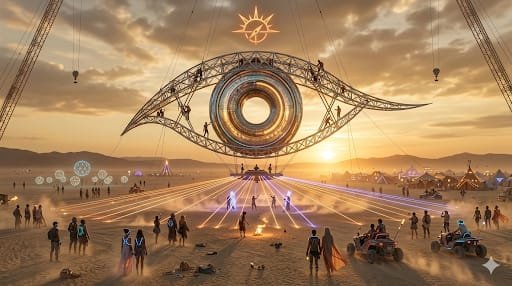
In this culture of radical self‑expression and radical self‑reliance, the Playa hosts massive art installations, robotic sculptures, 360‑degree projection‑mapping spectacles, immersive soundscapes, experimental wearables, and AI‑driven experiments that would be nearly impossible to test anywhere else. Architects design temporary experimental structures, sound camps build city‑scale audio environments, and AI‑art teams debut generative visuals that respond to the crowd in real time.
This is where innovation culture meets open‑source creativity: teams share schematics, code, and design files so others can learn, remix, and improve. The collaboration between art and technology turns the Playa into a living “human creativity testing ground.”
Think of it like this: your home kitchen becomes a testing place when you try a bold new recipe. At Burning Man, the entire event becomes a testing ground where artists and inventors safely push impossible ideas into reality then invite you to step inside, interact, and co‑create.
- Burning Man is not just a music or desert festival; it is one of the world’s largest experimental creativity laboratories.
- Every year the Playa becomes a temporary “smart creative city” built by artists, engineers, architects, coders, designers, AI creators, makers, and innovators.
- The event blends innovation culture, radical self‑expression, and temporary experimental architecture with open‑source creativity and collaboration.
- Massive art installations, robotic sculptures, projection‑mapped structures, immersive soundscapes, AI‑driven visuals, and futuristic experiments appear annually in the dust.
- Burning Man works like a giant “human creativity testing ground,” where artists and inventors safely test impossible ideas just as you test a bold new recipe in your home kitchen.
What “Art & Tech Innovations” Means in 2026
At Burning Man, “Art & Tech Innovations” refers to the fusion of visual and conceptual art with digital, physical, and AI‑driven technologies. This includes everything from reactive light walls and motion‑sensitive sculptures to AI‑generated visuals, blockchain‑linked artworks, and internet‑of‑things (IoT)‑enabled installations.
Typical examples you’ll see on the Playa include projection‑mapped art cars, kinetic sculptures that move with wind or code, reactive sound and light installations, robotic or motorized structures, and wearable tech that changes color or pattern based on your movement, voice, or environment. These are not just “art with wires”; they are deeply integrated systems where technology becomes the language of expression.
Why 2026 Is a Turning Point
2026 marks a turning point in Burning Man’s art‑tech evolution. LEDs have become cheaper and more energy‑efficient, microcontrollers and open‑source hardware (like Arduino, ESP32, and Raspberry Pi) are widely accessible, and AI tools for image, audio, and video generation are now in the hands of artists and small teams, not just big studios.
Meanwhile, the maker community has grown stronger: more people know how to code, solder, 3D print, laser‑cut, and build robust systems that can survive dust, heat, and power constraints. Burning Man’s temporary city in 2026 acts as a real‑world laboratory where these tools are stress‑tested at scale—on art cars, camps, and large sculptures under the harshest conditions.
Why Burning Man Became a Global Innovation Hub
Burning Man has evolved far beyond a desert gathering into a global innovation hub where art, technology, and radical experimentation collide. Unlike fixed cities or commercial galleries, the Playa offers a rare space where creators from every discipline can build, break, and rebuild ideas without the usual constraints. This temporary city becomes a living lab for creativity, where the rules are self‑made, and the only requirement is to try something new.
Burning Man has grown into a global innovation hub because it offers a rare environment where creativity, technology, and experimentation can flourish without the usual real‑world constraints. In a world dominated by deadlines, budgets, and corporate branding, the Playa swaps those rules for radical self‑expression, decommodification, and open collaboration. This cultural shift turns the desert into a magnet for inventors, engineers, designers, and artists who want to test ideas that would never be allowed or even imagined in a normal city.
Freedom of Experimentation
At Burning Man, artists are free to create without the pressure of selling tickets, pleasing sponsors, or chasing trends. There is no corporate advertising, no billboards, and no brand logos competing for attention. This freedom lets innovation become more personal, emotional, and experimental. People bring wild ideas robotic temples, self‑deconstructing sculptures, AI‑driven confession booths, or interactive dust‑reactive light walls—knowing they will be judged not by profit, but by impact, wonder, and participation. It’s this lack of commercial pressure that turns the Playa into a legitimate testing ground for the future of art and technology.
Collaboration Between Different Skills
Burning Man’s magic often lives in the space between disciplines. Engineers work side‑by‑side with artists, architects team up with coders, musicians collaborate with lighting designers, and AI creators co‑create with visual artists. These multidisciplinary collaborations result in rich, immersive experiences: a sound sculpture that moves with your body, a building that lights up in response to conversation, or a camp that feels like walking inside a living algorithm. When technical skill meets artistic vision, the result is something that neither side could have built alone.
Temporary City = Temporary Innovation Lab
Black Rock City exists for only a short time, built from scratch and then dismantled again. Because it is temporary, creators feel free to take bigger risks: unusual structural designs, experimental power systems, and cutting‑edge tech that might be too fragile or controversial for a permanent city. This “temporary‑city‑as‑lab” mindset is why Burning Man has become a global innovation hub, directly feeding into clusters like Burning Man Innovation Culture, How Burning Man Influences Silicon Valley, Why Tech Founders Attend Burning Man, and Creative Experimentation at Burning Man.
A Great Place for Global innovators, designers, and tech founders
- Burning Man is a sandbox for radical experimentation, free from corporate advertising and traditional commercial pressures.
- Artists, engineers, architects, coders, AI creators, and musicians collaborate in ways that don’t happen in rigid, siloed industries.
- The temporary nature of Black Rock City encourages bold risks: experimental structures, interactive tech, and unconventional experiences are welcomed, not blocked by bureaucracy.
- This environment has inspired Silicon Valley founders, designers, and innovators, who bring Burning Man’s culture of experimentation back into their companies.
- The Playa acts as a real‑world innovation lab, where ideas tested in the dust influence future trends in art, tech, and urban culture.
“Burning Man is where constraints dissolve and innovation becomes a shared language across disciplines.”
Massive Art Installations and Interactive Sculptures
At the heart of Burning Man are the massive art installations and interactive sculptures that dominate the Playa skyline. From coast‑to‑coast creators in California, Texas, New York, and Oregon to artists traveling from Europe, Canada, Australia, and Asia, these giant works are what most people remember long after the dust settles. They’re not just décor—they’re engineered, coded, and choreographed experiences that turn the desert into a living gallery.
Why are giant sculptures so central to Burning Man culture?
Giant sculptures are the visual anchors of Black Rock City. They define the Playa’s layout, guide navigation, and create shared landmarks for Burning Man art installations, mutant vehicles, and theme camps. Many of these pieces are taller than houses, built from metal, wood, or mixed materials, and engineered to survive wind, heat, and dust. Artists often spend months—or even years—planning, permitting, crowdfunding, and pre‑building before hauling everything into the desert just for one week of life on the Playa.
How do large‑scale desert art pieces differ from gallery art?
Large‑scale desert art is designed for extreme conditions. Metal sculptures, wooden temples, kinetic art, fire art, and interactive structures are built to withstand the harsh environment of the Nevada desert. Some installations use projection mapping, LED lighting, robotics, and motion sensors to respond to movement, sound, or touch. This blend of art, mechanical engineering, and sound design turns static sculptures into dynamic, evolving experiences rather than objects hanging on a wall.
What makes interactive and participatory art special at Burning Man?
At Burning Man, visitors don’t just watch—they become part of the artwork. In interactive and participatory art, people touch, climb, spin, push, shout, or move through the piece, and the installation responds. Some sculptures react to sound, others to motion or pressure, while others use motion sensors or RFID to unlock new layers of light or sound. It’s like a child pressing buttons on a toy to make lights and sounds appear—except amplified into a desert‑scale, community‑driven experience shared by thousands from the USA, Europe, and beyond.
How do “art burns” fit into the Burning Man experience?
Many of the most iconic Burning Man art installations are intentionally burned in controlled, ritual‑like ceremonies. This art burn tradition ties into the event’s themes of impermanence, transformation, and letting go. The fire becomes both a visual spectacle and a shared emotional moment, where the crowd gathers around giant wooden temples, metal sculptures, or kinetic structures as they slowly dissolve into flames. For many attendees, especially those from the West Coast, Texas, and international Burner communities, these burns are the most powerful and cathartic moments of the week.
Entity‑Rich Summary
- Massive art installations and interactive sculptures are central to Burning Man culture, anchoring the layout of Black Rock City.
- These works often combine LED lighting, fire effects, projection mapping, robotics, sound design, motion sensors, and mechanobservable engineering.
- Large‑scale desert art includes metal sculptures, wooden temples, kinetic art, fire art, and interactive structures built to survive extreme Nevada conditions.
- Interactive and participatory art lets visitors touch, climb, activate, or influence the artwork, turning them into co‑creators instead of spectators.
- Art burns symbolize impermanence and transformation, creating powerful emotional experiences for global attendees from the USA, Europe, Canada, Australia, and Asia.
- This ecosystem feeds future clusters like Burning Man Art Installations, Burning Man Mutant Vehicles, Burning Man Theme Camps, Burning Man Fire Art, and Burning Man Art Burns.
“At Burning Man, the desert doesn’t just hold art—it breathes with it, as giant sculptures and burning temples become living metaphors for risk, beauty, and release.”
Major Tech Domains Powering Art Innovations
Burning Man’s most memorable moments are rarely about a single band or camp—they’re about the invisible tech that powers the art: the sensors, code, lights, and code‑driven sound that make the Playa feel alive. Across the USA—especially in creative hubs like California, Texas, New York, and Colorado—and from Europe, Canada, Australia, and Asia, teams are using cutting‑edge tools to turn static sculptures into responsive, breathing experiences.
What kind of tech is turning Burning Man art into living experiences?
The core of today’ Burning Man art installations isn’t just metal and wood—it’s interactive systems, lighting networks, robotics, AR/VR layers, and AI‑driven visuals. These technologies are what separate a simple sculpture from a fully immersive, festival‑scale experience.
From the West Coast to Silicon Valley, Austin, Portland, and European Burning Stars, makers are leaning on cheap, open‑source hardware and software to build responsive, site‑responsive, and emotionally engaging works that feel like the future mixed with the primal.
Interactive & Responsive Installations
Through interactive & responsive installations, visitors trigger change in real time. Teams embed motion sensors, sound sensors, light sensors, and RFID readers into sculptures, walls, or platforms. These feed into microcontrollers like Arduino, ESP32, or Raspberry Pi–based systems, often running on open‑source frameworks and libraries.
The result is simple magic: if you walk up, the lights shift color; if you clap, the sculpture changes pattern; if you hold an RFID token, a hidden sound or light sequence unlocks. This is the backbone of interactive art installations, mutant vehicles, and theme camps that want people to feel like they’re inside the system, not just looking at it.
Projection Mapping & Immersive Visuals
Because projection mapping & immersive light turn irregular structures into “living” canvases. Artists use tools like MadMapper, TouchDesigner, Notch, or custom server‑based pipelines to warp 3D projections onto curved temples, art cars, and temporary structures.
On the Playa, this means dust, metal, and fabric become projection surfaces, while LED strips, matrices, and addressable lighting blend with the mapped layers. From San Francisco to Berlin, crews use these systems to create large‑scale immersive light environments that sync with music, crowd movement, or timed sequences, turning the desert into a dynamic, pixel‑driven dreamscape.
LED and Light‑Based Art
LED and light‑based art is what makes the Playa look like a neon‑lit, futuristic city when the sun goes down. Across the Nevada desert—from camps in the inner playa to mutant vehicles circling the Esplanade—teams deploy massive LED installations: addressable strips wrapped around temples, pixel‑mapped art cars, vertical LED towers, and entire camps lit like instrument panels.
These aren’t random sparkles. Many pieces use synchronized lighting systems that pulse, fade, or chase in time with music, creating a shared visual rhythm across Burning Man art installations, sound camps, and theme camps. Some artists push further into laser environments, where tightly focused beams cut through dust clouds, tracing geometric patterns in the sky. Others embrace neon‑style visuals with EL wire, plasma tubes, and custom electroluminescent panels that glow in surreal colors. From the USA West Coast to European Burners, the effect is the same: the black desert morphs into a living, glowing grid of light, where every structure feels like a node in a temporary smart city.
Robotics, Kinetic Sculpture & Moving Art
Because robotics, kinetic sculpture & moving art add mechanical life to the Playa. Artists deploy motorized arms, rotating platforms, wind‑driven kinetic pieces, custom servos, and linear actuators to make sculptures sway, open, spin, or morph in real time.
These systems must survive desert heat, dust, and remote power constraints, so teams focus on robust mechanical engineering, fail‑safe power systems, and clear safety protocols. From Austin makerspaces to European robotics collectives, this blend of art and mechanics turns static metal into emotionally charged, motion‑driven narratives that move with the crowd.
Virtual & Augmented Reality (VR/AR)
It’s both fun and functional. Virtual reality (VR) domes or pods offer immersive, enclosed experiences—often used for VR art, 360 filmmaking, or private meditation‑style journeys. Augmented reality (AR) comes through phones or glasses, layering digital effects onto the real Playa.
Geo‑located AR overlays create treasure‑hunt‑style experiences where AR markers, sound cues, or visual triggers guide people through hidden layers of Burning Man art installations, mutant vehicles, and theme camps. This blend of storytelling, navigation hints, and gamification makes exploration feel like a mixed‑reality game that spans the USA and the global Burner community.
AI‑Generated Art & Generative Systems
AI‑generated art & generative systems let artists co‑create with machines. Teams use AI image generators, audio models, and procedural code to create evolving visuals, textures, or soundscapes that shift in real time.
These systems can respond to crowd data, environmental inputs, or even random seeds, turning artworks into living, algorithmic installations. From Silicon Valley to London, debates around authorship, collaboration, and ethics continue, but the tech itself is undeniably reshaping how Burning Man art installations evolve and interact with the crowd.
Sound & Music Tech Innovations
Because sound & music tech innovations turn the Playa into a 3D audio environment. Teams use directional speakers, wave field synthesis, distributed speaker arrays, and interactive soundscapes that respond to movement or touch.
Reactive music engines shift tempos, harmonies, or textures based on crowd density or specific triggers. This blends sound art, architecture, and crowd movement—so a simple walk through a camp or past a sculpture becomes a scored, responsive experience that feels like a global live‑score spanning USA hotspots and international Burner communities.
Entity‑Rich Summary
- Major tech domains powering art innovations include interactive systems, projection mapping, robotics, VR/AR, AI‑generated art, and advanced sound design.
- Interactive & responsive installations use sensors, microcontrollers, and open‑source frameworks to let visitors trigger light, color, and sound changes.
- Projection mapping & immersive light turn art cars, temples, and temporary structures into dynamic, pixel‑driven canvases using tools like MadMapper, TouchDesigner, and Notch.
- Robotics, kinetic sculpture & moving art deploy motorized arms, rotating platforms, and custom servos to add mechanical life to sculptures, with a focus on safety and power in desert conditions.
- Virtual & Augmented Reality (VR/AR) creates immersive VR domes and geo‑located AR experiences that blend storytelling, navigation, and gamification across the Playa.
- AI‑generated art & generative systems use AI image and audio models to co‑create evolving visuals and soundscapes, sparking debates on authorship and ethics.
- Sound & music tech innovations include directional speakers, wave field synthesis, reactive music engines, and interactive soundscapes that sync with architecture and crowd movement.
- LED and light‑based art includes massive LED installations, synchronized lighting systems, laser environments, and neon‑style desert visuals.
- Addressable LEDs wrap temples, art cars, mutant vehicles, and theme camps, turning the Playa into a glowing, futuristic city at night.
- Synchronized systems make lights pulse, fade, or chase in time with music, soundscapes, and crowd energy.
- Laser environments use precise beams to create geometric patterns in dust and air, often layered over Burning Man art installations.
- Neon‑inspired elements like EL wire, plasma tubes, and custom electroluminescent panels add surreal, high‑contrast color to the dark landscape.
- This ecosystem feeds clusters like Burning Man Art Installations, Burning Man Mutant Vehicles, Burning Man Technology Culture, Burning Man AI Art, Burning Man Sound Camps, and Creative Experimentation at Burning Man.
“At Burning Man, technology doesn’t just support the art it becomes the brush, the paint, and the canvas all at once.”
Iconic Art & Tech Projects (2024–2026)
In 2024–2026, several flagship interactive installations have become landmarks for Burning Man’s tech‑forward turn. Projects like “The Responsive Portal” (2024) by a collective from Austin and Berlin, built with an LED matrix + Arduino + motion sensors, let visitors walk through a glowing arch that reshapes its pattern based on crowd density and movement. Another standout, “Echoes of the Temple” (2025), mixed a wooden structure with embedded microphones and reactive sound modules, turning whispers into low‑level light ripples across its surface.
Each of these pieces previews deeper cluster content—future posts like “How ‘The Responsive Portal’ Was Built” or “Engineering ‘Echoes of the Temple’” will unpack the wiring, code, and on‑playa troubleshooting that turned conceptual sketches into dust‑tested realities.
Flagship Interactive Installations
Flagship interactive installations now rely on sensors, microcontrollers, and networked systems to bridge the gap between intention and interaction. Teams embed motion sensors, sound pickups, and pressure pads into structures, then route that data through Arduino or ESP32 boards and custom code to drive LED arrays, motors, or sound engines.
From the US West Coast to European art‑tech collectives, these projects model how Burning Man art installations can evolve from static objects into responsive environments. In 2026, expect more multi‑node installations that sync with mutant vehicles and theme camps, turning the Playa into a distributed, interactive canvas.
AI‑Generated Art Camps & Exhibits
AI tools, really being used live at Burning Man in bold, visible ways. AI‑generated art camps & exhibits now exist across the Playa, where teams use diffusion models, text‑to‑image generators, and generative code to create or remix visuals in real time. Attendees can type prompts, upload photos, or move through sensor‑driven zones that trigger new AI‑composed images or animations projected onto walls, tents, or art cars.
From Silicon Valley to London‑based art collectives, these camps double as live demos of how AI art fits into festival culture—raising questions about authorship, collaboration, and ethics, while also feeding clusters like Burning Man AI Art and Creative Experimentation at Burning Man.
AR / Geo‑Located Experiences
AR / geo‑located experiences turn the dusty grid into a digital scavenger hunt. Using GPS, QR markers, web‑based AR, or dedicated event apps, teams create location‑based AR trails where certain visuals or effects only appear when you reach a specific zone on the map.
Imagine walking toward a Burning Man art installation and seeing a ghost‑layer of future‑past structures appear on your phone, or following a mutant vehicle route that unlocks AR animations as you move through the dust. These experiences blend storytelling, navigation hints, and gamification, making them perfect anchor pieces for clusters like Burning Man Technology Culture and Burning Man Theme Camps.
Robotics & Moving Structures
Robotics & moving structures bring literal motion to the city. Giant robots, kinetic towers, and self‑moving sculptures change shape, orientation, or expression in real time, using servos, linear actuators, and custom control systems.
From Austin makerspaces to Northern European robotics studios, these projects push the limits of safety, power, and maintenance in harsh desert conditions. Future cluster posts will dig into Burning Man robots, kinetic art budgets, and emergency shutdown systems, showing how these works survive the dust and still feel magical at night.
Wearable Tech & Light Art
Wearable tech & light art turns the crowd into a living light show. Think LED costumes, EL‑wire fashion, reactive wearables, and body‑mounted tech that pulse with music, respond to motion, or change color based on who you’re standing near.
Using Wi‑Fi, Bluetooth, or mesh networks, these costumes can “talk” to art installations, mutant vehicles, or sound camps, creating shared light patterns that move across the Playa like ripples. This is the core of Burning Man light art and a natural hook for clusters on Burning Man Wearable Tech, Burning Man Art Installations, and Burning Man Sound Camps.
Tips
- Iconic Art & Tech Projects (2024–2026) include flagship interactive installations, AI‑generated art camps, AR/geo‑located experiences, robotics & moving structures, and wearable tech & light art across the Playa.
- Flagship interactive installations like “The Responsive Portal” and “Echoes of the Temple” use LED matrices, Arduino, motion sensors, and reactive sound modules to let visitors shape the artwork in real time.
- AI‑generated art camps & exhibits deploy diffusion models, text‑to‑image tools, and generative code to create or remix visuals live, feeding discussions on authorship and ethics in festival art.
- AR / geo‑located experiences rely on GPS, QR markers, web‑based AR, and event apps to create hidden layers and scavenger‑hunt‑style journeys across Burning Man art installations, mutant vehicles, and theme camps.
- Robotics & moving structures feature giant robots, kinetic towers, and self‑moving sculptures built with servos, linear actuators, and custom control systems, with strong focus on safety, power, and maintenance in desert conditions.
- Wearable tech & light art uses LED costumes, EL‑wire fashion, reactive wearables, and body‑mounted tech, often connected via Wi‑Fi, Bluetooth, or mesh networks that sync with installations and sound systems.
- This ecosystem feeds clusters like Burning Man AI Art, Burning Man Technology Culture, Burning Man Art Installations, Burning Man Mutant Vehicles, Burning Man Sound Camps, Burning Man Wearable Tech, and Creative Experimentation at Burning
“At Burning Man, the most iconic art pieces don’t just sit on the Playa—they listen, move, and glow in response to the crowd around them.”
Mutant Vehicles: Engineering Meets Imagination
At Burning Man, the open desert roads hum with more than just dust—they pulse with Mutant Vehicles: Engineering Meets Imagination. These aren’t just modes of transport; they’re rolling art pieces built by teams from California, Texas, Nevada, New York, and beyond, as well as from Europe, Canada, Australia, and South America. With a blend of mechanical engineering, custom welding, LED art, sound design, and pure creative risk‑taking, these vehicles become the most mobile and magnetic artworks on the Playa.
What exactly counts as a “mutant vehicle” at Burning Man?
A mutant vehicle is any custom‑built, artistically transformed vehicle that rolls across Black Rock City under the festival’s strict safety and design rules. These rigs are never ordinary cars dropped into the dust; they’re reimagined machines shaped like dragons, ships, insects, spaceships, mythological beasts, or floating fantasy worlds. From the West Coast to Midwestern workshops and European maker labs, teams spend months turning trucks, RVs, trailers, and stripped‑down chassis into moving sculptures that double as mobile dance floors, social hubs, and interactive art cars.
What Makes a Vehicle “Mutant”
To be accepted as a mutant vehicle, a rig must undergo radical visual transformation. A standard car cannot be freely driven on the Playa unless it’s heavily modified into something unrecognizable from the factory. This rule pushes builders to bend metal, reshape bodies, stack structures, and integrate art in a way that turns the machine into a rolling theme camp rather than a commuter car.
Across the USA and the global Burner community, this standard has created a culture of extreme customization, where art cars become instantly identifiable landmarks in the dust—something that will be explored in future clusters like Best Mutant Vehicles and How Art Cars Are Built.
Technology Behind the Vehicles
Beneath the paint and fantasy shapes lives serious engineering. Builders use custom welding, hydraulic systems, advanced sound systems, LED programming, and robust mechanical engineering to keep these rigs moving, safe, and visually stunning. Battery systems and renewable energy experiments—like solar‑trailer setups, energy‑efficient LED arrays, and regenerative charging—are increasingly common, especially for teams coming from eco‑conscious hubs in California, Colorado, and Europe.
This tech backbone feeds into cluster posts on Burning Man Engineering Projects, LED Vehicle Design, and Playa Transportation Culture, where readers can dive into wiring diagrams, power calculations, and safety checklists behind the spectacle.
Art Cars as Social Experiences
Because art cars as social experiences turn the Playa into a kinetic party on wheels. Crowds cluster around moving rigs, dancing on custom platforms, reacting to interactive lighting, and drifting along as if the vehicle pulls its own gravity well of energy. Some rigs function as mobile dance floors, powered by sound systems aligned to the thrust of the engine, while others become interactive moving communities, where riders co‑control lights, sounds, or effects via buttons or sensors.
From Las Vegas‑area burners to international festival‑goers, these mutant vehicles are the moving soul of Burning Man’s transportation culture—anchoring future clusters like Burning Man Art Cars as Social Experiences and Playa Transportation Culture.
Entity‑Rich Summary (Bullet Points)
- Mutant Vehicles: Engineering Meets Imagination are custom‑built moving artworks that blend mechanical engineering, custom welding, LED art, sound design, and creative vision.
- They frequently resemble dragons, ships, insects, spaceships, animals, or fantasy worlds, built by teams from the USA, Europe, Canada, Australia, and beyond.
- To be “mutant,” a vehicle must undergo radical visual transformation, with stock cars banned from free Playa driving unless heavily modified.
- Technology behind the vehicles includes custom welding, hydraulic systems, advanced sound systems, LED programming, mechanical engineering, battery systems, and renewable energy experiments.
- Art cars as social experiences create mobile dance floors, interactive moving communities, and shared creativity hubs that draw crowds from across the Playa.
- This ecosystem feeds cluster posts like Best Mutant Vehicles, How Art Cars Are Built, Burning Man Engineering Projects, LED Vehicle Design, and Playa Transportation Culture.
“A mutant vehicle at Burning Man isn’t just a machine with a theme—it’s a moving neighborhood, powered by dust, code, and collective imagination.”
Artists & Builders Tech Creativity at Burning Man
Behind every glowing Burning Man art installation, mutant vehicle, AI art camp, or interactive theme camp sits a less glamorous but equally important process: how artists and builders actually turn an idea into a working tech‑driven experience. From USA‑based makers in California, Texas, and the Pacific Northwest to European collectives, Canadian burners, and Australian creators, the journey is surprisingly similar—just played out in different workshops, garages, and hackerspaces. It’s a mix of pen‑and‑paper dreaming, rapid prototyping, open‑source hardware, and code that turns sketches into dust‑tested realities.
How Artists & Builders Use Tech Creatively
Artists and builders now follow a structured yet creative workflow that blends artistic intuition with technical precision. A concept might start with a rough sketch, then evolve into a 3D mockup in Blender or similar tools, followed by a circuit diagram in Fritzing or KiCad, then a prototype built with Arduino, ESP32, or Raspberry Pi, and finally firmware written in Arduino IDE, Python, or C++. Once the project works, many teams share the code and schematics on GitHub, letting other Burning Man art installs, mutant vehicles, and AI‑art projects reuse or remix the work.
Art &Tech Creativity From Concept to Code
For today’s Burning Man art & tech projects, the pipeline often moves from concept → sketch → 3D model → circuit design → physical build → code → on‑playa testing. Creators use Blender for 3D mockups, Fritzing or KiCad for schematics, and Arduino IDE or PlatformIO to write and flash firmware.
From Silicon Valley hobbyists to Midwest makers and European art‑tech labs, this workflow lets artists prototype and refine ideas before hauling them into the Nevada desert. Future clusters like “How Art & Tech Projects Are Built” will break down each stage with concrete examples from Burning Man art installations, AI‑art camps, and mutant vehicles.
Open Source & Collaborative Making
Because open‑source hardware and shared code turn the Playa into a collaborative workshop. Platforms like Arduino, ESP32, Raspberry Pi, and off‑the‑shelf LED strips let different teams build on top of each other’s work. When someone releases a GitHub repo for a sensor‑driven light sculpture, another camp can tweak it for their own Burning Man art installation or theme camp.
From Austin makerspaces to German hacker collectives, this culture of open‑source collaboration fuels derivative projects that evolve with every Burn, feeding clusters like Burning Man Open Source Projects and Burning Man Technology Culture.
Rapid Prototyping with Affordable Tech
By leaning into rapid prototyping with affordable tech. 3D printing, laser cutting, CNC routers, and low‑cost sensors let teams iterate quickly without sky‑high fabrication costs. A small crew in Portland, Denver, or Toronto can test a dozen versions of a sculpture arm, lamp housing, or sensor mount before finalizing a design that goes to the Playa.
This approach links directly to cluster posts on “Budget‑Friendly Tech Builds” and “Sourcing Parts for Remote Events”, showing how Burning Man art installations, mutant vehicles, and AI‑art projects make the most of inexpensive, accessible tools.
Storytelling Through Interactive Systems
How does tech actually tell a story at Burning Man?
A: Through storytelling via interactive systems, where sensors and code act as “narrative triggers.” A visitor’s movement might reveal layers of a hidden story; their voice can change the color palette of a sculpture; or their proximity can unlock a new sound sequence in a theme camp or sound camp.
From West Coast art studios to European performance collectives, these systems turn passive observers into participants, laying the groundwork for clusters like Interactive Storytelling at Burning Man and Burning Man Immersive Art.
Custom Software for Art (TouchDesigner, Notch, etc.)
By using custom software for art like TouchDesigner, Notch, or similar visual programming environments. These tools let artists and media artists visually patch together nodes to control video, lighting, camera feeds, and sensor inputs, creating synchronized shows for Burning Man art installations, LED art cars, and AI‑driven projections.
From Los Angeles media labs to Berlin‑based VJ teams, these platforms are fueling a new wave of festival‑scale visual art, which will anchor clusters like Burning Man Media Art, LED Vehicle Design, and Playa‑Scale Visual Programming.
Entity‑Rich Summary (Bullet Points)
- How Artists & Builders Use Tech Creatively blends artistic vision with technical workflows, supported by Burning Man art installations, mutant vehicles, AI‑art projects, and theme camps.
- The concept‑to‑code pipeline involves sketches, 3D mockups (Blender), circuit diagrams (Fritzing, KiCad), and firmware (Arduino IDE, PlatformIO), often shared openly on GitHub.
- Open‑source hardware like Arduino, ESP32, Raspberry Pi, and off‑the‑shelf LED strips fuels a culture of collaborative making and derivative projects across the USA and the world.
- Rapid prototyping with affordable tech—using 3D printing, laser cutting, CNC routers, and low‑cost sensors—lets small teams iterate on Burning Man engineering projects before shipping to the Playa.
- Storytelling through interactive systems turns sensors and code into narrative triggers, turning visitors into participants in Burning Man immersive art and interactive installations.
- Custom software for art (TouchDesigner, Notch, etc.) lets artists control visuals, lighting, and camera feeds without deep coding, powering LED art cars, AI‑driven projections, and large‑scale media shows.
- This ecosystem drives clusters like Burning Man Open Source Projects, Burning Man Media Art, Burning Man Engineering Projects, LED Vehicle Design, Burning Man Immersive Art, and Burning Man Technology Culture.
“At Burning Man, the real art isn’t just the sculpture—it’s the invisible code and wiring that lets it listen, respond, and breathe with the crowd.”
Architecture, Temporary Cities, and Experimental Design
Burned once and rebuilt every year, Black Rock City is itself one of the most ambitious architecture and design experiments in the world. From the USA desert regions of Nevada, Arizona, and California to creative teams traveling from Europe, Canada, Australia, and Asia, the festival becomes a living laboratory for temporary urban planning, experimental structures, and sustainable desert design. In this ever‑reshaped Playa, architecture, logistics, art, and extreme‑environment engineering converge into a one‑week‑only city that feels both futuristic and fragile.
Architecture, Temporary Cities, and Experimental Design
Black Rock City is a deliberately designed temporary city, not a random scattering of tents. The circular city layout with the Man at the center, intersecting streets, and designated plazas reflects careful temporary urban planning in extreme desert conditions. From the USA’s West Coast planners to European urban designers, teams treat the Playa like a compressed version of a real city—complete with community‑focused planning, emergency systems, traffic routes, and infrastructure for water, power, and safety.
Everything must be portable, dust‑resistant, and ready to disappear without a trace, which pushes the boundaries of sustainable desert design and Burning Man architecture on a global scale.
Temporary Urban Planning
Through temporary urban planning that prioritizes safety, community, and flow. The circular layout and organized street systems make navigation easier, while community‑focused planning clusters theme camps, art installations, and service hubs so people can find what they need without getting lost.
Emergency systems, medical outposts, DMV checkpoints, and shade structures are woven into the layout like a real‑world city, but everything must be removable and leave no trace. This approach feeds future clusters like Black Rock City Layout and Temporary Architecture at Burning Man, exploring how festival‑scale design can influence real‑world urban thinking.
Experimental Structures and Domes
Experimental structures and domes dominate the Playa, from geodesic domes and pirate‑ship sail‑tents to futuristic shade structures, inflatable architecture, and portable modular homes. These rigs blend aesthetic boldness with engineering rigor, using materials that withstand heat, UV, and wind while still offering comfort and community space.
From Colorado‑based builders to European architects, these experiments explore sustainable building materials, solar shade integration, and collapsible designs, anchoring clusters like Playa Structures and Domes, Sustainable Desert Design, and Futuristic Camp Architecture.
Creativity in Harsh Conditions
By embracing creativity in harsh conditions. Teams battle dust storms, extreme heat during the day, and freezing nights, which means structures must be wind‑resistant, well‑anchored, and dust‑filtered. Portable engineering solutions—like sand‑anchored tent frames, modular shade walls, and solar‑powered ventilation systems—turn the Playa into a fully working temporary village in the middle of an empty desert for one week.
From Texas survival‑camp designers to Australian off‑grid builders, this mindset drives clusters like Burning Man Temporary Architecture, Sustainable Desert Design, and Futuristic Camp Architecture, showing how these one‑week cities become long‑term inspiration for real‑world eco‑design.
Entity‑Rich Summary (Bullet Points)
- Architecture, Temporary Cities, and Experimental Design frames Black Rock City as a design‑driven, temporary urban experiment built by creatives from the USA, Europe, Canada, Australia, and Asia.
- The circular city layout and organized street systems reflect temporary urban planning that prioritizes community, safety, and navigation.
- Emergency systems, infrastructure, and service hubs are integrated like a real‑world city, but built to be portable and leave no trace.
- Experimental structures and domes include geodesic domes, futuristic shade structures, inflatable architecture, and portable modular homes, blending aesthetic boldness with engineering resilience.
- Creativity in harsh conditions drives dust‑resistant, wind‑resistant, and heat‑managed designs using portable engineering solutions like modular frames and solar‑integrated shade.
- This ecosystem feeds clusters like Black Rock City Layout, Temporary Architecture at Burning Man, Playa Structures and Domes, Sustainable Desert Design, and Futuristic Camp Architecture.
“Building Black Rock City is like designing a smart, temporary metropolis in the middle of nowhere where dust, heat, and imagination are the only constants.”
Emerging Tech Trends Shaping Art at Burning Man
Art at Burning Man is no longer just paint, steel, and fire—it’s increasingly shaped by AI, machine learning, IoT, blockchain, and energy‑smart systems. From Silicon Valley tinkers in California to digital‑art collectives in Berlin, Toronto, and Sydney, creators are weaving these emerging technologies into the Playa in ways that feel experimental, risky, and deeply human. These aren’t just gimmicks; they’re becoming the backbone of how Burning Man art installations, mutant vehicles, AI art camps, theme camps, and sound camps are imagined, built, and experienced.
Emerging Tech Trends Shaping Art at Burning Man
The most visible shift is the rise of AI‑driven art generation, machine‑learning interactivity, IoT‑connected sculptures, blockchain‑tied ownership, and energy‑efficient, eco‑conscious tech. These trends are transforming how artists design, how audiences participate, and how works live on—both during the event and after it.
From USA‑based festival‑tech startups to European digital‑art labs and Australian makerspaces, the Playa is becoming a global testbed for these ideas, feeding clusters like Burning Man AI Art, Burning Man Technology Culture, Burning Man Engineering Projects, Burning Man NFTs & Digital Art, and Sustainable Desert Design.
AI‑Driven Art Generation
Through AI‑driven art generation, where artists use on‑device or cloud‑based AI models to create, remix, or “curate” visuals in real time. Some rigs run style‑transfer algorithms that overlay a camp’s signature look onto crowd‑submitted photos, while others use interpolation between artworks to create evolving, looped visuals.
Dynamic “AI curators” can even select and display different pieces based on time of day, crowd density, or sound levels. From West Coast AI artists to European generative‑art studios, this opens doors to cluster posts like “How to Train an AI On Your Own Art” and “Ethics of AI Art at Public Festivals.”
Machine Learning for Interactivity
Machine learning for interactivity lets installations “see,” “hear,” or “sense” the crowd. Teams use pose estimation, speech recognition, or emotion‑detection models to trigger changes in light, sound, or movement. A dancer’s gesture might reshape a visual projection; a shouted word could shift a color palette; a crowd’s energy level could unlock new audio layers.
However, these tools also raise questions about privacy and consent in public spaces, especially when cameras or microphones are involved. This tension will anchor clusters like Burning Man Privacy & Tech Ethics and Interactive Art with Machine Learning.
IoT and Connected Art
Through IoT and connected art, where thousands of small nodes—LEDs, sensors, motors, relays—communicate with a central hub or peer‑to‑peer network. These systems turn single sculptures into distributed, responsive ecosystems that react across space and time.
From Austin‑based IoT makers to Nordic hardware‑art collectives, teams design around power limits, wireless interference, dust, and heat, pushing Burning Man engineering projects and Playa‑Scale IoT Systems into new territory for future clusters.
Blockchain, NFTs, and Digital Ownership
blockchain, NFTs, and digital ownership are quietly embedded in some projects. Artists tokenize physical‑digital hybrids, using NFTs as “keys” to unlock AR experiences, exclusive photos, or voting rights over a sculpture’s final form. Others mint limited‑edition digital twins of their Burning Man art installations or mutant vehicles.
Still, this trend sparks community debates about inclusivity, speculation, and whether blockchain aligns with Burning Man’s decommodified spirit, feeding clusters like Burning Man NFTs & Digital Art and Tech Ethics at Festivals.
Energy‑Efficient & Sustainable Tech
Through energy‑efficient & sustainable tech like solar‑powered displays, low‑power LEDs, energy‑monitoring systems, and battery‑optimized controllers. These choices directly support Leave No Trace values by reducing fuel use, minimizing noise, and shrinking the Playa’s footprint.
From California‑based solar‑art teams to European eco‑design studios, this shift ties into clusters like Sustainable Desert Design, Burning Man Engineering Projects, and Futuristic Camp Architecture, where sustainability and spectacle meet in the dust.
How Emerging Tech Trends Are Reshaping Art
- Emerging tech trends like AI‑driven art generation, machine learning, IoT, blockchain, and eco‑tech are redefining Burning Man art installations, mutant vehicles, AI art camps, theme camps, and sound camps.
- AI‑driven art generation uses on‑device or cloud‑based AI, style‑transfer, interpolation, and dynamic AI “curators” to create evolving visuals and mixed‑media pieces.
- Machine learning for interactivity employs pose estimation, speech recognition, and emotion detection to let art respond to crowds, while raising questions about privacy and consent.
- IoT and connected art link LEDs, sensors, motors, and relays into distributed networks, turning sculptures into playa‑scale interactive systems.
- Blockchain, NFTs, and digital ownership allow artists to create token‑tied physical‑digital hybrids, sparking debates about decommodification and ethics.
- Energy‑efficient & sustainable tech includes solar‑powered displays, low‑power LEDs, and energy‑monitoring systems that support Leave No Trace and future sustainable desert design projects.
- This ecosystem powers clusters like Burning Man AI Art, Burning Man Technology Culture, Burning Man Engineering Projects, Burning Man NFTs & Digital Art, Interactive Art with Machine Learning, and Sustainable Desert Design.
“At Burning Man, emerging tech doesn’t replace the human touch it becomes the new brush that artists use to paint with light, data, and intention.”
How Attendees Experience Art & Tech on the Playa
For someone standing on the dust at Burning Man, the real question isn’t just what to see—it’s how to experience it. From USA‑based first‑time Burners in California, Colorado, and Texas to seasoned attendees traveling from Europe, Canada, Australia, and South America, the Art & Tech side of the festival asks visitors to be more than spectators: they’re invited to move, interact, navigate, and document in ways that blur the line between audience and participant.
This section explains how attendees actually engage with high‑tech art—from plotting a tech‑art route to respecting interactive boundaries, using festival apps and AR guides, and sharing their experiences online in a way that still honors the artists, camps, installations, and AI‑driven projects that made it possible.
How Attendees Experience Art & Tech on the Playa
By treating the Playa like a tech‑art scavenger hunt mapped out on the festival grid. Serious tech‑art watchers often note “tech‑heavy” zones on the official map—places like Effervescence Camp, Playa Robotics, AI Pavilion, or LED‑driven art corridors—where Burning Man art installations, mutant vehicles, AI art camps, and theme camps cluster together.
From daytime exploration of structure and design to nighttime immersion in light and interactivity, timing shapes the experience. Some pieces shine brightest at sundown, while others rely on motion‑sensing systems or sound‑driven reactions that only activate when the crowd is thick around Burning Man sound camps and interactive art installations.
Planning Your Tech‑Art Route
Attendees from the US West Coast, Midwest, and international burners often plan their routes around official map labels, camp locations, and installation sites rather than just campfire vibes. They mark AI‑driven art camps, LED‑light sculptures, interactive mutant vehicles, and sound‑driven theme camps on their personal map, then time their visits based on daylight vs. nighttime visibility and crowd density.
Daylight lets them study structural design, robotics, and dome architecture, while nightfall reveals projection‑mapped art, LED arrays, and reactive lighting. Future clusters like “Best Tech‑Art Spots on the Playa” will help readers reconstruct these itineraries with real‑world festival‑map insights.
Participatory vs. Passive Art
It comes down to participatory vs. passive art. Some Burning Man art installations are “hard‑interactive”: they invite touch, climbing, spinning, or pressing buttons. Others are “soft‑interactive,” responding to movement, voice, proximity, or RFID tokens without direct contact.
From California‑based participation artists to European interactive‑art collectives, creators carefully mark boundaries: where people should or shouldn’t step, which sensors to avoid blocking, and how to move through mutant vehicles, theme camps, and sound camps without breaking the experience. This mindset feeds clusters like How to Respect Interactive Art at Festivals and Participatory Culture at Burning Man.
Using Apps & AR Guides
Through festival apps, AR maps, audio‑guided tours, and QR codes that unlock hidden layers of Burning Man art installations, mutant vehicles, and AI art. Some attendees use official apps to track camp locations, while others tap into AR‑enabled markers that overlay digital effects, stories, or “easter eggs” onto physical sculptures.
From Texas‑based tech‑camp visitors to European digital‑art enthusiasts, users must balance mobile‑data limits, Wi‑Fi availability, and battery life in the desert, which will be explored in future posts like “Navigating Burning Man with Your Phone” and “AR‑Guided Experiences on the Playa.”
Sharing Your Experiences Online
With respectful documentation. Attendees from all US states and global burners are encouraged to ask for artist permissions before filming certain AI‑driven installations, wearable tech, or camp‑specific projects. They’re reminded to blur faces in light‑heavy shots, avoid copyright infringement, and credit the right camp, artist, or team.
From a content‑planning angle, this behavior feeds back into cluster content like “I Visited This Installation: A First‑Person Report” or “Day‑by‑Day Art & Tech Journals from the Playa,” where personal stories support Burning Man AI Art, Burning Man Technology Culture, and Burning Man Art Installations with real‑world voices.
How Attendees Experience Art & Tech
- Attendees from the USA, Europe, Canada, Australia, and the rest of the world experience Burning Man’s Art & Tech as an immersive, participatory journey across Black Rock City, art installations, mutant vehicles, AI art camps, and theme camps.
- Planning your tech‑art route involves mapping tech‑heavy zones (e.g., Effervescence Camp, Playa Robotics, AI Pavilion, LED‑driven art zones) and timing visits for daylight vs. nighttime interactivity.
- Participatory vs. passive art distinguishes between hard‑interactive (touch/climb) and soft‑interactive (motion/voice/RFID‑driven) experiences, with clear guidelines on respecting boundaries and not blocking sensors.
- Using apps & AR guides includes official festival apps, AR maps, audio‑guided tours, and QR codes that reveal extra layers of Burning Man art installations, mutant vehicles, and AI art projects.
- Sharing your experiences online means following artist permissions, copyright rules, and face‑blurring practices when posting photos and videos, which can feed into cluster posts like “I Visited This Installation” and festival‑diary‑style content.
- This ecosystem supports clusters like Burning Man AI Art, Burning Man Technology Culture, Burning Man Art Installations, Burning Man Mutant Vehicles, Burning Man Theme Camps, and Burning Man Immersive Art.
“At Burning Man, experiencing art and tech isn’t about collecting content for your feed—it’s about stepping into the code, the light, and the crowd, and becoming part of the circuit.”
Sound Camps, Music Technology, and Immersive Audio
At Burning Man, music doesn’t just play in the background—it shapes the city. From West Coast sound camps in California and Nevada to electronic‑music collectives traveling from New York, Texas, Berlin, and Melbourne, music technology has become one of the most powerful innovation zones on the Playa. Massive sound camps, experimental audio setups, and carefully engineered immersive audio experiences merge Burning Man art installations, theme camps, and mutant vehicles into a 360‑degree sonic landscape that feels as intentional as the structures themselves.
Sound Camps, Music Technology, and Immersive Audio
Because sound camps, music technology, and immersive audio turn music into architecture. Teams from the USA heartland to coastal hubs and international DJ‑artist alliances design 360‑degree sound environments, custom speaker arrays, deep bass tunnels, and acoustic experiments that respond to the dust, wind, and crowd like living organisms. Music isn’t just entertainment; it’s a spatial, sensory force that ties together Burning Man art installations, theme camps, and AI‑driven sonic projects, anchoring future clusters like Best Sound Camps, Music Technology at Burning Man, Playa Audio Engineering, and Immersive Music Experiences.
Advanced Sound Systems
Q: How do sound camps actually fill the desert with sound so evenly?
A: By building advanced sound systems from the ground up. Teams deploy custom speaker arrays arranged in rings, grids, or overhead hangs, creating 360‑degree sound environments that wrap around the crowd. Deep bass engineering with sub‑array stacking and tuned enclosures keeps low‑frequency energy physical yet controlled, while acoustic experimentation—like reflective surfaces, shaded zones, and sound‑barriers—helps steer sound away from camps that need quiet.
From Las Vegas‑area engineers to European sound‑design collectives, these rigs push the limits of Burning Man audio engineering and lay the groundwork for cluster posts on Playa Audio Engineering and Best Sound Camps.
Audio and Visual Synchronization
Q: Why do some stages feel like they’re “alive” with light and sound?
A: Because audio and visual synchronization turns music into a full‑body experience. Lights, projection‑mapped art cars, and LED‑driven installations are tightly synced to the beat, so every drop, chord, or vocal shift triggers a visual pulse. Interactive stage environments let crowd movement, motion sensors, or even hand‑claps influence the light show, blurring the line between sound camp, art installation, and theme camp.
From West Coast media‑artist crews to European VJ teams, this integration fuels clusters like Music Technology at Burning Man, Immersive Music Experiences, and Burning Man Light Art.
Experimental Music Experiences
Q: Is all the music at Burning Man just DJ sets, or is there something more experimental?
A: Far beyond standard sets, experimental music experiences dominate many corners of the Playa. Camps host ambient soundscapes, live electronic improvisations, generative audio installations, and interactive music spaces where visitors trigger or shape the music in real time. Some rigs even blend machine‑learning interactivity—turning movement or voice into sound—turning the dust into a sensory‑immersive playground.
From Texas‑based experimental labels to Australian sound‑art collectives, these projects anchor clusters like Immersive Music Experiences, Burning Man Experimental Music, and Burning Man AI‑Generated Sound
Where Sound Becomes the Art
- Sound camps, music technology, and immersive audio make music a core innovation domain at Burning Man, blending Burning Man art installations, theme camps, mutant vehicles, and AI‑driven projects into a sonic ecosystem.
- Advanced sound systems use custom speaker arrays, 360‑degree sound environments, deep bass engineering, and acoustic experimentation to create spatial audio experiences across Black Rock City.
- Audio and visual synchronization links lights, projection‑mapped structures, and LED art to music, turning stages and sound camps into interactive, beat‑driven environments.
- Experimental music experiences include ambient soundscapes, live electronic performances, interactive music spaces, and sensory‑immersive environments, often powered by generative or AI‑driven audio systems.
- This ecosystem feeds clusters like Best Sound Camps, Music Technology at Burning Man, Playa Audio Engineering, Immersive Music Experiences, Burning Man Experimental Music, and Burning Man AI‑Generated Sound.
“At Burning Man, sound doesn’t just fill the air—it becomes the architecture you walk through.”
How to Build or Contribute to Art & Tech Projects
For attendees from the USA—California, Colorado, Texas, New York, Oregon—and for international creatives arriving from Europe, Canada, Australia, and beyond, Burning Man offers something rare: a chance to help build large‑scale art & tech projects instead of just watching them. Whether someone shows up as a first‑time burner in Nevada or a seasoned festival‑tech veteran from Berlin or Melbourne, this section guides how they can meaningfully join Burning Man art installations, mutant vehicles, theme camps, AI art projects, and sound camps in the Playa dust.
How to Build or Contribute to Art & Tech Projects
Not at all. Many Burning Man art teams are built on the idea that everyone brings something to the table—whether it’s welding, coding, fundraising, sewing, sound engineering, or project logistics. From West Coast makers to Midwestern fabricators and European volunteers, roles are usually split into categories like lead artist, coder, electrician, welder, fabricator, project manager, dust‑crew, and logistics support.
Teams often post calls for volunteers months in advance through Burner networks, local maker spaces, Patreon pages, and project websites, sometimes even tagging roles like “Burning Man LED specialists” or “temporary city safety volunteers.” Some projects specifically look for people experienced in Arduino, Raspberry Pi, LED programming, projection‑mapping, or sound engineering, while others are happy with people who simply have a solid work ethic and a Willingness to learn.
Joining an Existing Art Team
Most people start by matching their skills to the kinds of teams that need them. A coder from Austin or Toronto might search for AI‑driven art installations or mutant vehicles using Arduino, ESP32, or Raspberry Pi. A welder from the Midwest or a European metalworker might look for large‑scale metal sculptures, titanium temples, or robotics camps.
Many teams advertise through dedicated Calls for Volunteers (CFVs), Kickstarter or Indiegogo campaigns, Discord servers, and local hackerspace bulletin boards. Once someone spots a project, they’re usually asked to submit a short note about their skills, tools, and availability—and if accepted, they enter a pre‑build phase in workshops, garages, or communal makerspaces months before hitting the Playa.
Designing a Small Tech Art Piece
It starts with a mini‑framework that keeps things realistic but exciting. Teams and individuals usually move from concept → sketch → tech stack → budget → power plan → safety plan → build log, refining each step before cutting metal or writing code.
For example, a small reactive LED portal or motion‑sensitive sound wall might follow this path:
- Concept: “a tunnel that reacts to people walking through it.”
- Sketch: rough drawings of structure, light layout, and sensor placement.
- Tech stack: Arduino or ESP32, motion sensors, LEDs, simple amplifier or sound module.
- Budget: material, electronics, power, transportation, tools.
- Power & safety: battery or solar setup, proper wiring, enclosures, and dust protection.
- Build log: photos, notes, and code snippets that later become Burning Man cluster posts like “How to Build a Reactive Light Portal.”
Budgeting for Art & Tech
They think in cost buckets and lean into reuse, pooling, and crowdfunding. Typical categories include LEDs and controllers, power supplies and batteries, wiring and conduit, structural materials (metal, wood, fabric), safety gear, and tools.
Teams from Canada, the US, and European hubs often borrow CNC machines, welding gear, or 3D printers from local makerspaces, salvage parts from past projects, or run modest crowdfunding campaigns through Patreon, Kickstarter, or community platforms. These strategies are the backbone of future posts like “Budget‑Friendly Burning Man Tech Builds” and “Sourcing Parts for Remote Events.”
Safety, Power, and Environmental Concerns
Dust, heat, fire, and high‑voltage systems in a remote, dry environment mean teams must treat safety, power, and environmental concerns as seriously as the artwork itself. They use professional electricians for complex wiring, proper fuses and circuit breakers, weatherproof enclosures, dust‑sealed controllers, and often solar‑assisted power systems to keep rigs running without turning the Playa into a fire‑hazard zone.
From desert‑proper teams in Nevada to eco‑conscious builders in California and Europe, these practices directly feed clusters like Burning Man Safety & Survival, Playa Power Systems, and Sustainable Desert Design.
Documenting Your Build for Future Content
By documenting the build like it’s a content series waiting to happen. Teams keep build logs, behind‑the‑scenes photos, wiring diagrams, and code snippets, then turn this into cluster‑ready blog posts such as “Choosing the Right LEDs for a Playa‑Scale Installation,” “Setting Up Power for a 24‑Hour LED Sculpture,” or “How We Built a Reactive Sound Wall for the Playa.”
From USA‑based content‑driven camps to European tech‑documentarians, this approach ensures that every project feeds not just the Burning Man art installation itself, but also long‑term SEO‑rich, audience‑driven content around Burning Man Engineering Projects, Burning Man AI Art, and Burning Man Technology Culture.
How to Build or Contribute to Art & Tech Projects
- How to Build or Contribute to Art & Tech Projects bridges Burning Man attendees from the USA, Europe, Canada, Australia, and the rest of the world into Burning Man art installations, mutant vehicles, AI art camps, sound camps, and theme camps.
- Joining an existing art team means matching skills like coding, welding, electrical work, fabrication, design, and logistics to Burning Man volunteer roles advertised through CFVs, makerspaces, crowdfunding pages, and community networks.
- Designing a small tech art piece follows a mini‑framework: concept → sketch → tech stack → budget → power → safety → build log, often starting with micro‑projects like a reactive LED portal or motion‑sensitive sound wall.
- Budgeting for art & tech involves tracking LEDs, controllers, power supplies, wiring, structural materials, and safety gear, while using reuse, borrowing, and crowdfunding to keep costs manageable.
- Safety, power, and environmental concerns drive teams to use proper enclosures, fuses, solar‑assisted power systems, and dust‑protected electronics, especially in Black Rock City’s harsh desert environment.
- Documenting your build for future content turns build logs, photos, wiring diagrams, and code snippets into cluster posts like “Choosing the Right LEDs,” “Setting Up Power,” and “How We Built X,” enriching Burning Man Engineering Projects, Burning Man AI Art, and Burning Man Technology Culture coverage.
“At Burning Man, the real art doesn’t start on the Playa it starts in the workshop, the garage, the hackerspace, and the shared document where someone decides to build rather than just watch.”
Sustainability, Renewable Energy, and Eco Innovation
Burning Man doesn’t just ask people to party in the desert—it quietly pushes them to think like mini‑environmental labs for a week. From USA‑based camps in California, Nevada, and Colorado to European eco‑design collectives and Australian off‑grid teams, the Playa has become a testing ground for sustainability, renewable energy, and eco‑innovation. In this temporary city, Burning Man art installations, mutant vehicles, theme camps, and AI art projects don’t just shimmer in the dust—they’re increasingly powered by solar energy, smart water systems, and Leave No Trace‑driven thinking.
Solar Energy and Off‑Grid Systems
Solar Energy and Off‑Grid Systems are growing every year. Solar‑powered camps and off‑grid systems now dot Black Rock City, using portable solar panels, battery storage solutions, and smart inverters to power LED art installations, mutant vehicles, AI‑driven exhibits, and sound‑camp gear. From California‑based solar‑tech hubs to German‑designed mobile‑energy kits, these rigs push energy independence experiments into the harsh desert, turning the Playa into a floating testbed for off‑grid creativity.
Water and Waste Solutions
Through smart water and waste solutions. Desert survival demands careful resource management, so camps use portable sanitation systems, greywater‑conscious designs, and water‑recycling ideas to minimize waste. Reusable containers, no‑single‑use‑packaging policies, and strict Leave No Trace protocols keep the dust free of trash and litter.
From Texas‑based desert‑survival specialists to Australian eco‑camps, these practices tie directly into clusters like Leave No Trace Guide, Sustainable Camps at Burning Man, and Festivals & Eco‑Awareness.
Eco‑Friendly Innovation Culture
By turning eco‑friendly innovation culture into a creative force. Teams from the USA, Europe, and Canada build art from reusable materials, salvaged metal, reclaimed wood, and recycled electronics, using sustainable creativity to send messages about climate awareness, resource limits, and regeneration. Installations literally show how art, technology, and ecological thinking can coexist on the Playa.
From eco‑art installations to Burning Man sound camps that run on solar and recycle gear, this mindset powers clusters like Eco Innovations at Festivals, Burning Man Environmental Art, and Sustainable Camps at Burning Man.
Sustainability, Renewable Energy, and Eco Innovation
- Sustainability, renewable energy, and eco innovation turn Burning Man into a desert‑based eco‑design lab for teams from the USA, Europe, Canada, Australia, and the rest of the world.
- Solar‑powered camps and off‑grid systems use portable solar panels, battery storage, and inverters to power Burning Man art installations, mutant vehicles, AI art projects, and sound camps, pushing energy independence on the Playa.
- Water and waste solutions include portable sanitation systems, water‑recycling ideas, and strict Leave No Trace practices that keep the desert clean and resource‑efficient.
- Eco‑friendly innovation culture embraces reusable materials, salvaged components, and environmental‑awareness‑driven art, turning sustainability into visible, tactile experiences.
- This ecosystem feeds clusters like Sustainable Camps at Burning Man, Solar Power on the Playa, Leave No Trace Guide, Eco Innovations at Festivals, Burning Man Environmental Art, and Burning Man’s Eco‑Tech Movement.
“At Burning Man, the most beautiful experiment isn’t in the lights or the music it’s in the way the entire city learns to live lightly on the land, even if only for a week.”
How Burning Man Influences Global Creative Industries
H2: How Burning Man Influences Global Creative Industries
Short Intro
Burning Man is no longer just a Nevada‑born experiment—it’s become a cultural exporter that quietly reshapes how the world builds products, brands, events, and art. From Silicon Valley CEOs and tech founders in California to festival producers in Europe, designers in New York, and creative teams in Australia, the Playa’s influence radiates far beyond the Black Rock Desert. The way people now think about interactivity, community, aesthetics, and risk‑taking often traces back to the lessons learned while building Burning Man art installations, mutant vehicles, AI art camps, theme camps, and sound camps under a harsh sun and an even harsher duststorm.
How Burning Man Influences Global Creative Industries
Because Burning Man doesn’t just inspire art—it rewires mindsets. The independence, creativity, and “let’s try it and see what happens” attitude that thrives on the Playa increasingly show up in Silicon Valley, event production, fashion, architecture, interactive media, and startup culture worldwide. From USA‑based designers in LA, Austin, and NYC to European creative agencies and Australian production houses, teams borrow Burning Man’s principles of radical self‑reliance, participation, and experiential design to shape how audiences interact with brands, music, and digital experiences.
Influence on Silicon Valley and Startups
Through real‑world sandboxing of creativity and risk. Many Silicon Valley entrepreneurs, product leads, and startup founders travel to the Playa, then bring that experiment‑driven, community‑centered mindset back into their companies. Teams that once feared “failed prototypes” now treat them like Burning Man art installations—temporary, permissionless experiments worth running despite the risk.
From California‑based incubators to remote‑first tech startups, this culture of creative thinking, human‑centered design, and bold experimentation underpins clusters like Silicon Valley and Burning Man and Burning Man’s Startup‑Culture Influence.
Influence on Modern Festivals and Events
Absolutely. Across the USA, Europe, Canada, and Australia, modern festivals and events increasingly borrow Burning Man’s DNA: interactive environments, themed “cities,” decommodification vibes, and community‑driven design. Organizers around the world now build immersive stages, participatory art, and tech‑heavy experiences that feel like mini‑Playas, treating audiences not as spectators but as co‑creators.
From desert‑style events in the US Southwest to urban‑immersive festivals in Berlin and Melbourne, this shift feeds clusters like Festivals Inspired by Burning Man and Future of Immersive Entertainment.
Influence on Digital Art and Media
By turning Playa creativity into global social‑media content. Burning Man art installations, mutant vehicles, AI‑driven projects, and LED‑driven light shows now travel across Instagram, TikTok, YouTube, and virtual art galleries, inspiring AI art, immersive storytelling, and experiential design trends far beyond the dust.
From digital‑art collectives in Tokyo to media‑artists in London, the Playa’s aesthetic and structure continue to shape Experiential Design Trends, AI‑driven storytelling formats, and future‑forward festival visuals, anchoring clusters like Burning Man’s Digital Art Legacy and Experiential Design Trends.
How Burning Man Influences Global Creative Industries
- How Burning Man Influences Global Creative Industries explains how Burning Man culture reshapes Silicon Valley, entertainment, architecture, fashion, event production, interactive media, and technology startups worldwide.
- Influence on Silicon Valley and startups shows how entrepreneurs, founders, and tech teams return from the Playa with a risk‑tolerant, experimental mindset that impacts product design, startup culture, and creative thinking.
- Influence on modern festivals and events highlights how immersive festivals, themed cities, and interactive environments around the USA, Europe, Canada, and Australia borrow Burning Man’s participatory, community‑driven design language.
- Influence on digital art and media traces how Playa‑born visuals, AI‑driven art, and LED‑driven experiences spread globally via social media, AI art platforms, and experiential design trends, reshaping digital art, immersive storytelling, and interactive experiences.
- This ecosystem feeds clusters like Silicon Valley and Burning Man, Festivals Inspired by Burning Man, Future of Immersive Entertainment, Experiential Design Trends, Burning Man’s Digital Art Legacy, and Burning Man Startup Culture Impact.
“Burning Man’s true reach isn’t measured in dust storms or art burns—it’s visible every time a festival, a startup, or a digital art project chooses participation over perfection.”
Challenges Behind Large‑Scale Art and Innovation
Behind every glowing Burning Man art installation, towering mutant vehicle, or mind‑bending AI art camp on the Playa lies a hidden layer of struggle: logistics, grit, and pure problem‑solving. From teams in California, Texas, Nevada, and New York to European collectives, Canadian makers, and Australian crews, turning visionary art into reality in the desert is far from glamorous. It’s a constant battle against environment, funding, and safety, which makes the end result—when the dust clears and the lights ignite—feel all the more miraculous.
Challenges Behind Large‑Scale Art and Innovation
Because large‑scale art and innovation at Burning Man demand real‑world engineering under unrealistic conditions. Teams must design for transportation in, dust‑protection, heat resilience, wind‑resistance, and safe power distribution, all while keeping projects light, modular, and easy to assemble on site. From Burning Man art installations to robotic sculptures and sound‑driven theme camps, even the most beautiful pieces face logistical and engineering hurdles that can make or break an entire year of work.
This reality feeds into future clusters like How Burning Man Art Is Funded, Desert Engineering Challenges, Building Safe Playa Structures, and Burning Man Logistics & Planning.
Harsh Environmental Conditions
Dust storms, intense heat, strong winds, and vast distances turn every project into an endurance test. Components that work fine in a workshop can fail under UV‑fried wiring, dust‑choked electronics, and relentless sun‑soaked metal. Transportation challenges—moving massive structures across the USA or from Europe and Canada—add layers of complexity, often forcing teams to disassemble, reinforce, and reassemble their rigs in the dust.
Funding and Community Support
Many rely on crowdfunding, donations, sponsorships, and community support—often combined with volunteer crews who donate time and tools. From US‑based Patreon campaigns to European‑run Indiegogo projects, these efforts show how collaborative funding and Burner‑driven volunteering keep large‑scale art alive.
Safety and Engineering Challenges
With serious safety and engineering planning: structural calculations, wind‑load tests, fire‑safety measures, electrical inspections, and clear emergency plans ensure that giant sculptures, mutant vehicles, and kinetic art don’t become hazards. This is why clusters like Building Safe Playa Structures and Desert Engineering Challenges will dig into the nuts and bolts behind the magic.
Challenges Behind Large‑Scale Art and Innovation
- Building large‑scale art and innovation at Burning Man is far harder than it looks, tested by harsh desert conditions, complex logistics, and tight budgets.
- Harsh environmental conditions like dust storms, extreme heat, wind, and long‑distance transportation push every Burning Man art installation, mutant vehicle, and theme camp to its limits.
- Funding and community support keep ambitious projects alive through crowdfunding, donations, sponsorship, and volunteer‑driven crews from the USA, Europe, Canada, and Australia.
- Safety and engineering challenges demand serious structural planning, fire‑safety measures, wind‑load testing, and electrical safety checks to protect both people and Playa‑scale art.
- This reality feeds into clusters like How Burning Man Art Is Funded, Desert Engineering Challenges, Building Safe Playa Structures, and Burning Man Logistics & Planning.
“Behind every glowing sculpture on the Playa sits months of unseen struggle—against dust, wind, budget, and gravity.”
The Future of Art and Technology at Burning Man
Burning Man has always been a mirror of the future, but over the next few years, that mirror is going to get a lot more digital, responsive, and eco‑conscious. From Silicon Valley founders in California to European media‑artists in Berlin, Canadian makers in Vancouver, and Australian experimental crews in Perth, the lines between Burning Man art installations, mutant vehicles, AI art, sound camps, and theme camps will blur even further. The future isn’t about replacing people with machines—it’s about using AI, immersive tech, and smarter sustainability to amplify the human imagination that already lives on the Playa.
The Future of Art and Technology at Burning Man
The next wave won’t just be prettier lights or louder sound—it will be AI‑driven, immersive, and deeply connected to sustainability. From USA‑based AI‑art labs to European digital‑performance collectives and Australian eco‑tech studios, teams are already testing how AI‑powered creativity, VR‑driven experiences, and advanced renewable systems can live side‑by‑side with the radical self‑expression that defines the festival.
This horizon feeds into clusters like Future Technology Trends at Burning Man, VR and AR Festival Experiences, AI Creativity in Art Communities, and Future of Experiential Design—each exploring how the Playa continues to shape the future of global creative industries.
AI‑Powered Creativity
Through AI‑powered creativity that becomes an assistant, not a replacement. Artists will use generative art tools, AI‑assisted installations, and interactive machine‑learning experiences to co‑create with their audience. Imagine a Burning Man AI art camp that morphs visuals in real time based on crowd movement, voice inputs, or shared stories, turning the Playa into a living, evolving gallery shaped by both code and collective imagination.
Immersive Virtual Experiences
It already does—and it will only grow. Immersive virtual experiences using VR and AR let people explore digital twin environments of the Playa, hybrid virtual festivals, and remote‑participant layers that blend with physical camps. From remote‑world viewers in Europe or Asia to US‑based campers using AR markers to unlock hidden spiritual layers of temples, this tech bridges geography while preserving the festival’s participatory spirit.
Smarter Sustainable Innovation
That’s the plan. Smarter sustainable innovation will push camps toward better renewable systems, eco‑friendly materials, and advanced portable infrastructure—think modular solar‑canopy structures, recycled‑material sculptures, and self‑contained water‑and‑waste systems that leave minimal trace. From California‑built solar‑art rigs to European circular‑design projects, this tech will feed clusters like Sustainable Camps at Burning Man, Solar Power on the Playa, and Eco Innovations at Festivals.
Human Creativity Will Stay Central
Human creativity will stay central. No matter how advanced the AI, VR, AR, or AI‑driven systems get, Burning Man’s heart will always be the people, stories, choices, and risks taken in the dust. Technology supports that imagination; it doesn’t replace it. This is the core idea behind clusters like AI Creativity in Art Communities, Future of Experiential Design, and Burning Man’s Human‑Centered Tech Evolution.
The Future of Art and Technology at Burning Man
- The future of art and technology at Burning Man will blend AI‑driven creativity, immersive VR/AR, and smarter sustainable innovation across Burning Man art installations, mutant vehicles, AI art camps, sound camps, and theme camps worldwide.
- AI‑powered creativity uses generative art, AI‑assisted installations, and interactive machine‑learning experiences to let artists and audiences co‑create in real time.
- Immersive virtual experiences expand the festival with VR and AR experimentation, digital twin environments, and hybrid virtual festivals that connect physical Playa‑goers with remote‑world participants from the USA, Europe, Asia, and beyond.
- Smarter sustainable innovation improves renewable systems, eco‑friendly materials, and portable infrastructure, turning the Playa into a sustainable‑tech testing ground for global events.
- Human creativity will stay central as the guiding force behind all tech advancements, ensuring that Burning Man remains a human‑driven festival even as it embraces cutting‑edge tools.
- This ecosystem feeds clusters like Future Technology Trends at Burning Man, VR and AR Festival Experiences, AI Creativity in Art Communities, Future of Experiential Design, Burning Man’s Eco‑Tech Movement, and Burning Man Human‑Centered Tech Evolution.
“At Burning Man, the future of art and tech always circles back to the same place: the human imagination walking through the dust, not the code that runs alongside it.”
Conclusion
Burning Man stands as one of the world’s most unique creativity ecosystems, where art, engineering, architecture, AI, sound, sustainability, and technology don’t just coexist—they collide and fuse into something bigger. On the Playa, the desert becomes a temporary laboratory where teams from the USA, Europe, Canada, Australia, and beyond test ideas that would be too risky, too weird, or too “imperfect” for commercial spaces.
Here, creativity matters more than polish; human collaboration, not profit, powers innovation. Artists, engineers, makers, and Burners from all walks of life trade skills, scrap metal, and wild ideas, turning abstract concepts into dust‑tested reality.
In the end, the desert becomes proof that when imagination, technology, and community work together, people can temporarily build an entirely different world—one that glows, moves, listens, and remembers them long after the fire goes out.
Final Tips for the Art & Tech Innovations at Burning Man
- Use this as a navigation map
Treat this page like your central guide to Burning Man art installations, mutant vehicles, AI art camps, sound camps, theme camps, and tech‑driven projects. From there, dive into the future clusters (like Burning Man AI Art, Burning Man Technology Culture, Playa Audio Engineering, and Sustainable Camps at Burning Man) for deeper, hands‑on guidance. - Plan your Playa strategy around tech‑heavy zones
Mark AI‑driven art camps, LED‑driven sculptures, robotics zones, sound‑rich areas, and solar‑powered installations on your map. Time visits for nightfall, when projection‑mapped art, reactive LEDs, and kinetic sculptures come alive under the stars. - Start small if you’re building something
Don’t jump straight into a 50‑foot metal‑and‑AI beast. Begin with a micro‑tech‑art project—a reactive LED portal, a motion‑sensitive sound wall, or a wearable‑tech camp element—and document it like a mini build‑series for future cluster posts. - Respect the art, tech, and people behind it
Ask before filming sensitive installations, avoid blocking sensors or power cables, and follow Leave No Trace and Burning Man safety protocols. The coolest tech‑art only works because real humans built, powered, and maintain it in the dust. - Turn your experience into content
Whether you’re a USA‑based creator or an international Burner, use photos, build logs, schematic notes, and code snippets to create future posts—like “I Built a Reactive Light Portal for the Playa” or “How We Powered Our Mutant Vehicle with Solar.”
Frequently Asked Questions
It’s the fusion of art, engineering, AI, sound, lighting, robotics, and sustainability into large‑scale, interactive experiences on the Playa.
No—many installations are designed for anyone to touch, enter, or move through, with tech working quietly behind the scenes.
Yes, teams often need helpers, builders, decorators, and volunteers far more than certified engineers; skills like welding, coding, or logistics are welcome but not always required.
Most teams prioritize consent and privacy, clearly marking where cameras, microphones, or data‑collecting systems are used and offering opt‑out options.
Keep a build log, behind‑the‑scenes photos, diagrams, and code snippets, then shape them into cluster posts like “How We Built Our Reactive Light Portal” or “Powering a Playa‑Scale Sculpture.”
Many teams use solar‑power, low‑power LEDs, recycled materials, and strict Leave No Trace practices to reduce environmental impact.
Yes—dust, heat, and power limits mean things can fail, which is why most teams build redundant systems, clear safety plans, and emergency backups.
Yes—Burners from Europe, Canada, Australia, and across the world regularly join art builds, tech teams, and theme camps on the Playa.
Many AI‑art camps, VR/AR layers, and digital twin environments can be explored remotely, while social media and documentaries bring the Playa creativity to a global audience.
Many AI‑art camps, VR/AR layers, and digital twin environments can be explored remotely, while social media and documentaries bring the Playa creativity to a global audience.
Check the official map labels for AI‑art zones, LED‑rich art corridors, sound‑rich camps, and robotics hubs when planning your route across Black Rock City.