
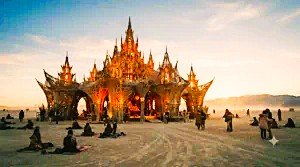
The Temple Guide 2026: Meaning, History & The Temple Burn at Burning Man
The Temple began in 2000 as an unplanned memorial when artist David Best and Jack Haye’s Temple of the Mind became a tribute to a crew member who died before the event Unlike The Man, which celebrates community through a festive burn, the Temple represents remembrance, healing, and impermanence. It has become one of the most respected traditions at Burning Man and is visited by nearly everyone during the event. This guide explains the Temple’s history, annual designs, traditions, visitor etiquette, and the meaning behind the Temple Burn. This guide explains its history, evolving design, and the emotional weight of its closing burn. It is widely considered the most solemn space in an otherwise high-energy event.
Unlike most of Black Rock City’s art, the Temple wasn’t originally designed as a memorial space — it became one by circumstance. In 2000, artists David Best and Jack Haye brought a structure called the Temple of the Mind to the playa; when their friend and fellow builder Michael Hefflin died in a motorcycle accident before the event, participants spontaneously began leaving remembrances there, and the tradition was born. The following year’s Temple of Tears cemented it as an annual fixture, and David Best has designed or coordinated roughly half of the Temples built since, alongside other artists who’ve taken on the role in later years.
This guide explains the Temple’s origin and evolution — from modest wooden structures to large-scale works like Galaxia, the largest Honorarium-funded project in Burning Man history at 20 meters tall — and the traditions that have grown around it: participants write letters to lost loved ones, leave photographs and mementos, and gather quietly amid the city’s otherwise constant activity. Unlike The Man’s celebratory Burn Night, the Temple Burn, typically held the night after, is marked by silence and collective grief and release rather than fireworks and cheering.
For visiting etiquette specifics and where the Temple sits relative to the rest of the city, see the Landmarks & Iconic Places Guide; for The Man’s contrasting celebratory burn, see The Man Guide.
In This Guide You’ll Learn
- 🛕 What is the Temple?
- 📜 History of the Temple
- 🏗️ How the Temple is built
- ❤️ Why people visit
- 📝 Memorial traditions
- 🔥 Temple Burn ceremony
- 🤝 Respectful behavior
- 📸 Photography guidance
- 🌍 Cultural significance
- ⚠️ Visitor etiquette
What Is the Temple at Burning Man?
The Temple is one of the most emotionally powerful places at Burning Man, and it holds a completely different energy from the rest of Black Rock City. While The Man is about release, celebration, and collective fire, the Temple is about memory, grief, love, healing, and quiet reflection. It is a space where people slow down, speak softly, and bring real parts of their lives to the playa. For many Burners, visiting the Temple becomes one of the most meaningful moments of the entire week.
Understanding the Purpose of the Temple
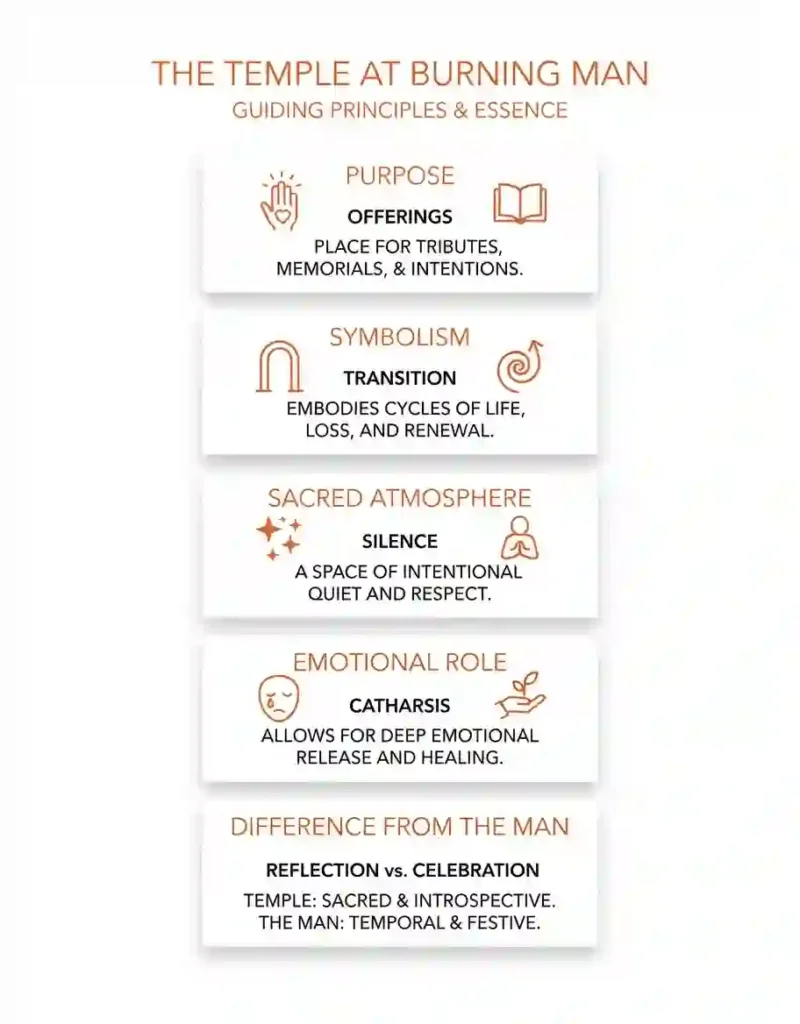
The Temple exists as a place for personal remembrance and emotional release. People come here to honor loved ones, reflect on loss, write letters, or simply sit in silence and process what they are carrying inside. It is not a performance space, and it is not built for noise or spectacle. Its purpose is to create room for honesty, stillness, and human vulnerability in the middle of an otherwise high-energy event.
Why the Temple Is Different from The Man
The Temple and The Man are both central icons of Burning Man, but they serve very different emotional roles. The Man is associated with community energy, transformation, and the big public burn, while the Temple holds a much quieter, inward-facing space. People often feel the difference immediately when they walk from one to the other. The contrast between them helps define the emotional range of the event itself.
What Does the Temple Symbolize?
The Temple symbolizes memory, love, loss, and the act of letting go. For some visitors, it represents grief; for others, gratitude, healing, forgiveness, or connection to someone who is gone. Its meaning is deeply personal, which is part of why it resonates so strongly with so many people. The Temple does not tell you what to feel — it gives you space to feel it.
Why the Temple Is One of Burning Man’s Most Sacred Spaces
The Temple is considered sacred not because of religion, but because of the care and respect people bring to it. Visitors treat it with a seriousness that is rare at large events, and that shared respect creates an atmosphere that feels almost reverent. People lower their voices, move gently, and respond to the space with attention. That collective behavior is what gives the Temple its sacred character.
The Emotional Heart of Black Rock City
If The Man is the visual center of Black Rock City, the Temple is often the emotional center. It absorbs thousands of private stories without asking for attention in return. Some people cry there, some pray, some sit in silence, and some write things they have never said aloud anywhere else. That emotional depth is why the Temple stays with people long after the event ends.
- The Temple is a quiet, reflective space for remembrance and healing.
- It is emotionally different from The Man.
- Its symbolism is personal rather than fixed.
- Visitors treat it with deep respect because of its sacred atmosphere.
The History of the Temple
The Temple did not begin as a polished festival landmark; it grew into its role over time as Burning Man evolved emotionally and culturally. What started as a smaller tradition eventually became one of the most important parts of the event. The Temple’s history is tied to the growth of Burner community values, especially remembrance, grief, and collective reflection. That history matters because it explains why the Temple now holds such a deep place in the culture.
How the Temple Tradition Began
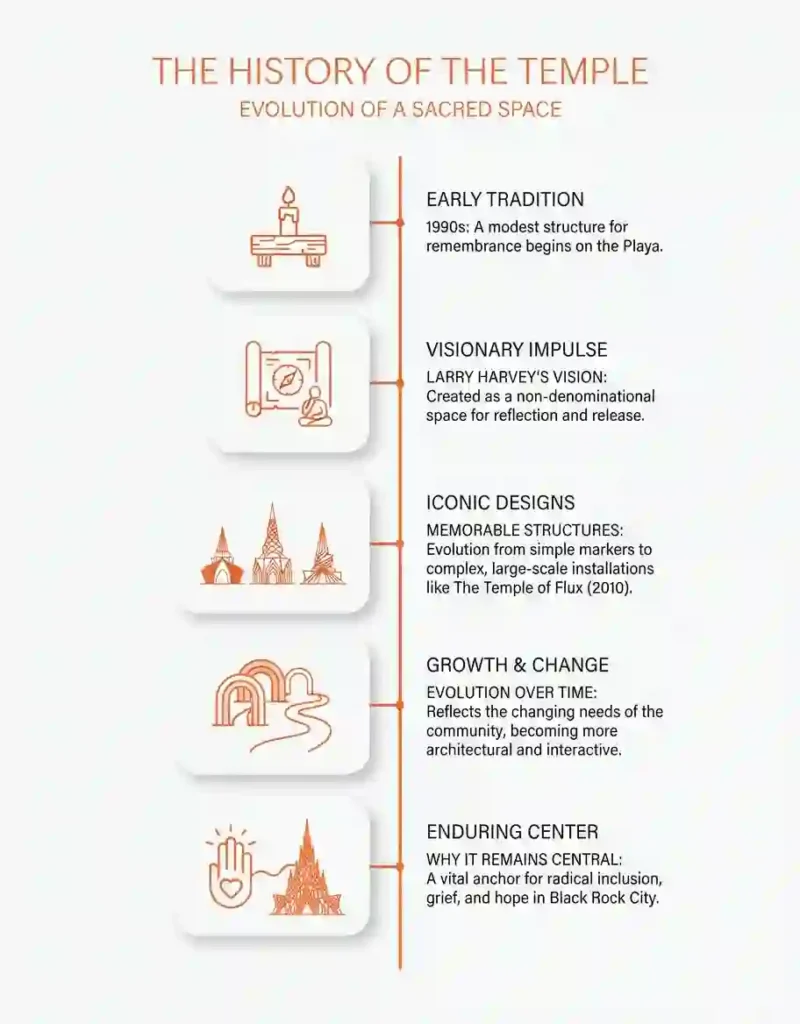
The Temple tradition began when Burning Man participants started creating spaces that held emotional meaning beyond art or spectacle. Over time, the idea of a dedicated memorial structure took shape and became part of the event’s identity. The early versions were less elaborate than what people see now, but they carried the same emotional purpose. From the beginning, the Temple was about giving grief and memory a physical place to live for a while.
Larry Harvey’s Vision and the Evolution of the Temple
Larry Harvey’s influence helped shape Burning Man into more than a festival of art and fire. The Temple became part of that broader vision by offering space for contemplation and emotional release. As the event matured, the Temple evolved into a major feature that reflected the human side of the culture. It became a place where the event’s deeper values could be felt, not just discussed.
Memorable Temple Designs Through the Years
Each year’s Temple becomes memorable because it reflects a different emotional shape, not just a different look. Some designs feel open and airy, while others feel more enclosed, layered, or monumental. Burners often remember a Temple design not because it was flashy, but because it supported the kind of experience people needed that year. In this way, the design becomes part of the memory.
How the Temple Has Changed Over Time
The Temple has changed in scale, style, and artistic language as Burning Man has grown. These changes reflect both creative evolution and the needs of the community. What has stayed the same is the Temple’s emotional role as a place of remembrance and release. That consistency is one reason it remains so important even as the event itself keeps changing.
Why the Temple Remains Central to Burning Man
The Temple remains central because it gives the event emotional balance. Without it, Burning Man would lean too heavily toward spectacle and energy without enough space for stillness. The Temple reminds people that celebration and grief can exist in the same world. That balance is part of what makes the culture feel complete.
- The Temple grew out of Burning Man’s evolving emotional culture.
- Its history reflects the event’s shift toward deeper reflection.
- Temple designs change, but the purpose stays consistent.
- It remains central because it gives the event emotional balance.
Who Should Visit the Temple?
The Temple is open to more than one kind of visitor, and that is one of its strengths. You do not need to be grieving a specific loss to understand or appreciate the space. Many people come because they want silence, perspective, a pause from the intensity of the playa, or a moment of meaning. The Temple welcomes anyone who wants to approach it with sincerity and care.
People Honoring Loved Ones
Many visitors come to the Temple to remember someone who has died. They may bring a name, a photo, a letter, or simply their presence. For these visitors, the Temple becomes a place where memory can be externalized and held in community space. It offers a kind of emotional shelter that can be hard to find elsewhere.
Visitors Seeking Quiet Reflection
Not everyone comes to the Temple because of grief. Some people come because they want stillness, perspective, or time to think. In a festival environment full of motion, the Temple offers a counterbalance that feels grounding. Even a few minutes there can reset the emotional rhythm of the day.
First-Time Burners
First-time Burners should absolutely visit the Temple, even if they do not fully know what to expect. It helps them understand that Burning Man is not only about art cars, music, and fire. The Temple reveals the quieter, deeper side of the event. That first visit often changes how people understand the whole culture.
Families and Friends
Families and close friends often experience the Temple together in a way that feels more intimate than the rest of the event. The shared silence can create room for real conversation or mutual support. It is one of the few spaces at Burning Man where people often slow down enough to simply be with each other. That can make it especially meaningful for groups.
Anyone Looking for a Meaningful Experience
Anyone who wants a meaningful, respectful, and emotionally honest experience should consider visiting the Temple. It is not exclusive, and it does not require a certain background or belief system. What matters most is presence and care. If you come with respect, the space offers something real in return.
- The Temple is for people honoring loved ones, reflecting quietly, or seeking meaning.
- First-time Burners should visit to understand the deeper side of the event.
- Families and friends often experience it together in a powerful way.
- The Temple welcomes respectful visitors of many different backgrounds.
How Is the Temple Designed Each Year?
The Temple is redesigned every year, but its purpose always stays rooted in memory and reflection. The design process has to balance artistry, emotional tone, structural demands, and the desert environment. That means the Temple is never just a pretty building; it is a thoughtful space created to hold feeling. Each year’s version becomes part of the event’s emotional memory.
Annual Design Selection
The annual design is chosen with care because the Temple carries a unique emotional responsibility. The selected design must feel appropriate to the community spirit of the year while still being structurally and visually strong. This process gives each Temple a distinct identity. It also helps the event feel fresh without losing continuity.
Architecture and Artistic Inspiration
The Temple often draws from architectural language that feels open, calm, and contemplative. Designers think about light, scale, line, and atmosphere so that the structure feels inviting rather than overwhelming. The best Temple designs create a sense of stillness just by the way they are shaped. That design quality matters as much as symbolism.
Sustainable Materials and Construction
The Temple must be built with materials that suit a temporary desert city and support the event’s Leave No Trace ethic. Sustainability is part of the design conversation from the beginning. The structure has to look beautiful while also being practical for transport, assembly, and eventual burn. That makes material choice a meaningful part of the process.
Volunteers and Community Builders
A Temple is never just the work of one person; it is a community effort. Volunteers and builders contribute time, skill, and care to make the structure real. That shared labor mirrors the emotional purpose of the Temple itself, which is also about collective participation. The building process becomes part of the story.
Building for the Desert Environment
The Black Rock Desert is harsh, unpredictable, and unforgiving to large structures. The Temple has to be designed for wind, dust, heat, and dry conditions that can challenge every stage of construction. That reality shapes everything from form to materials to timing. Good Temple design is both emotional and practical.
- The Temple is redesigned each year with emotional and structural care.
- Its design balances artistry, sustainability, and desert conditions.
- Volunteers play a major role in bringing it to life.
- The structure must feel calm while also surviving a harsh environment.
How Is the Temple Built?
Building the Temple is a serious process that begins long before people arrive in Black Rock City. The construction requires planning, skilled hands, safety awareness, and a lot of patience. What visitors see on the playa is the final result of many invisible stages of work. That behind-the-scenes effort is part of what makes the Temple feel so respected.
Planning Before the Event
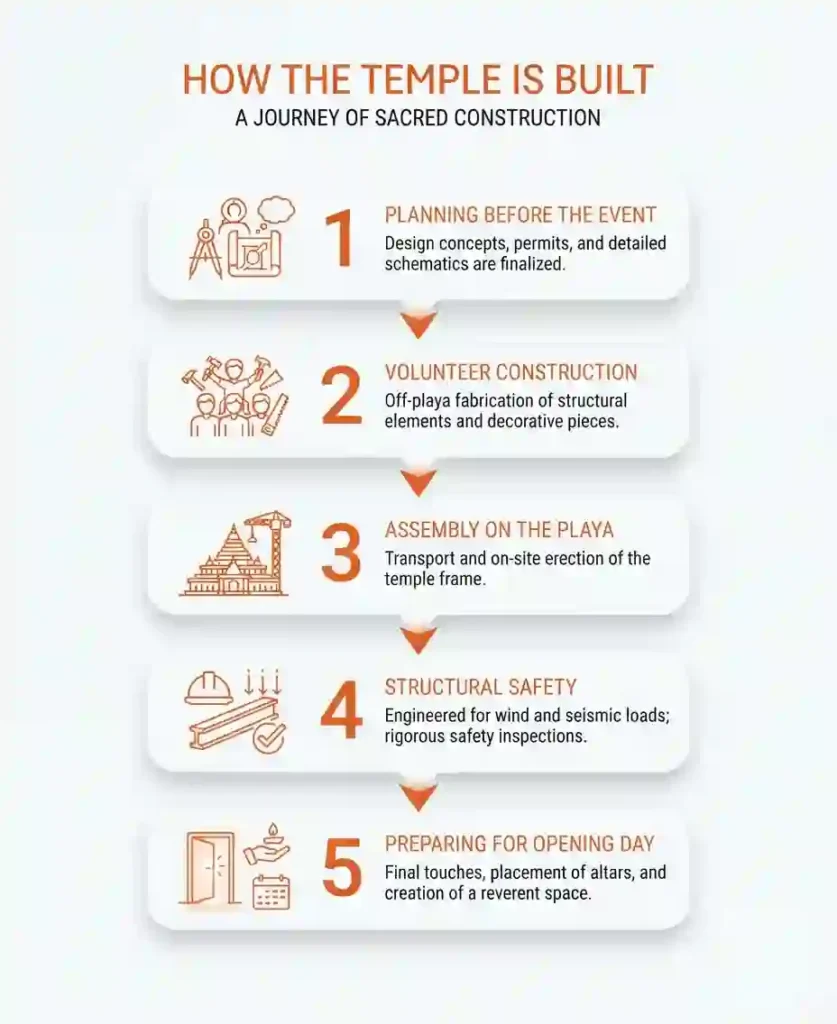
Much of the Temple’s work happens before the event begins. Designers, builders, and organizers must coordinate logistics, materials, and schedules so the structure can be assembled on time. The planning stage is where the emotional concept becomes a buildable project. Without that early work, the final structure would not be possible.
Volunteer Construction Process
Volunteer construction is a core part of how the Temple comes together. People show up to help because they believe in the project and what it means to the community. The work can be physically demanding, but it also carries emotional purpose. Many volunteers understand that they are helping build a space that will matter deeply to others.
Assembly on the Playa
Once construction reaches the playa, the work becomes more immediate and visible. Pieces are arranged, connected, and shaped under desert conditions that can change quickly. The assembly process has to move with both precision and flexibility. It is one of the moments where planning and reality meet face to face.
Structural Safety and Engineering
The Temple has to be safe, stable, and able to withstand the conditions of the desert. Engineering is not separate from the artistic process; it makes the experience possible. Every major public structure at Burning Man must be built with safety in mind, and the Temple is no exception. That careful engineering supports the emotional atmosphere people come for.
Preparing for Opening Day
Before visitors are allowed to fully experience the Temple, everything must be checked, finished, and made ready. This final stage helps ensure the structure is both beautiful and safe. It is also the moment when the Temple begins shifting from a construction project into a living memorial space. Once it opens, the emotional life of the structure truly begins.
- The Temple’s build starts long before the event opens.
- Volunteer labor is a major part of the construction process.
- Assembly on the playa requires patience and precision.
- Safety and final preparation are essential before visitors arrive.
Where Is the Temple Located?
The Temple sits in a deliberate location within Black Rock City, which helps shape the emotional geography of the event. Its position is not random; it gives visitors a place to walk toward with intention. The relationship between the Temple and The Man also matters because it creates a symbolic balance across the city. For many Burners, the walk to the Temple feels as meaningful as arriving there.
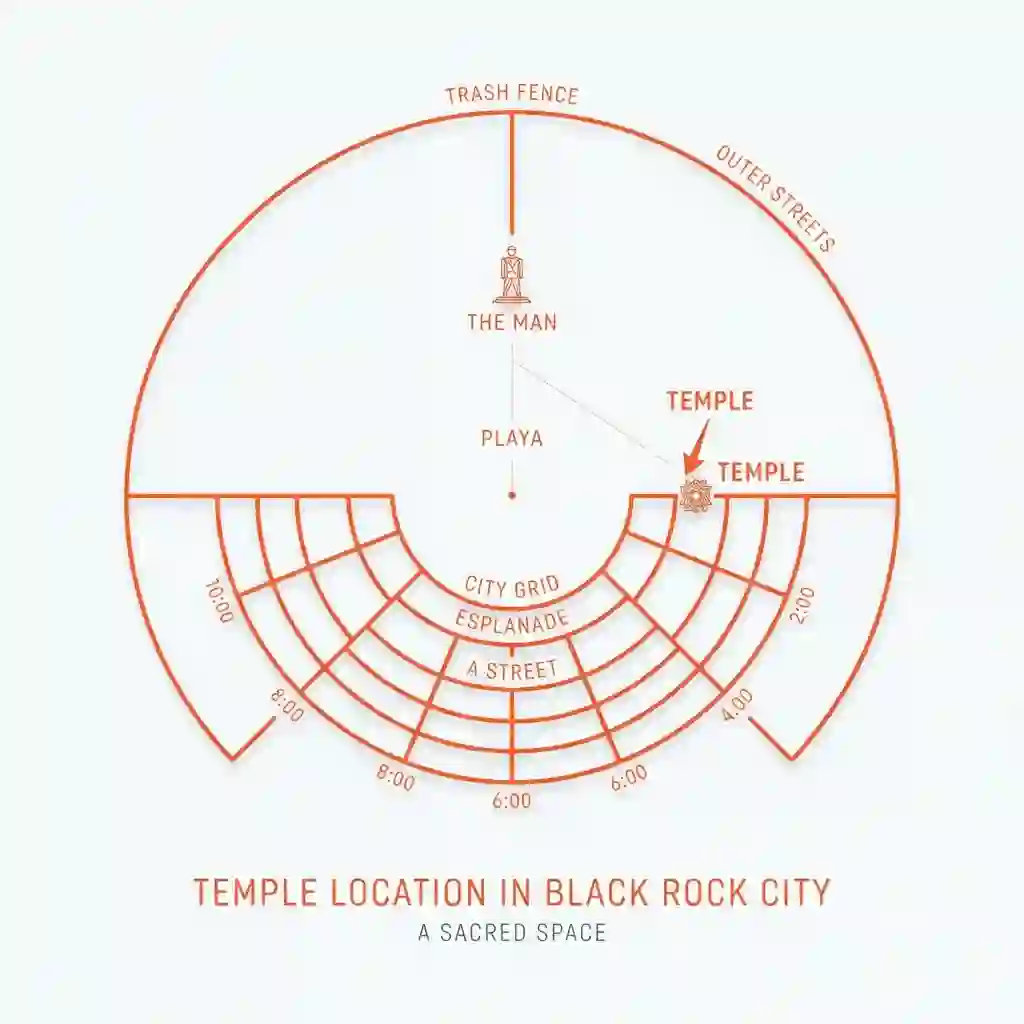
The Temple’s Position in Black Rock City
The Temple is placed so it functions as a major landmark within the temporary city. Its location helps organize how people move through the event and how they mentally map the space. Because it is such a distinct destination, many visitors treat the walk there as part of the experience. The journey is often part of the reflection.
Relationship to The Man
The Temple and The Man are often discussed together because they anchor opposite emotional poles of Burning Man. The Man is associated with energy, participation, and the burn, while the Temple holds stillness and memory. That contrast is powerful because it shows the event’s emotional range. Together, they give the playa both motion and pause.
Walking to the Temple
Walking to the Temple often feels different from walking to other places at Burning Man. People tend to slow down naturally as they get closer, and conversations often become quieter. The approach itself can help prepare a visitor emotionally for what they are about to enter. It is not just a path; it is a transition.
Best Times to Visit
The Temple can be deeply moving at different times of day, but many people find early morning, sunset, and nighttime especially memorable. Morning can feel calm and empty, while evening often brings a softer emotional tone. Choosing the right time depends on what kind of experience you want. Some people prefer quiet reflection, while others want to feel the shared atmosphere of other visitors.
Navigating Respectfully
Respectful navigation means approaching the Temple with awareness of the space and the people inside it. Visitors should move gently, avoid loud behavior, and keep their attention on the environment around them. The Temple is not a place to rush through. Treating it with care is part of how you honor the experience.
- The Temple’s placement helps shape the emotional map of Black Rock City.
- Its relationship to The Man creates an important contrast.
- The walk to the Temple is part of the experience.
- Visitors should approach and move through the space respectfully.
What Happens Inside the Temple?
Inside the Temple, people leave pieces of their hearts behind in the form of messages, photographs, mementos, and quiet presence. The space becomes a temporary archive of human feeling. Some people come in to write, some to cry, some to sit still, and some to stand in silence and witness what others have left. The Temple’s interior life is what makes it so unforgettable.
Personal Messages and Memorials
Visitors often leave names, notes, dedications, and short messages inside the Temple. These can be deeply personal and are usually written with great care. Each message becomes part of the collective emotional landscape of the space. Over time, the Temple becomes filled with these quiet acts of remembrance.
Photographs, Letters, and Mementos
Many people bring photographs, letters, ribbons, or small objects connected to someone they love. These items transform the Temple into a physical site of memory. They are not random decorations; they are meaningful offerings. Each one represents a relationship, a story, or a moment that mattered.
Quiet Reflection and Meditation
The Temple invites silence in a way that feels rare at Burning Man. People often sit, breathe, read messages, or simply stare at the structure and let their thoughts settle. That stillness creates a powerful contrast with the rest of the event. For many visitors, it becomes the first place where they truly slow down.
Community Healing
Although the Temple is personal, it also creates a shared emotional field. People often feel comforted simply by knowing others have brought their own stories there. That shared vulnerability can feel surprisingly healing. It reminds visitors that pain and love are both part of human life.
Respecting Others’ Experiences
Because everyone in the Temple is carrying something different, respect is essential. A person may be grieving, reflecting, or having a private emotional moment that is not visible from the outside. The best way to honor the space is to let others have their experience without interruption. Quiet empathy goes a long way there.
- Visitors leave messages, photographs, letters, and mementos inside the Temple.
- The space invites silence, reflection, and emotional release.
- The Temple supports both personal and shared healing.
- Respect for other visitors’ experiences is essential.
Can Anyone Leave a Memorial?
Yes, anyone who approaches the Temple respectfully can leave a memorial or personal message. The space is open to different kinds of remembrance, and there is no single correct way to participate. Some people write for a loved one, some for themselves, and some leave something symbolic instead of literal. What matters most is sincerity and care.
Temple Traditions: What People Leave Behind
| Memorial Item | Meaning |
| Letters | Messages to loved ones or personal reflections |
| Photographs | Honoring family members, friends, or memories |
| Poems & Artwork | Creative expressions of love, grief, hope, or gratitude |
| Names | Remembering people, pets, or meaningful moments |
| Small Handwritten Notes | Forgiveness, healing, future hopes, or personal milestones |
| Symbolic Objects* | Items with personal meaning that comply with Temple guidelines and are safe to burn |
*Only leave items that comply with Burning Man’s Temple guidelines and are appropriate for the burn.
What Visitors Commonly Leave
People commonly leave handwritten notes, names, photos, small tokens, or messages folded into the wood. Some visitors leave material connected to a memory, while others leave words that help them process emotion. The variety of offerings is part of what makes the Temple so moving. It reflects the many ways people carry love and loss.
Writing Letters and Messages
Writing a letter at the Temple can be deeply meaningful because it gives shape to thoughts that may be hard to say aloud. Many visitors use the space to speak directly to someone they lost or to express something they have been holding inside. The act of writing can be as important as the leaving itself. It turns feeling into something tangible.
Honoring Loved Ones
Leaving something at the Temple is often a way to honor a person who mattered deeply. That memorial may be private, simple, or highly personal. The Temple welcomes that kind of sincerity without requiring performance or explanation. It allows grief and love to be expressed in a quiet, respectful way.
Respecting Shared Spaces
The Temple is full of deeply personal material, so shared-space respect matters more than usual. Visitors should be mindful not to disturb items left by others or treat the space casually. What one person leaves may be sacred to another. Respect keeps the Temple emotionally safe for everyone who enters it.
Leave No Trace Considerations
Even though people leave memorials, the Temple still exists within Burning Man’s larger Leave No Trace ethic. Participants should think carefully about what they bring and what is appropriate to leave behind. The goal is to honor memory without creating unnecessary environmental harm. That balance is part of responsible participation.
- Visitors can leave memorials, letters, photos, or symbolic offerings.
- Writing at the Temple can help people process emotion.
- Respect for shared memorial space is essential.
- Leave No Trace still matters even in a memorial setting.
Why Is the Temple Burned?
The Temple is burned because fire gives emotional closure to a structure built for memory, release, and reflection. The burn is not a celebration in the same sense as The Man burn; it is quieter, deeper, and often more solemn. By the time the Temple burns, it has absorbed an enormous amount of meaning from the people who visited it. The fire becomes a final act of letting go.
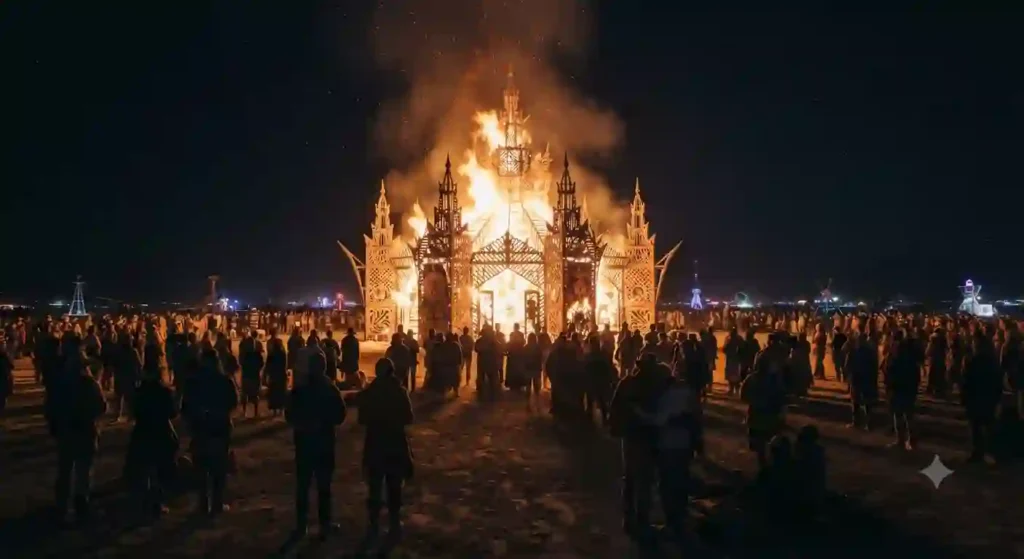
The Meaning Behind the Temple Burn
The Temple burn represents release, closure, and transformation. It allows the memorial space to complete its temporary life in the desert. People who have placed memories there often experience the burn as a final chapter. The meaning comes from both the structure and the emotional energy it has held.
Letting Go Through Fire
Fire has long been associated with transformation, and the Temple burn uses that symbolism in a very human way. Watching the structure burn can feel like releasing what can no longer be held. For some people, that moment brings relief; for others, sadness; for many, both at once. The burn honors that complexity instead of trying to simplify it.
A Ceremony of Reflection
The Temple burn is often experienced as a ceremony of reflection rather than excitement. People gather with a quiet attention that feels almost meditative. The mood is different from most large public burns because the emotional focus is inward. That reflective tone is a defining feature of the Temple tradition.
Why the Burn Happens in Silence
The silence is one of the most important parts of the Temple burn. It creates a respectful atmosphere where people can process what they are seeing without distraction. Silence also allows grief, memory, and gratitude to remain personal even in a public setting. The quiet makes the moment more powerful, not less.
The Difference Between the Temple Burn and The Man Burn
The Temple burn and The Man burn are often confused by newcomers, but they are emotionally distinct. The Man burn is generally more communal, energetic, and celebratory, while the Temple burn is more contemplative and quiet. They serve different roles in the emotional rhythm of the event. Understanding that difference helps first-timers experience both with the right mindset.
The Temple vs The Man
| Feature | The Temple | The Man |
| Primary Purpose | Reflection, remembrance, healing | Celebration, creativity, community |
| Atmosphere | Quiet and contemplative | Energetic and festive |
| Visitor Experience | Personal reflection and memorials | Gathering, exploration, celebration |
| Burn Ceremony | Silent and emotional | Festive and celebratory |
| Best Time to Visit | Sunrise, sunset, and throughout the week | Daytime, sunset, and burn night |
| Symbolism | Letting go, healing, remembrance | Creativity, impermanence, participation |
- The Temple burn brings closure to a memorial space.
- It is about release, reflection, and transformation.
- Silence is central to the experience.
- The Temple burn is emotionally different from The Man burn.
Temple Etiquette and Visitor Guidelines
The Temple asks visitors to be especially aware of how they move, speak, and behave. Because people come there carrying private emotions, etiquette matters more than at many other areas of Burning Man. The right behavior is not complicated, but it does require sensitivity. A respectful visitor helps preserve the calm that makes the Temple meaningful.
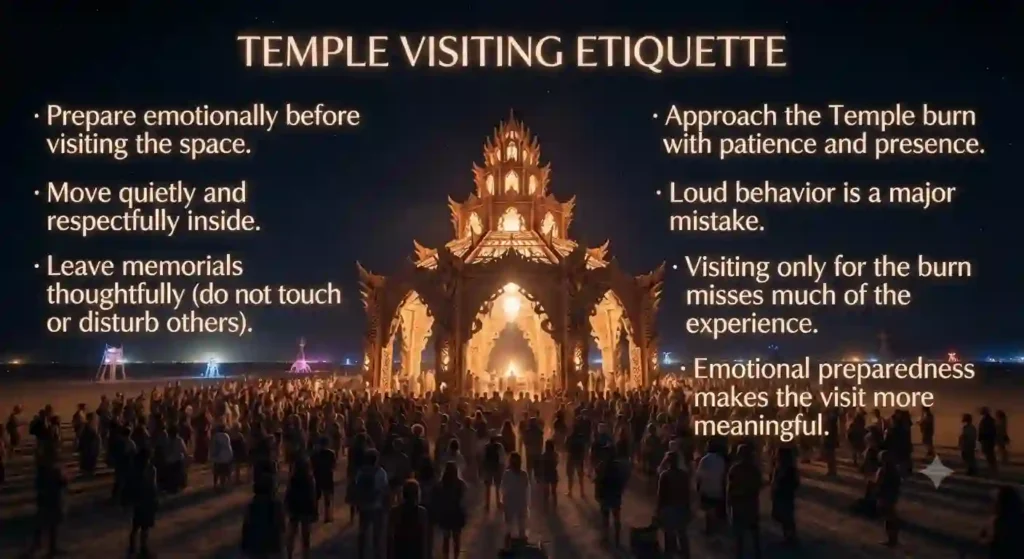
Maintaining Silence and Respect
Quiet behavior is one of the clearest signs of respect in the Temple. People should avoid loud conversation, joking, or disruptive movement. The space works best when visitors treat it as a place for presence rather than entertainment. Silence helps protect the atmosphere everyone came to feel.
Photography Etiquette
Photography is a sensitive issue because the Temple contains personal memorials and private moments. Visitors should be thoughtful about when and how they take photos, and they should never assume it is appropriate to photograph everything. Respect for the space should come before the desire for a picture. If in doubt, it is better to pause and observe.
Interacting With Memorials
Memorials inside the Temple should be treated carefully and never handled casually. Visitors should not move, touch, or disturb items that belong to others’ personal stories. Even small actions can carry emotional weight for someone else. The best approach is gentle observation and restraint.
Children and Families at the Temple
Children and families can visit the Temple, but they should be prepared for a quiet, emotional environment. Adults should explain the tone of the space beforehand so younger visitors understand how to behave there. Families often find that the Temple can open meaningful conversations about memory and care. With guidance, it can become a very valuable visit.
Supporting a Peaceful Environment
Everyone contributes to the overall feeling of the Temple, whether they realize it or not. Speaking softly, moving slowly, and being mindful of others all help maintain the environment. The Temple’s peace is fragile in a good way — it is held up by the people who visit it. That shared responsibility is part of what makes the space beautiful.
- Silence and respect are central Temple etiquette.
- Photography should be approached carefully.
- Memorials must not be disturbed.
- Families can visit if they prepare children for the tone of the space.
Interesting Facts About the Temple
The Temple may feel quiet and simple on the surface, but there is a great deal of work, scale, and meaning behind it. The structure changes every year, yet it always draws thousands of deeply personal offerings from visitors. Its emotional power is matched by the effort it takes to create it. That combination is what makes it so remarkable.
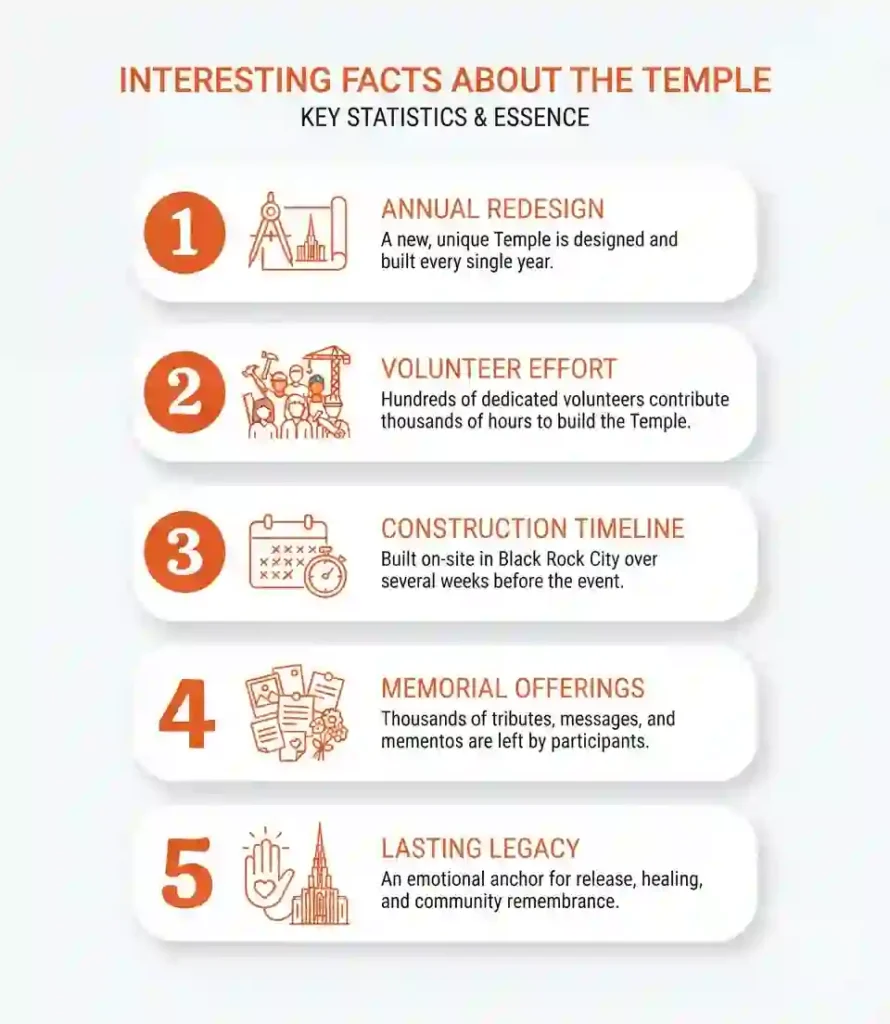
Annual Temple Designs
Each year’s Temple becomes a one-time expression of a larger emotional idea. That means no two years feel exactly the same, even though the core purpose remains steady. The annual redesign gives the community a fresh physical space to hold its memories. It also keeps the tradition alive as a living practice instead of a museum piece.
Volunteer Contributions
Volunteer work is a big part of how the Temple comes together. People contribute time, labor, and care because they understand the significance of the structure. Their work supports a space that may affect thousands of visitors in deeply personal ways. That contribution is a meaningful part of the story.
Construction Timeline
The Temple takes a long time to move from idea to finished structure. The process includes design, planning, materials, transport, assembly, and final preparation. The scale of the work is easy to underestimate until you realize how much has to happen before the public ever steps inside. The timeline itself reflects the seriousness of the project.
Thousands of Personal Memorials
By the end of the event, the Temple often holds countless personal messages and offerings. That accumulation turns it into one of the most emotionally dense places on the playa. Each item is small on its own, but together they create a powerful collective record of human feeling. The result is unforgettable.
The Temple’s Lasting Legacy
The Temple’s legacy continues long after the burn because people carry the experience with them. It influences how visitors think about grief, art, silence, and community. For many Burners, the Temple becomes one of the most meaningful things they have ever encountered at the event. Its impact often lasts far beyond the week itself.
- The Temple changes every year but keeps the same emotional purpose.
- Volunteers are essential to its creation.
- The construction timeline is long and demanding.
- Its legacy comes from the thousands of personal memorials it holds.
Common Myths About the Temple
The Temple is often misunderstood by first-timers who only know Burning Man through photos or short stories. Some people assume it is religious, others assume it is only for grief, and some think it is off-limits unless you bring a memorial. These ideas miss the point. Clearing them up helps visitors approach the Temple more openly and respectfully.
| Myth | Reality |
|---|---|
| The Temple is a religious building. | The Temple is a non-denominational space for reflection, remembrance, healing, and personal expression. |
| Only people experiencing grief should visit. | Anyone is welcome to visit for quiet reflection, gratitude, hope, or contemplation. |
| Talking is prohibited inside the Temple. | Silence is encouraged out of respect, but quiet conversation is acceptable when appropriate. |
| The Temple Burn is like The Man Burn. | The Temple Burn is traditionally observed in near silence and has a much more reflective atmosphere. |
| You must leave a memorial. | Many visitors simply sit quietly, meditate, or appreciate the architecture without leaving anything behind. |
| Photography is always inappropriate. | Photography is allowed, but visitors should be especially respectful of others’ privacy and emotional moments. |
Myth: The Temple Is a Religious Building
The Temple can feel sacred, but it is not a religious building in the formal sense. Its significance comes from the emotional and communal meaning people bring to it. Visitors from many backgrounds connect with it in different ways. That openness is part of its strength.
Myth: Only People Experiencing Loss Should Visit
The Temple is certainly important for people who are grieving, but it is not limited to them. Anyone who wants quiet reflection, emotional grounding, or a meaningful pause can visit. The space is broad enough to welcome many kinds of experience. It does not require a specific story to be valid.
Myth: Visitors Must Leave a Memorial
You do not have to leave anything to benefit from or participate in the Temple experience. Many people simply come to sit, observe, reflect, or support others. The Temple is meaningful even when you leave nothing behind. Presence alone can be enough.
Myth: Photography Is Completely Forbidden
Photography is sensitive, but it is not automatically forbidden in every situation. The real issue is respect, timing, and awareness of the people around you. Some moments are not appropriate to capture, and some memorials are private. Thoughtful behavior matters more than blanket assumptions.
Myth: The Temple Burn Is a Celebration Like The Man Burn
The Temple burn is not experienced the same way as The Man burn. It is usually quieter, more reflective, and emotionally heavier. People often come to it in a very different mindset. The distinction is one of the most important things for first-time visitors to understand.
- The Temple is not a formal religious building.
- It welcomes people beyond those experiencing loss.
- Leaving a memorial is optional.
- The Temple burn has a very different tone from The Man burn.
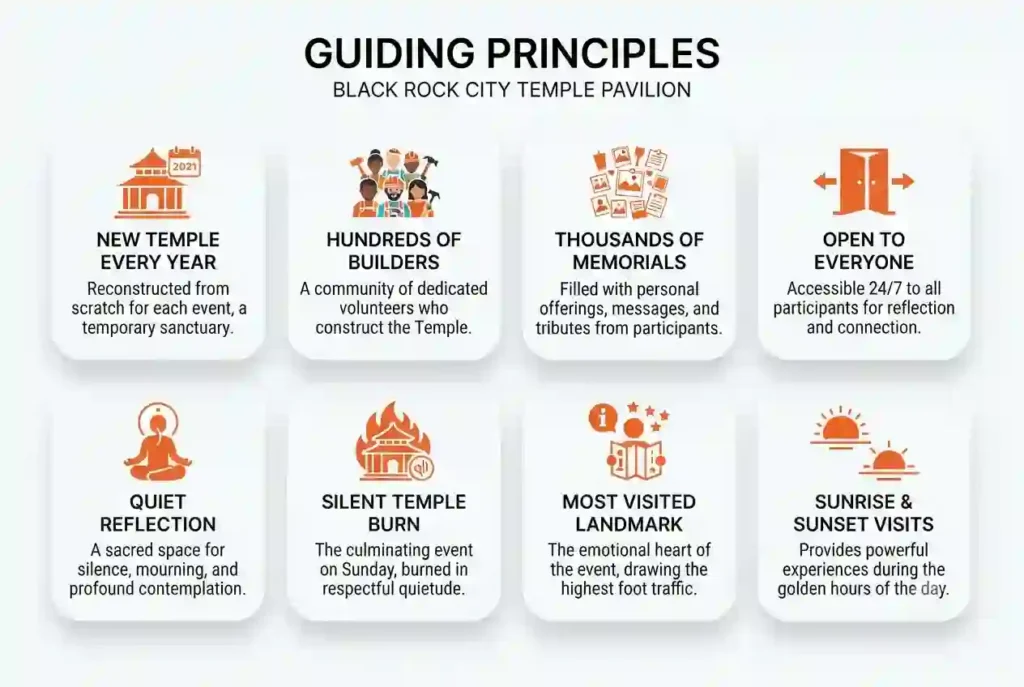
The Temple in Number
The Temple is one of the most meaningful places in Black Rock City. Every year, a new Temple is designed and built as a peaceful space where participants leave messages, photographs, artwork, and personal memorials before it is respectfully burned during the Temple Burn ceremony.
Key Numbers
- 🏛️ 1 New Temple Every Year — A unique Temple is designed and built specifically for each Burning Man event.
- 👷 Hundreds of Builders & Volunteers — Artists, architects, engineers, and volunteers collaborate to construct the Temple.
- ❤️ Thousands of Personal Memorials — Participants leave letters, photographs, names, artwork, and messages throughout the week.
- 🌍 Open to Everyone — Anyone may visit the Temple regardless of background, beliefs, or religion.
- 🤫 Quiet Reflection Encouraged — Unlike many areas of Burning Man, the Temple is treated as a peaceful space.
- 🔥 One Silent Burn Ceremony — The Temple Burn traditionally takes place on Sunday evening in near silence.
- 📸 One of the Most Visited Landmarks — Thousands of participants visit multiple times during the event.
- 🌅 Powerful at Sunrise & Sunset — Many visitors choose these quieter times for reflection and remembrance.
What Mistakes Do First-Time Visitors Make?
First-time visitors often misread the Temple because they approach it with the wrong expectations. The biggest mistakes usually involve tone, behavior, and emotional readiness. The Temple is simple to respect once you understand it, but newcomers can accidentally disrupt the atmosphere if they treat it like just another attraction. A little awareness makes a big difference.
Expecting a Festival Atmosphere
The Temple is not the place for hype, noise, or party energy. Newcomers sometimes arrive expecting something more like the rest of the event and are surprised by the quiet. That mismatch can lead to discomfort or inappropriate behavior. The Temple works best when you approach it with calm.
Speaking Loudly Inside the Temple
Loud voices can break the emotional atmosphere and disturb other visitors. Many people inside the Temple are in vulnerable moments, and volume matters more there than it does in other spaces. Speaking softly is a simple but important sign of respect. It helps preserve the tone.
Touching Personal Memorials
Visitors should never assume they can touch, move, or interact physically with memorials that belong to others. Those objects may carry deep emotional meaning for someone. Even a small gesture can feel intrusive. The safest behavior is to observe without interference.
Visiting Only During the Burn
Some first-timers only show up for the Temple burn and miss the quieter experience of visiting the structure during the week. That means they miss a major part of its meaning. The Temple is designed to be experienced over time, not just at the end. Earlier visits often leave a stronger impression.
Forgetting Emotional Preparedness
The Temple can bring up feelings that people do not expect. Visitors sometimes arrive without realizing how moving the space may be, and that can make the experience harder than it needs to be. Emotional preparedness does not mean overthinking it; it just means arriving open and grounded. That mindset helps a lot.
- First-timers often expect the wrong atmosphere.
- Loud behavior and touching memorials are major mistakes.
- Visiting only for the burn misses much of the experience.
- Emotional preparedness makes the visit more meaningful.
Experienced Burner Tips
Experienced Burners know that the Temple reveals more when you give it time and attention. It is not a place to rush through or reduce to a single moment. The best experiences usually come from returning, observing, and allowing the atmosphere to work on you slowly. That approach makes the Temple feel much deeper.
Visit More Than Once
Visiting the Temple multiple times lets you experience it in different emotional and lighting conditions. A quiet morning visit feels different from a late evening one. Returning more than once helps the space settle into your memory in a richer way. It also gives you time to process what you felt the first time.
Experience Sunrise or Sunset
Sunrise and sunset can make the Temple feel especially powerful. The changing light softens the structure and deepens the emotional tone of the space. Many Burners consider these the best times for reflection. They create a more contemplative atmosphere than midday.
Allow Time for Quiet Reflection
The Temple rewards patience, so it helps to give yourself time instead of squeezing it between other plans. Sitting quietly, reading messages, or simply taking in the structure can be enough. The slower you move, the more the space tends to open up. Reflection is part of the point.
Respect Everyone’s Personal Journey
Every visitor brings a different reason for being there, and none of those reasons should be judged. Some people are grieving, some are healing, and some are simply seeking stillness. Respecting those differences is essential. It keeps the Temple welcoming and emotionally safe.
Attend the Temple Burn Mindfully
The Temple burn deserves a mindful approach because of its solemn tone. Arrive with the right expectations, stay present, and allow the moment to unfold without forcing anything. The experience is often quieter and more intense than people expect. Mindfulness helps you receive it fully.
- Returning more than once deepens the experience.
- Sunrise and sunset are especially strong times to visit.
- Quiet reflection is the Temple’s natural rhythm.
- The burn should be approached mindfully and respectfully.
Temple Visitor Checklist
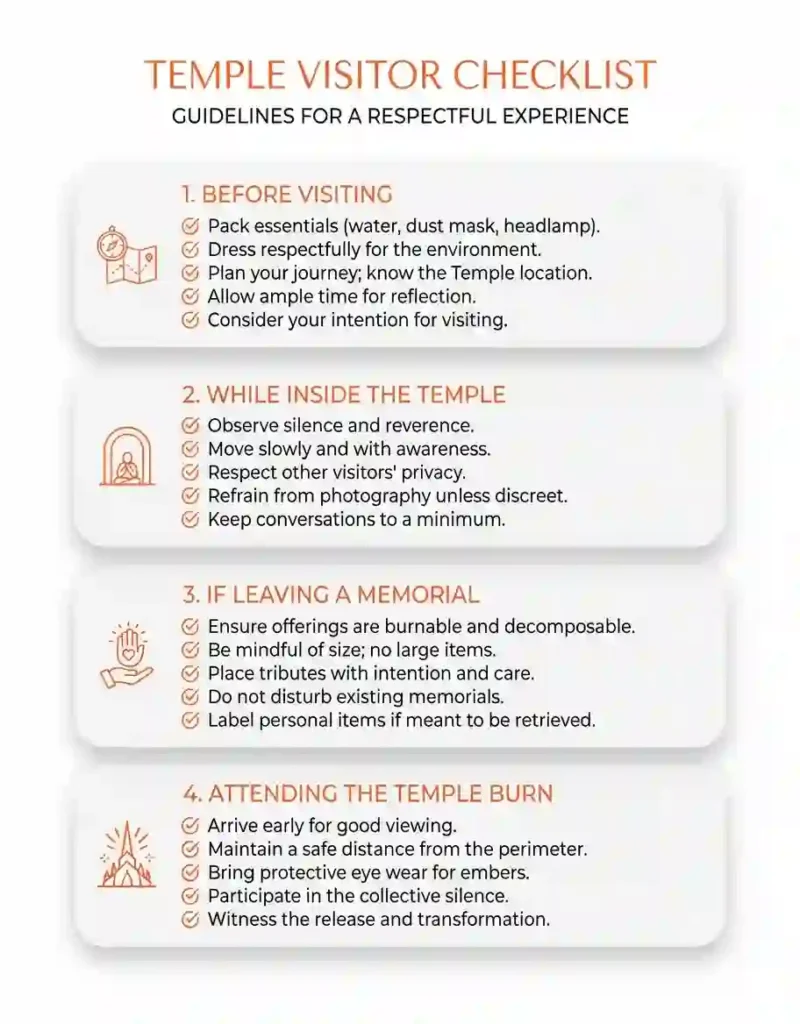
A simple checklist helps first-time visitors approach the Temple with care and confidence. The goal is not to overplan the experience, but to make sure you are emotionally and practically ready. The Temple is easy to visit, but it asks for a different kind of attention than the rest of Burning Man. A little preparation helps you show up well.
Before Visiting
Before you go, make sure you understand the tone of the space and what kind of experience you want to have. Bring only what you need, and think ahead about whether you plan to write something or simply observe. Emotional readiness matters here just as much as practical readiness. Going in with respect sets the right tone.
✅ Learn the purpose of the Temple
✅ Bring water for your visit
✅ Consider what you’d like to leave behind (if anything)
✅ Prepare to respect a quiet environment
While Inside the Temple
Once inside, move quietly and gently. Give other visitors space and avoid behavior that could interrupt their reflection. Stay aware of the memorials around you and treat them with care. The simplest rule is also the best one: be present, be calm, and be respectful.
✅ Speak softly
✅ Respect personal space
✅ Ask permission before photographing identifiable people
✅ Leave memorial items respectfully
If Leaving a Memorial
If you choose to leave something behind, make it intentional and appropriate. A note, letter, photo, or symbolic object can all carry meaning if they fit the setting. Be sure your offering does not create unnecessary clutter or conflict with the space’s temporary nature. Leave with care, not just emotion.
✅ Take only your personal belongings
✅ Leave no trace
✅ Reflect quietly before returning to the city
✅ Respect the significance of the space
Attending the Temple Burn
If you attend the Temple burn, prepare for a quieter and more reflective experience than the Man burn. Arrive with patience, respect the atmosphere, and let the moment happen without trying to turn it into something else. The burn is part of the Temple’s emotional life, not a spectacle to consume. That mindset will help you experience it well.
✅ Arrive early
✅ Follow Ranger instructions
✅ Remain quiet during the ceremony
✅ Respect the emotional experience of others
- Prepare emotionally before visiting the Temple.
- Move quietly and respectfully inside the space.
- Leave memorials thoughtfully if you choose to leave one.
- The Temple burn should be approached with patience and presence.
Key Insights About Temple
- The Temple is important because it supports memory and healing.
- It is open to all respectful visitors.
- Leaving messages is optional.
- The Temple burn is silent to preserve reflection and solemnity.Conclusion
- The Temple reflects the human side of Burning Man in a way that few places anywhere can match. It is not about spectacle or volume; it is about memory, grief, love, and the quiet ways people carry meaning. That emotional honesty is what makes it one of the most powerful spaces on the playa. The Temple leaves an impression that often lasts far longer than the event itself.
- The Temple Reflects the Human Side of Burning Man
- The Temple reminds visitors that Burning Man is not only about art and fire. It also makes room for tenderness, sorrow, gratitude, and reflection. That balance is essential to the event’s deeper identity. Without the Temple, the culture would feel incomplete.
- A Space for Remembrance, Healing, and Connection
- People come to the Temple carrying different stories, but they often leave with a similar sense of release or peace. The space creates connection without forcing it. That is one reason it resonates so strongly across such different kinds of visitors.
- Carrying the Temple’s Meaning Beyond the Playa
- The Temple’s meaning does not end when the burn is over. Visitors carry the experience home in the way they think, grieve, remember, and connect with others. That lingering effect is part of its power. It becomes something you live with, not just something you saw.
Frequently Asked Questions About the Temple
The Temple is a peaceful space where participants gather for reflection, remembrance, healing, and personal expression.
No. It welcomes people of all beliefs and serves as a non-denominational place for personal reflection.
Yes. Every participant is welcome to enter, reflect, and experience the Temple respectfully.
Many leave letters, photographs, artwork, names of loved ones, poems, or personal messages.
The Temple Burn symbolizes letting go, remembrance, healing, and acceptance as the event comes to a close.
The Temple traditionally burns on Sunday evening, the final night of Burning Man.
Yes, but visitors should be especially respectful and avoid photographing people during deeply personal moments without consent.
Silence allows participants to reflect, grieve, remember, and honor personal experiences without distraction.
Many arrive only on burn night and miss the opportunity to experience the Temple’s peaceful atmosphere throughout the week.
Absolutely. Many participants return several times during the week because the experience changes as more memorials are added.
No. Simply visiting, sitting quietly, or reflecting is just as meaningful as leaving a written message or personal item.
Where Should You Go Next?
| If You Want To… | Read This Guide |
| Learn about The Man | → The Man Guide |
| Explore Burning Man art | → Burning Man Art Guide |
| Discover monumental sculptures | → Large-Scale Art Installations Guide |
| Understand Burning Man culture | → Burning Man Culture Guide |
| Explore Black Rock City | → Black Rock City Guide |
Why Trust This Guide?
✅ Connects to related art and culture resources.
✅ Updated for the 2026 Burning Man season.
✅ Explains the Temple’s history, traditions, and cultural importance.
✅ Respects the diversity of personal experiences associated with the Temple.
✅ Suitable for first-time and returning Burners.
Temple Pro Tips
🤍 Visit early in the morning for the quietest atmosphere.
🌅 Return at sunset to experience the Temple in changing light.
📝 Bring a handwritten letter if you wish to leave a personal message.
📷 Photograph the architecture respectfully, but always prioritize consent and privacy.
🤫 Keep conversations quiet to preserve the peaceful environment.
❤️ Remember that every visitor may be carrying a deeply personal story.
🕊️ Attend the Temple Burn with an open mind and respect for the silent tradition. 🌍 Take time to appreciate both the architecture and the emotions shared within the space.
Conclusion
The Temple reflects the human side of Burning Man in a way that few places anywhere can match. It is not about spectacle or volume; it is about memory, grief, love, and the quiet ways people carry meaning. That emotional honesty is what makes it one of the most powerful spaces on the playa. The Temple leaves an impression that often lasts far longer than the event itself.
Temple Traditions: What People Leave Behind
| Memorial Item | Meaning |
| Letters | Messages to loved ones or personal reflections |
| Photographs | Honoring family members, friends, or memories |
| Poems & Artwork | Creative expressions of love, grief, hope, or gratitude |
| Names | Remembering people, pets, or meaningful moments |
| Small Handwritten Notes | Forgiveness, healing, future hopes, or personal milestones |
| Symbolic Objects* | Items with personal meaning that comply with Temple guidelines and are safe to burn |
*Only leave items that comply with Burning Man’s Temple guidelines and are appropriate for the burn.
The Temple Reflects the Human Side of Burning Man
The Temple reminds visitors that Burning Man is not only about art and fire. It also makes room for tenderness, sorrow, gratitude, and reflection. That balance is essential to the event’s deeper identity. Without the Temple, the culture would feel incomplete.
A Space for Remembrance, Healing, and Connection
People come to the Temple carrying different stories, but they often leave with a similar sense of release or peace. The space creates connection without forcing it. That is one reason it resonates so strongly across such different kinds of visitors.
Carrying the Temple’s Meaning Beyond the Playa
The Temple’s meaning does not end when the burn is over. Visitors carry the experience home in the way they think, grieve, remember, and connect with others. That lingering effect is part of its power. It becomes something you live with, not just something you saw.
Final Thoughts
The best way to experience the Temple is with respect, presence, and enough time to let it affect you. Do not rush it, do not reduce it, and do not treat it like a photo stop. Let it be quiet, let it be personal, and let it be real. After that, readers can continue into the The Man Guide, Burning Man Art Guide, Fire Art Guide, Mutant Vehicles Guide, and Black Rock City Guide to understand the wider landscape of the event.
Experience the Temple with Respect and Presence
The Temple is not something you “do” quickly. It is something you encounter slowly and remember deeply. If you give it space, it gives you something lasting in return.
- ❤️ Visit respectfully.
- 🛕 Allow quiet reflection.
- 📝 Respect personal memorials.
- 📸 Photograph thoughtfully.
- 🤝 Support the peaceful atmosphere.
- 🔥 Experience the Temple Burn respectfully.
- 🌱 Leave No Trace.
- 📖 Continue with the Large-Scale Art Installations Guide to explore more monumental artworks across the playa.