
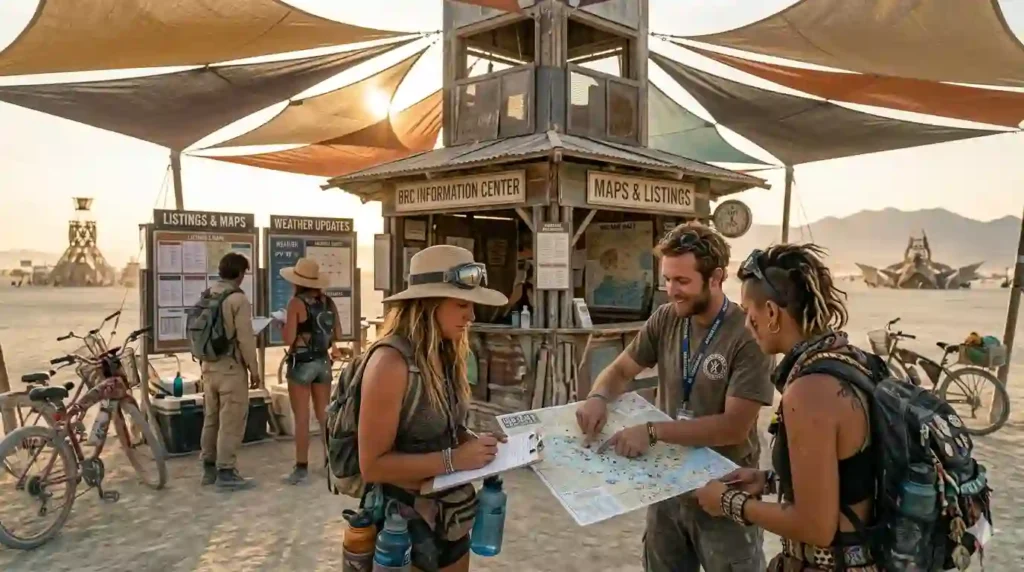
Black Rock City Services & Resources Guide 2026: How Burning Man’s Temporary City Operates
Behind Black Rock City’s apparent spontaneity is a remarkable volunteer-run infrastructure — departments like the Black Rock Rangers, the Department of Public Works (DPW), and Emergency Services build and operate the city before, during, and after the event. This guide explains what each department does and where to seek help. Volunteers, not paid staff, run nearly all of it.
Black Rock City doesn’t run on paid municipal staff — it’s built and operated almost entirely by volunteers organized into specialized departments, many of whom arrive weeks before the event to construct infrastructure and stay after most participants leave to help restore the desert.
The Department of Public Works (DPW) handles construction, road grading, and the physical build-out of the city itself. The Black Rock Rangers serve as a non-confrontational community safety and mediation presence, distinct from law enforcement. Black Rock City Emergency Services Department (ESD) provides on-site medical response. Arctica manages the city’s ice sales operation, one of the only commercial-style transactions permitted under the event’s Decommodification principle.
This guide introduces each major department, explains what kind of help or resources they provide, and clarifies where participants should turn for different needs — a lost item, a medical concern, a mediation issue between neighbors, or general information about the city. It also touches on how volunteering with one of these departments has become one of the most meaningful ways longtime Burners give back to the event each year.
Understanding this volunteer infrastructure helps you know exactly where to go if you need help on playa, while appreciating the scale of unpaid labor that makes the event possible. For public-facing amenities specifically, see the Amenities & Facilities Guide; for getting around the city these departments help maintain, see the Transportation Inside Black Rock City guide.
In This Guide You’ll Learn
- 👮 Burning Man Rangers
- 🚧 Department of Public Works (DPW)
- 🧊 Arctica (Ice Operations)
- 🚪 Gate & Exodus operations
- 🚑 Emergency & medical resources
- 🎒 Lost & Found
- 📻 Communication resources
- 🙋 Volunteer departments
- 🏙️ How city operations work
- ❤️ When to seek assistance
What City Services Are Available in Black Rock City?
Black Rock City is a temporary city, but it still needs a real support system to help participants stay informed, solve problems, and respond to unexpected situations. The services here are not about luxury or convenience. They exist to help people get oriented, ask for help, and stay safe when the environment, schedule, or situation becomes difficult. If you understand what support exists before you need it, the whole event becomes much easier to navigate. This section explains the city’s support network so participants know where to turn when they need guidance.
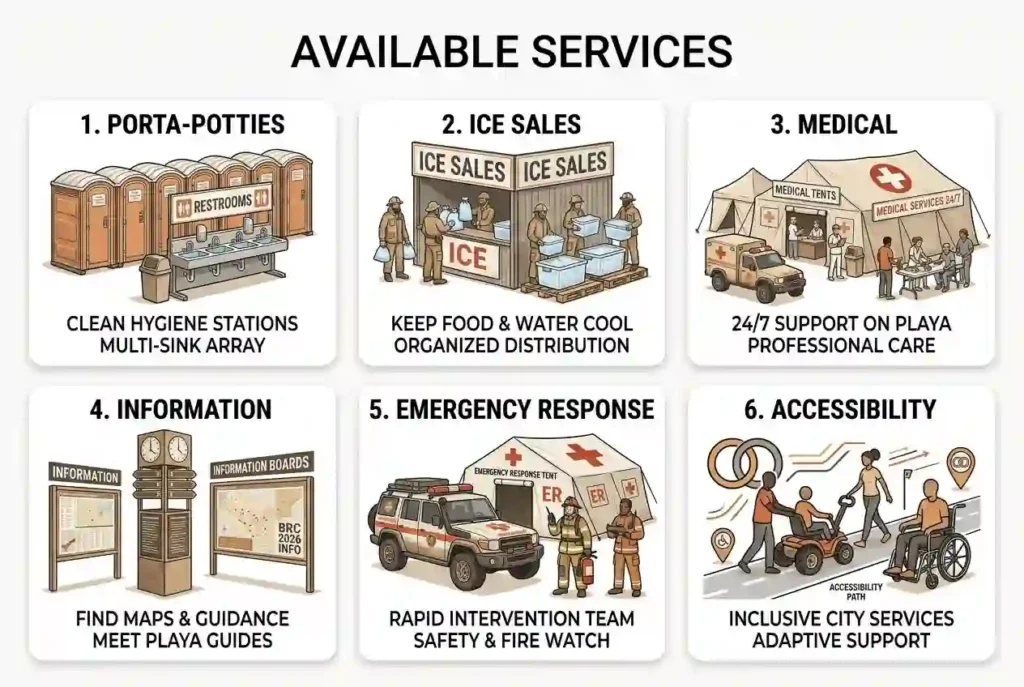
Understanding Community-Based Support Services
Black Rock City operates like a temporary city, which means it depends on community-based support services to keep the event functional and participant-friendly. These services are there to help people stay informed, get assistance when something goes wrong, and handle situations that need a calm human response. Rather than offering comfort or convenience, the city’s support network is built to solve practical problems in a difficult environment where confusion, stress, and urgency can happen quickly.
Understanding community-based support services is the first step because it shows that Black Rock City is not just a collection of camps and art pieces. It is a living temporary city with information points, participant support staff, medical responders, lost-item systems, communication channels, and volunteers who help everything run. These resources work best when participants know they exist before they need them, because the playa can make even small problems feel much bigger if you do not know where to turn.
How Black Rock City Operates as a Temporary City
Black Rock City is temporary, but it still carries real responsibilities for participant support. Public resources are available, but they are designed to work within a decentralized, self-reliant environment. That means participants need to know which service does what, where to find help, and how to ask the right question at the right time. If you understand the basics early, you are much better prepared to navigate the city without unnecessary stress.
Public Resources Every Participant Should Know
There are a few public resources every participant should know from the start. Playa Info is the main information hub. Black Rock Rangers are the people to contact for calm, non-emergency guidance. Medical is the place for health concerns that go beyond basic self-care. Lost and Found helps with missing belongings. Communication channels, volunteer teams, and official notices all support the city in different ways. Together, they form the backbone of participant help.
When to Seek Assistance
The best time to seek assistance is before a problem becomes overwhelming. Many participants hesitate because they do not want to seem dramatic or because they assume they should solve everything themselves. But Black Rock City is built around the idea that asking for help is normal when a situation requires it. If you are lost, confused, worried about someone’s health, dealing with a conflict, or unsure what to do next, that is exactly when the support system should be used.
Planning Ahead Before You Need Help
Planning ahead before you need help makes the whole event easier. Knowing the service locations, understanding who handles what, and carrying basic information with you can save time when things are stressful. In a place where dust, heat, crowding, and weak cell service can all interfere with your plans, preparation.
Black Rock City Services at a Glance
| Service | Purpose | Where to Find It | Best Time to Use |
| Playa Info | Maps, schedules, Lost & Found, general information | Center Camp area | Anytime during operating hours |
| Burning Man Rangers | Directions, mediation, participant assistance | Throughout Black Rock City | Anytime |
| Emergency Medical Services | Injuries, illness, urgent medical care | Medical stations across the city | 24/7 |
| Fire & Emergency Response | Fire safety and emergency incidents | Throughout Black Rock City | 24/7 |
| Accessibility Services | Mobility, communication, and inclusion support | Playa Info and designated accessibility resources | Before and during the event |
| Portable Toilets | Public sanitation | Throughout Black Rock City | Anytime |
| Lost & Found | Recover or report lost belongings | Playa Info | During operating hours |
- Black Rock City uses a support network to help participants stay informed and safe.
- These services are meant for problem-solving, guidance, and participant support.
- The city’s support system matters because the playa can make small issues feel much bigger.
- Knowing the basics early helps participants navigate the event with less stress.
- This section gives the overall map of help points before moving into specific services.
What Is Playa Info and How Can It Help You?
Playa Info is the main information hub in Black Rock City, and it is often the first place participants should go when they need directions, event details, or general guidance. It helps people understand where they are, what is happening, and how to find the information they need without wasting time. For many first-timers, Playa Info becomes the easiest way to get oriented early in the week.
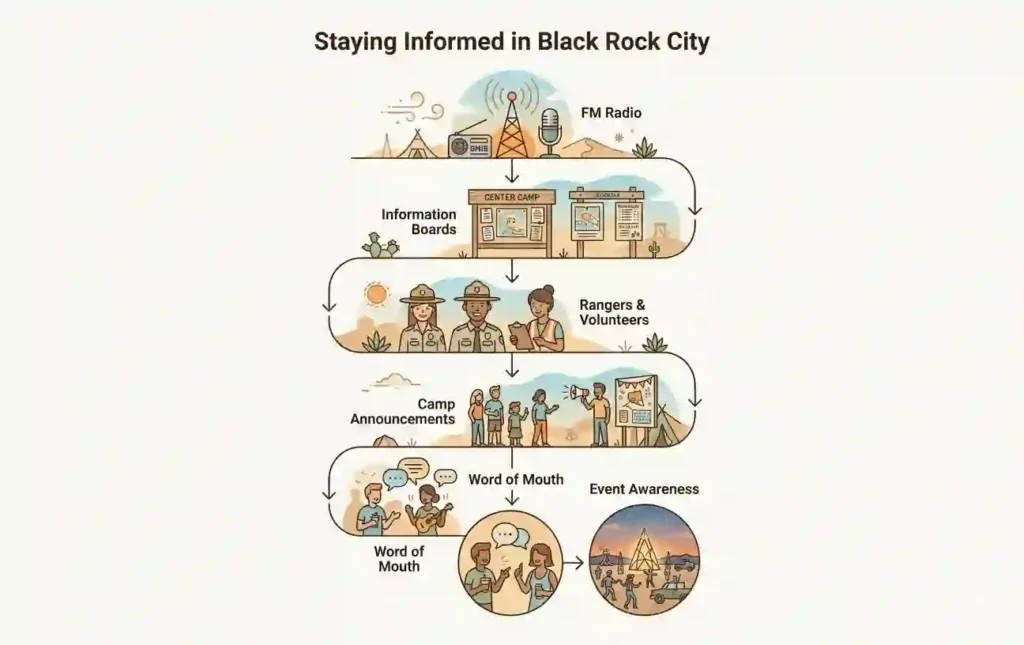
Understanding Playa Info
Playa Info is one of the most useful participant support points in Black Rock City. It acts as a central information hub where people can ask questions, find directions, and get a clearer sense of what is happening in the city. If you are trying to figure out where something is, what is scheduled, or how to orient yourself, Playa Info is usually the best first stop. It is especially helpful for first-timers who are still learning how the city works.
Black Rock City Support Services
| Department | Primary Role |
| Rangers | Community assistance |
| DPW | City construction & infrastructure |
| Arctica | Ice distribution |
| Gate | Arrival & departure |
| Emergency Services | Medical response |
| Lost & Found | Recovering misplaced items |
Services Available at Playa Info
The services available at Playa Info go well beyond basic directions. Participants can use it to find maps, ask about schedules, review event information, and get help with general navigation. In a city that can feel disorienting at first, that kind of guidance matters. Playa Info helps reduce confusion by giving people a place to go when they need practical answers quickly. It is a support point, but it also functions like a reference center for everyday questions.
Finding Maps, Schedules, and Event Information
Finding maps, schedules, and event information is one of the main reasons participants visit Playa Info. If you do not know where a camp is, want to confirm when an event happens, or need help finding a location on the playa, this is where you start. That makes Playa Info especially valuable early in the week, when people are still settling in and figuring out the city layout. It saves time, reduces guesswork, and helps participants make better decisions about where to go next.
Community Bulletin Boards
Community bulletin boards are another important part of the Playa Info experience. These boards often carry announcements, updates, notices, and participant information that help the city stay connected. Since communication can be unreliable in Black Rock City, bulletin boards remain a practical way to share information in a visible, low-tech format. They help people notice opportunities, recover missing items, and stay aware of what is going on without depending entirely on their phones.
When to Visit Playa Info
The best time to visit Playa Info is early, not after a problem becomes urgent. Even a short stop on your first day can help you understand the city faster and avoid unnecessary confusion later. If you know where Playa Info is and what it can help with, you give yourself an easy fallback when you need direction. That is why it is such an essential resource: it helps turn uncertainty into clear next steps.
- Playa Info is the city’s main information hub.
- It helps with maps, schedules, directions, and event information.
- Bulletin boards and notices make it useful for staying updated.
- It is a smart first stop when you feel lost or confused.
- Visiting early helps participants get oriented faster.
Who Are the Black Rock Rangers?
Black Rock Rangers are volunteer participants who help with calm, non-confrontational support. They are not police, and they are not there to act like law enforcement. Their role is to help people work through conflicts, uncertainty, stressful moments, or situations that need a grounded human response.
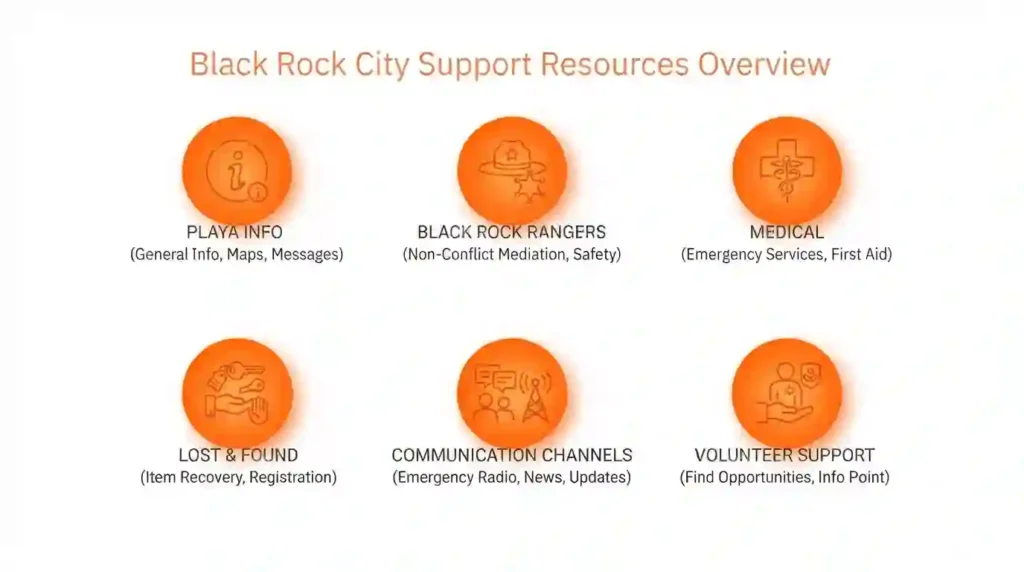
Understanding the Role of the Rangers
The Black Rock Rangers are veteran volunteers who help participants work through problems in a calm, respectful, and non-confrontational way. They are not law enforcement, and they are not there to act like police. Their role is to support participants, help manage tension, and guide people toward the right next step when a situation feels confusing or difficult. They are one of the city’s most recognizable support resources, especially when someone needs human guidance rather than a formal process.
How Rangers Help Participants
Understanding the role of the Rangers helps participants use them appropriately. Rangers are there to help keep things calm and to support the community, not to take over every situation. If a problem is stressful but not clearly an emergency, Rangers are often a strong first point of contact. They can help clarify what is happening, reduce conflict, and make sure people move toward the right support without unnecessary escalation. Their value lies in their experience and their ability to stay grounded.
Non-Emergency Conflict Resolution
Rangers are especially important in non-emergency conflict resolution. That means situations where two or more participants may need help talking through a disagreement, where someone is acting in a disruptive but not immediately dangerous way, or where the problem is more about confusion than direct danger. In those moments, a calm and knowledgeable presence can make a big difference. Rangers are trained to help create that calm. Their role is not to judge, but to stabilize.
Asking Rangers for Guidance
Asking Rangers for guidance is often the smartest move when you are not sure what to do next. Many participants hesitate because they do not know whether their problem is “serious enough” or because they worry they should not bother anyone. But Rangers are there for exactly those moments when people need help thinking clearly. If you are unsure, uncertain, or feeling overwhelmed, they are a good resource to approach.
When to Contact a Ranger
The best time to contact a Ranger is when a situation feels like it could become bigger without support. That might include conflict, confusion, concern for another participant, or a problem that requires a calm mediator. If something feels off and you are not sure whether to escalate it, a Ranger can help you decide what comes next. They are part of the participant support network that helps Black Rock City remain functional and humane under pressure.
- Rangers are volunteer support personnel, not police.
- They help with conflict resolution and general guidance.
- They are useful for stressful but non-emergency situations.
- They can help participants find the right support path.
- They are a calm, participant-centered resource.
What Services Are Available for Families and Children?
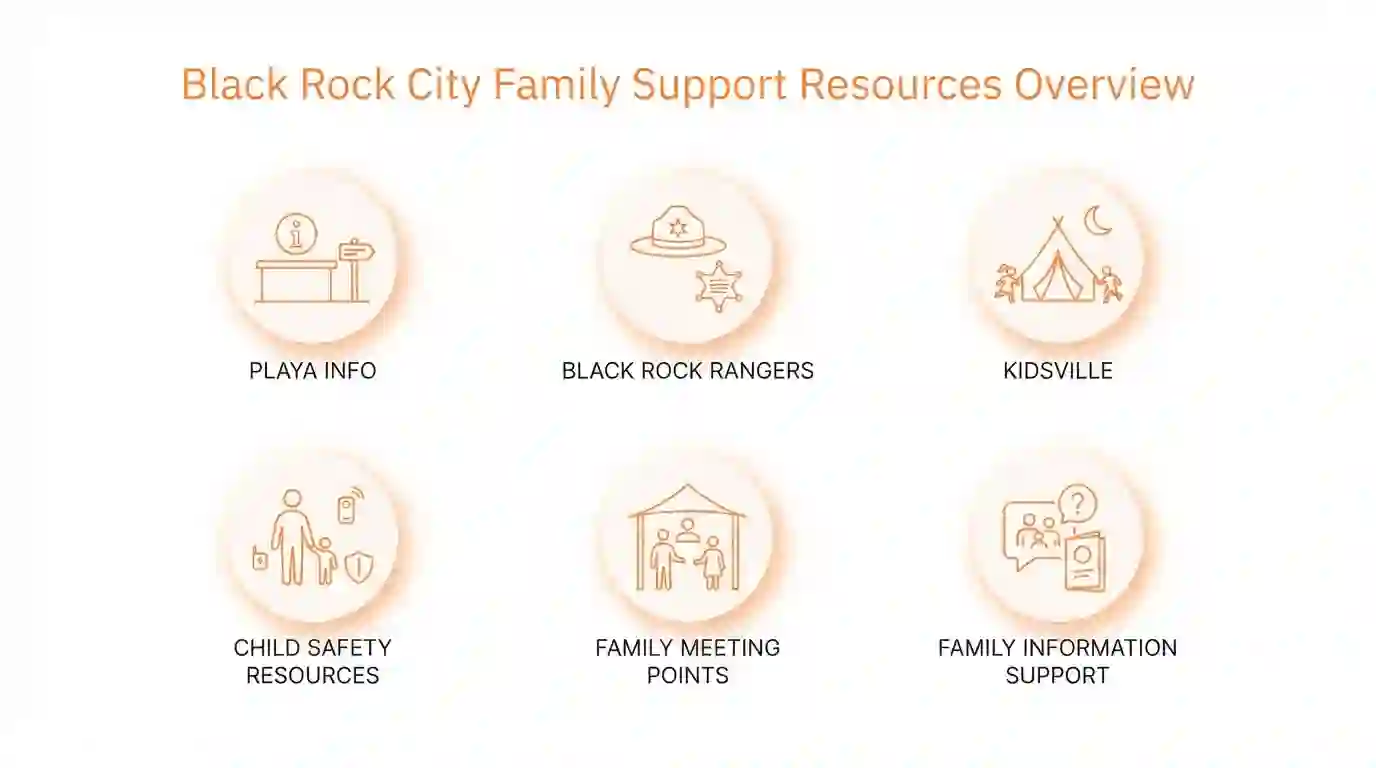
Black Rock City includes family-friendly support for participants bringing children, and this section should give readers a clear overview of where that support exists and how it works. Families need different kinds of help than solo participants or adult camps, so the city’s support network includes resources, communities, and response paths that can make family participation safer and more manageable. This section stays high-level and avoids detailed camping guidance so it can focus on support, safety, and where families should go for help. For readers who want deeper family camping details, this section can point to the dedicated Family Camps and Camping Guide.
Understanding Family Support in Black Rock City
Family support in Black Rock City is built around the idea that children and caregivers need practical help, clear information, and predictable meeting points. The city’s general support services can assist families when they need directions, guidance, or help with an unexpected situation, but families should also plan ahead because children need more structure than most adult participants. Rangers, Playa Info, and other city resources can help direct families to the right place, explain next steps, and support safe decision-making when something feels uncertain. This makes family support a shared effort between the city and the people participating in it.
Kids and Family-Oriented Communities
Kidsville is the best-known family-oriented camping community in Black Rock City and serves as a central point of reference for families looking for a supportive neighborhood environment. For this page, it should be described only as an overview so readers understand that family-focused communities exist without turning the section into a camping guide. These communities help families connect with others who are navigating the event with children, which can make daily life feel more organized and less stressful. A simple link to the Family Camps and Camping Guide can handle the detailed camping information separately.
Child Safety Resources and Assistance
Child safety is a community responsibility, not just a parent responsibility, because Black Rock City relies on participants looking out for one another. If a family needs help, Rangers and other city services can assist by guiding them to the right support path and helping keep the situation calm. The most important thing for caregivers is to know where to ask for help before they need it, because that makes it easier to act quickly if a child is overwhelmed, lost, or separated from the group. The city works best when families treat safety planning as part of the event itself, not as an afterthought.
What to Do If a Child Becomes Separated
If a child becomes separated, the first step is to stay calm and alert the right support people immediately. Families should know in advance what the child is wearing, where they are likely to be, and which meeting point to use if anyone gets separated. Daily meeting points are especially important because they give children and adults a simple plan to reconnect without confusion. Child identification recommendations, such as keeping current identifying details accessible, can also make it easier for support teams to assist quickly and effectively.
Family Information and Support Services
Families should use Playa Info as one of their main sources for current event information and guidance. Playa Info can help answer questions, point families toward the right resources, and provide practical orientation if someone needs direction. It is also a useful place to confirm where to go for family-related support without relying on hearsay or guesswork. When in doubt, families should start with official information sources and then follow the path that best fits their situation.
Helping Children Participate Safely
Helping children participate safely means planning ahead, staying visible, and keeping expectations realistic. Children do best when caregivers have a simple routine, clear meeting points, and a shared understanding of what to do if anyone gets separated. Families should also remember that the whole community has a role in keeping children safe, so participants should be alert, respectful, and willing to help if a child appears lost or uncertain. This section can close by directing readers to the Family Camps and Camping Guide for more detailed planning, logistics, and neighborhood information.
Summary
- Black Rock City offers family-friendly support through its broader participant services network.
- Kidsville is the main family-oriented community reference, but only an overview belongs here.
- Rangers, Playa Info, and city support can help families when they need guidance.
- Families should plan meeting points, identification, and separation procedures in advance.
- Child safety is a community responsibility, not just a parent responsibility.
- Playa Info is a helpful starting point for family questions and event orientation.
- Detailed camping and family neighborhood guidance should link to the Family Camps and Camping Guide.
What Medical Services Are Available?
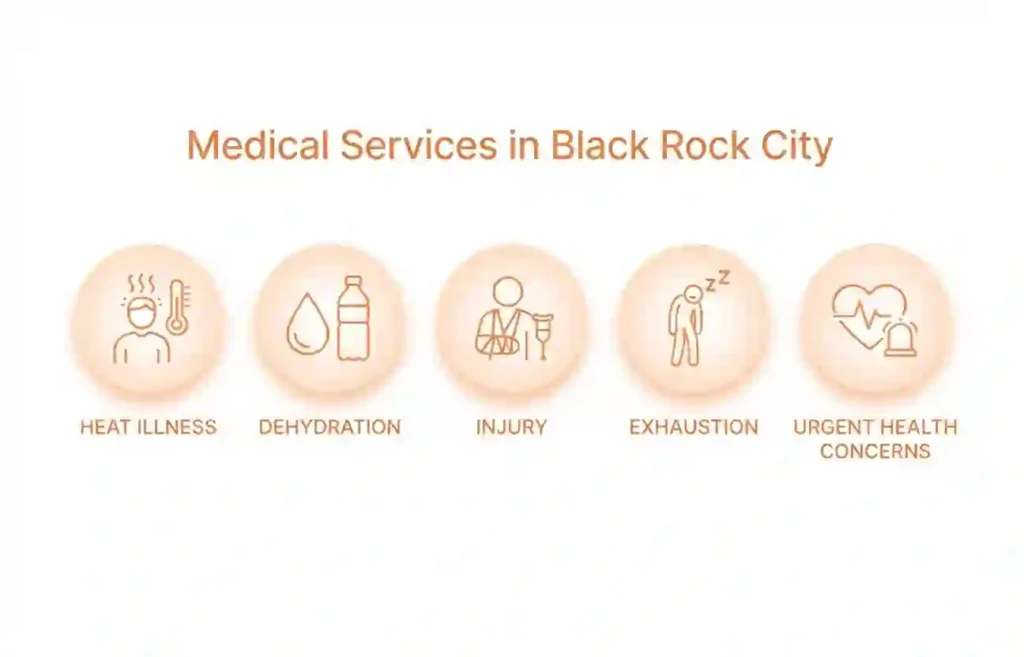
Medical services in Black Rock City exist to handle urgent health concerns in a harsh environment. Heat, dust, dehydration, exhaustion, and injury can happen quickly, so medical support is there to respond when a situation becomes serious. If someone is badly hurt, severely unwell, or showing symptoms that worry you, it is important to seek help early.
Emergency Medical Assistance
Medical services exist in Black Rock City because the playa can be physically demanding and sometimes unforgiving. Heat, dust, dehydration, exhaustion, illness, and injury can all happen quickly, so medical support is there to respond when a situation becomes serious. If someone is visibly unwell, badly hurt, or showing signs that worry you, medical care should be sought early. Waiting too long can turn a manageable issue into a much bigger one.
First Aid Services
Emergency medical assistance is meant for situations that require more than simple self-care or first aid. That could mean someone is fainting, unable to stay alert, experiencing severe discomfort, or showing signs of heat-related illness. The environment on the playa makes these symptoms more likely to worsen if ignored. Medical responders are there to evaluate the problem, provide assistance, and determine what kind of response is needed. Their role is to help protect participant health when conditions become unsafe.
When to Seek Medical Help
First aid services handle more immediate, lower-level concerns, but even those should not be brushed aside if symptoms are getting worse. A small cut, a headache, dizziness, or signs of dehydration can become serious in a hot and dusty environment. Medical support is not only for dramatic emergencies; it is also for helping participants respond to warning signs before they escalate. The earlier you ask for help, the better the outcome is likely to be.
Heat, Injury, and Illness Response
Knowing when to seek medical help is one of the most important parts of staying safe in Black Rock City. Some participants try to “push through” problems because they do not want to interrupt their experience, but that can be risky. Heat, injury, and illness should all be taken seriously, especially if they affect movement, awareness, or the ability to function normally. If something feels wrong, it is better to ask than to guess.
Preparing Before Medical Care Is Needed
Preparing before medical care is needed is the best strategy. That means understanding the warning signs of heat stress, keeping track of how you feel, and being willing to ask for support early if something changes. The playa rewards people who pay attention to their bodies and their limits. Medical services exist to help, but prevention and early action are just as important as the care itself.
- Medical services respond to urgent health concerns.
- They are important in a hot, dusty, physically demanding environment.
- Heat, injury, dehydration, and illness should be taken seriously.
- It is better to ask for help early than wait too long.
- Participants should know the warning signs before needing care.
How Are Emergencies Handled?
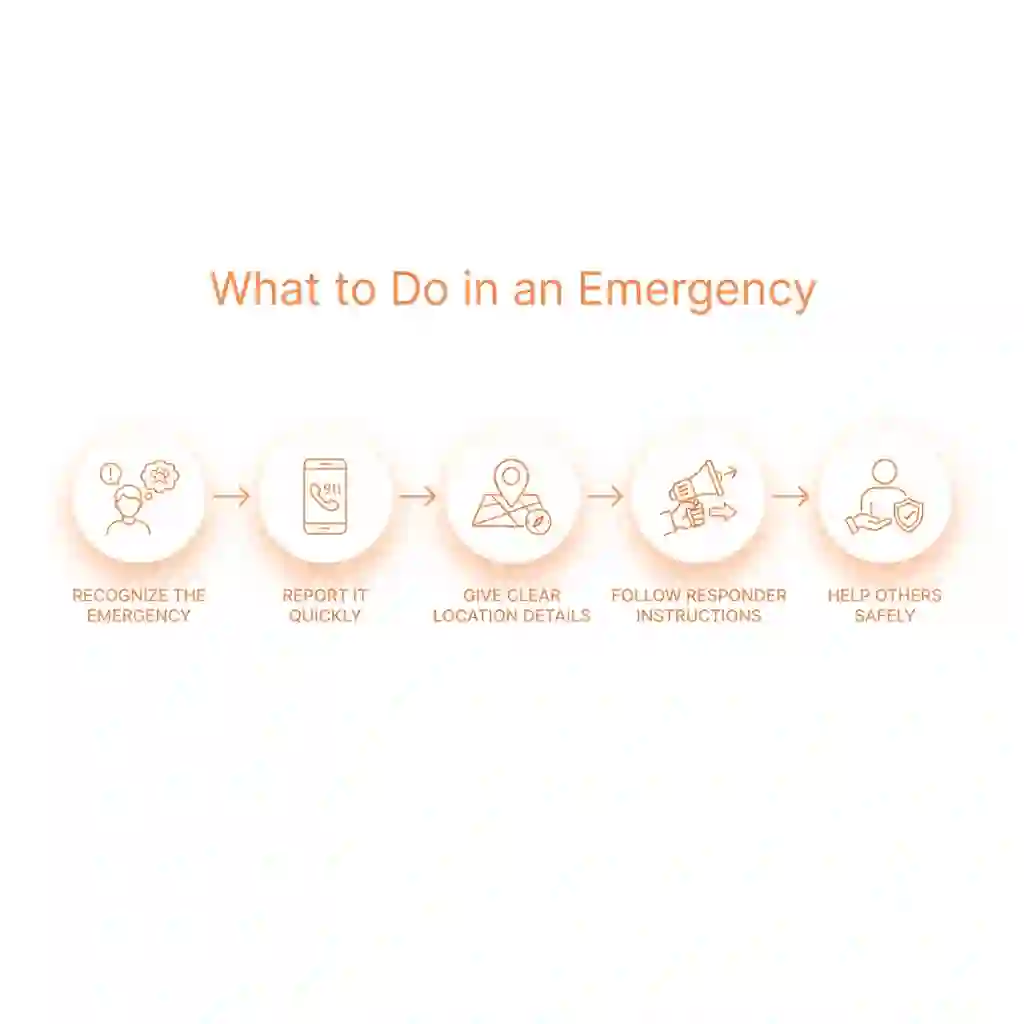
Emergencies are handled through fast reporting, clear communication, and prompt response. The first step is recognizing that a situation is truly urgent, such as unconsciousness, trouble breathing, serious injury, or immediate danger. Once that is clear, participants should report the situation right away so the appropriate responders can act quickly.
Recognizing an Emergency
Emergencies in Black Rock City are handled through quick recognition, clear reporting, and immediate response. The first step is identifying when something is truly an emergency. If someone is unconscious, having trouble breathing, badly injured, severely confused, or in immediate danger, that is not a situation to wait on. Emergencies need attention right away, and everyone nearby should treat them seriously.
Reporting Emergencies Quickly
Reporting emergencies quickly is essential because timing matters even more on the playa than it does in a normal city. The environment, distance, and heat can all slow down response if people wait too long to speak up. The clearer the report, the faster the right support can respond. That means saying what happened, where it happened, and whether anyone is in immediate danger. Fast, plain communication is much more useful than trying to explain everything perfectly.
Emergency Communication Procedures
Emergency communication procedures are designed to move information to the right people as quickly as possible. Participants should follow those procedures instead of improvising if a serious situation develops. Once the report is made, the next step is to follow instructions. That might mean keeping the scene clear, staying with the person who needs help, or helping responders access the area. Good reporting and good follow-through work together.
Following Instructions During Incidents
Following instructions during incidents is just as important as recognizing the emergency in the first place. Once trained responders are involved, participants should avoid creating extra confusion or risk. If you are nearby, do only what is helpful and safe. That may include keeping others back, offering simple assistance, or staying calm while the response unfolds. The goal is to support the situation without making it more complicated.
Helping Others Safely
Helping others safely is a key part of the emergency mindset in Black Rock City. Participants often want to jump in right away, which is natural, but it is important to stay aware of your own safety too. If you can help by calling for support, clearing space, or giving accurate information, that is valuable. In emergencies, the best help is usually calm, clear, and immediate.
- Emergencies must be reported quickly and clearly.
- Recognize urgent danger signs early.
- Follow responder instructions once help is on the way.
- Stay calm and avoid making the scene more risky.
- Fast reporting improves response and safety.
What Happens If You Lose Something?
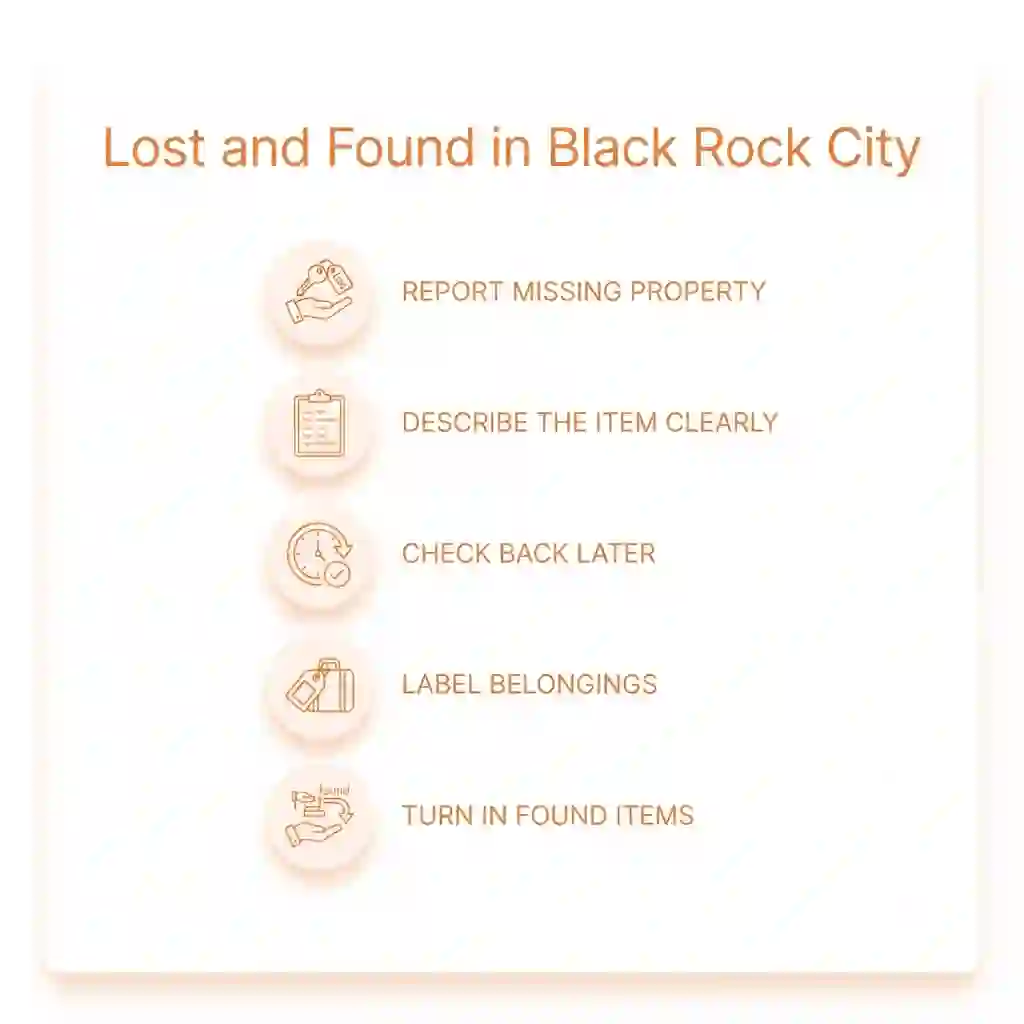
Lost and Found helps participants recover items that go missing on the playa. Because of dust, movement, crowds, and constant activity, it is very easy to misplace important belongings. Phones, glasses, keys, wallets, and other personal items can go missing quickly, so reporting missing property is a practical part of staying organized.
Lost and Found Services
Lost and Found is one of the practical support systems that participants often end up using, because it is very easy to lose things on the playa. Dust, movement, crowds, and the constant activity of the city can make it hard to keep track of personal items. Phones, glasses, keys, wallets, hats, costumes, and other belongings can go missing faster than you expect. Lost and Found gives participants a place to report and recover items instead of assuming they are gone forever.
Reporting Missing Property
Lost and Found services matter because they help the city recover from the everyday messiness of shared participation. If you lose something, reporting it quickly improves your chances of getting it back. If you find something that does not belong to you, turning it in helps someone else recover an important item. The system only works when participants use it honestly and promptly.
Recovering Found Items
Reporting missing property should happen as soon as you realize something is gone. Many participants delay because they hope the item will turn up later, but it is better to make the report early. That way, if someone else turns in the item, there is a better chance of matching it to the right person. Being specific about what is missing, where it was last seen, and what it looks like can also improve recovery.
Labeling Personal Belongings
Recovering found items is often easier when the owner has taken steps to identify them. That is why labeling personal belongings is such a smart habit. Marking items with your name, camp, or contact information can make a huge difference if something gets misplaced. It also helps reduce confusion when multiple similar items show up in Lost and Found. A little preparation goes a long way.
Preventing Common Losses
Preventing common losses starts with organization. Keep track of valuable items, do a final check before leaving a camp or venue, and store important things in the same place whenever possible. Many “lost” items are simply left behind in the rush of the moment. If you stay deliberate about your gear, you are much less likely to need Lost and Found in the first place.
- Lost and Found helps recover missing belongings.
- The playa makes it easy to misplace personal items.
- Reporting missing property early improves recovery chances.
- Found items should be turned in, not kept.
- Labeling belongings helps prevent permanent loss.
What Communication Resources Are Available?
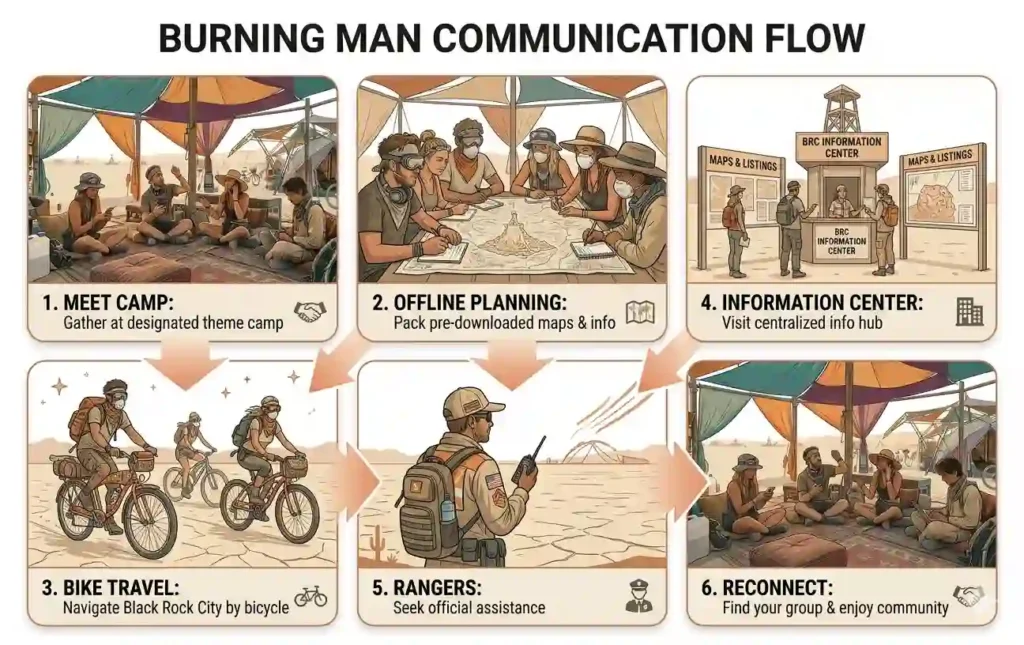
Communication in Black Rock City depends on more than phones. Because cell service can be unreliable, participants need to use public announcements, bulletin boards, Playa Info, camp notices, and other community channels to stay informed. These resources help people know what is happening even when digital communication is weak or unavailable.
Event Information Sources
Communication in Black Rock City is not limited to cell phones. Event information sources include Playa Info, bulletin boards, camp notices, announcements, and other community-based channels that help participants stay informed. Since phone service can be unreliable or overloaded, the city depends on multiple ways to share updates. That makes communication a shared responsibility rather than a one-device solution.
Public Announcements
Public announcements are one of the simplest ways the city keeps people informed. They can help participants learn about schedule changes, reminders, urgent notices, and citywide updates. Radio and community broadcasts can also help spread information when digital communication is weak. These methods may seem old-fashioned, but they work well in a temporary city where technology is not always dependable.
Radio and Community Broadcasts
Staying informed during the event means paying attention to more than one source. Participants who only rely on their phones often miss important updates because cell service can fail when crowds are heavy. Checking boards, listening to announcements, and asking nearby participants can help fill in the gaps. The city’s information system works best when people use it actively rather than waiting for information to find them.
Staying Informed During the Event
Communication without cell service is absolutely possible, but it requires a different mindset. Participants should expect to use physical notices, camp updates, word of mouth, and direct inquiry when needed. That does not mean communication is harder — it just means it works differently. Once you understand that, it becomes easier to stay connected even when your phone is useless.
Communication Without Cell Service
Volunteers are one of the main reasons Black Rock City functions as well as it does. They keep the city running by supporting information points, assisting with participant services, helping with logistics, and contributing to the systems that make the event work. Without volunteers, many parts of the city would become harder to manage and slower to respond. Their contribution is built into the city’s structure.
- Communication resources go beyond cell phones.
- Use announcements, boards, notices, and Playa Info.
- Service may be unreliable, so multiple sources matter.
- Public updates help participants stay informed.
- Communication on playa is a shared, community-based system.
How Can Participants Volunteer During the Event?
Volunteers help keep Black Rock City running. They support services, information points, participant systems, and behind-the-scenes operations that make the event work. Without volunteers, the city would be far harder to manage and much less responsive to participant needs.
Why Volunteers Keep the City Running
There are many volunteer opportunities available during the event, depending on the participant’s time, experience, and interest. Some roles are public-facing, while others help behind the scenes. Joining a volunteer team can give participants a better understanding of how the city actually works and can create a stronger sense of connection. It is also a good way to meet people and become part of the support network rather than simply moving through it.
Volunteer Opportunities
The benefits of volunteering are both practical and social. You gain insight into the city, meet new people, and often feel more grounded in the event overall. For first-timers, volunteering can be especially helpful because it turns the event into something more participatory and less overwhelming. You do not need to be an expert to help; reliability and willingness to learn are often enough.
Joining a Volunteer Team
Volunteering as a first-timer is very possible if you keep an open mind. The important thing is to show up, listen, and follow direction. Many volunteers begin with simple tasks and gradually get a better sense of the city’s systems. If you want to understand Black Rock City from the inside, volunteering is one of the best entry points.
Benefits of Volunteering
Accessibility services are available in Black Rock City, but this page only covers them at a high level. If a participant needs accessibility information resources, mobility assistance information, or accommodation support, the proper step is to ask through the official support channels. Accessibility concerns should be taken seriously and addressed early, not left until they become stressful or confusing.
Volunteering as a First-Timer
This page keeps accessibility coverage broad on purpose because the detailed information belongs in the dedicated Accessibility & Inclusion guide. That separation helps this page stay focused on general participant help while still showing that accessibility resources exist. The support path is important, and participants should know where to ask if they need it. The detailed programs, accommodations, and specialized guidance should be handled in the more specific guide.
- Volunteers keep the city functioning.
- Many support systems depend on participant help.
- Volunteering builds connection and understanding.
- First-timers can participate too.
- It is a strong way to support the community.
How Can Participants Access Accessibility Services?
Accessibility services are available, but this page only gives a high-level overview. If participants need mobility support, accommodation guidance, or accessibility information, they should use the appropriate support channels rather than trying to figure it out alone. The main idea here is that accessibility help exists and should be treated seriously.
Accessibility Information Resources
Where to ask accessibility questions depends on the need, but the key point is that participants should not be left guessing. If you need help understanding what is available, use the official accessibility resources or the dedicated guide. That approach gives people a clearer path and avoids duplicating content across the silo.
Mobility Assistance Information
When something goes wrong, the most important thing is to stay calm long enough to decide what kind of problem you are dealing with. On the playa, confusion can spread quickly because people are hot, tired, or distracted. If you can pause for a moment and identify the issue, you are more likely to choose the right support path. That first pause often makes everything easier.
Accommodation Support
Knowing which service can help is the next step. Playa Info may be the right choice if you are lost or unsure where to go. Rangers may be best if you need guidance or non-emergency support. Medical is the clear choice for health concerns. The more clearly you understand the support network, the faster you can move toward the right solution.
Where to Ask Accessibility Questions
Asking for assistance early is always better than waiting and hoping the problem improves on its own. Many issues on the playa become harder because people delay help until they are exhausted or overwhelmed. If you ask early, you give responders more time and give yourself a better chance at a smoother outcome. That is especially important in a temporary city where time and distance can make everything feel more complicated.
Linking to the Accessibility & Inclusion Guide
Helping others responsibly means being useful without putting yourself or others at more risk. If someone nearby needs help, the best actions are often simple: call for support, keep calm, and avoid making the scene worse. You do not need to solve the problem yourself to be helpful. In many cases, your role is just to get the right help moving.
- Accessibility help exists at a high level here.
- Detailed ADA and accommodation content belongs elsewhere.
- Participants should ask through official accessibility channels.
- Mobility and accommodation questions should be handled early.
- This page only introduces the support path.
What Should You Do If Something Goes Wrong?
When something goes wrong, the first step is to stay calm and identify what kind of problem it is. On the playa, small issues can grow quickly if nobody acts early. If someone is hurt, lost, overwhelmed, confused, or in conflict, the right response is to contact the support service that fits the situation.
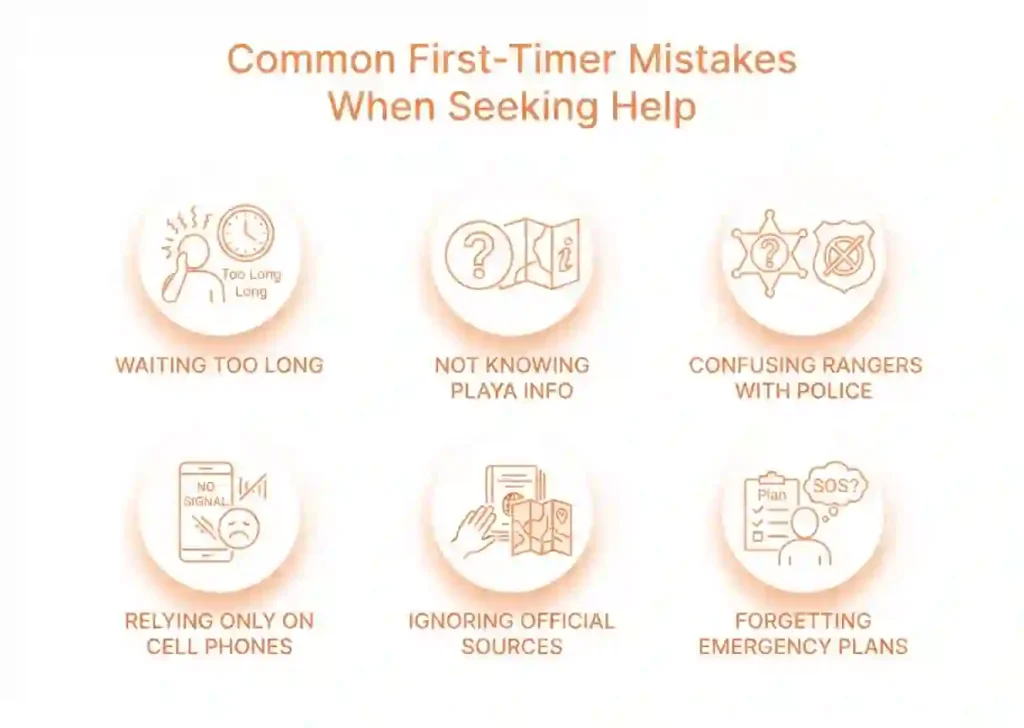
Waiting Too Long to Ask for Assistance
Assuming cell phones will solve everything is risky because service can be unreliable. A phone is useful when it works, but it is not a full communication strategy in Black Rock City. Forgetting emergency contact plans can also create problems if a real issue comes up. The best fix is to prepare before the event and know how to reach help without depending on one device.
Not Knowing Where Playa Info Is Located
Experienced Burners usually recommend learning the major service locations on day one. That means knowing where Playa Info, Rangers, Medical, and Lost and Found are before you need them. When you already know where to go, it is much easier to respond calmly if something happens. That early orientation pays off all week long.
Confusing Rangers with Law Enforcement
Visiting Playa Info early in the week is another common recommendation. It helps participants get maps, learn the layout, and understand how the city is organized before the busiest moments hit. The earlier you get your bearings, the less likely you are to feel overwhelmed later. It is one of the easiest ways to gain confidence quickly.
Ignoring Official Information Sources
Experienced Burners also say not to hesitate to talk to Rangers if something feels wrong or confusing. They are there to help, and using them appropriately can prevent small problems from getting bigger. Carrying basic emergency information is another smart habit, especially if you are separated from your group or need to speak quickly in a stressful situation. Having that information ready can save time.
Assuming Cell Phones Will Solve Everything
Helping build the community by volunteering is often part of the advice because it deepens your understanding of the event. When you contribute to the city, you see how it actually runs and become more connected to the people around you. Staying informed throughout the event matters too, because information can change quickly and the best participants stay aware rather than assuming nothing has changed.
Forgetting Emergency Contact Plans
Black Rock City’s support network works because different services handle different needs, but they all serve the same goal: helping participants move through the city with more confidence and less confusion. Community services make the city work by giving people clear places to go when they need information, guidance, health support, or help with an unexpected problem. That structure is part of what makes the city livable.
⚠️ Common Mistakes
- Treating Rangers like police.
- Depending on city services instead of preparing.
- Waiting too long during medical emergencies.
- Ignoring Gate instructions.
- Assuming Lost & Found stores everything indefinitely.
- Forgetting volunteers deserve respect.
- Stay calm and identify the problem first.
- Ask for help early instead of waiting.
- Use the service that fits the situation.
- Help others without increasing risk.
- Preparation reduces stress in emergencies.
What Tips Do Experienced Burners Recommend?
Experienced Burners usually recommend learning the major service locations on your first day. That means knowing where Playa Info, Rangers, Medical, and Lost and Found are before you actually need them. It helps reduce stress and makes the city feel easier to navigate.
Who Does What?
| Need | Department |
| Conflict assistance | Rangers |
| Medical emergency | Emergency Services |
| Ice | Arctica |
| Arrival & departure | Gate |
| Lost belongings | Lost & Found |
| Infrastructure | DPW |
Learn the Major Service Locations on Day One
Knowing where to get help builds confidence, and confidence matters on the playa. Participants who understand the support system can make decisions more quickly and handle stress better. They are less likely to panic when something goes wrong because they already know what to do. That is a major advantage in a temporary city where many things can feel unfamiliar at first.
Visit Playa Info Early in the Week
Prepared participants enjoy the event more because they spend less time struggling with uncertainty. They can focus more on the experience itself and less on figuring out basics under pressure. Black Rock City works best when people understand the support network and use it wisely. That balance of self-reliance and community help is one of the event’s most important strengths.
Don’t Hesitate to Talk to Rangers
Black Rock City runs on participation and support. The city depends on people who know where to go, who to ask, and how to use the support systems that keep everything moving. Every participant benefits from those resources, whether they need help directly or simply feel better knowing the system exists.
Carry Basic Emergency Information
The best time to learn about services is before you need them. Once you know the basics, the city becomes easier to understand and much less intimidating. That is why this guide matters: it helps participants see the support network clearly so they can use it confidently when the need arises.
Where can I get help at Burning Man?
You can start with Playa Info, Rangers, Medical, or Lost and Found depending on what kind of help you need.
Who Should You Contact? (Quick Help Directory)
| If You Need… | Contact |
| Medical emergency | Emergency Medical Services |
| Fire | Fire & Emergency Response |
| Directions | Burning Man Rangers |
| Lost property | Playa Info / Lost & Found |
| Accessibility assistance | Accessibility Services |
| Event information | Playa Info |
| Camp dispute or conflict | Burning Man Rangers |
| Welfare concern | Rangers or Medical Services |
Stay Informed Throughout the Event
What does Playa Info do?
Playa Info helps with maps, schedules, directions, event information, and general questions.
- Learn key service locations on day one.
- Visit Playa Info early in the week.
- Talk to Rangers when needed.
- Carry basic emergency information.
- Stay informed and consider volunteering.
Bringing Black Rock City’s Support Network Together
Black Rock City works because support services, volunteers, and participants all help hold the city together. Playa Info, Rangers, Medical, Lost and Found, and communication channels each play a different role, but together they form a support network that makes the city more usable and less overwhelming.
Community Services Make the City Work
Are Black Rock Rangers police?
No. Rangers are volunteer participants who offer calm support and guidance.
Knowing Where to Get Help Builds Confidence
Where do I go if I lose something?
Lost and Found is the main place to report missing items, and Playa Info can often help point you there.
Prepared Participants Enjoy the Event More
Yes. Medical support is available for injuries, illness, heat issues, and urgent health concerns.
Before Requesting Assistance
| Ask Yourself | ✓ |
| Have I tried solving it myself? | ☐ |
| Is it an emergency? | ☐ |
| Do I know which department helps? | ☐ |
| Am I respecting volunteers’ time? | ☐ |
- City support services work together as a network.
- Playa Info, Rangers, Medical, and Lost and Found each serve different needs.
- Knowing where to get help improves confidence.
- Prepared participants handle stress better.
- The support network makes participation easier.
Black Rock City Services & Resources in Numbers
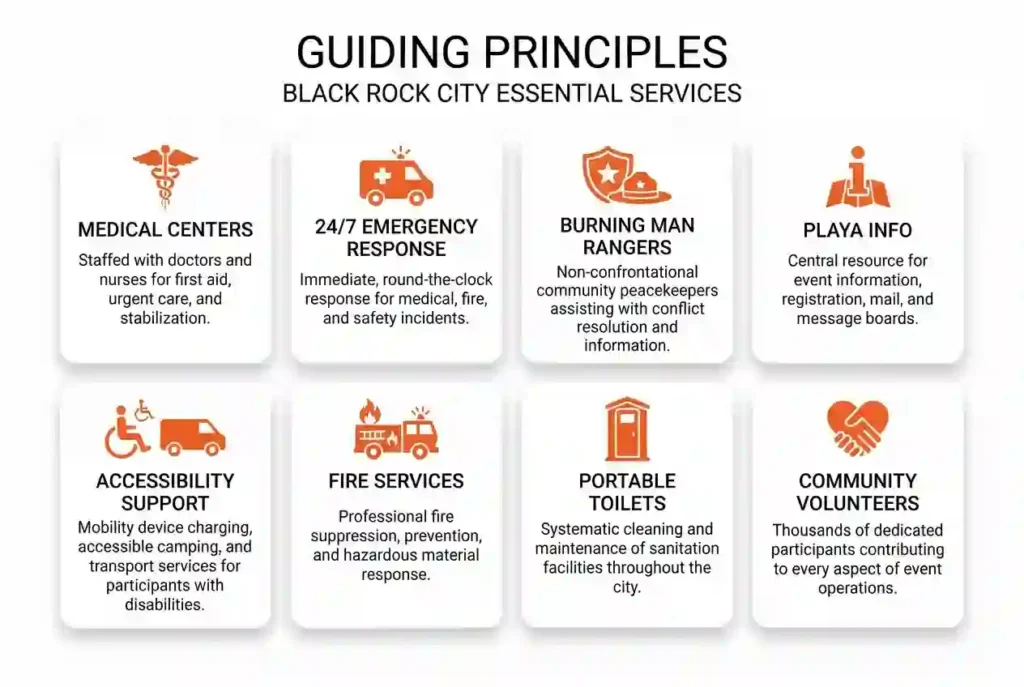
Black Rock City functions like a temporary city with a wide range of services that help participants stay informed, safe, healthy, and connected. Knowing where to find assistance can make your Burning Man experience much smoother.
Key Numbers
- 🏥 Emergency Medical Centers — Professional medical stations provide emergency and urgent healthcare throughout the event.
- 🚑 24/7 Emergency Response — Medical teams, firefighters, and emergency responders operate around the clock.
- 🤠 Burning Man Rangers — Volunteer Rangers help with conflict resolution, directions, safety concerns, and non-emergency assistance.
- ℹ️ Playa Info Center — Official information hub for maps, lost & found, accessibility services, and event updates.
- ♿ Accessibility Support — Accessible toilets, Accessibility Vehicle assistance, and inclusion resources are available for eligible participants.
- 🚒 Fire & Safety Services — Fire crews monitor burns and respond to fire emergencies.
- 🚻 Hundreds of Portable Toilets — Sanitation stations are distributed throughout Black Rock City.
- ❤️ Community First — Thousands of volunteers work together to keep Black Rock City safe, welcoming, and operational.
City Services Myths vs Reality
| Myth | Reality |
|---|---|
| You’re completely on your own at Burning Man. | Participants are expected to be self-reliant, but professional and volunteer support services are available throughout the city. |
| Rangers are police officers. | Burning Man Rangers are trained volunteers who provide mediation, information, and non-law-enforcement assistance. |
| Medical care isn’t available. | Emergency medical centers and trained medical professionals operate 24 hours a day during the event. |
| Playa Info is only for tourists. | Playa Info helps everyone with maps, lost & found, accessibility, and event information. |
| There are no emergency services. | Fire crews, emergency responders, and medical teams are available throughout Burning Man. |
| Burning Man has no organized infrastructure. | Black Rock City operates like a temporary city with essential public services and volunteer departments. |
Final Thoughts
Black Rock City works because support services, volunteers, and participants all help hold the city together. Playa Info, Rangers, Medical, Lost and Found, and communication channels each play a different role, but together they form a support network that makes the city more usable and less overwhelming.
Black Rock City Runs on Participation and Support
Every Participant Benefits from Community Resources
The Best Time to Learn About Services Is Before You Need Them
Community Services Make the City Work
Knowing Where to Get Help Builds Confidence
Prepared Participants Enjoy the Event More
- Black Rock City depends on participant support systems.
- Everyone benefits from knowing the service network.
- The city is easier when help points are understood early.
- Preparation reduces stress and confusion.
- Learning services before you need them is the best approach.
City Services & Resources Checklist
Before Arriving
✅ Download the official Black Rock City map
✅ Learn the locations of medical stations
✅ Save important emergency contacts
✅ Review official city services
After Arriving
✅ Locate Playa Info
✅ Find the nearest medical station
✅ Identify nearby portable toilets
✅ Learn where Rangers are stationed
During Your Stay
✅ Ask Rangers when you need help
✅ Report emergencies immediately
✅ Visit Playa Info for event updates
✅ Help fellow participants when appropriate
Before Leaving
✅ Return lost property to Lost & Found
✅ Dispose of MOOP properly
✅ Thank volunteers and support teams
✅ Follow Exodus guidance
Frequently Asked Questions About City Services & Resources
Burning Man Rangers, Playa Info, medical centers, and emergency services are available throughout Black Rock City.
Playa Info provides maps, event schedules, lost & found, accessibility information, and general participant assistance.
Yes. Emergency medical services operate day and night throughout the event. Medical support is available for injuries, illness, heat issues, and urgent health concerns.
No. Rangers are trained volunteers who provide guidance, mediation, and non-emergency assistance.
Lost property should be reported to or collected from the official Lost & Found service through Playa Info.
No. Public Wi-Fi is very limited, so participants should plan for minimal internet access.
Yes. Accessibility resources include accessible toilets, Accessibility Vehicles, and communication support for eligible participants.
Dedicated fire crews, emergency responders, and medical teams handle emergencies throughout Black Rock City.
Visit Playa Info, ask a Ranger for assistance, or use your saved camp location and city map.
Many first-time participants don’t realize how helpful Playa Info and the Burning Man Rangers are for directions, event information, and solving unexpected problems.
Cell service is often limited, unreliable, and heavily congested, so don’t depend on your phone for communication or navigation.
Use Playa Info, bulletin boards, public announcements, camp notices, and word of mouth.
Where Should You Go Next?
| If You Want To… | Read This Guide |
| Learn about participant facilities | → Amenities & Facilities |
| Prepare for emergencies | → Health & Emergency Guide |
| Understand transportation | → Transportation Guide |
| Navigate the city | → City Guide |
| Learn Leave No Trace | → Leave No Trace Guide |
Conclusion
Black Rock City succeeds because thousands of volunteers, staff members, and participants work together to support a temporary city unlike any other. Understanding these services allows participants to become more self-reliant while knowing where to find help when it is genuinely needed.
Final Thoughts
- 📖 Continue with the Transportation Guide to learn how to move safely around Black Rock City.
- 👮 Rangers support, not police, the community.
- 🚧 DPW builds and removes the city.
- 🧊 Arctica helps participants preserve food and medicine.
- 🚑 Emergency teams respond when needed.
- 🙋 Volunteers make the city possible.
- ❤️ Use services responsibly.
- 🌍 Respect the people behind the city’s operations.
Why Trust This Guide?
✅ Links to detailed survival and accessibility guides.
✅ Updated for the 2026 Burning Man season.
✅ Covers the major operational departments supporting Black Rock City.
✅ Explains how participant support systems function.
✅ Encourages responsible use of community resources.
City Services Pro Tips
- 🗺️ Visit Playa Info on your first day to become familiar with the city.
- 🤠 Don’t hesitate to ask a Ranger—they’re one of the best resources for directions and assistance.
- 🏥 Locate the nearest medical station before you need it.
- 📍 Save your camp’s address offline.
- 📱 Plan for limited cell service and have a backup meeting point.
- ♿ Learn where accessibility resources are located if anyone in your group may need them.
- 🚻 Memorize the nearest toilet locations around your camp.
- ❤️ Self-reliance is important, but knowing where to find help is just as valuable.