
Burning Man Transportation Guide 2026: Bus, Car, RV, Bike & Exodus
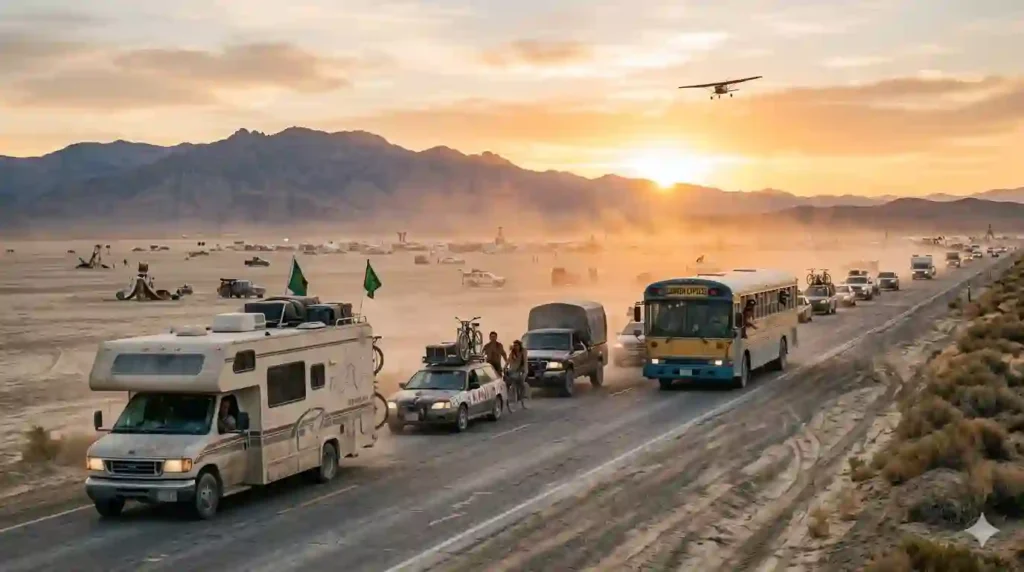
Getting to Burning Man requires careful planning, whether you’re driving, flying, taking the Burner Express, renting an RV, or traveling internationally. This transportation hub explains every major travel option ,gate entry ,parking ,exodus, and helping participants choose the safest, most practical, and cost-effective way to reach Black Rock City.
Reaching Black Rock City is part of the Burning Man adventure. Unlike traditional festivals, Burning Man takes place in Nevada’s remote Black Rock Desert, where transportation requires advance planning, preparation, and flexibility. Choosing the right travel method can significantly affect your budget, arrival experience, and overall comfort.
This transportation hub brings together every major travel option—from personal vehicles and RVs to Burner Express Bus, Burner Express Air, international travel, and Exodus planning—so you can prepare confidently for your journey to and from Burning Man.
In This Guide You’ll Learn
- 🚌 Burner Express Bus
- ✈️ Burner Express Air
- 🚗 Driving to Burning Man
- 🚐 RV & Camper Travel
- 🚙 Rental Cars & Vans
- 🤝 Carpooling & Ride Sharing
- 🚲 Bicycle Transportation
- 🚪 Gate Entry & Arrival
- 🚦 Exodus & Departure
- 🌍 International Travel Planning
Understanding Transportation at Burning Man
Getting to and navigating Burning Man is one of the biggest logistical challenges participants face. The event is held in the remote Black Rock Desert of northwestern Nevada—roughly 122 miles from Reno with no Services on the playa itself. Whether you’re driving, flying, renting an RV, or using Burner Express, transportation planning is critical to a smooth experience.
This guide covers everything you need to know: travel options, costs, safety risks, arrival/departure procedures, and first-timer strategies. For detailed breakdowns on specific methods, use the linked sub-pillar guides below.
Why Transportation Planning Matters
Transportation is your largest carbon footprint contributor at Burning Man and the single factor that determines whether you arrive stressed or ready to experience the event. Poor planning leads to:
- Long Gate waits: 2–10+ hours during peak load-in/exodus
- Vehicle breakdowns: Dust, heat, and rough terrain cause mechanical failures
- Fuel shortages: Gerlach is the last major fuel stop; 50–75 miles between services
- Safety risks: Dust storms, extreme heat (90–110°F), and remote desert conditions
- Missed entry: Arriving without ticket, vehicle pass, or playa-ready vehicle = denied access
Transportation Challenges in the Black Rock Desert
The Black Rock Desert creates unique challenges:
- Remote location: 122 miles from Reno; no services between Gerlach and playa entrance
- Dust: Fine alkali dust clogs engines, damages seals, corrodes metal
- Heat: Daytime temps 90–110°F; battery efficiency drops 20–30%; risk of overheating
- Flat but hard terrain: Alkali crust is fragile; vehicle tracks persist for years
- Limited cell coverage: GPS and communication unreliable; use offline maps
- Massive traffic volume: 50,000+ participants entering/leaving within 48-hour windows
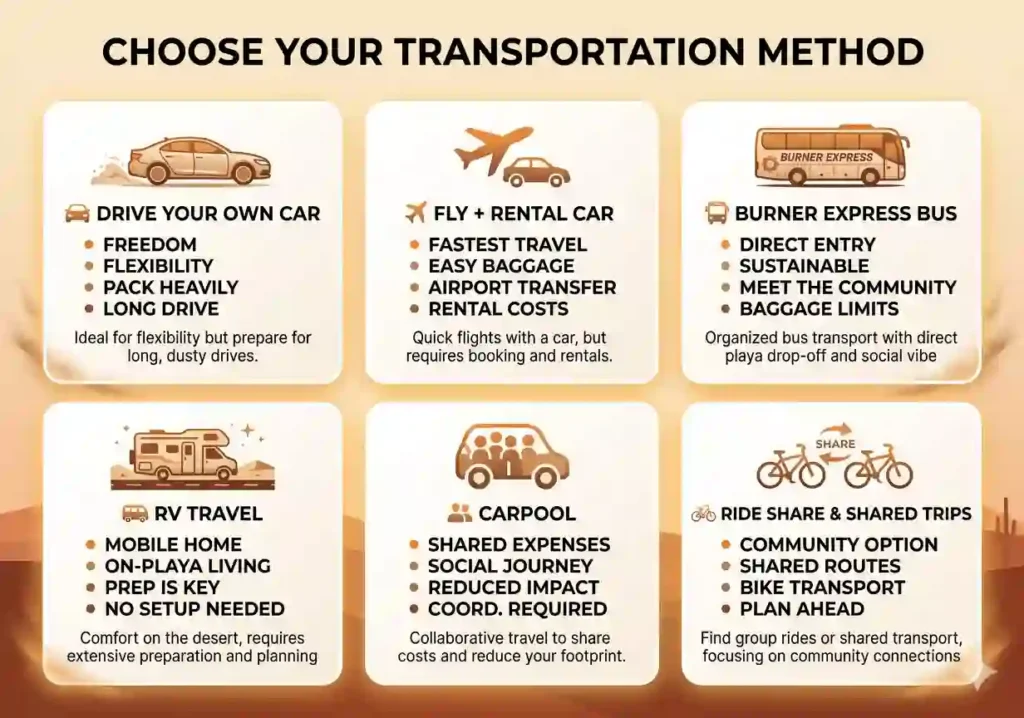
Choosing the Right Travel Method
Your best option depends on budget, group size, gear needs, and desert driving comfort:
| Priority | Best Option | Cost Range (per person) |
| Lowest Cost | Carpool (4-person) | ~$150–$300 |
| Best Value | Burner Express Bus (Reno) | ~$120–$720 (with flight) |
| Time Savings | Burner Express Air | ~$1,500–$2,100 |
| Most Comfort | RV Rental (4-person) | ~$500–$1,750 |
| Most Flexible | Driving Solo | ~$400–$700 |
First-timers: Burner Express Bus from Reno is ideal—affordable, no vehicle prep, bypasses Gate traffic.
Groups: Carpooling offers cost savings, cargo capacity, and flexibility.
International visitors: Fly to Reno + Burner Express Bus.
Time-sensitive: Burner Express Air saves time but has strict luggage limits.
How Do You Get to Burning Man?
Getting to Burning Man requires planning around distance, limited services, and event-specific transport options. The event is held on the remote Black Rock Desert playa in Nevada, so most travelers drive, fly regionally, or use official shuttles. Your choice affects arrival time, cost, vehicle pass needs, and how much gear you can bring. Understanding the options helps you avoid long entrance lines, mechanical issues, and last‑minute scrambling.
Driving to Black Rock City
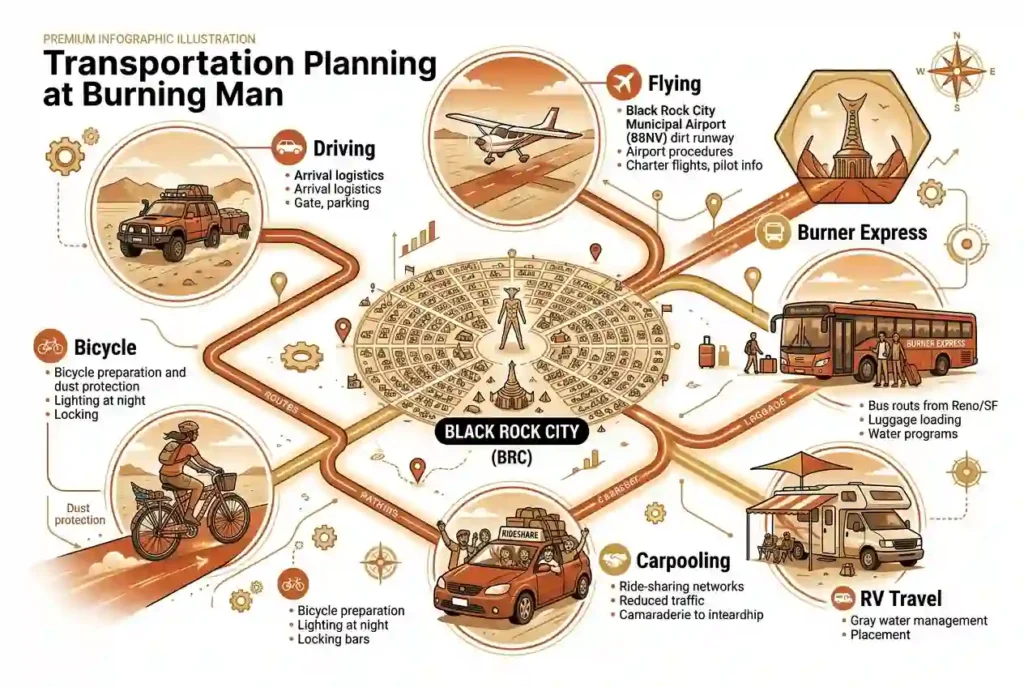
Driving is the most common method. Two main routes from Reno:
- I-80 east → Hwy 447 → Gerlach → County Road 34 (8 miles to entrance)
- I-80 → Hwy 50 → Fernley → Hwy 427 → Hwy 447 → Gerlach → County Road 34
Requirements
- Vehicle pass (~$100–$150 for standard vehicles; ~$150–$250 for RVs)
- Playa-worthiness: tires in good condition, functional suspension, dust protection (sealed windows/vents, air filters)
- Emergency kit: spare tire, jack, tools, oil, coolant, tire inflator
- Fuel: Fill up in Gerlach (last major stop); carry extra if safe
Cost: ~$400–$700 solo from Reno; ~$150–$300 per person (4-person carpool)
Internal Link: Driving to Burning Man Guide — Full vehicle prep checklist, route maps, and fuel planning
Flying to the Region
Most fly into Reno–Tahoe International Airport (RNO), ~122 miles from Black Rock City (2½–3 hours by car). Alternative routing: fly to San Francisco (SFO), Los Angeles (LAX), or Oakland (OAK), then connect to Reno.
Ground transport from Reno
- Burner Express Bus: ~$60 one way; bypasses Gate lines
- Rental car: ~$82–$123/day + fuel + vehicle pass + cleaning fees ($150–$200)
- Burner Express Air: ~$776 one way; 45-minute flight directly to playa (FAA: 88NV)
Cost: Flight to Reno (~$200–$600 domestic; ~$800–$1,500 international) + Bus (~$120 round-trip) = ~$320–$720 total
Internal Link: International Visitor Guide — Visa requirements, flight routing, and gear shipping for overseas attendees
Using Burner Express Services
Burner Express Bus (BxB):
- Departures: Reno Airport and San Francisco (Bill Graham Civic Auditorium)
- Cost: ~$60 one way (Reno), ~$95 (SF); ~$120–$190 round-trip
- Benefits: Bypasses Gate traffic, no vehicle prep, ADA-compatible, affordable
- Luggage: 2 bags (≤50 lbs each, max 62 linear inches) + 1 carry-on; extra luggage $100/unit
Burner Express Air (BxA)
- Departures: Reno, Hayward (HWD), Oakland (OAK), Southern California (seasonal)
- Cost: ~$776 one way from Reno (~$1,500 round-trip)
- Flight time: ~45 minutes from Reno to 88NV playa airport
- Luggage: Strict limits (1 bag ≤25 lbs, max 24″×14″×9″, soft-sided only)
- Benefits: Fastest option, no desert driving, bypasses Gate lines
Burner Express Bus Guide — Schedule, booking process, luggage policies, and departure locations
Burner Express Air Guide — Flight routes, weight restrictions, booking, and costs
Carpooling and Shared Transportation
Carpooling is the most effective way to reduce cost and emissions:
- Emissions reduction: 4-person carpool = ~75–150 kg CO₂ per person (vs ~400–600 kg solo)
- Cost savings: Split fuel (~$40–$65/person from Reno), vehicle pass (~$25–$40), rental (~$20–$31/day)
- Total: ~$150–$300 per person (4-person) vs ~$400–$700 solo
- How to find partners: spark.burningman.org/category/carpooling, RideFinder app (ridefinder.site), ePlaya forums
Benefits: Shared gear, reduced traffic, community building, lower environmental impact
Where Is Burning Man Located?
Burning Man is held at Black Rock City a temporary, self-contained metropolis on the playa of the Black Rock Desert in northwestern Nevada. The site is remote, flat, and far from major services, with a unique semicircular grid of radial and concentric streets. Its location shapes every aspect of travel, from route choices and fuel stops to vehicle readiness and timing for load-in and exodus.
Understanding Black Rock Desert Geography
Burning Man is held at Black Rock City—a temporary, self-contained metropolis on the playa of the Black Rock Desert in northwestern Nevada. Coordinates: roughly 40.7547°N, 119.2364°W.
The terrain is an ancient glacial lakebed (Lahontan) with flat alkali crust and fine, abrasive dust. The city is laid out in a semicircular grid with radial streets (named by time: 2:00 Street, 3:00 Street, etc.) and concentric streets (E, F, G, H, I, J, K, L, M).
Distance from Reno
- By air: ~100 miles (160 km) north-northeast
- By road: ~122 miles (196 km); 2½–3 hours driving normally
- Peak times: 3–4+ hours during load-in (Sat–Sun) or exodus (Mon–Wed)
- Gerlach: Last major fuel/supply stop; 75 miles from Reno on Hwy 447
Key Routes to Black Rock City
From Reno:
- I-80 east → Exit 43 (Wadsworth/Pyramid Lake) → Hwy 447 north → 75 miles to Gerlach → Right fork onto County Road 34 → 8 miles to entrance
From Fallon:
- Hwy 50 west ~31 miles to Fernley → Hwy 427 ~5 miles → Right onto Hwy 447 → ~75 miles to Gerlach → County Road 34
From San Francisco:
- I-80 east ~175 miles to Reno → Follow Reno route above (~550–580 miles total; 9–10 hours)
From Los Angeles:
- I-5 north ~380 miles to Reno → Follow Reno route above (~750–800 miles total; 10–12 hours)
Key Insights of BRC & Travel Routes
- Burning Man is on the Black Rock Desert playa in northwestern Nevada — remote, flat, and far from services, with a semicircular grid layout
- Black Rock Desert is an ancient lakebed with flat alkali crust and fine, abrasive dust; coordinates ~40.75°N, 119.24°W; terrain is open with rapid weather shifts
- Distance from Reno: ~100 miles air, ~122 miles road; 2½–3 hours driving normally, 3–4+ hours during peak load-in/exodus; Reno is the main staging point
- Distances from major cities: SF ~9–10 hrs (550–580 mi), LA ~10–12 hrs (750–800 mi), Seattle ~15–17 hrs (1,000–1,100 mi), Vegas ~9–10 hrs (550 mi), SLC ~10–11 hrs (650 mi)
- Key routes from Reno: I-80 east → Hwy 447 → Gerlach → County Road 34 (8 mi); from Fallon: Hwy 50 → Fernley → Hwy 427 → Hwy 447 → Gerlach → County Road 34; Gerlach is last major fuel stop
- Location challenges: remote distance, sparse cell coverage, minimal signage, dust/heat degradation, bottlenecked entrance lines, playa surface requiring rugged tires/suspension
- Planning tips: treat like an expedition — extra fuel/water, spares (filters, belts, tires), offline maps, stop in Gerlach, know tire pressure/load limits, time buffers, dust gear (mask, goggles), secure cargo, camp coordination, contingency buddy plan; early planning reduces stress and keeps you mobile
What Transportation Options Are Available?
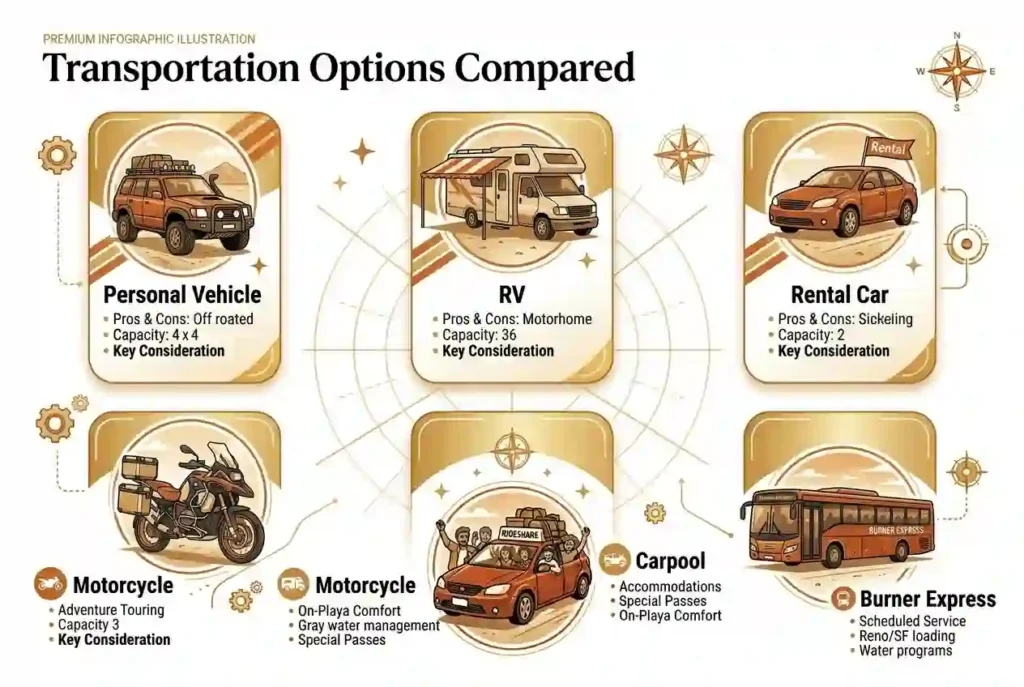
Travelers can drive personally, fly into Reno or the temporary Black Rock City Airport, use Burner Express Bus from Reno or San Francisco, or book Burner Express Air chartered flights from select cities. Carpooling with friends or camps is common. International visitors often fly to Reno and then arrange ground transport or join a shuttle. Compare based on cost, convenience, vehicle requirements, luggage capacity, and timing around load‑in and exodus.
H3 — Burner Express Bus
The Burner Express Bus is a simple way to get to Black Rock City without driving. It is especially useful for people who want to avoid Gate traffic and vehicle preparation.
Burner Express Air
Burner Express Air is the quickest way to reach the playa. It is ideal for travelers who value speed over cost and can pack light.
RV or Camper
RVs offer more comfort, storage, and sleeping space. They are a good fit for groups, but they come with higher rental, fuel, and cleaning costs.
Rental Car or Van
A rental vehicle can work well if you need flexibility but do not want to use your own car. You should always confirm the rental policy before entering the desert.
H3 — Carpooling and Rideshare
Carpooling is one of the most budget-friendly and community-friendly options. It works well when you can share fuel, gear, and driving responsibilities.
H3 — Motorcycle Travel
Motorcycles can work for experienced riders who travel light. They are less practical for large loads, but they can be efficient for desert travel.
H3 — Bicycle Transportation
Bicycles are the main way to move around once you are inside Black Rock City. A sturdy bike with lights and a lock makes the playa much easier to navigate.
Driving Your Own Vehicle
Driving works best if you want control over your schedule and need to bring a lot of gear. It also requires proper vehicle prep, fuel planning, and a valid vehicle pass.
Most participants drive personal cars, SUVs, or trucks.
Requirements:
- Vehicle pass (~$100–$150)
- Playa-worthiness inspection at Gate
- Dust protection (sealed windows/vents, air filters)
- Emergency supplies (water, food, first aid, tools)
Best vehicles: SUVs/crossovers with good cargo capacity and desert-rated tires
Rental Cars and Vans
Renting is feasible if you choose a rugged, dust-resistant vehicle (SUV/van) and confirm the rental agreement allows desert/playa use. Warning: Many companies charge hefty dust fees ($350–$500+ for cars; up to $5,000 for trucks) if not cleaned thoroughly.
Cost: ~$82–$123/day + fuel (~$150–$250) + vehicle pass (~$100–$150) + cleaning (~$150–$200) = ~$400–$700 total from Reno
Internal Link: Rental Car Guide — Rental policies, dust fee avoidance, vehicle selection, and budget planning
RV Transportation
RVs offer comfort (beds, climate control, storage) but are expensive and require wake management.
Cost: ~$200–$800/day rental (7-day = ~$1,400–$5,600) + fuel (~$300–$600) + vehicle pass (~$150–$250) + cleaning ($150–$500+) = ~$2,000–$7,000 total; ~$500–$1,750 per person (4-person group)
Challenges: No water/electric hookups on playa (dry-camping), waste management (grey/black water), dust cleaning fees, hard to maneuver on dusty terrain
Internal Link: RV Transportation Guide — RV selection, playa prep, waste/power management, and cleaning/return requirements
Motorcycle Travel
Dual-sport or adventure bikes (e.g., Honda CRF300L, Kawasaki KL650) are ideal for desert conditions. Motorcycles generally don’t need a vehicle pass but confirm camp parking.
Cost: Similar to driving solo (~$400–$700 from Reno) + motorcycle-specific gear (dust masks, goggles, protective clothing)
Challenges: Dust clogs engines, heat increases tire wear, long distances with limited services
Internal Link: Motorcycle Guide — Bike selection, dust protection, fuel planning, and safety tips
Shared Transportation Options
Beyond carpooling, shared options include:
- Burner Express Bus: ~$60 (Reno) / ~$95 (SF) one way; bypasses Gate
- Burner Express Air: ~$776 one way from Reno; direct to playa
- Rideshare programs: Official Burning Man rideshare via spark.burningman.org
Tips For Transportation Options
- Driving is the most common option: offers flexibility, cargo capacity, and independence; requires vehicle prep, vehicle passes, and desert-ready checklist
- Flying to Reno (RNO) saves driving time but costs more; Black Rock City Airport (88NV) offers direct playa access via charter but depends on weather/dust
- Burner Express Bus ($60 from Reno, $95 from SF) is affordable, reliable, and bypasses Gate traffic; Burner Express Air is faster but expensive (~$776 one-way from Reno)
- Carpooling with friends/camps reduces costs, builds community, and manages gear; coordinate arrival windows, fuel/tools, passes, parking, and contingency plans
- International visitors: fly to Reno, take Burner Express Bus or rent a car; check visas, secure vehicle passes early, use offline maps, and plan fuel stops; consider shipping freight for large art/installations
- Choose based on budget, timing, gear needs, and comfort with desert driving: driving for capacity/control, flying for time/convenience, Burner Express for simplicity/affordability, carpooling for community/cost savings
How Do International Visitors Travel to Burning Man?
International visitors typically fly into a major U.S. gateway (San Francisco or Los Angeles), then fly to Reno–Tahoe International Airport (RNO), the closest major airport to Black Rock City. From Reno, most take Burner Express Bus (~$60 one way) or rent a car for the ~122-mile drive to the playa. A smaller number use Burner Express Air to fly directly to the temporary Black Rock City Municipal Airport (FAA: 88NV) on the playa. The key is to plan airports, visas, ground transport, and gear shipping early and to coordinate with your camp for parking and arrival timing.
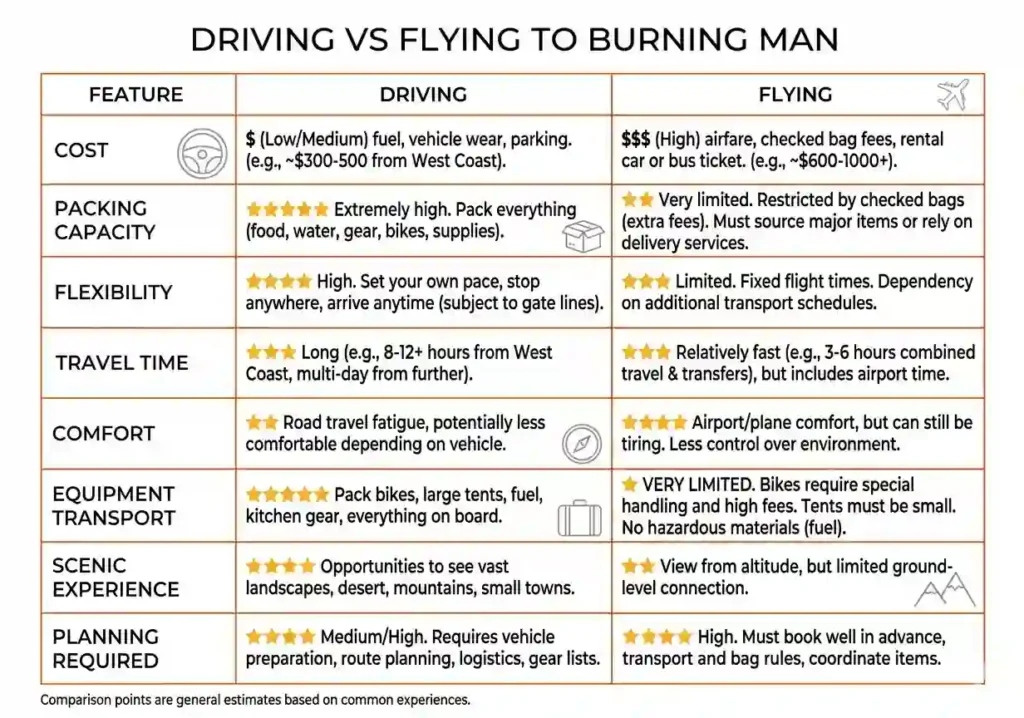
Transportation Planning for Overseas Attendees
- Start with a U.S. visa (B-2 Tourist Visa) and give yourself months for processing
- Book flights a few days before and after the event to buffer travel and jet lag
- Fly into SF/LA, then connect to Reno (RNO); Reno is the closest major airport with shuttle service
- Arrange ground transport from Reno: Burner Express Bus is the simplest option (~$60 one way)
- If you plan to bring a vehicle later, secure a vehicle pass early and confirm rental policies for playa use
- Coordinate with your camp for parking, arrival windows, and meetups
Choosing the Best Airport
- Primary: Reno–Tahoe International Airport (RNO) — ~122 miles to Black Rock City, 2½–3 hours by car; Burner Express Bus departs here
- Alternatives for international routing: San Francisco (SFO), Los Angeles (LAX), Oakland (OAK), San Jose (SJC) — then short flight to Reno
- Direct playa access: Black Rock City Municipal Airport (88NV) via Burner Express Air or private charter
- Smaller regional airports: Winnemucca (WMC), Susanville (SVE), Lovelock (LOL) — fewer commercial options
Renting Vehicles as an International Visitor
- Rent in Reno; many major agencies operate at RNO
- Confirm the rental agreement allows off-road/desert use and ask about playa dust fees
- Be aware that some companies charge hefty dust fees (e.g., $350–$500+) if the vehicle enters the playa
- Choose an SUV or van with good cargo capacity and dust resistance
- Secure a vehicle pass for most vehicles; check camp parking policies before booking
- Budget for fuel (~$150–$250), cleaning/detailing ($150–$200), and possible fees
Using Burner Express Services
- Burner Express Bus: departures from Reno Airport and San Francisco (Bill Graham Civic Auditorium); tickets start at $60 (Reno) and $95 (SF) one way; bypasses Gate traffic and arrives at the BxB Depot
- Burner Express Air (BxA): chartered flights from Reno, Bay Area, and Southern California directly to 88NV; ~45-minute flight from Reno; strict luggage rules (one bag ≤25 lbs, carry-on size)
- Both services reduce traffic and simplify logistics; book early as seats can sell out
Travel Planning Tips for First-Timers
- International visitors fly SF/LA → Reno, then take Burner Express Bus (~$60) or rent a playa-ready vehicle for ~122-mile drive to Black Rock City; BxA offers direct flights to 88NV but more expensive + strict luggage
- Plan visas early, book flights with buffers, coordinate gear shipping/community freight; avoid rental dust fees by choosing suitable vehicle + cleaning thoroughly; use Burner Express for simplicity; drive if you need cargo/flexibility
- Best airport: Reno (RNO), ~122 miles (2½–3 hrs); alternatives SFO/LAX/OAK/SJC + Reno flight; direct playa via 88NV charter; regional WMC/SVE/LOL fewer options
- Renting: Reno agencies; confirm off-road/desert allowance + dust fees ($350–$500+); choose SUV/van; secure vehicle pass; budget fuel ($150–$250), detailing ($150–$200), possible fees
- Burner Express: Bus from Reno ($60), SF ($95), bypasses Gate; BxA 45-min from Reno, strict luggage (1 bag ≤25 lbs, carry-on size); book early
- Gear: pack compactly, empty cooler for Reno, community freight for bulky items, ship freight for large art, Leave No Trace (take everything back)
- Challenges: visa delays, long travel, dust fees, limited services, currency/payment, passport safety
- First-timer tips: book flights with buffers, arrive Reno early for supplies, use Burner Express Bus, playa-ready SUV + confirm policies + budget cleaning, pack emergency supplies, offline maps + Gerlach fuel stop, camp coordination + buddy plan, keep passport safe + photocopies
How Do You Travel Inside Black Rock City?
Inside Black Rock City, people travel primarily by bicycle. The city is laid out in a semicircular grid with radial streets (named by time, e.g., 2:00 Street, 3:00 Street) and concentric streets (E, F, G, H, I, J, K, L, M). Distances between camps and key locations often range from 0.5 to 1.5 miles. Walking is possible but slow and exhausting in the heat and dust. Some camps offer RV or shuttle transport for members, but these are limited. Bikes are the default mode of transport for nearly everyone.
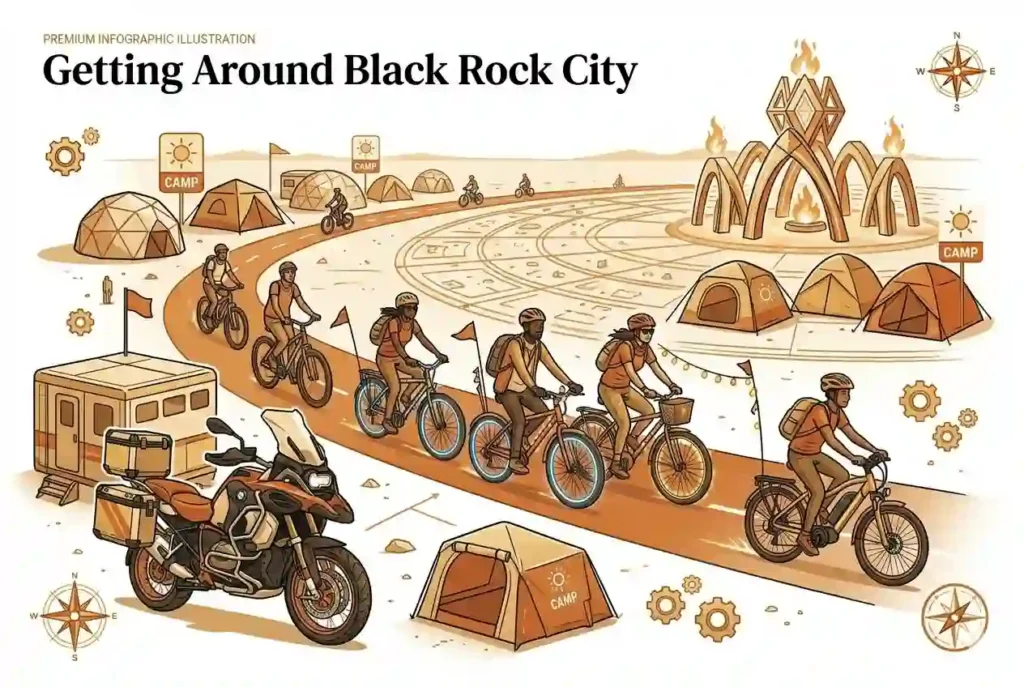
Why Bicycles Are Essential
A bicycle is essential at Burning Man because Black Rock City spans over a mile across the playa, and there are no internal public transit options beyond occasional volunteer shuttles. Your camp could be 10–20 minutes away from the Center City, art installations, or theme camps. A bike lets you explore the event efficiently, carry gear, and participate fully without exhausting yourself on foot. Most participants rely on bikes for daily mobility, and having one dramatically improves your experience.
Black Rock City spans over 1 mile across the playa. Your camp could be 10–20 minutes from Center City, art installations, or theme camps. There’s no internal public transit. Bicycles are the default mode of transport for nearly everyone.
Choose: Sturdy mountain bike with wide tires (2.0–2.5 inches), bright lights (mandatory for night riding), bell/horn, and lock.
Internal Link: Bicycle Guide — Bike selection, essential accessories, safety tips, and e-bike rules
E-Bikes and Alternative Mobility Options
E-bikes are allowed but subject to rules:
- Battery: Sealed, non-spillable; no exposed wires
- Speed: Max 15–20 mph; some camps restrict e-bikes in certain areas
- Charging: No charging on playa; bring extra batteries
Alternatives: Some camps offer scooters, wagons, or carts for gear transport, but bikes are most common.
Bicycle Safety Basics
- Ride slowly (5–10 mph on playa; dust and crowds require caution)
- Wear helmet (strongly recommended)
- Lights at night (mandatory)
- Signal with bell/horn when approaching others
- Stay on streets; avoid riding through camps or art installations
- Secure bike with lock ( theft is common)
What Happens During Arrival and Departure?
Arriving at Burning Man means entering through Gate Road, where your vehicle and documents are inspected before you’re granted access to Black Rock City. The process can take anywhere from 30 minutes to several hours, depending on your arrival time, vehicle type, and preparation. Once through Gate, you’ll follow directional signs to your campsite or the Burner Express Depot if you’re using shuttle services. Understanding the entry procedures, required documents, and timing strategies will help you avoid delays and start your experience smoothly.
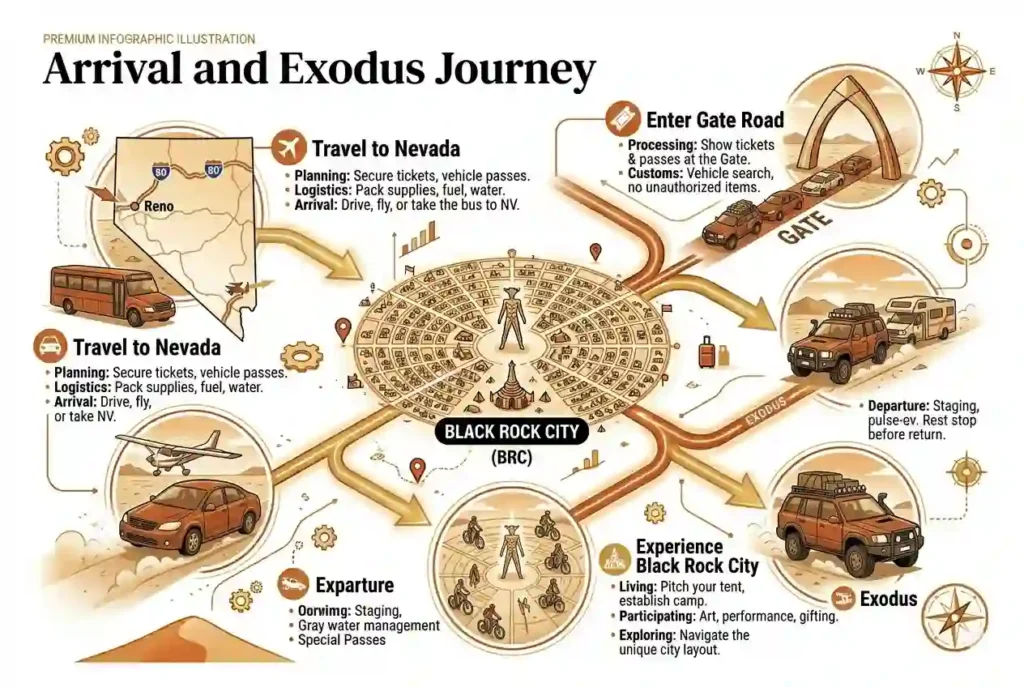
Entering Black Rock City
Arrival means entering through Gate Road, 8 miles from the playa entrance. Process takes 30 minutes to 4+ hours depending on arrival time, vehicle type, and preparation.
Requirements:
- Burning Man ticket (valid entry credential)
- Vehicle pass (if driving)
- ID (driver’s license/passport)
- Playa-worthiness: tires, suspension, dust protection, functional brakes/lights
Understanding Gate Road
Gate Road is a long, winding stretch with lanes organized by vehicle type (personal vehicles, RVs, art cars, trucks, Burner Express). Limited shade and services; prepare for heat, dust, and long waits.
Best arrival times: Tuesday–Wednesday midday (12–4 PM) for shortest lines
Avoid: Saturday–Sunday (peak load-in), Monday evening (exodus start)
Internal Link: Gate Entry Guide — Entry procedures, vehicle inspection checklist, document requirements, and timing strategies
What Is Exodus?
Exodus is the organized departure process after the event ends (typically Monday–Wednesday). 50,000+ participants leave within 48 hours, creating massive traffic at Gate Road. Wait times: 2–10+ hours during peak.
Best times to leave:
- Tuesday morning (Burnout early exit; requires special ticket)
- Wednesday after 10 AM
- Thursday after 8 AM
Avoid: Monday evening–Tuesday evening (peak exodus; 5–10+ hour waits)
Internal Link: Exodus Guide — Departure procedures, timing strategies, and avoiding long waits
Avoiding Long Wait Times
- Arrive off-peak (Tue–Wed midday)
- Use Burner Express (bypasses Gate lines)
- Carpool (fewer vehicles = shorter queues)
- Secure ticket, vehicle pass, and permits before departure
- Check Burner social media for line status
- Pack water/snacks/sun protection for waits
How Much Does Transportation Cost?
Transportation to Burning Man can range from $150 to $1,500+ per person, depending on your travel method, group size, and how much gear you bring. Driving is often the most affordable option if you share costs with a group, while flying or using Burner Express Air is significantly more expensive but saves time. RVs add high rental and fuel costs. Understanding all cost componentsfuel, vehicle passes, cleaning fees, insurance, and hidden expenses—helps you budget accurately and avoid surprises.
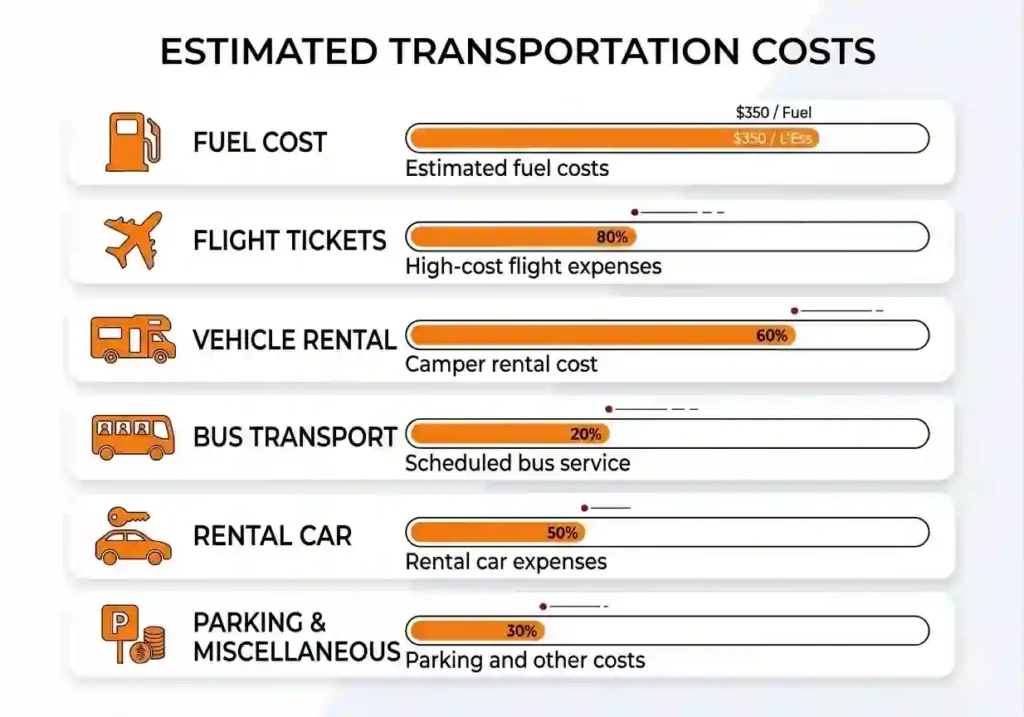
Driving Costs
- Fuel: ~$150–$250 round-trip from Reno; ~$300–$500 from SF/LA
- Vehicle pass: ~$100–$150 (standard); ~$150–$250 (RV)
- Rental: ~$82–$123/day + fuel + insurance + cleaning ($150–$200)
- Dust fees: $350–$500+ for rentals if not cleaned properly
- Total: ~$400–$700 solo from Reno; ~$150–$300 per person (4-person carpool)
Flying Costs
- Burner Express Bus: ~$60 (Reno) / ~$95 (SF) one way; ~$120–$190 round-trip
- Burner Express Air: ~$776 one way from Reno (~$1,500 round-trip)
- Flight to Reno: ~$200–$600 domestic; ~$800–$1,500 international
- Total (Bus): ~$320–$720 (flight + Bus)
- Total (Air): ~$1,700–$2,100 (flight + BxA)
- International: ~$1,600–$3,000+ (flight + ground transport)
RV Costs
- Rental: ~$200–$800/day (7-day = ~$1,400–$5,600)
- Fuel: ~$300–$600 round-trip
- Vehicle pass: ~$150–$250
- Cleaning: $150–$500+ (up to $5,000 for trucks)
- Total: ~$2,000–$7,000 per RV; ~$500–$1,750 per person (4-person group)
Budget-Friendly Transportation Strategies
- Carpool: ~$150–$300 per person (4-person) vs ~$400–$700 solo
- Burner Express Bus: ~$120 round-trip from Reno; no vehicle prep
- Minimize gear: Pack compactly; avoid freight shipping (~$300–$800)
- Avoid RVs: High rental, fuel, and cleaning costs
- Total budget range: ~$150–$700 per person depending on carpool size and flight costs.
Hidden Transportation Expenses
Don’t forget these often-overlooked costs:
- Dust cleaning fees: $350–$500+ for rentals; up to $5,000 for trucks if not cleaned
- Vehicle pass: required for most vehicles; ~$100–$250 depending on type
- Insurance add-ons: collision damage waiver, supplemental liability, personal accident (~$10–$50/day)
- Extra luggage fees: $100 per unit for Burner Express
- Freight shipping: ~$300–$800 for large gear/art to Reno
- Emergency supplies: water, food, first aid, tools (~$50–$100)
- Tire repair/replacement: dust can cause flats; ~$50–$150 per tire
- Fuel for idling: exodus waits can take hours; extra fuel needed (~$20–$50)
- Parking fees: some camps or regional lots may charge (~$10–$30)
Budgeting Transportation Tips
- Transportation cost range: $150–$1,500+ per person depending on method, group size, gear; driving = most affordable with carpool; flying/RV = expensive but time-saving
- Budget planning: estimate by travel method, group size, duration, gear, hidden costs; break into fuel, passes, rentals, tickets, fees, emergency buffer (10–20% extra)
- Driving estimates: fuel ~$150–$250 (Reno), ~$300–$500 (SF/LA); vehicle pass ~$100–$150; rental ~$82–$123/day + fuel + insurance + cleaning ($150–$200); dust fees $350–$500+; total Reno ~$400–$700 solo / ~$150–$300 carpool; total SF/LA ~$600–$900 solo / ~$200–$400 carpool
- Flying estimates: Burner Express Bus ~$60 Reno / ~$95 SF one way (~$120–$190 round-trip); Burner Express Air ~$776 one way Reno (~$1,500 round-trip); flights to Reno ~$200–$600 (SF/LA), ~$800–$1,500 (international); total Reno Bus ~$320–$720; total Reno Air ~$1,700–$2,100; international ~$1,600–$3,000+
- RV costs: rental ~$200–$800/day (7-day = ~$1,400–$5,600); fuel ~$300–$600; vehicle pass ~$150–$250; cleaning $150–$500+ (up to $5,000 for trucks); insurance ~$20–$50/day; total ~$2,000–$7,000+ per RV; ~$500–$1,750 per person (4-person group)
- Burner Express: Bus ~$60 Reno / ~$95 SF one way (~$120–$190 round-trip); Air ~$776 one way Reno (~$1,500 round-trip); extra luggage $100/unit; bike add-on included; early exit (Burnout) Tue; total Reno Bus ~$320–$720; total Reno Air ~$1,700–$2,100
- Carpool savings: fuel split ~$40–$65 per person (Reno, 4-person); vehicle pass ~$25–$40; rental ~$20–$31/day; cleaning ~$40–$50; total Reno ~$150–$300 (vs ~$400–$700 solo); total SF/LA ~$200–$400 (vs ~$600–$900 solo); benefits: shared gear, reduced emissions, community
- Hidden expenses: dust cleaning fees ($350–$500+ rentals, up to $5,000 trucks); vehicle pass (~$100–$250); insurance add-ons (~$10–$50/day); extra luggage ($100/unit); freight shipping (~$300–$800); emergency supplies (~$50–$100); tire repair/replacement (~$50–$150); fuel for idling (~$20–$50); parking fees (~$10–$30)
What Transportation Safety Risks Should You Know?
Transportation to and at Burning Man involves real safety risks due to the remote desert environment, extreme heat, dust, and long distances. Vehicle breakdowns, fuel shortages, dust storms, and weather hazards can quickly turn into serious emergencies if you’re unprepared. Understanding these risks, planning ahead, and carrying emergency supplies will help you stay safe and respond effectively if problems arise.
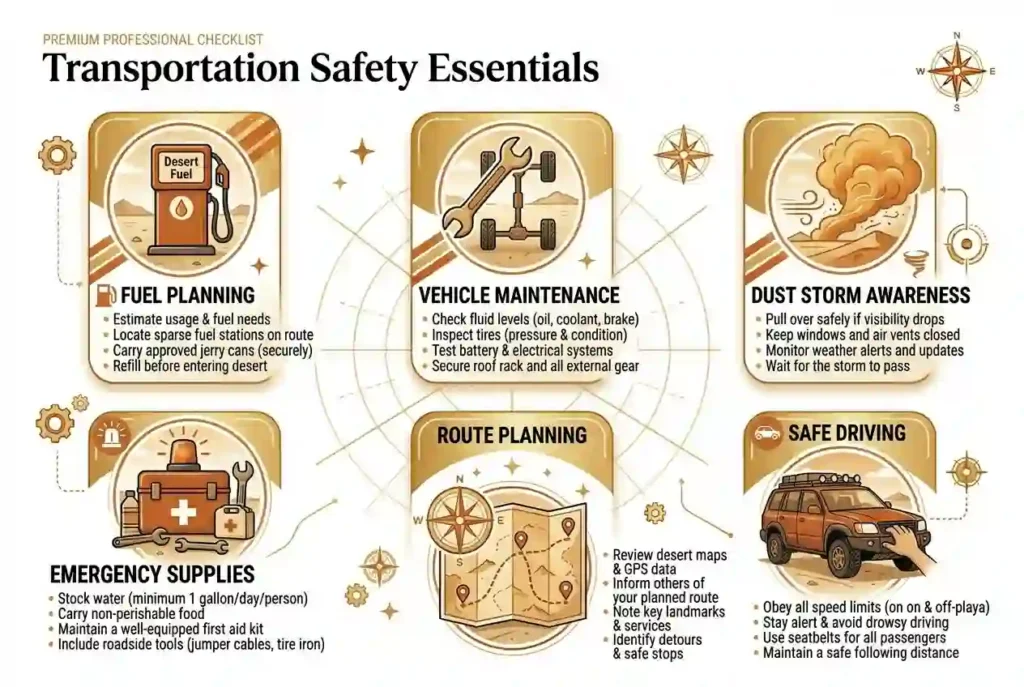
Desert Driving Risks
- Dust: Clogs engines, damages seals, corrodes metal
- Heat: 90–110°F; risk of overheating vehicles and heat exhaustion
- Long distances: 50–75 miles between services; Gerlach is last fuel stop
- Visibility: Dust storms reduce visibility to near zero
- Terrain: Loose surfaces require good suspension and desert-rated tires
Vehicle Breakdowns
Vehicle breakdowns are common due to dust, heat, and rough terrain:
- Causes: clogged air filters, overheating, tire blowouts, brake wear, electrical failures from dust corrosion
- Prevention: full mechanical check before departure (fluids, brakes, tires, belts, filters); install high-flow air filters and dust shields; check suspension and cooling systems
- What to do: stop safely off the road; call for help if needed; use emergency contacts; don’t attempt major repairs alone in extreme heat
- Emergency kit: carry spare tire, jack, lug wrench, duct tape, rags, extra oil, coolant, tire inflator, multi-tool
- Backup plan: have a buddy system or camp contact for assistance; know nearby repair shops along your route
Fuel Shortages and Planning
Fuel shortages can strand you in remote desert with no services:
- Risk: Gerlach is the last major fuel stop before the 8-mile playa entrance; distances between services are 50–75 miles
- Prevention: fill up in Gerlach; know your vehicle’s range; factor in heat/dust reducing efficiency; carry extra fuel if safe and allowed (sealed container)
- Planning: map fuel stops before departure; log fuel levels; don’t run low—plan conservative stops
- During exodus: idling for hours can use significant fuel; bring extra for delays
- Emergency: if stranded, stay with vehicle; call for help; don’t walk far in heat without supplies
Desert Weather Hazards
Desert weather can shift rapidly and create dangerous conditions:
- Heat: daytime temps 90–110°F (32–43°C); risk of overheating vehicles and heat exhaustion for people
- Cold nights: temps can drop to 50–60°F (10–15°C); need warm clothing
- Rain: rare but can cause flash flooding; washes become dangerous; roads may close temporarily
- Wind: high winds can create dust storms or make driving unstable
- Prevention: check weather before departure; pack sun protection (hat, sunscreen, sunglasses); bring warm layers for nights; avoid driving during extreme heat (midday)
- During events: seek shade; hydrate frequently; don’t overexert
Dust Storm Transportation Challenges
Dust storms are a major hazard on the playa and access roads:
- Risks: visibility drops to near zero; dust clogs engines, damages seals, corrodes metal; can cause accidents if drivers panic
- What to do: slow down gradually; turn off lights (to avoid others following you); pull safely off the road; stay in vehicle; wait for storm to pass
- Prevention: seal windows/vents; install dust shields and air filters; use dust-resistant lubricants; keep windows closed during storms
- After storm: clean vehicle thoroughly; check air filters, brakes, and electrical systems; replace if clogged
- Visibility: use low beams in dust; wear goggles and face mask when outside
Road Safety Best Practices
Safe driving on desert roads and playa requires specific habits:
- Speed: drive conservatively (5–10 mph on playa; respect posted limits on access roads); lower speeds reduce dust and heat stress
- Tires: check pressure regularly; use desert-rated tires with good grip; avoid sudden maneuvers on loose surfaces
- Brakes: inspect pads and fluid; dust reduces braking efficiency; allow extra stopping distance
- Visibility: use low beams in dust; wear goggles/mask; keep windows closed; check mirrors for dust buildup
- Routes: stay on marked roads; don’t drive through unfamiliar washes or soft playa areas; follow directional signs
- Etiquette: no overtaking in queues; yield to emergency vehicles; be patient and cooperative with staff
Emergency Preparedness
Being prepared for emergencies is critical in remote desert:
- Emergency supplies: water (1+ gallon per person per day), non-perishable food, first-aid kit, flashlight, high-vis vest, warning triangle, reflective tape
- Tools: multi-tool, paracord, duct tape, spare tire, jack, lug wrench, tow strap, tire inflator
- Communication: portable battery/solar charger, paper map, emergency contacts in vehicle; cell coverage is unreliable
- Buddy plan: coordinate with travel partner or camp; share contact info; agree on contingency if breakdown/sickness occurs
- Medical: know nearest medical facilities (Reno has hospitals); carry any personal medications; call Rangers for on-playa medical help
- Evacuation: if emergency evacuation is needed, follow staff directions; don’t attempt to bypass queues unless directed
Family Travel Safety Tips
Traveling with family requires extra precautions:
- Children: keep kids secured in car seats; don’t leave them unattended in vehicle; ensure they have water and sun protection
- Supplies: bring extra water, food, first aid, and comfort items (toys, books) for long waits
- Sun protection: hats, sunscreen, sunglasses for all family members; seek shade during midday heat
- Hydration: encourage frequent water intake; monitor for heat exhaustion signs (dizziness, nausea, fatigue)
- Communication: keep kids close; establish meeting points; have emergency contacts on hand
- Vehicle safety: ensure all seats have working seat belts; teach kids not to touch controls; lock doors when parked
- ** Camp coordination**: confirm family-friendly parking; know camp layout and safe zones; bring whistle or signal for kids
Desert Survival Hacks
- Supplies: Water (1+ gallon/person/day), non-perishable food, first aid, flashlight, high-vis vest
- Tools: Multi-tool, paracord, duct tape, spare tire, jack, lug wrench, tow strap, inflator
- Communication: Portable battery/solar charger, paper map; cell coverage unreliable
- Buddy plan: Coordinate with travel partner/camp; share contacts; agree on contingency
- Medical: Know Reno hospitals; call Rangers for on-playa help
What Transportation Strategy Is Best for First-Timers?
For first-timers, Burner Express Bus from Reno is often the best strategy: it’s affordable (~$60 one way), bypasses Gate traffic, and eliminates the stress of desert driving and vehicle prep. If you’re coming from San Francisco or want more flexibility, carpooling
with a playa-ready vehicle is a strong alternative. Driving alone is the most cost-effective for groups but requires significant preparation. International visitors should fly to Reno and take Burner Express Bus. The key is to prioritize simplicity, budget, and reliability over speed or convenience.
Budget-Friendly Travel Plans
Best for first-timers on a tight budget:
- Carpool from Reno: ~$150–$300 total per person (4-person group); split fuel (~$40–$65), vehicle pass (~$25–$40), rental (~$20–$31/day)
- Burner Express Bus from Reno: ~$120 round-trip + flight to Reno (~$200–$600) = ~$320–$720 total
- Minimize gear: Pack compactly; avoid freight shipping (~$300–$800)
- Avoid RVs: High rental ($200–$800/day), fuel ($300–$600), cleaning fees ($150–$500+)
- Total budget range: ~$150–$700 per person depending on carpool size and flight costs
Convenience-Focused Travel Plans
Best for first-timers prioritizing time and simplicity:
- Burner Express Air from Reno: ~$1,500 round-trip; 45-minute flight; bypasses driving; strict luggage (1 bag ≤25 lbs)
- Burner Express Bus from SF: ~$190 round-trip; 10-hour drive; no vehicle prep; bypasses Gate lines
- Fly to Reno + Bus: Flight to Reno (~$200–$600) + Bus (~$120) = ~$320–$720; 3 hours from Reno
- Prepare minimal gear: Pack compactly; buy supplies in Reno after arrival
- Total convenience range: ~$720–$2,100 per person depending on Air vs Bus
International Visitor Recommendations
Best strategy for international first-timers:
- Fly to a major U.S. gateway: San Francisco (SFO), Los Angeles (LAX), or New York (JFK)
- Connect to Reno–Tahoe International (RNO): ~$200–$600 from SF/LA; ~$800–$1,500 from Europe/UK
- Take Burner Express Bus from Reno: ~$60 one way; bypasses Gate; no vehicle prep needed
- Total cost: ~$1,600–$3,000+ (flight + Bus); ~$1,700–$2,100 if using Air
- Key tips: Apply for U.S. visa (B-2) months early; arrive in Reno 1–2 days before event for supplies; coordinate with camp for parking/meetups; keep passport safe (carry photocopies)
Solo Burner Transportation Strategies
Best for solo first-timers:
- Burner Express Bus from Reno: ~$120 round-trip; no vehicle prep; easiest for solo; bypasses Gate lines
- Join a carpool: Use spark.burningman.org/category/carpooling or RideFinder app (ridefinder.site); ~$150–$300 total; share gear/supplies
- Avoid driving solo: High cost (~$400–$700), high prep (vehicle pass, dust protection), no cost-sharing
- Consider Air if budget flexible: ~$1,500 round-trip; 45-minute flight; strict luggage limits
- Total solo range: ~$120–$1,500 depending on Bus vs Air
Family Transportation Planning
Best for families with children:
- Carpool with playa-ready vehicle: ~$150–$300 per person (4-person); split costs; bring extra water/food/first aid; kid-friendly supplies (toys, books)
- Burner Express Bus from Reno: ~$120 round-trip per person; no vehicle prep; ADA-compatible buses; extra luggage for mobility devices
- Avoid RVs unless necessary: High cost, waste management challenges, dust cleaning fees
- Family safety tips: Secure children in car seats; bring sun protection (hats, sunscreen); monitor hydration; establish meeting points at camp
- Total family range: ~$500–$1,500 for 4-person family (carpool vs Bus).
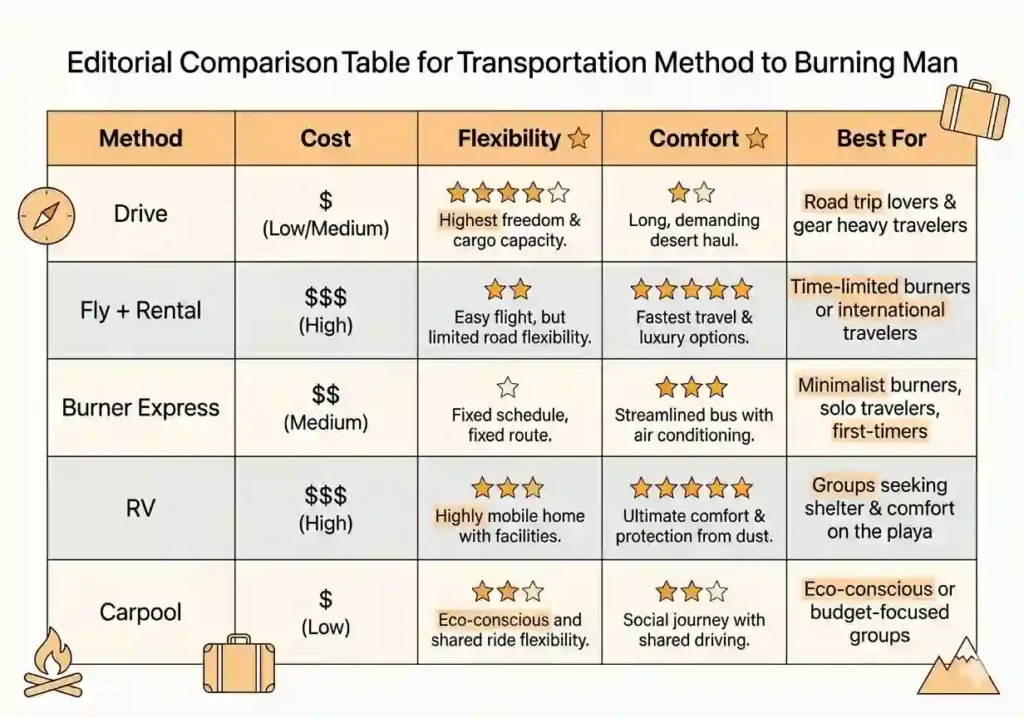
Comparing All Transportation Options
| Option | Cost (per person) | Time | Prep Needed | Best For |
| Burner Express Bus (Reno) | ~$60 one way / ~$120 round-trip | ~3 hours from Reno | Minimal (just ticket) | First-timers, solo travelers, no vehicle |
| Burner Express Bus (SF) | ~$95 one way / ~$190 round-trip | ~10 hours from SF | Minimal | SF Bay Area residents |
| Carpool (4-person) | ~$150–$300 total (from Reno) | ~3 hours from Reno | Moderate (vehicle pass, prep) | Groups, budget-focused, gear sharing |
| Driving Solo | ~$400–$700 total (from Reno) | ~3 hours from Reno | High (vehicle pass, dust prep, fuel) | Experienced drivers, flexible timing |
| Burner Express Air | ~$776 one way / ~$1,500 round-trip | ~45 minutes from Reno | Low (strict luggage limits) | Time-sensitive, no vehicle, budget flexibility |
| RV Rental | ~$500–$1,750 per person (4-person group) | ~3 hours from Reno | Very High (waste, power, cleaning) | Groups wanting comfort, long-term campers |
Transportation in Numbers
Getting to Burning Man is part of the adventure, but it also requires careful planning. Every year, tens of thousands of participants travel to Black Rock City by car, RV, bus, airplane, bicycle, and rideshare from across the United States and around the world. Each transportation method offers different costs, preparation requirements, and advantages.
Understanding your travel options before purchasing tickets or packing your gear can help you avoid unnecessary stress, reduce expenses, and arrive safely. This Transportation Guide introduces every major travel option and connects you to detailed guides covering driving, buses, flights, RVs, rentals, bicycles, gate entry, Exodus, and international travel.
Key Numbers
- 🚗 Thousands of Vehicles travel to Black Rock City every year.
- 🚌 Official Burner Express Bus operates from selected California and Nevada locations.
- ✈️ Multiple Airports serve participants traveling from across the world.
- 🚲 Most Travel Inside the City is done by bicycle or walking.
- 🌍 International Participants arrive from dozens of countries every year.
- 🚐 RVs and Camper Vans remain one of the most popular accommodation choices.
- 🚦 Gate Entry and Exodus are carefully managed to improve safety and traffic flow.
- 🤝 Carpooling helps reduce costs, vehicle numbers, and environmental impact.
Transportation Myths vs Reality
Many first-time participants underestimate how much planning is involved in traveling to Burning Man. Common misconceptions about road conditions, vehicle access, public transportation, airport options, and arrival procedures can lead to costly mistakes or unnecessary delays.
While some travelers assume they can simply drive to the playa without preparation, the reality is that every transportation method requires advance planning, especially during peak arrival and departure periods. Understanding these myths before choosing how you’ll travel helps you make informed decisions and ensures a smoother journey to and from Black Rock City.
| Myth | Reality |
|---|---|
| Driving is the only way to reach Burning Man. | Participants can also travel by Burner Express Bus, Burner Express Air, rideshare, RV, rental vehicle, or other transportation options. |
| I don’t need to prepare my vehicle. | Every vehicle should be inspected and prepared before traveling to the desert. |
| I can arrive anytime without delays. | Gate traffic varies, and peak arrival periods may involve long wait times. |
| I don’t need a Vehicle Pass if I have a ticket. | Admission tickets and Vehicle Passes are separate requirements for most private vehicles. |
| Flying removes all planning. | Air travelers still need transportation, camping gear, and travel logistics after landing. |
| Bikes are only for recreation. | Bicycles are the primary way to travel around Black Rock City. |
| Carpooling isn’t worth the effort. | Sharing rides saves money, reduces traffic, and supports Burning Man’s sustainability goals. |
| Exodus only takes a short time. | Departure traffic can require patience and advance planning. |
Transportation Accessibility
Burning Man offers transportation options that support participants with a variety of mobility needs. While accessibility services vary depending on the transportation method, planning ahead can make traveling to Black Rock City much easier.
Accessibility Considerations
- ♿ Accessible transportation options may be available through selected services.
- 🚌 Some Burner Express services provide accessibility accommodations.
- 🛺 Mobility assistance is available inside Black Rock City for eligible participants.
- 🚗 Accessible parking information is provided where applicable.
- ❤️ Accessibility teams can assist with transportation planning.
- 📖 Review official accessibility information before finalizing travel plans.
Common Transportation Mistakes
Mistakes to Avoid
❌ Forgetting to purchase a Vehicle Pass.
❌ Driving an unprepared vehicle into the desert.
❌ Waiting until the last minute to book flights or rentals.
❌ Underestimating travel time.
❌ Forgetting extra fuel where appropriate.
❌ Not checking arrival instructions before traveling.
❌ Ignoring weather and road conditions.
❌ Leaving without planning for Exodus.
Veteran Burner Transportation Tips
Insider Advice
⭐ Arrive during less congested periods whenever possible.
⭐ Fuel your vehicle before reaching remote areas.
⭐ Keep important travel documents easily accessible.
⭐ Label luggage and camping gear clearly.
⭐ Carry snacks and water during Gate entry and Exodus.
⭐ Keep your bicycle in good working condition throughout the event.
⭐ Allow extra travel time—you’ll almost always need it.
⭐ Stay patient during arrival and departure.
Is This Transportation Guide Right for You?
This guide is ideal if you:
✅ Are attending Burning Man for the first time.
✅ Need help choosing the best transportation option.
✅ Plan to drive, fly, rent an RV, or use Burner Express.
✅ Want to compare transportation costs.
✅ Are traveling internationally.
✅ Need help planning arrival and departure.
Frequently Asked Questions About Burning Man Transportation
This guide introduces every major transportation option for traveling to Burning Man and links to detailed guides covering buses, flights, driving, RVs, rentals, bicycles, Gate entry, Exodus, and international travel.
Start with the Driving Guide if you’re bringing your own vehicle or choose the guide that matches your preferred travel method.
The Burner Express Bus Guide covers routes, schedules, packing rules, tickets, and boarding information.
The Burner Express Air Guide explains airports, flights, baggage, and arrival planning.
The Driving Guide covers routes, vehicle preparation, fuel planning, and road trip advice.
Visit the Gate Entry & Arrival Guide and Exodus & Departure Guide for arrival procedures and departure planning.
The International Traveler Guide explains visas, airports, customs, transportation, and travel planning.
No. This pillar provides the overview, while each transportation guide covers one specific travel method.
The Bicycle Guide covers choosing, maintaining, and safely riding a bike on the playa.
Together they explain every stage of traveling to Burning Man—from planning your journey to arriving safely, exploring Black Rock City, and returning home.
Where Should You Go Next?
| If You Want To… | Read This Guide |
|---|---|
| Drive to Burning Man | → Driving Guide |
| Fly to Burning Man | → Burner Express Air Guide |
| Travel by bus | → Burner Express Bus Guide |
| Rent a vehicle | → Rental Cars & Vans Guide |
| Camp in an RV | → RV & Camper Guide |
| Share a ride | → Carpooling & Rideshare Guide |
| Explore by bicycle | → Bicycle Guide |
| Arrive smoothly | → Gate Entry Guide |
| Leave efficiently | → Exodus Guide |
| Travel internationally | → International Traveler Guide |
burning man Transportation Pro Tips
- 🚗 Choose your transportation method several months in advance.
- 📅 Book flights, rentals, and buses early.
- 🚲 Bring a reliable bicycle for getting around Black Rock City.
- ⛽ Fuel your vehicle before entering remote desert areas.
- 🧳 Pack efficiently and follow baggage restrictions.
- 🚦 Allow extra time for Gate entry and Exodus.
- 📖 Read the detailed transportation guide that matches your travel plans.
Key Takeaways
Traveling to Burning Man begins long before you reach Black Rock City. Careful transportation planning reduces stress, saves money, and helps you arrive ready to enjoy the experience instead of solving avoidable travel problems.
- Start early: Secure tickets, vehicle passes (3–6 months before), and transport bookings months ahead. Burner Express seats and carpool partners fill up quickly.
- Choose wisely: Match your method to priorities—budget (carpool/Bus), time (Air), flexibility (driving), or comfort (RV). First-timers should prioritize Burner Express Bus from Reno.
- Prepare for the playa: Dust, heat, and remote conditions demand vehicle prep (air filters, dust shields, playa-rated tires), emergency supplies (water, food, first aid, tools), and offline maps.
- Avoid peak times: Arrive Tue–Wed midday for shortest lines; leave Wed after 10 AM or Thu after 8 AM to avoid 5–10+ hour exodus waits.
- Don’t skip the bicycle: Essential for navigating the 1+ mile city; no internal transit exists. Bring a sturdy mountain bike with lights, bell, and lock.
- Respect Leave No Trace: Pack out all trash, clean your vehicle thoroughly (avoid $350–$500+ dust fees), and protect the fragile alkali crust.
Smart Tips
- 🚗 Choose the transportation option that best fits your budget, schedule, and camping plans.
- 🚌 Book transportation early, especially buses, flights, and rental vehicles.
- 🚐 Prepare your vehicle carefully before entering the desert.
- 🚲 Plan for local transportation inside Black Rock City.
- 🚦 Expect delays during peak arrival and departure periods.
- 🤝 Consider carpooling to save money and reduce environmental impact.
- 📖 Use this Transportation Guide as your roadmap before exploring the detailed travel guides.
Final Thoughts on Your Transportation Journey to Burning Man
Transportation planning is the single most critical logistical step before attending Burning Man. The remote Black Rock Desert location, extreme heat, fine alkali dust, and 50,000+ participants mean that small mistakes can lead to major delays, safety risks, or even denied entry. By choosing the right method for your needs, preparing thoroughly, and avoiding common pitfalls, you can arrive smoothly and focus on the transformative experience rather than logistics.
As you prepare for your journey, remember these final reminders:
- 🚗 Select the transportation method that matches your needs and budget.
- 🚌 Reserve buses, flights, rental vehicles, or RVs well in advance.
- 🚲 Plan how you’ll travel both to Black Rock City and around the city itself.
- 🚦 Prepare for Gate entry, traffic, and Exodus with patience and flexibility.
- 🌍 International travelers should allow extra time for visas, customs, and logistics.
- 🤝 Consider ridesharing whenever practical to reduce costs and traffic.
- 📖 Use this Transportation Guide as your starting point, then explore each specialized transportation guide for detailed planning.
Your Next Steps
- Review this guide and identify your best transportation option based on budget, group size, and comfort level
- Book transport early: Burner Express Bus/Air, carpool partners via spark.burningman.org, or vehicle pass
- Prepare your vehicle (if driving): Mechanical check, dust protection, emergency kit, fuel planning
- Coordinate with your camp: Confirm parking, meetup details, and ADA needs if applicable
- Plan departure: Avoid peak exodus; bring extra fuel for idling; clean vehicle before return
Arrive prepared, embrace the 10 Principles, and you’ll be ready to experience creativity, community, and the magic of the playa. Safe travels, Burner we’ll see you on the desert.