Burning Man Theme & Philosophical Camps Guide 2026: How These Bring Black Rock City to Life
Theme & Philosophical Camps function as Black Rock City’s neighborhoods, built entirely by participants who host workshops, performances, and community spaces at their own expense and effort. This guide explains how they operate, what different camp types offer, and how to choose or join one. They’re the social infrastructure that makes the city function.
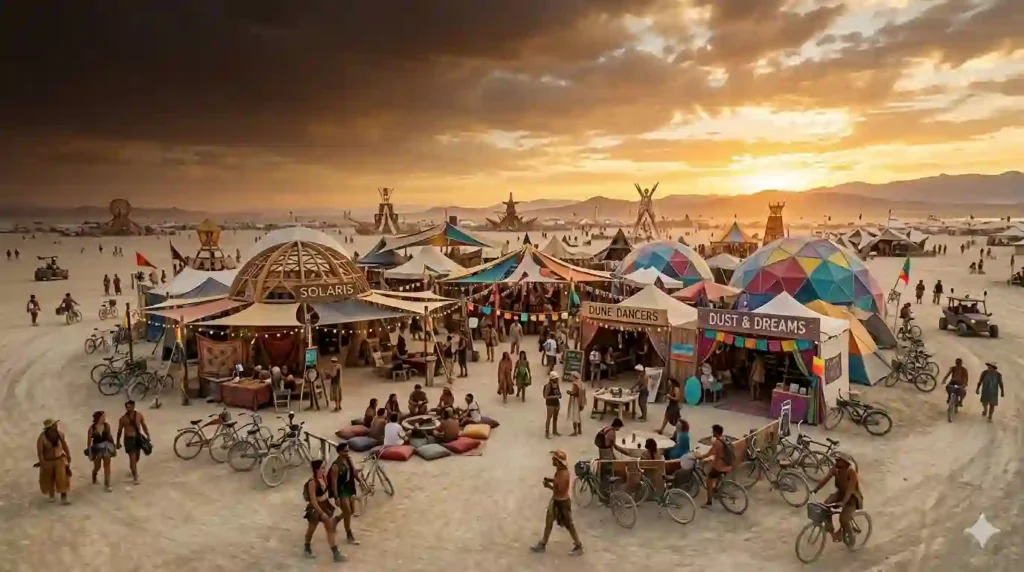
If Black Rock City is a temporary metropolis, Theme Camps are its neighborhoods — self-organized communities that build and staff interactive spaces entirely through volunteer effort and their members’ own resources, in keeping with the event’s Decommodification principle, which prohibits commercial sponsorship or transactions. A single camp might host workshops, live music, art installations, a communal kitchen, or a themed bar that serves free drinks to anyone who stops by; larger camps can involve dozens or even hundreds of members and years of accumulated infrastructure.
This guide explains the different scales of Theme Camp participation: joining an established camp (often requiring dues, work shifts, or an application, especially for larger or more sought-after camps), forming a small camp with a group of friends, or camping independently without joining one at all. It covers what participation typically looks like once you’re in a camp — shared responsibilities like cooking, building, or staffing a public-facing activity — and how camps register with Burning Man Project’s placement process to secure their spot in the city each year.
Whether you’re considering joining a camp for the first time, thinking about starting your own, or simply exploring the city as a visitor, this guide explains how Theme Camps operate and why they remain one of Black Rock City’s defining structures. For general first-time camping decisions, see the First-Time Camping Guide.
In This Guide You’ll Learn
- 🏕️ What Theme Camps are
- 🏕️ Shared Camps
- 🏘️ Villages
- ⛺ Open Camping
- ❤️ Why Theme Camps matter
- 🛠️ How Theme Camps are created
- 👥 Different types of Theme Camps
- 🤝 Community participation
- 🎁 Interactive experiences
- 🚶 Exploring open camps
- 🏗️ Camp responsibilities
- 🌍 Famous Theme Camps
- 🎒 Choosing the right camp
What Are Theme Camps at Burning Man?
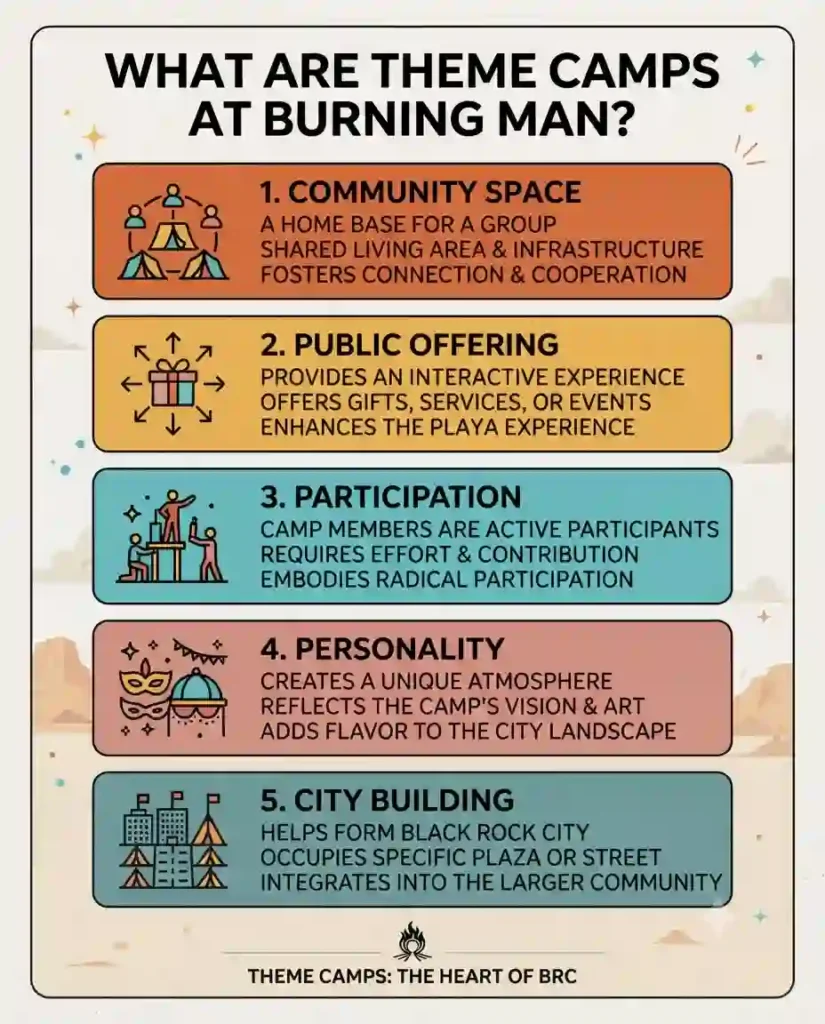
Theme Camps are one of the most defining parts of the Burning Man experience. They’re where people stop being just attendees and start becoming part of the living city itself. A theme camp is a participant-built space that offers some kind of experience, whether that’s music, art, coffee, conversation, wellness, learning, performance, or a wildly creative atmosphere that pulls people in. Theme camps characteristics:
- Participant-created neighborhoods
- Registered camps
- Community purpose
- Public interaction
- City planning
Understanding the Purpose of Theme Camps
The best way to think about a theme camp is as a gift to the city. It is not just a place to sleep or store gear. It is a community offering designed to give something back to others. Some camps serve food or coffee. Some host workshops, dance parties, or quiet places to reset. Others create immersive environments that feel like tiny worlds of their own.
Theme camps help make Black Rock City feel alive, social, and surprising. Without them, the city would be much more like a collection of tents. With them, every block has its own personality. That’s why experienced Burners often say the camp is not the side story it’s part of the whole point.
When You Can join a Theme Camp
What is the Best Time to Apply For a Theme Camp Joining
How Theme Camps Help Build Black Rock City
Theme camps shape the emotional geography of the playa. They create places where people gather, talk, rest, dance, learn, and meet strangers who become friends. A good camp can change how a neighborhood feels. A cluster of camps with a shared style can make an entire street feel animated and welcoming.
They also help turn the city into a participatory environment. Instead of waiting for entertainment to find you, you wander into it. Instead of watching from a distance, you pull over your bike, grab a seat, and become part of the moment. That active social energy is a huge part of why Theme Camps matter so much.
Why Every Camp Offers Something Different
No two camps are exactly alike. Some are loud and energetic, with DJs and dancing late into the night. Others are calm, intimate, and built for deep conversations or recovery from a long day in the dust. Some camps are structured around a single idea, while others are a mashup of personalities, interests, and inside jokes.
That variety is the charm. You might stumble into a camp serving espresso at sunrise, a camp with a repair station for bikes, or a camp offering tarot readings, bodywork, or participatory theater. Half the fun is not knowing what you’ll find until you get there.
Theme Camps vs Private Camping
Theme Camps are different from simple private camping. Private camping is mainly about having your own place to sleep and survive comfortably. A theme camp is built with a public-facing purpose. It’s meant to engage others, often through some kind of interactive or social offering.
That doesn’t mean every theme camp is huge or elaborate. Some are modest and low-key. But the expectation is different: theme camps are part of the broader civic fabric of Burning Man, not just personal shelter. If camping is about having a base, theme camping is about contributing to the city.
Theme Camps at a Glance
| Feature | Description |
| Built By | Participants |
| Purpose | Community, creativity, interaction |
| Open to Visitors | Many camps welcome visitors |
| Activities | Workshops, music, performances, discussions |
| Size | Small groups to large villages |
| Contribution | Gifts, services, experiences, art |
Why They’re the Heart of the Burning Man Experience
For many people, the most memorable moments at Burning Man happen inside a camp, not just at a major landmark. That’s where the random conversations happen. That’s where you may sit down for a drink and leave with new friends. That’s where the city feels human, social, and alive.
- ❤️ Why Theme Camps Matter
- Community building
- Creativity
- Hospitality
- Collaboration
- Participation
Theme Camps are not attractions in the usual sense — they’re communities built by participants. That’s what gives them depth. Out here, everyone has something to contribute, and the camp is one of the clearest places where that idea becomes real.
Theme Camps are participant-built communities that give something back to the city through interaction, hospitality, art, learning, or entertainment. They help create Black Rock City’s personality and turn the event into a living, social environment.
- Theme Camps are participant-built spaces that offer experiences like art, music, coffee, learning, wellness, and conversation.
- They are meant to give something back to the city, not just serve as private sleeping spaces.
- Theme Camps help make Black Rock City feel social, interactive, and full of personality.
- Every camp is different, which is why wandering from one to another is part of the fun.
- Compared with private camping, theme camping is more public-facing and community-driven.
- Many of the most memorable Burning Man moments happen inside theme camps through spontaneous connection and participation.
- Theme Camps are a major reason the event feels alive, human, and collaborative.
What Are Villages at Burning Man?
Villages are larger, collaborative neighborhoods made up of multiple theme camps that choose to share space, resources, and identity under a single village name. They often feel like mini-cities inside Black Rock City, with different camps contributing art, music, services, and social spaces to the same shared environment. Villages are ideal for Burners who want a strong sense of community while still allowing individual camps to express their own personality.
Understanding Burner Villages
Villages are officially recognized groupings of multiple camps that register together and are placed as a unified block in the city layout. Each camp inside the village usually has its own purpose—like a chill lounge, sound camp, tea house, workshop hub, or kitchen—but they coordinate to create a connected experience for residents and visitors. Villages often have shared streets, central gathering areas, and a name that becomes part of playa culture and word-of-mouth lore.
How Villages Differ From Theme Camps
A single theme camp is one organized group with its own structure, leadership, and offerings, whereas a village is an umbrella community containing several theme camps working together. In a village, each camp maintains its identity but collaborates on placement, infrastructure, and sometimes programming. This means that joining a village usually involves joining one of its member camps rather than joining the village as a whole.
Shared Infrastructure and Resources
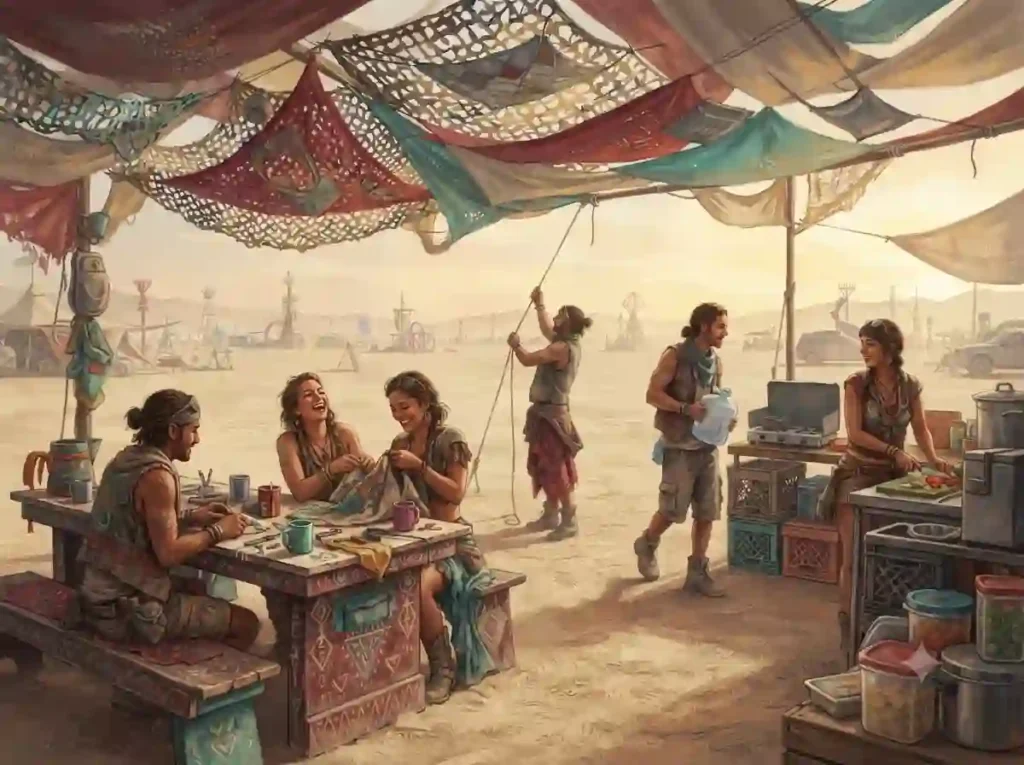
Villages often pool resources for big-ticket items like power systems, shade structures, communal kitchens, bike parking, and meeting spaces. Sharing infrastructure allows smaller camps to offer more to their members and visitors than they could manage alone. It also spreads responsibilities: one camp might manage power, another handles water, and another focuses on shared social spaces.
Who Should Choose a Village
Villages work well for Burners who want strong social structure, clear support systems, and a more “neighborhood” feeling than a standalone camp can provide. They are a great fit for first-timers who want guidance, creators who want to collaborate with multiple groups, and experienced Burners who enjoy organizing complex community spaces. People who like options quiet corners, party zones, workshops, and social areas often thrive in village life.
Advantages and Challenges of Village Living
Advantages include richer community life, more shared amenities, better support for logistics, and easier collaboration for art or projects. On the flip side, village living can mean more rules, more scheduled responsibilities, and less solitude than smaller camps or open camping. Noise, foot traffic, and internal politics can be more intense simply because more people are involved.
Villages at Burning Man
- Villages are groupings of multiple theme camps that share space, identity, and infrastructure.
- They offer richer community life, shared resources, and strong support systems, but can be more structured and busy.
- Villages are ideal for Burners who want collaboration, variety, and a neighborhood-style experience on the playa.
What part of village life feels most aligned with how you personally like to camp and participate in a community?
What Are Shared Camps?
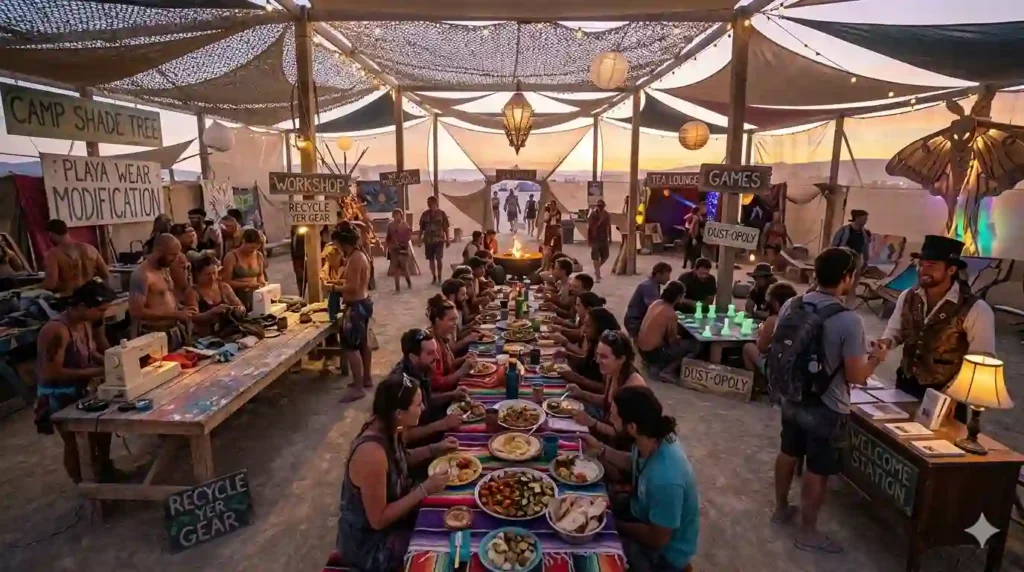
Shared camps are informal groups of friends, crews, or small communities who decide to camp together without becoming a fully public, registered theme camp. They focus on private group experience rather than offering scheduled activities to the wider playa. While they may share some organization and infrastructure, their main purpose is to give a known group a home base at Burning Man.
What Is a Shared Camp?
A shared camp is typically a cluster of tents, shade structures, vehicles, and small communal areas created by people who already know each other and want to live together during the event. It may look similar to a small theme camp from the outside, but it doesn’t usually register as a public camp or advertise activities to the broader community. The emphasis is on internal comfort, support, and friendship.
How Friends Build Shared Camps
Friends usually start by agreeing to camp together, then decide on basics like location (open camping or inside a low-key placed camp area), shade solutions, cooking arrangements, and group norms. They might use shared spreadsheets or group chats before the event to distribute gear responsibilities, plan meals, and align arrival times. Everyone contributes something—whether it’s a shade structure, kitchen setup, sound system, or just labor.
Shared Expenses and Responsibilities
In shared camps, costs and tasks are divided informally among members. One person might buy the big shade structure while others chip in for rebar, lighting, and kitchen gear. Responsibilities such as cooking, gray water management, and cleanup are typically handled through mutual agreements rather than formal schedules. The more clearly a shared camp defines expectations beforehand, the smoother things go on playa.
Advantages of Shared Camping
Shared camps offer flexibility, intimacy, and lower pressure than public theme camps. Burners enjoy a familiar crew, fewer participation requirements for strangers, and the freedom to shape camp culture exactly how they like. It’s often cheaper and simpler to set up than a large theme camp since infrastructure and obligations stay small and internal.
Is a Shared Camp Right for You?
A shared camp is a good option if you already have a group of friends or collaborators who want to camp together, and you don’t feel ready to commit to the obligations of a public theme camp. It’s also a strong choice for people who value privacy, customized routines, and fewer formal responsibilities, while still avoiding the complete independence of solo camping.
Theme Camp vs Shared Camp
| Aspect | Theme Camp | Shared Camp |
| Public participation | Open to visitors and activities | Primarily for the internal group |
| Registration | Usually formally registered | Often unregistered or informal |
| Organized activities | Public events, art, or services | Mostly internal social time |
| Infrastructure size | Larger, more complex setups | Smaller, simpler infrastructure |
Shared Camps Smart Tips
- Shared camps are private group camps built by friends who want to live together without becoming full public theme camps.
- They emphasize flexibility, intimacy, and internal comfort, with shared costs and responsibilities handled informally.
- Shared camps suit Burners who want group support and structure but less obligation and visibility than a registered theme camp.
If you imagine your ideal Burning Man crew, do they feel more like a public-facing theme camp or a private shared camp among friends, and why?
What Is Open Camping?
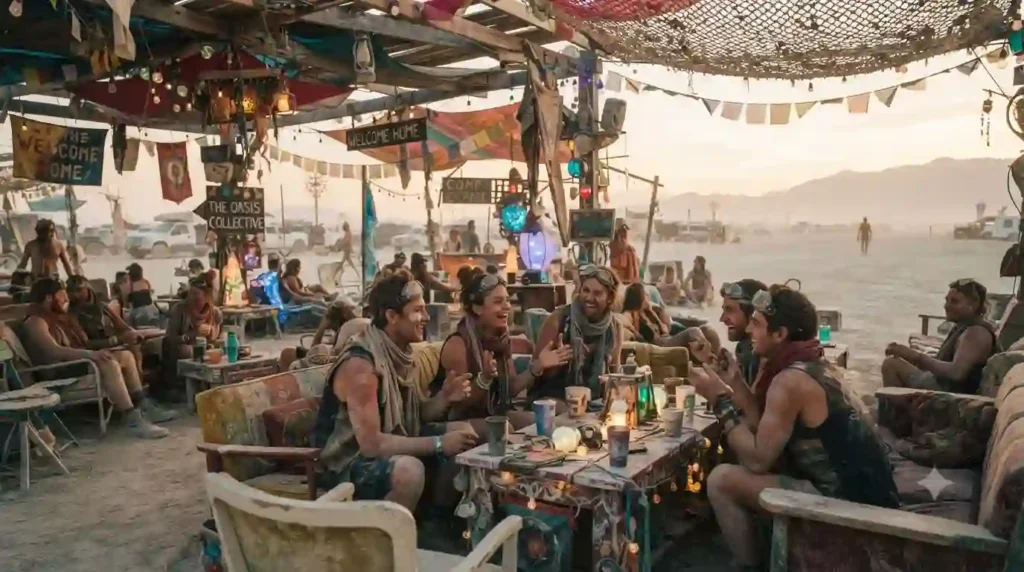
Open camping refers to unreserved areas of Black Rock City where individuals, small groups, or informal camps can set up without being part of an officially placed theme camp or village. It offers maximum independence and flexibility but requires more self-reliance. For many Burners, open camping is the purest form of “figure it out yourself” playa living.
Understanding Open Camping
In open camping, you choose a legal, available spot when you arrive and set up your camp according to city guidelines and common sense. There’s no pre-arranged infrastructure or organized programming, so you build your own environment from scratch. Your neighbors are whoever happens to camp nearby, and the vibe can range from quiet to lively depending on the area.
Who Chooses Open Camping?
Open camping is popular among solo Burners, small friend groups, and those who prefer minimal structure or commitments. It also appeals to people who decide to attend late, couldn’t connect with a camp in time, or simply enjoy spontaneous neighborhood formation. Many experienced Burners choose open camping because they like the freedom to shape each year differently.
Finding an Open Camping Location
When you arrive, you drive into the city and look for open, legal areas where camping is allowed. You’ll want to consider proximity to loud zones, art, bathrooms, and roads, as well as wind patterns and dust exposure. It’s wise to avoid blocking official roads or infrastructure and to leave enough space between structures for access and safety.
Advantages and Challenges
Advantages include full independence, no camp dues, and the freedom to design your camp exactly how you want. You can set your own schedule without obligations to camp shifts or group norms. Challenges include handling all logistics yourself, building infrastructure without shared resources, and potentially feeling less supported if problems arise. Weather, dust, and gear failures are all on you to manage.
Open Camping vs Theme Camps
Compared to theme camps, open camping offers far fewer shared amenities but far more autonomy. Theme camps provide community, infrastructure, and organized activities, while open camping provides a blank canvas for your own style of participation. Neither is “better”; the choice depends on how much structure, support, and social organization you want.
Independent Camping vs Theme Camps
| Feature | Theme Camp | Independent Camping |
|---|---|---|
| Community | Large built-in community | Create your own experience |
| Shared Infrastructure | Usually available | Bring everything yourself |
| Camp Dues | Often required | Usually none |
| Responsibilities | Shared camp shifts and duties | Personal responsibility only |
| Social Activities | Organized events and workshops | Self-planned |
| Best For | First-timers, groups, social participants | Experienced Burners, maximum independence |
| Flexibility | Follow camp schedule | Complete freedom |
Open Camping Inside Tips
- Open camping offers maximum independence with minimal pre-arranged infrastructure or commitments to a group.
- It suits Burners who prefer flexibility, self-reliance, and spontaneous neighborhood formation over structured camp life.
- Choosing between open camping and theme camps depends on how much community support and shared amenities you want versus autonomy.
If you had to choose right now, would you lean more toward open camping’s independence or a theme camp’s structured community, and what draws you to that choice?
Where Do Most Burners Stay?
Most Burners stay in a mix of theme camps, villages, RV setups, and open or solo camping, and the balance shifts slightly each year. While no official detailed breakdown is published annually, community observations suggest rough ranges that help first-timers understand typical camping patterns. These estimates are useful for deciding which style matches your ideal Burning Man experience.
Theme Camps and Villages (Approx. 40–55%)
A large portion of participants camp in registered theme camps or villages, benefiting from shared infrastructure, organized activities, and established communities. This range roughly reflects how central theme camps and villages are to the city’s culture and layout. For many first-timers, joining a camp or village is the easiest way to plug into playa life and avoid feeling isolated.
RVs and Campers (Approx. 20–35%)
Another significant group stays in RVs or camper vehicles, either within theme camps or in non-camp areas. RVs provide added comfort, temperature control, and protection from dust, making them popular with families, people with specific health needs, and those who prioritize sleep and recovery. Many guides dedicate entire sections to RV planning because it’s a distinct camping style with its own logistics and etiquette.
Open and Solo Camping (Approx. 15–35%)
The remaining slice of participants tend to camp in open or solo setups, ranging from small shared camps to individual tents under basic shade. This group values independence, DIY culture, and freedom from structured commitments. The percentage fluctuates depending on the year, ticket distribution, and how many camps register and are placed.
Which Camping Style Is Best for You?
The “best” style depends on your priorities: community and guidance, comfort and shelter, or independence and flexibility. First-timers often benefit from theme camps or villages because they provide support and clear expectations. People seeking maximum comfort may prefer RV-based setups, while seasoned DIY Burners or introverts might thrive in open or solo camping. Reflecting on your social style, budget, and energy levels helps narrow the choice.
Camping Style Overview
| Camping Style | Estimated Share | Best For |
| Theme Camps & Villages | ~40–55% | Community, guidance, first-timers |
| RVs & Campers | ~20–35% | Families, comfort-focused Burners |
| Open / Solo Camping | ~15–35% | Independence, DIY-minded Burners |
Add a clear note: these ranges are based on community observations and shared experience, because Burning Man does not publish official annual accommodation percentages.
Where Burners Stay
- Most Burners stay in theme camps or villages, RV setups, or open/solo camping, with rough community estimates guiding expectations.
- Different camping styles suit different priorities: community and guidance, comfort and shelter, or independence and DIY culture.
- Since official percentage breakdowns aren’t published, treat all numbers as approximate guides rather than precise statistics.
Given these options, which camping style do you think would match your personal balance of community, comfort, and independence?
How Do Theme Camps Work?
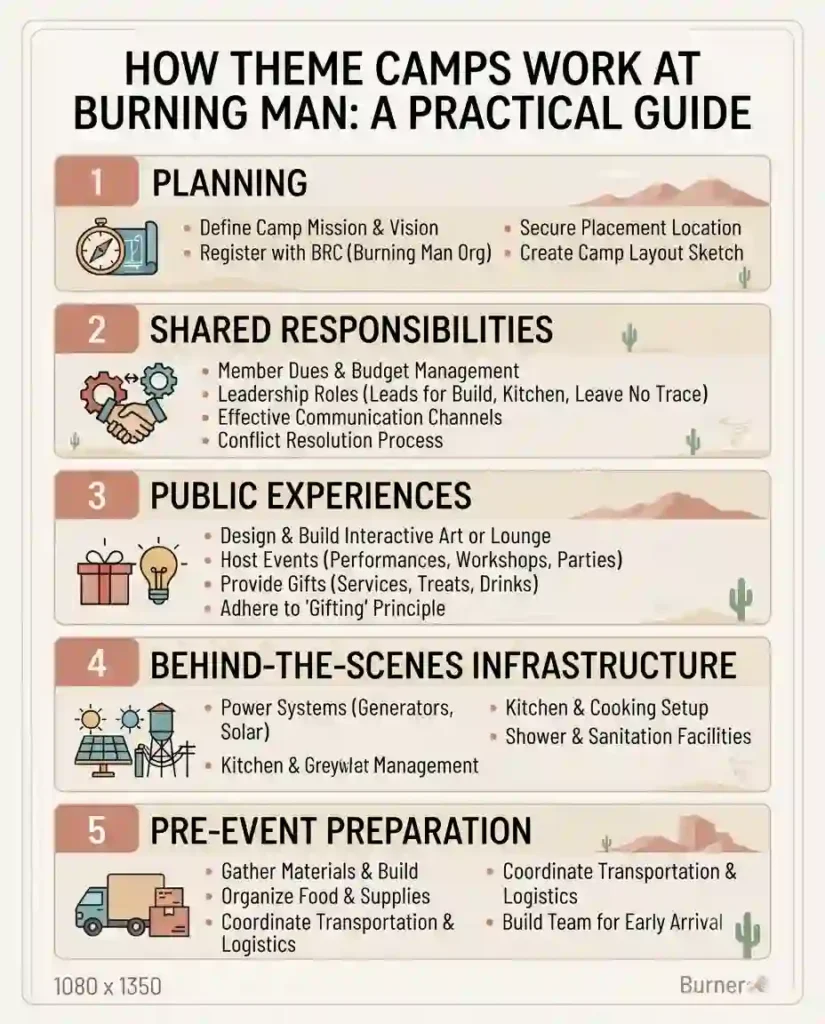
Theme Camps work because people agree to build something together and keep it running for the event. Behind every camp is planning, teamwork, logistics, and a shared idea of what the camp is supposed to offer. Some camps are very organized. Others are more informal. But all of them depend on participants showing up and doing their part.
How Camps Are Organized
Most camps have a core group that handles planning before the event. That group usually decides the camp’s theme, goals, layout, sign-up structure, and public offering. Some camps are tightly managed with defined roles. Others are looser and more social, with people stepping in where needed.
Even a camp that looks effortless often has a lot of coordination behind it. Someone is thinking about shade, someone is managing the kitchen, someone is tracking supplies, and someone is making sure the camp still works after a dust storm. That hidden structure is part of why camps can feel so smooth to visitors.
🛠️ How Theme Camps Are Created-Step By Step Guide
- Planning
- Registration
- Volunteers
- Infrastructure
- Setup
- Teardown
Shared Responsibilities and Community Living
Living in a theme camp means you’re not just taking care of yourself. You’re sharing space, tools, labor, and time with other people. That can be one of the best parts of camp life, but it also means you need to be reliable.
People in camps usually rotate tasks like setup, cleanup, greeter duty, cooking support, and public shift coverage. The magic happens when you pitch in instead of standing on the sidelines. A good camp works because people understand that everyone benefits when everyone contributes.
Creating Interactive Experiences for Everyone
A lot of camps are built around a public experience. That might be a dance floor, a tea lounge, a maker space, a costume exchange, a sound stage, or a chill zone with shade and conversation. The idea is that visitors are welcome to stop by and engage.
That experience should feel intentional. Camps often think carefully about how people enter, where they sit, what they see first, and how the space invites participation. When done well, a camp feels open and alive without becoming chaotic.
Camp Infrastructure Behind the Scenes
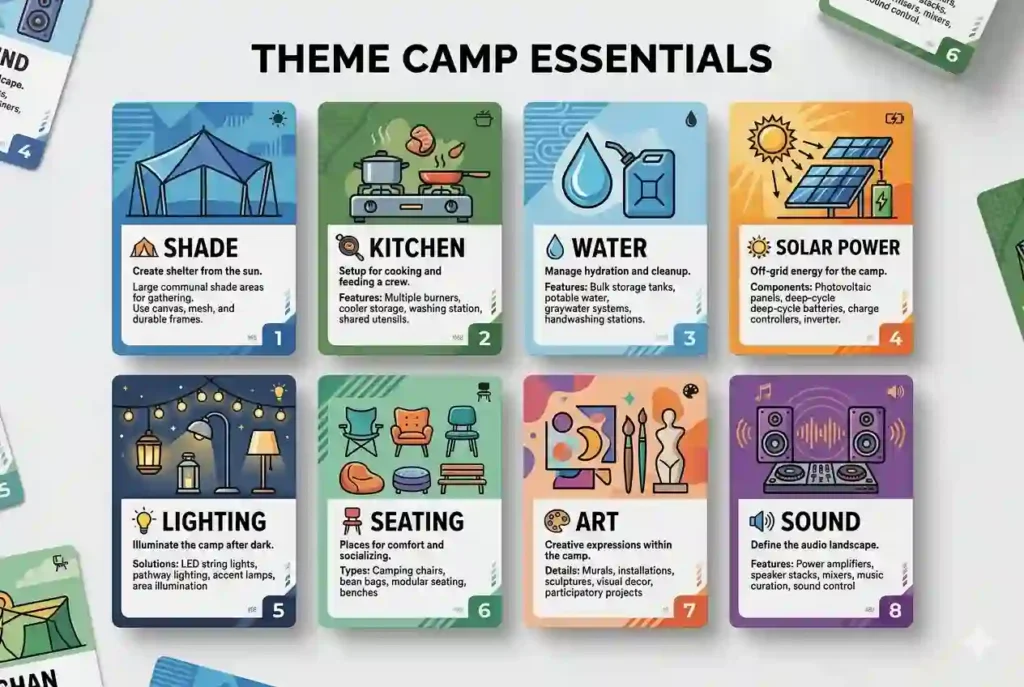
Behind the fun, there’s real infrastructure. Camps need structures for shade, storage, seating, lighting, power, and often food or water systems. Even smaller camps need to think about dust, wind, sanitation, and how things will hold up after long days in harsh conditions.
This is one reason experienced Burners respect camps so much. The visible fun is only possible because someone spent time solving the invisible problems. If you’ve ever wandered into a camp and thought, “Wow, this feels easy,” that usually means a lot of hard work happened before you arrived.
What Happens Before the Gates Open
Before the event begins, camps are often already deep into setup mode. Gear has to be loaded, sorted, transported, unpacked, and assembled. People need to know where things go, what the camp is offering, and how the camp will function under pressure.
There’s also mental prep. Camp members need to understand their responsibilities and be ready to adapt. Dust storms, delays, missing gear, and weather can all change the plan. The best camps don’t pretend things will be perfect — they build systems that can survive a little chaos.
Theme Camps Inside Tips
Theme Camps work through planning, shared labor, and a public-facing purpose. They rely on team roles, basic infrastructure, and a willingness to adapt before and during the event.
- Theme Camps are participant-built spaces that offer experiences like art, music, coffee, learning, wellness, and conversation.
- They are meant to give something back to the city, not just serve as private sleeping spaces.
- Theme Camps help make Black Rock City feel social, interactive, and full of personality.
- Every camp is different, which is why wandering from one to another is part of the fun.
- Compared with private camping, theme camping is more public-facing and community-driven.
- Many of the most memorable Burning Man moments happen inside theme camps through spontaneous connection and participation.
- Theme Camps are a major reason the event feels alive, human, and collaborative.
What Can You Experience at Theme Camps?
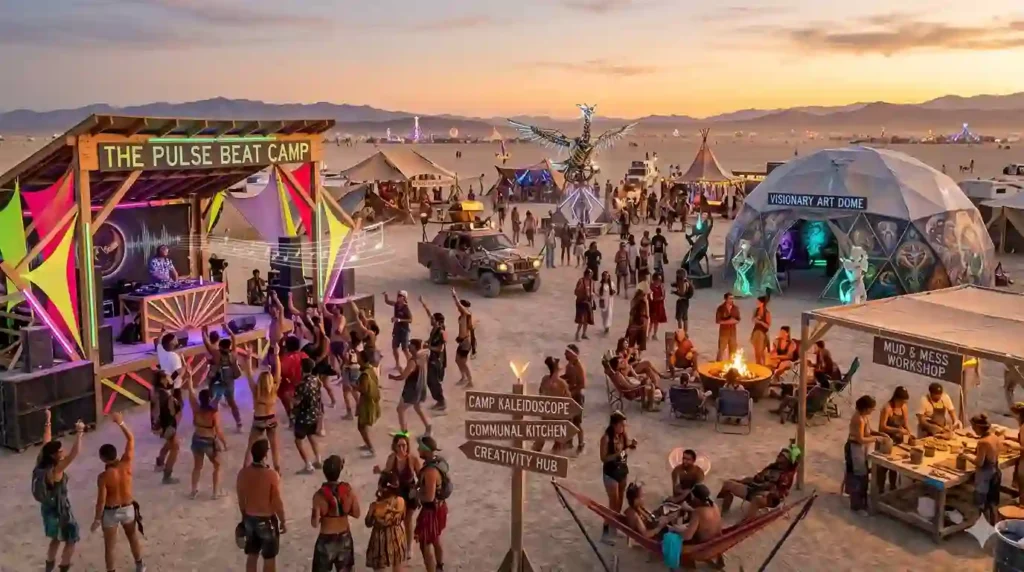
Theme Camps are where you can stumble into some of the most memorable experiences at Burning Man. You might find music, art, food, games, workshops, healing spaces, or complete surprises you never saw coming. The whole point is that a camp isn’t just a place — it’s an experience.
🎁 Public Experiences
- Workshops
- Games
- Performances
- Art
- Gatherings
- Learning experiences
Interactive Art and Creative Installations
Many camps include art as part of the experience. That might be sculptures, light structures, handmade décor, or interactive pieces that encourage you to touch, listen, write, or explore. Some camps function almost like tiny immersive galleries.
This is where Burning Man’s creative energy really shows itself. A camp can feel like a living installation, especially when the art is woven into the architecture and social design of the space. Wander into a camp that catches your eye — you never know what you’ll find.
Live Music, DJs, and Dance Floors
Some camps are all about sound. You may hear a DJ set pulling people in from down the block, or find a dance floor that fills up after dark. These camps can be high-energy social hubs, especially at night.
But even music camps can vary a lot. Some are full-volume party spaces. Others are more intimate, with curated soundscapes, ambient performances, or small electronic sets. Either way, if music is your thing, camps are one of the best places to find it.
Workshops and Skill-Sharing Sessions
A lot of camps organize workshops, talks, demos, and hands-on learning sessions. These can include anything from costume-making to electronics, movement, meditation, writing, repair skills, or practical survival knowledge. Burning Man has a strong culture of learning by doing, and camps are a big part of that.
These sessions often feel informal and personal. Instead of sitting in a classroom, you might be learning while sitting on a cushion under shade, talking with someone who genuinely loves the subject. That makes the experience feel more human and memorable.
Wellness, Healing, and Relaxation Spaces
Not every camp is about stimulation. Some are designed as places to slow down, recover, and reset. You might find massage, stretching, guided meditation, tea service, quiet seating, or shaded lounges where people can rest for a while.
These camps matter because Burning Man can be intense. Sometimes the most valuable camp is the one that lets you breathe again. If you’re feeling overwhelmed, these spaces can be a lifesaver.
Food, Coffee, and Hospitality Camps
Some camps are famous for hospitality. Coffee camps, snack camps, ice cream camps, and open-door food offerings can be incredibly popular because they meet a basic need in a fun, welcoming way. A warm drink or a cold treat in the middle of the day can feel like a tiny miracle.
Hospitality camps also tend to create easy conversation. People gather around food and drink naturally, and that makes these camps some of the best places to meet strangers. They’re simple, but they’re often unforgettable.
Games, Performances, and Unexpected Surprises
Some camps lean into play. You might find interactive games, costume contests, comedy, storytelling, tiny museums, absurd challenges, or weird one-off performances that happen only because the camp felt like it. These moments are part of the Burn.
The best part is that surprises are normal. You may enter expecting a quiet lounge and leave after participating in a ridiculous game or a spontaneous dance circle. That unpredictability is part of what gives camp-hopping its magic.
Popular Types of Theme Camps at Burning Man
| Camp Type | What You’ll Find |
|---|---|
| Art Camps | Interactive art, sculpture, creativity |
| Music Camps | DJs, live performances, dance floors |
| Wellness Camps | Yoga, meditation, healing sessions |
| Food & Beverage Camps | Coffee, tea, pancakes, community meals (gifted) |
| Educational Camps | Talks, workshops, science, technology |
| Maker Camps | DIY projects, crafts, engineering |
| Family Camps | Kid-friendly activities and quieter environments |
| International Camps | Cultural exchange and global communities |
Theme Camps can offer art, music, learning, healing, food, games, and unexpected social moments. They’re designed to be experienced, not just observed, and the best ones create memorable interactions.
- Theme Camps are organized through planning, teamwork, and shared responsibilities.
- Camp members usually split tasks like setup, hosting, cleaning, and keeping the camp running smoothly.
- Each camp has its own structure, public offering, and way of managing people.
- Camp infrastructure includes shade, storage, lighting, power, and other essentials.
- A lot of work happens before the event so the camp can function under desert conditions.
- Good camps stay flexible because weather, dust, and logistics can change the plan.
- The behind-the-scenes effort is what makes camp life look easy to visitors.
How Much Does It Cost to Join a Theme Camp?
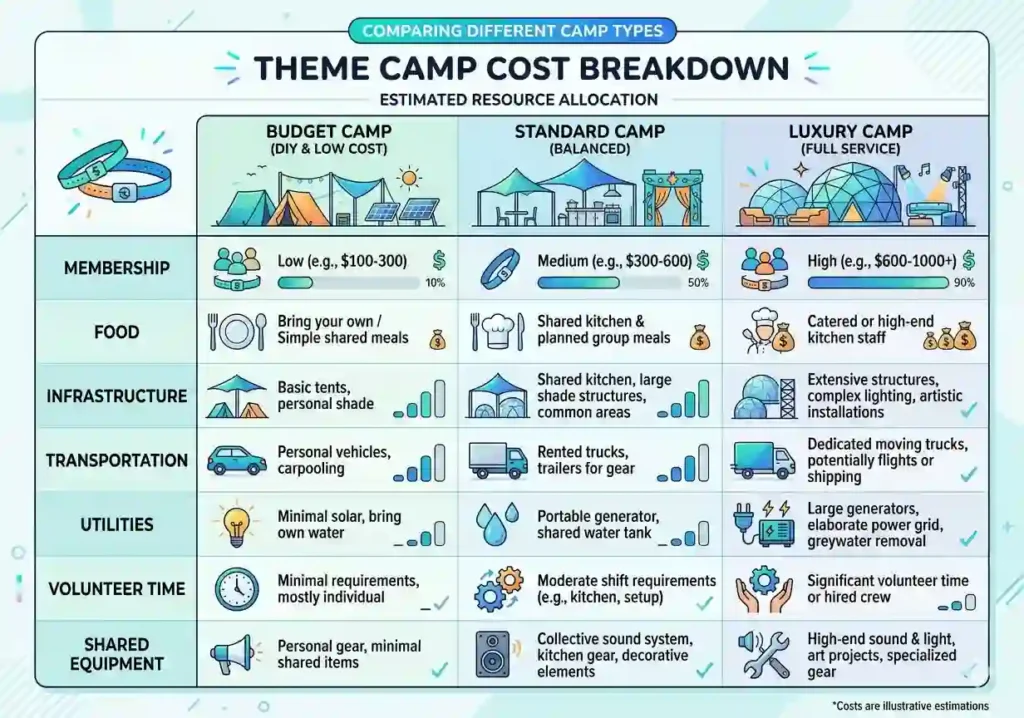
Joining a theme camp usually involves paying camp dues and covering your own personal expenses, and costs can vary widely depending on the camp’s infrastructure and style. Understanding what you’re paying for—and what’s still your responsibility—is essential before committing. A clear financial picture helps you avoid surprises and commit to a camp that fits your budget and expectations.
Understanding Camp Dues
Camp dues are the shared financial contributions each member pays to cover group expenses such as shade structures, communal kitchens, fuel, power systems, shared tools, and other camp infrastructure. Some camps charge modest dues to cover basics; others charge higher amounts if they provide extensive amenities or complex setups. Dues are typically collected well before the event to allow time for purchasing and planning.
What Camp Fees Usually Cover
Camp dues often pay for items such as large shade structures, communal cooking equipment, lighting, sound systems, water storage, gray water solutions, and sometimes shared food or beverages. They may also cover building supplies, transportation of heavy gear, decorative materials, and maintenance costs. However, camp fees rarely cover everything; each camp defines clearly what’s included and what’s not.
Additional Personal Expenses
Even after paying camp dues, you are still responsible for your own ticket, vehicle pass, travel costs, personal gear, costumes, and many aspects of your food and water. If the camp provides food, there may be rules about additional snacks or special diets you must handle yourself. Budgeting for both shared and personal expenses prevents last-minute stress and ensures you can fully participate.
Luxury Camps vs Community Camps
Luxury-style camps tend to offer more comfort such as pre-built shade, catered meals, professional infrastructure, or RV services and their dues are usually higher to reflect those services. Community-focused camps might prioritize art, interaction, and DIY culture over comfort, resulting in lower dues and higher hands-on participation. Neither is “better,” but they attract different types of Burners and cost structures.
Budgeting Before You Commit
Before joining a camp, it helps to list all possible costs: ticket, vehicle pass, camp dues, travel, food, costumes, personal gear, and any art or gifting items you plan to bring. Comparing that total against your available budget shows whether a particular camp level—luxury, mid-range, or very DIY—makes sense. If you’re on a tighter budget, a low-dues community camp or simple shared camp might be the better choice.
Theme Camp Costs
- Theme camp costs include both shared dues for infrastructure and personal expenses like tickets, gear, and travel.
- Luxury-style camps charge more for added comfort, while community-focused camps keep dues lower but expect more DIY participation.
- Creating a full budget before committing helps you choose the right camp type and avoid financial stress on the playa.
When you think about your own Burning Man budget, which cost category (dues, gear, travel, or comfort) do you feel you would prioritize or minimize first?
Do You Have to Join a Theme Camp?
No, you do not have to join a theme camp to enjoy Burning Man. Plenty of people stay in open camping and still have an amazing experience. The right choice depends on how social, structured, and involved you want your week to be.
Staying in Open Camping Instead
Open camping is a good option if you want more independence. It gives you flexibility, privacy, and less group obligation. You can still visit camps, join events, and explore the city without having to commit to camp duties or schedules.
Some people prefer this because they want a lighter social load. Others like the freedom to build their own rhythm. Open camping can work very well if you’re comfortable navigating the event on your own terms.
Visiting Camps Without Being a Member
You can absolutely visit theme camps without joining them. In fact, that’s one of the main joys of Burning Man. The city is built for exploration, and many camps welcome visitors who are respectful and open to participating.
The key is to enter with curiosity, not entitlement. Pull over your bike, grab a seat, and join the moment. If a camp is offering something publicly, you’re usually welcome to experience it, but you still need to follow the camp’s rules and social tone.
Pros and Cons of Joining a Theme Camp
Joining a camp can make the event feel more connected and less lonely. You’ll likely have a built-in group, shared responsibilities, and a stronger sense of belonging. That can be especially helpful for first-timers.
On the other hand, camp membership means you owe time, effort, and coordination to other people. You may have shifts, chores, planning meetings, or shared expectations. If you want complete freedom to roam at all hours, a camp may feel restrictive.
Choosing the Experience That Fits You
The best choice depends on your personality and your goals for the Burn. If you want community, accountability, and a built-in social base, joining a camp may be perfect. If you want flexibility and quiet independence, open camping might be a better fit.
Neither option is inherently better. They’re just different ways of participating. What matters is choosing the setup that helps you enjoy the event without feeling trapped or overcommitted.
Common Misconceptions About Theme Camps
A lot of newcomers think theme camps are only for insiders, party people, or long-time Burners. That’s not true. Many camps welcome new participants, and many are made stronger by fresh energy and perspective.
Another misconception is that joining a camp means you’ll lose your personal experience. In reality, a good camp often enhances it. You still get to explore the city, but you also have a home base and a group of people who know your name.Section summary:
You do not have to join a theme camp, but it can add community and structure if that fits your style. Open camping and camp membership both work — the best choice depends on how you want to experience the event.
- You do not have to join a Theme Camp to enjoy Burning Man.
- Open camping gives more independence and flexibility.
- Visiting camps is part of the Burning Man experience, even if you are not a member.
- Joining a camp can add community, structure, and a built-in support network.
- Camp membership also comes with responsibilities and shared expectations.
- The best choice depends on how social, flexible, or committed you want your experience to be.
- Both open camping and theme camping can work well.
What Should You Expect When Joining a Theme Camp?
Joining a theme camp means stepping into a shared, participatory community where your contributions help create the camp’s culture and offerings. You’re not just a guest—you’re part of the crew, with responsibilities, shifts, and social commitments. Knowing what to expect makes it easier to integrate smoothly and contribute in ways that feel good for you and the camp.
Participation Expectations
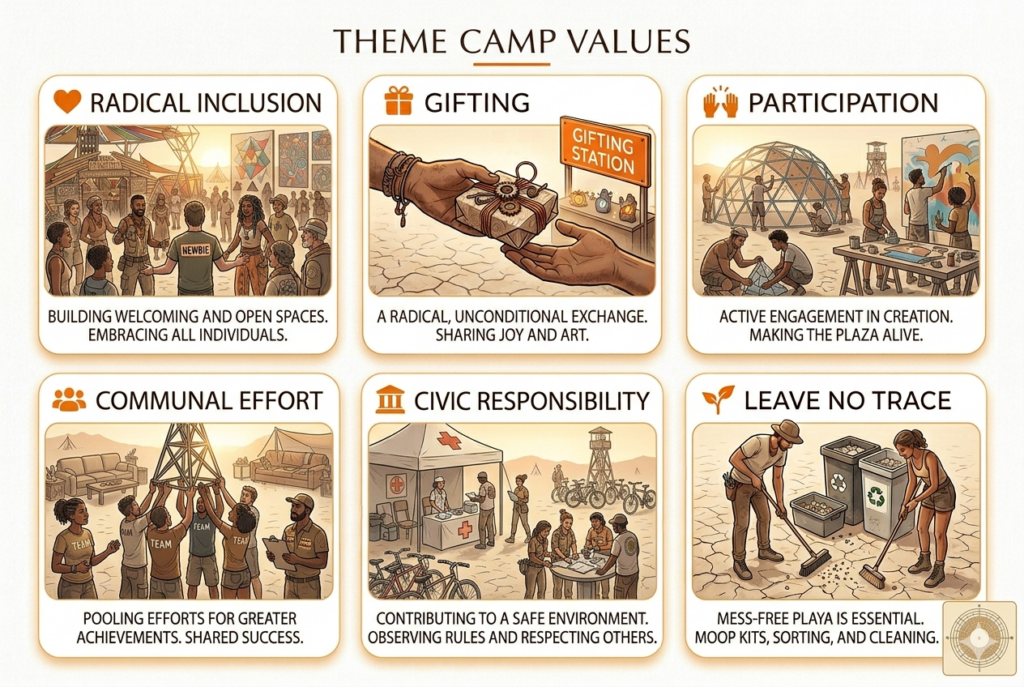
Theme camps usually expect members to actively participate in camp projects, setup, teardown, and daily operations. This can include helping build structures, decorating spaces, preparing food, or hosting camp activities for visitors. Participation is part of Burning Man’s culture, and camps rely on members being present and engaged rather than passive.
Camp Shifts and Responsibilities
Most camps organize shifts for tasks such as greeting visitors, tending bars or tea stations, running workshops, managing sound, cleaning shared areas, or handling kitchen duties. Shifts ensure that responsibilities are distributed fairly and that the camp runs smoothly throughout the event. You’re expected to show up on time, communicate if plans change, and support your campmates.
Community Living
Theme camp life involves close quarters, shared spaces, and constant social interaction. You’ll share noise, dust, chores, and joys with fellow campers, which can feel intense and rewarding. Strong communication, mutual respect, and flexibility help everyone navigate different schedules, moods, and energy levels in a healthy way.
- 🤝 Community Participation
- Volunteering
- Helping camp members
- Respecting camp spaces
- Joining activities
- Contributing skills
Camp Meetings and Communication
Many camps hold meetings before and during the event to align expectations, discuss logistics, and resolve issues. These meetings may cover topics like shift schedules, power usage, visitor guidelines, and upcoming events. Camps often use digital channels (email lists, chats, or forums) before the burn and informal huddles on playa to keep everyone informed.
Respecting Camp Culture
Every camp has its own culture, traditions, and boundaries—some are quiet and reflective, others are loud and party-focused. Respecting camp norms around consent, noise, privacy, and shared spaces is essential. You’re encouraged to express yourself while staying mindful of how your behavior impacts campmates and visitors.
🚶 Visiting Theme Camps Rules
- Camp etiquette
- Consent
- Visiting respectfully
- Open vs private spaces
- Participation expectations
Theme Camp Expectations
- Joining a theme camp means committing to shifts, shared responsibilities, and active participation in camp life.
- Community living involves close social interaction, regular communication, and respect for camp culture and norms.
- Clear expectations and honest communication help you integrate smoothly and create a fulfilling experience for yourself and your camp.
Thinking about your personality, which aspect of theme camp life—shifts, meetings, or constant community—would be the biggest adjustment for you?
How Can First-Timers Join a Theme Camp?
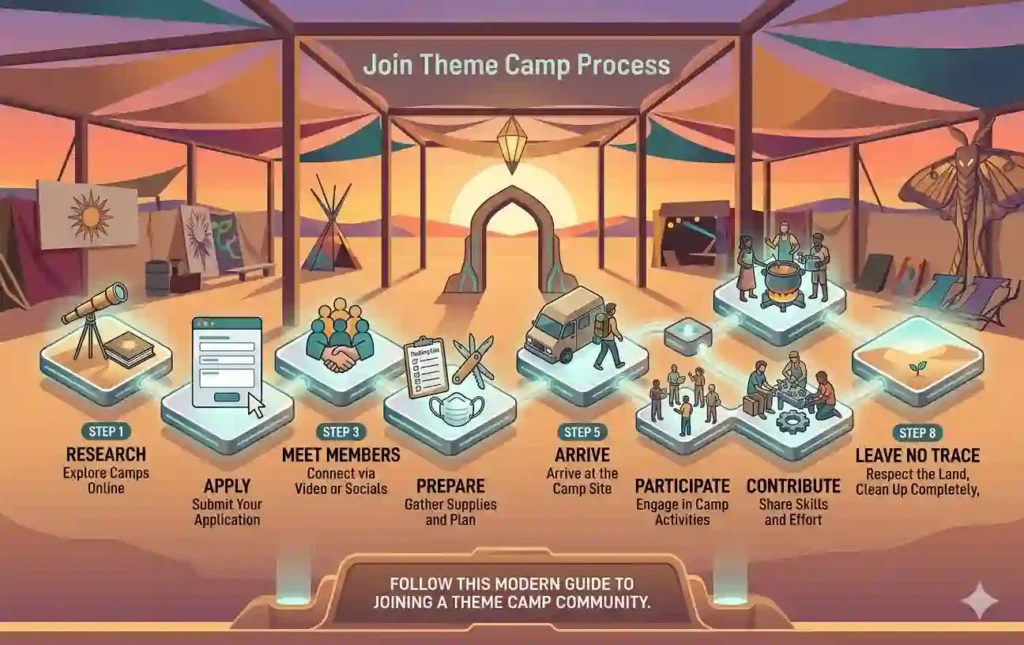
First-timers can absolutely join a theme camp, and many camps actively welcome them. The trick is to find a camp whose expectations match your personality, skill level, and willingness to contribute. This is not just about getting a place to stay — it’s about entering a shared commitment.
Finding Camps That Welcome New Burners
Start by looking for camps that clearly say they welcome newcomers. Some camps openly invite first-timers because they value fresh energy and participation. Others are more experienced and may expect people to already understand camp life.
Read camp descriptions carefully. Look for camps that feel organized, friendly, and realistic about what they ask from members. If a camp’s communication feels clear and respectful, that’s usually a good sign.
Applying Before the Event
Most camps want to know who is joining well before the event starts. That usually means applying, messaging, or filling out some kind of interest form. Don’t wait until the last minute.
When you apply, be honest about your experience, your availability, and what you can contribute. Camps do not need perfection — they need reliability. If you’re new, say so. Many camps appreciate honesty more than trying to sound like an expert.
Understanding Camp Expectations
Every camp has expectations. Some are practical, like helping build shade, doing a shift, or bringing certain supplies. Others are social, like being open to participation and being a good neighbor.
Before you commit, ask what the camp expects from members before, during, and after the event. Don’t assume the camp is just handing you a spot. A theme camp is a team, and teams work best when everyone understands the rules.
Asking the Right Questions Before Joining
Before you say yes, ask questions. Find out how much labor is expected, what gear you need to bring, whether there are scheduled shifts, and how the camp handles meals, rest times, and cleanup. Ask how decisions are made and whether there are fees or shared costs.
These questions are not rude. They show that you care about doing the job right. A strong camp will respect that.
Preparing for Camp Life
Once you join, get ready for communal living. That means showing up on time, respecting shared spaces, and being adaptable. It also means being ready for dust, noise, long days, and occasional frustration.
The more prepared you are, the easier it is to enjoy the experience. Bring a good attitude, a willingness to help, and enough personal supplies to avoid becoming a burden to the group.
First-timers can join theme camps by finding welcoming groups, applying early, and asking clear questions. Success depends on honesty, reliability, and a willingness to contribute to the camp community.
- First-timers can absolutely join Theme Camps if they find camps that welcome newcomers.
- It helps to apply early and be honest about your experience and availability.
- Camps usually want people who are reliable and willing to contribute.
- Before joining, ask about expectations, shifts, costs, and responsibilities.
- Joining a camp means preparing for communal life, not just getting a place to stay.
- Good communication helps you avoid surprises later.
- First-timers do best when they show curiosity, flexibility, and a willingness to help.
What Types of Theme Camps Can You Find?
Theme Camps come in many forms, and part of the fun is figuring out which style matches your interests. Some are energetic, some are quiet, some are practical, and some are delightfully weird. Every block has its own personality, and camp type often shapes the whole mood.
🌍 Famous Theme Camps
- Barbie Death Camp (historical)
- Center Camp-adjacent community spaces
- Large interactive villages
- Long-running camps
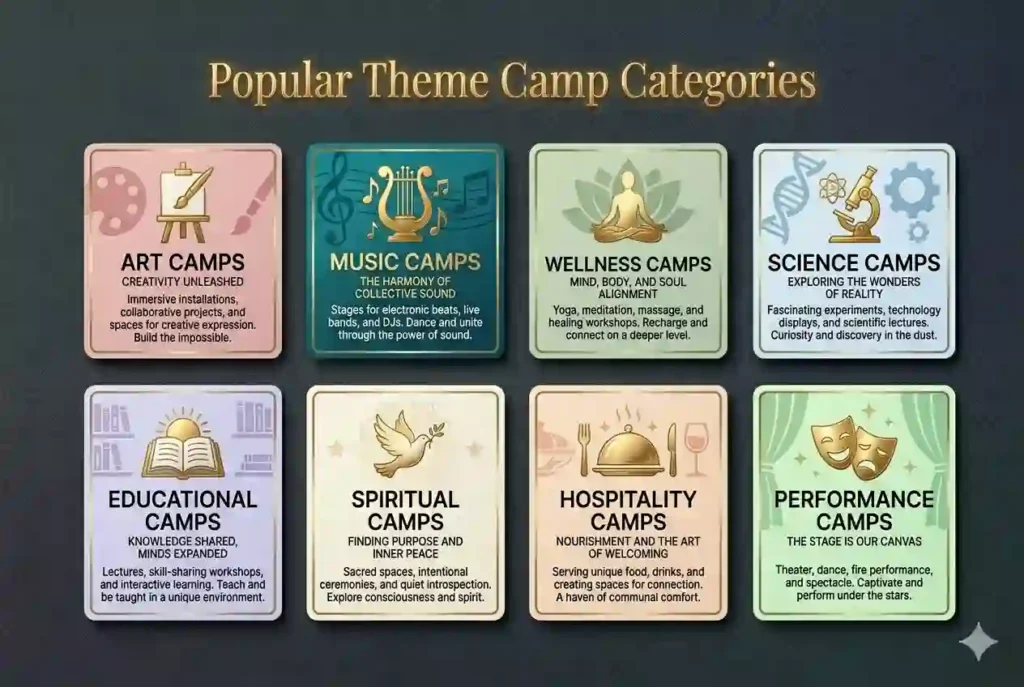
Art and Interactive Experience Camps
These camps focus on creative expression. They may include installations, hands-on art, participatory spaces, or interactive environments that feel like extensions of the city’s artistic side. These camps often attract people who like curiosity, creativity, and visual surprise.
If art is your thing, these camps can feel like small worlds within the larger world. They often blend social interaction with aesthetics, which gives them a rich and memorable feel.
Music and Sound Camps
Music camps center on sound, dancing, rhythm, and performance. Some are high-energy, while others are more experimental or lounge-like. They can be some of the most social camps on the playa.
If you want to find music, just follow the sound or the crowd. These camps tend to draw people in naturally, and they often become nighttime anchors for whole neighborhoods.
Wellness and Healing Camps
Wellness camps are built for relaxation, restoration, and care. They may offer massage, stretching, meditation, tea, quiet seating, or other calming experiences. These camps give Burners a place to pause.
A lot of people underestimate how important these camps are until they really need one. Burning Man can be physically and mentally demanding, and wellness camps help keep the experience balanced.
Food and Beverage Camps
These camps are popular because they offer hospitality in a simple, direct way. Coffee, snacks, cold drinks, warm soup, and treats can make a camp instantly memorable. There’s something special about being offered refreshment in the middle of a dusty desert day.
These camps often create easy conversation and a welcoming atmosphere. They’re not flashy, but they’re often among the most loved.
Learning and Educational Camps
Some camps are built around teaching. They may host workshops, discussions, skill-sharing sessions, or practical demos. These camps appeal to people who enjoy discovery and hands-on learning.
Out here, knowledge is often shared casually and generously. You might learn something useful in ten minutes that stays with you for years.
Science, Technology, and Maker Camps
Maker camps and science camps tend to be focused on building, tinkering, problem-solving, or experimenting. They may feature robotics, electronics, fabrication, or hands-on invention.
These camps often attract curious people who like to understand how things work. They can feel especially rewarding because the energy is playful, technical, and collaborative.
Family-Friendly Camps
Family-friendly camps create space for parents, children, and multigenerational participation. They usually offer calmer environments, flexible activities, and a more gentle social vibe.
These camps are important because they make the event feel more inclusive. They also remind everyone that Burning Man is not only about intensity — it can also be about shared community across ages.
Spiritual and Mindfulness Camps
Some camps center on reflection, meditation, ritual, or inner practice. These may be quiet, open, and less about performance than atmosphere. They often give people a break from stimulation and a place to reset.
If you like calm conversation and intentional spaces, these camps can be deeply rewarding. They often have a strong emotional tone without being preachy or overly formal.
International Community Camps
Burning Man attracts people from all over the world, and international camps bring that diversity into the city. These camps often reflect different cultural traditions, aesthetics, and social styles.
They can be a great way to experience another perspective without leaving the playa. That global mix helps keep the city fresh and layered.
Neighborhood Gathering Spaces
Some camps are less about a specific theme and more about creating a strong neighborhood presence. They may function as social anchors, gathering points, or friendly street-side hangouts. These are often the camps where you stop in just because the vibe feels right. Sometimes those are the places that become your favorite.
Theme Camps come in many styles, including art, music, wellness, food, education, maker culture, family spaces, spiritual spaces, and international communities. Each type creates a different mood and serves a different kind of participant.
- Theme Camps come in many styles, including art, music, wellness, food, learning, maker culture, family spaces, and spiritual spaces.
- Some camps are loud and high-energy, while others are calm and reflective.
- Food and beverage camps are popular because they offer hospitality in a simple way.
- Educational and maker camps focus on sharing skills and ideas.
- Family-friendly and spiritual camps create calmer, more intentional environments.
- International camps bring cultural variety and new perspectives to the city.
- The type of camp shapes the mood and experience you’ll have there.
What Is Camp Culture Like?
Camp culture is built around participation, responsibility, and social trust. It’s not just about where you sleep. It’s about how you live with other people in a temporary city. That means contributing, respecting boundaries, and showing up as a good neighbor.
Participation Instead of Spectating
The strongest camp culture usually comes from people who pitch in. That might mean helping set up, serving guests, cleaning, hosting, or keeping the camp running smoothly. Theme Camps aren’t attractions — they’re communities built by participants.
When you participate, the camp becomes more meaningful for everyone. Even small acts of help can change the atmosphere in a big way.
Contributing to Daily Camp Life
Camp life includes a lot of ordinary tasks. People need help with setup, cleanup, shifts, cooking, organizing, and problem-solving. These tasks may not sound glamorous, but they are what keep the camp alive.
If you’re part of a camp, be ready to contribute without being chased. Good campmates notice what needs doing and step in when needed. That attitude builds trust fast.
Respecting Camp Boundaries
Every camp has boundaries, even if they’re not always physical. Some spaces are open to visitors. Others are private. Some camps want people to engage fully, while others prefer light interaction.
Respecting those boundaries is part of good Burner behavior. Don’t assume that friendliness means unlimited access. Out here, social awareness matters.
Meeting New People Naturally
One of the great things about camps is that they make meeting people feel natural. You’re not forced into awkward introductions. You can just sit down, share a moment, and let the conversation unfold.
Some of the best playa memories start with a random conversation. A camp can turn a simple pause into a meaningful connection.
Building Lasting Burner Friendships
Many long-term Burner friendships begin in camps. Shared work, shared meals, and shared experiences create bonds fast. When you go through a dusty, ridiculous, beautiful week together, people remember it.
That’s one reason camp culture matters so much. It creates social glue. It gives the event its emotional staying power.
Camp culture is built on participation, daily contribution, respect for boundaries, and easy social connection. It often creates the friendships and memories people carry long after the event ends.
- Camp culture is built around participation, contribution, and shared responsibility.
- Campmates are expected to help with tasks, not just enjoy the benefits.
- Respect for boundaries and shared space is important.
- Camps often create natural opportunities for conversation and connection.
- Many long-term Burner friendships begin through camp life.
- The social energy of a camp often depends on how much people pitch in.
- Camp culture is one of the strongest ways Burning Man builds community.
What Etiquette Should You Follow When Visiting Theme Camps?
Visiting theme camps is one of the best parts of Burning Man, but it comes with etiquette. Think of it like being invited into someone’s temporary home, studio, and community all at once. Good manners make the experience better for everyone.
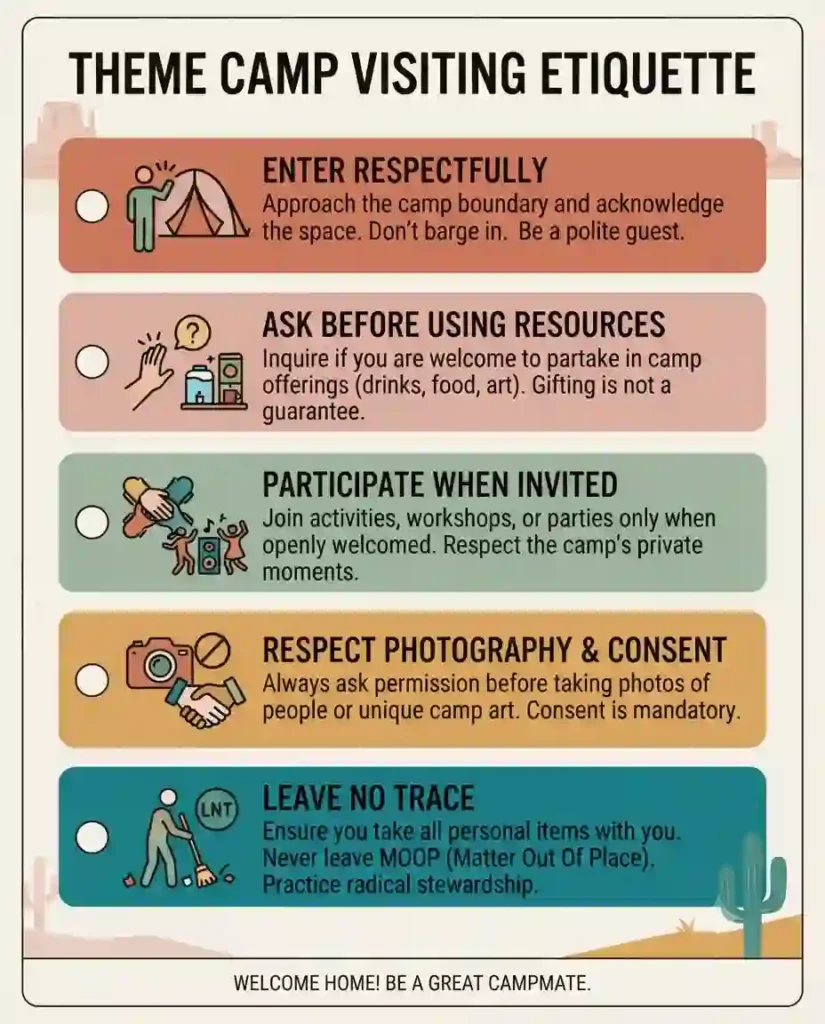
Entering Camps Respectfully
When you arrive at a camp, slow down and read the space. Look for signs, greeters, or cues about whether the space is open or private. Don’t rush in like you own the place. A little patience goes a long way. Most camps are happy to have visitors when those visitors are respectful and aware.
Asking Before Using Camp Resources
If a camp offers food, drinks, seating, shade, or services, don’t assume everything is free to take without context. Some offerings are public and open. Others are limited, shared, or meant for a specific experience. Ask if you’re unsure. That simple habit prevents awkwardness and shows appreciation for the work behind the camp.
Participating Instead of Only Watching
If a camp is offering an interactive experience, lean into it. Join the moment. Make the conversation. Try the thing. Theme Camps are usually more rewarding when you engage rather than simply spectate. That doesn’t mean you must do everything. It just means the spirit of the space is often participatory, not passive.
Respecting Photography and Consent
Always be careful with photos. Not everyone wants to be photographed, and not every camp wants its space documented. If there’s signage or a request about photography, follow it. When in doubt, ask. Respecting consent is part of protecting the trust that camps depend on.
Leaving Camps Better Than You Found Them
Pick up your own trash. Don’t leave gear behind. Don’t drag dust and clutter into someone else’s space. If you’ve been welcomed into a camp, leave with gratitude. That’s the simplest and most important rule. Good visitors make camps easier to love.
When visiting theme camps, be respectful, ask before using resources, participate where appropriate, follow photo and consent rules, and leave the space clean and intact.
- Enter camps respectfully and pay attention to signs, greeters, and boundaries.
- Ask before using resources like food, drinks, seating, or services.
- Participate when invited instead of only watching from the side.
- Be careful with photography and always respect consent.
- Leave the space clean and avoid bringing in unnecessary mess.
- Treat camps like someone’s temporary home and creative work.
- Good etiquette makes visits better for everyone.
How Do Theme Camps Prepare for Burning Man?
Theme Camps don’t happen by accident. They take planning, coordination, and a lot of group effort long before anyone steps onto the playa. What looks fun and effortless is usually the result of months of work.
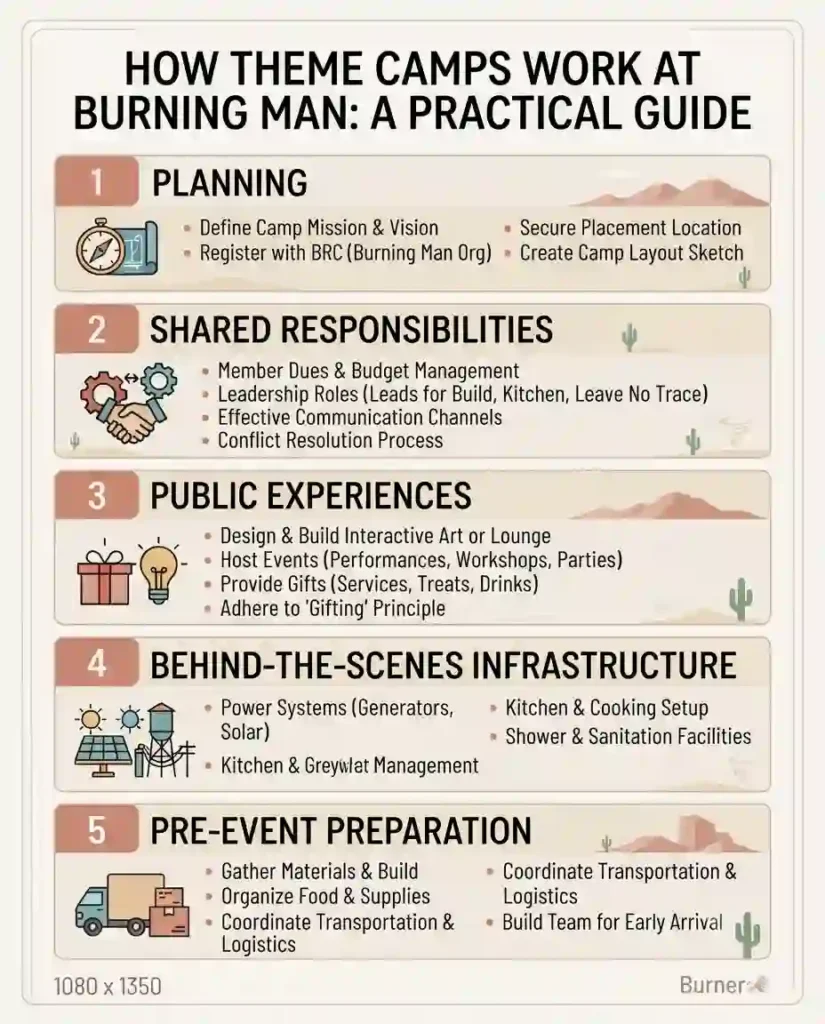
Year-Round Planning and Teamwork
Many camps start planning early. People discuss the camp’s identity, what it will offer, who will do what, and how the camp can operate smoothly during the event. These plans often evolve over time as the group grows or changes.
Teamwork matters here because the camp has to function under real pressure. A strong camp is usually built by people who know how to solve problems together.
Designing Camp Layouts
Camp layout is more than a map. It determines how people move, where guests enter, how public and private areas are separated, and how the camp feels. Good layout makes the camp intuitive and welcoming.
Poor layout can create confusion, crowding, or discomfort. That’s why experienced camps think hard about flow, shade, access, and function before they ever arrive.
Transporting Camp Equipment
Every camp has gear that has to get to the playa. That might include shade, furniture, tools, cooking gear, power systems, or decorative pieces. Packing, labeling, and transport logistics can get complicated fast.
If a camp is large, it usually has to think like a shipping operation. The more organized the transport, the smoother the build.
Building and Maintaining Camp Infrastructure
Once the camp arrives, it has to be built and then maintained. Shade systems need tension. Lights need power. Common spaces need cleanup. Storage needs order. Nothing stays perfect for long in the desert.
Camp members often take turns maintaining the space. That work keeps the camp usable and welcoming throughout the week.
Packing Down and Leaving No Trace
After the event, the work isn’t over. Everything must come down, get packed out, and leave the site clean. That includes trash, debris, forgotten items, and anything else that should not remain on the playa. This part matters deeply. Leave No Trace is not just a slogan it’s part of how camps protect the land and the future of the event.
Theme Camps require year-round planning, layout design, transport, infrastructure maintenance, and careful teardown. Leave No Trace is a core part of camp responsibility.
- Camps often spend months planning before the event.
- Preparation includes layout design, team coordination, and deciding what the camp will offer.
- Equipment, shade, storage, and power all need to be organized and transported.
- Camp members usually share the work of building and maintaining the space.
- Teardown is just as important as setup because everything must be packed out.
- Leave No Trace is a core part of camp preparation and responsibility.
- The visible camp experience depends on a lot of hidden work.
How Can You Find the Best Theme Camps During the Event?
Finding great camps is one of the joys of Burning Man. The city rewards curiosity. If you move slowly, look around, and stay open, you’ll discover a lot more than if you only chase a checklist.
🎒 Choosing the Right Camp Depends Upon
- Interests
- Activity level
- Family needs
- Quiet vs social
- Volunteering
- Creative participation
Using the Burning Man Camp Directory
The camp directory is a useful starting point. It helps you see what camps exist and what kinds of offerings they describe. That can help you plan your ride routes and spot camps that match your interests.Still, don’t treat the directory like a final answer. Some of the best camps are discovered in motion, not in advance.
Exploring Neighborhoods by Bike or on Foot
The best way to find camps is to explore. Bike through different neighborhoods. Walk when something catches your eye. Pull over when the music sounds good or the vibe feels right. Every block has its own personality. If you let the city breathe instead of forcing a route, you’ll find better moments.
Discovering Hidden Gems Off the Main Streets
Not all memorable camps sit on the busiest streets. Some are tucked away in quieter areas where fewer people stop. These hidden gems are often more intimate and less crowded. That can make them feel more personal. Sometimes the best camp is the one you almost missed.
Following Recommendations From Other Burners
Ask around. Burners love sharing discoveries. A camp recommendation from someone you trust can lead to a great experience. This is especially useful if you’re looking for something specific, like coffee, a chill space, a workshop, or a late-night music spot. Word of mouth still matters a lot out there.
Letting Serendipity Guide Your Experience
The playa has a way of surprising you. You may wander into a camp because you took the wrong turn and end up staying longer than expected. That kind of accident is part of the magic.
Don’t camp-hop with a checklist. Let the city surprise you. Some of the best memories come from following your instincts instead of your schedule.
You can find strong theme camps through the directory, but the best discoveries often come from exploring, asking other Burners, and leaving room for serendipity.
What Theme Camp Mistakes Should First-Timers Avoid?
First-timers often get excited about joining a theme camp without fully understanding what camp life involves. This section covers the most common mistakes new Burners make, from skipping research to forgetting that camps are built on shared effort, communication, and respect.
⚠️ Common Theme Camp Mistakes
Forgetting to thank volunteers.
Treating camps like tourist attractions.
Expecting free services without participating.
Entering private camp areas.
Ignoring consent.
Assuming every camp is always open.
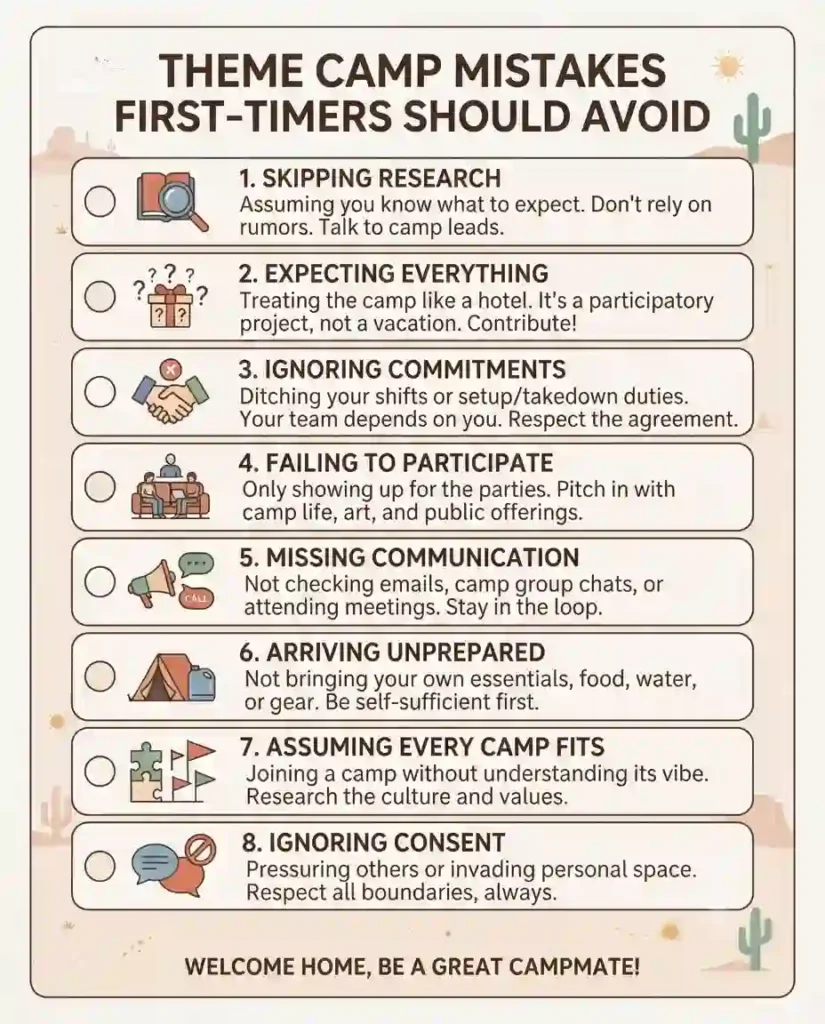
Choosing a Camp Without Researching Its Culture
First-timers should take time to understand a camp’s culture before joining. Every theme camp has its own rhythm, expectations, and social style, and what works for one person may not work for another. A camp’s theme alone is not enough to tell you whether it is a good fit. The best experience comes from joining a community that matches your energy, values, and willingness to participate.
Expecting a Theme Camp to Provide Everything
A theme camp is not a hotel, and it should never be treated like one. Newcomers sometimes assume that the camp will provide every comfort, but camp life is based on shared effort and mutual contribution. Everyone is expected to bring something to the table, whether that is time, labor, supplies, or positive energy. The stronger the participation, the stronger the camp becomes.
Joining Without Understanding the Commitment
Joining a camp means more than just reserving a place to stay. It usually comes with responsibilities before, during, and after the event. That may include setup help, public shifts, communication, or cleanup. If you do not understand the commitment, you may end up feeling overwhelmed, and the camp may end up carrying more than its share of the load.
Failing to Participate in Camp Activities
Theme camps are built around participation, not passive attendance. If you join a camp but remain distant or disconnected, you miss the whole point of the experience. Even small actions, like helping with setup, greeting visitors, or joining a shift, help create the spirit that makes camp life meaningful. Participation is often what turns a temporary group into a real community.
Ignoring Camp Communication Before Arrival
Communication before the event matters a great deal. Camps often share important updates about schedules, supplies, expectations, and logistics long before arrival. If you ignore messages or do not stay in touch, you may show up unprepared or miss key information. Staying responsive helps prevent confusion and shows respect for the people organizing the camp.
Arriving Unprepared for Shared Responsibilities
Camp members should arrive ready to contribute. Shared responsibilities are part of camp life, and people who come unprepared can create extra stress for everyone else. Whether it is helping with shade, cleaning up, or supporting public hours, being ready to work matters. A camp runs better when every person understands that they are part of the team.
Assuming Every Camp Matches Your Interests
Not every camp is meant for every person. Some camps are loud and social, while others are quiet and reflective. Some focus on music or art, while others center on wellness, learning, or hospitality. If you assume all camps are the same, you may end up disappointed. Choosing carefully helps you find a place where you genuinely feel comfortable.
Forgetting to Respect Camp Boundaries and Consent
Every camp has boundaries, even if they are not always formal or obvious. Some spaces are open to visitors, while others are private or limited to camp members. Respecting consent, privacy, and camp rules is essential. A respectful visitor understands that a camp is both a shared community space and someone’s temporary home.
- First-timers should avoid joining a camp without learning about its culture and expectations.
- A Theme Camp is not a full-service hotel, so do not expect everything to be provided for you.
- Joining a camp means accepting shared responsibilities, communication, and follow-through.
- Participation matters, so don’t just show up and stay passive.
- Camp communication before arrival is important and should never be ignored.
- Arriving unprepared can create stress for you and extra work for others.
- Not every camp fits every person, so choose carefully.
- Respect for camp boundaries, consent, and group norms is essential.
What Tips Do Experienced Burners Share About Theme Camps?
Experienced Burners usually know that the best camp experiences come from participation, flexibility, and community spirit. This section pulls together the kinds of advice seasoned participants often give about choosing the right camp, contributing well, and making the most of the experience.
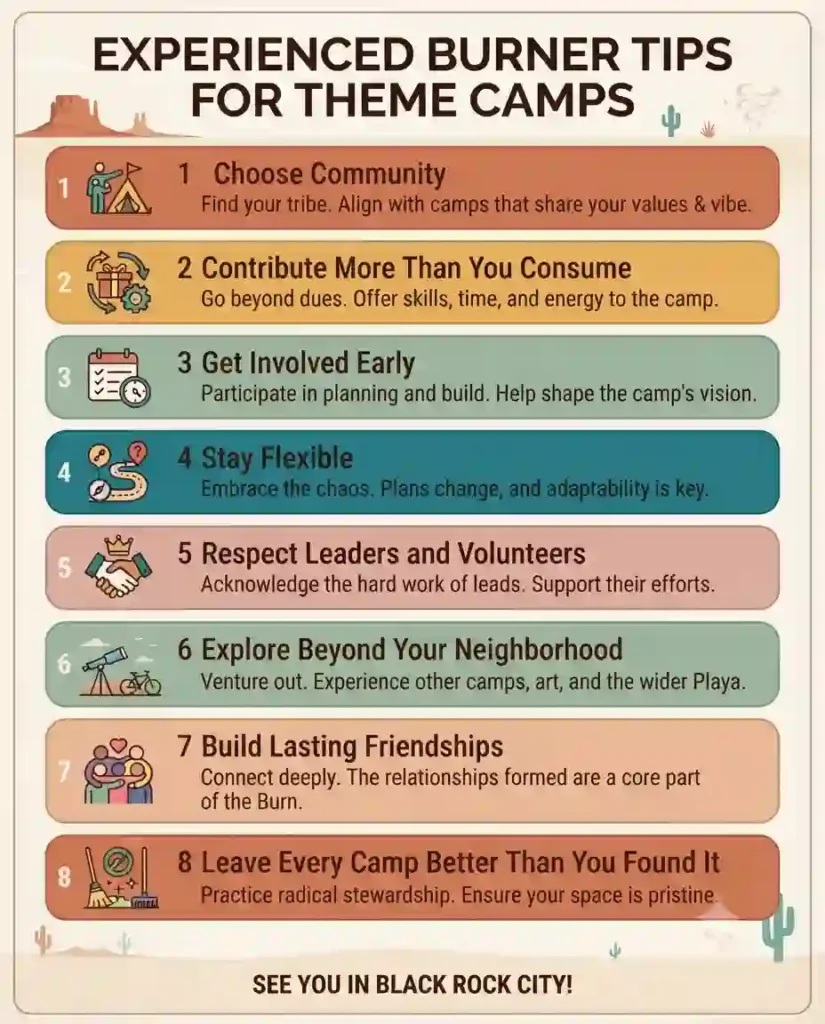
Choose the Community, Not Just the Camp Theme
Experienced Burners often say that the people matter just as much as the camp’s theme. A fun idea does not guarantee a good experience if the community is not a strong match. It is better to join a camp whose values, energy, and communication style feel right to you. A good community can make even a simple camp feel unforgettable.
Contribute More Than You Consume
One of the most common Burner lessons is to give more than you take. Camps work best when everyone participates in making them run smoothly. That might mean helping with chores, joining public hours, welcoming visitors, or handling practical tasks without being asked. The more you contribute, the more meaningful the experience becomes for everyone.
Introduce Yourself and Get Involved Early
It helps to show up early in a social sense, not just physically. Introduce yourself, learn names, ask how you can help, and get involved before you feel disconnected. Early participation builds trust and makes it easier to settle in. People remember the campmates who step in and become part of the rhythm right away.
Be Flexible and Embrace Unexpected Experiences
The playa rarely goes exactly as planned, and camps are no exception. Experienced Burners know that flexibility is one of the most valuable traits you can bring. Some of the best camp moments happen by surprise, when a conversation turns into a performance or a casual stop becomes the highlight of your night. Staying open helps you enjoy those moments instead of missing them.
Respect Camp Leaders, Volunteers, and Organizers
Behind every camp is a lot of effort that most visitors never see. Leaders, volunteers, and organizers spend countless hours making sure the camp works for everyone. Treating their work with respect is part of good Burner behavior. A little appreciation goes a long way when people are carrying so much responsibility.
Explore Beyond Your Own Neighborhood
It is easy to stay close to your own camp, especially when you are comfortable there. But experienced Burners often recommend exploring beyond your neighborhood. Some of the best discoveries happen when you wander into another area and find a camp you did not expect. The more you explore, the more alive and layered Black Rock City feels.
Build Relationships That Last Beyond the Burn
For many people, the friendships formed through camp life become some of the most lasting parts of the experience. Shared effort and shared space create bonds quickly. The strongest connections often continue long after the event ends, through reunions, projects, or future Burns. That long-term social value is one of the best things theme camps can offer.
Leave Every Camp Better Than You Found It
This is one of the simplest and most important Burner lessons. When you visit a camp, leave it in good shape. Clean up your own mess, be considerate of shared spaces, and treat the area with care. Good visitors make camps easier to love, and that respect helps the whole community thrive.
- Choose the community and vibe first, not just the camp’s theme.
- Contribute more than you consume so the camp stays strong and welcoming.
- Introduce yourself early and get involved instead of staying on the sidelines.
- Stay flexible because the best moments often happen unexpectedly.
- Respect the time and effort of camp leaders, volunteers, and organizers.
- Explore beyond your own neighborhood so you can discover more of Black Rock City.
- Build relationships that last beyond the event itself.
- Leave every camp and shared space better than you found it.
Common Myths About Theme Camps
Theme camps attract many myths and misconceptions, especially among first-timers trying to understand what camp life is really like. Clearing up these myths helps you set realistic expectations and choose a camp that fits your values and participation style. Most misunderstandings come from confusing a few high-profile examples with the everyday reality of most camps.
Theme Camps Myths vs Reality
| Myth | Reality |
|---|---|
| Theme camps are private clubs. | Many welcome visitors and encourage participation during public hours. |
| You must pay to enter theme camps. | Most public activities are offered freely as gifts, not sold. |
| Only experienced Burners can join a camp. | Many camps actively welcome first-time participants. |
| Theme camps are only for sleeping. | They create art, events, workshops, performances, cafés, and community experiences. |
| Every camp is loud and hosts parties. | Many camps focus on wellness, education, meditation, family activities, or quiet community spaces. |
| You don’t need to help if you join a camp. | Members are generally expected to contribute through setup, cleanup, hosting, or daily camp responsibilities. |
Myth: Theme Camps Are Luxury Resorts
Some people imagine theme camps as all-inclusive resorts where everything is provided and comfort is guaranteed. In reality, most camps are DIY communities built by participants, not paid service providers. Amenities can be basic, and there’s still dust, heat, wind, and plenty of work for everyone.
Myth: Only Experienced Burners Can Join
Many first-timers think they must “earn” their way into theme camps by attending multiple years first. In truth, lots of camps welcome newcomers and see fresh energy as a gift. Clear communication, willingness to participate, and respect for camp culture usually matter more than the number of burns you’ve attended.
Myth: Theme Camps Do Everything for You
Theme camps help with shared infrastructure, but they don’t remove your responsibility for survival basics. You’re still expected to bring essential personal gear, stay healthy, handle your own needs, and contribute effort. Camps support you, not replace your individual responsibility.
Myth: You Lose Your Independence
Another myth is that joining a camp means giving up your freedom and being controlled by camp rules. While camps do have guidelines to keep things running smoothly, you still choose how you spend much of your time. Good camps encourage exploration, personal projects, and healthy boundaries.
Reality: Participation Is What Matters
Beneath all the myths, one reality stands out: theme camps value participation over perfection. Showing up, contributing, communicating clearly, and treating others well matter far more than having the “right” gear or experience level. Camps succeed when members act like true collaborators rather than customers.
Theme Camp Myths Reality Tips
- Theme camps are not luxury resorts; they’re participant-built communities that still involve dust, effort, and shared responsibility.
- New Burners can join many camps as long as they communicate honestly and commit to participating.
- Real camp culture revolves around collaboration and participation, not perfection or entitlement.
Which of these myths did you personally feel most strongly before understanding theme camps better, and how does the reality change your view?
Theme Camps in Key Insights
Theme Camps are the heart of Black Rock City’s community life. They create neighborhoods filled with art, music, workshops, food, performances, and interactive experiences where participants contribute rather than simply consume.
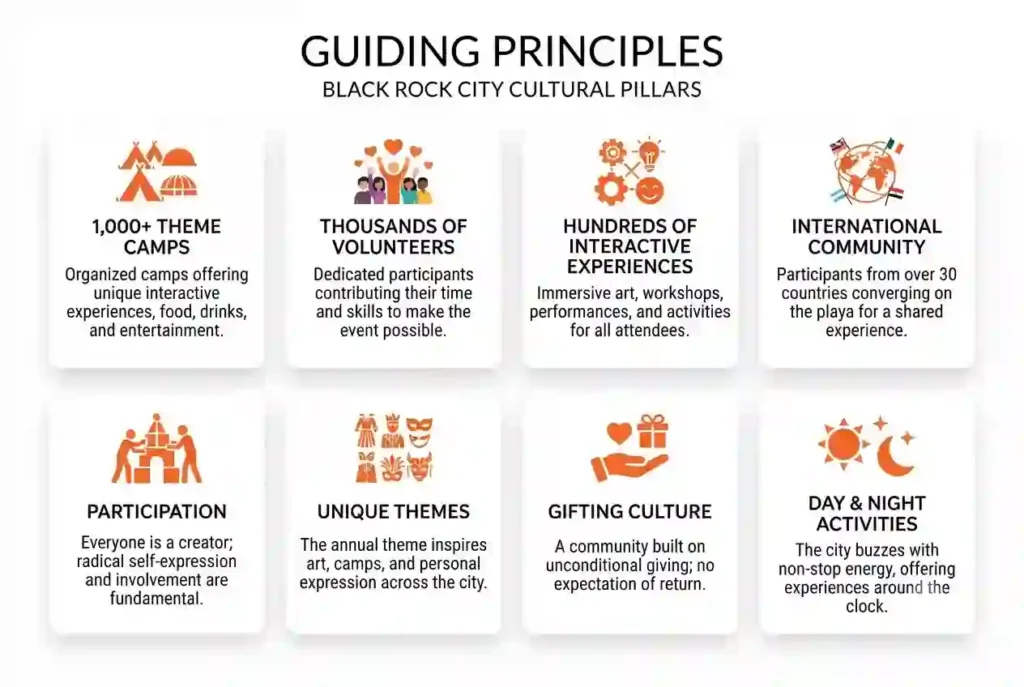
Key Numbers
- 🏕️ 1,000+ Theme Camps — More than one thousand registered camps help shape Black Rock City each year.
- 👥 Thousands of Volunteers — Theme camps are built and operated entirely by participants and volunteers.
- 🎭 Hundreds of Interactive Experiences — Camps host workshops, performances, games, cafés, art, wellness sessions, and social gatherings.
- 🌍 International Community — Many camps include members from multiple countries working together.
- 🤝 Participation Over Spectating — Visitors are encouraged to interact, volunteer, and contribute.
- 🎨 Every Camp Has a Unique Theme — Themes range from music and science to wellness, food, education, and art.
- ❤️ Gifting Culture Powers Camps — Most experiences are freely offered without commercial transactions.
- 🌅 Activities Day and Night — Theme camps remain active from sunrise until late at night, depending on their schedule.
Theme Camp Readiness Checklist
Before joining or creating a theme camp, it’s important to understand the responsibilities, costs, and participation expectations involved. This readiness checklist helps you quickly confirm whether you’re prepared for camp life from first contact to final cleanup. It ties together the key lessons from the entire Theme Camps Guide in a practical, action-oriented format.
Before Joining a Theme Camp
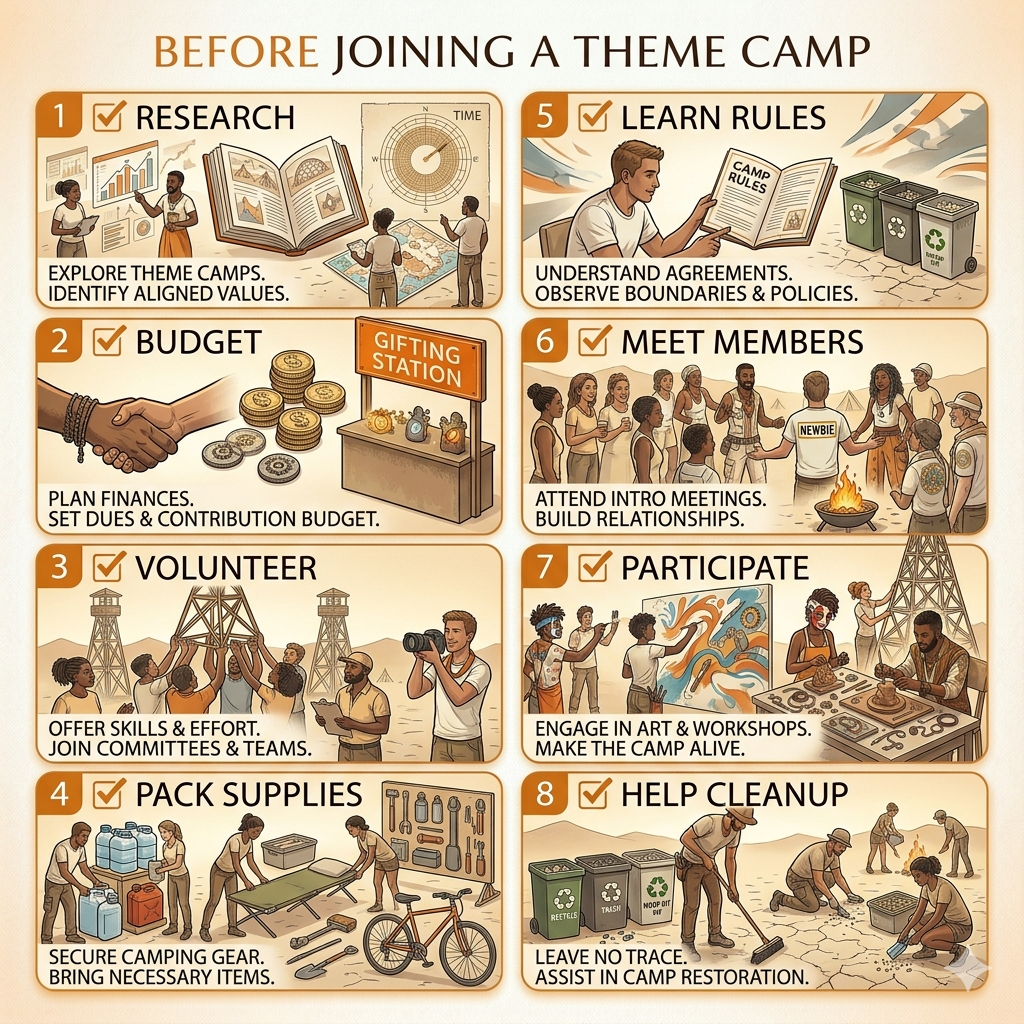
Before you say “yes” to any camp, take time to align your expectations and values. Research camps that match your interests, energy level, and participation style—party-focused, art-focused, quiet, family-friendly, etc. Read the camp’s guidelines carefully, confirm dues and deadlines, and understand what’s included versus what remains your personal responsibility. When you introduce yourself in applications or chats, be honest about your skills, limitations, and goals, and ask any questions before committing.
✅ Speak with camp organizers
✅ Confirm arrival and departure dates
✅ Review camp rules
✅ Understand shared responsibilities
Before Arriving at Black Rock City
Once you’ve joined a camp, your next step is preparation. Pay camp dues on time so organizers can secure gear and supplies. Coordinate transportation and arrival plans with campmates to avoid confusion and ensure smooth setup. Pack all required personal gear, including shelter, clothing, lighting, and basic health needs, even if your camp offers some shared resources. Bring enough food, water, and personal supplies as agreed in camp communications, and review your assigned responsibilities and shift schedule.
✅ Decide whether you want a social or quiet camp
✅ Learn the camp’s participation requirements
✅ Ask about dues and shared expenses
✅ Understand camp expectations
During Your Camp Stay
While you’re on playa, focus on being a reliable, engaged campmate. Show up for scheduled shifts and help cover gaps when emergencies happen. Respect shared equipment and common spaces by treating them gently and cleaning up after yourself. Follow Leave No Trace principles and be mindful of MOOP in and around your camp. Communicate with camp organizers if your plans or energy levels change, and support campmates when they need help with projects, issues, or burnout.
✅ Volunteer for camp shifts
✅ Respect quiet hours if applicable
✅ Participate in camp activities
✅ Help keep shared spaces clean
Before Leaving the Playa
As the event ends, your responsibilities continue. Complete your assigned cleanup tasks and help with teardown as your camp’s plan requires. Remove all your personal belongings and double-check hidden corners for forgotten items. Help restore shared camp areas, including structures, kitchens, and public-facing spaces, as agreed. Do a final MOOP sweep and strive to leave the camp area in better condition than you found it, honoring both your camp and the wider Burning Man community.
✅ Complete cleanup duties
✅ Pack out your belongings
✅ Thank camp organizers
✅ Stay connected with camp members
Theme Camp Participation Checklist
| Before Visiting a Camp | ✓ |
| Say hello | ☐ |
| Read posted signs | ☐ |
| Respect boundaries | ☐ |
| Participate when invited | ☐ |
| Leave no trace | ☐ |
| Thank camp members | ☐ |
Theme Camp Readiness Checklist
- The readiness checklist guides you from choosing the right camp through preparation, active participation, and responsible cleanup.
- It reinforces that theme camp life requires commitment to dues, gear, shifts, communication, and Leave No Trace values.
- Using this checklist helps first-timers and experienced Burners verify they’re truly ready to be a strong, supportive member of any camp.
Looking at this checklist, which phase—before joining, preparation, during the burn, or leaving—do you feel you most need to refine or build a more detailed plan for in your own content and personal approach?
Bringing the Theme Camp Experience Together
This section ties the whole theme camp journey together and shows how camps fit into the larger Black Rock City experience. It focuses on finding the right community, understanding the value of participation, and seeing how theme camps shape the memories people take home.
Finding the Right Community for Your Burn
The best theme camp experience starts with finding the right people. A camp is not just a location or a label — it is a temporary community with its own way of working and relating. If the fit is right, the camp becomes part of what makes your Burn feel personal and memorable. Choosing well can shape your whole event in a positive way.
Why Participation Creates the Best Memories
The memories people carry home usually come from joining in, not standing back. Participation turns a camp from something you observe into something you help create. Whether it is a shared meal, a spontaneous conversation, or a job you helped complete, those active moments tend to stay with you. That is why participation is at the center of the theme camp experience.
Making Theme Camps Part of Your Black Rock City Journey
Theme camps are one of the clearest ways to connect with the spirit of Black Rock City. They give structure, personality, and social life to the temporary city. Visiting them, joining them, or simply spending time inside them can make the event feel more real and more human. They are not separate from the journey — they are a major part of it.
Theme Camp Experience by Time of Day
| Time | Typical Experience |
| Morning | Coffee meetups, yoga, workshops |
| Afternoon | Art, talks, games, community events |
| Sunset | Gatherings and performances |
| Evening | Music, social spaces, interactive events |
| Late Night | Camps hosting nightlife experiences |
- Theme Camps are about community, participation, and shared experience.
- The best camp for you is the one that matches your energy, values, and willingness to contribute.
- Visiting, joining, and exploring camps are all part of the larger Burning Man journey.
- Real camp magic happens when people show up with openness and effort.
- Theme Camps help turn Black Rock City into a place of connection rather than just a temporary city.
- Your experience becomes richer when you treat camps as communities, not just attractions.
Final Thoughts
This closing section offers a warm wrap-up on the deeper spirit of theme camps. It reflects on how every camp has its own personality, why the best experiences are often unplanned, and why showing up with curiosity and a helpful attitude makes all the difference.
Every Theme Camp Has Its Own Story
No two camps are exactly alike, and that variety is part of the magic. Some are playful, some are calm, some are loud, and some are deeply intentional. Each one brings its own energy and its own way of welcoming people. That is why camp-hopping can feel so rewarding: you are moving through many different stories in one city.
The Best Experiences Often Aren’t Planned
Some of the strongest camp memories happen by accident. You may stop for a quick look and end up staying for an hour. You may wander in without expectations and leave with a new perspective or a new friend. The playa often rewards curiosity more than control, and theme camps are a perfect example of that.
Show Up Curious, Helpful, and Ready to Participate
If you want to get the most from theme camps, bring curiosity, kindness, and a willingness to help. That attitude opens more doors than trying to act like you already know everything. When you participate with respect and openness, the experience becomes richer for you and better for the camp. That is the heart of Burner culture in one simple idea.
- Every Theme Camp has its own story, energy, and personality.
- Some of the best camp experiences happen by surprise, not by plan.
- The best way to enjoy Theme Camps is to show up curious, helpful, and ready to participate.
- A respectful attitude opens the door to better conversations and stronger connections.
- Theme Camps are one of the clearest ways Burning Man becomes alive, social, and unforgettable.
Theme Camps FAQs
A Theme Camp is a participant-created community that offers interactive experiences, art, workshops, performances, or hospitality for the city.
Yes. Many camps actively welcome newcomers who are willing to participate and contribute.
Some camps collect dues to cover shared infrastructure and operating costs, but public activities are generally offered as gifts.
You can explore the official Theme Camp directory before the event or visit camps while exploring Black Rock City.
Usually yes. Most camps expect members to help with setup, hosting, cooking, cleanup, or other shared responsibilities.
Yes. Many camps welcome visitors during scheduled public events and interactive experiences.
Some are family-oriented, while others are designed for adult audiences. Always review camp descriptions before visiting.
Yes. Many camps include participants from around the world and welcome international Burners.
Choosing a camp without understanding its expectations, schedule, or participation requirements.
It depends on your goals. Theme camps provide community and shared resources, while independent camping offers greater flexibility and self-reliance.
Many camps recruit members months in advance through their websites, social media, community groups, or the official Burning Man Theme Camp listings.
Where Should You Go Next?
| If You Want To… | Read This Guide |
| Discover camp activities | → Activities & Experiences |
| Navigate the city | → City Guide |
| Explore Burning Man art | → Art & Creativity |
| Visit famous landmarks | → Landmarks & Iconic Places |
| Find city services | → City Services & Resources |
Why Trust This Guide?
✅ Links to related Black Rock City resources throughout the website.
✅ Updated for the 2026 Burning Man season.
✅ Covers the full Theme Camp experience for beginners and experienced Burners.
✅ Explains participation, responsibilities, and camp culture.
✅ Includes guidance for joining, exploring, and respecting Theme Camps.
Conclusion
Theme Camps are far more than places to sleep—they are the social and creative heartbeat of Black Rock City. Every camp contributes to the city through participation, hospitality, education, entertainment, or public art. Exploring Theme Camps with curiosity and respect allows you to experience the collaborative spirit that makes Burning Man unlike any other event.
- 🏕️ Theme Camps are built by participants.
- 🤝 Participation is more important than observation.
- 🎁 Many camps offer public experiences.
- ❤️ Every camp has its own personality.
- 🚶 Explore respectfully and engage with camp members.
- 🌍 Thousands of volunteers make Theme Camps possible.
- 🛠️ Community contribution strengthens every neighborhood.
- 📖 Continue with the Activities & Experiences Guide to discover what happens inside many Theme Camps
Theme Camp Pro Tips
- 🤝 Choose a camp that matches your interests and personality.
- 🏕️ Ask detailed questions before committing to a camp.
- 🎁 Contribute your skills—not just your camp dues.
- 🗓️ Arrive on time if helping with setup.
- 🧹 Leave shared spaces cleaner than you found them.
- 🎭 Visit different camps during the week—you don’t have to stay only in your own.
- ❤️ Remember that participation matters more than entertainment.
- 🌅 Some of the best Burning Man memories come from helping your camp, not just attending events.