Burning Man Honoraria Program 2027: Art Grants, Eligibility & Application Guide
Burning Man Project’s Honoraria Program provides partial funding to selected art projects each year, but most large-scale playa installations still depend heavily on artist fundraising and volunteer labor to reach completion. This guide explains how the grant process works and what artists typically need beyond it. Community support fills the gap grants alone can’t cover.
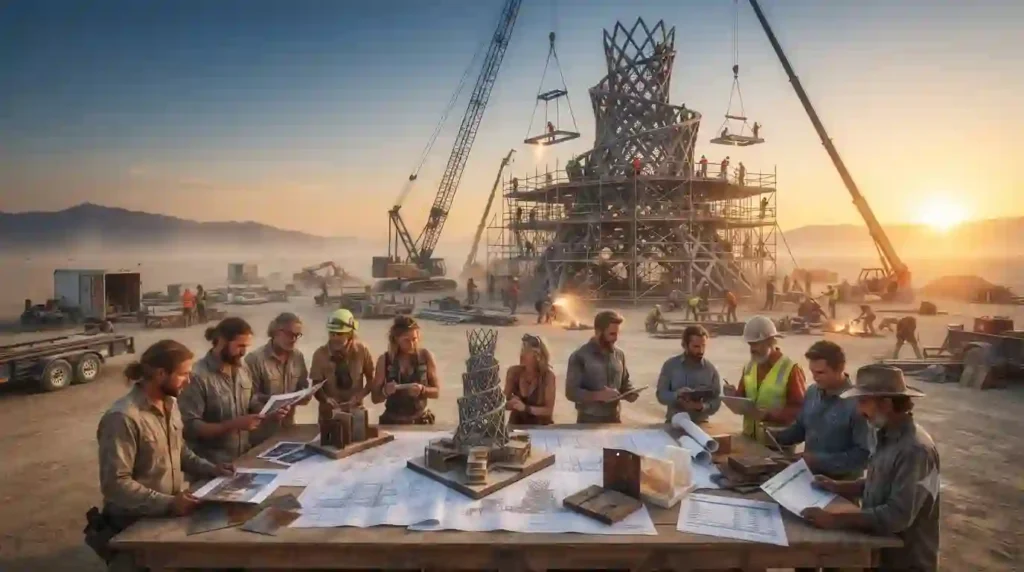
Behind every major sculpture on the open playa is a funding story that usually starts, but rarely ends, with Burning Man Project’s Honoraria Program — a competitive grant process that provides partial financial support to selected art installations each year. Galaxia, the largest Honorarium-funded project in Burning Man history at 20 meters tall with 30,000 square feet of structure, illustrates both the program’s ambition and its limits: even a flagship-funded project of that scale still relied on extensive additional fundraising, volunteer labor, and in-kind donations to reach completion.
This guide explains how the Honoraria application and selection process typically works, what grants do and don’t cover (materials and fabrication support rather than full project costs in most cases), and the other funding sources most artists lean on to close the gap — crowdfunding, sponsorship-adjacent community donations that stay within Decommodification norms, and significant volunteer labor from crews who join a project specifically because they believe in it. It’s written for artists considering applying for a future Honorarium as much as for participants curious how their favorite past installations came to exist.
For the large-scale works this funding often supports, see the Large-Scale Art Installations Guide; for the broader creative culture surrounding Burning Man art, see the Burning Man Art Guide.
In This Guide You’ll Learn
- 💰 What is the Honoraria Program?
- 🎨 How artists receive support
- 📝 Project proposal process
- 🤝 Community collaboration
- 🏗️ Building large-scale artwork
- ❤️ Volunteer participation
- 🌍 Global artist community
- 📈 Project lifecycle
- ⚠️ Challenges artists face
- 🔮 Future of Burning Man art
Burning Man 2027 Honoraria: LOI Deadline, Artist Q&A & How to Apply
Artist update — October 14, 2026
Are you developing a sculptural, interactive art installation for Black Rock City 2027? The 2027 Black Rock City Honoraria Letter of Intent (LOI) application is open, and artists should begin preparing their submissions now.
Important Dates for Artists
- October 1, 2026: LOI application opened.
- October 14, 2026, 4:00–5:30 PM Pacific Time: Scheduled online Honoraria Q&A with Burning Man Project Art Department staff.
- October 22, 2026, 10:00–11:30 AM Pacific Time: Another scheduled Q&A opportunity.
- October 29, 2026, 5:00 PM Pacific Time: Final deadline to submit the LOI.
- December 8, 2026: LOI notification date listed in the official timeline.
- January 11, 2027, 5:00 PM Pacific Time: Full-proposal deadline for invited applicants only.
Important: Check the official Q&A registration page for access and any schedule changes.
What Is the Letter of Intent?
The LOI is the first stage of the Black Rock City Honoraria application process. Artists submit an initial description of their proposed installation so the grant committee can determine which projects will be invited to submit a full proposal.
Honoraria support is intended for physical, sculptural artworks placed on the open playa. Interactive installations and mobile sculptures that meet the program’s criteria may qualify. Performances, workshops, theme camps, bikes, and passenger-carrying Mutant Vehicles are not eligible as Honoraria projects.
How to Prepare Your Application
- Read the official Honoraria program guidelines and frequently asked questions.
- Review the LOI questions in the official preview document.
- Prepare a clear explanation of your artistic concept and how participants will experience it.
- Gather concept images, sketches, drawings, or renderings that communicate your vision.
- Submit the LOI through your Burner Profile before the deadline.
Applications must be submitted through the official online process; email and postal submissions are not accepted. Burning Man Project recommends preparing responses in advance and applying early rather than waiting until deadline day.
Ready to take the next step? Read the official instructions and confirm the latest requirements before submitting your application.
Official application resources:
Dates and requirements can change. Always confirm the current information with Burning Man Project before applying.
🔥 2027 Honoraria Update: Applications Are Now Open
The Burning Man Project’s 2027 Black Rock City Honoraria Letter of Intent (LOI) is now open. Artists interested in receiving partial funding for eligible open-playa artwork can submit their LOI from October 1 through October 29, 2026.
The LOI opens at 12:00 PM Pacific Time on October 1 and closes at 5:00 PM Pacific Time on October 29. Artists invited beyond the LOI stage will submit a full proposal by January 11, 2027, with selected grantees notified in early March 2027.
Important: The full proposal is invitation-only. Artists must complete the LOI first.
2027 Honoraria Timeline:
October 1 — LOI opens
October 29 — LOI deadline
December 8 — LOI notifications
January 11, 2027 — Full proposal deadline for invited artists
Early March 2027 — Selected grantees notified
What Are Burning Man Art Grants?
Burning Man art grants are one of the main ways large-scale playa art becomes possible. They help artists move from concept to creation by offering support for ambitious projects that reflect the culture of the event. At Burning Man, grants are not just financial assistance; they are a form of cultural investment. They help turn community energy, creative vision, and technical skill into temporary art that can transform Black Rock City.
Understanding the Burning Man Honoraria Program
The Honoraria Program is the best-known form of Burning Man art support because it helps selected artists bring major works to the playa. It exists to encourage public art that is creative, participatory, and meaningful to the event experience. The program gives artists a chance to build projects that might otherwise be too expensive or complex. In that way, honoraria help shape the visual identity of Burning Man.
Honoraria and performance art are the backbone of Burning Man’s cultural fabric. The Burning Man Project runs a competitive Honoraria process for large‑scale, burnable sculptures, theme camps, and interactive experiences, with 2026’s theme encouraging interconnected narratives and participatory rituals.
Core pathways
- Apply for BRC Honoraria months in advance (often deadlines in late fall the prior year).
- Follow fire‑art guidelines (fuel type, safety distances, burn‑permits, and MOOP‑free cleanup).esim.holafly+1
- Volunteer or pitch for performance slots in plazas, art cars, and theme camps once in city.
Why Art Grants Exist
Art grants exist because many powerful projects require more resources than individual artists can easily provide. Materials, transportation, labor, engineering, and safety planning all cost money. Without support, some of the most ambitious ideas would never be realized. Grants help make sure that creative vision is not limited by budget alone.
Supporting Creativity Through Community
Burning Man art funding reflects the idea that community should help support shared creativity. When people contribute to an art project, they are helping build the world they want to experience. That support is part of what makes the event feel collaborative. The art becomes a shared achievement rather than a private object.
How Grants Help Artists Build Large Projects
Large projects often need funding for more than just materials. They may require design services, heavy equipment, transport, volunteer coordination, and months of fabrication. A grant can help bridge those gaps. That support makes it possible for artists to think bigger and build more safely.
Why Art Funding Matters at Burning Man
Art funding matters because it directly affects the quality and diversity of the playa landscape. Without support, fewer artists would be able to bring complex, large-scale, or experimental works. Funding helps ensure the event remains visually rich and culturally meaningful. It also helps keep the art ecosystem healthy over time.
- Art grants help turn creative ideas into real playa projects.
- The Honoraria Program is the most recognizable funding model.
- Grants support materials, labor, transport, and safety planning.
- Community-backed funding strengthens Burning Man’s artistic culture.
The History of the Honoraria Program
The Honoraria Program grew out of the need to support ambitious public art on the playa. Over time, it evolved from a practical funding approach into a core part of how Burning Man builds its artistic landscape. That history reflects the event’s growth and its commitment to supporting creators. The program has helped define what Burning Man art looks and feels like today.
How Art Grants Began
Art grants began as a way to help artists realize works that would be too difficult to build independently. As the event grew, so did the need for structured support. Early grant systems helped establish the idea that public art deserved resources. That support made more ambitious work possible.
The Evolution of Artist Support
Artist support evolved as Burning Man became more complex and more established. The event needed systems that could support larger projects, more applicants, and greater artistic diversity. Over time, the process became more refined and more selective. The goal remained the same: encourage meaningful art on the playa.
Expanding Opportunities for Creators
As the program grew, it created more opportunities for a wider range of creators. Artists with different backgrounds, styles, and levels of experience gained access to support. That expansion helped diversify the kinds of projects appearing at Burning Man. It also encouraged more experimentation.
Community-Funded Art
Community-funded art became an important part of the ecosystem because it showed that support could come from many directions. Some artists combined grant funding with donations or volunteer labor. That blend of support helped projects become more resilient. It also reinforced the shared nature of the work.
Honoraria Today
Today, honoraria remain one of the most important ways Burning Man supports large-scale and culturally significant art. The program continues to shape what visitors see on the playa. It also remains a symbol of the event’s commitment to creativity and participation. Honoraria are now deeply embedded in Burning Man culture.
- Honoraria began as a way to support ambitious public art.
- Artist support expanded as the event grew.
- Community funding became part of the broader ecosystem.
- The program remains central to Burning Man art today.
Burning Man Honoraria 2026: What Changed This Year?
The 2026 Honoraria update defines the program’s scale, funding focus, and how funded projects fit inside a much larger field of playa art.
75 Projects Received Honoraria Funding
In 2026, 75 projects were selected for direct Honoraria support based on scale and participant impact.
- Seventy-five projects were awarded Honoraria for Black Rock City 2026.
- Recipients shared roughly $1.3M in direct payments.
- Funded projects received priority logistical support and an assigned artist liaison.
- Selection favored open-playa, large-scale, and highly interactive works.
- Limited cohort size preserves program focus and increases visibility for chosen pieces.
400+ Art Installations Go Beyond Honoraria
The Honoraria cohort is a funded subset within a much larger ecosystem of playa art.
- Over 400 installations were planned for BRC 2026, including many self-funded works.
- Most playa art remains community- or artist-funded rather than grant-funded.
- Self-funded pieces often rely on crowdfunding, sponsorship, and volunteer labor.
- Numerous crowd-favorite works historically have not been Honoraria-funded.
- Distinguishing funded vs self-funded clarifies expectations for scale and onsite resources.
International Representation & Fire Works
2026 showed increased global participation and a notable number of flame-enabled projects.
- Fifteen Honoraria projects came from international teams in 2026.
- Fourteen projects planned flame or fire effects, increasing safety and permitting needs.
- International projects introduce extra shipping, customs, and coordination requirements.
- Fire-enabled works require detailed safety plans, licensed operators, and spectator zones.
- These trends reflect emphasis on spectacle, cultural diversity, and experiential art.
“Funding magnifies possibility but doesn’t replace community—nearly every piece on the playa still depends on collaboration.”
How Does the Honoraria Grant Program Work?
The grant program works through an application and review process designed to identify projects that fit Burning Man’s artistic and community values. Artists submit proposals, which are evaluated for creativity, feasibility, and contribution to the event. The process helps make sure support goes to projects that can realistically succeed. It also helps maintain fairness and artistic quality.
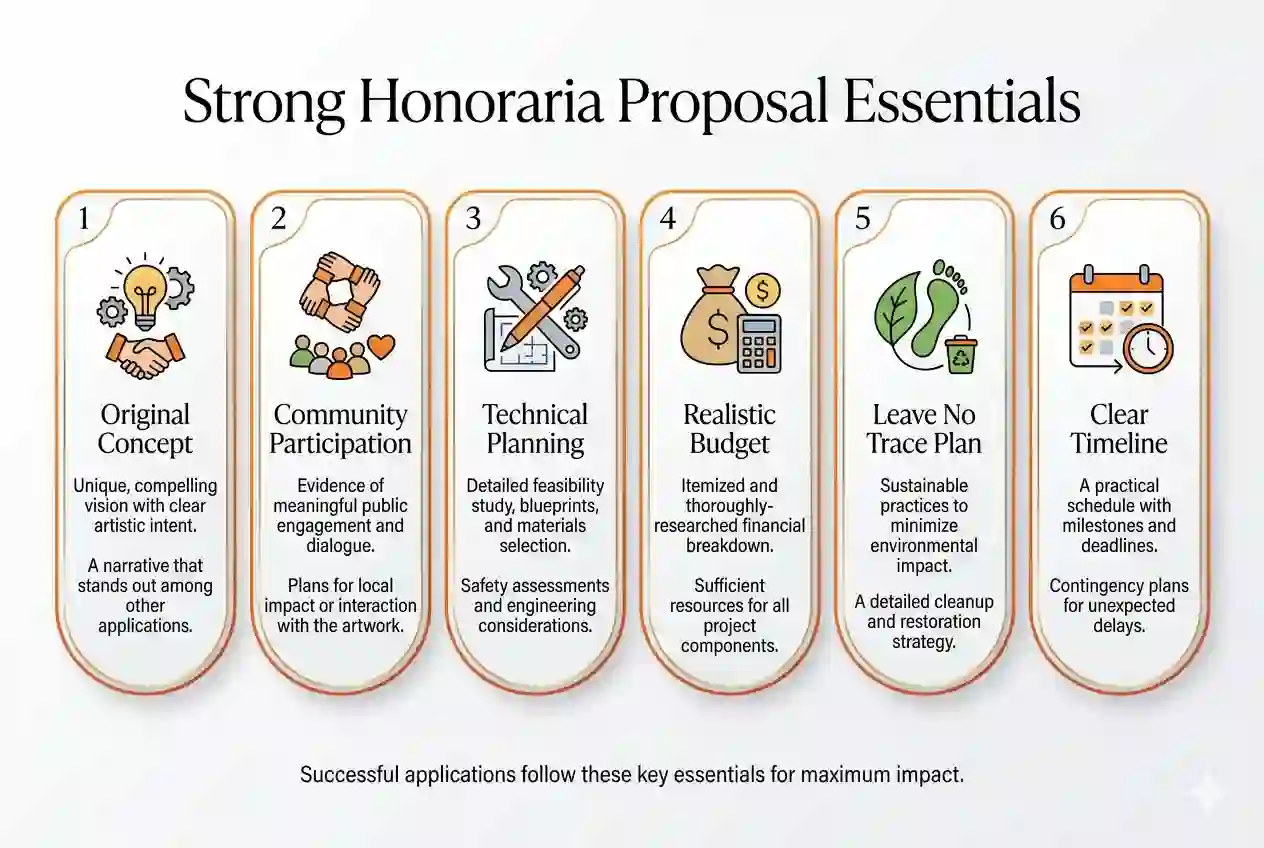
Who Manages the Program?
The program is managed by the organization responsible for Burning Man’s art support system. That team handles application intake, review coordination, and funding decisions. Their role is to balance artistic vision with practical constraints. Managing the program carefully is essential because the stakes are high.
Annual Application Process
Each year, artists go through an application process to propose their projects. The process usually requires conceptual detail, practical planning, and budget clarity. This helps reviewers understand both the artistic value and the build reality. A strong application shows vision and responsibility.
Proposal Review
Proposal review is where the team evaluates whether a project is a good fit for support. Reviewers consider many factors, including originality, feasibility, and community impact. The review process is competitive because funding is limited. That means strong proposals need to stand out on both creative and practical grounds.
Selection Criteria
Selection criteria usually focus on artistic merit, participation, feasibility, safety, and alignment with the event’s values. The more clearly a project demonstrates those qualities, the stronger its case becomes. A good idea is not enough if it cannot be built safely. Selection is about the whole package.
Grant Awards
Grant awards provide financial support to selected projects, but the amount and structure can vary. Some projects receive more extensive help, while others get partial support. The award is a starting point, not a guarantee that everything is covered. Artists still need to manage budgets carefully.
- The program uses an application and review process.
- Proposals are judged on creativity, feasibility, and fit.
- Funding is competitive and limited.
- Grant awards support, but rarely cover everything.
What Does the Burning Man Honoraria Program Actually Fund?
What Does the Burning Man Honoraria Program Fund?
The Honoraria Program provides partial funding for eligible artwork intended for the open playa at Black Rock City. Burning Man Project looks for work that is visually appealing, sculptural, impactful and interactive.
Art That Can Qualify
- 3D and sculptural artwork
- Interactive installations
- Public-facing open-playa installations
- Mobile art that meets the program’s requirements
- Art related to the annual theme or independent of the theme
Art That Is Not Funded
Honoraria does not fund:
- Theme camps or camp-frontage art
- Performances, workshops or activities
- DJs or amplified sound
- Domes, tents, teepees, stages or prefabricated structures
- Standalone murals or 2D artwork
- Mutant vehicles
- Mutant bikes
- Food- or drink-focused experiences
- Artwork containing sleeping spaces
The official program emphasizes that Honoraria funding is for eligible public artwork on the open playa, not general event or camp expenses.
Intro: Honoraria targets specific art forms that best serve open playa interaction and public impact; this section explains what qualifies and what does not.
Open-Playa Sculptural Art
Intro: Large, three-dimensional sculptures placed on the open playa are core-eligible works.
- Emphasis on durable, freestanding structures visible from multiple approaches.
- Designs must address desert anchoring, wind loads, and maintenance.
- Large sculptures commonly require heavy rigging and specialized transport.
- Works should offer broad public-facing impact rather than being camp-centric.
- Durability and a maintenance plan strengthen applications.
Interactive and Participatory Installations
Intro: Projects that invite participant engagement or co-creation are prioritized.
- Interaction should be safe, accessible, and clearly facilitated.
- High-participation pieces demonstrate community value in LOIs.
- Staffing and maintenance plans are expected for sustainable interaction.
- Accessibility features increase selection chances and inclusivity.
- Examples include responsive light/sound works, tactile builds, and co-created sculptures.
Fire Art
Intro: Installations incorporating controlled flame can qualify but face extra review and safety requirements.
- Applicants must submit detailed fire-safety plans, fuel management, and operator credentials.
- Fire works require coordination with burn-permit authorities and onsite safety teams.
- Mandatory spectator safety perimeters and emergency procedures are enforced.
- Fire art is visually powerful but logistically intensive and insurance-sensitive.
- Pre-approved operators and contingency plans improve approval odds.
Mobile Art
Intro: Kinetic or movable sculptures can be eligible if they are not mutant vehicles.
- Mobility plans must consider playa traffic patterns, speed limits, and safety zones.
- Mobile pieces require crew for navigation, staging, and safe operation.
- Mutant vehicles and motorized mutant bikes are specifically excluded from Honoraria.
- Clear movement and safety documentation strengthens proposals.
- Coordinate with playa traffic management for mobile staging and routes.
What Honoraria Does NOT Fund
Intro: The program explicitly excludes categories that don’t align with open-playa sculptural goals.
- Theme camps, performances, workshops, and amplified sound/DJs are not eligible.
- Murals, prefabricated structures, mutant vehicles/bikes, and camp infrastructure are excluded.
- The program focuses on public, sculptural interventions rather than camp or event funding.
- Applications centered on events, workshops, or camp infrastructure should pursue other funding.
- Use official program wording in LOIs to avoid misclassification.
“The Honoraria program invests in public, sculptural work that transforms the playa into a shared gallery.”
Who Can Apply for an Art Grant?
Burning Man art grants are open to a range of creators, which helps keep the artwork diverse and dynamic. Individual artists, collectives, and new voices all have a place in the process. That openness helps the playa reflect different perspectives. It also keeps the art scene from becoming too narrow.
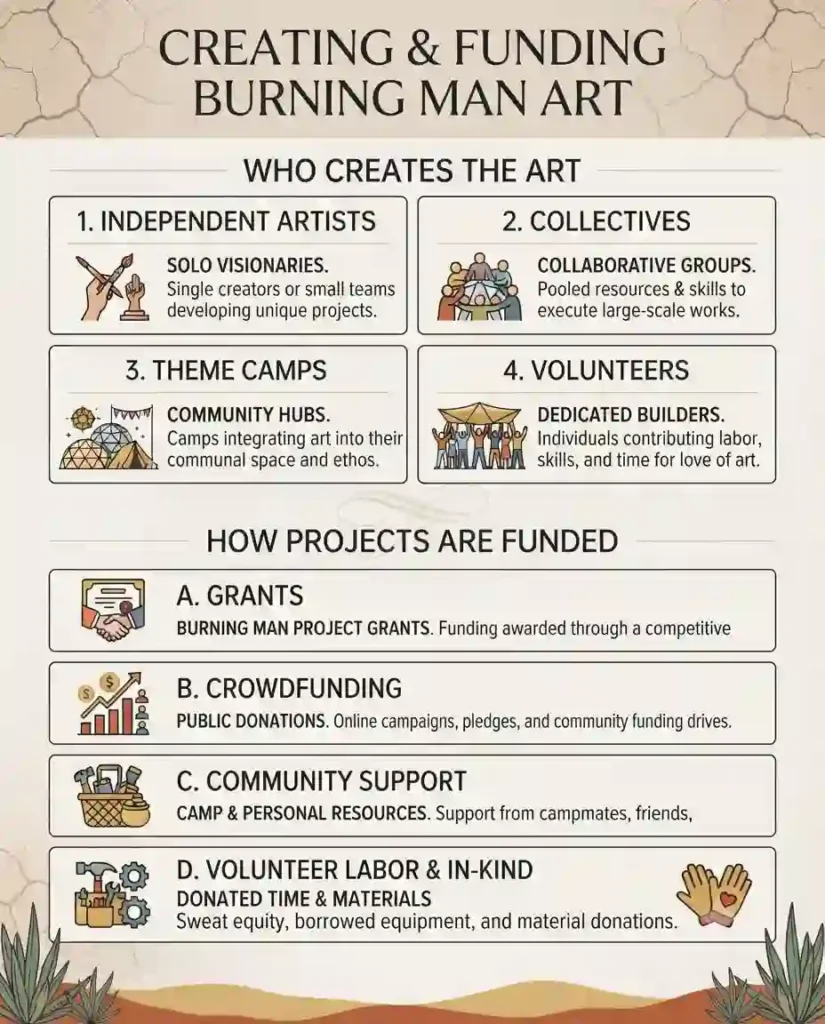
Individual Artists
Individual artists can apply if they have a strong enough concept and the ability to carry the project forward. Solo applicants often bring a very clear artistic voice. Their proposals may be more focused or personal. The key is showing both vision and execution ability.
Artist Collectives
Artist collectives are often well suited for large or complex projects because they can share skills and responsibilities. Working as a group also helps with fabrication, planning, and build logistics. Collectives can make ambitious projects more realistic. Collaboration is a major advantage.
International Applicants
International applicants can contribute strongly to the Burning Man art scene because the event values creative diversity. Artists from outside the United States bring different traditions and methods. That international participation enriches the visual culture of the playa. It also broadens the event’s reach.
First-Time Artists
First-time artists can absolutely apply if they have a solid idea and a realistic plan. New creators should not assume the process is only for established names. A clear, workable proposal can be compelling. The important thing is readiness.
Returning Grant Recipients
Returning recipients may apply again with new ideas or expanded versions of their previous work. Their earlier experience can help strengthen future proposals. However, each application still needs to stand on its own. Past success helps, but it does not guarantee funding.
- Individuals, collectives, international artists, and first-timers can apply.
- Clear planning matters as much as creative ambition.
- Collaboration is especially helpful for larger projects.
- Past support does not remove the need for a strong new proposal.
Burning Man Honoraria 2026: The Numbers
Quick, scannable statistics from 2026 make this a go-to reference for artists, writers, and attendees.
75 — Honoraria Projects Funded
The program’s selective cohort size highlights how competitive Honoraria is.
- Seventy-five projects received Honoraria in 2026.
- Selection size allows focused logistical and liaison support.
- Being selected provides funding and significant visibility.
- Use this figure to signal rarity and prestige to applicants.
- Include as a headline stat for meta snippets and social cards.
$1.3M — Total Direct Awards
Total direct grant payments to artists in 2026 were approximately $1.3 million.
- Grants are typically partial, intended to supplement but not fully fund projects.
- The average award approximates ~$17K per project, though amounts vary.
- Distinguish this from the broader art-budget totals that may include the Temple grant.
- Present the dollar figure in visual cards for clarity and shareability.
400+ — Total Installations on Playa
The broader field of playa art far exceeds the Honoraria cohort in scale and diversity.
- Over 400 installations were planned for Black Rock City 2026.
- Many memorable pieces originate from self-funded or community-funded efforts.
- This number encourages attendees to explore beyond the grant winners.
- Use the figure to frame Honoraria within the larger artistic ecosystem.
15 — International Projects
The Honoraria cohort included teams from many countries, expanding cultural perspectives on playa.
- Fifteen projects in 2026 were led by international artists/teams.
- Represented countries included Australia, Canada, Philippines, and more.
- International entries often bring distinct fabrication and storytelling approaches.
- Note extra logistical considerations like shipping and customs for these teams.
14 — Fire/Flame Projects
Fourteen Honoraria projects planned flame elements, increasing safety and scheduling complexity.
- Fire-enabled projects require permits, licensed operators, and emergency planning.
- Spectator safety perimeters and scheduled burn times are standard.
- Fire works are visually dramatic but demand extra preparation and insurance.
- Highlight this stat for attendee planning and safety messaging.
“Numbers tell scale; context tells the story—75 funded projects sit inside a thriving field of 400+ installations.”
Honoraria Art Series
BRC Honoraria Program, where selected large‑scale, interactive artworks receive grants and support from Burning Man Project to help cover build, materials, and installation costs on the playa.
🎨 Burning Man Honoraria Project Timeline
| 📍 Phase | 📅 Timeline | 🛠️ Key Activities |
|---|---|---|
| 🔍 Pre-Application | Oct – Dec 2025 |
• Research previous Honoraria projects • Study successful art installations • Develop concept ideas & budget planning • Build your creative team • Gather references, sketches & inspiration |
| 📨 Open Call | Jan 15 – Feb 28, 2026 |
• Application portal officially opens • Submit concept art & technical drawings • Provide budget & safety documents • Explain installation logistics • Final deadline: Feb 28, 11:59 PM PT |
| 🧠 Review Period | Mar 1 – Apr 30, 2026 |
• Committee reviews all submissions • Technical feasibility assessments • Artist interviews & discussions • Safety and structural evaluations • Possible revision requests |
| 📢 Notification | May 15, 2026 |
• Selected projects officially announced • Grant funding amounts confirmed • Artist onboarding begins • Build schedules & deadlines shared |
| 🏗️ Build Phase | Jun – Dec 2026 |
• Weekly progress check-ins • Engineering & structural reviews • Fabrication and testing process • Fire safety inspections • Final approval preparations |
| 🔥 On-Playa Installation | Aug 28 – Sep 6, 2026 |
• Transport art to Black Rock Desert • Installation & lighting setup • Final safety inspections • Public interaction testing • Opening celebration & unveiling |
✨ Quick Insight: Burning Man Honoraria projects often require nearly a full year of planning, engineering, fundraising, and collaboration before reaching the playa.
Massive Art Funded by Burning Man Project
Scale and Impact
- 20+ feet tall Visible from miles away
- Interactive or experiential
- Able to withstand 60+ mph winds
- Accessible to thousands of people
Types of Projects
- Mega-structures (temples, towers, domes)
- Fire art (large flame sculptures)
- Interactive installations (music, movement, light)
- Community spaces (shade structures, gathering places)
2026 Focus Areas
- Climate resilience (art that addresses environmental issues)
- Digital integration (AR, VR, app-connected art)
- Accessibility (art for all ages, abilities, and backgrounds)
- Community participation (projects that invite contribution)
Why does this program exist?
Without honoraria grants, most large-scale projects would be impossible. The cost of materials, transportation, engineering, and safety for playa-sized art can reach $50,000-$500,000+. Burning Man Project funds these projects to:
- Create landmark artworks that define the city
- Ensure safety and technical feasibility
- Support artist development
- Provide a diverse range of experiences for participants
Who benefits from this program?
- Artists get funding, technical support, and mentorship
- The City gets large-scale anchor points and wayfinding
- Participants get memorable experiences and photo opportunities
Burning Man Project builds a legendary art collection
“Honoraria art transforms the playa from a temporary town into a living museum of radical expression.” – Art Department Director
2026 Burning Man Honoraria Projects to Look For
Named 2026 Honoraria projects give attendees concrete targets and make the page timely and actionable.
Axis Mundi-Themed Honoraria Art
Several 2026 pieces interpret Axis Mundi themes—vertical connection, ritual, and cosmology.
- Axis Mundi: Resonant Spire — vertical, acoustic sculpture encouraging procession and reflection.
- Above and Below — layered installation exploring sky/earth relationships and perspective shifts.
- The Serpents — winding sculptural forms intended for movement through or around them.
- Headwaters — communal gathering piece evoking origin stories and shared ritual.
- Axis Mundi works emphasize verticality, procession, and collective viewing experiences.
International Honoraria Projects
International entries broaden cultural narratives and bring varied fabrication approaches to playa.
- ALUNA The Frequency of Being — immersive sound/light installation by an international team.
- Mebuyan Pulse — Philippines-based project melding cultural motifs with interactive light.
- CORREFOC — fire-and-procession inspired piece rooted in international traditions.
- Do Baskets Dream of Shores or Sea — woven, tactile structures exploring migration themes.
- Heart Remains — reflective, site-specific memorial or emotional-reflection installation.
Fire Honoraria Projects
Fire-based works are high-visibility draws but require strictly enforced safety protocols.
- Fire Gnome — compact flame interactions with controlled spectator zones and operators.
- Flaming Carousel — rotating kinetic sculpture enhanced with flame elements on scheduled events.
- Royal Trumpets — choreographed flame sequences paired with sound and procession.
- Attendees should confirm light-up or burn times and respect safety perimeters.
- Fire projects often attract crowds—plan early arrival and safe viewing positions.
Why These Projects Matter
Highlighting specific projects improves user utility and boosts SEO for event-time searches.
- Named projects provide concrete search targets and planning anchors for attendees.
- Featuring international and fire works signals program diversity and spectacle in 2026.
- Linking to project pages or social feeds increases real-time relevance and discoverability.
- Use project names as anchor text for internal linking and route planning.
- Encourage readers to check WhatWhereWhen and project socials for last-minute updates.
“The playa rewards curiosity—seek the big pieces, but linger where invitation sparks participation.”
What Types of Projects Receive Funding?
Funding usually goes to projects that bring meaningful artistic value to the playa and can be realistically built and installed. The strongest proposals often combine visual impact with participation, safety, and a clear contribution to Black Rock City. Large scale is not the only factor, but it often helps when paired with originality. The goal is to support work that genuinely enriches the event.
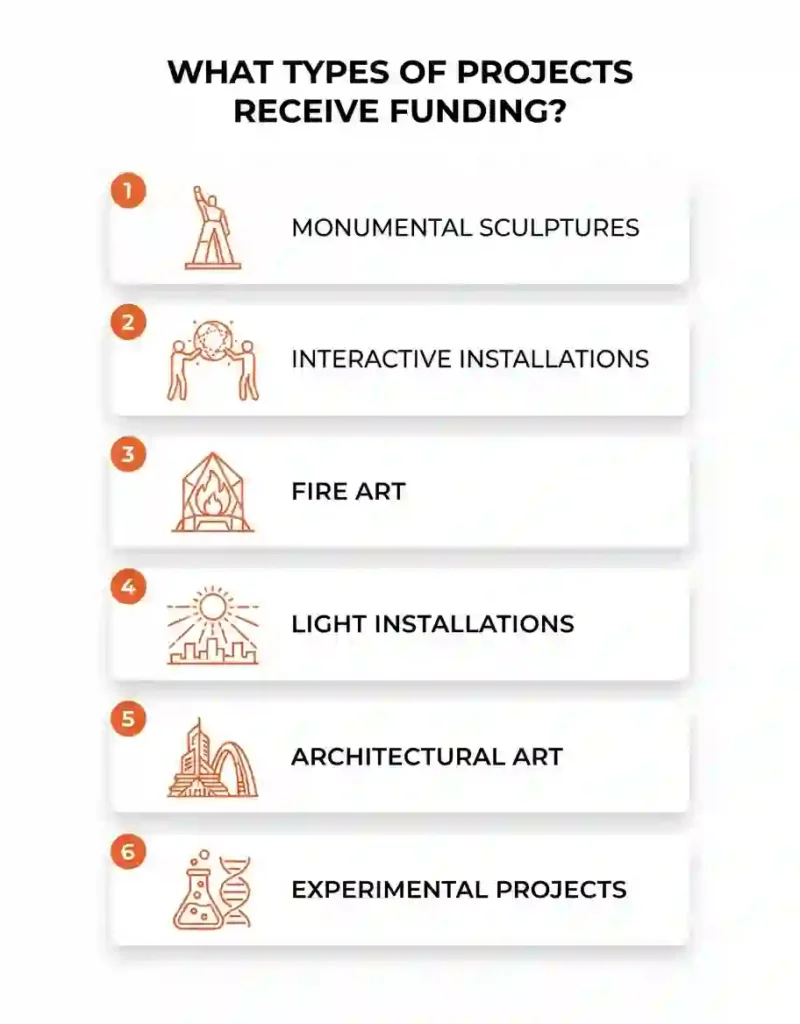
Monumental Sculptures
Monumental sculptures are a common funding category because they create strong visual landmarks. These projects often need substantial resources for fabrication and transport. They can shape how visitors move through the landscape. Their scale makes them memorable.
Interactive Installations
Interactive installations are highly valued because they encourage participation and community engagement. They make the audience part of the artwork itself. That participatory quality aligns closely with Burning Man culture. Grants can help bring more of these works to life.
Fire Art
Fire art often requires careful technical planning and safety systems, which can make funding especially useful. A well-supported fire project can combine spectacle with responsibility. That balance is important for the event. Grants help artists build more ambitious and safer flame-based works.
Light Installations
Light installations can transform the playa at night and create a strong sense of atmosphere. These projects often involve technical systems, power needs, and design precision. Funding helps cover those requirements. The result can be visually striking and immersive.
Architectural Art
Architectural art may function as structure, sculpture, or temporary space. These projects often require engineering and significant material support. Grants make it possible to build works that people can enter or move through. They often become destinations in themselves.
Experimental Projects
Experimental projects are important because they push the boundaries of what art at Burning Man can be. They may involve unusual materials, methods, or interactions. Funding helps artists take creative risks. Those risks often lead to memorable results.
- Funding supports monumental, interactive, fire, light, architectural, and experimental projects.
- Participation and feasibility matter as much as visual scale.
- Technical works often need extra support.
- Grants help artists take creative risks responsibly.
What Do Judges Look For?
Judges and reviewers look for a combination of artistic strength and practical readiness. They want to see a project that can contribute meaningfully to the event while also being buildable, safe, and well planned. A proposal has to convince them on multiple levels. Strong art and strong execution both matter.
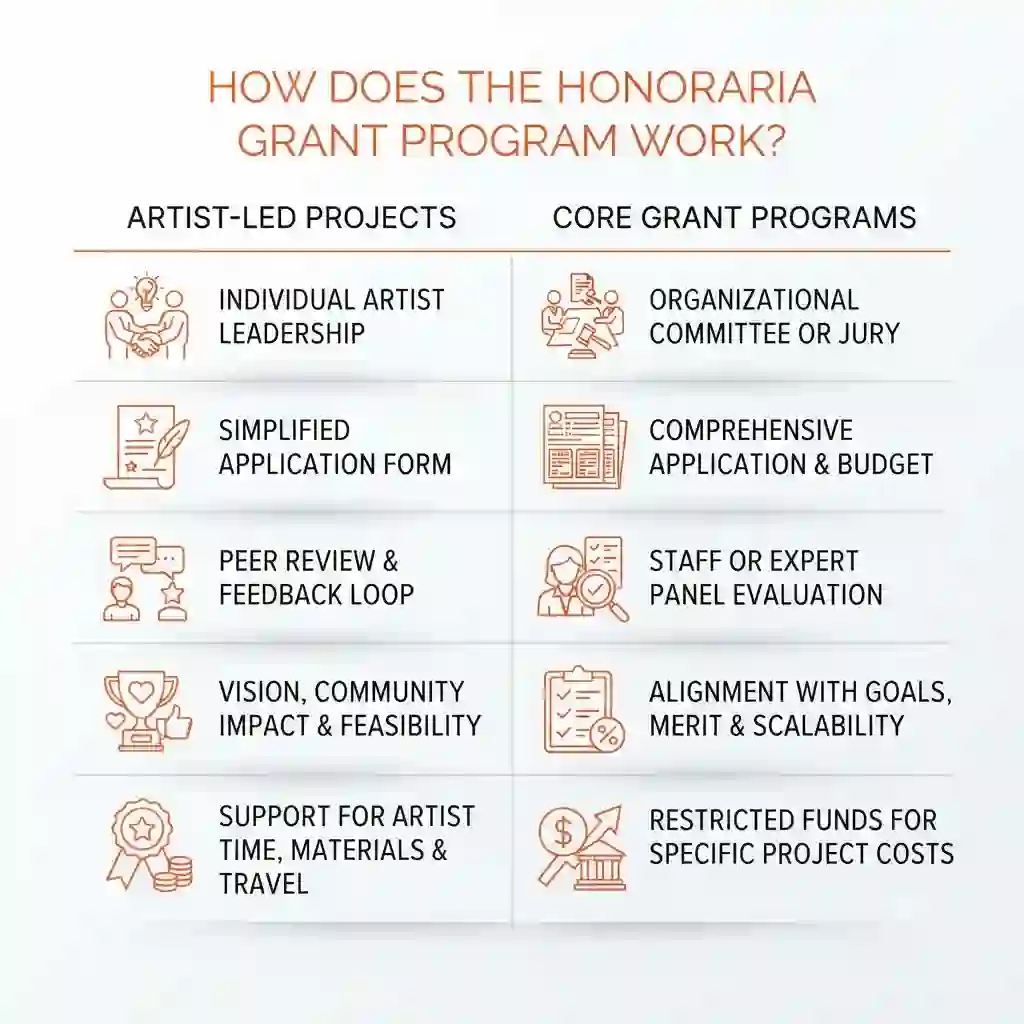
Creativity and Originality
Creativity and originality are essential because Burning Man values fresh ideas and bold expression. Reviewers want to see a clear artistic voice rather than something generic. Distinctiveness helps a proposal stand out. Originality is one of the first things people notice.
Participation and Interactivity
Participation matters because Burning Man is built around involvement rather than passive viewing. Proposals that invite visitors to engage often feel more aligned with the event. Interactivity can make a project more meaningful. It also gives the work a stronger social dimension.
Feasibility
Feasibility is critical because even the best idea must be buildable in the real world. Reviewers need confidence that the project can be finished on time and survive the playa. A feasible plan shows maturity and discipline. Without feasibility, creativity alone is not enough.
Engineering and Safety
Engineering and safety are non-negotiable because public art must protect both people and the work itself. Reviewers look for signs that the artist understands structure, risk, and operational needs. That includes everything from stability to fire or electrical concerns. Safety is part of the artistic responsibility.
Community Value
Community value helps reviewers understand how the project will enrich the Burning Man experience for others. The best works often create gathering, reflection, surprise, or participation. A project that serves the community has a stronger case. Burning Man art is public art first and foremost.
- Reviewers look for creativity, participation, feasibility, safety, and community value.
- Originality helps proposals stand out.
- Buildability matters as much as artistic vision.
- Good proposals show responsibility and public benefit.
How to Find Honoraria Art at Burning Man 2026
This practical guide explains where Honoraria pieces are placed, how they’re listed, and best ways to discover them during the event.
Open Playa vs Theme Camp Art
Placement type strongly affects how you’ll find and experience a work on the playa.
- Honoraria works are typically placed on the open playa or city plazas for broad public access.
- Theme camp art is usually camp-centered, may host events, and is often self-funded.
- Open playa installations tend to be larger and designed for walk-by or procession experiences.
- If you want scheduled workshops or performances, check theme camp listings instead.
- Knowing placement type helps you prioritize walking routes and planning time.
How Registered Art Is Listed
Official listings provide the coordinates, artist statements, and scheduling details you need.
- Registered Honoraria projects appear in WhatWhereWhen and the Burning Man art directory with coordinates.
- Listings include artist descriptions, placement notes, and sometimes light-up or burn timings.
- Use CSV exports, the Burning Man app, or printable maps for route planning.
- Confirm coordinates via multiple sources during setup—placements can shift as the city builds.
- Bookmark project pages and check liaison updates for last-minute changes.
What Where When and Art Tours
Official schedules and curated tours help you see key pieces with context and safety.
- WhatWhereWhen lists light-up schedules, artist talks, and event windows for installations.
- Official and community-led art tours provide curated routes and interpretive commentary.
- Printed maps, mobile apps, and guided tours work best in combination for planning.
- Reserve spots for popular guided tours when available—they often fill quickly.
- Tours are particularly helpful for safer night navigation and expert context.
How Participants Can Discover Art at Night
Nighttime discovery is rewarding but requires extra preparation and attention to safety.
- Look for lighting cues, scheduled illuminations, and check WhatWhereWhen for light-up times.
- Carry headlamps, spare batteries, and reflective markers for safe travel between works.
- Respect safety perimeters around fire and mechanically moving pieces; do not cross barriers.
- Use buddy systems and plan return routes—night navigation is more difficult than daytime.
- Follow project social channels for surprise activations or last-minute schedule changes.
Local and Social Intel
Real-time artist and liaison updates often reveal pop-up activations and best viewing windows.
- Artist posts, liaison messages, and burner channels frequently announce light-up times and activations.
- Use project hashtags and social platforms to track last-minute changes or surprise events.
- Artist talks and installation days are rich sources of insider viewing tips.
- Community groups often publish curated evening routes and safety notes.
- Combine official listings with social intel for the most complete discovery experience.
“Maps help you find art; artists and fellow burners help you experience it.”
Beyond Grants: How Artists Fund Their Projects
Not every project is funded entirely through grants. Many artists use a combination of strategies to make their ideas real. That can include donations, crowdfunding, personal investment, and volunteer labor. The funding mix often reflects the scale and ambition of the project.
Honoraria Grants vs Self-Funded Art
| Feature | Honoraria Grant | Self-Funded Artwork |
| Funding Source | Partial support from Burning Man | Artist, donors, crowdfunding, sponsors |
| Application Required | Yes | No grant application required |
| Open Playa Placement | Yes, if selected | Possible through registration and approval |
| Artist Liaison Support | Included | Available for registered projects |
| Heavy Equipment Assistance | Available for eligible projects | May be available for registered installations |
| Budget Responsibility | Shared | Entirely managed by the artist |
| Creative Freedom | High | High |
Crowdfunding Campaigns
Crowdfunding allows artists to raise support from a wider audience. It can help cover costs while also building community interest in the project. This approach is especially useful for independent creators. It also helps people feel invested before the work even arrives.
Community Donations
Community donations often come from people who believe in the project and want to help bring it to life. These contributions can make a meaningful difference, especially for smaller teams. Donation-based support is very aligned with Burning Man values. It turns appreciation into action.
Personal Investment
Many artists invest their own money, time, and resources into their projects. That personal commitment can be significant. It also shows the depth of belief behind the work. Personal investment is often what gets a project started.
Volunteer Contributions
Volunteer contributions are a major part of the funding ecosystem because labor is a resource too. Volunteers help build, transport, assemble, and support projects. Their effort reduces cost and strengthens community ownership. In many cases, volunteer labor is essential.
Sponsorship vs Commercialization
Commercial sponsorship can raise ethical issues because Burning Man is not meant to function like an advertising platform. Projects should not become brand promotions or product placements. Community fundraising is different because it supports art without turning it into marketing. That distinction protects the event’s culture and values.
- Artists often use multiple funding sources.
- Crowdfunding and donations can support independent work.
- Volunteer labor is a major form of contribution.
- Commercial advertising is not the same as community fundraising.
How Much Does Burning Man Pay Artists?
Clear answers about typical grant sizes, limits, and why artists still need other funding sources.
Is Honoraria Full Funding?
Honoraria grants are generally partial—artists should plan for additional funding.
- Honoraria usually covers only part of production costs, not the full budget.
- Artists are expected to secure additional funds for transport, fabrication, and crew.
- Many awarded projects combine grants with crowdfunding and sponsorship.
- Treat Honoraria as seed or partial support rather than full financing.
- Clear, realistic budgets in LOIs help selection panels evaluate feasibility.
How Much Can an Artist Request?
While awards vary, very large grants are uncommon—budget conservatively.
- Grants above $20,000 are rare; 2026’s $1.3M across 75 projects averages roughly $17K each (varies).
- Individual awards depend on scope, demonstrated need, and budget justification.
- Applicants should provide line-item budgets and justify each requested cost.
- Demonstrated matching funds or in-kind contributions strengthen proposals.
- Include contingency and maintenance line items to avoid shortfalls.
Why Artists Still Need Additional Funding
Major cost drivers—fabrication, transport, and rigging—often exceed grant amounts.
- Heavy fabrication and specialized rigging are major expense categories.
- Transport to playa, customs (for international teams), and onsite staging add cost.
- Insurance, permits, and safety training further increase budgets.
- Unforeseen repairs or weather damage require reserve funds.
- Community labor and maker-space partnerships help reduce net expenses.
What Other Resources Can Artists Use?
Multiple funding streams and partnerships commonly fill budget gaps.
- Temple Grants and other program-specific funding may apply to eligible projects.
- Crowdfunding platforms, regional arts councils, and private sponsors are common sources.
- Fabrication shops, university partnerships, and maker spaces can provide discounted services.
- Community build days and volunteer labor reduce onsite expenses and build engagement.
- Post-award liaison support often reduces hidden logistical costs and helps avoid surprises.
Applicant Best Practices
Strengthen LOIs with clear budgets, matched funds, timelines, and risk plans.
- Itemize costs: materials, transport, rigging, permits, crew, insurance, and contingency.
- Show matched funding, letters of support, or in-kind commitments to demonstrate feasibility.
- Include fabrication, shipping, and onsite installation timelines with milestones.
- Provide prior-project examples demonstrating capacity, safety compliance, and community engagement.
- Maintain timely communication with liaisons after selection to streamline logistics.
“A grant opens doors—community and creative fundraising build the house.”
Burning Man Honoraria vs Self-Funded Art
A direct comparison clarifies which path fits your project goals, scale, and funding needs.
Funding & Financial Model
Intro: Source of funding affects scale, contingency planning, and available support.
- Honoraria: partial grant funding from Burning Man plus program recognition.
- Self-funded: artist, camp, or community pays costs, often via crowdfunding or sponsorship.
- Both models can use hybrid funding (grant + crowdfunding + sponsors).
- Funding model influences contingency plans, logistical backup, and donor interest.
- Honoraria status can increase visibility and attract additional funding.
Application, Registration & Liaison Support
Application path determines access to liaisons, staging priority, and permit assistance.
- Honoraria requires LOI/application and selection; recipients get an artist liaison and prioritized staging.
- Self-funded works may still register but don’t receive grant review or prioritized resources.
- Liaison support helps with permits, staging schedules, and safety coordination.
- Self-funded teams must coordinate logistics and staging independently.
- Apply for Honoraria when you need partial funding plus programmatic logistical support.
Scope, Eligibility & Expectations
Project type and intended audience determine whether Honoraria or self-funding is appropriate.
- Honoraria favors large, interactive, sculptural, and public-facing works.
- Self-funded projects include camp art, performances, and a wide spectrum of scales.
- Honoraria recipients are often expected to facilitate public engagement and documentation.
- Self-funded works can be more experimental or camp-centered without grant constraints.
- Clear expectations reduce conflicts during setup and placement.
Support Services & Logistics
Honoraria recipients access prioritized staging windows and safety coordination not guaranteed for self-funded works.
- Honoraria projects typically get earlier staging windows, priority placement, and dedicated liaison time.
- Self-funded teams rely on standard registration processes and community coordination.
- Both must meet playa safety and environmental standards; Honoraria projects get earlier guidance.
- Shared tool libraries, volunteer coordination, and community build spaces can reduce costs for self-funded builds.
- Early planning and documentation are critical regardless of funding path.
Decision Guidance for Artists
Use project scale, public reach, and funding need to choose the right path.
- Apply for Honoraria if the project is large, open-playa-focused, and needs partial funding or liaison support.
- Choose self-funded route for camp-centered, performance-based, or smaller-scale works.
- Consider hybrid approaches: partial grant plus crowdfunding or sponsorship to bridge gaps.
- Prepare itemized budgets, safety plans, and community support statements for any path.
- Seek liaison feedback early and document prior experience to strengthen applications.
“Grant or no grant, every project that arrives on playa is a collaboration between artist, community, and the city.”
How Art Projects Come to Life
An art project at Burning Man goes through many stages before it reaches the playa. A concept becomes a design, then a team effort, then a physical object that must survive a harsh environment. The lifecycle is long and demanding. That process is part of what makes the final work feel meaningful.
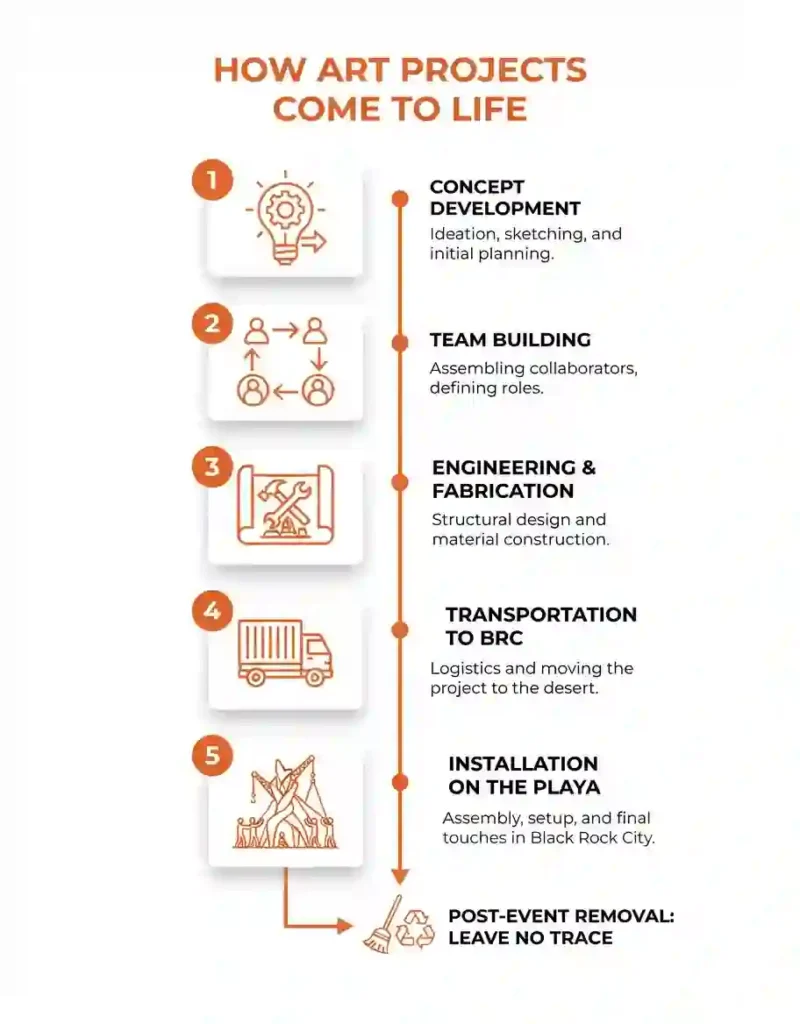
Concept Development
Concept development is where the project begins as an idea. The artist thinks about meaning, audience experience, scale, and form. This stage shapes everything that follows. A strong concept gives the project direction.
Team Building
Team building helps turn a concept into something achievable. Artists may recruit fabricators, engineers, volunteers, and coordinators. The team becomes the engine behind the project. Collaboration is often essential.
Engineering and Fabrication
Engineering and fabrication make the idea physically real. This stage involves materials, structure, safety, and technical problem-solving. The project must be built to handle transport and desert conditions. Good fabrication is what makes the vision stable.
Transportation to Black Rock City
Transporting the project to the playa is a major logistical challenge. Pieces often need to be carefully packed and moved over long distances. Planning matters because damage or delay can affect the whole build. Transport is part of the project’s stress test.
Installation on the Playa
Once on-site, the project is assembled under time pressure and environmental constraints. The team must work efficiently while managing dust, wind, and limited resources. This stage is intense but exciting. The project finally begins to take shape in its intended home.
Post-Event Removal
After the event, the artwork must be removed unless it has a planned afterlife elsewhere. This step is part of the Leave No Trace ethic and the temporary nature of Burning Man. Removal is not an afterthought; it is part of the project lifecycle. Responsible cleanup matters just as much as creation.
How an Honoraria Project Comes to Life
| Stage | What Happens |
| Idea | Artist develops the initial concept and vision |
| Letter of Intent | Initial proposal is submitted for consideration |
| Full Proposal | Detailed plans, engineering, and budget are reviewed |
| Selection | Successful projects receive Honoraria funding |
| Fundraising | Artists secure additional financial and in-kind support |
| Fabrication | Construction begins with artists, engineers, and volunteers |
| Installation | Artwork is transported and installed on the open playa |
| Public Experience | Participants interact with the completed installation |
| Deinstallation | Artwork is removed and the site is restored following Leave No Trace |
- Art projects move from concept to team to fabrication to transport.
- Playa installation is a major logistical phase.
- Post-event removal is part of responsible art making.
- The full lifecycle reflects Burning Man values.
Art Grants by the Numbers
The Burning Man Honoraria Program helps artists bring ambitious public art to the open playa by providing partial funding, mentorship, and logistical support. While only a limited number of projects receive Honoraria grants each year, hundreds of additional artworks are still created through crowdfunding, donations, sponsorships, and community collaboration
The numbers behind art grants help show how much support and effort exists within the system. They make the scale of the program easier to understand. They also reveal how many people are involved in bringing art to the playa. Numbers give the process real-world weight.
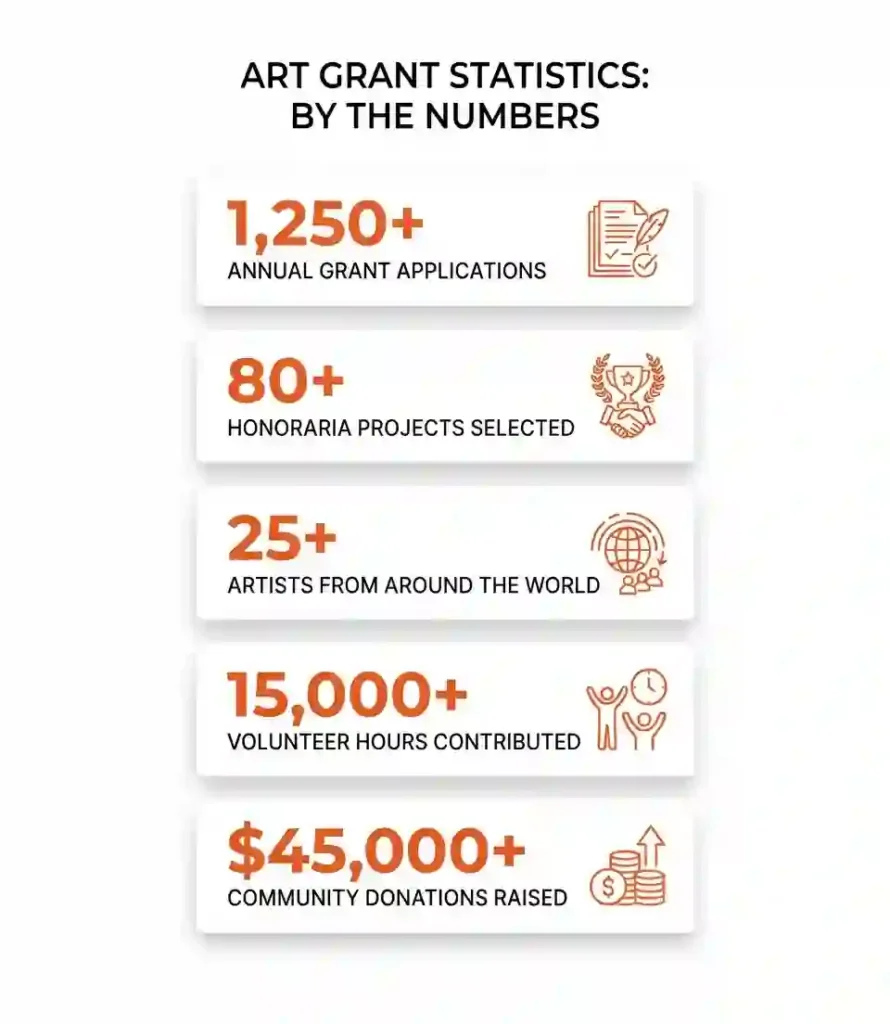
Annual Grant Applications
Each year brings a new group of applications from artists hoping to build on the playa. This shows how active and competitive the art ecosystem is. It also reflects continuing interest from the creative community. The applicant pool helps shape the event.
Honoraria Projects Selected
Only a portion of projects are selected, which makes each award meaningful. Selection is competitive because resources are limited. That competition helps maintain quality. It also means the chosen works carry real responsibility.
Artists From Around the World
Artists from many countries apply and participate, which makes the program globally significant. This diversity expands the cultural range of the event. It also shows how far Burning Man’s influence reaches. The playa becomes an international creative meeting point.
Volunteer Hours Contributed
Volunteer hours often add up to a huge amount across the full lifecycle of a project. That labor includes design help, fabrication, logistics, build support, and cleanup. It demonstrates how collective the art-making process is. The finished work is the result of shared effort.
Community Donations Raised
Community donations can be substantial and are often crucial for projects that rely on broader support. They show public enthusiasm and trust. Donations help bridge funding gaps. In many cases, they help turn a good plan into a real installation.
Years of the Honoraria Program
The program has been operating long enough to become part of the culture itself. Its longevity shows that public art support is not incidental at Burning Man; it is foundational. The years behind the program represent accumulated trust and experience. That history gives the funding system credibility.
Key Numbers
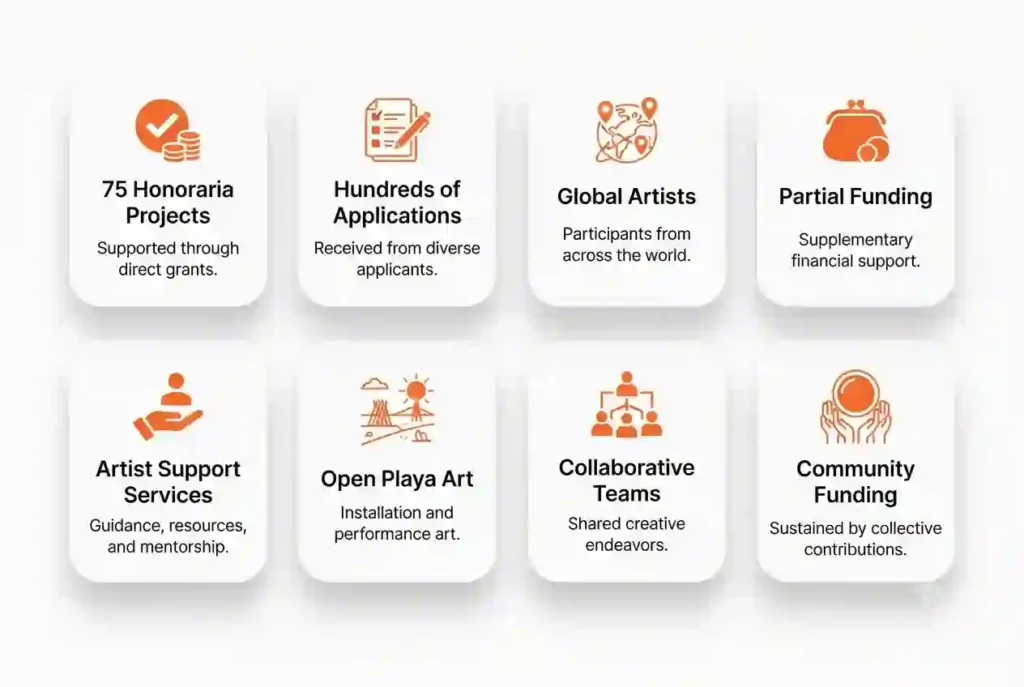
- 🎨 Approximately 75 Honoraria Projects — Around seventy-five large-scale artworks receive Honoraria funding each year.
- 📑 Hundreds of Applications — Artists worldwide submit proposals during each grant cycle.
- 🌍 Global Artist Participation — Individuals, artist collectives, and eligible nonprofit organizations from around the world may apply.
- 💰 Partial Funding Only — Honoraria grants cover only part of a project’s total budget, so artists usually raise additional funds elsewhere.
- 🏗️ Heavy Equipment & Logistics Support — Selected projects receive technical assistance, artist liaisons, equipment, and installation support.
- 🔥 Open Playa Focus — Honoraria supports public art placed on the open playa rather than theme camp installations.
- 🤝 Artists + Engineers + Volunteers — Successful projects rely on multidisciplinary collaboration from concept through installation.
- ❤️ Community Makes the Art Possible — Donations, crowdfunding, volunteer labor, and participant support help transform ideas into reality.
- Grant applications and selections show strong demand.
- Artists from around the world participate.
- Volunteer hours and donations are major parts of the ecosystem.
- The Honoraria Program has deep institutional history.
Can First-Time Artists Receive Funding?
Yes, first-time artists can receive funding if their proposal is strong and realistic. New creators should not assume they are excluded just because they are new. What matters most is the clarity of the idea and the ability to build it responsibly. Many great projects start with a first opportunity.
Opportunities for New Creators
New creators can bring fresh energy and ideas to the event. They may approach the playa with less habit and more curiosity. That can be a strength. A first project can stand out because it feels honest and original.
Tips for Strong Applications
A strong application should clearly explain the idea, the build plan, the budget, and the expected impact. Reviewers need to understand both the artistic vision and the logistics. Clarity matters a great deal. A thoughtful proposal can overcome lack of experience.
Learning From Previous Projects
Studying previous projects helps new artists understand what works. It can reveal how teams structure their ideas and budgets. Learning from others also reduces avoidable mistakes. Experience can be borrowed before it is earned.
Building Community Support
Community support can strengthen a first-time application because it shows that others believe in the project. That support may come from volunteers, donors, or collaborators. A project with visible backing often feels more viable. Community trust matters.
Avoiding Common Application Mistakes
First-time artists often make mistakes by underestimating costs, skipping details, or failing to show how the project will actually happen. These problems are avoidable with care and planning. Strong applications are both creative and grounded. Simplicity and honesty often help more than overstatement.
- First-time artists can absolutely receive funding.
- Clear, realistic proposals are essential.
- Learning from previous projects improves applications.
- Community support strengthens credibility.
Common Myths About Burning Man Art Grants
Art grants are often misunderstood because people assume they work like full sponsorships or guaranteed funding. In reality, the system is more selective and more nuanced. Clearing up the myths helps artists approach the process more realistically. It also protects the integrity of the program.
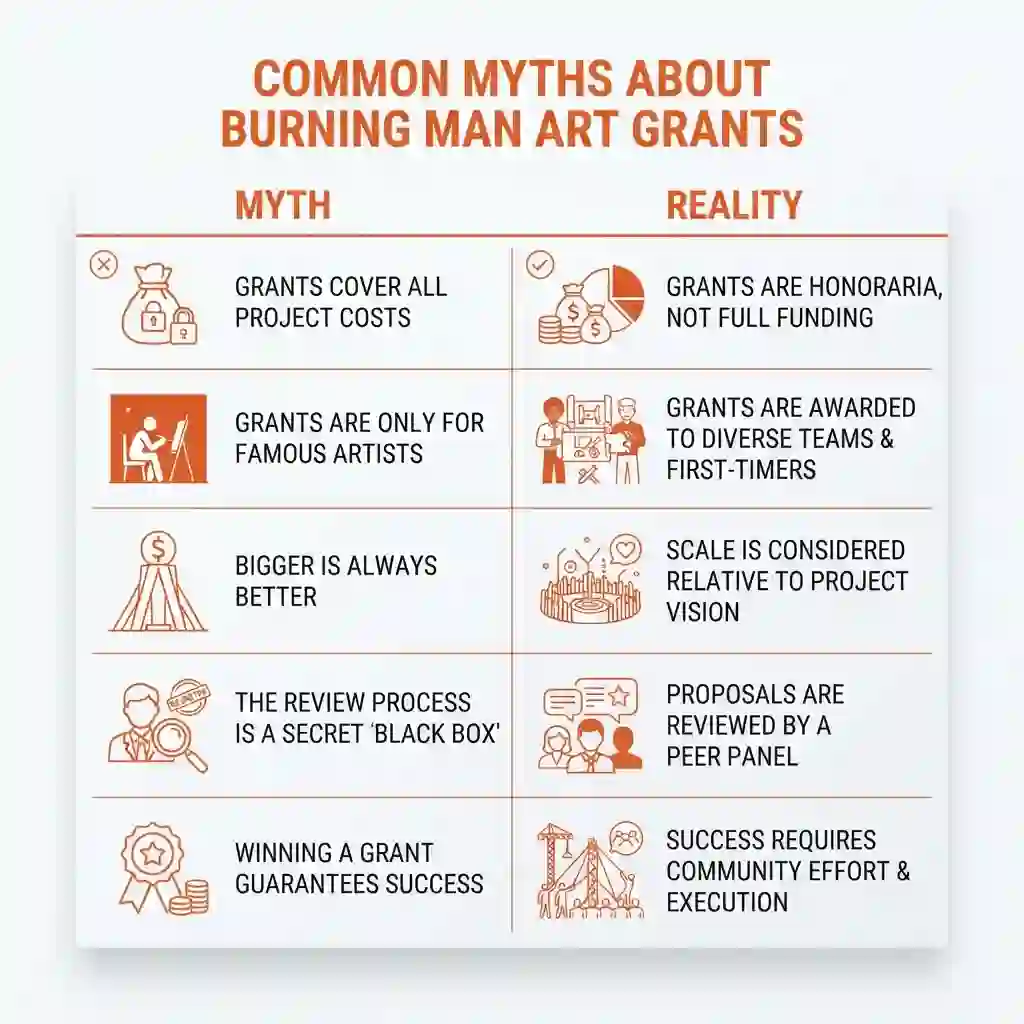
Myth: Burning Man Pays for Every Art Project
Burning Man does not pay for every project. Funding is selective and limited. Many artists support their work through other means as well. Grants are only one part of the picture.
Myth: Only Famous Artists Receive Grants
Fame is not the only factor in selection. Strong ideas, feasibility, and community value matter a great deal. New voices can absolutely be considered. The process is more about project quality than celebrity.
Myth: Grants Cover Every Expense
Grants rarely cover everything, especially for large and complex projects. Artists usually need additional funding or support. That reality is part of planning responsibly. A grant is often a foundation, not a full solution.
Myth: Large Camps Automatically Receive Funding
A large camp does not automatically mean grant support. Every application has to stand on its own merits. Size alone is not enough. The project still needs to be compelling and feasible.
Myth: Community Donations Aren’t Important
Community donations are very important because they help fill gaps and show support. They can be essential to making a project possible. They also reflect the participatory spirit of Burning Man. Community backing is a real asset.
H2: Art Grants & Honoraria Myths vs Reality
| Myth | Reality |
|---|---|
| Burning Man fully pays for every artwork. | Honoraria grants usually provide only partial funding, and artists raise the remaining budget themselves. |
| Only famous artists receive grants. | Emerging artists, collectives, and first-time applicants can also be selected if their proposals are strong. |
| Honoraria funds theme camps. | The program supports eligible public art placed on the open playa, not theme camp installations. |
| Receiving a grant guarantees project success. | Artists are still responsible for fundraising, construction, logistics, and project delivery. |
| You must live in the United States to apply. | Eligible artists from many countries can submit proposals. |
| Only funded projects appear at Burning Man. | Hundreds of artworks are self-funded or community-funded every year in addition to Honoraria projects. |
- Grants do not fund everything.
- Famous names are not automatically favored.
- Large camps do not get automatic support.
- Community donations are a major part of the ecosystem.
Common First-Time Applicant Mistakes
New applicants often make predictable mistakes because they focus too much on the idea and not enough on the implementation. The application process rewards detail, realism, and preparedness. Avoiding common mistakes can greatly improve a proposal. Planning matters.
Underestimating Costs
Many first-time applicants underestimate how much their project will actually cost. That can make the proposal feel unrealistic. Costs should include materials, labor, transport, and contingencies. Accurate budgeting is essential.
Weak Project Planning
A beautiful concept with no clear plan is hard to support. Reviewers need to see a path from idea to playa. Weak planning creates doubt. Strong planning builds confidence.
Ignoring Safety Requirements
Safety is one of the most important parts of any public art project. Ignoring it can weaken or disqualify a proposal. Artists need to show they understand the risks and how they will address them. Safety is not optional.
Missing Deadlines
Missing deadlines can end a project before it starts. The process has timing requirements for a reason. Applicants need to stay organized and plan ahead. Deadlines matter.
Lacking Volunteer Support
Many projects depend on volunteers, so failing to show a support network can make the proposal less convincing. A team demonstrates commitment and feasibility. Volunteer support is often a major part of success. Collaboration strengthens the application.
- Cost underestimation is a common problem.
- Planning and safety must be clear.
- Deadlines are critical.
- Volunteer support improves feasibility.
Experienced Artist Tips
Experienced artists often succeed because they understand how to balance vision with practicality. They know that good proposals are built early and supported by strong teams. Their advice can help newer creators avoid common problems. The process rewards preparation.
Start Planning Early
Early planning gives artists time to refine the concept, build the team, and solve logistical issues. It also reduces pressure near deadlines. Starting early is one of the simplest ways to improve success. Time is a major advantage.
Build a Reliable Team
A reliable team helps carry the project through the many difficult stages of development and build. Team strength often determines whether a project succeeds under pressure. Good collaborators are invaluable. Trust matters.
Create a Realistic Budget
A realistic budget shows that the project is grounded in actual conditions. It helps reviewers trust the proposal. It also helps the artist avoid financial surprises later. Accuracy is better than optimism.
Focus on Participation
Projects that invite participation often resonate more strongly with Burning Man values. Participation makes the artwork feel alive and social. It can also increase public impact. That makes it a smart design priority.
Learn From Previous Honoraria Projects
Studying earlier supported projects can teach artists a lot about scale, logistics, and presentation. It helps reveal what worked and why. That knowledge can improve future proposals. Learning from the past is a strong strategy.
- Start early and build a reliable team.
- Use realistic budgets.
- Participation strengthens proposals.
- Previous projects offer useful lessons.
What Happens After Burning Man?
What happens after Burning Man is just as important as what happens before and during the event. The project’s afterlife reflects the values behind it. Documentation, removal, reuse, and learning all matter. A project is not truly complete until its aftermath is handled responsibly.
Documentation of the Project
Documentation helps preserve the project’s story through photos, notes, and records. It also helps artists explain their work to future supporters or collaborators. Good documentation has long-term value. It turns a temporary project into lasting knowledge.
Removal and Leave No Trace Responsibilities
Removal is a key responsibility because the playa must be left clean and undisturbed. Artists and teams need to dismantle or recover what they brought in. This is part of the event’s ethics. Leave No Trace applies after the art is gone too.
Reuse or Relocation of Artwork
Some pieces are reused or relocated after the event if their design allows it. This can give the work a second life beyond Burning Man. Reuse also reduces waste. It is a practical and sustainable outcome.
Maintenance and Storage
If a work is saved for later use, it may need maintenance and proper storage. Desert conditions can be hard on materials. Planning for storage protects the investment and future usability. Long-term care matters.
Lessons for Future Projects
Every project teaches lessons that can improve the next one. Artists learn more about budgeting, logistics, teamwork, and public response each time they build. Those lessons make future work stronger. Experience becomes part of the creative process.
- Documentation preserves the project’s story.
- Removal and cleanup are core responsibilities.
- Some artwork is reused or relocated.
- Lessons from each project help future builds.
How Competitive Is the Honoraria Program?
The Honoraria Program is highly competitive because many strong projects apply and funding is limited. That means good ideas can still be turned away simply because the program cannot support everyone. Understanding that competitiveness helps artists set realistic expectations. It also encourages them to strengthen every part of their application.
Number of Applications vs Awards
The number of applications is typically much larger than the number of awards available. That gap makes the process selective. Artists should assume they need to stand out in multiple ways. Competition is part of the reality.
Why Many Good Projects Are Not Selected
Many good projects are not selected because funding is limited and the program has to balance scale, feasibility, and diversity. A proposal may be excellent but still not fit the year’s available support. That does not mean the project lacks value. It means the system is selective.
Other Ways Artists Bring Projects to Burning Man
Artists often bring projects through other means, including donations, collectives, crowdfunding, and personal investment. These paths can be just as meaningful as a grant. They also show commitment and adaptability. Support can come from many directions.
Community Fundraising Success Stories
Community fundraising can be a powerful way to turn an idea into a real project. When people believe in the vision, they often contribute time or money. That support can carry a project far. It also creates a stronger sense of shared ownership.
Building Long-Term Artist Networks
Long-term artist networks help creators learn, collaborate, and return with stronger proposals. Relationships matter in a project-based community. Over time, these networks make the art ecosystem more resilient. They also support knowledge sharing.
- The Honoraria Program is very competitive.
- Many strong projects are not selected each year.
- Artists often use alternative funding paths.
- Networks and fundraising help projects survive and grow.
Famous Honoraria-Funded Projects
Some honoraria-funded projects become especially memorable because they leave a strong mark on the playa and on Burning Man culture more broadly. These works often combine scale, originality, and strong community impact. They show what funded art can achieve. Their influence often lasts beyond a single year.
Landmark Sculptures
Landmark sculptures are the kinds of works people use to orient themselves on the playa. They often become visual anchors and gathering points. Their size and presence make them unforgettable. They help define the landscape.
Interactive Installations
Interactive installations funded through honoraria often become especially beloved because they invite participation. People remember how the art made them feel and what they did inside it. These works are often highly social. Participation makes them powerful.
Fire Art Projects
Fire art projects funded with support can become major night-time spectacles. They combine technical precision with dramatic effect. That combination creates strong emotional moments. Fire and funding together can produce unforgettable results.
Temple Connections
Some projects connect emotionally or conceptually to Temple-style themes, even if they are not the Temple itself. These works may evoke reflection, memory, or quiet presence. That emotional depth can be very powerful. Not all meaningful art is loud.
Lasting Influence on Burning Man Culture
The most important funded projects often influence how later artists think about scale, participation, and public art. Their legacy goes beyond the event. They help shape the culture of Burning Man over time. That is one of the best measures of success.
- Famous funded projects often become landmarks.
- Interactive and fire-based works can be especially memorable.
- Some pieces carry Temple-like emotional weight.
- The best projects influence future Burning Man culture.
Art Grant Applicant Checklist
A checklist helps applicants stay organized through a complex process. It keeps the project moving and reduces the chance of missing key steps. Good applications often come from disciplined preparation. The checklist is both practical and protective.
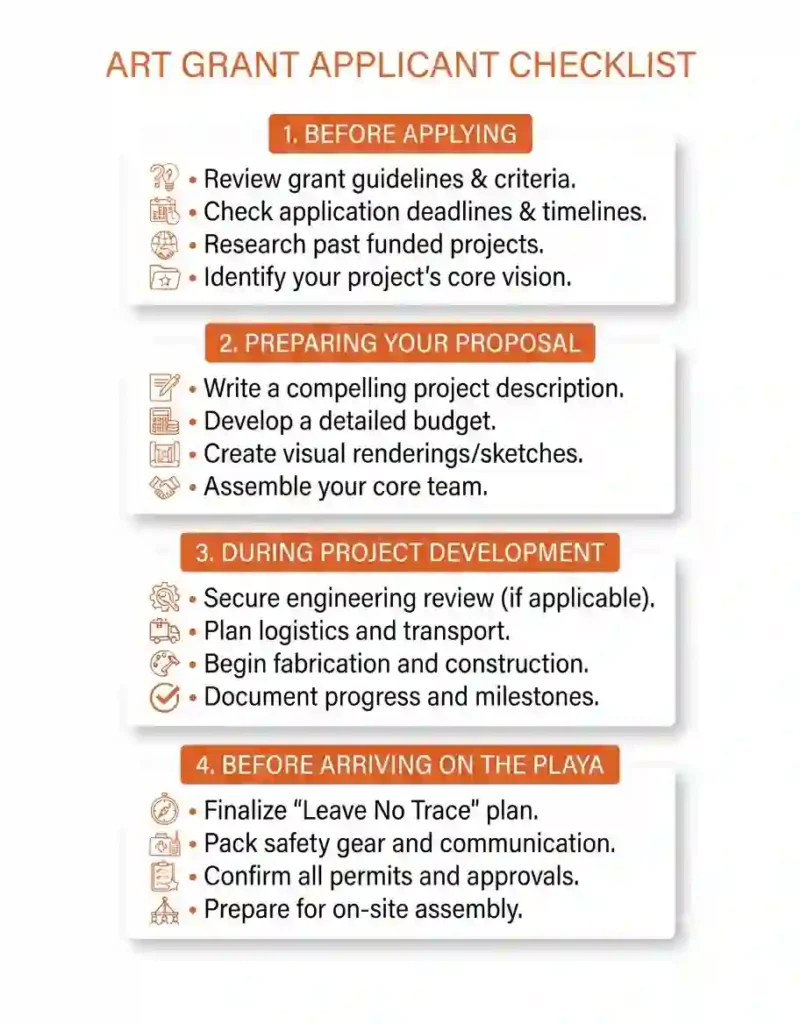
Before Applying
Before applying, make sure the concept is clear, the scope is realistic, and the basic team is in place. You should also understand the funding expectations. Preparation at this stage saves time later. A solid foundation matters.
Preparing Your Proposal
When preparing the proposal, include the artistic vision, technical plan, budget, and schedule. The goal is to help reviewers understand the project completely. Clear communication is essential. Good proposals are easy to follow.
During Project Development
During development, keep track of milestones, costs, and safety needs. This is where many projects gain or lose momentum. Staying organized helps the build stay on track. Project management matters.
Before Arriving on the Playa
Before arriving, confirm transport, assembly plans, volunteer schedules, and on-site logistics. The project needs to be ready for the realities of the desert. Last-minute uncertainty can create problems. Final readiness is crucial.
- Applicants should prepare before submitting.
- Proposals need artistic and technical detail.
- Development tracking helps the project stay on course.
- Playa readiness requires confirmed logistics.
Conclusion
Every great playa artwork begins with an idea, but it only becomes real through planning, funding, community support, and careful execution. Burning Man art grants and honoraria make that transformation possible. They help artists build ambitious, participatory, and meaningful works that shape Black Rock City. The program is not just about money; it is about making creative culture possible at scale.
Every Great Playa Artwork Begins With an Idea
The idea is the spark, but the process turns it into something real. That journey is what makes the artwork meaningful. It is a story of imagination becoming form.
Community Makes Monumental Art Possible
Without community support, many of these projects would never happen. Funding, labor, and belief all matter. Community is part of the artwork’s foundation.
Honoraria Helps Creativity Flourish
The Honoraria Program gives artists a chance to build what they imagine. That support keeps the playa visually rich and culturally alive. It helps creativity flourish in a very real way.
Final Thoughts
The best way to understand Burning Man art grants is to see them as part of a larger ecosystem of participation, responsibility, and shared creation. They support not only the finished work, but the whole process behind it. Readers can continue into the Burning Man Art Guide, Art Installations Guide, Interactive Art Guide, Fire Art Guide, Mutant Vehicles Guide, and Technology & Innovation Guide.
- 🎨 Appreciate the work behind every installation.
- ❤️ Support artists respectfully.
- 🤝 Learn about community collaboration.
- 🏗️ Understand the creative process.
- 🌍 Celebrate artistic innovation.
- 🌱 Respect Leave No Trace.
- 📖 Continue with the Technology & Innovation Guide to discover how engineering supports modern Burning Man art.
Support the Artists Who Build Black Rock City
Supporting artists means supporting the culture that makes Burning Man distinctive. The grants, the labor, and the ideas all come together to shape the experience.
Art Grants & Honoraria Checklist
Before Applying
✅ Read the current Honoraria guidelines
✅ Prepare concept sketches and renderings
✅ Build a realistic project budget
✅ Assemble your creative team
During the Application
✅ Explain your artistic vision clearly
✅ Demonstrate technical feasibility
✅ Include a detailed construction timeline
✅ Provide accurate budget estimates
If Selected
✅ Work with your Artist Liaison
✅ Complete required engineering and safety reviews
✅ Coordinate installation logistics
✅ Continue fundraising if needed
After Installation
✅ Maintain your artwork throughout the event
✅ Remove the installation responsibly
✅ Restore the site following Leave No Trace
✅ Document lessons for future projects
Frequently Asked Questions About Art Grants
It is a competitive grant program that provides partial funding and support for selected public art installations on the open playa.
No. Artists are expected to secure additional funding through donations, sponsorships, crowdfunding, or personal contributions.
Individuals, artist collectives, and eligible nonprofit organizations from around the world are welcome to apply
The program primarily supports large-scale, sculptural, interactive artworks intended for public display on the open playa.
No. Theme camps and art located within theme camps are generally not eligible for Honoraria grants.
Previous attendance is recommended but is not always required for consideration
Selected projects may receive artist mentorship, logistics coordination, heavy equipment access, engineering reviews, and on-playa support.
No. Applications follow an annual schedule with published deadlines and review stages
Yes. Many successful Burning Man artworks are entirely self-funded or community-funded.
Underestimating construction costs, transportation, installation logistics, and volunteer coordination.
It is highly competitive, with hundreds of proposals submitted each year and only a limited number selected for funding.
- The program supports selected art projects, not every submission.
- International and first-time artists can apply.
- Funding levels vary.
- Approval begins a much larger build process.
Why Trust This Guide?
✅ Links to related art and participation resources.
✅ Updated for the 2026 Burning Man season.
✅ Explains the Honoraria Program and broader art funding ecosystem.
✅ Covers artist collaboration, volunteers, and community support.
✅ Suitable for artists, creators, and curious participants.
Art Grants & Honoraria Pro Tips
- 🎨 Build a realistic budget instead of relying solely on grant funding.
- 👷 Include experienced builders and engineers in your project team.
- 🤝 Start recruiting volunteers early.
- 💰 Explore crowdfunding and community fundraising alongside your application.
- 📅 Allow extra time for fabrication, transportation, and desert installation.
- 📄 Read every application requirement before submitting.
- ❤️ Strong collaboration often matters as much as artistic vision.
🌍 Remember that many unforgettable Burning Man artworks are community-funded, not grant-funded.