
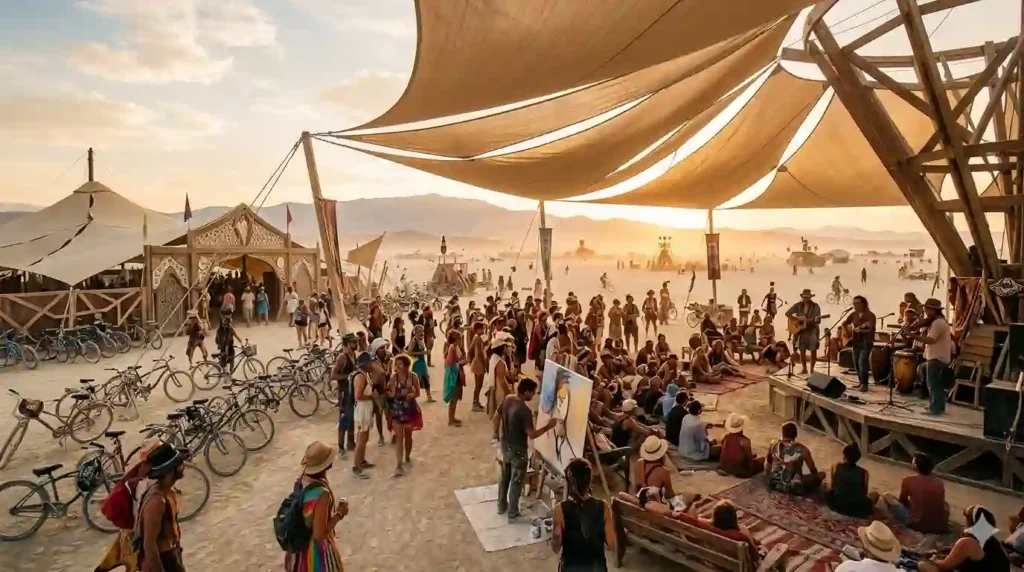
Center Camp Guide 2026: The Heart of Black Rock City
Center Camp Plaza is Black Rock City’s designated commerce-free social hub, anchored by the iconic Canopy structure and one of the only places in the city selling coffee. This guide explains its layout, daily programming, and etiquette. It’s often the first place first-timers orient themselves after arrival.
Positioned at the inner edge of Black Rock City’s radial street plan, Center Camp Plaza functions as the event’s social and cultural heart — a space explicitly designed for gathering rather than any single art installation or theme camp’s territory. Its centerpiece, the Canopy, provides one of the only substantial shade structures in the city and hosts a continuous rotation of performances, live music, spoken word, and community conversation throughout Burn Week. Center Camp Café, one of the few places inside Black Rock City where participants can purchase something (traditionally coffee and chai), operates as a limited, deliberate exception to the event’s Decommodification principle.
This guide explains Center Camp’s layout relative to the wider city, what kind of programming typically happens there throughout the day and night, and the informal etiquette that governs the space — it’s a rest and connection point as much as an entertainment venue, and many participants treat it as a natural first stop after arrival to get oriented before exploring further out. It also covers realistic timing: Center Camp tends to be busiest during peak daytime heat, when its shade becomes especially valuable, and quieter (though still active) late at night.
For the wider city layout Center Camp anchors, see the Black Rock City Map & City Guide; for other iconic landmarks nearby, see the Landmarks & Iconic Places guide.
In This Guide You’ll Learn
- ☕ What Center Camp is
- ⛺ The Canopy
- 🎭 Performances & entertainment
- 🎨 Interactive art
- 🧘 Workshops & community activities
- 🤝 Meeting people
- 🎁 Gifting culture
- 🗺️ Center Camp Plaza layout
- 📸 Photography tips
- ❤️ Visitor etiquette
What Is Center Camp?
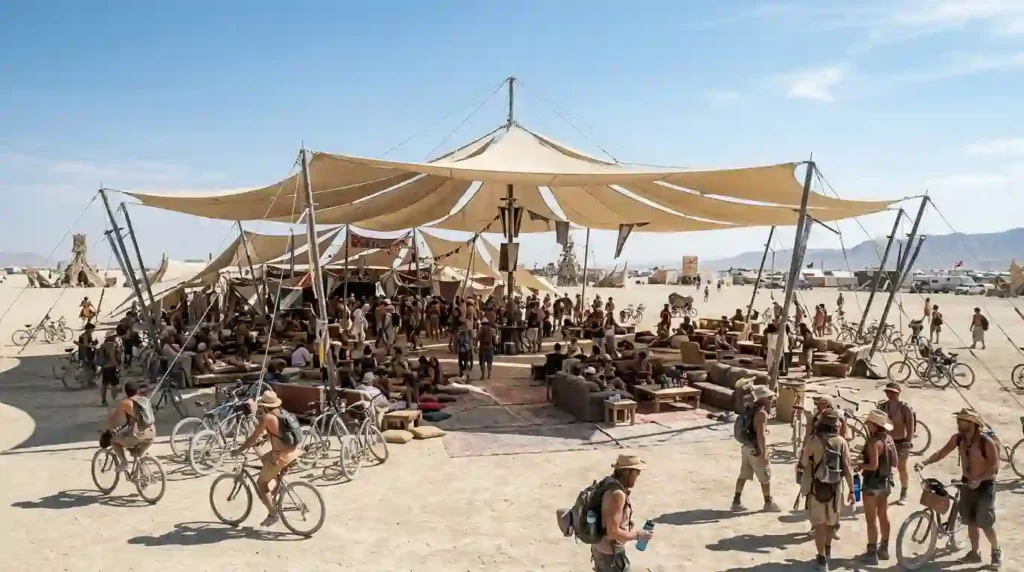
Center Camp is Burning Man’s central communal “living room” an open, shaded space designed for resting, meeting people, and experiencing the heart of Black Rock City’s community. Center Camp is one of those places that’s easier to experience than to describe.
The Purpose of Center Camp
Center Camp is the official central gathering space of Black Rock City. It’s a large, shaded structure historically one of the biggest shade structures on the playa that serves as a communal hub where participants can come together, rest, connect, share, create, and simply be present with one another.
Unlike theme camps, which are run by individual groups with their own identities and agendas, Center Camp belongs to everyone. It’s one of the few spaces at Burning Man that is intentionally designed as a shared public square a place with no single owner and no single purpose, beyond fostering human connection.
Why It Exists
Burning Man is built on ten core principles, and several of them radical inclusion, communal effort, participation, and immediacy are physically embodied in Center Camp’s existence. The space was created to give participants a common ground: somewhere that anyone could walk into, regardless of which camp they’re staying in, what costume they’re wearing, or how many times they’ve attended.
In a city that can feel overwhelming in its scale and stimulation, Center Camp offers something quieter and more intentional — a space for conversation, reflection, and human encounter.
How It Fits Into Black Rock City
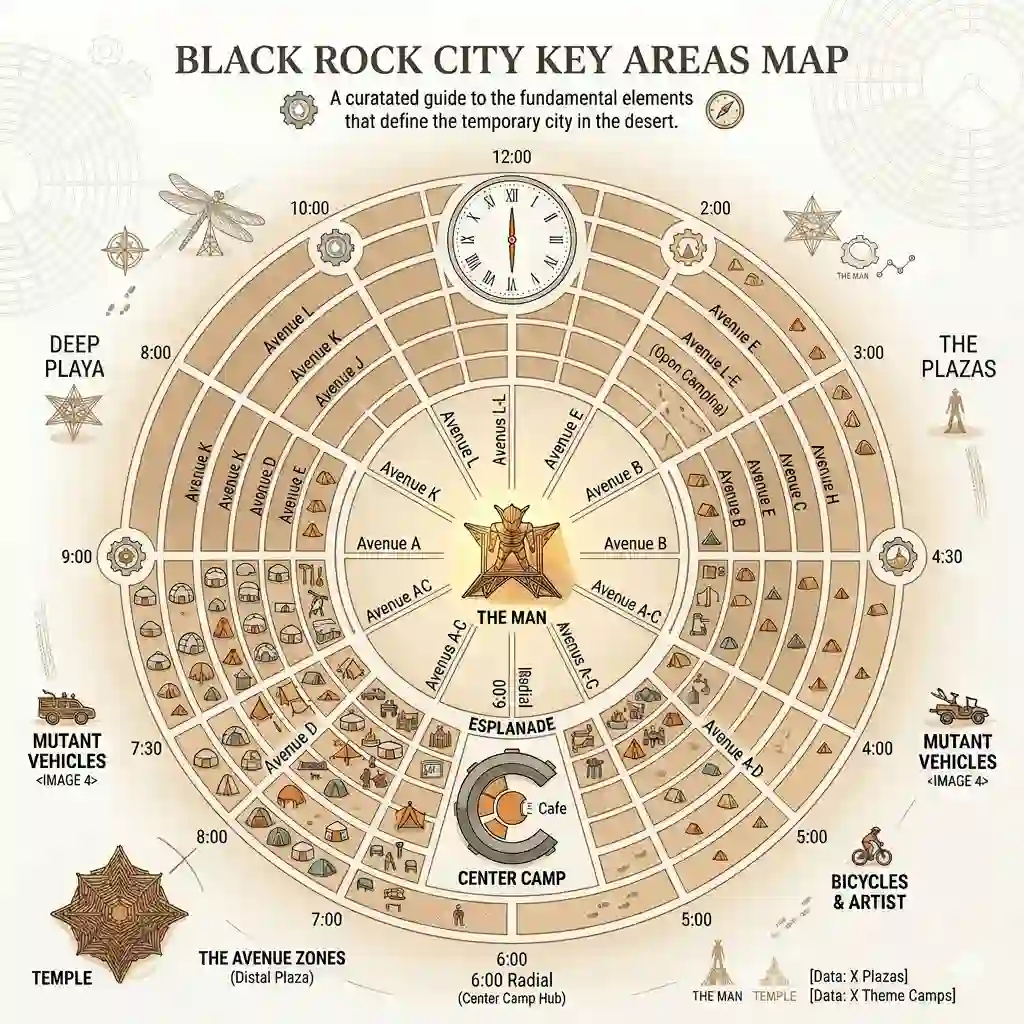
Think of Black Rock City as a clock face. The city is arranged in a semicircle, with streets running in concentric arcs and radial streets extending outward like the spokes of a wheel. The Man stands at the center of the open playa. Center Camp sits along the Esplanade the innermost arc at the 6 o’clock position, directly south of The Man.
This placement is deliberate. Center Camp acts as the city’s anchor at its most accessible point, bridging the dense residential camping areas with the open expanse of the deep playa.
Why It Is Considered a Community Hub
Beyond its physical location, Center Camp earns its “hub” status through what happens inside it. Conversations start there between strangers who become friends. First-timers get their bearings there. Artists perform, teachers teach, and curious people simply wander in and discover something unexpected. It’s one of the rare places at Burning Man where spontaneous human connection is the entire point.
- Center Camp is the official central gathering space of Black Rock City.
- It is a large shaded public structure, not a private theme camp.
- The space exists to embody core principles like radical inclusion, participation, and communal effort.
- Anyone can walk in, regardless of where they camp or how experienced they are.
- Its location at 6 o’clock on the Esplanade makes it a natural anchor in the city’s layout.
- Center Camp is considered a community hub because it focuses on human connection, conversation, and shared experience.
The History of Center Camp
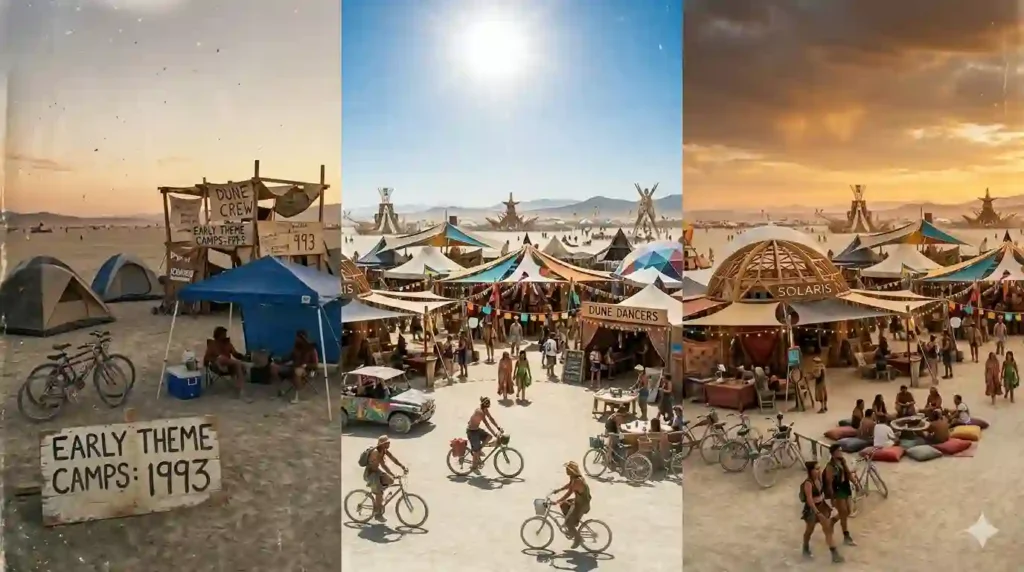
The story of Center Camp follows the growth of Burning Man itself, evolving from simple infrastructure into one of the event’s most iconic community spaces. Center Camp has been part of Burning Man for most of its history as a large-scale event, and its evolution mirrors the evolution of Black Rock City itself.
Early Years of Burning Man
Burning Man began on Baker Beach in San Francisco in 1986 as a small, informal gathering. When the event moved to the Black Rock Desert in Nevada in 1990, it was a very different experience from what it is today a few hundred people in an open desert, with no infrastructure and very little organization. There was no Center Camp, no streets, no map. Just the playa, the people, and the burn.
Growth of Center Camp
As Burning Man grew through the early and mid-1990s from hundreds to thousands of participants the need for shared infrastructure became clear. The city began to take organized shape, with the radial street grid emerging as the framework for Black Rock City. Center Camp developed as part of this evolution, becoming an increasingly intentional space as the event scaled.
By the late 1990s, Center Camp had established itself as a genuine fixture a place where participants could find coffee, shade, community, and a moment of stillness amid the intensity of the playa.
Changes Through the Decades
Through the 2000s and 2010s, Center Camp grew in scope and ambition. The physical structure became more elaborate. The programming became richer. Coffee famously one of the only things sold for money at Burning Man became a Center Camp institution, drawing participants from across the city who needed a dose of caffeine and human company.
Over the decades, the space has hosted performances, lectures, art installations, community forums, and countless informal gatherings. Its specific offerings have changed from year to year, but its role as the city’s social center has remained constant.
Evolution of Its Role
Interestingly, as Black Rock City has grown now regularly drawing 70,000+ participants Center Camp’s role has subtly shifted. In the early years, it was one of the few organized gathering places in the city. Today, there are hundreds of theme camps, dozens of performance venues, and art installations scattered across miles of playa. Center Camp no longer holds a monopoly on community space but it still holds something unique: a sense of being the city’s original living room.
Center Camp in Modern Burning Man
In recent years, the organization behind Burning Man has continued to reimagine what Center Camp can be, experimenting with its programming, layout, and identity. The coffee tradition has continued in various forms. The emphasis on participatory culture, community programming, and accessible gathering space has remained central to its identity. Whatever form it takes in 2026, Center Camp will continue to be one of the most intentionally community-focused spaces in Black Rock City.
- Early Burning Man gatherings on Baker Beach and in the early desert years had no Center Camp or formal city grid.
- As attendance grew in the 1990s, organizers created a more structured city and developed Center Camp as part of that infrastructure.
- By the late 1990s, Center Camp was established as a place for shade, coffee, and community.
- In the 2000s and 2010s, the structure and programming became more elaborate, with performances, talks, and art.
- Coffee service became a Center Camp tradition and a rare example of money exchange on playa.
- As Black Rock City expanded and more camps and venues appeared, Center Camp’s role shifted from “only” gathering place to “original living room.”
- Recent years have seen ongoing experimentation with layout and programming, but the core focus on community has stayed the same.
Where Is Center Camp Located?
This is one of the most frequently asked questions about Center Camp and for good reason. Center Camp sits at one of the easiest-to-find spots in Black Rock City, acting as a key landmark that helps participants orient themselves in the desert. Black Rock City can be disorienting, especially on arrival, and knowing where Center Camp is helps you orient everything else.
Position Within Black Rock City
Center Camp is located at the 6 o’clock position on the Esplanade the innermost road of Black Rock City’s arc-shaped street grid. If you’re standing at The Man and looking directly south, Center Camp is directly in front of you along the city’s central axis. The address in Black Rock City terms is roughly the intersection of the Esplanade and the 6 o’clock radial road making it one of the easiest landmarks in the entire city to locate once you understand the city’s layout.
Relationship to The Man
The Man is the iconic wooden effigy that stands at the geographic and symbolic center of the open playa, burned ceremonially on Saturday night of the event. Center Camp sits directly to the south of The Man, along the main south-facing axis of the city. Walking from Center Camp toward The Man takes you directly into the deep playa the open, art-filled expanse that stretches between the city and the open desert.
This relationship is important: Center Camp and The Man form the two anchor points of Black Rock City’s central axis, with the Esplanade, the open playa, and ultimately the Temple beyond The Man all aligned along this north-south line.
Relationship to the Playa
Center Camp sits at the inner edge of the city the point where the residential camping areas transition into the open playa. This makes it a natural gateway. Walking out from Center Camp toward The Man, you move from the social, inhabited city into the more open, art-focused, experiential playa. Coming back from the playa, Center Camp is one of the first large landmarks you encounter.
How to Find Center Camp
Finding Center Camp is straightforward once you know what to look for. From anywhere in the city, navigate to the Esplanade (the innermost arc road) and head toward the 6 o’clock position. The physical structure of Center Camp — a large, shaded open-air building is visible from a significant distance. If you’re on a bike, it’s an easy ride from almost anywhere in the city. On foot, it’s worth budgeting 15–30 minutes depending on your starting point.
Why Its Location Matters
Center Camp’s position at the city’s central south axis isn’t accidental. It places the community hub at the most accessible point of the city equidistant from the 3 o’clock and 9 o’clock ends of the Esplanade, directly connected to the main playa axis, and highly visible from a wide area. It’s the one location in Black Rock City that almost everyone passes through or near at some point during the week.
- Center Camp is located at 6 o’clock on the Esplanade, the innermost arc street.
- From The Man, looking directly south, Center Camp is right in front of you on the city’s main north–south axis.
- Its “address” is roughly Esplanade & 6:00 radial road.
- Walking from Center Camp toward The Man leads directly into the deep playa and art fields.
- Center Camp sits at the transition between residential areas and the open playa, acting as a gateway.
- It is visible from a distance thanks to its large, shaded structure.
- The central location makes it equidistant from the 3:00 and 9:00 sides of the city and easy for almost everyone to pass by.
Why Center Camp Is Important
Center Camp matters not just because of where it is, but because of what it does: it creates a shared space where the entire city can gather, connect, and orient.
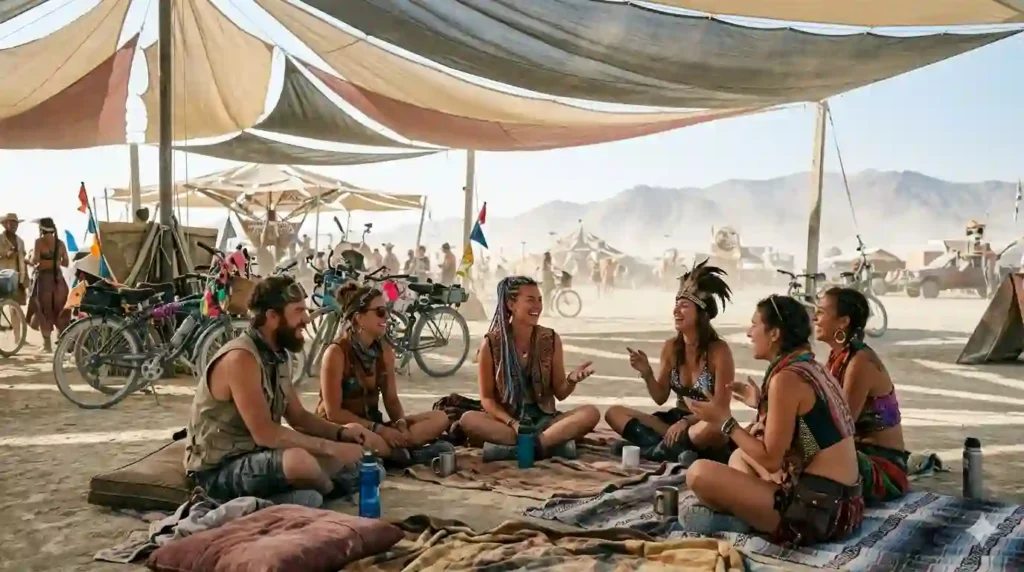
❤️ Why Center Camp Is Called the Heart of Black Rock City
Instead of simply describing the venue, explain that Center Camp is where thousands of participants naturally gather to exchange ideas, perform, learn, volunteer, and build new connections. While The Man symbolizes celebration and the Temple symbolizes reflection, Center Camp represents everyday community life—a place where participation happens continuously rather than during a single ceremony. The official 2026 materials describe it as the city’s “heart” and emphasize The Canopy as a 24-hour community venue filled with performances, workshops, conversations, and collaborative experiences.
Gathering and Connection
At its core, Center Camp exists to bring people together. In a city of 70,000+ participants spread across miles of desert, having a designated central space where gathering is the explicit purpose is genuinely valuable. It gives people a reason and a place to converge and some of the most meaningful conversations and connections at Burning Man happen precisely because two people happened to be in the same shade structure at the same time.
Orientation for New Participants
For first-timers, Center Camp serves a critical orientation function. It’s easy to find, it’s large enough to be a reliable landmark, and the people and information available there can help newcomers understand the city, its culture, and what’s available to them. Many first-timers describe their first visit to Center Camp as the moment Black Rock City started to make sense.
Community Interaction
Center Camp is one of the few spaces in Black Rock City where the entire community across all camps, all backgrounds, all experience levels intersects. Unlike theme camps that attract specific subcultures or interest groups, Center Camp draws a genuinely diverse cross-section of the Burning Man population. That diversity, in one shared space, produces a quality of interaction you won’t find many other places on the playa.
Shared Experiences
Some of the most universal Burning Man experiences happen at Center Camp the first cup of coffee on a dusty morning, a spontaneous performance that draws a crowd, a conversation with a stranger that changes how you think about something. These shared experiences are part of what builds community across an event that’s otherwise highly decentralized and individualized.
Accessibility and Visibility
Center Camp is one of the most physically accessible places in Black Rock City. Its central location, large footprint, and open-air design make it welcoming to participants with varying mobility needs, and its high visibility ensures that anyone looking for it can find it. This accessibility both physical and social is part of what makes it a genuine hub rather than just another venue.
- It provides a central, intentional place for people to gather in a city of tens of thousands.
- For new burners, Center Camp serves as a key orientation point and information hub.
- The space attracts a diverse mix of participants from all camps and backgrounds.
- Shared experiences like coffee, conversations, and performances help build a sense of city-wide community.
- Its design and layout make it physically accessible and easy to find.
- Center Camp’s openness and visibility support both social and practical accessibility.
What Happens at Center Camp?
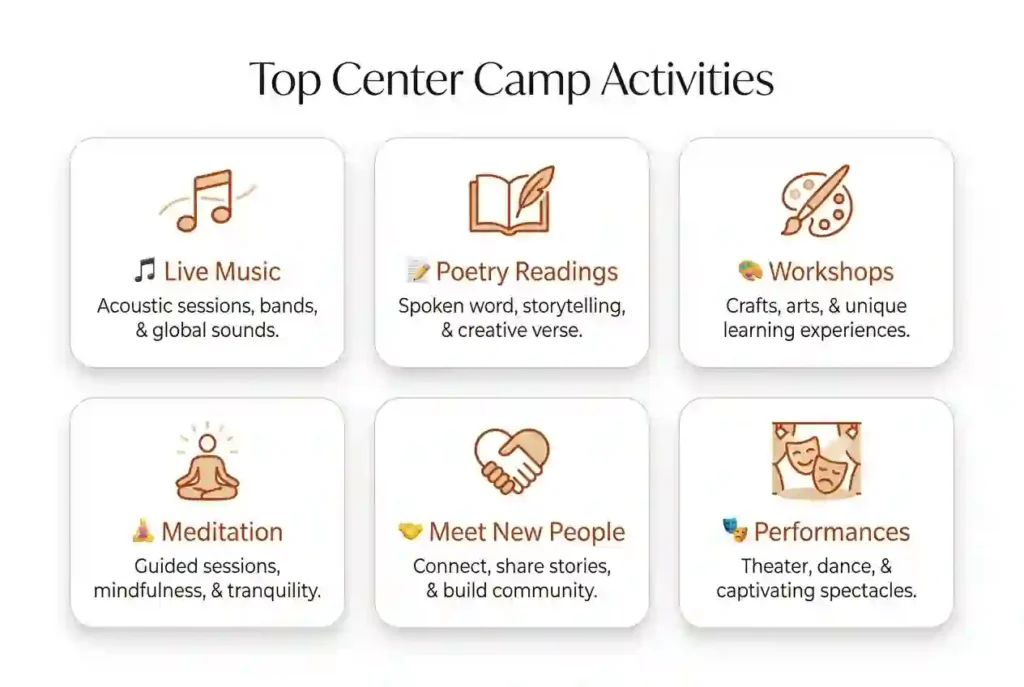
This is where Center Camp gets really interesting. It’s not a stage with a scheduled lineup. It’s not a bar with a specific vibe. It’s a living, breathing community space where the programming is as much about what participants bring to it as what’s officially organized. Center Camp is a constantly changing community space where the activity depends as much on what participants bring as on any official programming.
Informal Gatherings
The most constant thing at Center Camp is informal human gathering. People come to sit, talk, rest, people-watch, and simply be present with others. There’s no agenda required. You can walk in alone and leave having met a dozen interesting people or you can come with a group and find a corner to decompress together. Both are equally valid.
Workshops and Discussions
Center Camp has historically hosted a rich calendar of workshops, talks, and discussions covering an enormous range of topics philosophy, art, technology, community, relationships, creativity, and more. These sessions are typically participatory, not lecture-based, reflecting Burning Man’s emphasis on active engagement over passive spectating.
Art and Performances
Performances happen at Center Camp throughout the day and evening music, spoken word, dance, theater, circus arts, and forms of expression that resist easy categorization. Some performances are scheduled; many are spontaneous. The open, communal nature of the space makes it a natural stage for anyone who wants to share something with the community.
Community Meetups
Groups use Center Camp as a meeting point throughout the week friends who’ve lost each other in the city, campmates coordinating their day, strangers who agreed to reconnect after a conversation the night before. It’s one of the most reliable “meet me at Center Camp” spots in the city.
Educational Sessions
Knowledge sharing is a core part of Burning Man culture, and Center Camp is one of its most natural venues. Participants teach classes on everything from lock-picking to meditation to wilderness navigation to relationship communication. If you have something to share and an hour to give, Center Camp is often the place to do it.
Cultural Activities
From impromptu drum circles to organized cultural celebrations, Center Camp hosts a wide range of activities that reflect the diversity of the Burning Man community. These aren’t performances in the traditional sense they’re participatory cultural expressions that anyone can join.
- Informal gatherings are constant: people resting, talking, and people-watching without a fixed agenda.
- Workshops and discussions cover topics like art, philosophy, technology, and relationships, usually in a participatory style.
- Performances include music, spoken word, dance, circus arts, and spontaneous creative acts.
- It serves as a reliable meetup spot for friends, campmates, and new connections.
- Educational sessions allow participants to teach skills ranging from practical to deeply personal.
- Cultural activities and celebrations often take a participatory form, inviting anyone to join.
Events and Programming at Center Camp
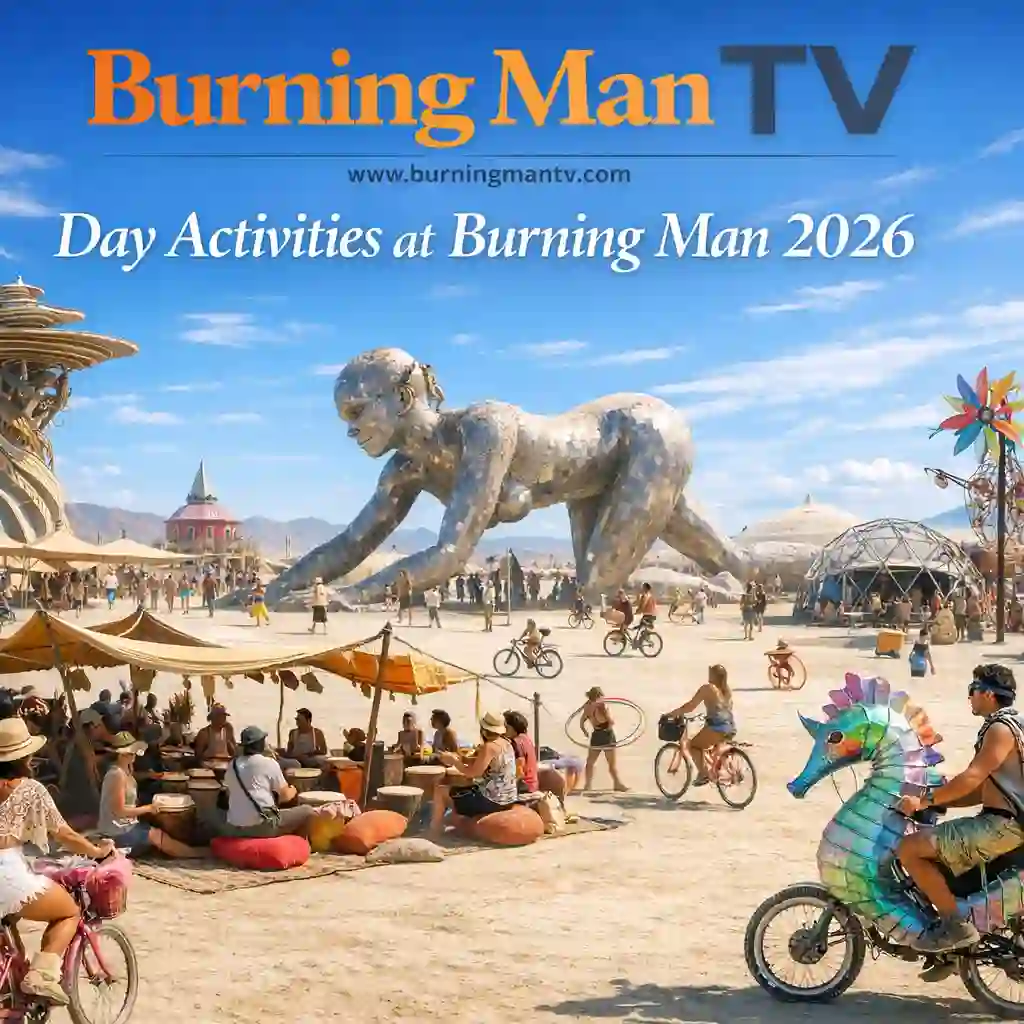
Throughout the week, Center Camp cycles through different energies, from quiet daytime workshops to lively evening performances and spontaneous community-led events.
Daytime Activities
During the day, Center Camp tends toward a more relaxed, conversational energy. Workshops and educational sessions are common in the morning and early afternoon. The shade attracts people escaping the heat of the playa, which creates a naturally contemplative atmosphere. Coffee, conversations, and creative sessions define the daytime experience.
Evening Activities
As the temperature drops and the playa comes alive with light and sound, Center Camp shifts energy. Performances become more frequent and more elaborate. The social atmosphere intensifies. The interplay of light, art, and community creates an evening experience that’s distinct from the daytime Center Camp same space, completely different feeling.
Community-Led Events
Many of the best things that happen at Center Camp aren’t on any official schedule. They’re organized by participants who show up with an instrument, an idea, a skill, or simply a desire to bring people together. This unpredictability is a feature, not a bug. Some of the most memorable Center Camp moments happen because someone decided to do something and others decided to join.
Scheduled Programs
Each year, there is typically a schedule of organized programming at Center Camp workshops, performances, and special events with defined times and formats. Checking the What Where When guide (Burning Man’s official event schedule) before and during the event will help you catch the sessions that interest you most.
Special Gatherings
Certain moments in the Burning Man week create natural gatherings at Center Camp — the morning after a major burn, the quiet hours of early morning when the night owls and the early risers overlap, the final days of the event when the community begins to reflect. These gatherings aren’t on any schedule, but they’re worth experiencing.
- Daytime tends to be relaxed, with workshops, talks, and educational sessions in the shade.
- The cooler evening hours bring more energetic performances and intensified social activity.
- Many of the most memorable happenings are community-led, not formally scheduled.
- Center Camp typically features a schedule of organized programs listed in the What Where When guide.
- Special unscheduled gatherings often occur around key moments in the week, like mornings after major burns or reflective late-week times.
Center Camp and Burner Culture
Center Camp is one of the clearest physical expressions of Burning Man’s cultural principles, especially participation, inclusion, and communal effort.
Participation Over Spectating
Burning Man’s principle of participation is perhaps most visibly embodied at Center Camp. The space is designed not for audiences but for participants. The line between performer and spectator blurs constantly. Someone watching a workshop becomes someone asking a question becomes someone leading the next discussion. This participatory culture is one of Burning Man’s most distinctive qualities, and Center Camp is one of its clearest expressions.
Meeting New People
If there’s one place at Burning Man where talking to strangers feels not just acceptable but actively encouraged, it’s Center Camp. The open, communal atmosphere removes the social barriers that might otherwise make approaching someone unfamiliar feel awkward. Some of the deepest friendships in Burning Man culture began with a conversation at Center Camp.
Conversations and Connections
The conversations at Center Camp tend to be different from conversations elsewhere on the playa. There’s less noise, less stimulation, and more space for depth. People talk about ideas, experiences, lives, and visions. The temporary city has a way of making people more open, and Center Camp’s community-focused atmosphere amplifies that openness.
Sharing Knowledge
One of Burning Man’s least-celebrated but most meaningful traditions is the sharing of knowledge between participants. Center Camp is one of the primary venues where this happens where someone who knows something teaches it to others, not for money or recognition, but because sharing is part of the culture.
Community Building
Every interaction at Center Camp every conversation, every shared workshop, every impromptu performance is an act of community building. Over the course of a week, these interactions accumulate into something larger: a sense of belonging, of shared experience, of being part of something meaningful. Center Camp is one of the places where that sense of community is most intentionally cultivated.
- The space is designed for active participation, not passive spectating.
- Meeting new people is easy and encouraged, with low social barriers compared to everyday life.
- Conversations at Center Camp often go deeper, with more reflection and openness than in louder areas of the playa.
- Knowledge sharing is common, with participants teaching and learning for its own sake.
- Repeated interactions, workshops, and performances all contribute to ongoing community building.
For more on the values that shape experiences like Center Camp, see the Burning Man Culture Guide.
Center Camp for First-Timers
If you’re attending Burning Man for the first time, Center Camp deserves a prominent place in your plans especially in your first day or two. For new burners, Center Camp is one of the best starting points to understand the city, meet people, and feel grounded in the Burning Man experience.
Why New Burners Should Visit
Center Camp is one of the most welcoming, accessible, and human-scale spaces in Black Rock City. It’s a great place to decompress after the intensity of arrival, to get your bearings, and to have your first real conversations with other participants. Many first-timers find that a visit to Center Camp early in the week fundamentally changes how they experience the rest of the event.
Learning the Layout of the City
Center Camp’s position at the 6 o’clock axis makes it a perfect starting point for understanding Black Rock City’s layout. Once you know where Center Camp is and how it relates to The Man, the Esplanade, and the numbered clock streets, the rest of the city starts to make spatial sense. Use it as your anchor.
Finding Information
Center Camp is traditionally one of the places where participants can find orientation resources, event schedules, and community information. If you have questions about what’s happening, where things are, or how something works, Center Camp is a good place to start looking for answers — either from official resources or from experienced burners who are happy to help.
Meeting the Community
As a first-timer, meeting people at Burning Man can feel daunting. Center Camp removes some of that friction. The open, community-focused atmosphere makes it easy to start conversations, join activities, and connect with people from all over the world who share your curiosity and openness.
Building Confidence Early
Visiting Center Camp early in your first Burning Man experience gives you a spatial anchor, a social foundation, and a sense of familiarity that makes the rest of the week more navigable. It’s a gentle entry point into a city that can feel overwhelming at first — and a reminder that beneath all the spectacle, Burning Man is fundamentally about people connecting with people.
- It offers a welcoming, human-scale entry point into an otherwise overwhelming environment.
- The 6 o’clock axis and relation to The Man help first-timers make sense of the city map.
- Orientation resources and experienced participants often help answer practical and cultural questions.
- The space makes it easier to start conversations and connect with others early in the week.
- Building familiarity with Center Camp early helps new burners navigate more confidently for the rest of the event.
For more advice tailored to first-timers, see the First-Timer Guide.
Art and Creativity Around Center Camp
The area in and around Center Camp functions as a constantly evolving canvas where interactive art, performance, and collaborative creativity thrive.
Interactive Art
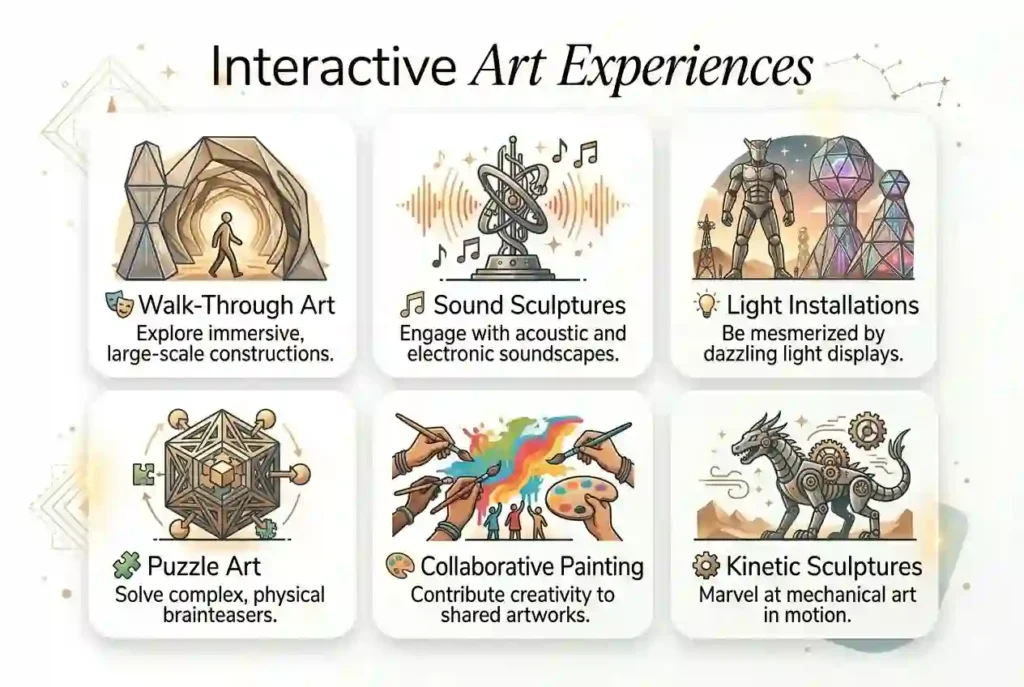
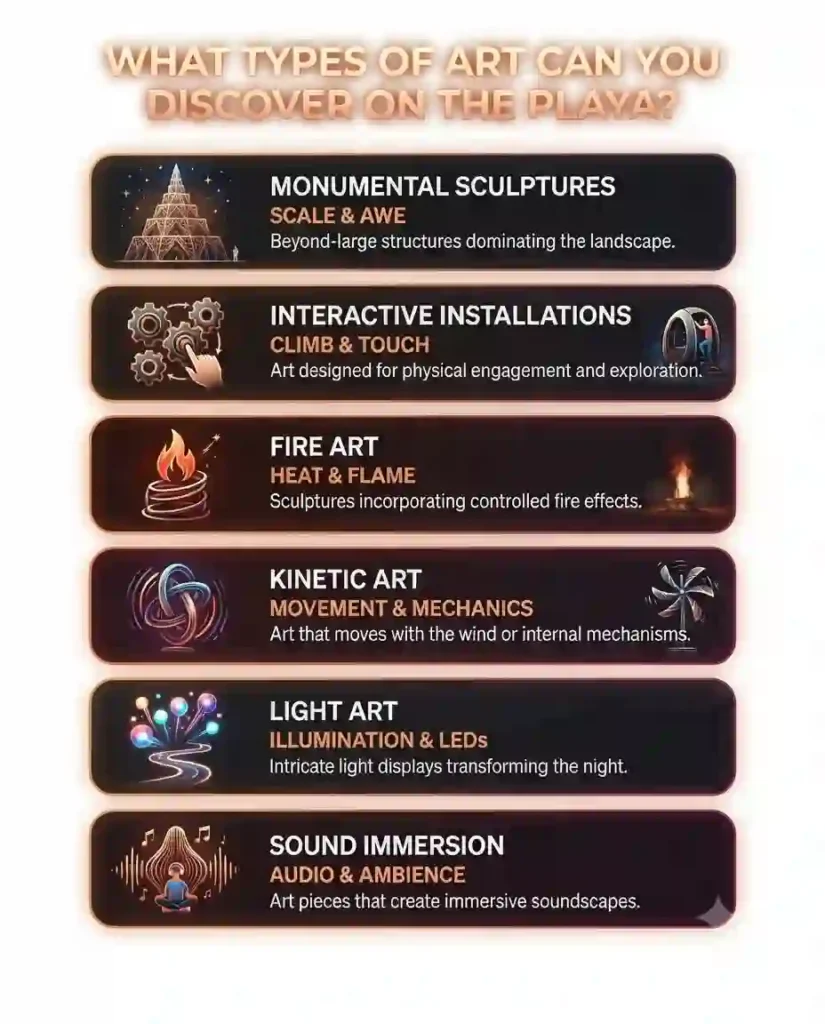
Center Camp and its immediate surroundings have historically featured interactive art installations works that invite participation rather than passive viewing. These installations reflect Burning Man’s deep commitment to art as experience rather than art as object. If you see something near Center Camp that seems to invite interaction, it almost certainly does.
Performances
The area around Center Camp is a natural gathering point for performers from musicians and dancers to fire artists and theatrical groups. Performances near Center Camp can be scheduled or spontaneous, intimate or large-scale. Walking through the area with an open sense of curiosity is often rewarded.
Creative Expression
Center Camp itself functions as a canvas for creative expression. The space changes throughout the week as participants add, modify, and interact with the environment. The cumulative creative energy of thousands of participants passing through a single space over seven days produces something genuinely remarkable.
Community Projects
Collaborative and community-driven art projects find a natural home in and around Center Camp. These are works that are built, shaped, or completed by participants during the event a living demonstration of communal effort, one of Burning Man’s core principles.
Artistic Gatherings
Art-focused conversations, critiques, planning sessions, and collaborative discussions happen informally at Center Camp throughout the week. If you’re an artist or simply someone who loves thinking about art, the conversations you can stumble into at Center Camp are often as valuable as anything on an official program.
- Interactive art installations near Center Camp invite touch, play, and participation.
- The surrounding area attracts performers of all kinds, from musicians to fire artists.
- The structure itself evolves as participants add creative touches throughout the week.
- Collaborative art projects often use Center Camp as a base or workspace.
- Artists and art-lovers frequently gather here to talk, plan, and reflect on creative work.
For a deeper dive into Burning Man’s art ecosystem, see the Burning Man Art Guide.
Center Camp During the Day
By day, Center Camp becomes a shaded refuge where participants can rest, learn, and connect at a slower, more reflective pace.
Atmosphere and Energy
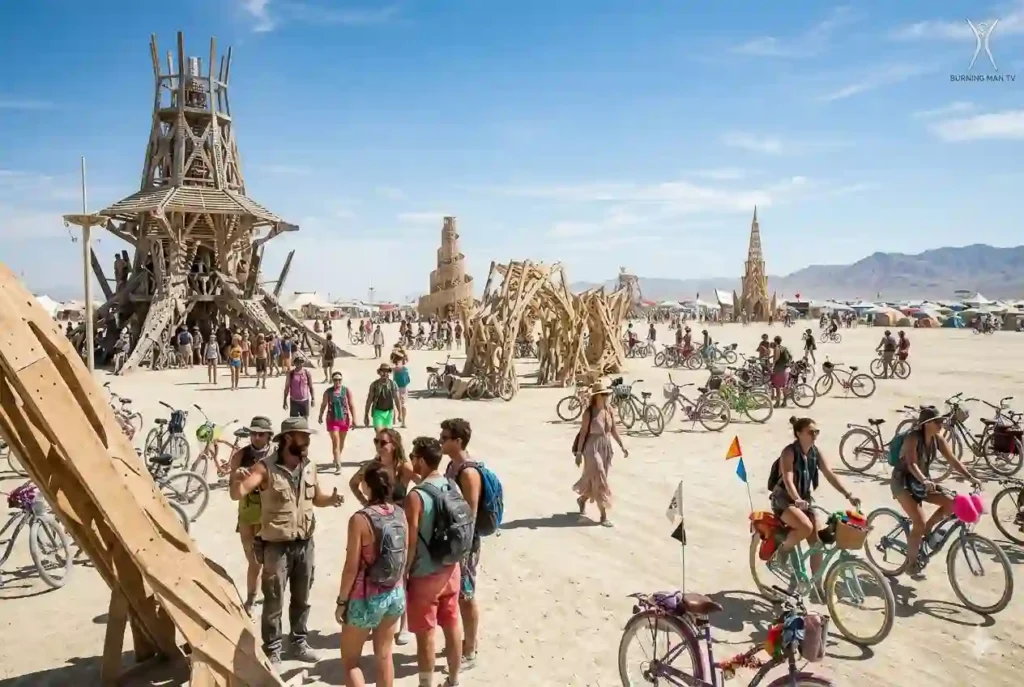
Daytime Center Camp has a distinctive energy quieter and more contemplative than the city’s nighttime intensity, but still alive with activity and human presence. The shade makes it a welcome refuge from the desert sun, and the social atmosphere encourages lingering.
Relaxation Spaces
One of Center Camp’s most important daytime functions is simply giving people a place to rest. The playa is physically demanding heat, dust, walking, dancing, exploring. Center Camp offers shade, seating, and a slower pace that allows participants to recharge before heading back out.
Workshops and Talks
The daytime programming at Center Camp tends to be more educational and conversational workshops on skills and ideas, talks that invite discussion, sessions that ask participants to think and share. If you’re the kind of person who loves learning, the daytime Center Camp schedule is worth paying attention to.
Social Interaction
Daytime Center Camp has a particular social quality that’s hard to find elsewhere on the playa. The lower stimulation level compared to nighttime events creates space for longer, deeper conversations. Some of the most meaningful interactions people have at Burning Man happen at Center Camp in the middle of the afternoon.
- The daytime atmosphere is calmer and more contemplative than the city at night.
- Shade and seating make it a key place to rest and recover from desert conditions.
- Workshops and talks focus on learning, skills, ideas, and shared discussion.
- The lower-stimulation environment supports longer, more thoughtful conversations.
Center Camp at Night
At night, Center Camp transforms into a glowing social hub with a distinctly different vibe, blending performance, movement, and late-night conversations.
Lighting and Ambiance
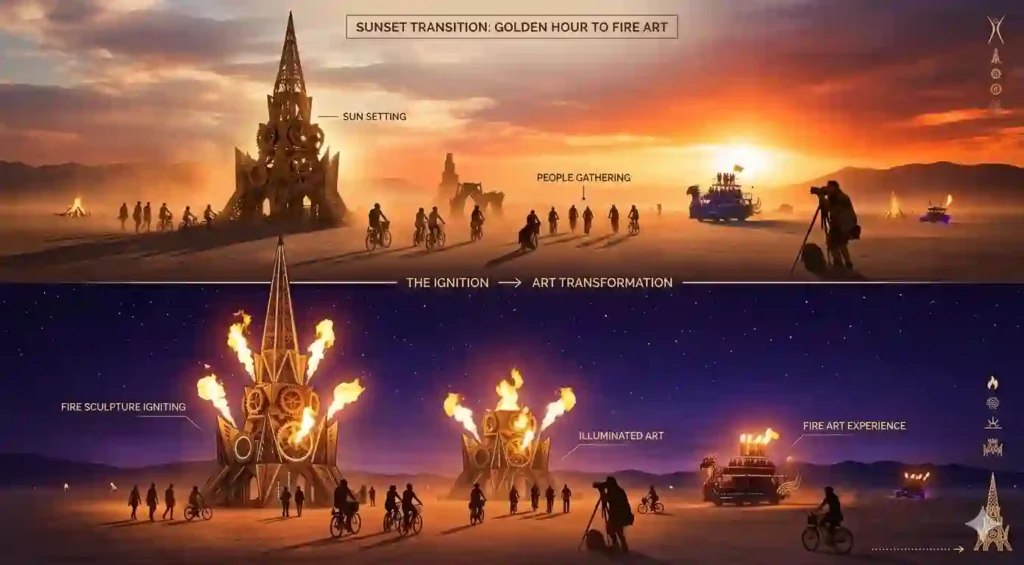
At night, Center Camp transforms. The desert darkness is held back by light art, installed illumination, and the ambient glow of the city around it. The physical space looks different, feels different, and draws a different crowd than the daytime version.
Evening Gatherings
Evening gatherings at Center Camp tend to be more energetic and performative than daytime sessions. Musicians, dancers, and performers find larger and more animated audiences after dark. The communal energy of the city’s nighttime pulse flows through Center Camp even as it maintains its own distinct identity.
Nighttime Exploration
Center Camp at night is worth exploring with the same open curiosity you’d bring to any art installation on the deep playa. Wander through it. See what’s happening. Let the experience be whatever it turns out to be, rather than arriving with a fixed agenda.
Unique Experiences After Dark
Some of the most memorable Center Camp moments happen after midnight, when the city’s nighttime energy is at its peak and the people gathered at Center Camp include both those heading out and those returning from the playa’s deeper zones. The mix of exhaustion, wonder, and openness that characterizes the late night playa is present at Center Camp in a particularly concentrated form.
- Lighting and art create a new visual and emotional atmosphere after dark.
- Evening gatherings are more energetic, with more performances and engaged audiences.
- Wanderers can explore the space as an experience in itself, without a fixed plan.
- Late-night hours often produce uniquely memorable interactions and moments of shared openness.
Resources and Information Near Center Camp
Center Camp isn’t just social; it’s also surrounded by some of the most important information and support services in Black Rock City.
Orientation Resources
Center Camp has historically been one of the best places in Black Rock City to find orientation resources for new participants city maps, event guides, and simply experienced burners who are happy to answer questions. If you’re disoriented or looking for specific information, Center Camp is a reasonable first stop.
Event Information
The What Where When guide Burning Man’s comprehensive event schedule is the primary resource for finding out what’s happening across the city. Copies are typically available at Playa Info, which is located near Center Camp. Checking the guide regularly and planning a few anchor activities helps participants make the most of their time.
Community Services
A range of community support services operate near Center Camp, including Playa Info (the city’s information hub) and access points for Black Rock Rangers (Burning Man’s community safety team). Knowing where these resources are before you need them is always a good idea.
Meeting Points
Center Camp is one of the most reliable meeting points in the entire city. Its central location, large footprint, and high visibility make it easy to say “meet me at Center Camp” with confidence that both parties can find their way there. Designate a specific spot within Center Camp near the coffee bar, at a particular art piece, at a corner of the main structure for even more reliable rendezvous.
Support Resources
If you or someone in your group needs support during the event whether practical, emotional, or medical the resources near Center Camp include access to Black Rock Rangers, Playa Info staff, and the general community of experienced participants who tend to congregate there. Center Camp’s communal atmosphere makes it a naturally supportive environment.
- Orientation materials and maps are often accessible nearby for new participants.
- Playa Info, near Center Camp, is the main hub for event schedules and the What Where When guide.
- Community services such as Playa Info and Black Rock Rangers maintain a presence in this area.
- Center Camp works as a reliable, central meeting point for groups.
- Support resources for practical, emotional, or safety needs can often be found close by.
For a complete overview of resources available throughout Black Rock City, see the Playa Resources Guide.
How Center Camp Connects the City
Center Camp acts as both a physical and social connector, linking neighborhoods, people, and experiences across Black Rock City.
Geographic Importance
Center Camp’s position at the 6 o’clock axis of Black Rock City makes it a geographic connector between the residential camping areas (to the east and west along the Esplanade) and the open playa (to the north). It sits at the intersection of the city’s main cross-axis, making it one of the most naturally trafficked locations in Black Rock City.
Social Importance
As the city’s designated community hub, Center Camp creates social connections across camps, groups, and individuals who might otherwise never cross paths. The simple act of sharing a common space shade, coffee, a workshop, a performance builds social bonds that extend beyond Center Camp and throughout the event.
Cultural Importance
Center Camp embodies several of Burning Man’s core cultural values in physical form: radical inclusion (anyone can enter), participation (everyone is invited to contribute), communal effort (the space is built and maintained collectively), and immediacy (it’s a place to be present, not to document). Visiting Center Camp is, in a real sense, an encounter with Burning Man culture at its most distilled.
Community Interaction
The interactions that happen at Center Camp ripple outward into the rest of the city. The conversation you have there sends you somewhere new. The workshop you attend introduces you to someone who invites you to their camp. The performance you see inspires something you do later. Center Camp functions as a catalyst for the broader community experience.
Citywide Connections
Center Camp’s role as a connector extends to the physical connections it creates the paths that run from Center Camp toward The Man, toward the Temple, and along the Esplanade in both directions form the main axes of movement through Black Rock City. Understanding Center Camp’s place in this network helps participants navigate the entire city more confidently.
Daily Life at Center Camp
| Time | Experience |
| Morning | Coffee, yoga, conversations |
| Afternoon | Workshops, art, community |
| Sunset | Music, gatherings |
| Evening | Performances |
| Late Night | Social interaction, spontaneous events |
- Its 6 o’clock position links residential Esplanade areas with the open playa.
- The space brings together burners who might never meet otherwise.
- Center Camp embodies core cultural values like inclusion, participation, and immediacy.
- Experiences there often ripple out, influencing where people go and what they do next.
- The paths from Center Camp to The Man, the Temple, and along the Esplanade form major movement arteries in the city.
Common Misconceptions About Center Camp
Despite its name and prominence, many people misunderstand what Center Camp is — and what it isn’t.
⚠️ Common Mistakes
- Thinking it’s only a café.
- Rushing through without exploring.
- Missing daytime workshops.
- Ignoring participation opportunities.
- Blocking performances while taking photos.
- Forgetting consent.
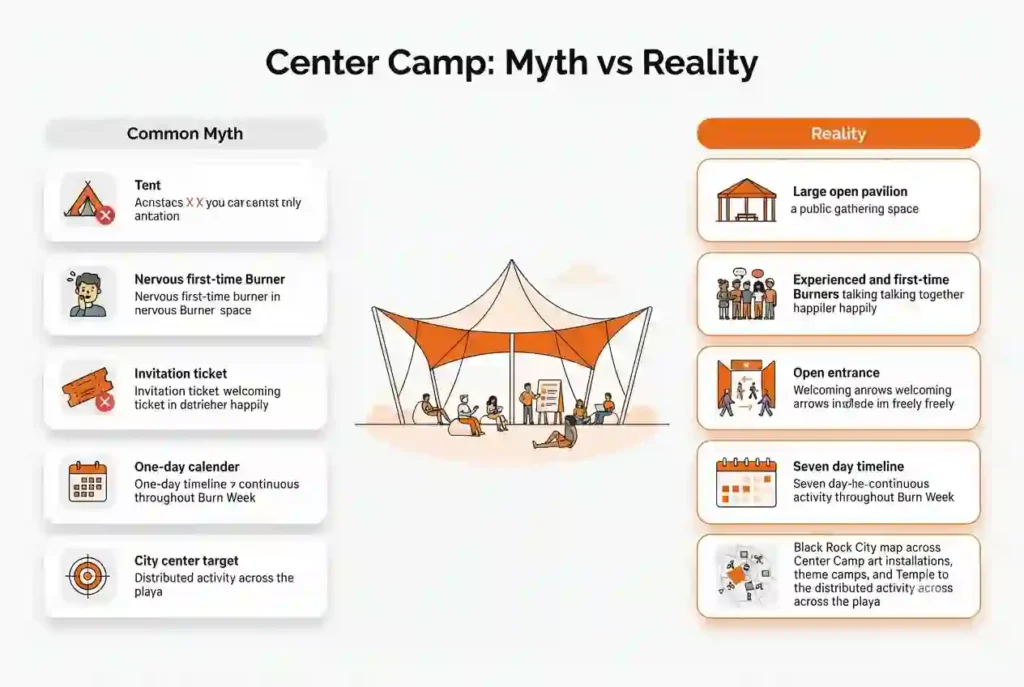
Is It a Camp?
Despite the name, Center Camp is not a residential camping area. You can’t pitch your tent there. It’s a public gathering space a large, shaded communal structure not a place where participants live. The name reflects its role as the camp at the center of the city, not a camp in the sense of a place to sleep.
Is It Only for First-Timers?
Absolutely not. While Center Camp is particularly valuable for first-timers finding their footing in the city, it’s a rich and rewarding space for participants at every experience level. Veteran burners return year after year for the conversations, the performances, and the community.
Do You Need an Invitation?
No. Center Camp is one of the most openly accessible spaces in Black Rock City. Walk in. There’s no guest list, no admission, no registration. If you’re at Burning Man, Center Camp is yours.
Is It Active All Week?
Yes. Center Camp operates throughout the event from early in the week through the final days. The energy and programming shift as the week progresses, but the space remains open and active throughout.
Is It the Center of Everything?
Geographically and socially, Center Camp holds a central position but “center of everything” is a bit of an overstatement in a city where art, music, culture, and community are distributed across miles of playa. Think of it less as the center of everything and more as the city’s living room: not where everything happens, but where a lot of people come together, and where the city’s communal identity is most tangibly present.
What Can You Experience at Center Camp?
| Activity | Best Time | Who Will Enjoy It |
|---|---|---|
| Community Talks | Morning & Afternoon | First-time Burners, lifelong learners |
| Live Music & Performances | Afternoon & Evening | Music lovers and performers |
| Workshops | Throughout the Day | Participants seeking hands-on experiences |
| Coffee & Socializing | Morning | Solo travelers and groups |
| Art Viewing | Day & Night | Photographers and art enthusiasts |
| Meeting Fellow Burners | Anytime | Everyone looking to connect |
- Center Camp is not a place where people live; it is not a residential camp.
- It is not just for first-timers; veterans also use and value it.
- No invitation or special access is required; it is open to all participants.
- The space is active throughout the event, with shifting energy as the week progresses.
- It is central and important, but not the only focal point in a city full of distributed art and culture.
Center Camp Key points
Center Camp has long been one of the social and cultural gathering spaces of Burning Man. From daily meetups and performances to information services and community activities, these numbers highlight why it remains an important destination for many participants.
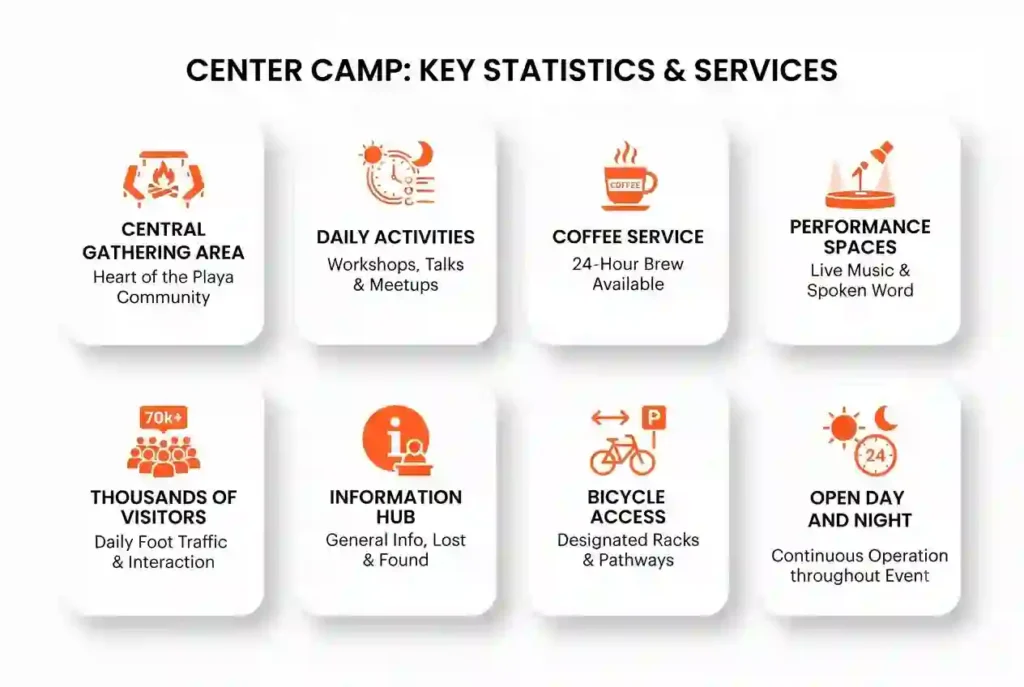
Key Numbers
- 🏕️ 1 Central Gathering Area — Center Camp serves as one of the main community hubs within Black Rock City.
- 🎭 Daily Community Activities — Talks, workshops, performances, and meetups take place throughout the event.
- ☕ Coffee & Refreshments Available — Center Camp traditionally offers coffee and beverages through volunteer-supported services.
- 🎤 Multiple Performance Spaces — Visitors can enjoy live music, storytelling, poetry, and interactive events.
- 🤝 Thousands of Daily Visitors — Participants gather to meet friends, relax, and explore community activities.
- 🗺️ Information & Orientation Nearby — Many first-time Burners visit Center Camp to get oriented and locate resources.
- 🚲 Easy Bicycle Access — Bike parking areas make Center Camp one of the easiest locations to reach.
- 🌅 Open Day and Night — Activities continue from morning until late evening, creating a constantly changing atmosphere.
Center Camp Myths vs Reality
| Myth | Reality |
|---|---|
| Center Camp is the center of every Burning Man activity. | It is a major gathering place, but art, performances, and experiences happen throughout Black Rock City. |
| Only experienced Burners visit Center Camp. | Many first-time visitors stop here to explore, meet people, and attend events. |
| Center Camp is only for drinking coffee. | It hosts talks, workshops, performances, art, and community gatherings in addition to refreshments. |
| You must belong to a theme camp to participate. | Most Center Camp activities are open to all participants. |
| Center Camp is quiet all day. | The atmosphere changes throughout the day, from peaceful mornings to lively evenings. |
| You can drive directly to Center Camp. | Participants usually walk or ride bicycles, as personal vehicle movement is highly restricted inside Black Rock City. |
First-Timer Center Camp Checklist
This checklist helps new participants use Center Camp strategically: to orient themselves, connect with others, and get more from their first Burn.
Before Visiting:
- Review the Black Rock City map and locate Center Camp at the 6 o’clock Esplanade position
- Identify nearby landmarks The Man to the north, the main radial roads on either side
- Check the What Where When guide for any scheduled workshops or performances that interest you
- Let your campmates know Center Camp is a reliable meeting point if you get separated
While Visiting:
- Explore the full space before settling see what’s happening in different areas
- Attend a workshop or sit in on a discussion
- Talk to at least one person you don’t know
- Find the coffee (if it’s available that year) and enjoy a moment of stillness
- Discover what camps and art installations are in the immediate surrounding area
After Visiting:
- Use Center Camp’s 6 o’clock position as your primary navigation anchor throughout the week
- Return at a different time of day the space feels genuinely different in the morning, afternoon, and at night
- Explore the surrounding neighborhoods and see how they connect to Center Camp.
First-Timer Center Camp visiting Secret Tips
- Before visiting: locate Center Camp on the map, note nearby landmarks, check What Where When, and pick it as a backup meeting point.
- While visiting: explore the whole space, attend at least one session, talk to someone new, and seek out coffee if available.
- After visiting: use Center Camp as your main navigation anchor and return at different times of day to experience its changing energy.
Center Camp Checklist
Before Visiting
✅ Check the daily event schedule
✅ Bring water and sun protection
✅ Lock your bicycle
✅ Know your camp location before leaving
While Exploring
✅ Attend a workshop or performance
✅ Meet new participants
✅ Respect quiet spaces and performances
✅ Follow Leave No Trace principles
During Your Visit
✅ Visit during both daytime and nighttime
✅ Explore nearby art installations
✅ Take breaks in shaded community spaces
✅ Support volunteer-led activities respectfully
Before Leaving
✅ Collect all personal belongings
✅ Remove any MOOP
✅ Unlock your bicycle
✅ Plan your next destination
Frequently Asked Questions About Center Camp
Center Camp is one of Black Rock City’s primary gathering spaces for community activities, performances, workshops, and social interaction.
Yes. All Burning Man participants are welcome to visit and take part in public activities.
You can attend talks, workshops, performances, community gatherings, and explore nearby art and social spaces.
Coffee service has traditionally been offered, but availability may vary depending on the year’s event plans.
It is centrally positioned within Black Rock City, making it easy to reach by bicycle or on foot.
Yes. It’s an excellent place to experience Burning Man culture, meet people, and attend beginner-friendly activities.
Yes. Bicycle parking areas are available, but always lock your bike before exploring.
Visitor numbers vary throughout the day, with mornings, afternoons, and evenings offering different experiences.
Is Center Camp worth visiting every day?
Center Camp remains an important gathering place, although Burning Man activities are now more widely distributed throughout Black Rock City than in earlier years.
| Activity | Best Time | Who Will Enjoy It |
|---|---|---|
| Community Talks | Morning & Afternoon | First-time Burners, lifelong learners |
| Live Music & Performances | Afternoon & Evening | Music lovers and performers |
| Workshops | Throughout the Day | Participants seeking hands-on experiences |
| Coffee & Socializing | Morning | Solo travelers and groups |
| Art Viewing | Day & Night | Photographers and art enthusiasts |
| Meeting Fellow Burners | Anytime | Everyone looking to connect |
☕ Visit early in the morning for a quieter atmosphere.
🎭 Check the daily schedule before arriving.
🚲 Always lock your bicycle.
💧 Carry water even for short visits.
🤝 Join conversations and community events—you don’t need an invitation.
🌅 Visit once during the day and again after sunset for two very different experiences.
🎨 Explore the surrounding art and theme camps nearby.
🌱 Leave every space cleaner than you found it.
Final Thoughts: Why Center Camp Remains a Key Part of Black Rock City
In a city defined by spectacle, scale, and constant stimulation, Center Camp offers something different: a place to pause. To talk. To connect. To simply be in the company of other humans who’ve made the same unusual choice to be here, in this desert, at this moment. Center Camp endures as a core part of Burning Man because it offers something simple yet rare: a place to pause, connect, and feel the city’s community in one shared space.
Center Camp has played a meaningful role throughout Burning Man’s history not by being the loudest or the most elaborate, but by being consistently present, consistently open, and consistently committed to the idea that community is built one conversation at a time.
For first-timers, it offers orientation a way into the city that feels human-scale and welcoming. For experienced burners, it offers continuity a familiar landmark in a city that changes every year. For everyone, it offers the simple, irreplaceable experience of being in a shared space with people who are fully present and open to connection.
Whatever brings you to Burning Man in 2026, make time for Center Camp. Wander in without a plan. See what’s happening. Talk to someone new. Let the city’s living room do what it’s been doing for decades bringing people together, one dusty afternoon at a time.
- In a high-stimulation environment, Center Camp offers a place to slow down and connect.
- Its role over the years has been defined by consistent openness and focus on community.
- For first-timers, it provides orientation; for veterans, it offers continuity and familiarity.
- It reminds everyone that Burning Man is ultimately about people connecting with people.
- Making time to visit Center Camp without a plan often leads to surprising, meaningful experiences.