
Black Rock City Amenities & Facilities Guide 2026: Essential Services for Everyday Life
Explore Black Rock City’s amenities and facilities, including restrooms, ice sales, cafés, camping support, information centers, public spaces, charging options, and participant resources. Radical Self-Reliance means Burning Man doesn’t run on typical festival infrastructure, but a limited set of public amenities — still support daily life. This guide explains exactly what’s available and what isn’t. Knowing the difference prevents packing mistakes.
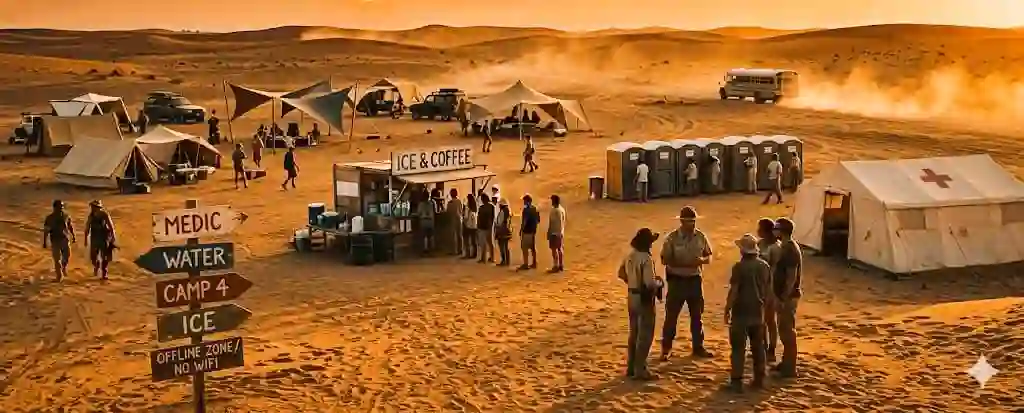
Burning Man’s Radical Self-Reliance principle means participants are expected to bring their own food, water, and shelter — there are no grocery stores, restaurants, or general vendors inside Black Rock City. That said, a limited set of public amenities does exist to support basic needs: an extensive network of portable restrooms placed throughout the city, Arctica ice sales (traditionally one of the only items participants can buy on playa, alongside coffee at Center Camp), Ranger outposts and information booths, and designated public gathering plazas maintained as neutral community space.
This guide explains what amenities Black Rock City actually provides, where to typically find them relative to the city’s radial layout, and how they’re maintained by volunteer departments throughout the week. It also clarifies common misconceptions first-timers have — no, there isn’t a general store; yes, ice is genuinely one of the only purchasable items; and restroom locations, while numerous, still require some planning around peak-usage times.
Understanding these limited public facilities helps you pack correctly rather than assuming services that don’t exist. For the volunteer departments and organizational infrastructure behind these amenities, see the Black Rock City Services & Resources guide; for water and hydration planning, see the Packing List guide.
In This Guide You’ll Learn
- 🚻 Portable restrooms
- 🧊 Ice sales locations
- ☕ Center Camp cafés and gathering areas
- ⛺ Public camping facilities
- 🪑 Rest and gathering spaces
- ℹ️ Information points
- 🔌 Charging and power considerations
- 🚰 Water considerations
- ♻️ Waste management
❤️ Facility etiquette
What Amenities Are Available in Black Rock City?
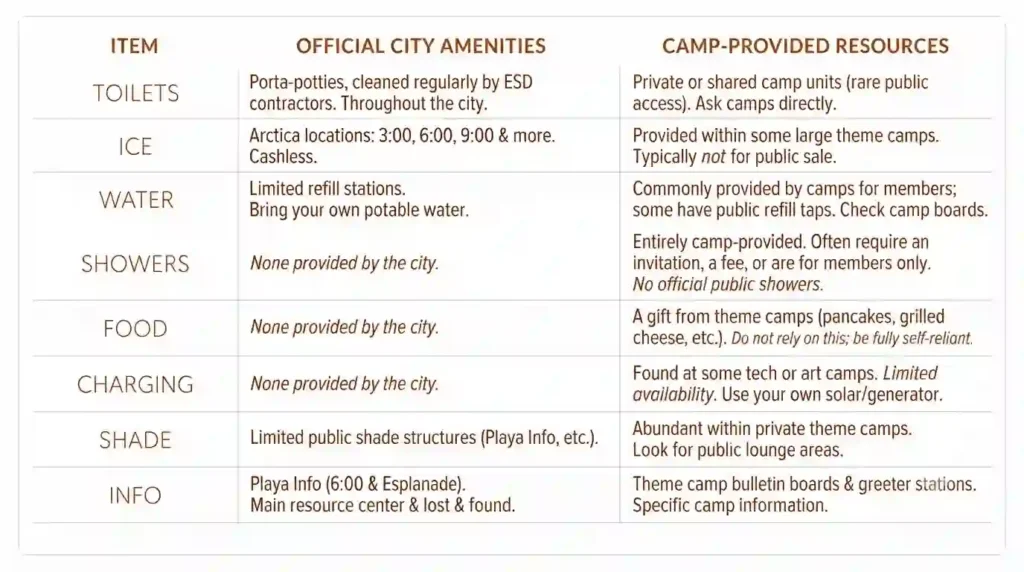
Black Rock City provides a mix of official infrastructure and grassroots hospitality. On the official side you’ll find porta-potties, ADA units, Arctica ice sales, Playa Info booths, Medical, Lost & Found, and city-run information points. Much of the rest—showers, coffee, meals, shade, charging stations—comes from theme camps and volunteer collectives who gift services to the community. Expect basic, highly functional public amenities and generous but inconsistent camp-provided comforts.
Understanding Everyday Participant Facilities
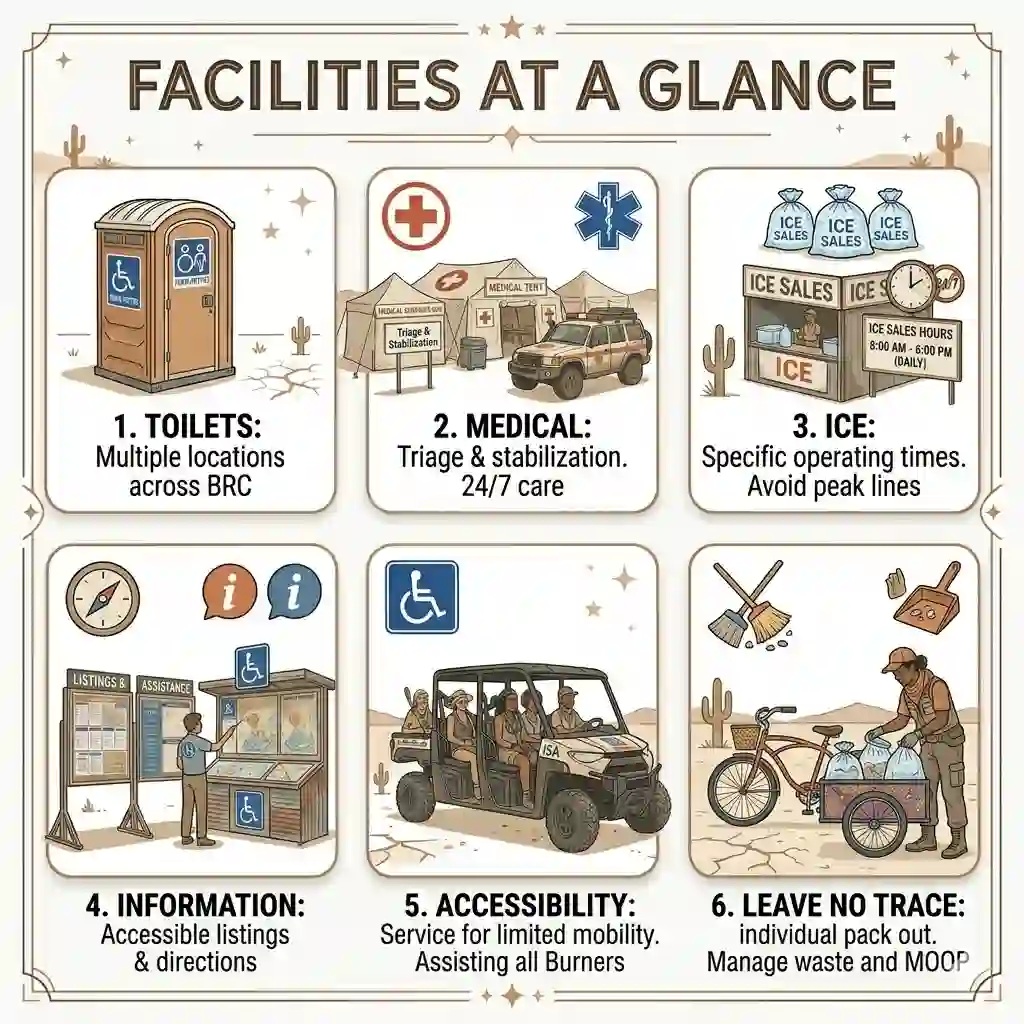
Everyday life in Black Rock City combines official city services with neighborly gifting. Portable toilets and ice are the backbone of public support. Theme camps and hospitality groups supply food, coffee, showers, and charging out of community spirit. Plan to use public services as backups and camps as generous extras—you remain responsible for essentials.
What Burning Man Provides—and What It Doesn’t
Burning Man provides core sanitation, emergency services, some public shade and info hubs, and sanctioned vendors for critical items like ice. It doesn’t provide grocery stores, full-service restaurants, continuous hot showers, or unlimited charging. There’s no running potable water piped to camps—bring your own. Understand that many comforts are volunteered, not guaranteed.
- Provides: core sanitation, emergency services, limited public shade/info booths, and sanctioned vendors for essentials (like ice).
- Doesn’t provide: grocery stores, full‑service restaurants, continuous hot showers, unlimited charging, or piped potable water to camps.
- Many comforts are volunteer-run—plan for variability and bring backups.
Planning Around Radical Self-Reliance
Radical self-reliance means bringing the basics: water, shelter, shade, food, first aid, sun protection, and power. Official amenities supplement your setup; they don’t replace it. Pack with redundancy for water, ice, and power so you never depend entirely on public or camp-provided services.
Public Amenities vs Camp-Provided Resources
Public amenities are distributed for city-wide needs and are often simple and busy. Camp-provided resources can be more comfortable and creative but vary wildly in schedule and availability. Respect gifting etiquette: take what you need, offer thanks, and never assume a camp’s generosity is an entitlement.
Essential Amenities Overview
| Facility | Purpose |
| Portable Restrooms | Sanitation |
| Ice Sales | Food preservation |
| Center Camp | Community gathering |
| Public Seating | Rest and socializing |
| Information Points | Guidance and announcements |
| Waste Stations | Responsible disposal support |
Finding Facilities Throughout the City
Each year the event publishes maps showing restroom clusters, Arctica locations, Playa Info, Medical, Lost & Found, and art placement. Save maps offline and mark key nodes: Center Camp, Man Plaza, and main spokes where services concentrate. Use Playa Info and Rangers on arrival to confirm exact locations.
- Portable toilets (porta-potties) are the primary public sanitation system. They’re installed and serviced by contractors and placed in clusters along streets and high-traffic venues. Units are basic but reliable, with periodic servicing. Expect hand-washing stations near many banks, but bring hand sanitizer for backup.
- Restroom clusters sit at regular intervals throughout the city, especially near Center Camp, major art installations, and high-traffic intersections. Look for signage and maps that mark banks of units. Playa Info can direct you to the nearest bank if you’re unsure.
- Use toilets responsibly: keep seats down, flush if available, and leave the area tidy. Zip up tents and close doors to keep dust out. Carry and use hand sanitizer or wash your hands after each use. Report damaged or overflowing units to Playa Info or Rangers rather than attempting fixes yourself.
- Keeping Public Restrooms Clean
- Carry a small disinfectant spray or wipes for quick tidy-ups. Use trash bins for non-biodegradable waste. If you see trash or bulky items in a unit, notify Playa Info—improvised fixes make things worse and can delay servicing.
- Never dispose of baby wipes, feminine products, diapers, paper towels, grease, or trash in porta-potties. These items clog systems and create major maintenance issues. Use designated sanitary bins; if none are available, pack items out with you.
Where Can You Find Portable Toilets?
Sanitation is one of the event’s highest logistical priorities, so porta‑potties are distributed in banks across city streets and near major venues. These units are contractor‑serviced, placed at predictable intervals, and usually include a number of ADA‑compliant toilets and hand‑washing stations nearby. This section explains how the public toilet system works, where you’re most likely to find clusters, rules of etiquette to keep units usable, and what to avoid putting inside units. It’s the practical primer on public sanitation so you can stay comfortable and help keep systems running.
How Burning Man Portable Toilets Work
Portable toilets (porta-potties) are the primary public sanitation system. They’re installed and serviced by contractors and placed in clusters along streets and high-traffic venues. Units are basic but reliable, with periodic servicing. Expect hand-washing stations near many banks, but bring hand sanitizer for backup.
Where Restrooms Are Located
Restroom clusters sit at regular intervals throughout the city, especially near Center Camp, major art installations, and high-traffic intersections. Look for signage and maps that mark banks of units. Playa Info can direct you to the nearest bank if you’re unsure.
- 🚻 Portable Restrooms Important Characteristics
- Locations
- Usage etiquette
- Cleanliness
- Accessibility
- Best practices
Portable Toilet Etiquette
Use toilets responsibly: keep seats down, flush if available, and leave the area tidy. Zip up tents and close doors to keep dust out. Carry and use hand sanitizer or wash your hands after each use. Report damaged or overflowing units to Playa Info or Rangers rather than attempting fixes yourself.
Keeping Public Restrooms Clean
Carry a small disinfectant spray or wipes for quick tidy-ups. Use trash bins for non-biodegradable waste. If you see trash or bulky items in a unit, notify Playa Info—improvised fixes make things worse and can delay servicing.
What Accessibility Facilities Are Available?
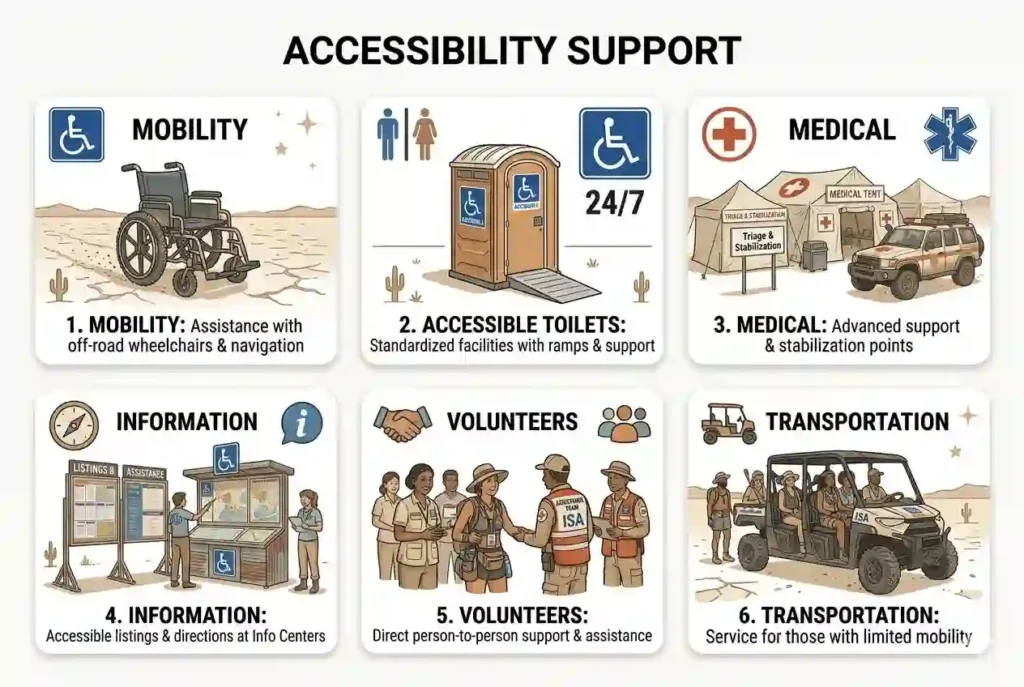
Accessibility at Burning Man focuses on creating usable public spaces while recognizing the playa’s challenging terrain. The city includes ADA‑compliant porta‑potties, mobility‑friendly access points near major venues, and on‑site assistance through Playa Info, Rangers, and accessibility volunteers. This section provides a high‑level overview of public accessibility features and where to find help, while pointing readers to the full Accessibility & Inclusion guide for detailed accommodation processes, transport options, and specialist services. Use it to quickly locate priority facilities and understand respectful etiquette for accessible resources.
ADA-Compliant Portable Toilets
Black Rock City includes ADA-compliant porta-potties in many restroom clusters and near key venues. These units are larger, ramp-accessible, and fitted with grab bars to accommodate mobility devices and users who need more space.
Mobility-Friendly Public Facilities
Some pathways and routes to major installations are maintained with mobility in mind, but playa conditions vary. Even accessible routes may have softer ground or silt. Expect variable terrain and plan routes accordingly.
Accessibility Information Resources
This guide provides an overview of accessibility facilities; the dedicated Accessibility & Inclusion guide covers applications, specific programs, and deeper supports. For on-site help, consult Playa Info, Rangers, and the event’s Accessibility team.
Respecting Accessible Facilities
Use ADA facilities only if you need them. These resources are prioritized for participants with mobility or medical needs. Misuse deprives others who rely on accessible features.
Finding Accessibility Assistance During the Event
If you need assistance finding accessible toilets, ramps, or support services, head to Playa Info or contact Rangers. Accessibility volunteers can help locate resources and provide temporary solutions when possible.
- ADA‑compliant porta‑potties and some mobility‑friendly access points are placed near central venues.
- This is a high‑level overview—detailed supports (applications, transport, specialized services) live in the Accessibility & Inclusion guide.
- Respect priority use of accessible facilities and contact Playa Info, Rangers, or Accessibility volunteers for on-site assistance.
Where Can You Buy Ice at Burning Man?
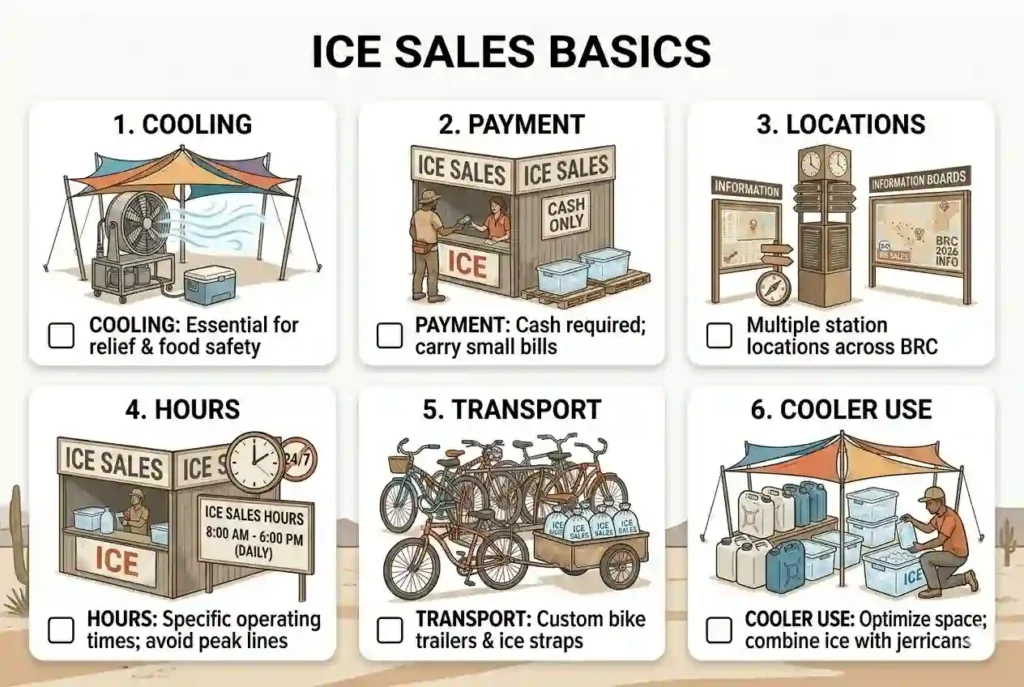
Ice is a surprisingly central resource on the playa—used for cooling, preserving food, and keeping morale high in full sun. Arctica is the sanctioned ice vendor and operates mapped sales points with scheduled hours; many camps also gift or occasionally sell small amounts. This section covers where Arctica usually sets up, when sales typically occur, how to plan your ice needs for perishables and coolers, and practical tips for moving and storing ice back to camp. Think of it as your logistics checklist for keeping things chilled when temperatures spike.
Understanding Arctica Ice Sales
Arctica is the sanctioned ice vendor. They sell bagged ice at specific distribution points across the playa. Ice is sold by the bag and is essential for cooling, preserving food, and morale—especially in full sun.
Ice Purchase Locations
Ice stations usually operate near entry points and at central city hubs; exact locations change yearly and appear on the city map. Expect lines, especially in the morning and early afternoon when camps stock up.
When Ice Is Available
Arctica operates during scheduled hours. They may not sell 24/7, and sales often peak after arrival days. Buy early to secure supply—don’t assume you’ll be able to get ice late at night.
Planning Your Ice Supply
Bring quality coolers, freeze block ice before arrival if possible, and calculate consumption based on perishables and drink cooling. Blocks and large insulated containers slow melt better than loose bag ice.
Tips for Transporting Ice Back to Camp
Use wheeled carts and insulated containers to move ice. Cover coolers from sun and secure loads to bikes or carts. Plan trips during cooler parts of the day and coordinate with campmates to consolidate runs.
- Arctica is the official ice vendor; bagged ice is sold at mapped distribution points on scheduled hours.
- Expect queues after arrival and during hot daytime hours—buy early and plan multiple runs if needed.
- Use heavy-duty coolers, freeze blocks pre-event when possible, and transport ice with carts/insulated covers to extend life.
Where Can You Find Water and Hydration Resources?
Water is a mission‑critical item and not something to improvise on the playa. Individual camps are responsible for their own potable water; public refill stations at Playa Info, Medical, or select hubs exist only as supplemental points.
This section explains typical water availability, how to plan daily and weekly water needs, expectations for public refills, and simple strategies—hydration packs, marked jugs, water managers—for keeping your camp hydrated. It avoids deep medical advice (see the Water & Hydration Guide) while giving the operational details you need to build a reliable water plan.
Understanding Water Availability
There’s no city-wide running potable water for individual camps—most water is participant-provided. Limited public refill stations (Playa Info, Medical) may exist for topping off, but these are supplemental. Bring a primary water supply for your camp.
Water Refill Expectations
Public water points are for emergencies and short fills rather than sustained supply. Don’t rely on them for daily needs; use them to top off hydration packs or handle unexpected shortages.
Planning Your Daily Water Needs
General guidance suggests 1.5 to 3 liters per person per day depending on heat and exertion; many experienced Burners plan for more during peak heat. Account for cooking, washing, and guests. Mark containers and ration water sensibly.
Staying Hydrated Throughout the Week
Space drinking across the day, use electrolyte supplements if you sweat heavily, and create visible water stations in camp to encourage regular sipping. Hydration packs reduce friction in staying hydrated while exploring.
Why Self-Sufficiency Still Matters
Because public water is limited, self-sufficiency in water is a core participation principle. Coordinate refill schedules within your camp and assign a water manager to track supplies and top-offs.
- No piped potable water to camps; public refill points (Playa Info/Medical) are supplemental and limited.
- Bring your primary water supply and plan conservatively (commonly 1.5–3+ liters/person/day depending on activity and heat).
- Use hydration packs, marked jugs, and a camp water‑management plan; public refills are backups, not main sources.
Are There Food, Coffee, and Beverage Camps?
Food and beverage culture at Burning Man is overwhelmingly based on gifting. Theme camps and hospitality collectives range from pop‑up snack stations to full communal meals; coffee camps are a beloved staple. This section outlines the difference between gifted hospitality and commercial sales, where and how you’ll find coffee and meals, how to read camp schedules and bulletin boards, and how to manage expectations—especially if you have dietary restrictions. Use it to find community food options while still planning your main food supply.
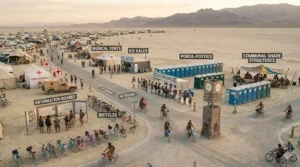
Understanding Community Food Camps
Food at Burning Man is overwhelmingly gifted by camps and individuals. Hospitality ranges from simple snacks and fruit to full communal dinners. These offerings reflect camp capacity and schedules—be grateful and don’t assume constant availability.
Coffee Camps Around the City
Coffee camps are a beloved playa institution. They offer free coffee as a gift, often with set hours and community rules. Popular coffee camps can draw lines; arrive early or come during off-peak hours for a quicker cup.
Gifting Food vs Commercial Sales
The culture centers on gifting; commercial sales are generally prohibited except for sanctioned vendors. If a camp posts a menu with prices, check if it’s authorized. Otherwise, assume food is gifted and show appreciation through thanks, help, or a small reciprocal service.
Finding Pop-Up Hospitality Experiences
Schedules for hospitality events are often posted on camp boards, Playa Info, or event apps. Walk the city—many delightful meals and coffee happen spontaneously and are among the best surprises of the burn.
Managing Expectations About Meals
If you have dietary restrictions, bring your own staples. Don’t count on restaurants or continuous meal service. Plan a mix of self-prepared food and gifted meals to stay flexible and nourished.
- Food is mostly gifted by theme and hospitality camps; coffee camps are common social hubs but can run out.
- Commercial sales are rare—assume gifting culture and bring your own food for dietary needs or guarantees.
- Check camp bulletin boards, Playa Info, and walk the city to find pop‑up hospitality and posted schedules.
Are Public Showers Available?
Showers on the playa are limited and often run by camps or volunteer groups rather than provided as a citywide service. You’ll find everything from simple solar shower bags to trailer‑mounted shower rigs offered by hospitality camps.
This section explains typical shower availability, how camp‑based shower systems operate, and practical alternatives—wipes, no‑rinse washes, sponge baths—plus water‑conservation practices and Leave No Trace considerations. It helps you plan hygiene routines that match the reality of limited shower infrastructure and the community systems that supplement it.
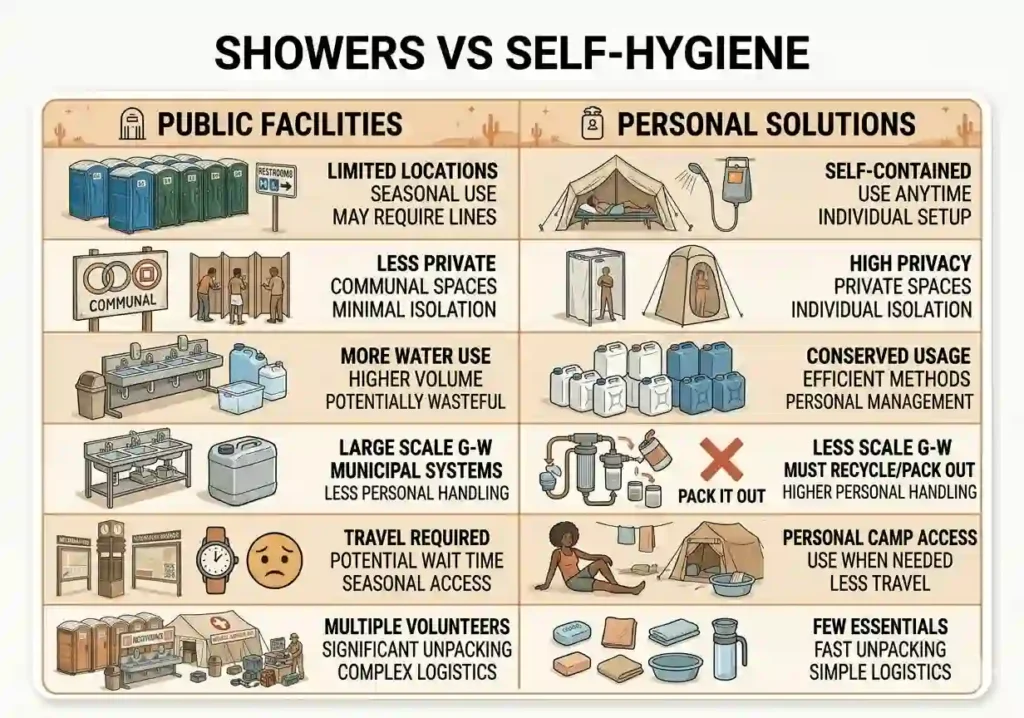
Understanding Shower Availability
Large, permanent public showers are uncommon. Some years, centralized shower trailers appear, but most showering happens via camp systems—solar shower bags, bucket showers, or volunteer-run trailer showers. Showers are often limited and scheduled.
Camp-Based Shower Systems
Many camps offer showering as a gifted service with posted hours and rules. These systems vary from simple solar setups to elaborate rigs with tanks and privacy stalls. Bring towels, modesty wraps, and shower shoes.
Personal Hygiene Alternatives
Wipes, no-rinse bodywash, sponge baths, and dry shampoo are staples for many Burners. These options use less water and keep you comfortable between proper washes.
Water Conservation Practices
Shower with the shortest time possible and reuse graywater when permitted by your camp’s Leave No Trace practices. Use biodegradable soaps only when allowed and only in designated systems.
Staying Comfortable Without Traditional Facilities
Plan multiple hygiene strategies: wipes after dusty activities, quick face washes at communal sinks, and a rotation of fresh clothing. A little routine upkeep goes a long way for morale and health.
- Permanent public shower infrastructure is uncommon; most showers are camp‑run (solar bags, bucket systems, or volunteer trailers).
- Bring hygiene alternatives (wipes, no‑rinse wash), towels, and modesty wraps; expect posted hours and limits.
- Conserve water, follow graywater and Leave No Trace rules, and plan hygiene routines that suit limited facilities.
Can You Charge Phones and Electronics?
Power and charging are a patchwork of official, camp, and personal solutions. Official charging stations are rare and often crowded; many camps run charging tables as gifts, and personal solar panels and power banks are the most reliable options.
This section covers public charging expectations, how camps typically manage charging stations, practical solar and battery solutions, tips for labeling and managing devices, and recommendations for planning power before arrival so you don’t find yourself out of juice at a critical moment.
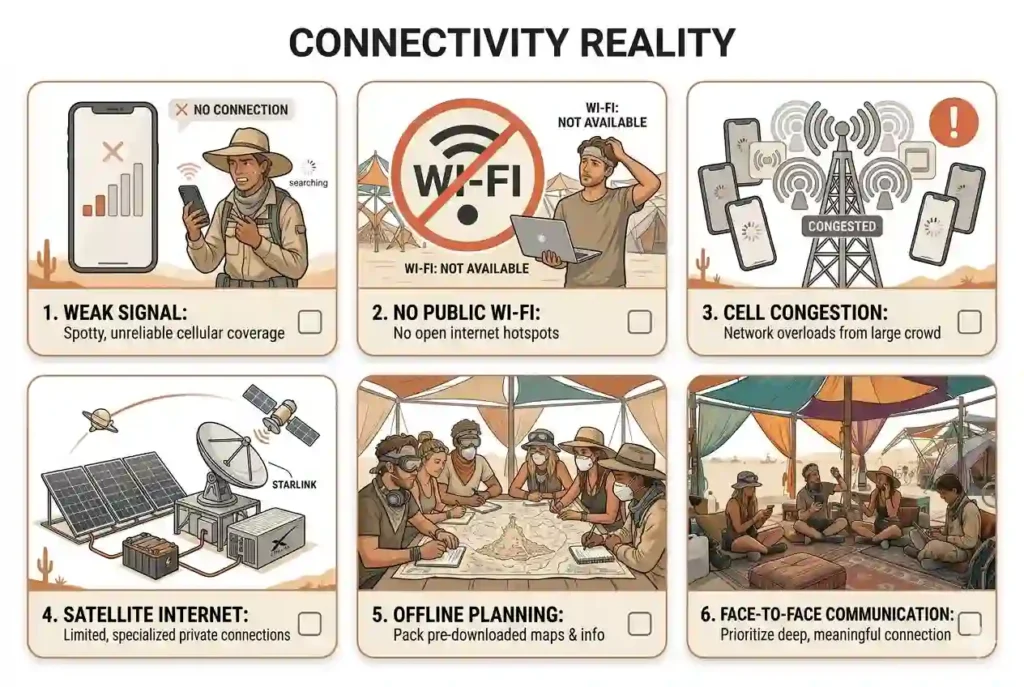
Public Charging Expectations
Official charging stations are scarce and not guaranteed. When they exist, they fill quickly. Don’t expect reliable, fast charging from public sources.
Camp Charging Options
Many camps run charging tables as gifts. These are generous but often require queuing and may have rules about session lengths. Ask the volunteer charging crew how to sign in or leave devices.
Solar Charging Solutions
Portable solar panels and solar-charged power banks are widely used. They’re particularly effective for small devices and can keep essentials running if you plan properly.
Battery Management Tips
Bring high-capacity power banks, spare batteries for critical devices, and multi-port chargers. Put devices into low-power modes and label chargers to avoid mix-ups.
Planning Power Before Arrival
Decide whether your camp will host generator or solar setups and contribute to those systems. Bring personal backups so you’re not entirely dependent on communal power.
- Official charging stations are scarce and often crowded; don’t depend solely on public charging.
- Many camps gift charging tables—expect queues and time limits; bring high‑capacity power banks, spare batteries, and portable solar panels.
- Label chargers, use low‑power settings, and coordinate with your camp’s power strategy (solar/generator) for backups.
Where Can You Rest During the Day?
Daytime rest is about finding shade, quiet, and cooling in an environment where fixed infrastructure is limited. Center Camp and a few plazas offer public shade, but most comfortable spots—large canopies, seated lounges, misters—come from theme camps and hospitality areas.
This section surveys public shade options, community gathering spaces, cooling strategies, and where to find quieter blocks or family zones to recharge. It also covers etiquette for using shared resting areas so you can relax without overstaying someone else’s hospitality.
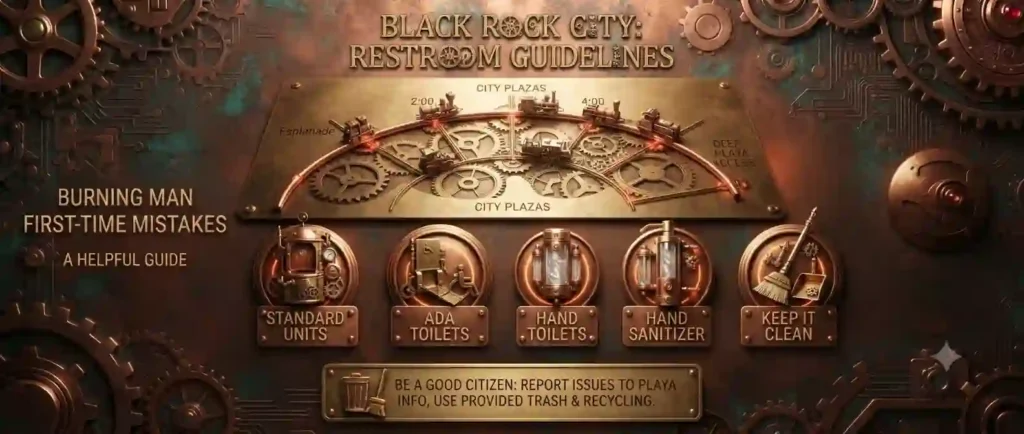
Public Shade Structures
Shade is at a premium. Center Camp and a handful of plazas offer built shade, but the best rest spots are often camp-created canopies. Aim to seek shade in cooler hours and contribute to shared shade spaces when you can.
Community Gathering Spaces
Theme camps provide much of the daytime lounging and socializing—seating, water stations, and quiet corners. Check camp postings for schedules and participation expectations.
Cooling Down Between Adventures
Some camps offer misting stations, chilled towels, or ice buckets for quick cooldowns. Use these strategically and avoid blocking access to others.
Quiet Places to Recharge
Look for family camps, satellite neighborhoods, or outer blocks where foot traffic is lighter. Quiet is a valued commodity—enter those spaces with awareness and gratitude.
Using Shared Spaces Respectfully
Ask before you settle in, keep your area tidy, and limit stay time when spaces are busy. Offer thanks or help if you can—small contributions keep shared spaces welcoming.
- Public shade is limited (Center Camp/plazas); most daytime rest comes from camp canopies and hospitality spaces.
- Seek misting stations, shady art installations, or quieter neighborhood blocks and family zones for downtime.
- Ask before settling in, follow posted rules, and limit stay time in busy shared spaces.
What Family-Friendly Facilities Are Available?
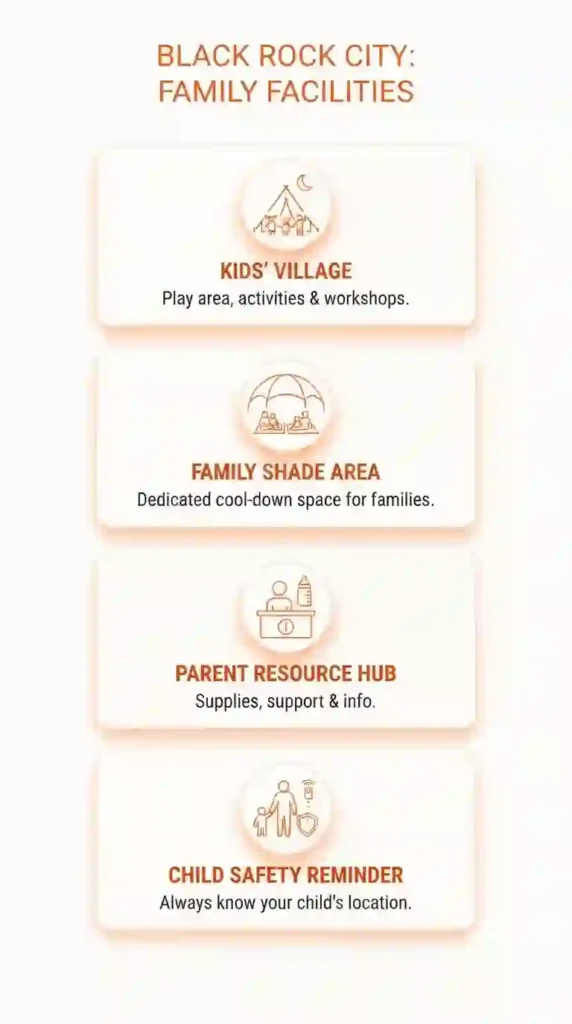
Families are welcomed with specific camps and quieter zones designed for children’s safety and play. Family camps and Kids’ Village provide scheduled activities, shaded play areas, and community support, but you still must bring core supplies and supervise constantly.
This section highlights kid‑friendly community spaces, family gathering areas, resources parents should pack, safety considerations, and tips for planning a comfortable family experience on playa so families can balance creativity with predictable routines.
Kid-Friendly Community Spaces
There are family-friendly camps and Kids’ Village areas that provide play spaces, activities, and safer, quieter environments for children. These areas are community-run and follow specific rules to protect kids.
Family Gathering Areas
Family zones are generally quieter and closer to essential facilities. Check maps for Family Camp and quiet neighborhoods if traveling with children.
Resources for Parents
Bring child-focused gear—sun protection, shade canopies, extra water, easy snacks, and a small first-aid kit. Coordinate with Family Camp in advance for specific needs and local help.
Child Safety Considerations
The playa is an unpredictable environment—supervise children constantly, use bright clothing and name tags, and set clear check-in times and points with your camp.
Planning a Comfortable Family Experience
Arrive early to position near amenities, coordinate with family-oriented camps, and set expectations for daily routines so kids get enough rest and hydration.
- Family camps and Kids’ Village offer play areas, scheduled activities, and quieter, safer zones for children.
- Parents should bring extra shade, child-sized gear, ample water, sunscreen, and a child‑specific first‑aid kit.
- Supervise children constantly, use high‑visibility clothing/name tags, and set clear check‑in points with your camp.
What Everyday Resources Help You Live Comfortably?
Comfort on the playa depends on small, repeatable resources: clear bulletin boards and Playa Info for schedules, bike parking and visibility systems, communal toolboxes, and camp first‑aid kits. This section lists everyday conveniences that keep life running smoothly—where to find posted notices, how bike parking typically works, what camp‑shared items to expect, and a checklist of convenience items to bring. It emphasizes practical camp organization—roles, redundancy, and small systems that prevent daily friction.
Information Boards and Community Notices
Find schedules, art info, and service listings on camp bulletin boards and Playa Info kiosks. These boards are critical for discovering pop-up hospitality and scheduled needs.
Bike Parking Areas
Bike parking clusters are common near major hubs. Use bright flags, lock bikes when possible, and walk them in crowded areas to avoid collisions.
Camp Resource Sharing
Many camps maintain communal toolboxes, spare supplies, and first-aid kits. Ask politely and offer something in return, whether help, a gift, or later reciprocation.
Convenience Items to Bring Yourself
Bring: ample water, a sturdy shelter and shade, toilet paper, hand sanitizer, sunscreen, hat, goggles, dust mask, basic tools, batteries and power banks, and a compact first-aid kit. Extras for gifting are always appreciated.
Preparing for Self-Reliance
Assign camp roles for water management, first aid, shade setup, and communications. Run a pre-event checklist and keep redundancy in water, ice, and power to avoid emergency shortfalls.
- Key resources: Playa Info and camp bulletin boards for schedules, bike parking (use flags/locks), camp toolboxes, and shared first‑aid kits.
- Pack conveniences: toilet paper, hand sanitizer, sunscreen, goggles, dust masks, basic tools, batteries, power banks, and spare parts.
- Assign camp roles (water manager, medic, bike repair) and maintain redundancy in critical supplies.
What Mistakes Do First-Timers Make About Amenities?
Newcomers often assume festival‑style conveniences, underestimate consumables, or misunderstand gifting etiquette. Common errors include expecting stores and 24/7 services, underpacking water/ice/power, relying on theme camps as a primary plan, and misusing accessible or public facilities. This section walks through those common mistakes with clear examples and short corrective tips so first‑timers can replace assumptions with realistic planning and respectful behavior.
Expecting Festival-Style Services
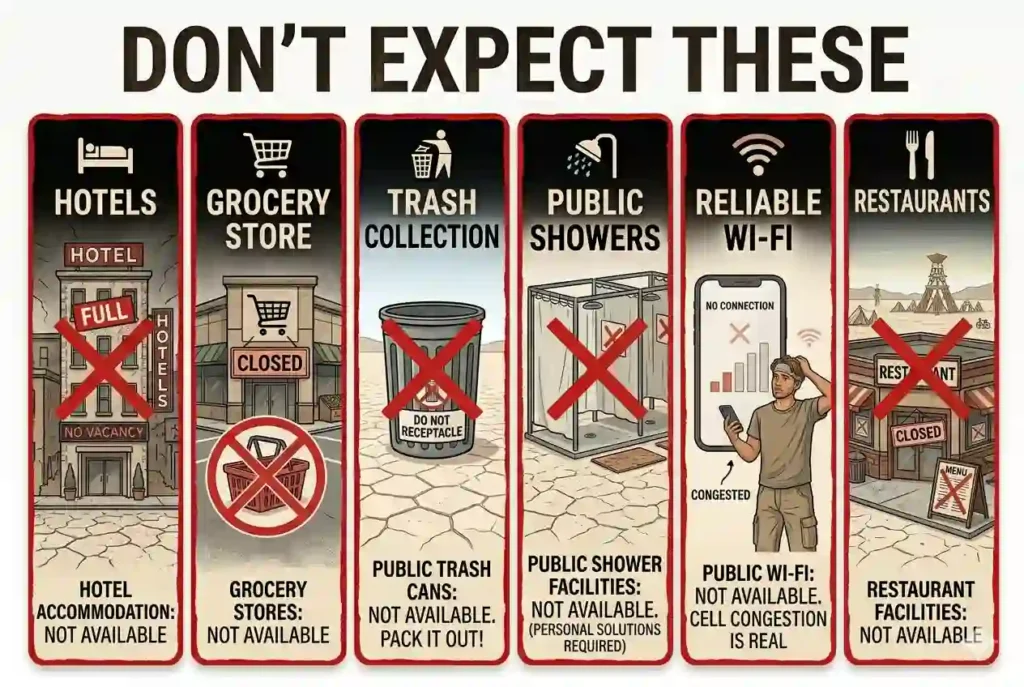
First-timers often assume festival-standard amenities (restaurants, convenience stores, endless showers). Burning Man is different—plan to be self-sufficient and grateful for community gifts.
Assuming Everything Is Available 24/7
Many services and camp hospitality have limited hours. Public units may be serviced on schedules; don’t expect round-the-clock availability.
Forgetting Backup Supplies
Underestimating water, ice, batteries, and shade is common. Extra supplies prevent discomfort and emergencies.
Misunderstanding Radical Self-Reliance
Counting on others for basic survival needs can leave you stranded. Bring essentials and use community services as enhancing supports.
Relying Too Much on Theme Camps
Theme camps are generous but limited. They’re not a substitute for your own planning—respect the boundary between gift and dependence.
Not Learning Basic Facility Etiquette
Improper toilet use, misuse of accessible facilities, or leaving shared spaces messy harms the community. Learn and follow basic etiquette; it preserves resources for everyone.
⚠️ Common Mistakes
- Ignoring Leave No Trace.
- Assuming free drinking water is available.
- Forgetting ice melts quickly.
- Leaving trash in public spaces.
- Relying on public power.
- Misusing portable restrooms.
- Expecting festival‑style services (stores, restaurants) instead of self‑reliance.
- Assuming 24/7 availability and underpacking water, ice, power, and shade.
- Over-relying on theme camps and poor facility etiquette (using ADA units unnecessarily, leaving messes) strains resources.
What Do Experienced Burners Recommend?
Seasoned participants emphasize over‑preparing, mapping essentials early, and treating community resources with care. Practical recommendations include bringing extra supplies, plotting restroom/ice/Playa Info locations on arrival, labeling gear, offering reciprocal gifts for camp hospitality, and keeping backup power and water plans. This section compiles the most reliable, camp‑tested tips from experienced Burners to help you avoid common pitfalls and make the most of both public amenities and camp offerings.
Daily Facility Checklist
| Before Leaving Camp | ✓ |
| Water bottle filled | ☐ |
| Ice checked | ☐ |
| Portable toilet supplies | ☐ |
| Battery charged | ☐ |
| Trash bag packed | ☐ |
| Map available | ☐ |
Bring More Than You Think You’ll Need
Stock up on consumables; it’s better to return with extras than run out. Water, ice, batteries, and shade are top priorities.
Know Where Essential Facilities Are Located
Upon arrival, map restrooms, Arctica, Playa Info, Medical, and Lost & Found. Share this with campmates and post a copy in your camp.
Use Shared Resources Responsibly
Take only what you need from a camp’s offerings, adhere to posted rules, and offer help or a small gift in return.
Always Have a Backup Plan
Plan alternate ways to hydrate, cool down, and power devices. Backups keep you safe on hot or dusty days.
Respect Accessibility Facilities
Conserve ADA resources for those who need them. Report issues that affect access so staff can respond.
Leave Every Shared Space Better Than You Found It
Carry extra trash bags, pick up visible litter, and report maintenance issues. Small actions protect community resources.
- Bring more supplies than you think you’ll need—water, ice, batteries, shade.
- Map essential services on arrival (restrooms, Arctica, Playa Info, Medical, Lost & Found) and share with campmates.
- Use shared resources responsibly, have backup plans, respect accessibility facilities, and leave shared areas cleaner than you found them.
Making the Most of Black Rock City’s Amenities
The city’s amenities shine when individual preparedness meets communal generosity. Small services—shaded benches, a water cooler, a quiet lounge—amplify quality of life; they’re most effective when campers plan baseline self‑reliance and treat gifted offerings as extras. This section explains how to combine planning with community etiquette to access services responsibly, encourage reciprocity, and contribute to the systems that support everyone’s participation.
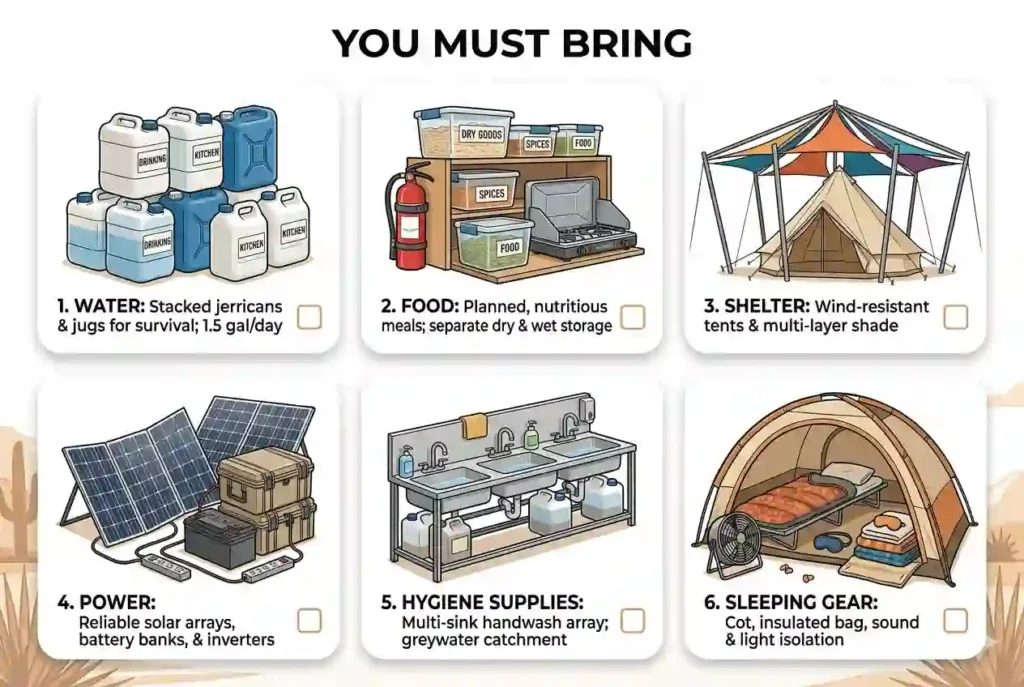
What You Must Bring Yourself
| Item | Reason |
| Drinking water | Self-reliance |
| Food | Personal responsibility |
| Power bank | Limited charging |
| Hygiene supplies | Personal comfort |
| Shade | Desert protection |
| First-aid kit | Basic preparedness |
Self-Reliance and Community Work Together
Amenities work best when individuals arrive prepared and the community fills in extra comforts. Plan your baseline, then enjoy the gifts and creativity of the city.
Small Amenities Make a Big Difference
A shaded table, water cooler, or charging bench can be a city lifeline. Treat community resources with care and contribute when you can.
Planning Ahead Creates a Better Burn
Good planning improves your own experience and reduces strain on public and camp resources. The better-prepared the city is, the more people can participate fully.
- Amenities work best when personal preparation meets community gifting—plan a strong baseline and enjoy camp generosity.
- Small amenities (shade, water coolers, charging benches) have outsized impact—treat them with care and contribute where possible.
- Planning ahead and pitching in keeps city services functioning and benefits everyone.
Amenities & Facilities in Number
Although Burning Man encourages Radical Self-Reliance, Black Rock City provides essential public amenities that help support everyday life during the event. Knowing where these facilities are located will make your experience safer, easier, and more enjoyable.
Key Numbers
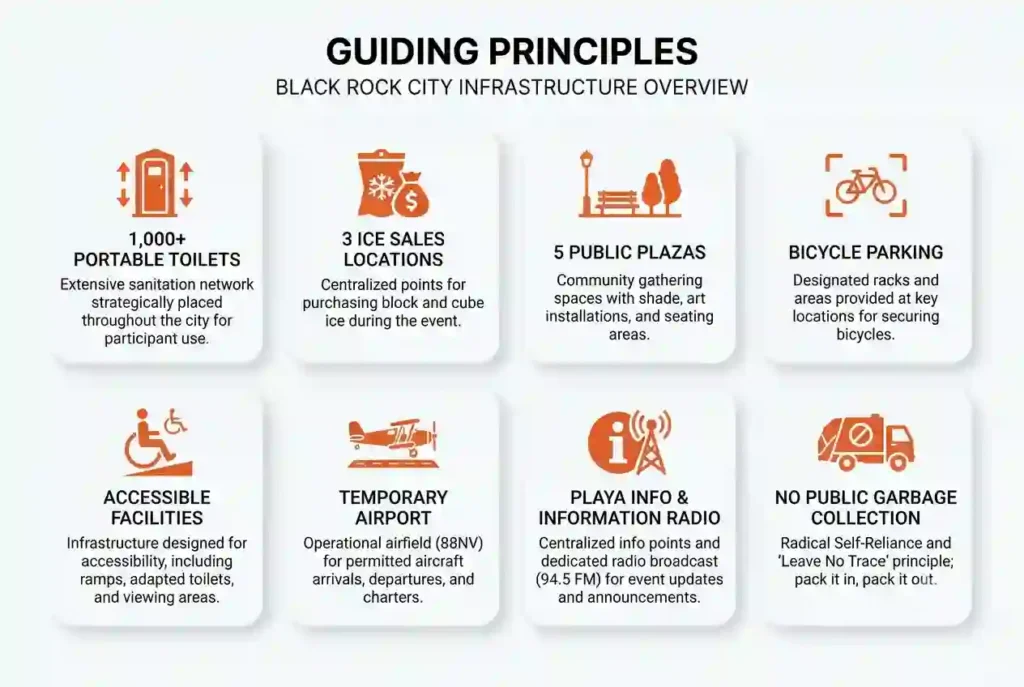
- 🚻 1,000+ Portable Toilets — More than one thousand porta-potties are distributed throughout Black Rock City and serviced 24 hours a day.
- 🧊 3 Main Ice Sales Locations — Arctica sells ice at Center Camp, 3:00 & G, and 9:00 & G during the event.
- 🏛️ 5 Public Plazas — Community plazas provide gathering spaces surrounded by theme camps and public activities.
- 🚲 Thousands of Bicycle Parking Areas — Bike parking is available throughout Black Rock City near major destinations.
- ♿ Accessible Public Facilities — ADA-accessible toilets and accessibility resources are available across the city.
- 🛬 Temporary Airport — Black Rock City includes a temporary airport serving approved aircraft operations.
- 📻 Information Radio & Playa Info — Official information channels keep participants informed throughout the event.
- ❤️ No Public Garbage Collection — Every participant must pack out all waste under the Leave No Trace principle.
Amenities & Facilities Myths vs Reality
| Myth | Reality |
|---|---|
| Burning Man has no public facilities. | Black Rock City provides toilets, ice sales, plazas, accessibility facilities, medical stations, and information services. |
| There are showers available for everyone. | Public showers are not provided. Participants must bring their own bathing solutions or use camp facilities if available. |
| Drinking water stations are everywhere. | Participants must bring and manage their own drinking water; there are no public potable water stations. |
| Ice is sold everywhere. | Ice is only available at official Arctica locations. |
| Trash bins are available around the city. | There are no public trash cans or garbage collection services. Everything must be packed out. |
| Portable toilets are difficult to find. | Toilet banks are distributed throughout the city and marked on official maps. |
Final Thoughts
Facilities and amenities are tools that support community participation, not a replacement for good planning. Respect for accessibility, sanitation, and shared spaces keeps services functioning and preserves goodwill. This section reiterates the core message: pack redundantly, map essential services on arrival, follow etiquette, and help maintain shared resources so Black Rock City remains livable and generous for all participants.
Facilities Support the Community—They Don’t Replace Preparation
Official amenities and gifted camp services are invaluable, but they are not a substitute for personal planning. Bring essentials, honor communal offerings, and help maintain what we all share.
The Best Resource You Bring Is Good Planning
Arrive with redundancy: water, shelter, coolers, power, and attitude. Map resources on arrival and rotate responsibilities so your camp functions smoothly.
Respect Shared Spaces and Help Keep Black Rock City Running
Respect accessibility, use public services correctly, and pitch in—these small actions keep amenities available and the city healthy.
Amenities & Facilities Checklist
Before Arriving
✅ Bring all drinking water
✅ Pack enough food for your stay
✅ Bring personal hygiene supplies
✅ Download the official city map
After Arriving
✅ Locate the nearest toilet bank
✅ Find the closest Arctica ice location
✅ Identify nearby plazas
✅ Visit Playa Info
During Your Stay
✅ Use only official toilets
✅ Buy ice before your cooler runs low
✅ Lock your bicycle near public facilities
✅ Carry your own reusable water bottle
Before Leaving
✅ Remove all trash and MOOP
✅ Empty coolers responsibly
✅ Check your campsite carefully
✅ Leave the playa cleaner than you found it
Essential Amenities at a Glance
| Facility | What It Provides | Available to Participants | Notes |
|---|---|---|---|
| Portable Toilets | Public sanitation | ✅ Yes | Available throughout the city |
| Arctica Ice Sales | Ice for coolers | ✅ Yes | Official locations only |
| Public Plazas | Gathering spaces | ✅ Yes | Community events and art |
| Playa Info | Maps and information | ✅ Yes | Participant assistance |
| Bicycle Parking | Bike parking areas | ✅ Yes | Near major destinations |
| Accessible Facilities | ADA support | ✅ Yes | Throughout Black Rock City |
| Public Showers | Shower facilities | ❌ No | Bring your own hygiene solution |
| Public Trash Collection | Garbage disposal | ❌ No | Pack out everything |
Amenities & Facilities FAQs
This FAQ collects quick, direct answers to the questions attendees ask most: where bathrooms and ADA units are, where to buy ice, whether showers and running water exist, charging options, food availability, family support, and what first‑timers should memorize. Each answer is short, practical, and links readers to deeper pillar pages (Water & Hydration Guide, Accessibility & Inclusion, Food & Nutrition) for how‑to details.
Yes. More than 1,000 portable toilets are available throughout Black Rock City and serviced around the clock.
Yes. Ice is sold only at official Arctica locations during scheduled operating hours.
No. Burning Man does not provide public showers, so participants should bring their own hygiene solutions.
No. Participants are responsible for bringing enough potable water for their entire stay.
No. Burning Man has no public garbage collection, and all waste must be packed out.
Yes. ADA-accessible portable toilets are located throughout Black Rock City.
Visit Playa Info or listen to Burning Man Information Radio for official updates.
Generally no. Aside from limited services such as ice (and a few exceptions), participants should not rely on purchasing food and must bring their own supplies.
Portable toilets, Playa Info, bicycle parking, and Arctica ice stations are among the most frequently used public facilities.
Assuming Burning Man functions like a commercial festival with shops, food vendors, showers, and convenience stores—it does not.
No. Black Rock City has no grocery stores, pharmacies, or convenience shops, so arrive fully prepared with everything you’ll need.
Where Should You Go Next?
| If You Want To… | Read This Guide |
| Learn city operations | → City Services & Resources |
| Prepare for survival | → Survival Guide |
| Understand emergency support | → Health & Emergency Guide |
| Navigate the city | → City Guide |
| Learn Leave No Trace | → Leave No Trace Guide |
Conclusion
Black Rock City’s amenities help support everyday life, but they are designed to complement—not replace—personal preparation. Understanding where facilities are located and how to use them responsibly allows everyone to enjoy a cleaner, safer, and more comfortable experience while respecting the community and the desert environment.
Final Thoughts
📖 Continue with the City Services Guide to understand how Black Rock City operates behind the scenes.
🚻 Use public facilities responsibly.
🧊 Plan ahead for ice and supplies.
☕ Public gathering spaces encourage community.
🚰 Bring your own water and essentials.
♻️ Practice Leave No Trace.
❤️ Respect shared spaces.
🏕️ Self-reliance remains essential.
Why Trust This Guide?
✅ Links to survival and city service guides for complete preparation.
✅ Updated for the 2026 Burning Man season.
✅ Covers participant-facing facilities available in Black Rock City.
✅ Focuses on practical day-to-day needs.
✅ Encourages Radical Self-Reliance alongside responsible facility use.
Amenities & Facilities Pro Tips
🧊 Buy ice early before afternoon queues become longer.
🚻 Learn the locations of nearby toilet banks on your first day.
🚲 Always lock your bicycle when visiting public facilities.
💧 Carry your reusable water bottle everywhere.
🗺️ Save Arctica and Playa Info locations on your offline map.
♿ Familiarize yourself with accessibility facilities if traveling with someone who may need them.
🌅 Explore the public plazas—they’re excellent places to discover art, performances, and community activities.
❤️ Remember: Burning Man provides essential facilities, but Radical Self-Reliance means you’re responsible for your food, water, shelter, and personal comfort.