
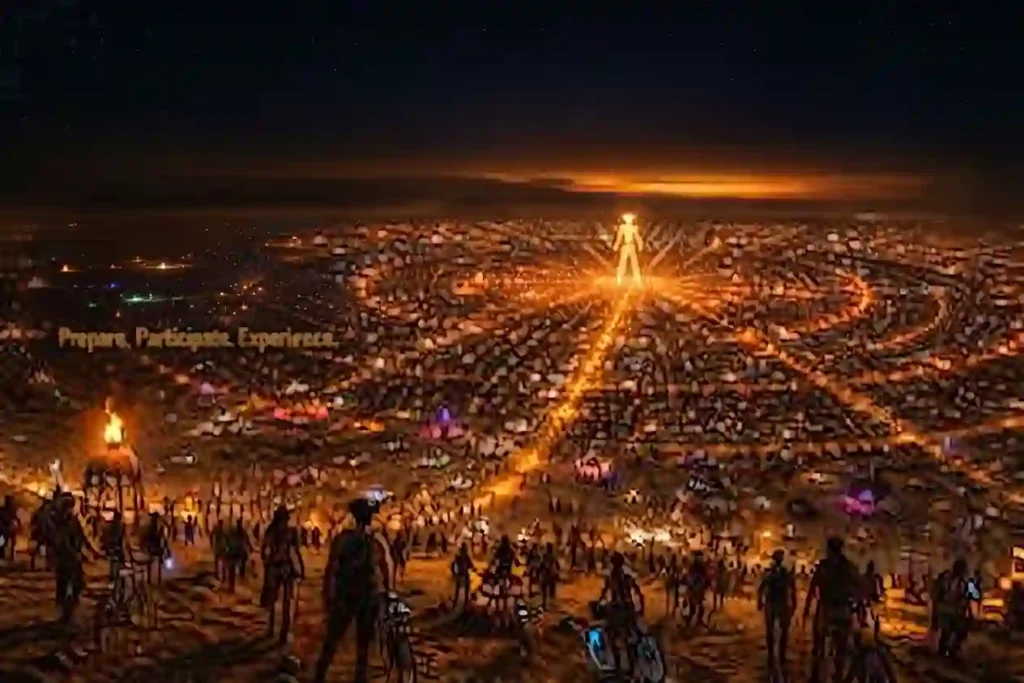
Black Rock City Guide 2026: Explore the Temporary City of Burning Man
Explore Black Rock City at Burning Man 2026. Learn about the city map, theme camps, art, landmarks, services, amenities, transportation, accessibility, photography, and daily life.
Each year in late August, a functioning city rises from an empty stretch of Nevada’s Black Rock Desert and disappears completely nine days later, leaving no trace of its existence behind. Black Rock City is built around a distinctive radial street plan, organized like clock positions around a central point, with The Man at its heart and the Temple positioned on the open playa beyond the residential arc. At its peak in recent years, the city has hosted around 72,000 people — making it, for that single week, one of Nevada’s largest population centers.
This guide introduces every major component of the city: how to read the official map and radial street system, the theme camps that function as neighborhoods and community hubs, iconic landmarks like The Man, the Temple, and Center Camp, the volunteer-run departments (Rangers, DPW, Arctica ice sales, Emergency Services) that keep the city operating, and the transportation options — walking, cycling, and mutant vehicles — used to get around. It’s written for both first-timers trying to picture the city before arrival, who make up roughly a quarter of each year’s population, and returning Burners looking for a refresher on any specific area.
Rather than covering every topic exhaustively here, this pillar page gives a working overview of the city as a whole and links to a dedicated guide for each component — the map, theme camps, landmarks, amenities, services, transportation, accessibility, and photography — so you can explore whichever aspect matters most to your planning.
On This Page You’ll Explore
- 🗺️ Black Rock City map and layout
- 🎨 Art and creative installations
- 🏕️ Theme camps and neighborhoods
- 🌅 Activities and experiences
- 🏛️ Iconic landmarks
- 🏕️ Public amenities and facilities
- 🛠️ City services and infrastructure
- 🚲 Transportation within the city
- 📸 Photography and media guidelines
- ♿ Accessibility and inclusion resources
What Is Black Rock City?
Black Rock City is the living, breathing container for Burning Man: a seasonal, participant-built city that appears on Nevada’s playa each year and disappears without a trace. It’s more than an event site it’s a social experiment where thousands of people co-create public life, art, and infrastructure from scratch.
Expect dense neighborhoods, massive art, improvisational services, and a culture that prizes participation over spectatorship. Whether you’re curious about its history, civic logic, or day-to-day rhythms, Black Rock City combines intentional design with wild creativity, and understanding it helps you move from visitor to active participant.
Understanding Black Rock City
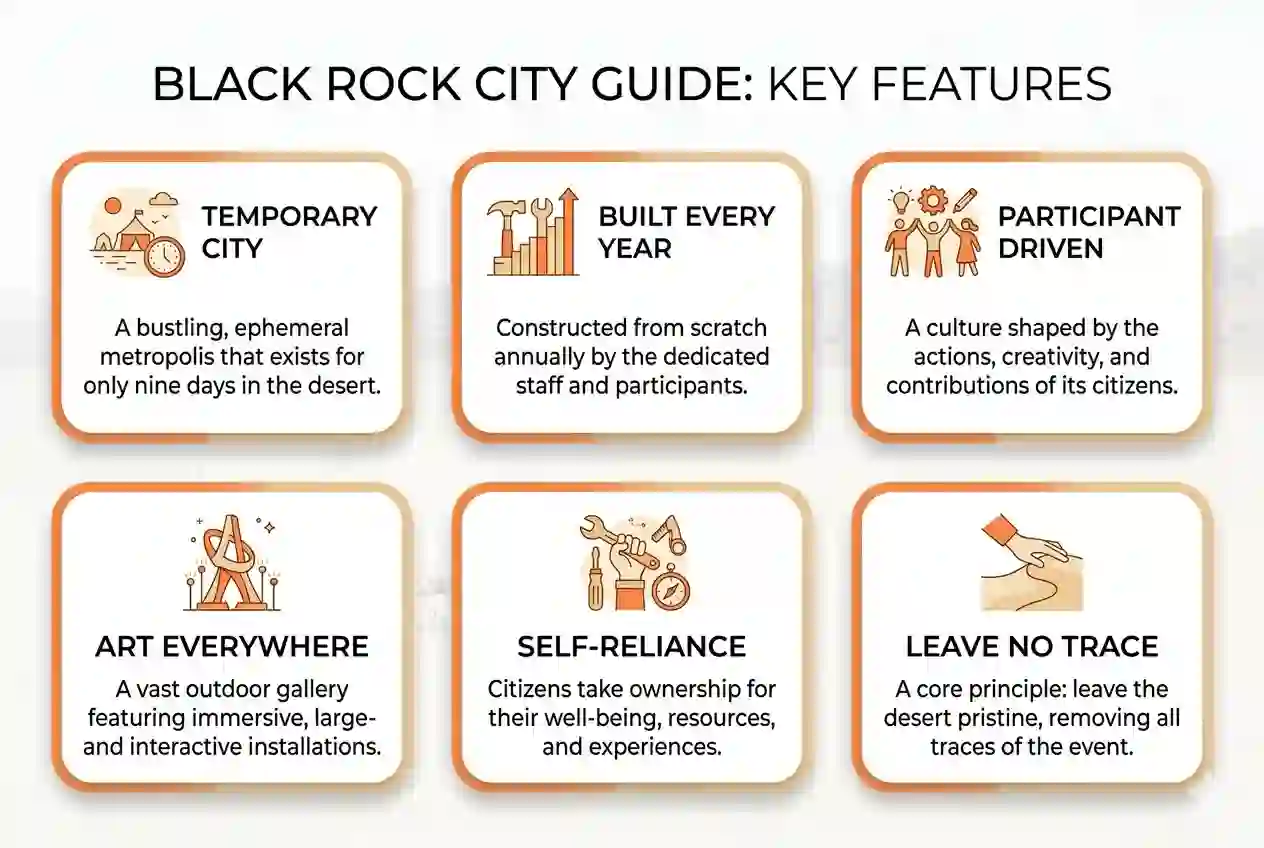
Black Rock City (BRC) is the once-a-year city built on the alkaline flats of Nevada’s Black Rock Desert for Burning Man. It’s a deliberately temporary municipality streets laid out, services run, art erected, communities formed then taken apart and removed after the event. Think of it as a full-scale, participant-driven experiment in community, creativity, and radical self-reliance.
Why Black Rock City Exists
At its core, BRC exists to host Burning Man’s culture and principles: radical self-expression, gifting, decommodification, communal effort, civic responsibility, leaving no trace, and participation. It’s a place where art and social norms are intentionally different: people are makers first and consumers second, and social interaction is often the primary “program.”
How Black Rock City Is Built Each Year
BRC’s construction is a massive choreography. Months of planning start with the Playa Restoration Plan and layout design, then road crews, civic teams, and volunteers mark the ring and radial streets. Art teams bring in sculptures and installations; theme camps arrive with infrastructure for shade, sound, and shared kitchens. Key services medical, Rangers, DPW (Department of Public Works), greeters set up before participants pour in. By the end of the event, all structures are deconstructed and the site is cleaned to meet strict Leave No Trace standards.
- Temporary city concept
- Annual construction
- Participant involvement
- City planning
- Infrastructure
Population and Scale
The population fluctuates annually; recent burns have seen between 60,000–80,000 participants. That makes BRC larger than many small towns but compressed onto a very different footprint radial streets and tight camps that create intense density and social opportunity.
Black Rock City as a Temporary Community
Because everyone comes in with specific roles artists, camp organizers, volunteers, sound crews the social fabric is woven rapidly. That intensity creates deep short-term social bonds, but it also requires clear ethics and expectations: respect personal boundaries, participate where you can, and pitch in to keep the city functioning.
Black Rock City at a Glance
| Feature | Overview |
| Location | Black Rock Desert, Nevada |
| Population | Tens of thousands of participants |
| Duration | Approximately one week |
| Layout | Radial city with named streets |
| Transportation | Walking and bicycles |
| Major Landmarks | The Man, Temple, Center Camp |
| Community | Theme camps and neighborhoods |
| Principles | Participation, gifting, Leave No Trace |
What Makes It Different from Other Cities
- Temporariness: BRC exists for roughly a week and disappears, so infrastructure emphasizes mobility and removability.
- Participant-driven: Most offerings from camps to art are created and run by attendees, not outside vendors.
- No commerce: There’s no money exchanged for goods or experiences inside the city (with some limited exceptions like ice sales through official vendors).
- Culture-first planning: Rules and logistics are built around fostering community participation and safety, not profit.
How Is Black Rock City Organized?
Black Rock City’s organization is a practical art form: planners map a semicircle of radials and rings, volunteers staff essential services, and camps and installations slot into neighborhoods to create a living city. The layout is deliberately legible — a clock-based address system, concentric avenues, and named plazas so people can find each other in a dense, temporary settlement. Beyond physical design, organization includes civic systems (Rangers, DPW, medical), governance norms, and volunteer roles; together they keep the city safe, functional, and aligned with Burning Man’s guiding principles.
- Radial street design
- Clock positions
- Plazas
- Neighborhoods
- Open playa
Understanding the City Layout
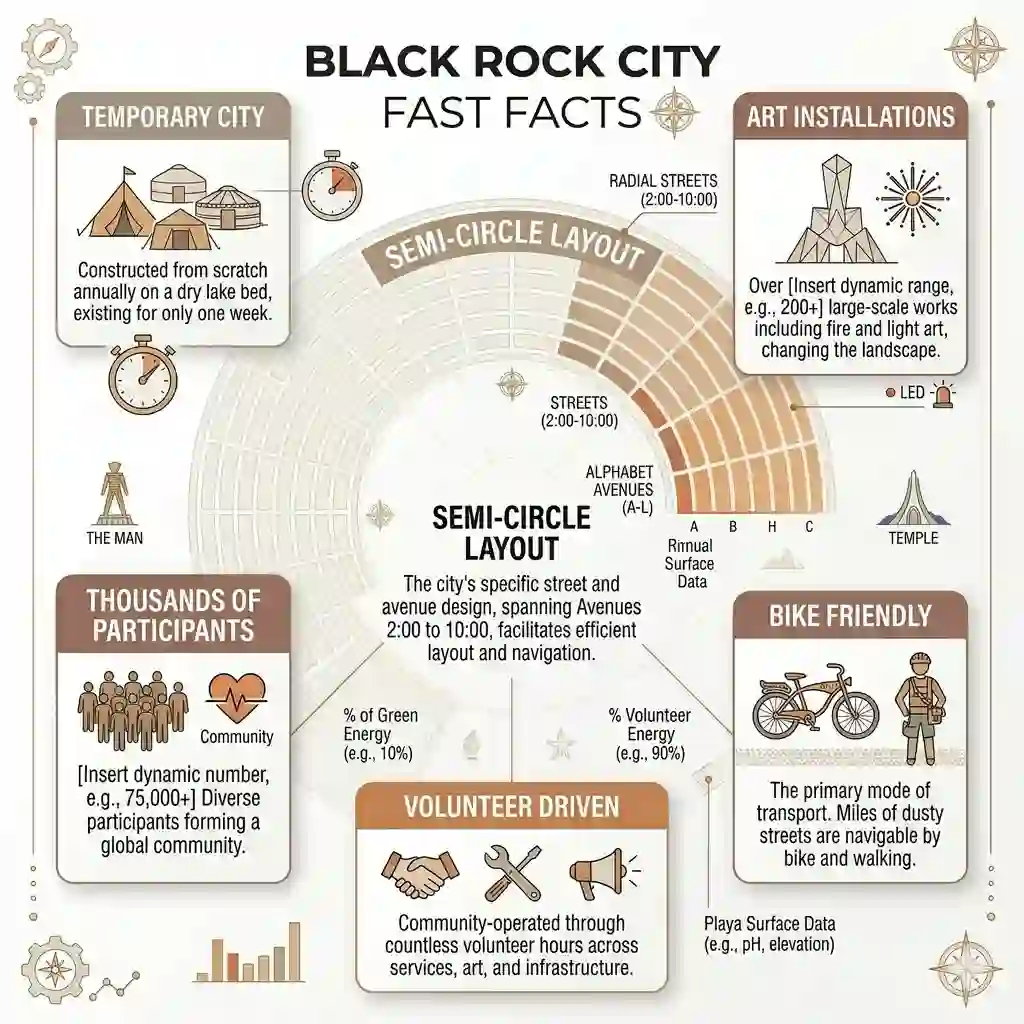
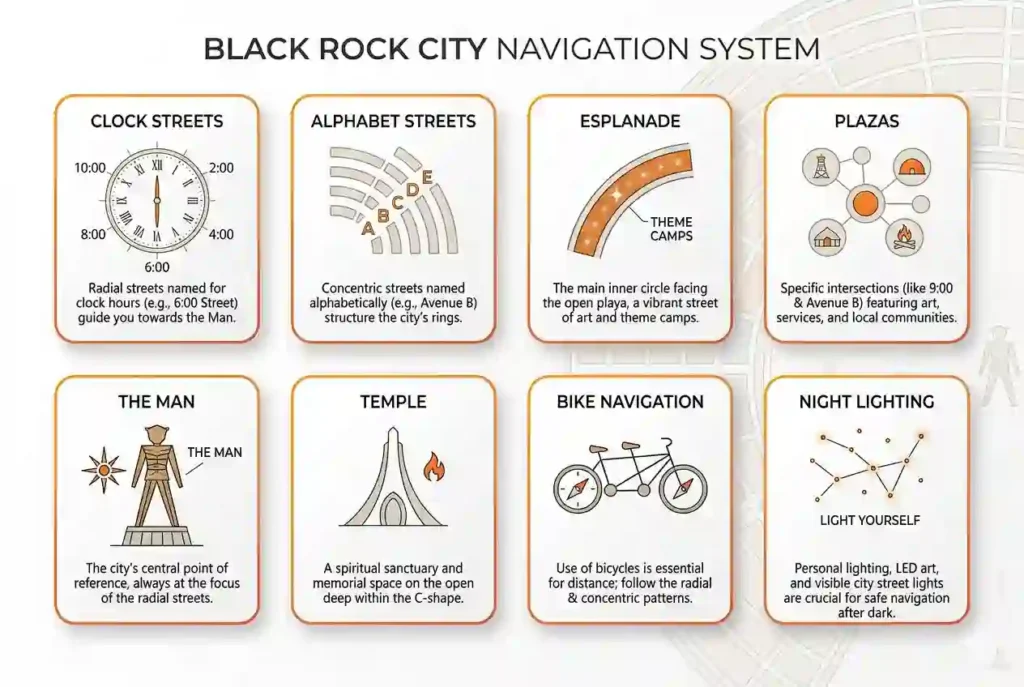
BRC is organized as a semicircle (the “city”) surrounding a central open space where the Man stands. Streets are laid out as numbered radial streets (like 3:00, 4:30 on a clock) intersecting concentric lettered or named avenues. This clock-based layout makes orientation easier once you get the hang of it.
How Is Black Rock City Organized?
The Clock and Street System
- Clock-based addresses: Streets are referenced by clock positions and block numbers rather than cardinal directions.
- Radials: Streets run outward from the Esplanade like spokes.
- Concentric avenues: Rings connect radials and help define neighborhood bands.
- Address example: “3:00, 4th & Esplanade” points you to the 3 o’clock radial, 4th block, near the central ring.
Key Districts and Neighborhoods
- Inner Playa / Esplanade: Immediate area around the Man and Center Camp, dense with art and major camps.
- Mid Playa: Larger art installations and theme camps with more space and louder sound.
- Deep Playa: Farther out, sparse, quiet, home to massive artworks and exploratory experiences.
- The Man Plaza: Central gathering area for the Man burn and big ceremonies.
Open Camping Areas
Open camping zones let individuals and informal groups set up without being part of a registered theme camp. These are great for new participants or those who prefer independence, but they require more self-sufficiency.
Plazas and Gathering Spaces
Every neighborhood includes plazas or smaller public gathering areas where people meet, play music, or host pop-up performances. These informal hubs are critical to the city’s social life.
Finding Your Way Around the City
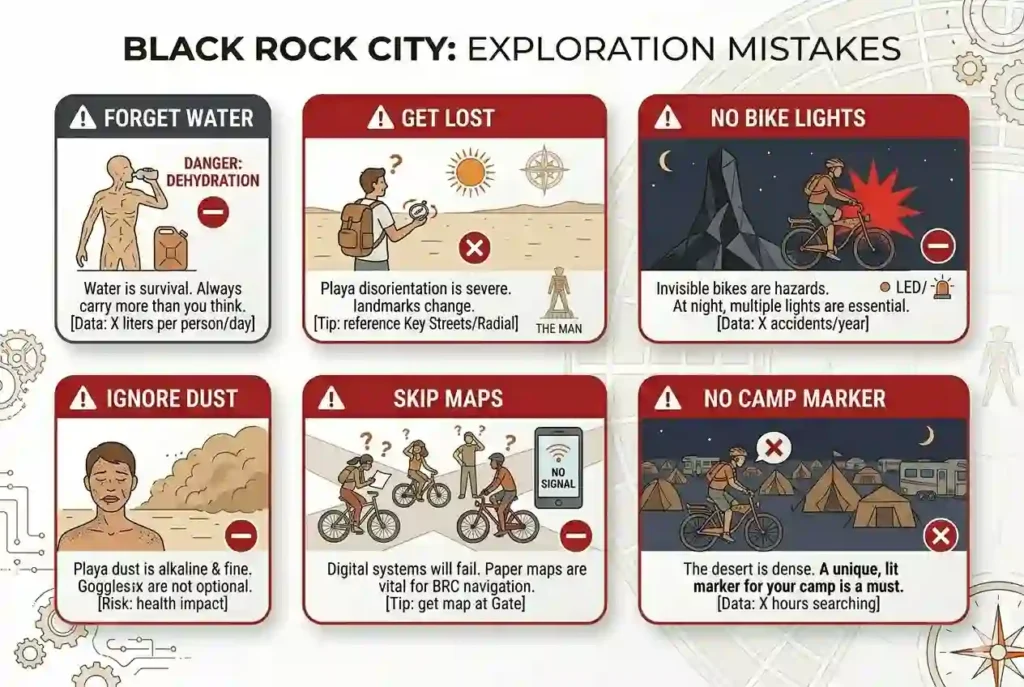
- Bring a paper map and take a photo of your camp coordinates.
- Roll-call landmarks: pick distinctive art or large camps as rendezvous points.
- Use the clock system in directions; locals find it intuitive.
- Carry a small, readable sign with your camp name and coordinates.
How Accessible and Inclusive Is Black Rock City?
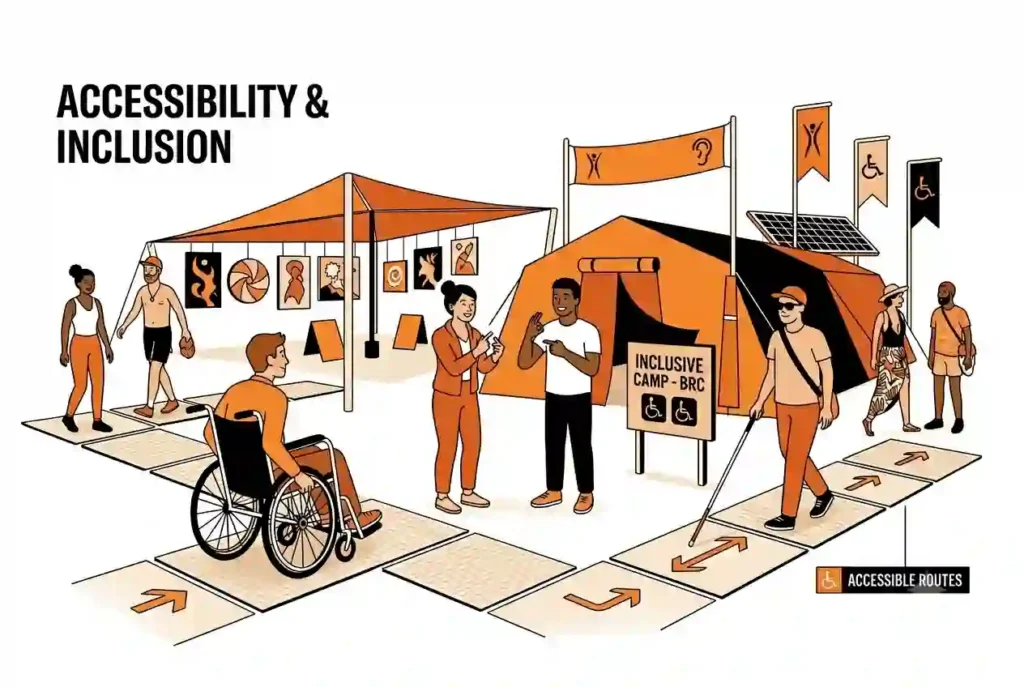
Black Rock City is designed around participation, but accessibility has to be planned deliberately because the event takes place in a harsh temporary desert environment. The city aims to support broader participation through information, services, and community coordination, while also recognizing that different people have different access needs. This overview section should stay high-level and point readers toward the master accessibility guide for deeper details.
Burning Man’s commitment to Radical Inclusion means accessibility is part of the larger cultural conversation, not just a technical service. Visitors should be able to find information about support options before arriving and during the event, even if the specifics vary by year and situation. The goal of this section is to help people understand that accessibility exists across the city, while directing them to the more detailed pages for actual planning.
Burning Man’s Commitment to Radical Inclusion
Radical Inclusion is one of the cultural principles that shapes how the event approaches participation. In accessibility terms, this means the event should aim to welcome people with different abilities, backgrounds, and needs rather than assuming a one-size-fits-all experience. The principle does not remove barriers automatically, but it does create the expectation that inclusion matters.
Accessibility Resources Across Black Rock City
Accessibility resources may appear in different parts of the city, including camps, facilities, services, and information points. Because Black Rock City is temporary and spread out, participants need to know that access support may be distributed rather than concentrated in one place. This makes orientation and planning especially important.
Accessibility & Inclusion in Black Rock City
Black Rock City is designed to encourage participation by people with a wide range of abilities. While the desert environment presents unique challenges, Burning Man provides accessibility resources and works to improve inclusion each year. Individual accommodations and services may vary, so participants should review official accessibility information before arriving.
Accessibility Features You May Find
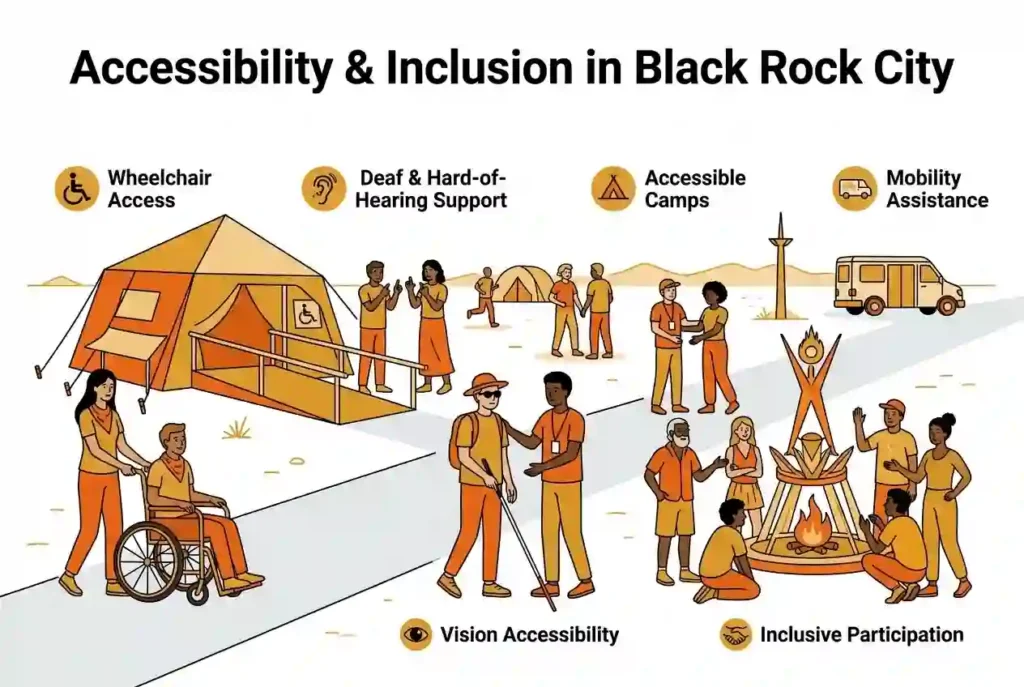
- ♿ Accessible portable toilets throughout the city
- 🏕️ Accessible camping options for eligible participants
- 🚗 Accessible parking and mobility support where available
- 🤟 Communication assistance for Deaf and Hard-of-Hearing participants
- 👁️ Resources for Blind and Low-Vision participants
- ❤️ Accessibility volunteers and participant support
- 📖 Accessibility information available before the event
Tip: Review the complete Accessibility & Inclusion Guide for detailed eligibility, services, applications, and planning advice.
Accessibility Planning Before Arrival
Planning before arrival is one of the most important steps for any attendee with access needs. Participants should think about transportation, camp support, communication needs, and what accommodations they may need on the playa. Early planning helps reduce stress and improves the chances of a smoother experience.
Inclusive Participation Opportunities
Accessibility is not only about movement or facilities; it is also about whether people can actually participate in the event. Some participants may need support for communication, navigation, or camp life in order to join fully. The more inclusive the preparation, the more meaningful participation becomes.
Overview of Accessibility Services
Black Rock City may offer different types of accessibility support depending on the area and the participant’s needs. These services can relate to transportation, camp access, facilities, or event coordination. The overview should stay general and avoid repeating the detailed service descriptions that belong in the master guide.
Finding Accessibility Information During the Event
Participants should know how to find help once they are in the city because not everything can be solved before arrival. Clear information pathways, support contacts, and camp communication all matter. During the event, fast access to the right information can make a major difference.
- Black Rock City is participation-first, but accessibility needs deliberate planning because the event happens in a temporary desert environment.
- The city supports inclusion through information, services, and community coordination, while recognizing that people have different access needs.
- This section should stay high-level and direct readers to the master accessibility guide for full planning details.
- Radical Inclusion means accessibility is part of the event’s culture, not just a technical add-on.
- Visitors should be able to find support information before arrival and during the event, even though details may change from year to year.
- Accessibility resources are spread across camps, facilities, services, and information points, so orientation matters.
- Planning before arrival is essential and should cover transportation, camp support, communication, and needed accommodations.
- Accessibility is also about meaningful participation, not just movement or facilities.
- Some participants may need help with communication, navigation, or camp life to take part fully.
- The city may offer different accessibility services depending on the participant’s needs and location.
- Participants should know how to find help during the event because not everything can be solved in advance.
- Clear information, support contacts, and camp communication can make a major difference during the event.
What Can You See and Experience in Black Rock City?
The playa is a sensory buffet: from towering kinetic sculptures and immersive installations to pop-up performances, workshops, and intimate camp gatherings. Every corner holds something unexpected interactive art that asks you to touch or participate, theme camps offering food and services, and deep-playa monuments that reward exploration. Experiences shift dramatically from day to night, and what you find depends as much on your willingness to wander and engage as on the official program. Expect emotional surprises, participatory challenges, and moments that stick with you long after the dust settles.
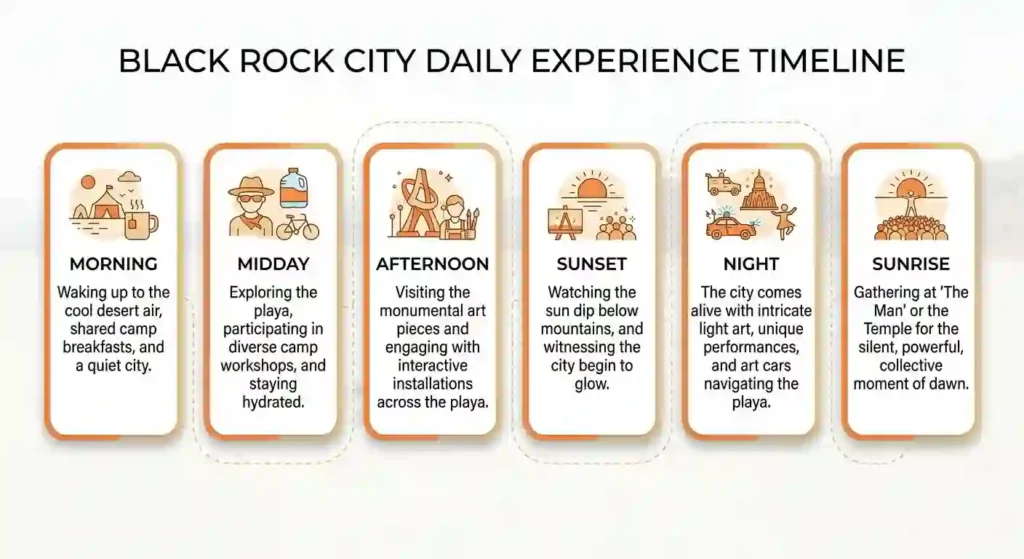
Art Across the Playa
Art is everywhere tiny interactive pieces on side streets to towering, mechanized sculptures in Deep Playa. Many pieces invite interaction, often at your emotional or physical participation. Expect surprises and installations that change between day and night.
Interactive Experiences
Participatory art is central: immersive rooms, sound baths, performance rituals, and installations that react to your presence. The best experiences ask you to be present and respond; they’re not passive shows.
Theme Camp Activities
Theme camps host everything from pop-up bars (gifting, no sales), workshops, dance parties, yoga, to communal dinners. Camps create neighborhoods with consistent vibes some quieter and family-oriented, others late-night and high-energy.
- ❤️ Daily Life in Black Rock City
- Morning routines
- Community interaction
- Exploration
- Camps
- Art
- Evening experiences
Daytime Exploration
Mornings and afternoons are for discovering art, visiting quiet camps, and attending workshops. The light on the playa is harsh and beautiful; plan sun protection and hydration while you wander.
Nighttime Adventures
Nights are when many installations transform lights, sound, and performance come alive. Night riding (on bike) is an essential skill; the city becomes a different place after dark.
Unexpected Discoveries
Part of BRC’s charm is the serendipity: a popup tea salon, impromptu art interventions, or a friend you haven’t seen in years. Stay open and curious.
Internal links: 🎨 Art & Creativity, 🌅 Activities & Experiences, 🏕️ Theme Camps
What Are Theme Camps and Why Are They Important?
Theme camps are the social architecture of Black Rock City: organized groups that build shared spaces offering programming, services, or art to the community. They turn streets into neighborhoods with distinct vibes quiet restorative zones, raucous music stages, healing tents, or inventive workshops.
More than amenities, camps create social contracts: volunteers staff shifts, campers pitch in with logistics, and visitors receive curated experiences without monetary exchange. For newcomers, theme camps are where you meet people, learn skills, and contribute they’re essential to the city’s participatory and gift-based culture.
Understanding Theme Camps
Theme camps are organized groups that build a shared space offering programming to the community. They range from small clusters offering coffee to massive camps with stages and infrastructure.
After H2: What Are Theme Camps and Why Are They Important? (Place Theme Camp Illustration)
How Theme Camps Shape the City?
Camps provide the city’s social infrastructure: meeting points, entertainment hubs, services like shade and water distribution, and community rituals. Their presence determines street culture and helps distribute activity across the playa.
Types of Theme Camps
- Hospitality camps: serve food, coffee, or tea.
- Arts and performance camps: host shows, workshops, or exhibits.
- Restorative camps: offer quiet spaces, first-aid, or meditation.
- Family and kid camps: focused on safety and activities for children.
- Sound camps: large music stages and DJ setups (often with strict sound policies).
Joining a Theme Camp
Most camps have application processes before the event; others accept drop-in volunteers on the playa. To join: research camps ahead, reach out via their public channels, and offer specific skills or shifts to be useful.
Theme Camp Etiquette
- Respect camp rules and volunteers.
- Pitch in: cleanup and staffing are appreciated.
- Don’t assume all camps are open for drop-in; ask first.
- Observe quiet hours at night near residential camps.
Finding Camps That Match Your Interests
Use official camp directories, community forums, and social platforms to connect before arrival. Many camps advertise volunteer slots and needs in advance.
Internal link: 🏕️ Theme Camps
What Are the Most Important Black Rock City Landmarks?
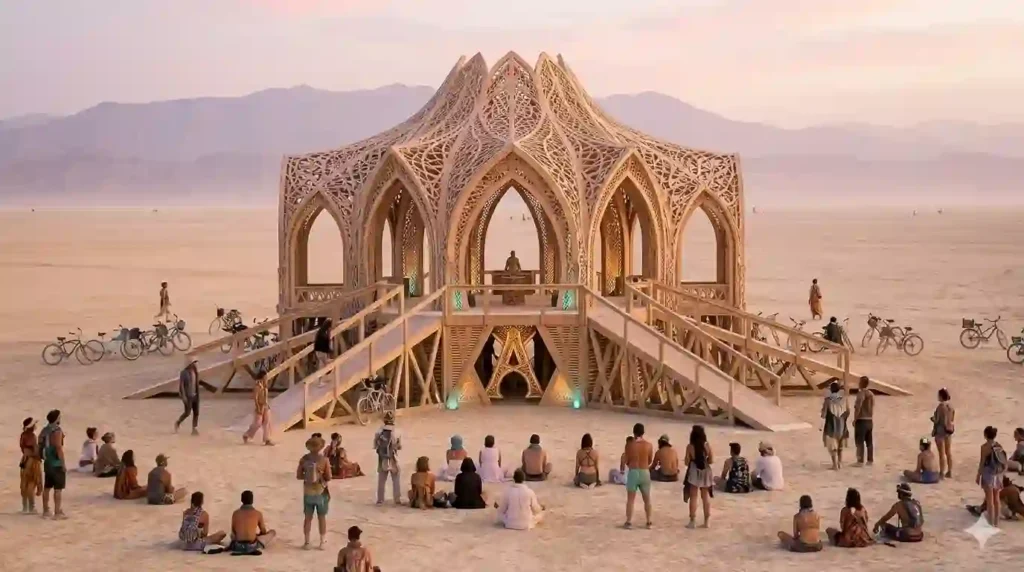
Landmarks in Black Rock City are both physical anchors and cultural touchstones: the Man and Temple host communal rituals; Center Camp functions as a civic heart; the Esplanade and Deep Playa define movement and exploration. These places orient you spatially and emotionally, giving the city its rhythm of ceremony, art, and service. Recognizing landmarks helps you navigate and plug into events, while also revealing how the city balances spectacle with intimacy. For many participants, visiting these sites is a ritual in itself part pilgrimage, part practical navigation.
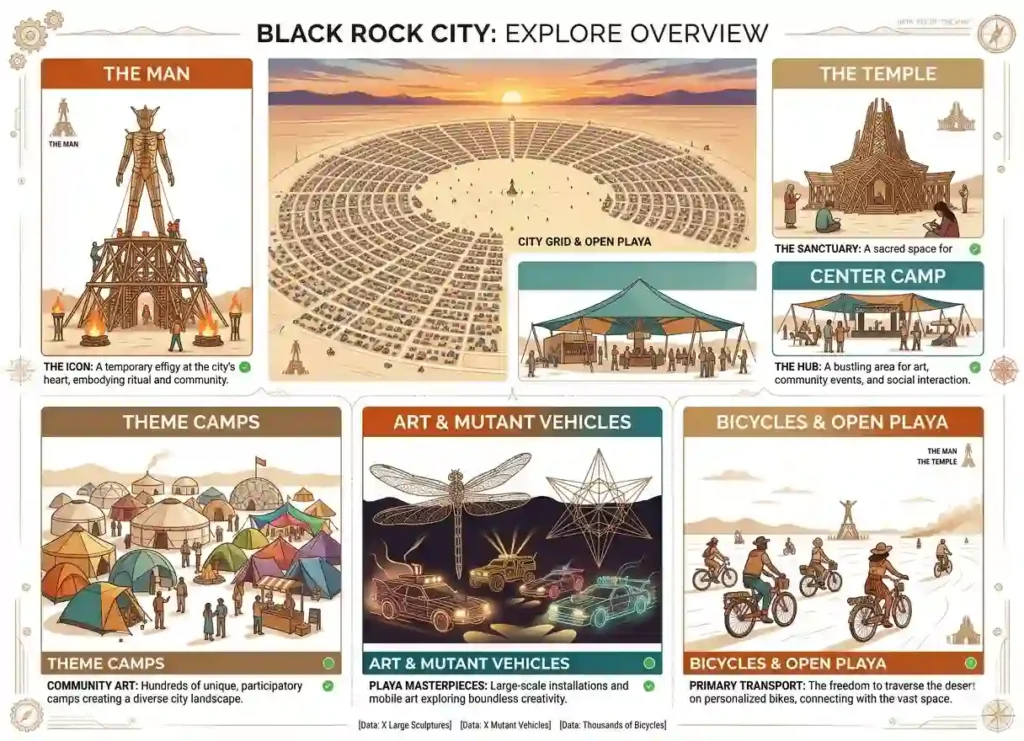
The Man
The Man is BRC’s central figure a large effigy burned near the end of the event. It serves as both a literal and symbolic center for gatherings and ceremony.
The Temple
The Temple is a contemplative, often awe-inspiring structure dedicated to reflection, memorials, and personal catharsis. It’s quiet, sacred, and treated with deep respect.
Center Camp
Center Camp is a heart-of-the-city hub offering shade, coffee, performances, and volunteer-run services. It’s a common meeting point for both locals and newcomers.
Deep Playa
Deep Playa refers to the outer area where the biggest installations and quieter exploration live. It’s farther from the main bustle and often more experimental.
Esplanade
The Esplanade is the ring road circling the central area and is dense with camps, art, and pedestrian traffic. It’s a major artery for walking and bikes.
Major Art Zones
Designated art zones concentrate large-scale installations and curated experiences. These zones help distribute foot traffic and highlight significant works.
Internal link: 🏛️ Landmarks & Iconic Places
What Amenities and Facilities Are Available?
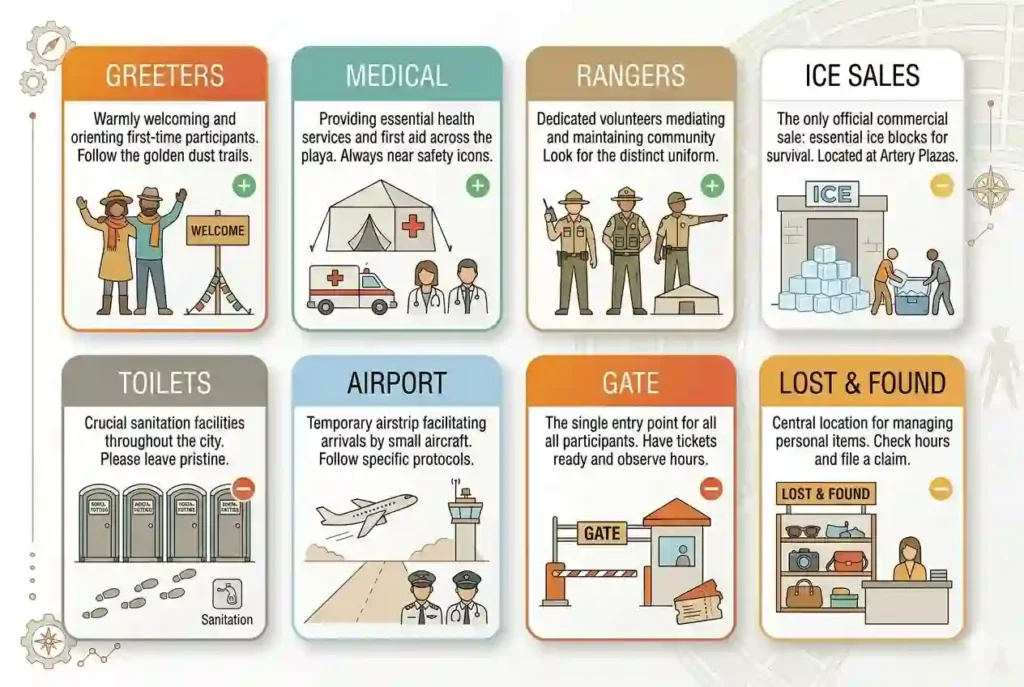
While Black Rock City isn’t a typical urban environment, it offers targeted amenities to support a large temporary population: official ice vendors, distributed toilets, water refill points, shade structures, and volunteer-run services like charging stations and repair booths. Most resources are finite and logistically complex, so planning and cooperation matter. Many camps augment public services with private facilities for their members, and community-run hubs fill in gaps. Understanding what’s available — and what you must provide for yourself is key to staying healthy and comfortable on the playa.
Ice and Arctica
Ice is sold by official vendors at specific locations (often called “Arctica”). Buying ice early is crucial; it’s a primary perishable you can’t realistically bring in bulk for large groups.
Portable Toilets
Porta-potties are distributed across the city and serviced regularly. Expect lines during peak hours and plan accordingly. Many camps also set up private shower or restroom facilities for members.
Hydration and Water Planning
There’s no running water: bring enough for drinking, cooking, and hygiene. Camps often share water resources, but individual planning is essential plan at least one gallon per person per day as a working minimum and more for hot days.
Shade and Rest Areas
Shade structures and public rest places are scattered across the city; bring your own shade for your camp. Temperatures swing dramatically from day to night, so plan layered clothing and a cool-down strategy.
Family-Friendly Facilities
There are family-oriented camps and designated quiet areas. If traveling with children, research camps and facilities that support caregivers.
Daily Living Resources
Basic essentials battery charging, small repairs, basic first aid are often available through camps and services, but rely on self-sufficiency primarily.
Internal link: 🏕️ Amenities & Facilities
What Services Help Black Rock City Function?
BRC runs on a mix of professional coordination and volunteer labor: Playa Info and DPW handle logistics, Black Rock Rangers mediate community issues, medical teams provide care, and organized outreach supports vulnerable participants. Behind the spectacle is a staffed civic system that plans for safety, waste management, and emergency response.
These services are designed to be both practical and aligned with Burning Man’s community norms: volunteers lead many roles, and official teams partner with county and federal agencies when needed. Knowing who does what helps you access help quickly and participate responsibly.
Playa Info
Playa Info provides maps, schedules, and guidance for newcomers. Visit early if you need orientation.
Black Rock Rangers
Rangers are volunteer civic-minded participants who mediate community issues, help with safety concerns, and offer non-law-enforcement support.
Medical Services
On-site medical teams handle increasingly complex needs each year. They operate clinics and first-aid stations and coordinate emergency transfers when necessary.
Emergency Services
DPW, Rangers, and organized safety teams coordinate with county services and BLM officials for emergency situations and logistics.
Lost and Found
A formal lost-and-found helps collect and redistribute lost items. Many personal items are recovered via community networks before reaching the central lost-and-found.
Safety and Support Resources
- Harm reduction teams and peer support spaces
- Heat and hydration stations
- Vulnerable-person support through outreach teams
Internal link: 🛠️ City Services & Resources
How Do People Travel Around Black Rock City?
Getting around Black Rock City is a mix of pedaling, walking, and occasionally being chauffeured by mutant vehicles. Bicycles are the default nimble, efficient, and essential for night travel while walking suits short hops and lingering to explore. E-bikes speed things up but bring charging and maintenance considerations. Art cars roam with permits, offering moving stages or rides. The city’s layout favors radial movement, so planning routes and lighting is crucial. Mobility on the playa is as much a safety issue as convenience, and smart transport choices let you experience more while minimizing risk.
Why Bicycles Are So Popular
Bikes are fast, quiet, reliable, and fit the city’s layout. They let you traverse long radials quickly and are easy to park. Bring lights and reflectors; night visibility is vital.
Walking the Playa; Much of BRC is pedestrian-friendly. Walk short distances for nearby events or to soak in the atmosphere.
E-Bikes and Alternative Mobility
E-bikes speed up travel but can be heavier and battery-dependent. Be mindful of e-bike rules and charging logistics.
Mutant Vehicles
Mutant Vehicles (art cars) are mobile artworks and must be permitted. They are a hallmark of the playa, offering parades, rolling stages, and public art.
Transportation Safety
- Lights, reflective tape, and helmets for night riding.
- Observe speed limits and sound curfews.
- Lock bikes in camp; bring a basic repair kit.
Accessibility Transportation Options
Shuttle services and ADA accommodations are offered for those who pre-register. Many camps provide mobility assistance on request.
Internal link: 🚲 Transportation Inside Black Rock City
What Should You Know About Photography and Media?
Photography and media in Black Rock City require cultural sensitivity as much as technical skill. The playa yields unforgettable images, but many participants come for privacy, catharsis, or intimate moments that aren’t meant for broadcast. Consent is a simple but powerful guideline: ask before photographing people, respect no-photo requests, and follow posted rules for installations. For larger or commercial projects, permits and coordination are necessary. Practically, protect your gear from alkaline dust and plan for dramatic lighting conditions at dawn and dusk.
Photography Culture at Burning Man
Photography is common, but context matters. Many participants welcome documentation; others come to BRC for privacy and reflection.
Consent Before Taking Photos
Always ask before photographing individuals, intimate moments, or inside installations posted as private. A quick consent check prevents harm.
Social Media Expectations
Respect requests to not post images, especially when they involve identifiable people in vulnerable contexts. Many installations request specific tagging or attribution guidelines.
Drone and Filming Rules
Drone use is tightly restricted by safety and airspace rules. Commercial filming generally requires permits; hobby drones are often prohibited.
Best Photography Opportunities
Sunrise and sunset, illuminated installations at night, and the Man and Temple provide strong visual moments. Protect your gear from alkaline dust.
Respecting Participant Privacy
If someone asks you not to photograph or publish an image, respect that request. Community trust is worth more than a viral post.
Internal link: 📸 Photography & Media
How Accessibility Works at Black Rock City?
Accessibility at BRC is an ongoing, community-driven effort: there are ADA services, accessible camps, and volunteer supports, but the environment remains challenging rough surfaces, long distances, and variable weather. Inclusion shows up through gender-neutral facilities, family-oriented camps, peer-support networks, and explicit sensitivity efforts. Real accessibility often depends on pre-planning and camp-level accommodations, so coordinate early with organizers and accessibility teams. The city aims to be open, but participants should expect to advocate for needs and tap community resources proactively.
Burning Man’s Commitment to Radical Inclusion
Burning Man publicly commits to principles that support inclusion: radical inclusion, civic responsibility, and communal effort. That ethos shapes programming, volunteer training, and outreach from gender-inclusive restrooms to family-friendly camps and peer-support initiatives. However, commitment on paper doesn’t erase physical and environmental barriers. The organization and many community groups work to lower those barriers, but inclusion at BRC is often realized through participant-driven efforts: camps that prioritize accessibility, volunteers who offer assistance, and pre-event coordination that helps people with specific needs find resources and supportive crews.
Accessibility Resources for Participants
There are formal resources attendees can tap before and during the event: the official Accessibility & Health team, ADA registration for needs-based services, and accessible parking passes coordinated with Gerlach/BLM permits. On-playa, accessibility advisories, campsite referrals, and volunteer pushing teams help navigate distances. Many camps advertise accessibility amenities (shaded seating, ramps, loaner equipment) in camp directories and community forums. For complex medical or mobility needs, early contact with Accessibility & Health and your camp lead is essential to arrange logistics and backups.
Deaf and Hard-of-Hearing Communities
The community supports deaf and hard-of-hearing participants through captioned programming, sign-language-interpreted events, and visual-alert systems at major gatherings. Several camps specialize in accessible communication, offering VRS (video relay service) help, captioned screenings, and printed schedules. If you rely on interpretation, plan ahead: contact event organizers and specific camps to request interpreter coverage or join programs that provide ASL volunteers. Many workshops and performances will post accessibility options in advance if notified.
Blind and Visually Impaired Participation
Navigating the playa without sight is feasible with planning and community support. Volunteer “pusher” networks and sighted-guide teams offer assistance for movement, tent setup, and event navigation. Some camps specialize in multisensory installations and tactile art, which are excellent entry points. Blind and low-vision participants should coordinate with Accessibility & Health and their camp to arrange guide support, tactile maps, and verbal descriptions for key installations. Consider carrying high-contrast, tactile markers at your camp to aid independence.
Wheelchair Accessibility on the Playa
Wheelchair users face real challenges: soft surfaces, uneven ground, and long distances. Still, many participants attend successfully by planning around these limits. Options include: camp-level ramps and hard-packed pathways; borrowing or bringing playa-friendly all-terrain wheelchairs; arranging powered wheelchair battery support; and using volunteer pushing teams. The event provides some accessible toilets and ADA parking near entry points, but the playa’s terrain limits full accessibility. Early communication with Accessibility & Health and your camp is crucial to arrange camp-level modifications and mobility support.
Accessible Camps and Support Networks
Accessible camps are community-created hubs that prioritize low-sensory environments, accessible infrastructure, and trained volunteers. They serve as safe spaces for rest, medical support, and social connection. Many of these camps list amenities like ramped entries, quiet hours, sensory-friendly programming, and mobility equipment loans in camp directories. Support networks online forums, pre-event meetups, and social groups for specific disabilities are invaluable for sharing tips, coordinating rides, and arranging spot-help on playa.
Transportation and Mobility Assistance
Mobility support begins before you arrive: request ADA vehicle access, plan for accessible parking, and coordinate drop-off points with your camp. On playa, volunteer-run shuttles, golf-cart teams, and pushing crews can move people short distances. For longer travel, some camps maintain battery-swap stations for powered chairs and e-bikes. If you use a powered mobility device, plan for spare batteries, sealed storage from dust, and recharging logistics — many camps pool resources to create charging hubs.
Inclusive Participation Opportunities
Inclusion at BRC goes beyond physical access: it’s about meaningful participation. Many camps host workshops focused on accessibility, disability justice, and inclusive art. Volunteer roles can be adapted — registry, info-desk shifts, mediation — so participants with mobility or sensory limitations can contribute fully.
Project teams often welcome remote or planning-only roles (design, outreach, fundraising) that lead to on-playa participation. Reach out to camp leads and accessibility groups to find roles that match your abilities and interests.
Practical Tips and Next Steps
- Contact Accessibility & Health early and share detailed needs.
- Connect with accessible camps via directories and forums before arrival.
- Pack redundancy: spare batteries, tactile markers, noise-cancelling gear.
- Arrange a trusted camp contact and an emergency plan for medical transport.
- Volunteer with accessibility teams to both receive support and give back.
What Challenges Should First-Timers Expect?
First-timers face sensory overload, logistical pitfalls, and cultural learning curves. The desert environment brings dust storms, temperature swings, and the need for strict self-sufficiency in water, food, and shelter. Socially, newcomers must navigate gifting norms, volunteer culture, and the etiquette of participatory events. Mistakes are common under-packing water, insufficient bike lights, or missing quiet-hours cues but they’re fixable with humility and preparation. Embrace gradual exploration, ask experienced participants for help, and accept that learning comes with trial and error.
Navigating a Large Temporary City
Scale and sensory overload are real. Expect to get lost, to be overwhelmed, and to learn the clock-system on the fly.
Understanding Community Expectations
Participation, gifting, and mutual aid are cultural expectations. Bring something to contribute (time, skill, resources) beyond just attendance.
Managing Daily Needs
Self-sufficiency for water, food, shelter, and shade is non-negotiable. Plan for the environment: dust storms, cold nights, and hot days.
Avoiding Common Mistakes
- Underpacking water and shade.
- Not bringing adequate bike lighting.
- Assuming services are like city conveniences.
- Not labeling or securing gear (items shift in camps).
Preparing for the Unexpected
Have a basic emergency plan, a stop-gap medical kit, and agreed rendezvous points with travel companions.
Thriving in Black Rock City
- Offer help often.
- Take small risks: speak to strangers, join a workshop.
- Respect boundaries; ask before entering private camp spaces.
- Rest: schedule downtime to avoid burnout.
Common First-Timer Mistakes in Black Rock City
Exploring Black Rock City becomes much easier when you avoid the mistakes many first-time participants make.
Mistakes to Avoid
❌ Thinking Black Rock City is a traditional festival venue.
❌ Not learning the city layout before arriving.
❌ Forgetting your camp location.
❌ Exploring without enough water or sun protection.
❌ Missing smaller neighborhoods while only visiting famous landmarks.
❌ Expecting every camp to provide public services.
❌ Ignoring consent before taking photographs.
❌ Waiting until nighttime to navigate without proper lighting.
Veteran Burner Tips for Exploring Black Rock City
Experienced Burners know that the best experiences often happen away from the busiest attractions.
Insider Tips
- ⭐ Walk or ride without a strict schedule.
- ⭐ Visit different neighborhoods during both day and night.
- ⭐ Stop whenever something catches your curiosity.
- ⭐ Introduce yourself to camp members respectfully.
- ⭐ Attend workshops, performances, and community events.
- ⭐ Explore beyond The Man and the Temple.
- ⭐ Carry water, lights, and navigation tools at all times.
- ⭐ Leave space for unexpected discoveries—they often become the best memories.
Black Rock City Safety & Navigation Tips
Even though Black Rock City is carefully planned, it’s still a temporary city in the middle of the desert.
Before Exploring
- 📍 Learn the city’s street layout.
- 🚲 Prepare your bicycle and lights.
- 💧 Carry enough drinking water.
- 🌞 Pack sun and dust protection.
- 📱 Save important camp and emergency information.
While Exploring
- 🚴 Ride carefully and respect pedestrians.
- 🤝 Ask before entering private camp areas.
- 📸 Respect photography and consent guidelines.
- 🌙 Carry lights after sunset.
- ❤️ Help others when appropriate while remaining self-reliant.
Is Black Rock City Right for You?
Black Rock City may be the perfect experience if you:
✅ Enjoy immersive art and creativity.
✅ Want to actively participate rather than simply watch.
✅ Appreciate community-driven experiences.
✅ Like camping and outdoor adventures.
✅ Enjoy meeting people from around the world.
✅ Are prepared for Radical Self-Reliance.
Who Will Enjoy Black Rock City Most?
Black Rock City appeals to people who enjoy:
- 🎨 Interactive art and creativity
- 🤝 Community participation
- 🌍 Cultural exploration
- 🚴 Outdoor adventure
- 🏕️ Camping experiences
- 🎭 Live performances and workshops
- 📷 Photography (with consent)
- 💡 Innovation and creative expression
How Black Rock City Works
| Card | Description |
| 🏛️ Temporary City | Built from the desert each year, then completely removed. |
| 🤝 Community Participation | Participants create the city together. |
| 🎨 Interactive Art | Art is designed to be explored and experienced. |
| 🏕️ Theme Camps | Camps provide activities, workshops, and shared experiences. |
| 🌱 Leave No Trace | Every participant helps restore the desert after the event. |
| ❤️ Ten Principles | The values that shape life in Black Rock City. |
Black Rock City Myths vs Reality
Black Rock City is unlike any other place in the world, which is why it’s often misunderstood by first-time visitors. Many people imagine it as a music festival, a permanent city, or a commercial event, but the reality is very different. Built from the ground up each year in Nevada’s Black Rock Desert, Black Rock City is a temporary, participant-created community based on creativity, self-reliance, and the Ten Principles of Burning Man. Understanding the difference between common myths and reality will help you prepare more effectively and appreciate the unique culture that makes Black Rock City an unforgettable experience.
| Myth | Reality |
|---|---|
| Black Rock City is just another music festival. | Black Rock City is a temporary participant-built city focused on art, community, creativity, and participation—not commercial entertainment. |
| Everything is provided once you arrive. | Participants practice Radical Self-Reliance by bringing their own food, water, shelter, and essential supplies. |
| Only artists or experienced Burners belong there. | Black Rock City welcomes first-time participants, families, volunteers, artists, makers, and curious newcomers from around the world. |
| The city exists all year round. | Black Rock City is built specifically for Burning Man and completely removed afterward, leaving the desert restored through Leave No Trace. |
| Theme Camps are private clubs. | Many Theme Camps invite participants to join workshops, performances, art projects, and community activities during public hours. |
| You need a strict schedule to enjoy the city. | Some of the most memorable experiences come from wandering, exploring, and embracing unexpected moments. |
| You can photograph anyone freely. | Photography is encouraged, but respecting privacy and asking for consent before photographing people is an important community value. |
| Black Rock City is only about surviving the desert. | While preparation is essential, the city’s true purpose is to foster creativity, collaboration, self-expression, and meaningful human connection. |
Frequently Asked Questions About Black Rock City
Black Rock City is the temporary city built each year in Nevada’s Black Rock Desert to host the Burning Man event. It becomes home to tens of thousands of participants before being completely removed after the event.
This guide introduces the city’s layout, neighborhoods, landmarks, theme camps, transportation, services, accessibility, photography, and community resources, with links to more detailed guides.
Start with the City Guide, then continue to Theme Camps, Activities & Experiences, Landmarks, Transportation, and Accessibility based on your interests.
Visit the City Guide and Landmarks & Iconic Places Guide to understand the city’s layout, streets, districts, and major destinations.
The Theme Camps Guide explains how camps operate, public hours, participation opportunities, and what visitors can expect.
The Transportation Inside Black Rock City Guide explains bicycles, walking, art cars, accessibility transportation, and safe travel throughout the city.
Read the Amenities & Facilities Guide and the City Services & Resources Guide to learn where to find information, support, toilets, medical services, ice sales, and other essential resources.
The Accessibility & Inclusion Guide covers mobility support, accessible facilities, communication assistance, and resources for participants with disabilities.
No. This pillar page provides the complete overview, while each linked guide explores one topic in greater detail.
Together they explain how Black Rock City is designed, how participants live and explore the city, where to find services, and how to fully experience Burning Man’s unique temporary community.
No. Burning Man is the event, while Black Rock City is the temporary city built to host the event. The city is created, inhabited, and then completely removed each year, leaving the desert as part of the Leave No Trace commitment.
Why Trust This Guide?
✅ Links to detailed guides for every major city topic.
✅ Updated for the 2026 Burning Man season.
✅ Covers the complete structure and operation of Black Rock City.
✅ Designed for both first-time participants and experienced Burners.
✅ Organized around official city systems and participant experiences.
Explore Black Rock City Your Way
Every participant experiences Black Rock City differently. Choose the guide that matches your interests.
| If You Want To… | Read This Guide |
| Understand the city’s layout | → City Guide |
| Discover interactive art | → Art & Creativity Guide |
| Visit famous locations | → Landmarks & Iconic Places Guide |
| Experience Theme Camps | → Theme Camps Guide |
| Find essential services | → Amenities & Facilities Guide |
| Get help and city resources | → City Services & Resources Guide |
| Ride safely around the city | → Transportation Inside Black Rock City Guide |
| Take respectful photos | → Photography & Media Guide |
| Plan accessible participation | → Accessibility & Inclusion Guide |
| Discover activities and events | → Activities & Experiences Guide |
Conclusion
Black Rock City is far more than a festival venue—it’s a fully functioning temporary city created through collaboration, participation, and shared responsibility. Every street, camp, artwork, and gathering contributes to an experience unlike anywhere else in the world. Understanding how the city works helps you explore confidently, connect with the community, and make the most of your Burning Man journey.
- 🏙️ Black Rock City is built from scratch every year.
- 🎨 Art and participation shape every neighborhood.
- 🏕️ Theme camps create the city’s unique culture.
- 🚲 Walking and cycling are the primary ways to explore.
- 🛠️ Volunteers and participants help the city function.
- ♿ Accessibility resources support a more inclusive experience.
- 📸 Respectful photography helps preserve community trust.
- 📖 Continue with the Black Rock City Map Guide to understand the city’s layout before arriving.
Final Thoughts on Exploring Black Rock City
Understanding the City’s Unique Culture
BRC asks you to rethink how you participate in public life. It’s less about spectacle and more about contribution, connection, and the shared responsibility of community.
Balancing Exploration and Participation
Mix wandering with volunteering or camp shifts to get both the serendipity of discovery and deeper social ties.
Connecting with the Community
Bring curiosity, humility, and a willingness to help. Those are the best ways to be welcomed into the city’s many micro-communities.
Making the Most of Your Experience
Plan for basics, pack light but smart, volunteer, and keep an open heart. The playa rewards preparation and presence.
Preparing for Future Burns
Keep notes on what worked, gather community contacts, and consider applying to volunteer or build your own camp next year.