What Are Burning Man Regional Burns? Complete Guide to the Global Burner Network (2027)
Burning Man Regional Burns bring the spirit and principles of Burning Man to communities around the world. This guide explains how the Regional Network works, what makes an event official, how Regional Burns differ from Black Rock City, and why they have become an important part of the global Burner community.
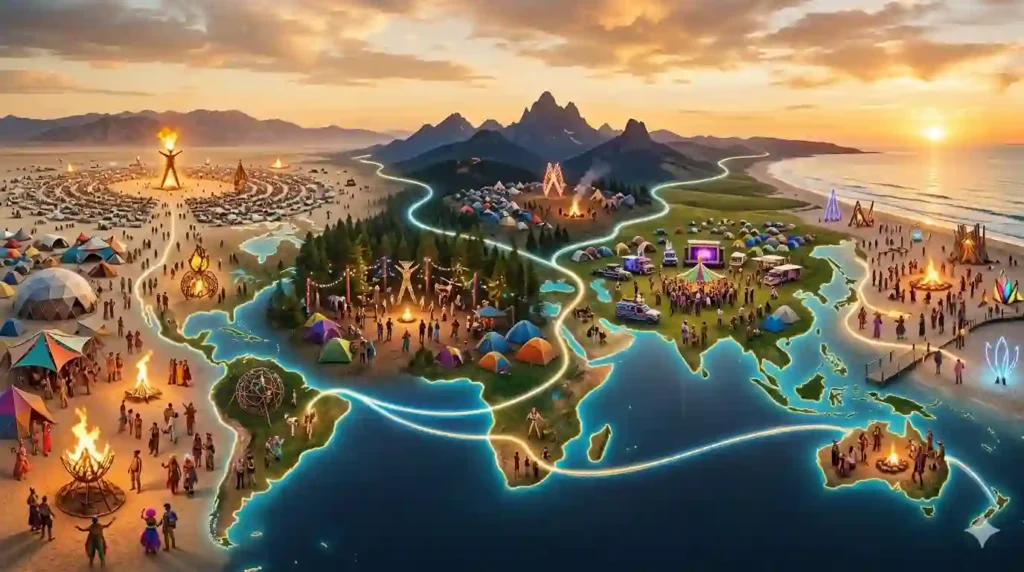
Burning Man is not limited to Black Rock City. Around the world, local Burner communities come together through Regional Burns—events inspired by Burning Man’s culture, 10 principals, participation, creativity, gifting, and community spirit.
From small gatherings to large multi-day events, Regional Burns give people an opportunity to experience Burner culture closer to home, meet other participants, contribute art and skills, and become part of a global community. Each Regional Burn has its own character, traditions, location, and organizing team while remaining connected to the wider Burning Man community.
Whether you are discovering Regional Burns for the first time or looking for an event near you, this guide explains what Regional Burns are, how they work, where they take place, and how you can participate.
🌍 What Will This Regional Burns Guide Cover?
Use this guide to understand the Regional Burn community from the ground up:
- 🌎 What Are Regional Burns? — Understand what makes a Regional Burn different from the main Burning Man event.
- 🗺️ Where Are Regional Burns Held? — Explore the global spread of Regional Burns and Burner communities.
- 🔥 How Do Regional Burns Work? — Learn about participation, camps, art, events, and community organization.
- 🎨 Art & Creative Participation — Discover how participants contribute art, installations, performances, and creative projects.
- 🤝 Regional Burner Communities — Learn how local communities connect, collaborate, and welcome newcomers.
- 📅 Finding Regional Events — Understand how to discover Regional Burns and related gatherings.
- 🙋 How Can You Participate? — Explore ways to volunteer, contribute skills, join a camp, create art, or simply become involved.
- 🌐 The Global Burner Network — See how Regional Burns connect local communities with the wider Burning Man culture.
- 🧭 First-Timer Guidance — Learn what to consider before attending your first Regional Burn.
- 🌱 Community & Sustainability — Understand how local events approach environmental responsibility, participation, and community impact.
September 2026 Regional Burns & Burning Man Community Events
The Third Degree Burn — Australia
September 10–14, 2026 · Australia
An official Burning Man Regional Event where experienced Burners and newcomers come together to create a temporary community through art, music, performance and participation. The 2026 gathering emphasizes consent, connection, radical self-expression and collective creation, inviting participants to bring their own skills, ideas and energy to build the experience together.
MicroBurn — United Kingdom
September 10–14, 2026 · Powys, Wales, UK
A not-for-profit Regional Burning Man community event held in a Welsh valley, MicroBurn focuses on connection, participation and creating a close-knit temporary community. Inspired by Burning Man principles, the gathering encourages participants to contribute through art, dancing, music, creativity, collaboration and shared experiences.
🇬🇷 Pyraegea — Greece | September 12–19
The global Burner season continues in a completely different setting when Pyraegea 2026 begins September 12 in Greece. The Southern Dodecanese edition starts from Rhodes and takes the Burning Man-inspired community onto the water.
Unlike a traditional desert gathering, Pyraegea is a non-commercial, self-organized sailing event created by Burners in the spirit of the Ten Principles. Its official community resources cover boats and crew, consent and safety, art, workshops, performances, gifting and responsible sailing practices.
The Burn moves from the playa to the sea. 🌊
B.U.R.N. Burn — Illinois, USA
September 16–20, 2026 · Ottawa, Illinois, USA
Chicago’s Regional Burn brings participants together for an extended weekend of creativity, connection and community at Camp Tuckabatchee. Inspired by Burning Man culture, B.U.R.N. Burn encourages participants to help create the experience through art, participation, collaboration and shared community rather than simply attending as spectators.
Resonance — Kansas
September 17–20, 2026 · Kansas
A Regional Event built around the “Everything Is Relative” theme, connecting tiny natural wonders with the scale and mystery of the cosmos. The event emphasizes creativity, imagination, participation and the relationship between the microscopic and the universal.
Hearths O’Phyre — Iowa
September 24–27, 2026 · Iowa
The 2026 theme, “Welcome to Bat Country,” invites participants into a playful world of desert delirium, Midwestern creativity, art, performance and camp building. The event centers on radical self-expression and collective participation.
Granite Burn – Mythbehavin — New Hampshire
September 24–28, 2026 · New Hampshire
An official Regional Burning Man event guided by the 10 Principles, bringing participants together for art, music, community, creativity and exploration in a temporary environment in Chatham, New Hampshire.
Time TO Burn — Toronto Decompression
September 26, 2026 · Ontario, Canada
This is not a Regional Burn, but a Burning Man Decompression event. It gives the Toronto-area community an opportunity to reconnect through music, art, performances, theme camps and radical self-expression after the main Burn season.
Understanding Regional Burns
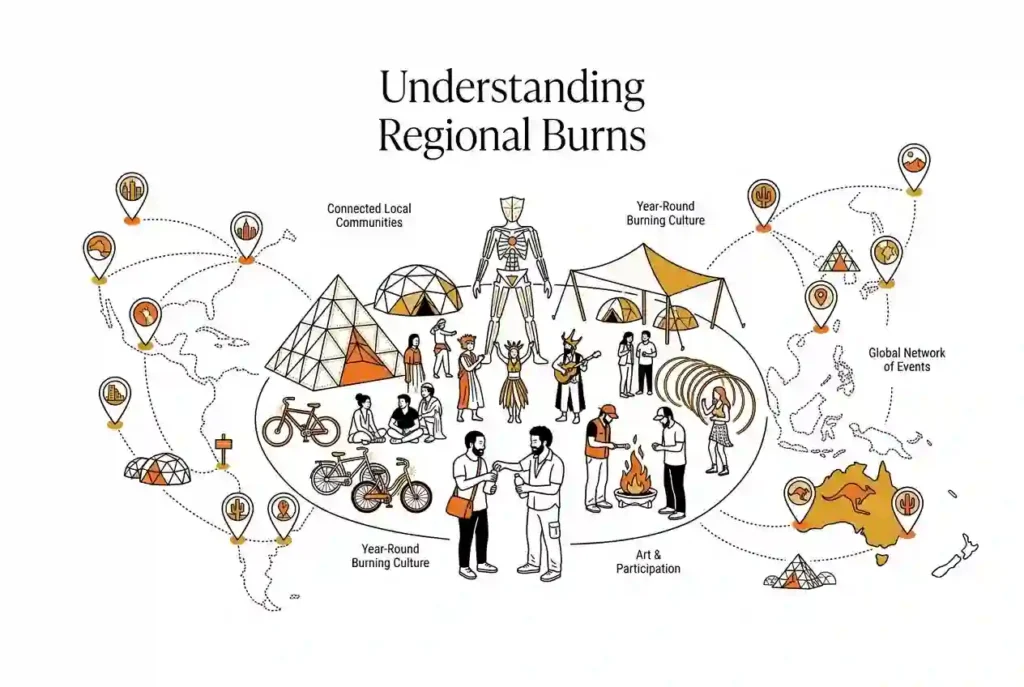
Regional burns are local, participant-led events inspired by Burning Man’s Ten Principles but scaled to fit local communities, resources, and regulations. They recreate the participatory, gifting, and leave-no-trace culture in a smaller setting—often on private land or permitted public sites—with theme camps, art, workshops, and volunteer-run infrastructure. Regional burns provide lower-cost, lower-risk opportunities to practice building, stewardship, and community skills, and they act as recruitment and training grounds for the main event while strengthening year-round local networks.
What is a Regional Burn?
A regional burn is a locally organized event that follows Burning Man principles participation, gifting, civic responsibility—but on a smaller scale. It typically includes theme camps, workshops, art installations, music, and communal infrastructure run by volunteers. Sizes range from intimate gatherings to multi-day events with hundreds or thousands of participants.
How is a Regional Burn different from Burning Man?
Regional burns are usually smaller, locally regulated, and adapted to community norms. They often have stricter local permitting, fewer large-scale art builds, and sometimes different accessibility or age policies. The core culture is similar, but logistics, scale, and legal frameworks vary significantly from Black Rock City.
Are Regional Burns officially connected to Burning Man?
Many regional events are unofficially inspired by Burning Man but coordinate through the Burning Man Regional Network. Some are recognized or supported by Burning Man Project resources, while others remain independent. Connection varies—check each event’s site or the Regional Network directory for official relationships and guidelines.
Can I attend a Regional Burn without attending Burning Man?
Yes. Regional burns are independent entry points to playa culture and welcome newcomers. They’re ideal for people who haven’t been to Burning Man, offering practice in gifting, consent, camp-building, and volunteer roles in a smaller, often more accessible setting.
Why do Regional Burns exist?
Regional burns sustain playa culture locally building mentorship, fundraising for art, testing infrastructure, and creating social networks. They lower barriers to participation, spread skills, and offer regular community touchpoints so people can practice principles year-round rather than waiting for the annual desert event.
What happens at a Regional Burn?
Expect theme camps, interactive art, workshops, music, volunteer shifts, gifting, and communal meals. Some host small-scale effigies or burns, kid-friendly zones, or educational programming. Events typically emphasize participant-created programming and require attendees to contribute through service, art, or hosting.
Are Regional Burns worth attending?
Yes, for newcomers and veterans alike. They’re lower-cost ways to experience playa principles, learn practical skills, and build local friendships. Regional burns often lead to stronger camp placements, volunteer roles, and readiness for larger events, while offering meaningful community and creative experiences closer to home.
Is a Regional Burn a festival?
Not in the commercial sense. While they share festival elements (music, art), regional burns emphasize noncommercial participation, gifting, and co-creation rather than passive consumption. They function as community gatherings or temporary autonomous zones rather than ticketed entertainment spectacles.
H3: What is the purpose of Regional Burns? (50 words)
Their purpose is to practice Burning Man principles locally, cultivate leadership and technical skills, fund and develop art projects, and provide recurring social spaces. They strengthen regional networks that feed into larger events and help distribute the culture beyond a single annual gathering.
How do Regional Burns support the Burning Man community?
Regional burns train volunteers, incubate art, grow new leaders, and maintain year-round engagement. They provide safer learning environments for first-timers, produce regional talent and infrastructure, and help spread principles through local outreach, making the broader community more resilient and diverse.
- Regional burns are local, principle-driven events that mirror Burning Man at smaller scale.
- They provide training, community-building, and art incubation.
- Great entry points for newcomers; useful for veterans to practice and mentor.
- Varying degrees of official connection—check the Regional Network for details.
- Focus on participation, gifting, volunteerism, and local stewardship.
Regional Burns vs Burning Man
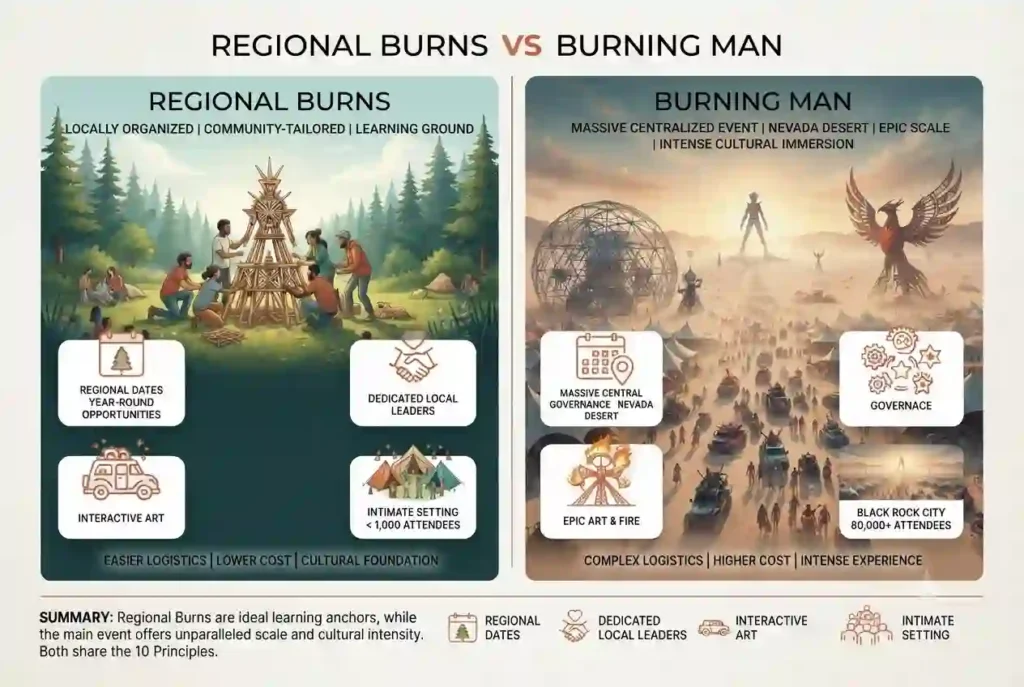
Regional burns and Burning Man share core principles but differ significantly in scale, logistics, and context. Regional burns are locally organized events—often smaller, community-tailored, and bound by local permits—where participants practice gifting, consent, and Leave No Trace in familiar regions. Burning Man (Black Rock City) is the massive, centralized annual event in Nevada with global infrastructure, complex art builds, and unique governance. Regional events are ideal learning grounds and community anchors; the main event offers unparalleled scale, epic art, and intense cultural immersion.
Is a Regional Burn the same as Burning Man?
No. Regional burns adopt Burning Man’s culture and principles but operate at local scale with different permits, site conditions, and resources. They emphasize participation and gifting like Burning Man but typically feature smaller art, fewer attendees, and rules adapted to local legal and community requirements.
Which is better for beginners: Burning Man or a Regional Burn?
Regional burns are generally better for beginners. They’re lower cost, lower pressure, and offer hands-on learning in a smaller, friendlier setting. Newcomers can practice gifting, consent, and camp logistics before committing to the scale, expense, and intensity of Black Rock City.
Are Regional Burns easier than Burning Man?
Typically yes—easier in logistics, travel, and sensory intensity. Smaller camps, fewer large-scale builds, and proximity to home resources reduce complexity and stress. But “easier” depends on the specific regional event and its organizing capacity; some regional burns can still be ambitious and demanding.
Do Regional Burns have the same culture?
They share the same underlying principles—participation, gifting, decommodification—but local flavor varies by region. Organizers adapt practices to regional norms, regulations, and participant priorities, so cultural overlap is strong but not identical across all regional events.
Do Regional Burns follow the 10 Principles?
Most regional burns embrace the Ten Principles as a guiding framework, though interpretation and emphasis vary by organizer. Commonly promoted principles include participation, gifting, and Leave No Trace, while tailoring policies to local laws, land use, and community priorities.
Are Regional Burns less expensive?
Generally yes. Regional burns often have lower ticket prices, reduced travel costs, and locally shared resources. They still require gear and contributions, but the overall financial barrier tends to be lower than attending the main Burning Man event in Nevada.
How many people attend Regional Burns?
Attendance varies widely—from intimate gatherings under 100 participants to multi-hundred or low-thousand events. Size depends on venue capacity, local organizing capacity, permitting, and regional demand. Check each event’s site or regional network page for accurate attendance figures.
Are Regional Burns less crowded?
Yes, most regional burns are less crowded than Black Rock City because of smaller attendance caps and dispersed local sites. Less crowding makes camps and programming more accessible and reduces sensory overload for newcomers, creating a more relaxed environment for first-time participants.
How Regional Burns Compare to Black Rock City
| Regional Burns | Black Rock City |
| Smaller communities | Temporary city of 70,000+ participants |
| Local culture influences | Global Burner community |
| Easier travel for many participants | Requires traveling to Nevada’s Black Rock Desert |
| Often shorter events | Approximately one week |
| Great for newcomers | The flagship Burning Man event |
| Community-focused atmosphere | Large-scale art, city infrastructure, and extensive programming |
- Regional burns mirror Burning Man principles but differ in scale and logistics.
- Often cheaper, less crowded, and better entry points for beginners.
- Culture and practices overlap but vary regionally.
- Regional events provide practical training and artistic incubation for the main event.
Finding a Regional Burn
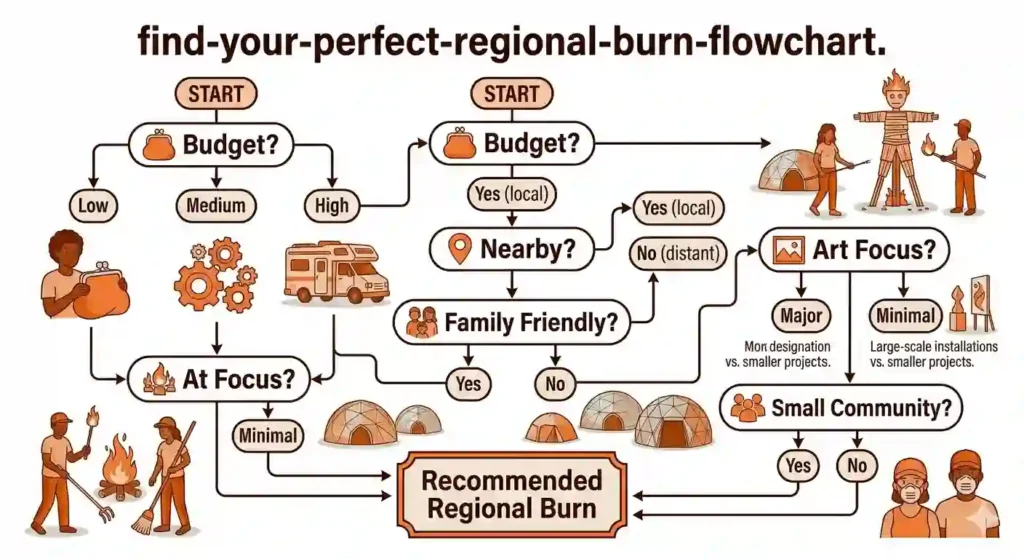
Finding a regional burn near you starts with the Burning Man Regional Network directory, which lists official and partner events worldwide. You can also search social platforms (Facebook, Meetup) for local Burner groups, check regional event calendars, and ask in community forums or Discord servers. Once you identify options, review event details: dates, location, ticket info, size, and rules. Contact local organizers, attend pre-event meetups, and choose a burn that matches your experience level and interests.
How do I find a Regional Burn near me?
Use the Burning Man Regional Network directory to search by region or country. Supplement with Facebook groups, Meetup listings, and local event calendars. Ask in community forums or Discord servers for recommendations, then contact organizers to confirm dates, tickets, and rules before attending.
What Regional Burns happen in the United States?
The U.S. hosts many regional burns, including large multi-day events and smaller gatherings. Examples include regional events in California, Nevada, Oregon, Colorado, Texas, and the Northeast. Check the Regional Network directory for current calendars, as dates and locations change yearly and new events may launch.
Are there Regional Burns outside the USA?
Yes—regional burns exist across many countries, including Canada, Europe, Australia, New Zealand, Mexico, and parts of Asia and South America. The Burning Man Regional Network tracks recognized events globally. Use the directory to find official or partner regional burns near you outside the U.S.
Which Regional Burn should I attend first?
Choose a beginner-friendly, smaller burn with clear participant guidelines and accessible location. Prioritize events that offer workshops, volunteer opportunities, and camp support. Attend a pre-event meetup to meet organizers and participants. A local, low-cost event with strong community values is ideal for your first regional experience.
What are the biggest Regional Burns?
The largest regional burns vary by region and year, often drawing hundreds to low-thousands of participants. Some well-known large events occur in California, Australia, and parts of Europe. Check the Regional Network site or regional event pages for current attendance figures and size categories.
How often do Regional Burns happen?
Frequency varies by region: many happen annually, some semi-annually, and others quarterly or seasonally. Local organizers set schedules based on permits, weather, and community demand. Check event calendars or regional group announcements for upcoming dates and recurring annual or seasonal burns.
What countries host Regional Burns?
Countries hosting regional burns include the U.S., Canada, U.K., Germany, France, Netherlands, Australia, New Zealand, Mexico, Spain, Italy, and others. The Burning Man Regional Network directory lists recognized events by country. Use the directory to discover official or partner regional burns globally.
Are there Regional Burns in Europe?
Yes, Europe hosts many regional burns, including events in the U.K., Germany, France, Netherlands, Spain, and Italy. These vary in size and format but generally follow Burning Man principles. Check the Regional Network directory or local Burner groups for current European event calendars and registration details.
Are there Regional Burns in Canada?
Yes, Canada hosts regional burns across provinces, including events in Ontario, British Columbia, Alberta, and Quebec. Canadian regional burns often feature theme camps, workshops, and volunteer-run infrastructure. Use the Regional Network directory or local Burner groups to find upcoming Canadian events and contact organizers.
Are there Regional Burns in Australia and New Zealand?
Yes, Australia and New Zealand both host regional burns. Australian events span major cities and rural regions, while New Zealand runs smaller, community-focused burns. These events often include art installations, workshops, and volunteer shifts. Check the Regional Network directory or local Burner groups for upcoming dates and registration info.
- Start with the Burning Man Regional Network directory for official events.
- Use social platforms, meetups, and forums to find local options.
- Choose beginner-friendly burns with clear guidelines and support.
- Regional burns exist globally—U.S., Canada, Europe, Australia, New Zealand, and more.
- Frequency varies: many are annual; some are seasonal or semi-annual.
Popular Regional Burns
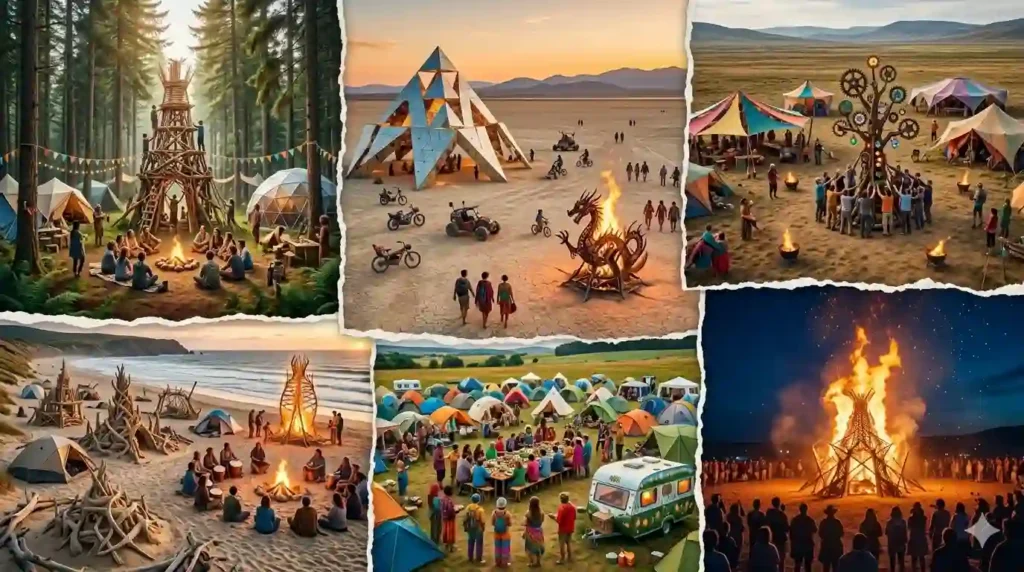
Popular regional burns are well-known events that attract large regional communities and often serve as training grounds for Burning Man. They typically feature theme camps, interactive art, workshops, volunteer infrastructure, and participant-led programming. Below are concise answers to frequently searched events with key details about location, timing, and scale.
What is SOAK?
SOAK is Portland and western Oregon’s annual regional Burning Man gathering. Held late May at Justesen Ranch in Tygh Valley, it features Burning Man-esque culture theme camps, art, and volunteer-run services. Tickets start around $100; volunteers can reduce cost via a point system. Pre-event involvement helps volunteers earn half off.
What is Transformus?
Transformus is a regional Burning Man art festival in Stokes County, North Carolina, held third weekend in July. It creates a temporary city called Mysteria with art installations, neighborhoods, nightlife, and camps. Core events include an effigy burn on Saturday night and a temple/art burn on Sunday night, drawing hundreds of participants.
What is Flipside?
Burning Flipside is Austin, Texas’s regional art and music festival inspired by Burning Man. It emphasizes participatory arts, music, and community programming in a local setting. Flipside features theme camps, art installations, and volunteer-run infrastructure, offering a smaller-scale but culturally rich experience for Texans and visitors.
What is Element 11?
Element 11 is Nevada’s regional burn, often centered near Las Vegas. It runs for several days with theme camps, interactive art, workshops, and volunteer-managed infrastructure. The event embraces Burning Man principles and serves as a regional entry point for desert participants, offering a scaled-down alternative closer to home than Black Rock City.
What is Apogaea?
Apogaea is Colorado’s regional burn, known for its strong collection of propane flame effects and interactive art. It’s held in the Rockies with camping, workshops, music, and participant-led programming. Apogaea attracts burners seeking mountain-based experiments in gifting, consent, and Leave No Trace in a high-altitude desert setting.
What is Lakes of Fire?
Lakes of Fire is a major regional burn in the Midwest (Michigan area), often drawing large attendance. It features theme camps, music, art installations, and volunteer infrastructure around lakeside camping. The event emphasizes community participation, gifting, and safe, family-friendly programming, making it a popular destination for regional burners.
What is Frostburn?
Frostburn is a winter regional burn in the Northeastern U.S. (often in New York or nearby states), running during colder months. It adapts Burning Man principles to winter conditions—camp preparation, cold-weather gear, and resilience. Frostburn offers a smaller, community-focused ice-and-fire experience with art and workshops.
What is KiwiBurn?
KiwiBurn (Kiwiburn) is New Zealand’s annual regional Burning Man event. Everybody contributes, everybody pays. It’s a collective, participatory experience with theme camps, art, workshops, and volunteer infrastructure. KiwiBurn runs domestically for NZ participants, emphasizing community, gifting, and Leave No Trace in a local, accessible format.
What is AfrikaBurn?
AfrikaBurn is South Africa’s regional burn, held in the Mar/Apr timeframe in the Marula area. It’s a large participatory arts and community event following Burning Man principles. AfrikaBurn features theme camps, art installations, music, and volunteer-managed services, attracting burners from across South Africa and neighboring countries.
What is Midburn?
Midburn is Israel’s regional burn, often described as amazing by burners. It embraces Burning Man principles with theme camps, art, workshops, and volunteer infrastructure. Midburn draws participants from Israel and the region, offering a culturally rich, participatory experience in a local setting adapted to regional regulations and community norms.
- Popular regionals include SOAK (Oregon), Transformus (NC), Flipside (Austin), Element 11 (Nevada), Apogaea (Colorado), Lakes of Fire (Midwest), Frostburn (Northeast winter), KiwiBurn (NZ), AfrikaBurn (South Africa), and Midburn (Israel).
- Each offers theme camps, art, and volunteer-run services adapted to local conditions.
- They serve as training grounds and community-building hubs for regional burners.
International Regional Burns
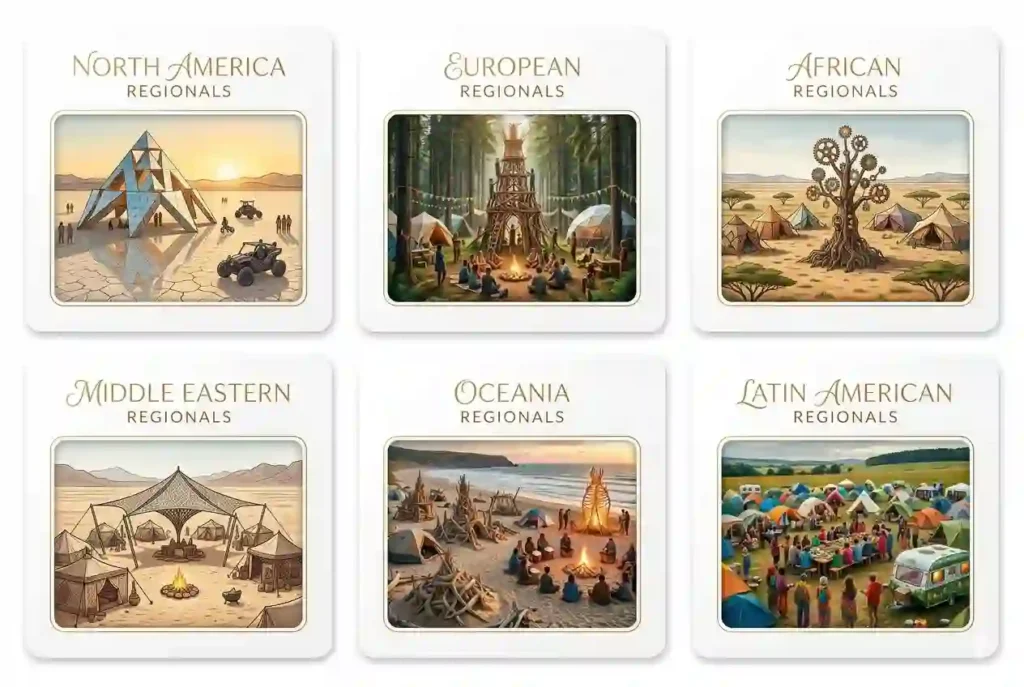
International regional burns are official or partner events outside the U.S. that embody Burning Man’s Ten Principles and offer global participants local alternatives to Black Rock City. They host theme camps, art, workshops, music, and volunteer infrastructure tailored to regional regulations and environments from desert events in South Africa and Israel to forest gatherings in Sweden and New Zealand’s summer celebration. These events stretch the culture worldwide, creating multicultural networks while keeping the core values of participation, gifting, and Leave No Trace.
What is Afrika Burn?
AfrikaBurn is South Africa’s official regional Burning Man event, held at Quaggafontein in the Tankwa Karoo desert, Western Cape. Founded in 2007, it’s Africa’s largest regional burn and one of the largest arts festivals in Africa. It runs late April, draws over 13,000 people, and features art burns, theme camps, music, and gifting, with no commerce on-site.
What is Mid burn?
Midburn is Israel’s regional Burning Man event, held 6 days annually in the Negev Desert (since 2014–2018 and again from 2022). It returns each fall, offering an immersive 5–6 day experience with art, music, theme camps, and volunteer infrastructure. Midburn embraces Burning Man principles in a harsh desert environment with minimal phone reception.
What is KiwiBurn?
Kiwiburn is New Zealand’s regional Burning Man event, held annually over six days in late January in the Rangitikei district (southern North Island). It’s the longest-running international regional burn, operating almost every year since 2004. KIWIburn emphasizes community participation, gifting, and Leave No Trace in a summer, accessible local setting.
What is Borderland?
The Borderland is Sweden’s regional burn, occurring at the end of July in Alversjö, near Copenhagen. It embodies Burning Man’s ten principles, fostering creativity, inclusivity, and participation. Participants create a temporary city with theme camps, art, and immersive programming, welcoming newcomers and offering a playground for artists and performers.
What is Nowhere Festival?
The Nowhere Festival is a UK regional burn inspired by Burning Man, often held in rural settings. It features participatory art, music, workshops, and theme camps while emphasizing gifting, consent, and Leave No Trace. Nowhere offers a smaller-scale but culturally rich alternative for UK-based burners and international visitors.
Which international Burn is most popular?
AfrikaBurn is the largest and most popular international regional burn, drawing over 13,000 attendees annually and recognized as Africa’s biggest arts festival. Other highly attended events include Borderland (Sweden), KiwiBurn (NZ), and Midburn (Israel), but AfrikaBurn’s scale and official status make it the most prominent globally.
How do Regional Burns differ by country?
Regional burns adapt to local laws, climate, and culture. Desert events (AfrikaBurn, Midburn) require heat/dust prep; forest events (Borderland) need rain gear; winter events need cold-weather strategies. Some have stricter permits, age limits, or alcohol policies. Each tailors programming, infrastructure, and scale to community capacity and national regulations.
Are international Burns beginner-friendly?
Many are beginner-friendly, especially smaller regional burns with clear guidelines, orientation, and volunteer support. Larger events like AfrikaBurn draw crowds but still offer mentorship. Choose beginner-friendly burns with workshops, camp support, and accessible locations. Pre-event meetups and contact with organizers help newcomers feel prepared and welcomed.
Can I attend a Burn outside my country?
Yes, international burns welcome global participants. Check visa requirements, travel logistics, ticket costs, and local safety guidelines. Many international burns offer volunteer programs that reduce ticket costs. Plan ahead for gear, transport, and health precautions. Attending abroad can deepen cultural exchange and expand your Burner network.
Which international Burn is closest to the original Burning Man experience?
AfrikaBurn and Midburn are often considered closest due to their desert settings, large-scale art, effigy/temple burns, and strong adherence to Burning Man principles. Both recreate the intensity and scale of Black Rock City more closely than smaller, forest-based regional burns, offering harsh environments and immersive participant-led cities.
- International regional burns: AfrikaBurn (SA), Midburn (Israel), KiwiBurn (NZ), Borderland (Sweden), Nowhere (UK).
- AfrikaBurn is the largest and most popular globally.
- Events adapt to local climate, laws, and culture.
- Many are beginner-friendly; choose smaller, supportive events first.
- International attendee visas, transport, and safety must be planned.
First-Timer Questions About Regional Burns
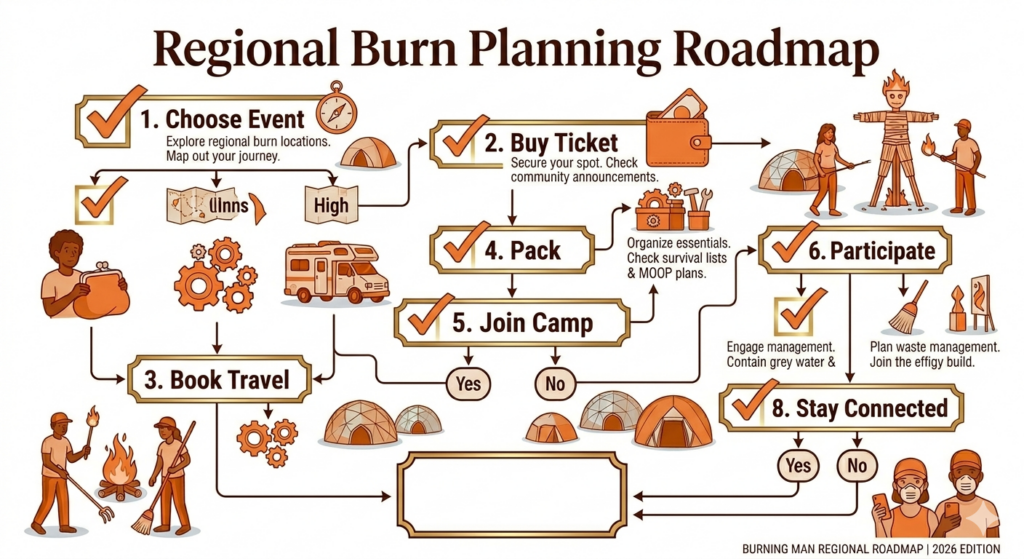
Regional burns are ideal on-ramps for first-timers: they’re smaller, lower-cost, and often more welcoming than the main event. Expect participatory culture theme camps, art, workshops, gifting, and volunteer-run infrastructure. Preparation includes packing shelter, water, sun/dust protection, and a small gift or skill to offer. Clothing is creative and practical; camping experience is helpful but not required. Newcomers succeed by being curious, reliable, and respectful of consent and Leave No Trace.
Should I attend a Regional Burn before Burning Man?
Yes, regional burns are great prep. They teach gifting, consent, camp skills, and event logistics in a smaller, safer setting. You’ll build confidence, make local connections, and practice Leave No Trace before investing in the scale and expense of Black Rock City.
Is a Regional Burn good for first-timers?
Absolutely. Regional burns are beginner-friendly: lower cost, smaller crowds, clearer guidance, and strong mentorship. Many offer workshops and camp support for newcomers. They reduce overwhelm and help you learn playa norms before the intensity of the main event.
What should I expect at my first Regional Burn?
Expect theme camps, interactive art, workshops, music, volunteer shifts, gifting, and communal meals. Programming is participant-led. You’ll be asked to contribute help at a camp, join a build, or host a small activity. Expect a relaxed but participatory community focused on shared experiences.
How do I prepare for a Regional Burn?
Pack tent/shade, water (1.5–2 gallons/day), food, sun/dust protection, sturdy shoes, headlamp, bike (optional), repair tools, and first-aid. Bring small gifts or useful items. Contact your camp early, confirm arrival plans, and learn event rules. Attend pre-event meetups to meet neighbors and learn logistics.
What do people wear at Regional Burns?
Creative, practical, weather-appropriate clothing: breathable layers, hats, sunglasses, boots, and costume elements. Many wear bright colors, funky accessories, and LED lights for night. Pack for conditions—warm layers for cool nights, rain gear if rainy. Comfort, mobility, and self-expression matter more than formal dress codes.
Do I need camping experience?
No formal experience is required, but basic camping skills help: set up a tent, manage shade, store food safely, and handle waste. If you’re new, choose a camp with mentorship or attend a beginner workshop. Many first-timers learn by doing and get support from experienced neighbors.
How much planning is required?
Moderate planning: secure camp placement or volunteer role, book travel/accommodation if needed, pack essentials, and coordinate arrival times. Review event rules, permits, and safety info. Plan for water, food, and emergency contacts. Pre-event meetups and camp communication reduce last-minute stress.
What mistakes do newcomers make?
Common mistakes: underpacking water/shade, arriving without camp plans, skipping consent habits, taking photos without permission, leaving trash, flaking on shifts, and assuming freebies. Bring labeled gifts, follow Leave No Trace, and communicate clearly. Reliability and respect earn trust faster than flashy gestures.
Is it easier to meet people at Regional Burns?
Yes, smaller size and community focus make connections easier. Camps, volunteer shifts, and workshops create repeat interactions. You’ll meet neighbors through shared tasks and casual conversations. Smaller crowds mean less overwhelm and more time to build genuine relationships compared to the main event.
How welcoming are Regional Burn communities?
Very welcoming. Most regional burns emphasize inclusion, mentorship, and low-pressure programming. Organizers and campmates often greet newcomers, offer help, and invite participation. First-timer-friendly camps and orientation sessions help integrate you quickly. Community norms prioritize kindness, consent, and shared responsibility.
- Regional burns are ideal first experiences: smaller, cheaper, and welcoming.
- Pack essentials (water, shade, protection), bring gifts/skills, and join camps.
- Expect participatory programming, volunteer shifts, and community meals.
- Avoid common mistakes: underpacking, flaking, unsolicited photos, and waste.
- Connections are easier due to smaller size and mentorship.
Tickets & Costs for Regional Burn
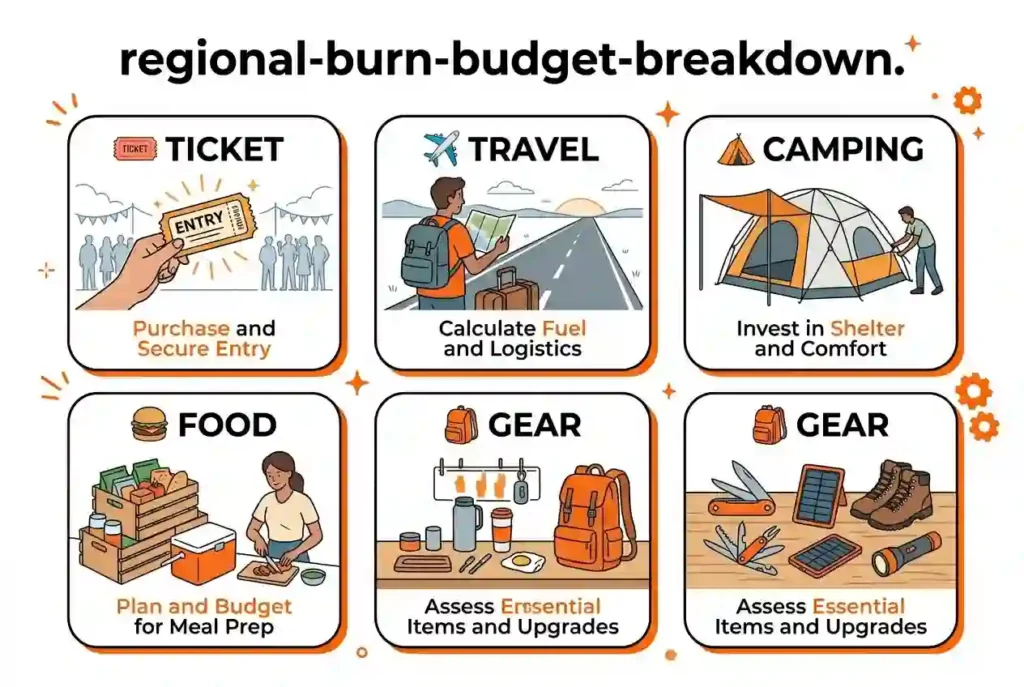
Regional burns vary in ticket pricing and what’s included, but most are significantly cheaper than Burning Man. Typical tickets range from $40–$150, often covering entry, camping, and basic infrastructure (shade, water stations, sanitation). Many offer volunteer discounts or point systems to reduce costs. Tickets usually sell out in advance arrive early or register via camp. Refunds are limited; vehicle passes may be separate expenses. Budget for gear, food, transport, and contingencies.
How much do Regional Burn tickets cost?
Ticket costs vary by region: often $40–$150 for entry + camping. Larger events (AfrikaBurn, Borderland) may cost up to $150–$250. Smaller local burns can be $30–$80. Check the event’s official site for current pricing. Some offer early-bird discounts or tiered pricing by season.
Are Regional Burns cheaper than Burning Man?
Yes, Regional burns are typically much cheaper. Burning Man tickets often exceed $500 plus travel, lodging, and gear. Regional burns reduce travel costs, have lower ticket prices, and often include camping and basic infrastructure. Total cost is usually 1/3–1/2 of the main event for comparable experience.
What is included in a ticket?
Most tickets include entry, camping access, and basic infrastructure: sanitation, water stations, shade areas, and sometimes communal meals. Some events include workshops, art burns, or music programming. Check the event’s FAQ for specifics—some exclude vehicle passes, parking, or premium amenities like showers or lockers.
How quickly do tickets sell out?
Tickets often sell out weeks to months in advance, especially for popular events (AfrikaBurn, Borderland, KiwiBurn). Early-bird tickets may disappear within days. Plan to register early, join camp waitlists, or contact organizers for updates. Smaller burns may sell out faster due to limited capacity.
Are there volunteer discounts?
Yes, many regional burns offer volunteer discounts, point systems, or free tickets for completing shifts. Volunteer roles include gate, kitchen, build crews, medics, or event support. Sign up early via the event’s volunteer portal and confirm shift requirements. Some events require pre-event training or commitment periods.
Can I buy tickets at the gate?
Some events allow gate sales, but many require pre-registration. Popular burns often cap attendance and sell out early. Check the event’s FAQ or ticketing page. If gate sales exist, expect limited availability and higher prices. Register early to secure entry and camping spots.
Are refunds available?
Refunds are limited or non-refundable for most regional burns. Some offer partial refunds with deadlines or transfer options. Check the event’s ticket policy for exceptions (medical emergencies, venue changes). Purchase tickets with flexible payment options if possible and confirm cancellation terms before buying.
Do Regional Burns have vehicle passes?
Many events offer optional vehicle passes for parking, camping, or transport. Some require vehicles for off-site camping. Fees vary: $10–$50 or included with ticket. Check event rules for vehicle restrictions, parking capacity, and safety requirements. Some burns prohibit vehicles inside the site or require special permits for RVs.
What hidden costs should I expect?
Hidden costs include gear purchases (tent, shade, water containers), food, transport, fuel, parking fees, insurance, and emergency supplies. Some events charge extra for vehicle passes, showers, or lockers. Budget for repairs, first-aid kits, and unexpected delays. Factor in travel time and accommodation if staying off-site.
How much should I budget overall?
Overall budget: $200–$600 for most regional burns (ticket + gear + food + transport). Larger events may cost $300–$900 including travel. Smaller local burns can be $100–$300. Include gear upgrades, food, fuel, and emergency funds. Plan for 10–20% extra for contingencies or unexpected needs.
- Tickets: $40–$150 (up to $250 for large events); cheaper than Burning Man.
- Includes entry, camping, basic infrastructure; vehicle passes may be separate.
- Volunteer discounts available; buy early—tickets sell out fast.
- Refunds limited; plan for hidden costs: gear, food, transport, parking.
- Overall budget: $200–$900 depending on event size and travel.
Camping & Accommodation
Most regional burns prioritize camping as the primary accommodation, but some offer cabins, RV parking, or off-site lodging options. Expect participatory, volunteer-run infrastructure with shade, water stations, and sanitation. Shelter should be sturdy, weather-resistant, and adaptable to local conditions (heat, rain, cold). Camping is generally easier than Burning Man due to smaller scale and closer access to home resources. Pack essentials: tent, shade, water (1.5–2 gallons/day/person), food, first-aid, and repair tools.
Do Regional Burns require camping?
Most require or strongly encourage on-site camping, but some allow RVs, cabins, or off-site lodging. Check event rules—some limit vehicle camping or require permits. If camping isn’t allowed, look for nearby motels or partner accommodations. Contact organizers for alternatives if you need non-camping options.
Can I bring an RV?
Many regional burns allow RVs with specific permits or parking zones. Some require vehicle passes and limit size. Check event rules for RV restrictions, fuel policies, and water/power hookups. Some burns prohibit RVs inside the site or require special permits. Contact organizers for RV-friendly options.
Are there cabins at Regional Burns?
Some regional burns offer cabin lodging or partner with nearby accommodations, but most emphasize camping. Cabins may be limited, require extra fees, or be available only for volunteers. Check the event’s FAQ or housing options. If cabins aren’t offered, plan for tent/shade camping with proper gear.
What type of shelter works best?
Sturdy, weather-resistant tents with shade structures work best. Use windproof anchors, UV-resistant fabric, and rain covers if needed. Extra tarps, rebar stakes, and ventilation help. For cold nights, insulated sleeping bags and warm layers. Choose lightweight, portable gear for easy transport and setup at camp.
Is camping easier than Burning Man?
Yes, smaller scale, closer home, and simpler logistics make camping easier. Less crowding, fewer large builds, and accessible resources reduce stress. Many regional burns offer mentorship, camp support, and easier access to water/food. Ideal for first-timers learning camping skills and event norms.
What weather conditions should I expect?
Weather varies by region: desert events (AfrikaBurn, Midburn) have heat and dust; forest events (Borderland) bring rain and cool nights; winter burns need cold gear. Check local climate forecasts and event-specific prep guides. Pack layered clothing, sun/dust protection, and rain gear. Prepare for temperature swings day to night.
How much food and water should I bring?
Bring 1.5–2 gallons of water per person/day plus extra for cooking. Pack non-perishable food, snacks, and cooking supplies. Include electrolyte packets, sunscreen, and hydration reminders. Plan for meals, snacks, and emergency rations. Some events offer communal meals, but self-sufficiency is expected for most camping needs.
What camping gear is essential?
Essentials: tent/shelter, shade structure, sleeping bag/mat, headlamp, water containers, food, first-aid kit, repair tools, stove, chairs, and bug protection. Add sun protection (hat, sunscreen), dust masks/goggles, and warm layers. Include a bike lock, multi-tool, and portable power. Pack light but comprehensive for safety and comfort.
Are generators allowed?
Many events restrict or ban generators due to noise, pollution, and fuel safety. Some allow quiet, low-emission generators with permits. Check event rules for generator policies, fuel storage, and noise limits. If prohibited, use solar power, battery packs, or camp-provided electricity. Confirm with organizers before bringing any power source.
How do camps work at Regional Burns?
Camps are participant-led groups that provide shared shelter, programming, and services. They coordinate setup, meals, shifts, and cleanup. Some offer guest spots; others require membership or dues. Contact camp leads early to secure placement, learn expectations, and join shifts. Camps foster community, mentorship, and shared infrastructure for attendees.
- Most burns require camping; RVs/cabins may be available with permits.
- Shelter: sturdy tent + shade; prepare for heat, rain, cold.
- Bring 1.5–2 gallons water/day, non-perishable food, and essential gear.
- Camping is easier than Burning Man; smaller scale, mentorship, accessible resources.
- Generators often restricted; check event rules for power options.
- Camps provide shared shelter, programming, and community support.
Community & Culture of Regional Burns
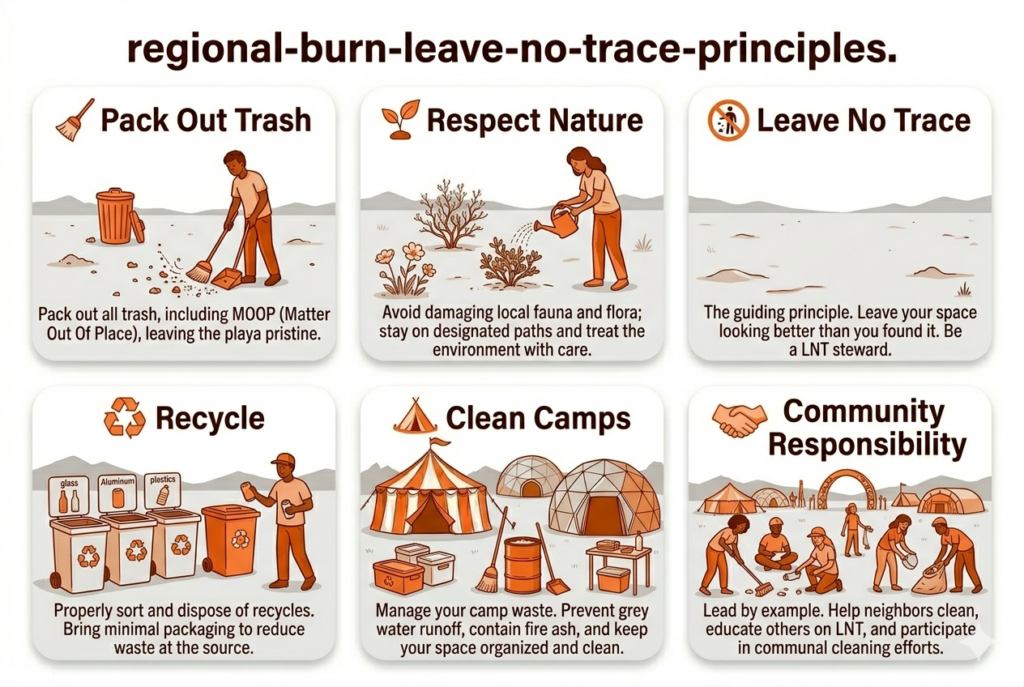
Regional burns embrace Burning Man’s core culture and most follow the Ten Principles as a guiding framework, though interpretation varies by region. Participants practice Leave no trace , gifting (non-transactional sharing), radical self-reliance (personal preparedness), communal effort (collaborative building), and participation (active contribution over passive consumption). Communities operate through volunteer-run infrastructure, theme camps, and shared responsibility. Family-friendly options exist; alcohol policies vary by location. Sobriety is respected, and contribution is encouraged through volunteering, hosting, or bringing skills/gifts.
Do Regional Burns follow the 10 Principles?
Most follow the Ten Principles as a guiding framework, though emphasis and implementation vary. Commonly promoted: participation, gifting, Leave No Trace, and radical self-reliance. Some adapt principles to local laws or community norms. Check the event’s FAQ for their specific interpretation and policy alignment with Burning Man’s core values.
What is gifting at Regional Burns?
Gifting is voluntary, non-transactional sharing offering food, water, services, art, or time without expecting payment or return. Examples: handing out water, hosting a workshop, fixing a bike, or performing. Gifting builds reciprocity, strengthens bonds, and creates a culture of generosity. Label food, respect consent, and avoid obvious waste.
What is radical self-reliance?
Radical self-reliance means preparing for your own needs: bring shelter, water, food, sun/dust protection, first-aid, and tools. It’s personal responsibility for safety and comfort. You’re expected to solve problems independently unless help is offered. Self-reliance reduces strain on neighbors and emergency services, enabling the event to function smoothly.
What is communal effort?
Communal effort is collaborative work to build and sustain the event—shared infrastructure, art builds, kitchen shifts, and cleanup. Participants contribute labor, skills, or resources to create a temporary city. It’s teamwork that makes large projects possible, reduces individual workload, and fosters trust through shared responsibility and visible contribution.
What is participation culture?
Participation culture expects active contribution volunteering, hosting, creating art, or helping neighbors—rather than passive attendance. Everyone is encouraged to create experiences, join shifts, and share skills. Participation builds community, creates meaning, and ensures the event functions through shared effort. It’s the core of Burner identity and event success.
How do Regional Burn communities operate?
Communities operate through volunteer-run teams, theme camps, and shared norms. Camps coordinate setup, meals, programming, and cleanup. Volunteers manage gates, sanitation, medics, and safety. Communication flows via group chats, meetings, and signage. Decision-making is collaborative, with organizers, camp leads, and participants working together to maintain infrastructure and culture.
Are Regional Burns family-friendly?
Many are family-friendly, with some offering kid zones, family camps, and quiet hours. Check event rules for age policies, child safety, and programming. Bring extra shade, water, and child-specific gear. Family camps often provide shared childcare rotations and activities. Some events restrict minors or require guardian supervision.
Is alcohol common at Regional Burns?
Alcohol policies vary: some allow limited consumption in designated areas, others prohibit it entirely due to local laws or safety. Some events serve alcohol at camps or partner vendors. Check event rules for restrictions, age limits, and designated zones. Respect local regulations and community norms when consuming.
Can I attend sober?
Yes, sober attendance is fully supported and respected. Many participants choose sobriety for safety, clarity, or personal reasons. Events focus on participation, gifting, and community, not substances. You can contribute through volunteering, art, or hosting without alcohol. Many camps offer non-alcoholic options and sober-friendly spaces for support.
How do I contribute to the community?
Contribute by volunteering (gate, kitchen, build crews), hosting a workshop, bringing skills (carpentry, first aid), or gifting useful items (water, tools). Offer help at camp, join shifts, and participate in cleanup. Reliability, communication, and respect earn trust. Small consistent contributions matter more than flashy gestures.
- Most regional burns follow Ten Principles with regional adaptations.
- Gifting = non-transactional sharing; radical self-reliance = personal prep.
- Communal effort = collaborative building; participation = active contribution.
- Communities operate via volunteer teams, camps, and shared norms.
- Family-friendly options exist; alcohol policies vary; sobriety is respected.
- Contribute via volunteering, hosting, skills, or gifting useful items.
Art & Creativity at Regional Burns
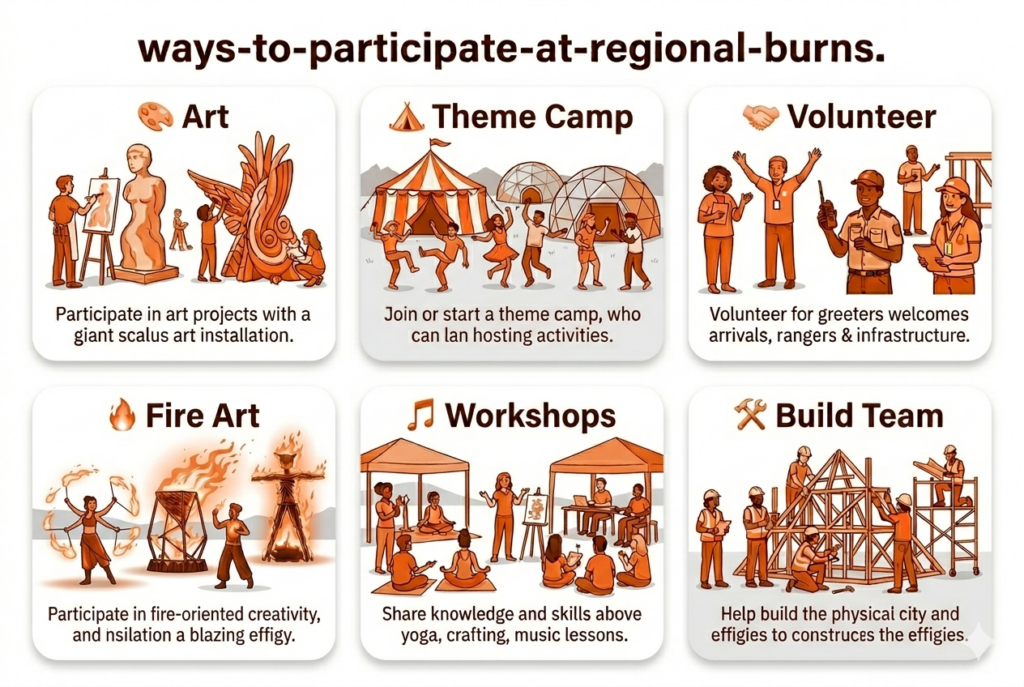
Regional Burns celebrate creativity through art installations, interactive experiences, fire performances, and workshops. While scale varies, many feature large art pieces, effigies, and themed camps. Artists participate by building installations, hosting workshops, or joining camp crews. Some events offer small art grants or support for materials. Common art includes sculpture, light pieces, flow toys, and interactive installations. Beginners can create simple projects; interactive art invites participation. Fire performances are common in many regions. Creativity is central it drives participation, gifting, and community bonding.
Do Regional Burns have large art installations?
Many have large art installations, including effigies, sculptures, and interactive pieces. Scale varies by event size and budget. Larger burns (AfrikaBurn, Borderland) feature multi-meter structures and light shows. Smaller regional burns may have modest installations. Check the event’s art page for current projects and artist opportunities.
Can I bring my own art project?
Yes, many Regional Burns welcome participant art. Submit proposals via the event’s art portal or contact camp leads. Projects must meet safety, size, and placement rules. Some require permits or insurance. Small portable art is easier to approve. Coordinate with organizers early for installation guidance and site requirements.
How do artists participate?
Artists participate by building installations, hosting workshops, performing, or joining camp crews. They may apply for grants, collaborate with theme camps, or volunteer for setup/cleanup. Artists often run interactive stations, lead build sessions, or provide performances. Participation integrates art with community service and shared programming.
Are there art grants available?
Some Regional Burns offer small art grants, material support, or funding for projects. Grants vary by event check the art portal or organizer FAQs. Larger events may have dedicated grant programs; smaller burns may offer informal support. Apply early with project details, budgets, and safety plans. Grants help prototype art for larger burns.
What types of art are most common?
Common art includes sculpture, light installations, flow toys, interactive pieces, and performance art. Effigies, temple burns, and themed camps are frequent. Many events feature music, dance, and visual art. Beginner-friendly options: painted signs, small sculptures, and light-up accessories. Teams often collaborate on larger builds.
Can beginners create art for a Burn?
Yes, beginners can create simple art: painted signs, small sculptures, light-up accessories, or interactive stations. Start with portable, low-risk projects. Join a camp or workshop to learn skills. Many events offer mentorship and beginner-friendly art sessions. Small contributions matter and build confidence for larger projects.
How do interactive installations work?
Interactive installations invite participant engagement: touch, move, create, or perform. Examples: flow toy stations, light-up walls, or build-your-own art. Artists guide participation, set safety rules, and provide materials. Visitors often contribute to the piece, making it co-created. Interactive art strengthens community bonding and participation culture.
Are there fire performances?
Yes, many Regional Burns feature fire performances, including fire spinning, torch dancing, and flame art. Safety rules apply: fire permits, trained performers, and designated zones. Some events host fire workshops. Check local regulations and event policies. Fire art adds spectacle and attracts participants, but requires strict safety protocols.
Can anyone host a workshop?
Many events welcome workshop hosts submit proposals via the program portal or contact organizers. workshops can cover skills, art, fitness, or community topics. Beginners can host simple sessions with camp support. Check size limits, safety requirements, and scheduling. Workshops strengthen participation and share knowledge across the community.
How important is creativity at Regional Burns?
Creativity is central it drives participation, gifting, and community bonding. Art fosters self-expression, collaboration, and shared meaning. Creative contributions make events unique and memorable. Participants often create art, performances, or workshops to share. Creativity embodies Burner identity and strengthens communal effort across all Regional Burns.
- Regional Burns feature large art, effigies, and interactive installations.
- Bring your own art: submit proposals; small projects easier to approve.
- Artists participate via builds, workshops, performances, and camp crews.
- Some events offer small art grants or material support.
- Common art: sculpture, light pieces, flow toys, fire performances.
- Beginners can create simple art; interactive art invites participation.
- Creativity is central to participation, gifting, and community bonding.
Theme Camps at Regional Burns
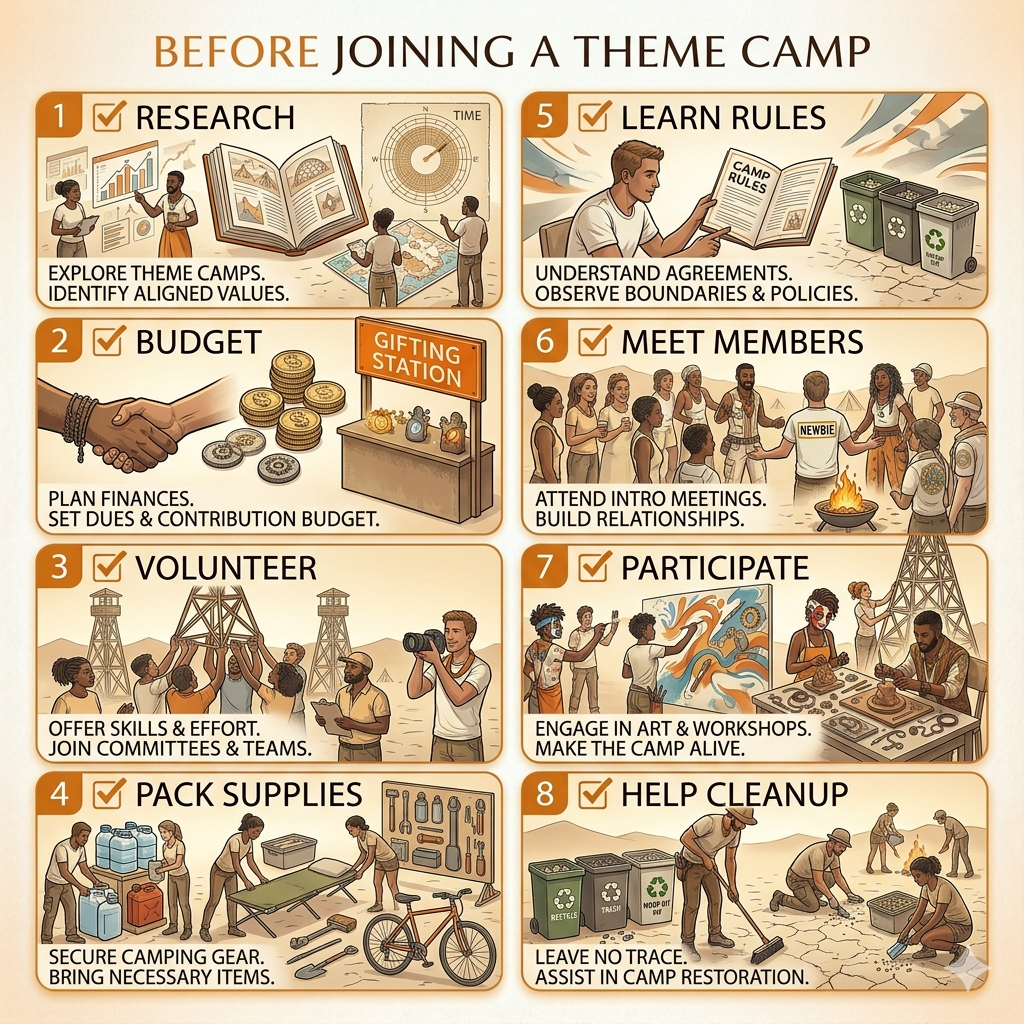
Yes, you can join a theme camp at a Regional Burn. Camps are participant-led groups providing shared shelter, programming, and services like kitchens, workshops, or music. They’re often smaller than Burning Man camps but still require coordination and dues. First-timers benefit from mentorship and shared resources. Creating your own camp is possible with planning and volunteer support. Camp members commit to shifts, cleanup, and contributing skills. Camps contribute essential infrastructure, community cohesion, and participant-led programming. Open camping is usually available for those without camp placement.
Can I join a theme camp at a Regional Burn?
Yes, most camps welcome new members. Contact camp leads via event forums, social groups, or the camp directory. Offer skills, time, or resources. Many camps have guest spots or volunteer roles for newcomers. Join pre-event meetups to meet members and confirm expectations early.
How do theme camps work?
Camps are participant-led groups that share shelter, programming, and services. They coordinate setup, meals, shifts, and cleanup. Members contribute skills, labor, or funds. Camps host workshops, music, or art. They operate through collaboration, shared responsibility, and volunteer-run infrastructure to create community spaces.
Are camps smaller than Burning Man camps?
Yes, Regional Burn camps are typically smaller due to lower attendance and budgets. They may have fewer members, simpler builds, and limited infrastructure. But they still offer programming, shared resources, and community. Smaller size often means easier integration and more personal mentorship for newcomers.
What are camp dues?
Camp dues are fees members pay for shared costs: land rent, materials, power, water, sanitation, and programming. Dues vary: $20–$150+ depending on camp size and services. Some camps offer volunteer discounts or point systems. Ask camp leads for exact dues, payment schedules, and what’s included.
Should first-timers join a camp?
Yes, joining a camp eases logistics, provides mentorship, and reduces isolation. Camps offer shared gear, meals, and support. First-timers learn norms quickly through camp activities. Many camps welcome newcomers for shifts or guest spots. Joining speeds integration and builds lasting connections with experienced Burners.
Can I create my own camp?
Yes, if you have a concept, crew, and resources. Submit a camp proposal via the event portal or contact organizers. You’ll need a plan for programming, infrastructure, and volunteer shifts. Start small: host a workshop or music session. Build a team and secure placement early for best results.
What responsibilities do camp members have?
Members commit to setup, cleanup, shifts (kitchen, gate, hosting), and contributing skills or funds. They follow camp rules, participate in programming, and maintain shared spaces. Reliability, communication, and respect earn trust. Members help with meals, repairs, and community support throughout the event.
How do camps contribute to the event?
Camps provide infrastructure (shade, power, water), programming (workshops, music, art), and community support. They host gatherings, run kitchens, and manage shared resources. Camps create social hubs, reduce strain on central services, and foster participation. Their contributions make the event function and enrich the experience for all attendees.
What are the best camps for newcomers?
Best newcomer camps are first-timer-friendly, offer mentorship, and have clear expectations. Look for camps with workshops, open kitchens, and guest spots. Contact camp leads early, ask about dues and shifts, and attend pre-event meetups. Smaller camps often provide more personal support and easier integration.
Is open camping available?
Yes, most Regional Burns allow open camping for those without camp placement. Open camping areas may have limited infrastructure; bring your own shelter, water, and power. Check event rules for designated zones, capacity limits, and safety requirements. Open camping is great for solo attendees or flexible schedules.
- Join camps: contact leads, offer skills, attend meetups.
- Camps share shelter, programming, and services; smaller than Burning Man camps.
- Dues: $20–$150+ for shared costs; volunteer discounts exist.
- First-timers benefit from mentorship and shared resources.
- Create camps with proposals, crew, and infrastructure plans.
- Members commit to shifts, cleanup, and contributions.
- Camps provide infrastructure, programming, and community hubs.
- Open camping available for solo or flexible attendees.
Volunteering at Regional Burns
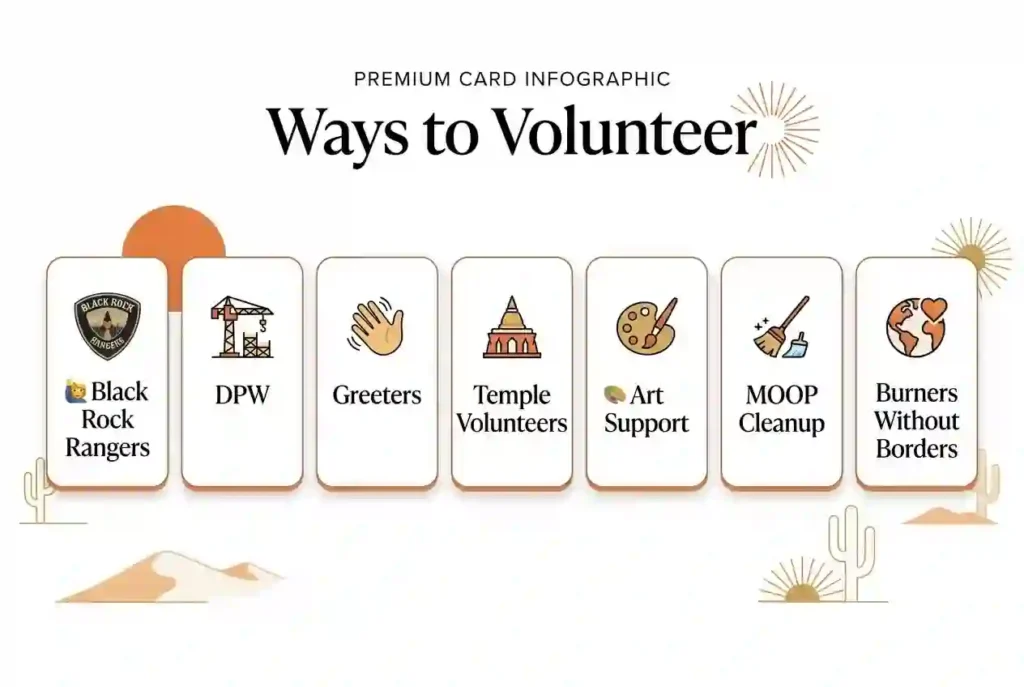
Volunteering is a core way to contribute at a Regional Burn and often earns discounted or free tickets. Roles include gate/greeter, kitchen, build crews, medics, sanitation, and event coordination. Volunteering isn’t always required but is encouraged for community support. First-timers can volunteer with basic skills; many roles offer on-site training. Hours vary by role (4–8+ hours). Ranger teams handle safety, conflict resolution, and community norms. Event crews manage infrastructure and logistics. Benefits include community integration, skill-building, cost savings, and deeper event involvement.
How do I volunteer at a Regional Burn?
Sign up via the event’s volunteer portal or contact camp leads. Choose roles matching your skills and energy. Complete required training or orientation. Confirm shift schedules and arrival times. Early registration increases chances for preferred roles. Some events offer volunteer discounts or free tickets for completed shifts.
What volunteer roles exist?
Common roles: gate/greeter, kitchen staff, build crews (art, infrastructure), medics/first aid, sanitation, sound/tech, signage, and event coordination. Some offer hospitality or welcome desk roles. Roles vary by event size and needs. Check the volunteer portal for current opportunities and descriptions.
Do volunteers get discounted tickets?
Yes, many Regional Burns offer discounted or free tickets for volunteers completing shifts. Discounts vary: partial refunds, point systems, or full ticket waivers. Some require minimum hours or pre-event training. Confirm volunteer perks via the event’s volunteer page or coordinator before signing up.
Is volunteering required?
Volunteering isn’t always required but is strongly encouraged for community support. Some events require volunteer shifts for certain roles (camps, art builds). Casual attendees can participate without volunteering, but contributing helps integration and reduces costs. Check event rules for mandatory shift policies.
What skills are most needed?
Most needed skills: carpentry, welding, electrical, cooking, first aid, bike repair, radio ops, crowd management, logistics, and communication. Many roles train volunteers on-site, so eagerness matters more than mastery. Show reliability, clear communication, and willingness to learn. Diverse skills strengthen event infrastructure.
Can first-timers volunteer?
Yes, first-timers can volunteer for straightforward roles (kitchen, greeter, cleanup). Many events offer orientation and training. Start with low-barrier shifts to learn norms and meet neighbors. Volunteer coordinators guide new volunteers. Contributing early builds trust and speeds community integration for newcomers.
How many hours do volunteers work?
Hours vary by role: 4–8+ hours per shift, often 1–2 shifts total. Some events require 8–12 hours for ticket discounts. Confirm shift length and frequency via the volunteer portal. Flexible scheduling exists for casual volunteers; committed roles may require longer hours.
What are Ranger teams?
Ranger teams handle safety, conflict resolution, and community norms. They mediate disputes, support survivors, enforce rules, and assist lost attendees. Rangers use restorative practices rather than punitive measures. Training includes de-escalation, first aid, and consent protocols. Rangers are vital for event safety and trust.
How do event crews operate?
Event crews manage infrastructure and logistics: gates, sanitation, power, art builds, and coordination. They work in teams with clear roles, schedules, and safety plans. Crews communicate via radios or group chats. They coordinate with camp leads and organizers to maintain systems and resolve issues quickly.
What are the benefits of volunteering?
Benefits include discounted/free tickets, community integration, skill-building, deeper event involvement, and networking. Volunteers gain operational experience, meet neighbors, and contribute to a shared purpose. Volunteering builds trust, reputation, and friendships. It’s a powerful way to learn Burner culture and support the event.
- Volunteer via portal or camp leads; choose roles matching skills.
- Roles: gate, kitchen, build crews, medics, sanitation, tech, coordination.
- Volunteers often get discounted/free tickets; some require shift minimums.
- Volunteering encouraged but not always mandatory.
- Needed skills: carpentry, cooking, first aid, logistics, communication.
- First-timers can volunteer for simple roles with training.
- Hours: 4–8+ per shift; 1–2 shifts common.
- Rangers handle safety, mediation, and community norms.
- Event crews manage infrastructure and logistics.
- Benefits: cost savings, community integration, skill-building, networking.
Family & Inclusivity
Regional Burns strive to be inclusive and many are family-friendly, with some offering family camps, kid zones, and quiet hours. Children can attend with guardian supervision and proper gear. Events vary in safety for women and LGBTQ+ inclusivity—most emphasize consent, radical inclusion, and community accountability. Older adults are welcome; accessibility options exist but may be limited. People with disabilities can attend with planning (ADA camps, mobility support). Pets are often restricted. Inclusivity is a core value, though implementation depends on local policies and camp cultures.
Are Regional Burns family-friendly?
Many are family-friendly, with some offering kid zones, family camps, and quiet hours. Check event rules for age policies, child safety, and programming. Bring extra shade, water, and child-specific gear. Family camps often provide shared childcare rotations and activities. Some events restrict minors or require guardian supervision.
Can children attend?
Yes, children can attend with guardian supervision and proper preparation. Bring shade, water, sun/dust protection, and noise-reducing gear. Choose family-friendly camps or zones. Some events have age restrictions or require guardians for minors. Plan for naps, hydration, and safe play areas. Child-friendly programming varies by event.
Are there family camps?
Yes, many Regional Burns have family camps offering shared childcare, kid programming, and quiet spaces. Contact camp leads for guest spots or membership. Family camps provide support, meals, and child-safe activities. Check event FAQs for family camp listings and placement options for families with children.
Are Regional Burns safe for women?
Most emphasize safety through consent culture, community accountability, and Ranger support. Many have women-focused camps or safe spaces. Report issues to Rangers or camp leads. Safety varies by event culture; check reviews and policies. Bring safety gear, establish buddy systems, and communicate boundaries clearly.
Are Regional Burns LGBTQ+ friendly?
Most are LGBTQ+ friendly, embracing radical inclusion and consent. Many have LGBTQ+ camps or programming. Check event policies for inclusivity statements and anti-discrimination rules. Some events host pride-themed activities. Cultural norms vary by region; research camp cultures and event guidelines for LGBTQ+ support.
Are older adults welcome?
Yes, older adults are welcome and often valued for mentorship and experience. Many camps appreciate diverse age groups. Some events offer quiet zones or accessible seating. Check for age-specific programming or healthcare support. Reliability, communication, and participation make older attendees integral to community.
Can people with disabilities attend?
Yes, people with disabilities can attend with planning. Some events offer ADA camps, mobility assistance, accessible showers, and designated parking. Contact organizers for accessibility needs and accommodations. Bring necessary gear and communicate needs early. Accessibility varies by venue; confirm options before attending.
How inclusive are Regional Burns?
Most are highly inclusive, emphasizing radical inclusion, consent, and community accountability. Many host diverse programming and camps for marginalized groups. Inclusivity varies by event culture and local laws. Check event statements for diversity commitments. Participate in workshops on inclusion and support underrepresented voices.
Are pets allowed?
Most Regional Burns prohibit pets due to safety, noise, and environmental concerns. Some allow service animals with documentation. Check event rules for pet policies and service animal accommodations. If allowed, bring secure containment and follow local regulations. Avoid bringing pets unless explicitly permitted.
What accessibility options exist?
Accessibility options include ADA camps, mobility vehicle rentals, accessible showers, designated parking, and volunteer assistants. Some events offer quiet zones and sensory-friendly programming. Contact organizers for needs and accommodations. Accessibility varies by venue; confirm services before attending and plan for transport and support.
- Many Regional Burns are family-friendly with kid zones and family camps.
- Children can attend with supervision and proper gear.
- Family camps offer shared childcare and kid programming.
- Safety for women and LGBTQ+ inclusivity vary; most emphasize consent and inclusion.
- Older adults welcomed; accessibility options exist but may be limited.
- People with disabilities can attend with planning and accommodations.
- Pets often prohibited; service animals allowed with documentation.
- Inclusivity is core; implementation varies by event culture.
Safety & Survival guide
Regional Burns are generally safe due to volunteer-run infrastructure, community accountability, and Ranger support. Biggest risks include heat/dust exposure, dehydration, injury, and nighttime navigation. Weather varies by region: desert burns have extreme heat; forest events bring rain and cool nights. Medical services (medics, first aid) are available on-site.
Emergency procedures involve Rangers, medics, and clear communication channels. Pack a first-aid kit with essentials (bandages, antiseptic, pain relievers, sunscreen, electrolytes). Stay safe at night with lights, buddy systems, and clear paths. Communication uses radios, group chats, or signage. Severe weather triggers shelter-in-place protocols. Critical survival skills: hydration, shade management, first aid, and navigation.
Are Regional Burns safe?
Yes, most are safe with volunteer-run safety teams, Rangers, and community accountability. Risks exist but are managed through protocols, training, and shared responsibility. Check event safety pages for crime reports, medical support, and emergency plans. Use buddy systems, report issues, and follow guidelines.
What are the biggest safety risks?
Biggest risks: heat exposure, dehydration, dust inhalation, injury (falls, burns), nighttime accidents, and occasional interpersonal conflicts. Prepare with shade, water, sun protection, and first-aid. Use buddy systems and avoid solo night travel. Report hazards to Rangers or camp leads immediately.
How do weather conditions differ?
Weather varies by region: desert burns (AfrikaBurn, Midburn) have extreme heat, dust, and dry winds; forest events (Borderland) bring rain and cool nights; winter burns need cold gear. Check local climate forecasts and event-specific prep guides. Pack layered clothing, sun/dust protection, and rain gear.
Are there medical services?
Yes, most have on-site medics, first aid stations, and emergency response teams. Some partner with local hospitals. Medics handle injuries, heat issues, and emergencies. Report medical needs to Rangers or camp medics. Bring personal medications and first-aid supplies. Check event FAQs for medical service details.
How do emergency procedures work?
Emergency procedures involve Rangers, medics, and clear communication channels (radios, group chats). Report incidents to Rangers or camp leads. Evacuation plans exist for severe weather or medical emergencies. Follow event signage and instructions. Keep emergency contacts handy and know medical station locations.
What should be in a first-aid kit?
Essentials: bandages, antiseptic wipes, pain relievers, sunscreen, electrolyte packets, tweezers, blister treatment, burn gel, and personal medications. Add sunglasses, dust masks, and hydration reminders. Include a small notebook for emergency contacts. Customize for individual needs and event-specific risks.
How do I stay safe at night?
Use headlamps, layers clothing, and light-up accessories. Stay with a buddy or group. Avoid isolated areas. Mark your camp with lights. Follow event safety zones and lighting paths. Keep contact info accessible. Report suspicious activity to Rangers. Night safety relies on visibility and communication.
What communication systems exist?
Communication uses radios (for staff), group chats (WhatsApp, Discord), event apps, and signage. Some events provide info booths or volunteer Bluetooth channels. Check event FAQs for communication guidelines. Carry a charged phone, backup battery, and know emergency contact numbers. Use radios for urgent safety issues.
What happens during severe weather?
Severe weather triggers shelter-in-place protocols: secure tents, move to safe zones, and follow Ranger instructions. Evacuation plans exist for extreme storms or heat. Some events pause programming. Check event alerts for weather updates. Bring emergency gear and know evacuation routes. Stay informed via radios or event apps.
What survival skills are most important?
Most important skills: hydration management, shade building, first aid, navigation, and storm preparedness. Learn to pack water, set up shelter, treat injuries, and read maps. Practice buddy systems and emergency communication. These skills reduce risk and enable self-reliance in harsh playa conditions.
- Regional Burns are generally safe with volunteer teams, Rangers, and community accountability.
- Biggest risks: heat, dehydration, dust, injury, night accidents.
- Weather varies: desert = heat/dust; forest = rain/cool; winter = cold.
- Medical services: on-site medics, first aid, emergency response.
- Emergency procedures: Rangers, medics, radios, clear communication.
- First-aid kit: bandages, antiseptic, pain relievers, sunscreen, electrolytes.
- Night safety: lights, buddy systems, marked camps, avoid isolation.
- Communication: radios, group chats, event apps, signage.
- Severe weather: shelter-in-place, evacuation plans, follow instructions.
- Survival skills: hydration, shade, first aid, navigation, storm prep.
Building Toward Burning Man
A Regional Burn is an ideal training ground for Burning Man smaller scale, lower cost, and closer to home let you practice gifting, consent, camp skills, and event logistics safely. Key lessons transfer: hydration, shade management, packing essentials, volunteer roles, and community norms. Desert events (AfrikaBurn, Midburn) best mimic Black Rock City’s harsh environment. Attending a Regional Burn reduces first-timer mistakes by building confidence and connections. Experienced burners use regionals to mentor, test gear, and refine projects. Attend one or two regionals first; test gear like tents, shade, bikes, and water systems there.
Can a Regional Burn prepare me for Burning Man?
Yes, Regional Burns teach gifting, consent, camp setup, and volunteer roles in a safer, smaller setting. You’ll build confidence, learn hygiene and hydration habits, and make local connections. This hands-on practice reduces overwhelm and first-timer mistakes at Black Rock City.
Which Regional Burn is best before attending Burning Man?
Desert regional burns (AfrikaBurn, Midburn, Element 11) best mimic Black Rock City’s heat, dust, and isolation. They offer similar infrastructure and intensity. Choose events with effigy/temple burns and large art for authentic preparation. Smaller regional burns are good for learning basics before tackling desert conditions.
What lessons transfer to Black Rock City?
Transferable lessons: hydration strategies, shade building, packing essentials, camp coordination, volunteer shifts, consent culture, and Leave No Trace. You’ll learn to navigate crowds, manage gear, and communicate with neighbors. These skills reduce stress and improve safety at Burning Man.
What skills should I learn first?
Learn first: hydration management (1.5–2 gallons/day), shelter setup, bike maintenance, basic first aid, and dust/sun protection. Master packing essentials, camp communication, and volunteer sign-ups. These basics build confidence and self-reliance for larger, harsher events like Burning Man.
How different is the desert environment?
Desert environments (AfrikaBurn, Midburn, Black Rock City) are harsher: extreme heat, dust storms, dry winds, and limited water. Night temps drop sharply. Forest regionals are milder. Prepare for heat exhaustion, sunburn, and dust inhalation. Practice desert-specific gear and hydration at desert regionals first.
Will attending a Regional Burn reduce first-timer mistakes?
Yes, attendees learn packing, camp placement, consent habits, and logistics before the main event. This reduces underpacking, flaking, unsolicited photos, and waste. You’ll navigate crowds better, manage gear, and communicate clearly. First-timer mistakes drop significantly after regional burn experience
How do experienced burners use Regional Burns?
Experienced burners use regionals to mentor newcomers, test art projects, refine gear, and build teams. They volunteer for leadership roles, host workshops, and recruit campmates. Regionals serve as training labs for larger builds and community-building before Black Rock City.
Should I attend multiple Regional Burns first?
Attending one or two regionals is ideal for first-timers. Start with a smaller, beginner-friendly burn to learn basics, then a desert regional for intensity. Multiple regionals build skills, confidence, and connections. Over-attending may delay main event readiness; balance practice with progression.
What gear can I test at a Regional Burn?
Test gear: tents, shade structures, bikes, water containers, headlamps, repair tools, first-aid kits, and power systems. Try dust masks, goggles, and layered clothing. Evaluate comfort, durability, and setup time. Regional burns let you refine gear before investing in Burning Man-specific equipment.
Is a Regional Burn the best training ground for Burning Man?
Yes, Regional Burns are the best training ground due to lower cost, smaller scale, and accessible mentorship. They offer hands-on practice in gifting, consent, camp skills, and logistics. Desert regionals mimic Black Rock City conditions closely. Start with one regional, then progress to Burning Man.
- Regional Burns prepare you via hands-on practice in gifting, consent, camp skills, and logistics.
- Desert regionals (AfrikaBurn, Midburn) best mimic Black Rock City.
- Transferable lessons: hydration, shade, packing, volunteer roles, community norms.
- Learn first: hydration, shelter setup, bike maintenance, first aid, dust/sun protection.
- Desert environments are harsher: extreme heat, dust, dry winds, night drops.
- Regionals reduce first-timer mistakes: underpacking, flaking, unsolicited photos, waste.
- Experienced burners mentor, test gear, refine projects, and recruit at regionals.
- Attend 1–2 regionals first; start small, then desert.
- Test gear: tents, shade, bikes, water, headlamps, tools, first aid, power.
- Yes—Regional Burns are the best training ground for Burning Man.
Regional Burns in Numbers
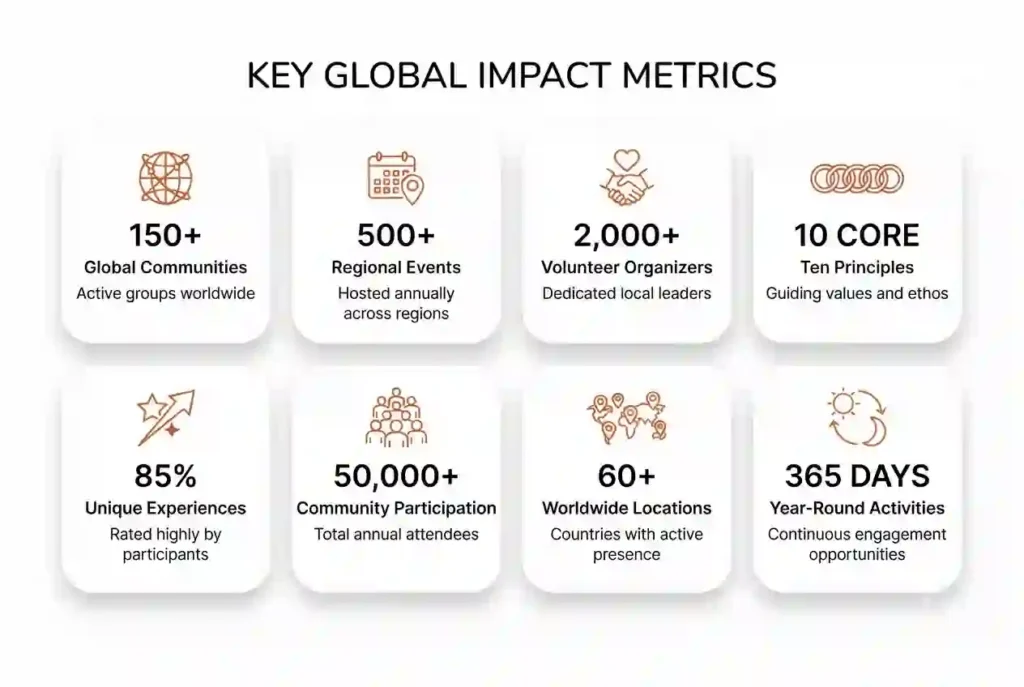
Burning Man isn’t limited to Black Rock City. Every year, officially recognized Regional Burns bring Burner culture to communities around the world. From small local gatherings to large multi-day events, Regional Burns allow participants to experience the Ten Principles, creativity, gifting, and community closer to home.
Key Numbers
- 🌍 Dozens of Countries – Official Burning Man Regional communities exist across North America, Europe, Asia, Oceania, Africa, and Latin America.
- 🏕️ Hundreds of Regional Events – Local Burner communities organize regional gatherings, campouts, decompressions, and burns throughout the year.
- 🤝 Volunteer-Led Communities – Most Regional Burns are organized by dedicated local volunteers and nonprofit groups.
- 🎨 Inspired by the Ten Principles – Every official Regional Burn embraces Burning Man’s core principles while reflecting local culture.
- 🔥 Each Event Is Unique – No two Regional Burns are exactly alike in size, location, traditions, or activities.
- 🌱 Community First – Participation, gifting, Leave No Trace, and collaboration remain central to every Regional event.
- ✈️ Closer to Home – Regional Burns give people the opportunity to experience Burner culture without traveling to Nevada.
- ❤️ Year-Round Participation – Burner communities stay active throughout the year with workshops, art projects, volunteer events, and gatherings.
Accessibility & Inclusion at Regional Burns
Regional Burns strive to make participation welcoming and inclusive, but accessibility services vary because each event is independently organized by its local community. Before attending, review the event’s official accessibility information and contact the organizers if you have specific accommodation needs.
What May Be Available
- ♿ Accessible camping areas
- 🚻 Accessible toilets and sanitation facilities
- 🅿️ Accessible parking
- 🛺 Mobility assistance (at selected events)
- 🤟 ASL or sign language interpretation (some events)
- 🧏 Communication support for Deaf and Hard-of-Hearing participants
- 🐕 Service animal policies (where permitted)
- ❤️ Accessibility volunteers and participant support
Tip: Accessibility services differ from one Regional Burn to another, so always check the official event website before traveling
Common First-Timer Mistakes at Regional Burns
Many first-time participants assume Regional Burns work exactly like Black Rock City or traditional festivals. Learning from common mistakes helps you arrive better prepared and enjoy the experience.
Mistakes to Avoid
❌ Arriving without reading the event guide
❌ Assuming food, water, or supplies will be available
❌ Treating the event like a spectator festival instead of participating
❌ Ignoring local weather and environmental conditions
❌ Forgetting to volunteer or interact with the community
❌ Leaving waste or MOOP behind
❌ Not learning the Ten Principles before attending
❌ Waiting until the last minute to prepare
Veteran Burner Tips for Regional Burns
Experienced Burners often say that Regional Burns provide one of the best opportunities to experience the true spirit of Burning Man because communities are often smaller, more personal, and highly collaborative.
Insider Tips
⭐ Introduce yourself to your neighbors—they’re often happy to help newcomers.
⭐ Volunteer for a shift early in the event to meet people quickly.
⭐ Participate in workshops, art projects, and community activities instead of only attending parties.
⭐ Respect local customs because every Regional Burn has its own unique traditions.
⭐ Bring a small gift or creative contribution rather than expecting entertainment.
⭐ Stay after major activities to help with cleanup whenever possible.
⭐ Keep an open mind—many unforgettable experiences happen unexpectedly.
⭐ Leave the event having contributed more than you consumed.
Regional Burn Safety & Preparation Tips
Although Regional Burns are often smaller than Burning Man, preparation is still essential.
Before You Go
- 📍 Learn about the venue and local environment.
- 🎟️ Read all event rules and ticket information.
- 🎒 Pack according to the event’s climate.
- 🚗 Plan transportation and parking.
- 📱 Save emergency contact information.
During the Event
- 💧 Stay hydrated.
- 🌞 Protect yourself from weather conditions.
- 🤝 Respect consent and personal boundaries.
- 🌱 Follow Leave No Trace.
- ❤️ Help others when appropriate without compromising your own safety.
Is a Regional Burn Right for You?
Regional Burns can be a great choice if you:
✅ Want to experience Burner culture closer to home.
✅ Are preparing for your first Burning Man.
✅ Enjoy volunteering and creative collaboration.
✅ Want to meet your local Burner community.
✅ Prefer smaller, community-focused events.
✅ Want to practice self-reliance before visiting Black Rock City.
Regional Burns Myths vs Reality
| Myth | Reality |
| Burning Man only happens in Nevada. | Official Regional Burns take place in many countries around the world. |
| Regional Burns are smaller copies of Burning Man. | Each Regional Burn develops its own traditions while following the Ten Principles. |
| Only experienced Burners can attend Regional events. | Many Regional Burns welcome newcomers and first-time participants. |
| Regional events are commercial festivals. | Most are community-led, nonprofit events focused on participation rather than spectatorship. |
| Every Regional Burn looks the same. | Each reflects its local culture, environment, and community. |
| Burner communities only meet once a year. | Many organize year-round events, volunteer projects, workshops, and gatherings. |
Regional Burns Planning Checklist
Before Choosing an Event
✅ Learn what Regional Burns are
✅ Find the event closest to you
✅ Review the event’s website and community guidelines
✅ Understand local participation requirements
Before Registering
✅ Check ticket availability
✅ Review camping or accommodation options
✅ Join local Burner community groups
✅ Learn the event’s volunteer opportunities
Before Traveling
✅ Pack according to the event environment
✅ Review local weather and regulations
✅ Prepare transportation plans
✅ Read the event survival information
During the Event
✅ Participate instead of spectating
✅ Respect local community traditions
✅ Practice gifting and consent
✅ Follow Leave No Trace principles
Frequently Asked Questions About Regional Burns
This guide introduces the worldwide Regional Burn network and connects you to detailed guides about communities, events, participation, volunteering, and planning.
A Regional Burn is an officially recognized community event inspired by Burning Man’s Ten Principles and organized by local Burner communities.
Yes. Many Regional Burns are excellent introductions to Burner culture before attending Black Rock City.
Visit the Regional Events Guide to explore official Burning Man events around the world.
Yes. Every officially recognized Regional Burn is built around the Ten Principles while adapting them to its local community.
No. Each event has its own size, traditions, and atmosphere while sharing the same core values.
No. Many participants experience Burner culture for the first time through Regional events.
No. This pillar page provides an overview, while the linked guides explore each topic in greater depth.
Yes. Most Regional events depend on volunteers to help build, organize, and support the community.
Together they explain how Regional Burner communities operate, how events are organized, and how you can participate throughout the year.
Where Should You Go Next?
Whether you’re looking for a nearby Burner community or planning your first Regional Burn, these guides will help you continue your journey.
| If You Want To… | Read This Guide |
| Find Regional Burns worldwide | → Regional Events Guide |
| Learn about local Burner communities | → Global Burner Network Guide |
| Volunteer at community events | → Volunteer Programs Guide |
| Understand Burning Man culture | → Ten Principles Guide |
| Explore community projects | → Burners Without Borders Guide |
| Learn Burning Man history | → Burning Man History Guide |
| Discover sustainability efforts | → Sustainability Guide |
| Explore Fly Ranch | → Fly Ranch Guide |
Regional Burns Pro Tips
🌍 Choose the Regional Burn that best matches your location and interests.
🤝 Introduce yourself to the local community before attending your first event.
🎒 Prepare according to the local environment rather than assuming every event is like Black Rock City.
❤️ Volunteer whenever possible—it’s one of the fastest ways to connect with the community.
🎨 Participate actively instead of simply observing.
🌱 Respect local traditions while embracing the Ten Principles.
📖 Use this Regional Burns Guide as your starting point, then explore each specialized guide for more detailed planning.
🌍 Related Regional Guides
| If You’re Interested In… | Continue Reading |
|---|---|
| Understanding Regional Burns | → What Are Regional Burns? |
| Finding events nearby | → Find a Regional Burn Near You |
| Meeting local Burners | → Regional Burn Communities |
| Planning your first Regional | → First-Time Regional Burn Guide |
| Comparing Regional events | → Regional Burn Comparisons |
| Learning about the official network | → Official Regional Network Guide |
Key Takeaways
Before attending a Regional Burn, remember these important points:
- 🌍 Regional Burns bring Burning Man culture to communities around the world.
- 🤝 Every official Regional Burn follows the Ten Principles while celebrating local creativity.
- 🎨 Participation is far more important than passive attendance.
- ❤️ Volunteering is one of the best ways to become part of the community.
- 🏕️ Prepare for each event based on its local environment and requirements.
- 🌱 Practice Leave No Trace and respect the host community.
- 📖 Use this Regional Burns Guide as your roadmap, then continue exploring the specialized community guides.
Final Thoughts
Regional Burns show that Burner culture extends far beyond Black Rock City. Whether you’re attending your first local gathering or exploring events on another continent, every Regional Burn offers an opportunity to experience creativity, collaboration, and community in a unique setting.
As you continue your journey, remember these final reminders:
- 🌍 Explore the Regional Burn closest to your home or travel plans.
- 🤝 Connect with your local Burner community before attending.
- 🎨 Bring your creativity, curiosity, and willingness to participate.
- ❤️ Volunteer to support your Regional community whenever possible.
- 🌱 Respect local traditions while practicing the Ten Principles.
- ✨ Remember that every Regional Burn is unique, so embrace new experiences with an open mind.
- 📖 Use this guide as your starting point, then explore the detailed Regional Burn guides to discover communities and events around the world.
What’s Next? Continue Your Burning Man Journey
Now that you’ve explored the worldwide Regional Burn community, continue learning with these essential pillar guides.
| Next Step | Recommended Guide |
| Learn the Ten Principles | → Burning Man Culture Guide |
| Prepare for Black Rock City | → First-Timer Guide |
| Plan your survival strategy | → Survival Guide |
| Understand transportation | → Transportation Guide |
| Explore Black Rock City | → Black Rock City Guide |
| Discover Burning Man art | → Art Guide |