Burning Man’s 10 Principles: Meaning, Examples & How They Shape Black Rock City and Regional Burns
The 10 Principles of Burning Man are the cultural guideposts behind Black Rock City and Burner communities worldwide. They explain why Burning Man is more than a festival: it is a participatory, non-commercial, creative, self-reliant, and community-built culture.
Larry Harvey wrote the Ten Principles in 2004 as guidelines for the newly formed Regional Network. They were not designed as a strict rulebook; they describe the ethos and cultural behaviors that emerged organically through the Burning Man community. Today, they guide Black Rock City as well as Burner communities, camps, civic projects, and Regional Burns around the world.
The 10 Principles do not only shape Black Rock City in Nevada. They are also the cultural backbone of official Burning Man Regional Events, local Burner communities, volunteer projects, art gatherings, and year-round civic initiatives worldwide. More than 80 official Regional Events take place across dozens of countries, each adapting the Principles to its local environment, laws, culture, and community needs.
Whether someone attends Burning Man in the Black Rock Desert, joins a Regional Burn, volunteers at a local Burner project, or participates in a community art gathering, these Principles provide a shared cultural language: prepare yourself, welcome others, contribute, give freely, protect the environment, and create meaningful experiences together.
The Burning Man Project reported 87 official Regional Events in 2024, including 49 in the United States and 34 in 17 countries outside the U.S.; the network had 240 Regional Contacts across 106 regions in 34 countries and one virtual space.
“We achieve being through doing.”
— Burning Man’s Principle of Participation
What You Will Learn in This Guide
This guide explains the Ten Principles in simple, practical language so that first-time Burners, returning participants, solo campers, camp members, and Regional Burn attendees can understand what these values look like in real life.
🔟 The complete list of the 10 Principles and what each one means
- 📜 Who wrote the Principles and why they were created in 2004
- 🧭 Whether the Principles are rules or cultural guidelines
- 🎁 How gifting works and why it is not the same as bartering
- 🚫 What Decommodification means for brands, logos, advertising, sponsorships, and consumer culture
- 💧 How Radical Self-Reliance works in the desert and why preparation matters
- 🎭 How Radical Self-Expression works alongside consent, respect, and personal boundaries
- 🏗️ Why camps, art, volunteers, and shared work matter
- 🧹 How Leaving No Trace and MOOP protect the playa
- 🙌 How first-time Burners can participate, even without joining a theme camp
- 🌅 What Immediacy means and why direct experience matters
- 🌍 How Regional Burns and Burner communities use the Principles worldwide
The 10 Principles do not only shape Black Rock City. They are also the cultural backbone of more than 80 official Burning Man Regional Events and year-round Burner communities around the world.
✅ A practical final checklist to help you live the Principles before, during, and after the Burn
What Are the 10 Principles of Burning Man?
The Ten Principles are not ten random ideas. Together, they explain how participants create a temporary city that values creativity, personal responsibility, generosity, shared effort, environmental care, and direct human experience.
They are especially important for first-time Burners because Burning Man is not designed to work like a normal music festival. You do not arrive as a customer expecting entertainment, food, shade, services, and convenience to be supplied for you. You arrive prepared to take care of yourself and help create the experience for others.
The 10 Principles at a Glance
| # | Principle | Simple meaning |
| 1 | Radical Inclusion | Everyone can belong and participate |
| 2 | Gifting | Give freely without expecting a return |
| 3 | Decommodification | Keep advertising, sponsorship, and consumer culture from dominating the experience |
| 4 | Radical Self-Reliance | Prepare yourself and use your own practical and inner resources |
| 5 | Radical Self-Expression | Share your creativity and authentic self while respecting others |
| 6 | Communal Effort | Work together to create art, camps, events, and community |
| 7 | Civic Responsibility | Act responsibly toward safety, public welfare, and the law |
| 8 | Leaving No Trace | Remove your impact and protect the environment |
| 9 | Participation | Help create the experience rather than only consuming it |
| 10 | Immediacy | Be present and value direct experience |
The Principles are guideposts for Black Rock City and the wider global Burner culture. They are not rules meant to control every individual action.
[Button: Explore the Complete Burning Man Culture Guide]
Why Do the 10 Principles Matter?
The Principles matter because Black Rock City exists for only a short time, yet it requires thousands of people to cooperate, prepare, create, care for one another, and clean up after themselves.
Black Rock City is deliberately temporary. It rises in the desert for a limited period and then disappears without a trace. That is why self-reliance, participation, civic responsibility, and Leaving No Trace are not abstract ideas; they are practical necessities.
The Principles Shape Every Major Part of Burning Man
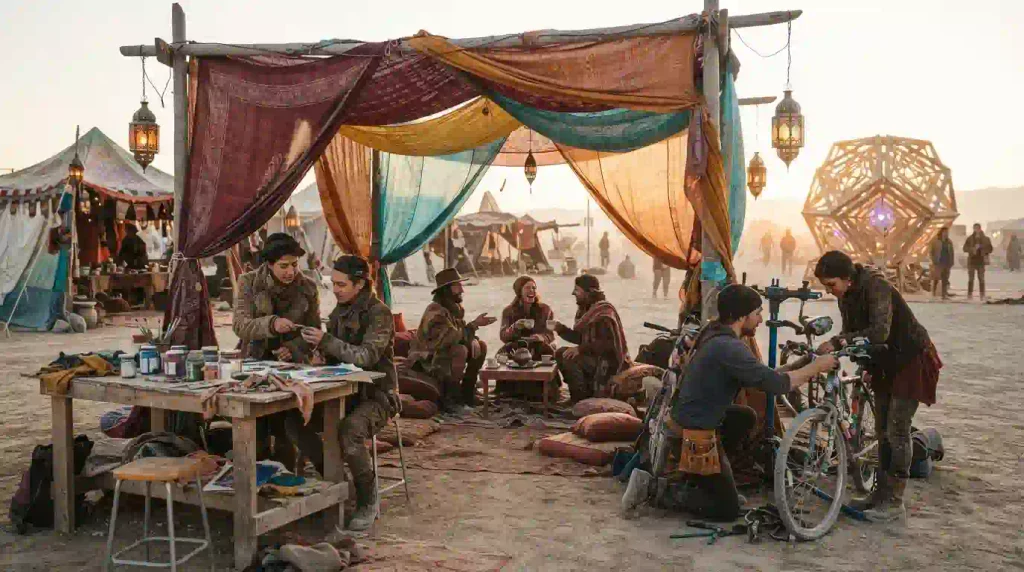
Theme camps use communal effort and participation to create public experiences.
Art installations reflect radical self-expression, gifting, and collaboration.
The gift economy creates connection without turning every interaction into a sale or trade.
Playa survival depends on radical self-reliance and preparation.
Safety and camp operations require civic responsibility.
Playa restoration depends on Leaving No Trace and collective accountability.
The emotional power of the event often comes from Immediacy: being fully present instead of simply watching through a screen.
Burning Man culture is made through the actions of participants. In other words, it is something people do, not merely something they claim to identify with.
Facts and Figures
The Ten Principles were written by Larry Harvey in 2004.
The Regional Network includes hundreds of regional contacts and communities across dozens of countries.
Why the Principles Matter Beyond the Playa
The Ten Principles are not limited to one week in the Nevada desert. They travel with Burner communities into cities, neighborhoods, regional campouts, art collectives, volunteer groups, skill-sharing events, environmental cleanups, and local gatherings around the world.
Official Burning Man Regional Events use the Principles as a shared cultural foundation. Although every event has its own local organizers, land requirements, safety plans, laws, climate, traditions, and scale, the same core values remain recognizable: Radical Inclusion, Gifting, Decommodification, Radical Self-Reliance, Radical Self-Expression, Communal Effort, Civic Responsibility, Leaving No Trace, Participation, and Immediacy.
In 2024, the global network included 87 official Regional Events, bringing together approximately 93,000 participants. These events occurred across the United States and internationally, showing that Burner culture is not confined to Black Rock City—it is practiced year-round by communities around the world.
There are more than 100 official Regional Events globally, along with many more independent Burner gatherings and community projects.
Black Rock City is a temporary city built, operated, experienced, and removed by its participants.
The culture depends on people preparing for themselves while contributing to a larger community.
[Button: Learn How Black Rock City Is Built]
Are the 10 Principles Rules or Guidelines?
No. The 10 Principles are cultural guideposts, not a simple list of enforceable event rules.
Larry Harvey wrote them to articulate the community’s developing ethos and culture. They were not created as rules that dictate how every person should behave.
However, that does not mean Burning Man has no rules, no laws, no safety standards, or no accountability.
Principles vs Official Rules
| Cultural Principles | Official Rules and Requirements |
| Explain shared values and cultural expectations | Establish legal, operational, safety, and event requirements |
| Guide behavior through community ethics | Require specific behavior in specific situations |
| Example: Participate rather than only consume | Example: Follow traffic rules, safety requirements, and laws |
| Example: Leave No Trace | Example: Do not abandon trash, gear, or hazardous materials |
| Encourage thoughtful judgment | May involve official enforcement or consequences |
A person can technically attend Burning Man while misunderstanding the Principles. But they will likely struggle to understand the culture and may place an unfair burden on their camp, neighbors, volunteers, or the environment.
What First-Time Burners Should Remember
The Principles do not replace local, state, or federal laws.
The Principles do not replace consent.
The Principles do not replace safety rules.
The Principles do not mean you can act without regard for others.
The Principles do not mean that every decision has one perfect or universally agreed answer.
The Principles are meant to help people create a better community, not to give people a way to judge strangers harshly.
“When unclear edges are encountered, we ask for help rather than assume we know the ‘right’ answer.”
[Button: Read Burning Man Safety and Etiquette]
What Does Radical Inclusion Mean at Burning Man?
Radical Inclusion means that anyone may be part of Burning Man. No one needs to be wealthy, fashionable, experienced, artistic, extroverted, connected to a famous camp, or already part of Burner culture to belong.
Radical Inclusion means welcoming and respecting the stranger. It means that no one needs to meet special social, financial, creative, or cultural prerequisites before participating.
What Radical Inclusion Looks Like in Real Life
Welcoming first-time Burners without making them feel inexperienced.
Inviting someone standing alone into a conversation or activity.
Explaining camp activities with patience.
Respecting people from different countries, cultures, identities, abilities, ages, and backgrounds.
Making activities more accessible whenever possible.
Treating a quiet newcomer with the same respect as a longtime Burner.
Avoiding cliques that make outsiders feel unwelcome.
What Radical Inclusion Does Not Mean
Radical Inclusion does not mean that personal boundaries disappear. It does not mean consent is optional, safety does not matter, or anyone can demand access to another person’s body, camp, resources, time, or private space.
Inclusion works alongside respect.
First-Timer Action
If you are new, you do not need to “earn” the right to participate. Start small: ask a question, join a workshop, help your camp, introduce yourself, pick up MOOP, or offer a useful skill. [Button: Read the Solo Burner and First-Timer Guide]
What Does Gifting Mean at Burning Man?
Gifting means offering something freely, without expecting payment, barter, repayment, social status, or an equal-value return.
At Burning Man, gifts can be physical objects, but they do not have to be. A gift can be an experience, skill, act of help, meal, performance, conversation, or moment of genuine human connection.
What Can You Gift at Burning Man?
A snack, cold drink, coffee, tea, or meal.
A song, poem, dance, DJ set, or live performance.
A workshop or practical skill.
Bike repair, costume repair, hair braiding, makeup, or mending.
A game, conversation, story, joke, or moment of human connection.
Shade, seating, music, art, or a welcoming camp space.
Help when someone has a reasonable need.
A handmade item that does not become MOOP.
Your time, energy, knowledge, or care.
Do You Have to Bring Physical Gifts?
No. You do not need to arrive with hundreds of cheap trinkets or plastic souvenirs.
In fact, low-quality giveaways can create MOOP: Matter Out Of Place. A meaningful experience, helpful act, skill, workshop, or conversation is often a better gift than something that will break, blow away, or be thrown out.
Is Gifting the Same as Bartering?
No.
| Gifting | Bartering |
| Give freely | Exchange something for something |
| No equal return is expected | A return is expected |
| Focuses on generosity and connection | Focuses on transaction and value |
| “This is for you.” | “I will give you this if you give me that.” |
Common Gifting Misconception
Misconception: “The gift economy means I can arrive with no supplies because others will give me what I need.”
Reality: Gifting is not a substitute for self-reliance. Bring enough food, water, shelter, lighting, medication, clothing, and essential supplies to care for yourself. Gifts are voluntary and joyful, not resources you are entitled to expect.
[Button: Discover Meaningful Burning Man Gift Ideas]
What Does Decommodification Mean at Burning Man?
Decommodification means protecting Burning Man culture from being dominated by advertising, commercial sponsorship, branding, promotion, and consumer-style transactions.
In Simple Words
At Burning Man, people are meant to meet one another as human beings and co-creators—not as customers, followers, sales targets, influencers, brand ambassadors, or audiences being marketed to.
What Decommodification Looks Like
A camp creates an interactive experience instead of a branded activation.
A participant shares a skill without using it to collect customers.
Art is made to be experienced, not used as a product advertisement.
A gathering focuses on contribution and connection rather than VIP access.
People resist turning Burner culture into a commercial lifestyle product.
Common Misconceptions About Decommodification
Does Decommodification Mean All Logos Are Forbidden?
No. It is too simplistic to say every visible logo is forbidden.
The deeper concern is commercial exploitation: advertising, sponsorship, promotional activity, brand activation, influencer marketing, and using Burner culture as a sales channel. A small logo on normal clothing or a rental vehicle is not the same thing as turning an experience into a corporate promotion.
Does Decommodification Mean Burning Man Is Anti-Business?
No. It does not mean that people cannot own businesses, work for companies, or use ordinary purchased supplies. It means the culture aims to prevent commercial transactions and marketing from controlling the social experience.
Does Decommodification Mean Nothing Costs Money?
No. Tickets, travel, supplies, rentals, fuel, camp materials, and many other practical things cost money. Decommodification concerns the culture inside the community experience: it resists turning participation, art, identity, and human interaction into consumer transactions.
Why Decommodification Matters
When money, branding, VIP treatment, and commercial promotion become the center of an event, people can become passive consumers. Burning Man’s cultural ideal is different: people build, contribute, host, make art, give, experiment, and participate.
[Button: Read the Burning Man Culture and Etiquette Guide]
What Does Radical Self-Reliance Mean at Burning Man?
Radical Self-Reliance means preparing yourself to function responsibly in a difficult environment.
At Burning Man, self-reliance includes your practical supplies, physical health, emotional resilience, planning, knowledge, and ability to adapt when conditions change.
What Radical Self-Reliance Looks Like
Bringing enough drinking water for your needs.
Planning for extreme heat, cold nights, dust storms, wind, and sun exposure.
Carrying food, medication, lighting, shelter, goggles, masks, and protective clothing.
Maintaining your bike and having lights for nighttime riding.
Knowing where to get help during a genuine emergency.
Learning basic camp skills before arriving.
Not expecting your camp to solve every problem you could have prepared for yourself.
Does Self-Reliance Mean Doing Everything Alone?
No.
You can belong to a camp. You can accept gifts. You can ask for help. You can collaborate. You can rely on a community in an emergency.
Radical Self-Reliance means you should not arrive unprepared and expect others to carry the burden of foreseeable needs such as your water, food, shelter, medicine, or waste.
First-Timer Preparation List
Water and hydration plan.
Food and cooking plan.
Dust goggles and face protection.
Sun protection and shade.
Warm clothing for cold desert nights.
Reliable tent and wind-resistant shade.
Bike, lights, lock, and repair basics.
Personal medication and first-aid supplies.
Trash and greywater plan.
Emergency contacts and a camp communication plan. [Button: Open the Burning Man Survival and Packing Guide]
What Does Radical Self-Expression Mean at Burning Man?
Radical Self-Expression means offering your authentic creativity, identity, imagination, art, style, skills, or voice to others.
It may look like spectacular costumes and large art installations, but it can also be quiet, intimate, practical, handmade, funny, thoughtful, musical, or deeply personal.
Ways People Practice Radical Self-Expression
Designing wearable art or an unusual outfit.
Building an art installation or interactive sculpture.
Performing music, dance, theatre, comedy, or spoken word.
Hosting a tea party, workshop, story circle, or playful game.
Making a mutant vehicle, sign, costume, or camp environment.
Sharing a special talent, passion, or point of view.
Bringing an unusual idea to life with others.
Do You Have to Wear Costumes?
No. You do not need to be loud, naked, glittery, fashionable, or extroverted to participate.
A practical dust outfit, handmade accessory, comfortable clothing, a quiet conversation, a useful skill, or an honest creative contribution can all be forms of self-expression.
What Radical Self-Expression Does Not Mean
It does not mean “anything goes.”
Self-expression exists alongside consent, civic responsibility, respect, safety, and the rights of other participants. No one’s self-expression should remove another person’s ability to feel safe, respected, or free to participate.
[Button: Explore Burning Man Outfits, Art, and Self-Expression]
What Does Communal Effort Mean at Burning Man?
Communal Effort means people work together to build the experiences, art, camps, neighborhoods, services, and culture that make Burning Man possible.
Black Rock City is not a finished product delivered to customers. It is built through shared labor, cooperation, creativity, planning, and care.
What Communal Effort Looks Like
Building shade structures and camp infrastructure.
Cooking, cleaning, maintaining tools, and taking camp shifts.
Helping build or strike an art installation.
Repairing a neighbor’s bike.
Hosting a workshop with other contributors.
Supporting a mutant vehicle, performance, or public camp event.
Helping a camp clean, organize, and pack out.
Working with others to solve a problem during difficult weather.
What Is a Do-Ocracy?
A do-ocracy is a culture where people who take responsible action can help make things happen.
Instead of waiting for someone else to build the experience, participants step forward. They communicate, collaborate, take responsibility, and do the work.
Can Open Campers Participate?
Yes. You do not need to be in a large theme camp to practice communal effort. Open campers can help neighbors, volunteer, make art, attend community meetings, join a cleanup, offer a skill, or create a small interactive experience.
[Button: Learn About Theme Camps and How to Join One]
What Does Civic Responsibility Mean at Burning Man?
Civic Responsibility means acting in ways that protect public welfare, respect laws, reduce harm, and support a functioning community.
What Civic Responsibility Looks Like
Respecting local, state, and federal laws.
Taking safety seriously in camps, art projects, vehicles, and public spaces.
Not creating preventable hazards for others.
Using fire, generators, structures, vehicles, and equipment responsibly.
Helping someone find appropriate medical or emergency support.
Communicating camp rules and responsibilities clearly.
Thinking about how your actions affect neighbors and the broader community.
Taking responsibility for public events you organize.
Who Is Responsible for Safety?
Everyone has a role.
Organizers, camps, volunteers, artists, participants, and service providers all contribute to community safety. You are responsible for your own preparation, but you are also part of a temporary city where choices can affect many other people.
Civic Responsibility and Consent
Civic responsibility includes respecting boundaries and consent. A creative environment is not an excuse to ignore another person’s autonomy, safety, or comfort.
[Button: Read the Burning Man Safety, Consent, and Emergency Guide]
What Does Leaving No Trace Mean at Burning Man?
Leaving No Trace means taking full responsibility for your environmental impact and leaving no physical trace of your activities behind.
This is one of the most important practical principles for Black Rock City because the city rises temporarily in a fragile desert environment and then disappears.
What Is MOOP?
MOOP means Matter Out Of Place.
MOOP can be large, obvious trash—but it can also be tiny debris that is easy to miss and difficult to remove from the playa.
Examples of MOOP
Zip-tie ends.
Cigarette butts.
Food scraps.
Plastic fragments.
Broken glow sticks.
Sequins and glitter.
Feathers.
Wood chips.
Fake flowers.
Fabric scraps.
Bottle caps.
Loose beads.
Tape.
Packaging.
Lost costume pieces.
Unsecured decorations blown away by wind.
Leaving No Trace Rules for First-Time Burners
Pack out everything you bring in.
Do not leave tents, furniture, bikes, shade structures, or unwanted supplies.
Sweep and inspect your camp daily, not only during departure.
Secure loose objects before wind picks them up.
Avoid items that shed, break, glitter, fragment, or become trash.
Carry a personal MOOP bag when walking or biking.
Plan for trash, recycling, greywater, and waste before arriving.
Pick up MOOP even when it is not yours.
Do a final line sweep before leaving camp.
Leave the land as clean as possible.
Is Leaving No Trace Only About Picking Up Trash?
No. It is about planning your entire impact.
Leaving No Trace begins before the event: choosing durable gear, avoiding disposable products, securing decorations, planning food carefully, reducing packaging, and bringing a realistic waste-management plan. [Button: Read the Complete Burning Man Leave No Trace and MOOP Guide]
What Does Participation Mean at Burning Man?
Participation means actively helping create the experience instead of only consuming what others have created.
What Does “No Spectators” Mean?
It does not mean you must perform, volunteer constantly, or build a giant sculpture.
It means Burning Man culture values active involvement. You can explore, observe, rest, and be quiet—but the broader cultural invitation is to become a contributor, not only a consumer.
Easy Ways First-Time Burners Can Participate
Help your camp with setup, cleaning, cooking, or strike.
Volunteer for an event shift.
Make a small art piece or sign.
Host a simple workshop.
Share a skill.
Help repair a bike.
Join an interactive activity instead of only photographing it.
Pick up MOOP.
Welcome a newcomer.
Offer music, food, tea, storytelling, games, or practical help.
Thank artists and camp hosts.
Help a neighbor solve a small problem.
Does Participation Mean Joining a Theme Camp?
No. A theme camp can make participation easier because it provides a community and shared purpose, but it is not the only path.
You can participate through volunteering, art, open camping, small gifts, workshops, interactions, cleanup, community care, and personal creativity.
Why Participation Matters
Paying money may get you to the event, but it does not replace meaningful contribution. Black Rock City works because participants create, repair, teach, serve, host, build, dance, volunteer, clean, and care.
[Button: Find Ways to Participate and Volunteer at Burning Man]
What Does Immediacy Mean at Burning Man?
Immediacy means valuing direct experience, presence, connection, and real encounters in the moment.
What Immediacy Looks Like
Talking to a stranger instead of only filming them.
Joining an unexpected moment of art, music, play, or conversation.
Watching the sunrise without turning it into content.
Letting yourself be surprised.
Being fully present with friends, campmates, and new people.
Exploring the playa with curiosity and awareness.
Experiencing art rather than treating it only as a photo backdrop.
Does Immediacy Mean You Cannot Use Technology?
No. Immediacy is not a ban on phones, cameras, GPS, or practical tools.
It is a reminder not to let screens, content creation, status-seeking, and constant documentation replace the experience itself.
Does Immediacy Mean Being Reckless?
No. Presence is not the opposite of planning.
The best Burning Man experience combines self-reliant preparation with openness to surprise. Prepare well, then let yourself be present.
[Button: Explore Burning Man Activities, Art, and Experiences]
How Do the 10 Principles Work Together?
The Principles are strongest when understood as a connected system, not as ten separate slogans.
| Principles Working Together | Real-Life Meaning |
| Radical Self-Reliance + Participation | Prepare your own needs, then bring energy to the community |
| Gifting + Decommodification | Give without making every interaction a sale, trade, or promotion |
| Radical Inclusion + Radical Self-Expression | Welcome differences while respecting every person’s rights and boundaries |
| Communal Effort + Participation | Build, host, repair, clean, create, and contribute together |
| Civic Responsibility + Leaving No Trace | Care for people, public welfare, the land, and the future of the event |
| Immediacy + Participation | Be present, engage directly, and move beyond passive consumption |
A Practical Example
Imagine you are in a theme camp:
You bring your own supplies and stay prepared: Radical Self-Reliance.
You help build the shade structure: Communal Effort.
You host a small tea service for strangers: Gifting.
You do not use the tea service to promote a company: Decommodification.
You welcome newcomers into the space: Radical Inclusion.
You share your own music, art, style, or hosting personality: Radical Self-Expression.
You follow safety expectations and respect neighbors: Civic Responsibility.
You pick up every scrap from the tea service: Leaving No Trace.
You actively help make the camp happen: Participation.
You sit with guests and genuinely enjoy the unexpected conversations: Immediacy.
[Button: See How Theme Camps Create Black Rock City]
What Does Consent Mean at Burning Man?
Consent means getting a clear, voluntary, informed, and enthusiastic “yes” before touching someone, photographing them, filming them, giving them something, entering their space, or involving them in an activity.
At Burning Man, people may wear unusual clothing, costumes, little clothing, elaborate makeup, body paint, or nothing at all. None of this is an invitation to touch, photograph, sexualize, follow, pressure, or interact with someone without permission.
Consent is one of the most important ways to respect Radical Inclusion, Radical Self-Expression, Civic Responsibility, and Participation.
Consent in Simple Words
Consent means:
- Ask first.
- Listen to the answer.
- Respect “no.”
- Respect hesitation.
- Do not pressure someone.
- Do not assume silence means yes.
- Do not assume a person’s clothing means yes.
- Do not assume a previous yes means yes again.
- Check in if the situation changes.
- Stop immediately if someone changes their mind.
The best consent is clear, enthusiastic, informed, and freely given.
What Does Enthusiastic Consent Mean?
Enthusiastic consent means a person actively wants to participate.
It is more than the absence of a “no.” It is a genuine, willing, comfortable “yes.”
For example:
- “Would you like a hug?”
- “Can I take your photo?”
- “Would you like some glitter?”
- “May I join your camp space?”
- “Can I dance with you?”
- “Would you like this gift?”
- “Can I touch your costume?”
- “Do you want help with that?”
A relaxed, clear yes is consent.
Silence, uncertainty, intoxication, pressure, fear, confusion, discomfort, or someone being unable to communicate clearly are not a reliable yes.
Consent at Burning Man Includes More Than Sex
Many people only think of consent as sexual consent. But respectful consent at Burning Man applies to many everyday situations.
| Situation | What Respectful Consent Looks Like |
|---|---|
| Hugging someone | “Can I give you a hug?” |
| Taking a photo | “May I take your photo?” |
| Filming a performance | Ask performers and nearby participants before recording |
| Giving body glitter or face paint | “Would you like some?” before touching them |
| Joining someone’s camp | Ask whether the area is public, private, or for camp members |
| Offering food or a drink | Tell people what it is and allow them to decline |
| Dancing closely | Ask or use clear non-verbal communication, then respect distance |
| Touching a costume | Ask before touching clothing, accessories, wings, lights, or body art |
| Giving advice or emotional support | Ask whether the person wants support, space, water, or help finding resources |
Consent and Photography
People at Burning Man may be expressing themselves in vulnerable, emotional, private, playful, spiritual, or deeply personal ways. Before taking a photo or video, ask clearly.
Do not assume that a person is comfortable being photographed because they are dressed dramatically, dancing in public, nude, near art, or participating in an event.
A respectful approach is simple:
“Hi, your outfit is amazing. Would you be comfortable if I took a photo?”
If the answer is no, smile, thank them, and move on without argument.
Consent and Gifts
Even gifting needs consent.
A gift should be freely offered, but nobody is required to accept it. Do not pressure people to take food, drinks, substances, objects, jewelry, stickers, glitter, or personal items.
A good question is:
“Would you like this, or would you prefer to pass?”
Respecting a “no, thank you” is part of genuine gifting.
Consent and Intoxication
A person who is extremely intoxicated, unconscious, confused, overwhelmed, sleeping, unable to communicate, or unable to make an informed decision cannot give meaningful consent.
If someone appears unsafe, disoriented, unwell, or unable to care for themselves, focus on safety. Find their friends, campmates, Rangers, medical support, or other appropriate help.
A Simple Consent Checklist
Before you touch, photograph, film, offer, join, or escalate an interaction, ask yourself:
- Did I ask clearly?
- Did I receive a real and enthusiastic yes?
- Does the person look comfortable and able to decide freely?
- Am I respecting their personal space?
- Would I stop immediately if they changed their mind?
- Am I avoiding pressure, assumptions, or entitlement?
- Am I treating them as a person, not as content, a costume, or an experience for me?Consent is not a barrier to connection. It is what makes connection safer, more respectful, and more meaningful.
[Button: Read the Burning Man Consent, Safety, and Etiquette Guide]
What Mistakes Do First-Time Burners Make?
First-time Burners often make mistakes because they prepare for a festival instead of preparing for a temporary desert city. The best way to avoid problems is to understand that Burning Man requires both Radical Self-Reliance and Participation.
You do not need to be perfect. Every Burner learns through experience. But good preparation can prevent avoidable stress, unnecessary waste, health problems, camp conflict, and disappointment.
1. Arriving Without Enough Water
A first-time Burner may underestimate how much water they need for drinking, cooking, cleaning, and basic survival in a hot, dry, dusty desert environment.
Do not assume your camp, nearby camps, or strangers will provide water when you run out.
Better Approach
- Build a personal water plan before leaving.
- Carry water whenever you leave camp.
- Keep water accessible during the day and overnight.
- Include electrolytes in your planning.
- Learn the signs of dehydration and heat stress.
- Remember that alcohol does not replace hydration.
2. Treating Burning Man Like a Normal Music Festival
Burning Man has music, art, parties, performances, camps, and large gatherings. But it is not designed as a conventional consumer event.
A common mistake is arriving expecting:
- Constant entertainment provided for you.
- Food vendors everywhere.
- Easy access to shade.
- A hotel-level sleeping experience.
- Reliable mobile service.
- Convenience stores for forgotten essentials.
- A fully organized schedule.
- Staff to solve every personal problem.
Better Approach
Arrive prepared to contribute, explore, adapt, help, and co-create.
The best Burning Man question is not:
“What will Burning Man give me?”
A better question is:
“What can I bring, make, share, or help create?”
3. Bringing Too Much Disposable or Fragile Stuff
Cheap decorations, plastic trinkets, glitter, feathers, loose sequins, fragile costumes, packaging, and disposable lights can quickly become MOOP.
Better Approach
Choose items that are:
- Reusable.
- Durable.
- Easy to secure.
- Easy to pack out.
- Less likely to break.
- Less likely to blow away.
- Less likely to shed pieces.
- Useful after the event.
4. Not Having a Dust Plan
Dust is not a minor inconvenience. It can affect your eyes, lungs, electronics, clothes, bedding, food, mood, and ability to navigate.
Better Approach
Bring:
- Sealed goggles.
- A well-fitting dust mask or face covering.
- Scarves or buffs for lighter dust.
- Zip bags or sealed containers for electronics.
- A way to protect bedding and clothing.
- Moisturizer, lip balm, saline, and cleaning supplies.
- Extra clothing layers.
5. Underestimating Cold Nights
Many people focus only on daytime heat. Desert nights can become very cold, especially after wind, dust, or weather changes.
Better Approach
Bring:
- Warm layers.
- A jacket or insulated outer layer.
- Socks and closed shoes.
- A warm sleeping setup.
- A blanket or sleeping bag suitable for cold nights.
- A wind-resistant shelter.
6. Going Out Without Essential Supplies
A Burner may leave camp expecting a short walk, then get pulled into hours of art, dancing, a dust storm, unexpected adventure, or a long ride across the city.
Better Approach: Carry a “Go Bag”
Keep a small backpack, belt bag, bike bag, or shoulder bag stocked with:
- Water.
- Electrolytes.
- Snack.
- Sunscreen.
- Lip balm.
- Goggles.
- Dust mask.
- Headlamp.
- Extra batteries or charging solution.
- ID and necessary information.
- Small first-aid supplies.
- Wet wipes.
- MOOP bag.
- Bike tools if needed.
- A warm layer after sunset.
A useful self-check is H.A.L.T. If you feel overwhelmed, irritable, emotional, exhausted, or close to a breaking point, ask yourself whether you are:
- Hungry.
- Angry.
- Lonely.
- Tired.
Often, food, water, rest, connection, shade, or a quiet moment can make a huge difference.
7. Forgetting to Light Yourself at Night
Dark clothing without lights can make you difficult for cyclists, pedestrians, art cars, and mutant vehicles to see.
Better Approach
- Wear visible lights at night.
- Put lights on your bike.
- Carry backup batteries.
- Make sure people can see you from the front, back, and sides.
- Avoid creating dangerous dark obstacles around camp.
8. Not Learning Their Camp’s Expectations
A theme camp may have shifts, dues, setup work, strike responsibilities, kitchen rules, storage rules, quiet hours, gifting expectations, and public-interaction responsibilities.
A major source of camp tension is joining a camp for its location, shade, facilities, or social status without contributing fairly.
Better Approach
Before joining a camp, ask:
- What are my setup responsibilities?
- What are my strike responsibilities?
- Do I have work shifts?
- What does this camp offer the city?
- What tools or supplies do I need to bring?
- What are the kitchen and water rules?
- What is the camp’s approach to consent and safety?
- What happens if I cannot complete a shift?
- How do we handle conflict?
- What does participation look like here?
9. Assuming Gifting Means Bartering
Some first-timers bring objects expecting something of equal value in return. Others accept gifts but feel pressured to repay every person immediately.
Better Approach
A gift is freely offered. Say thank you, receive it with appreciation if you want it, and do not assume you owe an immediate exchange.
You can gift in your own way at another time.
10. Forgetting That Consent Includes Photos
A person’s outfit, nudity, dance, art, camp, emotion, or unusual appearance is not automatic permission to photograph or film them.
Better Approach
Ask first. Respect the answer. Do not pressure. Do not treat people as content.
11. Ignoring Leave No Trace Until the End
Waiting until the final day to deal with trash, debris, greywater, broken gear, packaging, or camp cleanup creates stress and causes MOOP.
Better Approach
- Do a daily MOOP sweep.
- Keep a trash and recycling system.
- Secure lightweight items.
- Use reusable equipment.
- Clean as you go.
- Plan your strike before you arrive.
- Leave enough time and energy for camp breakdown.
12. Having Rigid Expectations
Many first-time Burners imagine one perfect version of Burning Man: nonstop dancing, life-changing art, magical romance, total freedom, instant friendship, or a spiritual awakening every hour.
The reality can include heat, dust, exhaustion, waiting, confusion, loneliness, camp work, weather, conflict, and moments when nothing seems to happen.
Better Approach
Stay open. Let go of the need to control the experience. Some of the best memories can come from the unplanned moments.
Burning Man rarely gives you exactly what you expect. It often gives you an experience shaped by what you prepare for, what you contribute, and how open you remain to the unexpected.
[Button: Avoid These First-Time Burning Man Mistakes]
What Advice and Hacks Help Returning Burners?
Returning Burners have experience, memories, skills, and confidence. But returning to the playa can also create a new challenge: avoiding the assumption that you already know everything.
Every year can feel different. Your camp may change. Your body may change. Your finances may change. Your friendships may change. The weather may change. The event culture, city layout, art, and personal needs may change.
The best returners arrive experienced but still curious.
1. Re-Read the Current Preparation Information
Do not rely only on what worked years ago.
Event details, ticket processes, camp requirements, travel conditions, vehicle policies, safety guidance, and placement practices can change. Read current guidance before every event year.
Returner Hack
Create a new annual Burning Man folder with:
- Ticket information.
- Travel itinerary.
- Camp contact details.
- Camp dues and contribution requirements.
- Packing spreadsheet.
- Medical information.
- Gear repair list.
- Water and food plan.
- Arrival and departure plan.
- Emergency contacts.
- Consent and safety notes.
- Camp strike schedule.
2. Audit Your Gear Before You Pack
Returning Burners often have a garage, closet, storage box, or shed full of playa gear. It is easy to assume everything still works.
Returner Hack
Test your gear at least several weeks before departure:
- Inflate your air mattress.
- Test lights and replace batteries.
- Check tent poles, stakes, ropes, and zippers.
- Inspect bike tires, brakes, chains, and lights.
- Test coolers and water containers.
- Inspect shade fabric for tears.
- Check rechargeable power banks.
- Wash and repair costumes.
- Remove old glitter, feathers, broken decorations, and MOOP risks.
- Replace damaged goggles, masks, and medical supplies.
3. Build a Better Go Bag
Returning Burners know that a strong go bag can change the whole week.
Returner Go Bag Essentials
- Water.
- Electrolytes.
- Salty snack.
- Sunscreen.
- Lip balm.
- Goggles.
- Dust mask.
- Headlamp.
- Backup batteries.
- Small first-aid kit.
- Bandages.
- Wet wipes.
- Hand sanitizer.
- Bike lights.
- Zip ties.
- Multi-tool.
- Dental floss or strong cord.
- Small trash bag or MOOP bag.
- Emergency contact information.
- A light layer for temperature changes.
4. Use the “One In, One Out” Rule
Returning Burners can easily overpack costumes, decorations, camp items, novelty gifts, and random supplies.
Returner Hack
For every new decorative, costume, or camp item you bring:
- Remove one old item from your packing list.
- Ask whether it can create MOOP.
- Ask whether it will be used more than once.
- Ask whether it adds true value or only more work.
- Ask whether you can pack it out easily.
This reduces clutter, stress, and waste.
5. Plan Your Strike Before Build Week
Many people plan their arrival, costumes, art, meals, and parties—but forget that strike is one of the most important forms of participation.
Returner Hack
Before you leave home, decide:
- Who is responsible for each camp area?
- Who handles trash and recycling?
- Who handles greywater?
- Who does the final MOOP sweep?
- Who checks shade structures?
- Who loads shared equipment?
- Who checks for forgotten gear?
- Who documents the final camp condition?
- Who stays until every responsibility is complete?
A camp that plans strike early protects the playa and prevents burnout.
6. Be a Culture Carrier, Not a Gatekeeper
Returning Burners can help first-timers understand the culture. But experience should not become superiority.
Better Returner Advice
- Explain without lecturing.
- Welcome questions.
- Share practical knowledge.
- Teach self-reliance instead of doing everything for someone.
- Invite new people to contribute.
- Correct misinformation with kindness.
- Do not mock people for being new.
- Remember that every veteran Burner was once a first-timer.
7. Practice Better Gifting
Returning Burners often learn that meaningful gifts are not necessarily objects.
Returner Gifting Hacks
- Host a simple workshop.
- Offer a repair station.
- Share tea, coffee, fruit, shade, or conversation.
- Teach a useful playa skill.
- Create a rest space.
- Help a newcomer adjust their bike lights.
- Offer a daily MOOP walk.
- Host a quiet listening space.
- Repair costumes.
- Share knowledge about camp life, navigation, or Leave No Trace.
8. Protect Your Energy, Not Just Your Schedule
Returning Burners sometimes try to do too much because they know how many events, camps, art projects, parties, and friends are available.
Returner Hack
Choose priorities before arriving:
- One personal goal.
- One community contribution.
- One art experience you do not want to miss.
- One rest or recovery practice.
- One meaningful connection you want to make.
Leave room for surprise. You cannot do everything, and you do not need to.
9. Keep a Camp Communication System
Confusion creates stress, especially during build, burn week, dust storms, and strike.
Returner Hack
Set up simple camp communication:
- Camp map.
- Emergency meeting point.
- Camp address and cross streets.
- Arrival instructions.
- Shift schedule.
- Shared tools list.
- Water and kitchen rules.
- Consent expectations.
- Quiet-hours agreement.
- Lost-person plan.
- Strike schedule.
- Contact list.
10. Improve Your Leave No Trace System Every Year
Experienced Burners can lead by example.
Returner Leave No Trace Hacks
- Bring fewer disposable items.
- Use reusable lights instead of glow sticks.
- Avoid feathers, glitter, loose sequins, and shedding decorations.
- Pre-cut zip ties only when needed.
- Carry a MOOP bag every day.
- Assign daily camp MOOP sweeps.
- Use a tarp or ground cloth under messy activities.
- Check costume items for loose pieces.
- Separate trash, recycling, and burnables carefully.
- Perform multiple final sweeps before departure.
11. Check In With Your Body and Mind
The playa can be physically demanding and emotionally intense. Returning does not make you immune to dehydration, exhaustion, anxiety, loneliness, overstimulation, or emotional burnout.
Returner Well-Being Reminder
- Eat real meals.
- Drink water consistently.
- Use electrolytes when needed.
- Sleep enough.
- Take shade breaks.
- Use earplugs when rest is needed.
- Take quiet time away from crowds.
- Talk to campmates.
- Ask for help before a small problem becomes a crisis.
12. Leave Space for Immediacy
Returning Burners may over-plan because they know so much is happening. But one of the deepest parts of Burning Man is still Immediacy.
Returner Hack
Schedule fewer “must-do” events than you think you need.
Leave room to follow a strange light, help a stranger, accept an invitation, find an unexpected art piece, sit in silence, watch a sunrise, or change your plan completely.
A returning Burner’s greatest advantage is not knowing where everything is. It is knowing how to stay prepared, helpful, flexible, and open to what the playa brings.
[Button: Read Advanced Burning Man Preparation Tips for Returning Burners]
How Do Regional Events Use the Burning Man Principles?
The 10 Principles are the cultural backbone of Burning Man Regional Events worldwide. They connect Black Rock City with local Burner communities, independently organized Regional Burns, art gatherings, civic projects, volunteer initiatives, skill shares, and year-round community events.
The Principles give Regional Events a shared foundation, but they are not copied in exactly the same way everywhere. Each region interprets and practices them according to its local laws, land, climate, culture, resources, and community needs. A desert burn in the United States, a forest gathering in Europe, a beach cleanup, a city-based Burner meetup, and a virtual Burner community may look very different—but each can use the same Principles to guide how people gather, contribute, care for one another, and leave a positive impact.
In 2024, Burning Man’s Regional Network recorded 87 official Regional Events across the world, involving about 93,000 participants. The network included 240 Regional Contacts in 106 regions, spanning 34 countries and one virtual space.
Are Regional Burns the Same as Burning Man?
No. A Regional Burn is not simply a smaller copy of Black Rock City.
Regional Events are independently organized gatherings inspired by Burning Man culture and guided by the Ten Principles. Their size, location, weather, music, art, ticketing, camping conditions, safety policies, local laws, and community traditions can be very different.
What connects them is not identical production or identical programming. What connects them is the shared intention to create participatory, inclusive, self-reliant, community-led, environmentally responsible experiences.
Before attending any Regional Event, always read that event’s own official information. A regional gathering may have specific requirements for tickets, age limits, camping, fire safety, vehicles, weather preparation, consent, waste, and Leave No Trace practices.
Regional Burns and local Burner communities adapt the Principles to their own locations, needs, cultures, laws, and community goals.
Burning Man is more than an event or place. Around the world, Burner communities create projects, gatherings, civic experiences, art events, and local connections rooted in the Ten Principles.
How Regional Events Put the Principles Into Action
Radical Inclusion: Creating newcomer-friendly meetups, accessible activities, all-ages options, and welcoming spaces.
Gifting: Hosting free exchanges, skill shares, Really Really Free Markets, food drives, and community dinners.
Decommodification: Avoiding advertising-driven experiences and focusing on participation over commercial promotion.
Radical Self-Reliance: Teaching emergency preparedness, camp skills, art-building skills, and practical resilience.
Radical Self-Expression: Encouraging local art, costumes, performances, maker gatherings, and creative projects.
Communal Effort: Building local teams, volunteer networks, art collectives, and community resources.
Civic Responsibility: Working with local communities, respecting laws, planning responsibly, and considering public welfare.
Leaving No Trace: Organizing park cleanups, beach cleanups, MOOP sweeps, recycling projects, and sustainability events.
Participation: Asking attendees to co-create rather than merely attend.
Immediacy: Creating face-to-face gatherings that foster real connection.
Important Regional Event Reminder
Every Regional Burn is different.
A local event may have its own ticket conditions, safety policies, age rules, land-use restrictions, vehicle regulations, fire requirements, consent policies, and local laws. The Ten Principles provide cultural direction, but attendees must always read that specific event’s official guidance.
[Button: Find Burning Man Regional Events and Local Communities]
What Is Gifting at Burning Man?
Gifting means giving freely without expecting payment, barter, or an equal-value return. Gifts can be objects, but they can also be experiences, skills, food, art, help, time, or care.
[Button: Explore All Burning Man First-Timer Resources]
Common Misconceptions About Gifting and Decommodification
“I Need to Bring Lots of Cheap Gifts.”
No. Thoughtful gifts do not need to be expensive, physical, or mass-produced. Time, skill, help, art, hospitality, and shared experience can be more meaningful—and less likely to create MOOP.
“Gifting Means I Can Trade for What I Want.”
No. Gifting is not barter. You do not give something because you expect a drink, ride, service, or object of equal value in return.
“The Gift Economy Means I Can Come Unprepared.”
No. Radical Self-Reliance still applies. You must bring enough water, food, shelter, medication, and survival supplies for yourself.
“Decommodification Means Every Logo Is Banned.”
No. Decommodification is primarily about preventing commercial promotion, sponsorship, advertising, exploitation, and consumer culture from dominating Burning Man.
“Decommodification Means Nobody Can Spend Money.”
No. Participants spend money on tickets, travel, supplies, gear, fuel, rentals, and preparation. The cultural principle concerns how people interact and whether the social space becomes commercialized.
“Participation Means I Must Build a Giant Art Installation.”
No. Participation can be small. Help your camp, volunteer, host a conversation, pick up MOOP, offer a skill, repair a bike, make a small piece of art, or welcome a newcomer.
“Leaving No Trace Means I Only Need to Clean Up at the End.”
No. Leaving No Trace begins before you arrive. It includes packing wisely, preventing litter, securing gear, minimizing waste, and maintaining a clean camp throughout the event.
[Button: Read Burner Etiquette and Common First-Timer Mistakes]
Final Checklist: How to Live the 10 Principles
Use this as your final pre-burn checklist.
Before You Arrive
I understand that the Principles are cultural guideposts, not a replacement for laws or official event rules.
I have a realistic water, food, shelter, dust, medication, and waste plan.
I know what Radical Self-Reliance means in a desert environment.
I have read the event’s current official safety and preparation guidance.
I have planned at least one small way to contribute.
I know what MOOP is and how I will prevent it.
I understand that gifts do not require repayment.
I will not expect strangers or my camp to solve problems I could have prepared for.
During the Event
I will welcome newcomers and respect difference.
I will offer gifts freely without expecting return.
I will avoid turning interactions into sales, promotion, or branding.
I will take responsibility for my own needs.
I will express myself while respecting consent and boundaries.
I will help build, maintain, and clean shared spaces.
I will act responsibly toward safety, laws, and public welfare.
I will pick up MOOP and protect the playa.
I will participate in ways that are meaningful to me.
I will make space for direct, present experience.
When You Leave
I will inspect my camp carefully.
I will complete a final MOOP sweep.
I will pack out every item I brought.
I will not abandon tents, furniture, bikes, or waste.
I will thank the people who helped create the experience.
I will think about how to carry these Principles into everyday life. [Button: Download the Complete Burning Man Packing and Survival Checklist]
Where Should You Go Next?
If you are a first-time Burner, preparation is your next step.
Understanding the 10 Principles gives you the foundation, but practical preparation helps you live those principles safely, responsibly, and confidently on the playa.
| Your Next Step | What You’ll Learn | Start Here |
|---|---|---|
| 🧭 First-Time Burner Guide | Understand what Burning Man is, what to expect, how the event works, and how to prepare before your first Burn. | Burning Man First-Timer Guide → |
| 🎒 Complete Packing List | Build a practical packing list covering clothing, shelter, lighting, tools, personal supplies, playa essentials, and emergency items. | Complete Burning Man Packing List → |
| 💧 Food, Water & Hydration | Learn how much water and food to plan for, how to stay hydrated, and how to manage supplies in extreme desert conditions. | Food, Water & Hydration Guide → |
| ⛺ Camping & Shade Guide | Learn how to choose your camping setup, create shade, protect yourself from dust and heat, and make your camp more comfortable. | Burning Man Camping & Shade Guide → |
| ♻️ Leave No Trace & MOOP | Understand MOOP, Leave No Trace, cleanup responsibilities, and how to leave your campsite and the playa without a trace. | Leave No Trace & MOOP Guide → |
| 🏕️ Joining a Theme Camp | Discover how theme camps work, how to find opportunities, what participation can involve, and how to approach a camp respectfully. | How to Join a Theme Camp → |
| 🎪 Theme Camps Explained | Learn what theme camps are, how they contribute to Black Rock City, and how camps differ from ordinary camping groups. | Theme Camps Explained → |
| 🎁 Gift Ideas Without MOOP | Explore practical gifting ideas that support participation without creating unnecessary waste or cleanup problems. | Burning Man Gift Ideas That Do Not Create MOOP → |
| 🤝 Safety, Consent & Etiquette | Learn the basics of consent, personal boundaries, Burner etiquette, respectful participation, and staying safe in a temporary community. | Burning Man Safety, Consent & Etiquette → |
| 🌍 Regional Burns Around the World | Discover Burner communities and Regional Events beyond Black Rock City, including Burns across the USA, Europe, Australia and other regions. | Regional Burns Around the World → |
Start With the Essentials
If you’re completely new, follow this order:
1. First-Timer Guide → 2. Packing List → 3. Food, Water & Hydration → 4. Camping & Shade → 5. Safety, Consent & Etiquette → 6. MOOP & Leave No Trace
Then explore Theme Camps, gifting, and Regional Burns when you’re ready to go deeper.
The goal isn’t simply to survive the playa. It’s to arrive prepared enough that you can participate, connect, create, and practice the Principles responsibly.
Conclusion: The Principles Are the Bloodline of Burning Man
The 10 Principles are the cultural bloodline of Burning Man, Black Rock City, and Burner communities around the world. They explain why a temporary city in the Nevada desert—and more than 80 official Regional Events across multiple countries—can become living experiments in creativity, generosity, responsibility, self-expression, collective effort, and direct human connection.
journal.burningman
They are not meant to turn participants into perfect people or give anyone a weapon for judging others. They are meant to help people make better choices together.
Arrive prepared. Give freely. Respect others. Create something. Help when you can. Take care of the land. Stay present.
That is how a person moves from simply attending Burning Man to helping create it.
Burning Man’s 10 Principles: Meaning, Real-Life Examples & First-Timer Guide
The 10 Principles of Burning Man are the cultural guideposts behind Black Rock City and Burner communities worldwide. They explain why Burning Man is more than a festival: it is a participatory, non-commercial, creative, self-reliant, and community-built culture.
Larry Harvey wrote the Ten Principles in 2004 as guidelines for the newly formed Regional Network. They were not designed as a strict rulebook; they describe the ethos and cultural behaviors that emerged organically through the Burning Man community. Today, they guide Black Rock City as well as Burner communities, camps, civic projects, and Regional Burns around the world.
“We achieve being through doing.”
— Burning Man’s Principle of Participation
Black Rock City 2027 is confirmed for August 29 through September 6, 2027, in Nevada’s Black Rock Desert. The announced theme is Spellbound.
[Button: Start Your Burning Man First-Timer Guide]