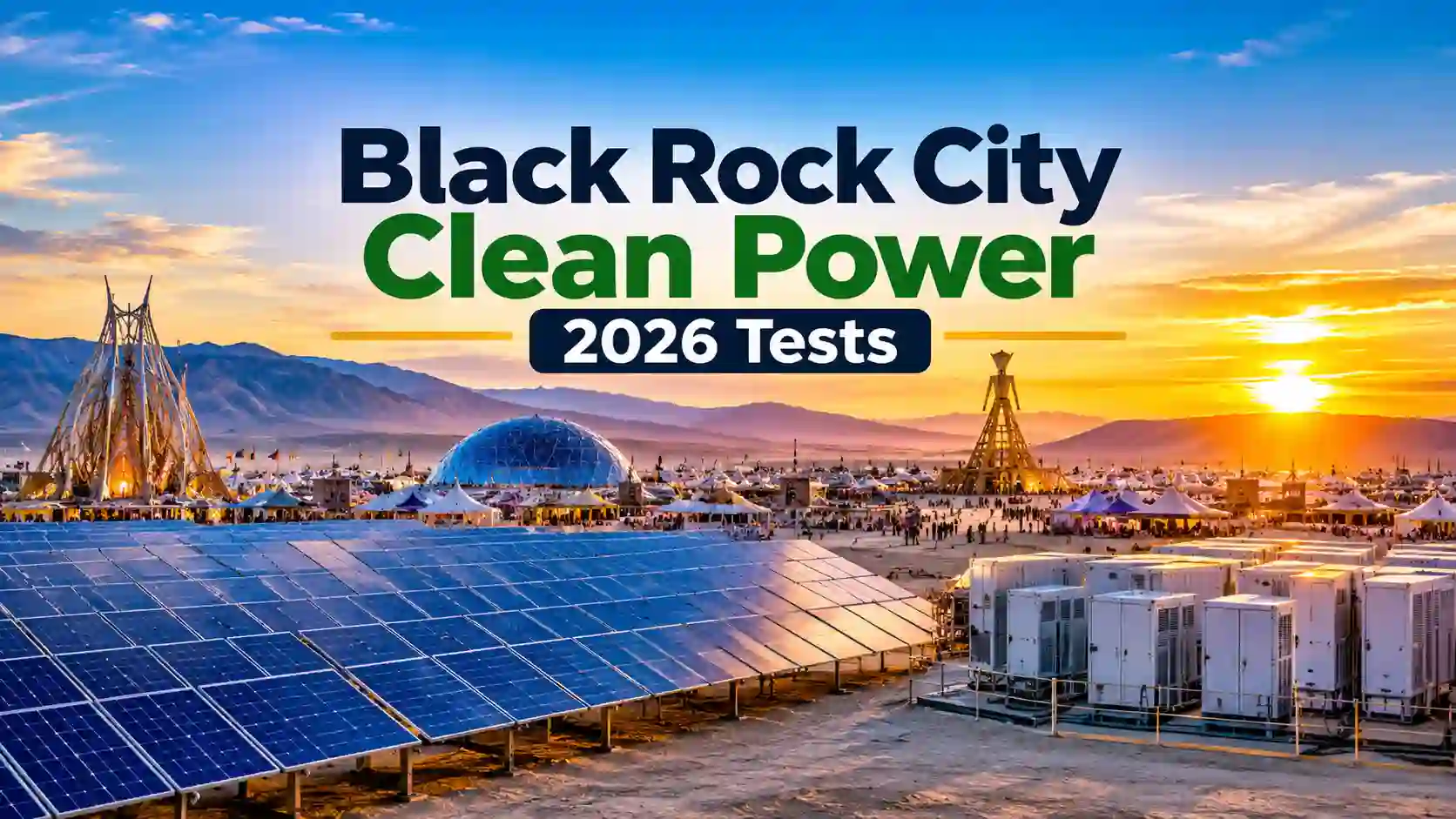
Black Rock City Clean Power: What 2026 Tested and What the 2027 Lab Plans
2026 Energy Guide · Facts, Figures & Plans
Black Rock City does not run entirely on renewable energy. But it is becoming an important real-world testing ground for cleaner power systems.
In 2025, solar panels, battery storage and renewable fuels helped reduce the city’s reliance on fossil fuels. In 2026, the SOLARPUNKS Solar Station operated a 1.1 MW solar array alongside a 5.4 MWh battery system, while other teams tested hybrid power, electric-vehicle charging and battery-supported infrastructure.
The next step is already taking shape. Burning Man Project says it plans to launch a more formal Regeneration Innovation Lab in 2027, creating another opportunity to test technologies that could have applications far beyond the desert.
Here is what the published figures show, which experiments took place, and what is planned next.
Last checked: November 28, 2026.
How to read the years: 2025 represents reported progress and measured results. 2026 covers documented experiments and deployments. 2027 refers to announced plans, not completed results.
What Are the Key Facts About Black Rock City Clean Power?
The following figures come from Burning Man Journal reporting and describe different years and different types of energy projects.
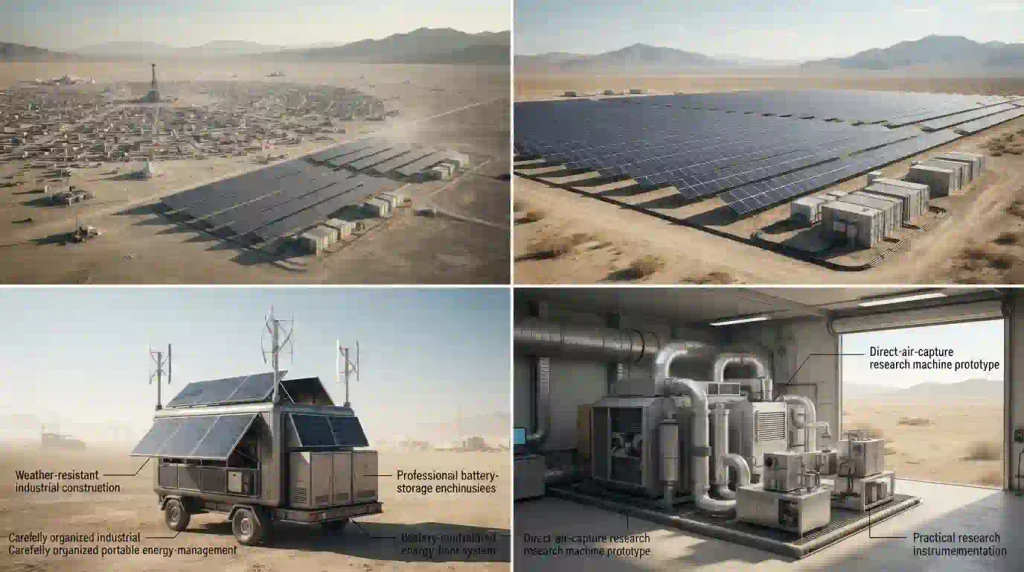
Status: The Regeneration Innovation Lab is planned for 2027, not yet launched.
| Detail | Published information |
|---|---|
| Sustainability roadmap | Burning Man Project released its 2030 Environmental Sustainability Roadmap in 2019 |
| 2025 camp solar adoption | 59% of placed camps used solar panels |
| 2025 generator-free camps | 19% of placed camps completely ditched generators |
| 2025 art installations | 63% used solar |
| 2025 battery storage | More than 16 MWh of battery capacity |
| 2025 infrastructure grids | 15 of 41 were solar-powered |
| 2026 Solar Station | 1.1 MW solar array and 5.4 MWh battery system |
| 2026 Solar Station output | Approximately 10 MWh of free renewable electricity offered |
| 2027 plans | Regeneration Innovation Lab and a carbon-capture prototype |
| Lab contact | regeneration@burningman.org |
2025 figures at a glance
- 59% — placed camps using solar panels
- 19% — placed camps that completely stopped using generators
- 63% — art installations using solar
- 27% — electric mutant vehicles, as reported by the Journal
- 24,000+ gallons — diesel saved by Burning Man Project’s power grids
These are separate measurements. For example, the 59% figure for camps using solar is not the same as the 59% reduction in average generator runtime reported for the Project’s power grids.
Is Black Rock City Fully Powered by Renewable Energy?
No. Burning Man Project’s published 2025 emissions analysis says generators and gas appliances accounted for 59% of Black Rock City‘s total emissions.
Solar power, batteries and renewable fuels are reducing fossil-fuel dependence, but these projects do not mean that the entire temporary city operates on renewable electricity.
How Much Progress Did Burning Man Make Toward Cleaner Power in 2025?
The 2025 figures provide an important baseline for understanding the newer experiments.
Burning Man Project’s Regeneration Department compared actual fossil emissions with a business-as-usual baseline: an estimate of what emissions would have been without its sustainability investments.
The Journal reported that Project operations reduced fossil-fuel emissions by 48% against that baseline. Across Black Rock City as a whole, fossil emissions were at least 25% lower than they would have been without solar, batteries and renewable fuels.
How Many Camps, Art Installations and Mutant Vehicles Used Solar or Electric Power?
The Journal reported these 2025 findings:
- 59% of placed camps had solar panels.
- 19% of placed camps completely ditched generators.
- 63% of art installations used solar.
- The Journal also reported electric mutant vehicles at 27%.
The published passage does not specify the denominator behind the 27% mutant-vehicle figure, so it should be treated as the Journal’s reported percentage rather than converted into an estimated vehicle count.
How Did Battery Storage Reduce Generator Runtime?
In 2025, Burning Man Project’s Power and Solar teams and their collaborators deployed more than 16 MWh of battery capacity across power grids and community service camps.
Fifteen of the 41 infrastructure grids were solar-powered. Most of Burning Man Project’s generator grids were also interconnected with batteries.
Instead of keeping generators running continuously, the battery systems supplied power between charging periods. Generators could then run when needed to recharge the batteries.
The Journal attributed a 59% reduction in average generator runtime to this intervention. It also reported more than 24,000 gallons of diesel saved for Burning Man Project’s power grids.
Important distinction: 16 MWh refers to battery storage capacity, not the amount of electricity generated.
What Role Did Renewable Fuels Play?
Battery storage was only one part of the 2025 strategy.
Burning Man Project reported that renewable diesel replaced 40% of its fossil-diesel consumption. It also reported that 100% of the propane distributed through the Black Rock City Fuel Program and used in Project operations was renewable propane.
Together, renewable fuels displaced more than 68,000 gallons of fossil fuels across the city.
The Journal also notes that renewable-fuel processing and transportation involve fossil fuels, and those emissions were not included in its analysis.
These qualifications matter when interpreting the reported environmental benefits.
How Much Solar Power Did Black Rock City Test in 2026?
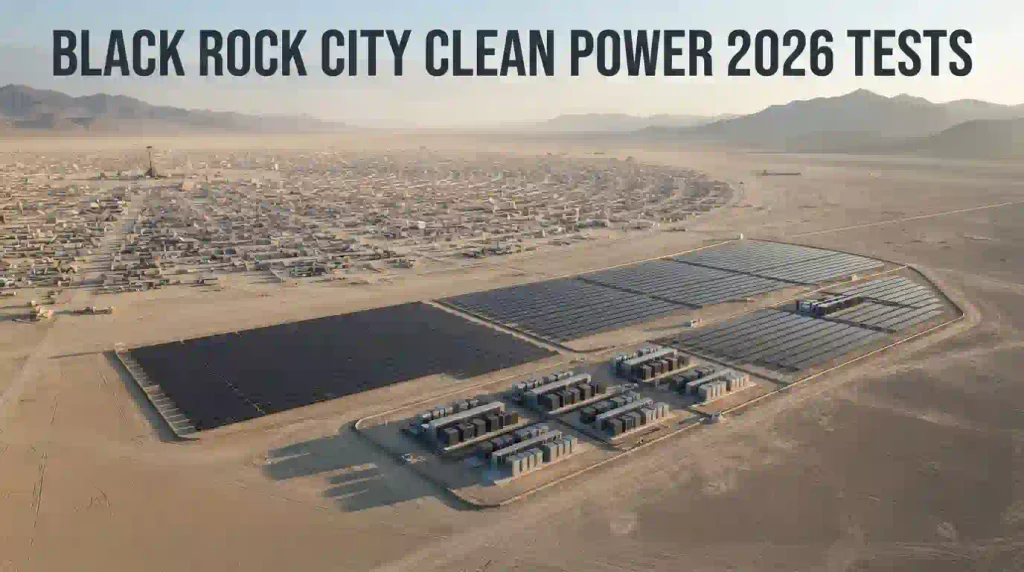
Black Rock City tested a 1.1 MW solar array paired with 5.4 MWh of batteries in 2026. The SOLARPUNKS Solar Station supplied camps, art installations and a mutant vehicle, according to the Burning Man Journal. The Journal calls it believed to be the largest temporary solar microgrid ever deployed, a qualified claim and not an independently confirmed record.
What Did the SOLARPUNKS Solar Station Do in 2026?
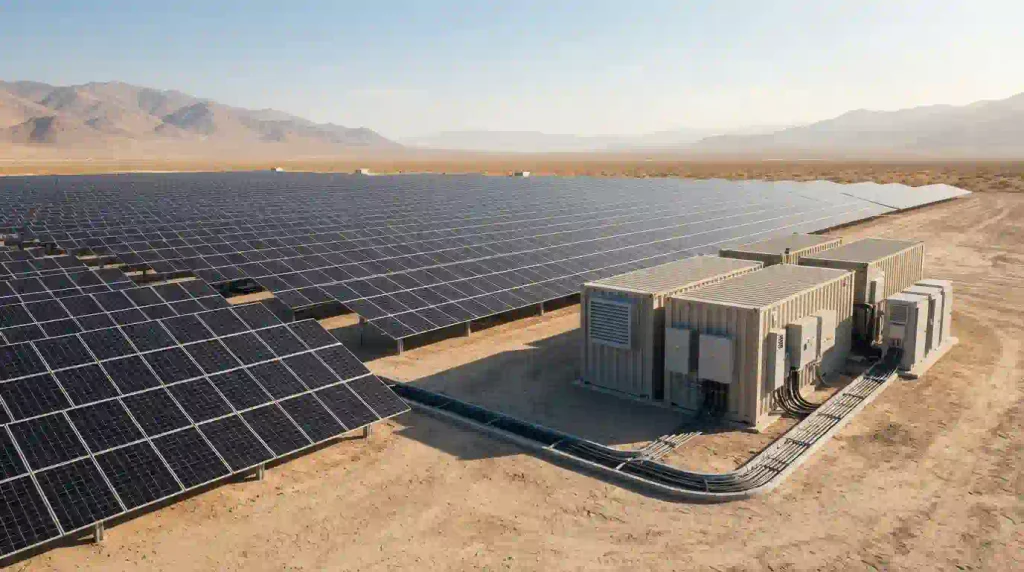
The SOLARPUNKS Solar Station was one of the most visible clean-power experiments at Black Rock City in 2026.
Funded by Burning Man Project, SOLARPUNKS and Solaris, the system combined a large solar array with battery storage to provide electricity for camps, art and electric vehicles.
How Large Was the Solar Array and Battery System?
The Solar Station used:
- A 1.1 MW solar array
- A 5.4 MWh battery system
- Approximately 1,800 solar panels
The Burning Man Journal described it as believed to be the largest temporary solar microgrid ever deployed on Earth.
That wording is important. It is a qualified description from the Journal, not an independently established world record.
What Did the Solar Station Power?
During Black Rock City 2026, the Solar Station fully powered:
- Five theme camps
- Six art installations
- The Robot Heart mutant vehicle
It also offered approximately 10 MWh of free renewable electricity for charging e-bikes, personal devices and electric mutant vehicles.
This demonstrates how a shared solar-and-battery installation can support several different types of activity within a temporary city.
What Is the Difference Between MW and MWh?
These two measurements describe different things.
- MW (megawatt) measures power: how much electricity a system can deliver at a particular moment.
- MWh (megawatt-hour) measures energy: an amount of electricity stored or delivered over time.
For example, a 1 MW system delivering power continuously for one hour would supply 1 MWh of energy.
The Solar Station’s 1.1 MW array and 5.4 MWh battery therefore describe two different parts of its system: solar power capacity and battery energy storage.
Who Is Behind SOLARPUNKS?
Christina “Xtina” Chu, Corey Johnson and Karin Campbell developed SOLARPUNKS from a camp built around one central idea: operating without generators.
The project has grown beyond Black Rock City. Its work includes solar-powered concerts and festivals, as well as mobile solar and battery systems deployed following the Los Angeles wildfires.
Those systems supported first responders, medical equipment and community distribution hubs, according to the Journal.
The wider goal is to explore how renewable energy can support industries such as music, film and fashion.
Which Other Clean-Power Experiments Ran in Black Rock City in 2026?
The Solar Station was not the only project testing alternatives to conventional generator power.
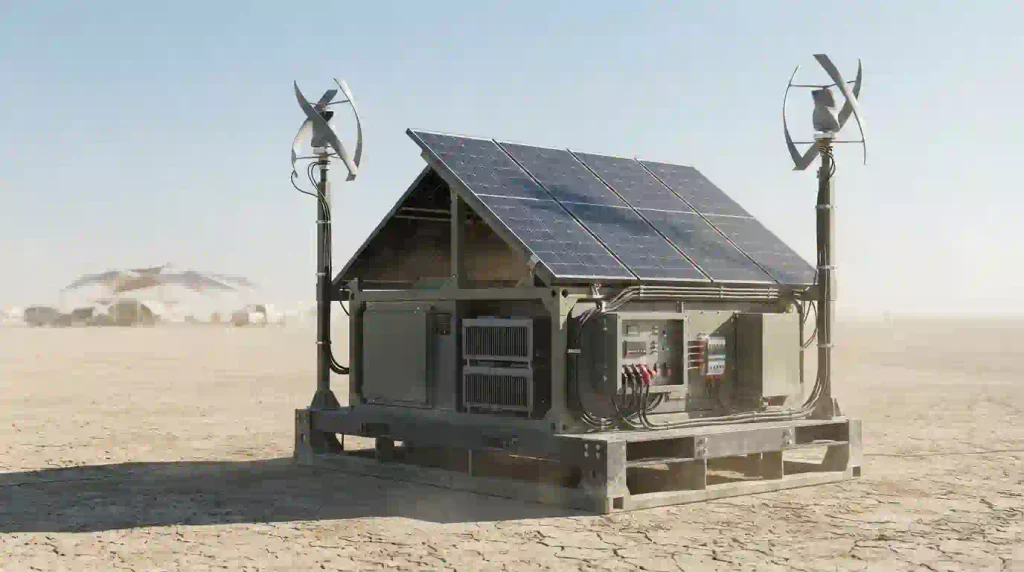
Other teams brought different technologies to the playa, including hybrid power systems, electric-vehicle charging and battery-supported infrastructure.
| Project | Technology tested | Reported 2026 application |
|---|---|---|
| SOLARPUNKS | Solar array and battery storage | Five camps, six art installations and Robot Heart |
| lokl Energy | Solar, wind and battery hybrid pod | Greeters Station |
| ElectricFish | Portable solar-powered Level 3 EV charging | EV charging technology testing |
| Sunbelt Rentals | Battery storage units | Black Rock City power grids |
| Overdrive Energy Solutions | Solar and hybrid battery systems | Entire airport grid |
How Did lokl Energy’s Hybrid Pod Power the Greeters Station?
lokl Energy brought a prototype portable renewable-energy pod to Black Rock City.
Its system combined solar panels, wind turbines and battery storage to provide portable electricity. The Journal reports that it powered the Greeters Station, where arriving participants are welcomed into the city.
The company’s CEO, Louis Lalonde, described replacing generators within five years as his goal. This is the company’s stated ambition, not a confirmed outcome.
What Is ElectricFish Testing at Burning Man?
ElectricFish is developing portable, solar-powered Level 3 electric-vehicle charging technology capable of delivering up to 400 kW.
The company sees potential beyond vehicle charging, including decentralized power systems that could support wider energy needs.
The Journal reports that ElectricFish hopes to expand its charging stations in Black Rock City in 2027 and beyond.
It also reports the company’s claims that approximately 200 people had signed up for its units and that it hoped to have the technology operating at around 50 gas stations by the following year.
Those figures are company-reported claims and future targets, not independently verified deployment results.
Why Did Sunbelt Rentals Deploy 85 Battery Storage Units?
Sunbelt Rentals worked with Burning Man Project’s Department of Public Works Power team to test and improve energy distribution and storage.
Its director, Gary Meador, told the Journal that Black Rock City required 85 battery storage units on Sunbelt grids in 2026.
He compared that requirement with approximately six units for the Super Bowl.
Meador also emphasised the planning involved, saying that a project of this scale requires at least six months of preparation.
The comparison illustrates the infrastructure demands of a temporary city operating in a remote desert environment.
How Did Overdrive Energy Solutions Power the Airport Grid?
Overdrive Energy Solutions brought solar and hybrid battery systems to Black Rock City in 2026.
According to the Journal, those systems powered the entire airport grid.
The company also develops mobile energy systems for disaster response, combining battery storage, solar and other power sources to provide electricity when traditional infrastructure is unavailable.
This creates a potential connection between temporary-event energy systems and emergency power applications.
What Is Planned for Burning Man in 2027?
Burning Man Project’s next phase includes a more formal innovation programme and additional technology experiments.
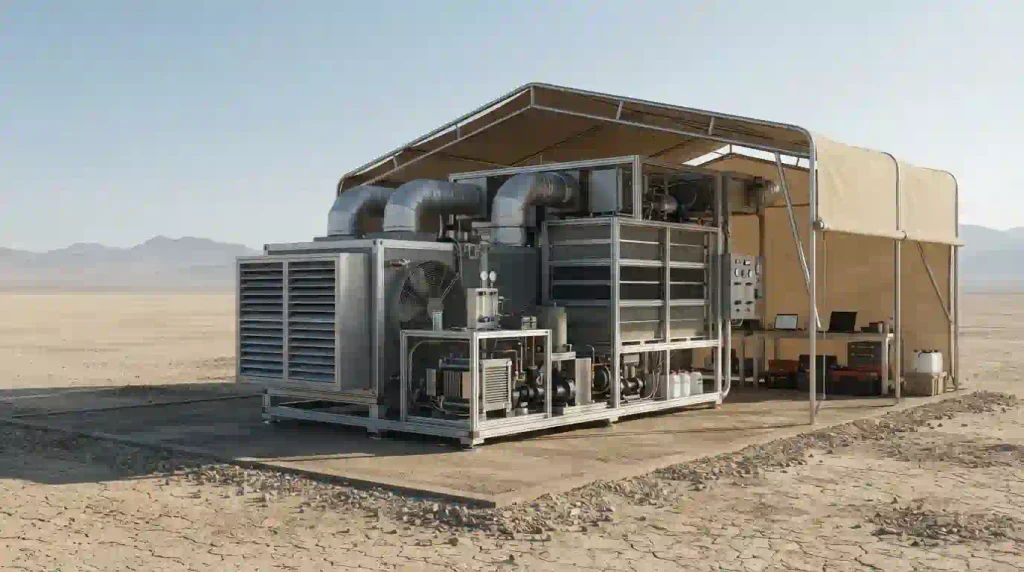
These are plans for 2027, not completed projects.
What Is the Regeneration Innovation Lab?
Burning Man Project says it plans to launch a more formal Regeneration Innovation Lab in 2027.
The initiative builds on clean-energy projects that have already been tested in Black Rock City.
The idea is to provide a more organised environment for innovators and community groups to experiment with technologies that could be useful at events and in communities beyond the playa.
The organisation has not yet published a full operating format or a confirmed launch date.
How Can Innovators Contact the Lab?
Burning Man Project has provided an email address for people interested in getting involved:
Innovators, researchers and clean-energy teams interested in the initiative can use this contact to express their interest and ask about future opportunities.
Do not assume that an application process, funding programme or participation place is already open. Those details have not been confirmed in the announcement.
What Is Black Rock Labs’ Carbon-Capture Prototype Planned for 2027?
Carbon capture is another area of experimentation connected with Burning Man’s regenerative innovation work.
Black Rock Labs plans to bring a carbon-capture machine to the playa as a prototype in 2027.
How Could Captured Carbon Become a Useful Product?
Black Rock Labs co-founder David Shearer and senior advisor Matt Atwood are exploring technology that captures carbon dioxide directly from the air and uses it to create products such as dry ice.
Dry ice has potential applications in cooling and refrigeration.
The team’s wider ambition is to explore ways to help communities keep essential supplies cold without depending on conventional electricity infrastructure.
Why Could This Matter Beyond Burning Man?
In communities without reliable electricity, keeping medicines and other temperature-sensitive supplies cold can be difficult.
Technologies that provide alternative cooling options could have practical applications in remote areas and places where conventional power infrastructure is limited.
However, the Black Rock Labs prototype is planned for 2027. Its performance, reliability and practical applications have not yet been demonstrated through published playa results.
How Has Burning Man’s Power Experimentation Reached Other Events?
One of the most interesting parts of this story is how knowledge developed in Black Rock City can be applied elsewhere.
The technology itself is only one part of the process. Measuring electricity demand, understanding how a grid behaves and improving power distribution can also help other large events.
How Did Genie’s Grid-Measurement Process Reach Coachella?
Andrea “Genie” Gini, a power technology consultant with Burning Man Project’s Department of Public Works Power team, designed a system to remotely measure Black Rock City’s electrical grid.
The system was deployed in 2017 and refined through experience in Black Rock City.
The Journal reports that the same grid-measurement process was used at Coachella in 2025 and 2026, helping inform the festival’s power operations.
This is a specific example of knowledge transfer. It does not mean that Coachella adopted Burning Man’s entire energy programme.
What Can Other Festivals Learn From Black Rock City?
Large temporary events need to supply electricity for many different activities, often in locations with limited existing infrastructure.
Black Rock City’s experiments demonstrate why several elements matter:
- Measuring electricity demand before and during an event.
- Matching power systems to actual operational requirements.
- Combining batteries with other electricity sources.
- Testing portable and decentralised energy systems.
- Planning equipment deployment well in advance.
These lessons may help other events explore ways to reduce their dependence on fossil-fuel generators.
Could These Technologies Help During Emergencies?
Portable solar and battery systems may have applications beyond festivals.
Overdrive’s disaster-response systems, SOLARPUNKS’ post-wildfire deployments and the carbon-capture team’s proposed cooling applications all point toward possible uses outside entertainment events.
The technologies are at different stages of development. Their potential should not be confused with proof that every application is already commercially established.
How Can Artists, Camps and Innovators Get Involved?
Burning Man’s clean-power work is not limited to large technology companies.
Artists, theme camps and mutant-vehicle crews can also explore renewable-energy options and learn from people who have experience with them.
What Does the Renewables for Artists Team Offer?
The Renewables for Artists Team (RAT) provides technical mentoring and assistance to artists, camps and others interested in transitioning from generators to renewable energy sources.
Its work connects people interested in renewable energy and supports planning for Black Rock City, Regional Events and special events.
This is particularly relevant to artists and camp organisers who are beginning to think about how their projects will be powered.
When Is the Next Official RAT Meeting?
The official Black Rock City 2027 planning page lists the following online session:
| Detail | Information |
|---|---|
| Organisation | Renewables for Artists Team |
| Date | Wednesday, December 16, 2026 |
| Time | 6:30 PM Pacific Time |
| Format | Online |
| Who can attend? | Anyone interested in renewable energy |
| Main focus | Mentoring and assisting artists, camps and others transitioning from generators |
International time conversions
| Location | Local date and time |
|---|---|
| US Pacific | Wednesday, Dec. 16 · 6:30 PM |
| US Eastern | Wednesday, Dec. 16 · 9:30 PM |
| London | Thursday, Dec. 17 · 2:30 AM |
| Sydney | Thursday, Dec. 17 · 1:30 PM |
Check the official RAT joining page for the latest meeting instructions and schedule.
What Can Theme Camps and Artists Do Before Spellbound 2027?
People planning a camp, art installation or mutant vehicle can begin by understanding their project’s energy requirements.
Useful starting points include:
- Explore solar and battery options suitable for the size of the project.
- Review the Green Theme Camp Community’s Green Resource Guide.
- Investigate renewable-fuel options through the Black Rock City Fuel Program.
- Ask RAT about educational resources and mentoring.
- Consider how electric vehicles and e-bikes can access renewable charging.
- Consult qualified electrical professionals before installing or modifying electrical systems.
For more information about participation planning, see our Burning Man 2027 Spellbound Planning Guide.
You can also explore our existing guide to the Burning Man Renewable Energy and RAT Team.
What Is Still Unconfirmed About Burning Man’s Clean-Power Plans?
Separating completed results from future intentions is essential when reporting on new technology.
The following details should be treated carefully:
- Regeneration Innovation Lab: Burning Man Project has announced a 2027 plan, but a complete format and launch date have not been published.
- Carbon capture: Black Rock Labs plans a 2027 prototype; no playa prototype results have been published.
- ElectricFish expansion: The company’s sign-up and gas-station figures are company-reported claims and targets.
- lokl’s generator replacement goal: Its CEO has described a five-year ambition; it is not a confirmed result.
- Fully renewable Black Rock City: The published evidence describes individual projects and partial systems, not a city entirely powered by renewable energy.
These distinctions help readers understand what has already happened and what they can reasonably expect next.
What Burner Dates Are Coming Up?
Several Burner deadlines and gatherings fall in the next two weeks. These are separate from the clean-power story, so check each organizer’s page for the latest.
| Date | What | Time |
|---|---|---|
| Nov 28 | BURN2 theme submissions due | No closing hour specified |
| Nov 28 | Kiwiburn first-round lottery draw | Noon NZ time (3 PM Pacific, Nov 27) |
| Dec 1 | Kiwiburn event registration deadline | Check Kiwiburn’s page |
| Dec 5 | Sydney Decompression | 3 PM to 4 AM AEDT |
| Dec 5 | Salt Lake City community forum | 2 PM Mountain (1 PM Pacific) |
| Dec 10 | Theme Camp Statement of Intent opens | 12 PM Pacific |
| Dec 12 | Las Vegas community forum | Noon, per the official listing |
Frequently Asked Questions About Black Rock City Clean Power
Is Black Rock City Fully Powered by Renewable Energy?
No. Burning Man Project’s 2025 analysis reported that generators and gas appliances accounted for 59% of the city’s total emissions. Solar, batteries and renewable fuels are helping reduce fossil-fuel dependence, but the city has not completed a full transition to renewable energy.
What Is the SOLARPUNKS Solar Station?
It is a temporary solar-and-battery installation at Black Rock City. In 2026, it combined a 1.1 MW solar array with a 5.4 MWh battery system and supplied power to five theme camps, six art installations and Robot Heart.
How Much Free Electricity Did the Solar Station Offer?
The Burning Man Journal reported approximately 10 MWh of free renewable electricity for charging e-bikes, devices and electric mutant vehicles in 2026.
What Is Burning Man’s Regeneration Innovation Lab?
It is a more formal innovation initiative that Burning Man Project plans to launch in 2027 to support experimentation with regenerative technologies. Its full format and launch date have not yet been announced.
What Is Black Rock Labs Planning for 2027?
Black Rock Labs plans to bring a carbon-capture machine to Black Rock City as a prototype in 2027. The project is exploring ways to turn captured carbon dioxide into useful products, including dry ice.
What Does RAT Stand For?
RAT stands for Renewables for Artists Team. It provides mentoring and assistance to artists, camps and others exploring a transition from generators to renewable energy.
When Is the December 2026 RAT Meeting?
The official Black Rock City 2027 planning page lists an online RAT meeting for December 16, 2026, at 6:30 PM Pacific Time.
What happens after the Kiwiburn draw?
Lottery winners get a seven-day initial purchase window, then a 24-hour window. A draw place doesn’t guarantee a ticket until you complete the purchase.
When do theme camp forms close?
The Theme Camp Statement of Intent closes January 28, 2027, at 12 PM Pacific.
Read the Kiwiburn 2027 Lottery Guide
Read the Sydney Decompression Guide
Open the Spellbound Planning Guide
How Can Innovators Contact Burning Man’s Regeneration Innovation Lab?
Burning Man Project has provided the following contact address:
What Comes Next for Clean Power at Burning Man?
The story of Black Rock City’s energy transition is not about one solar array or one new battery system.
The 2025 results show measurable progress in solar adoption, battery storage and renewable fuels. The 2026 experiments demonstrate how different technologies can support camps, art installations, vehicle charging and essential infrastructure. The plans for 2027 point toward further experimentation through the Regeneration Innovation Lab and a carbon-capture prototype.
The next challenge is to establish which technologies can work reliably, scale beyond the playa and provide practical benefits to other events and communities.
Black Rock City is temporary. The knowledge developed there may have a much longer life.
Explore more Burning Man coverage: Visit the BurningManTV News Room for the latest community updates, planning information and stories from the global Burner network.
Official Sources and Further Reading
This article draws on the following primary sources:
- The Race to Decarbonize Black Rock City — Burning Man Journal, July 15, 2026
- The Playa Is a Lab: Regeneratively Powering a Temporary City and the World — Burning Man Journal, November 3, 2026
- How Burning Man Is Building a Regenerative Future — Burning Man Journal, November 6, 2026
- Black Rock City 2027: Spellbound — Official Burning Man Project page
- Renewables for Artists Team — Official meeting information
BurningManTV is an independent publication and is not affiliated with or operated by Burning Man Project. Figures and project descriptions are attributed to their published sources. Future plans and company-reported targets may change. Confirm participation and technical details with the relevant organisers before making decisions.