
The Man Guide 2026: History, Meaning & The Burn at Burning Man
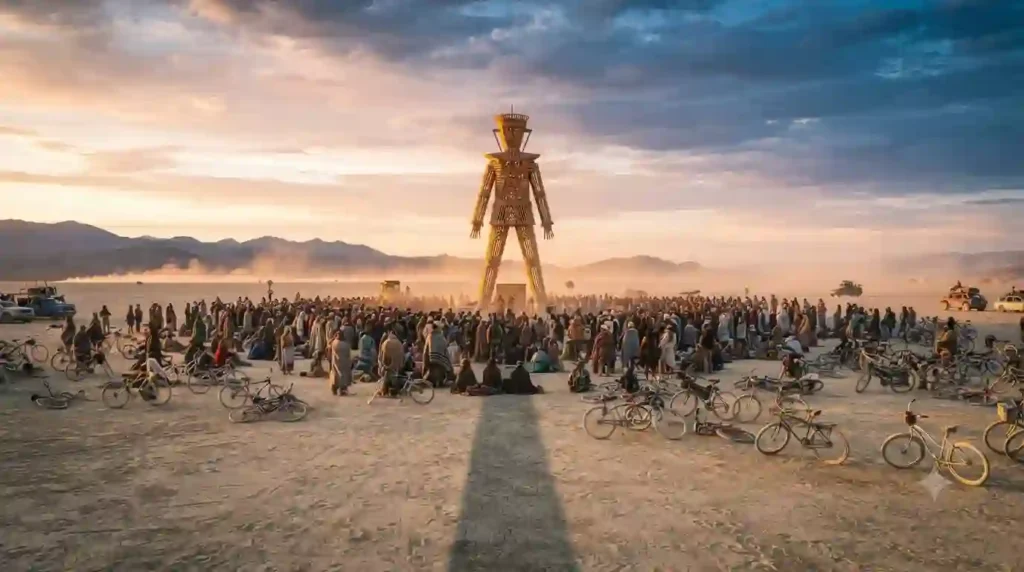
The Man is both Burning Man’s namesake and its literal center point, dating back to a 1986 gathering on San Francisco’s Baker Beach where founders Larry Harvey and Jerry James burned an eight-foot wooden figure. This guide explains its history, evolving design, and the Burn Night tradition. It remains the city’s most recognizable landmark nearly four decades later.
Every Burning Man traces its name and origin to a single event: in 1986, Larry Harvey and Jerry James burned an eight-foot-tall wooden effigy on San Francisco’s Baker Beach as a small, informal gathering among friends. That structure grew dramatically over the following decades — after relocating to Nevada’s Black Rock Desert in 1990, The Man became the literal center point of Black Rock City’s radial street plan, standing atop an elaborately redesigned base that changes theme every year while the core figure remains a recognizable constant.
This guide covers The Man’s history from its Baker Beach origins through its evolution into one of the world’s most recognizable temporary sculptures, how the surrounding base design is reimagined annually by different artist teams to reflect the year’s theme, and the traditions surrounding Burn Night itself — typically held on the Saturday of the event, drawing nearly the entire population of Black Rock City to witness the structure’s ceremonial destruction, often accompanied by fire performances and fireworks. It also explains what The Man represents culturally: less a religious or political symbol and more a communal focal point representing creativity, impermanence, and the temporary nature of the city itself.
For the Temple’s distinctly different, more reflective burn tradition, see The Temple Guide; for other fire-based art throughout the week, see the Fire Art Guide.
In This Guide You’ll Learn
- 🔥 What is The Man?
- 📜 History of The Man
- 🏗️ How The Man is built
- 🎨 Annual designs
- 🌅 Visiting The Man
- 🔥 Burn Night tradition
- ❤️ Cultural significance
- 📸 Photography tips
- 🌍 The Man’s global influence
- ⚠️ Visitor etiquette
What Is The Man at Burning Man?
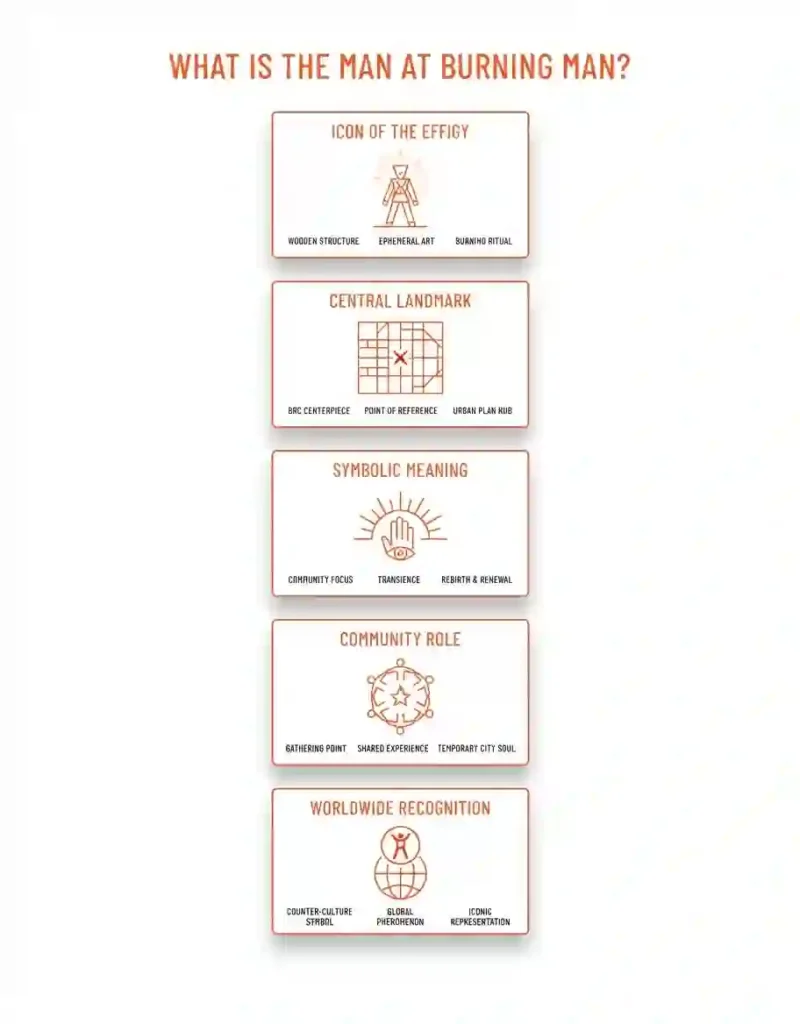
Burning Man’s most recognizable symbol is The Man, the towering effigy at the center of Black Rock City. For a lot of first-timers, it’s the thing they see in photos before they ever understand what it means, but for returning Burners it’s the visual anchor that helps define the whole city. The Man is not just a sculpture; it’s a shared reference point, a cultural marker, and one of the clearest symbols of the event’s spirit. It sits at the heart of the playa experience, drawing people in all week long and culminating in one of the most iconic burns in the world.
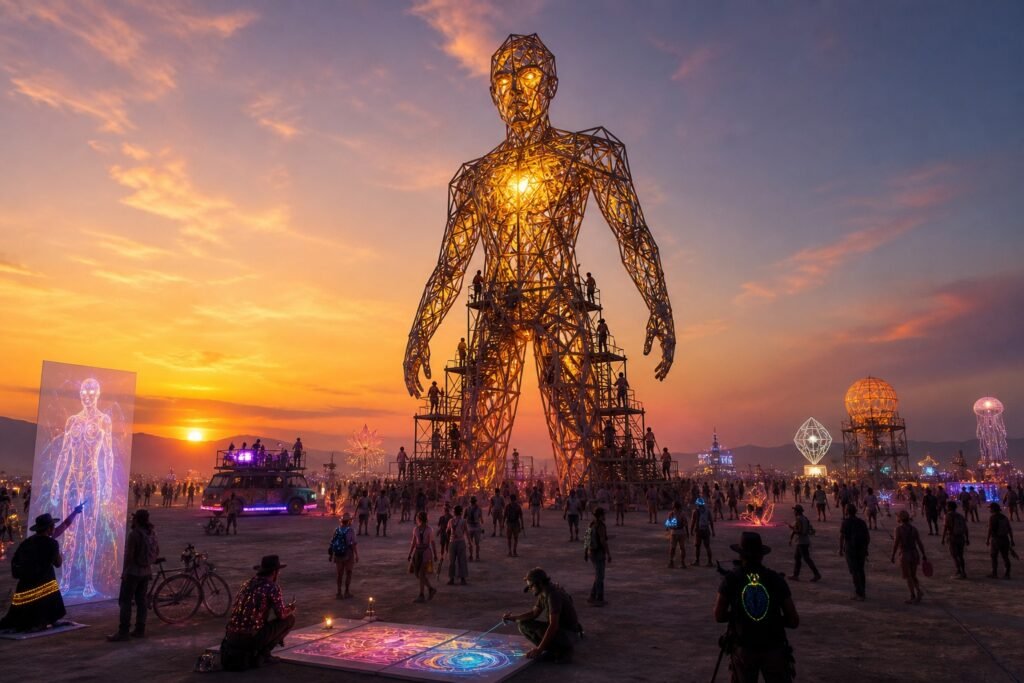
Understanding the Icon of Burning Man
The Man is the central wooden figure that gives Burning Man its name and visual identity. It stands as the most recognized structure in Black Rock City and serves as a gathering point for thousands of people throughout the event. For many attendees, it becomes the place they orient themselves, meet friends, and take in the scale of the city. It represents the shared creative energy that makes the event feel larger than any single art project or camp.
Why Is It Called “The Man”?
The name is simple, direct, and intentionally human. The original burning effigy was literally a man-shaped figure, and the name stuck because it was easy to say and easy to remember. Over time, that plain name turned into something bigger, because Burners started attaching meaning, memory, and ritual to it. The name still feels approachable, which is part of why it has lasted so long.
The Man as the Heart of Black Rock City
The Man is placed in a central location so people can use it as a navigational and social landmark. In a temporary city where nearly everything changes from year to year, that fixed center matters more than people realize. It gives Black Rock City a sense of structure and helps turn the open desert into a place that feels mapped and alive. When people say “meet me at The Man,” they are really talking about one of the main shared points of the whole event.
What Does The Man Represent?
The Man can mean different things to different Burners, and that flexibility is part of its power. For some, it represents community and collective effort; for others, it stands for release, change, or the temporary nature of all things. It is both a literal art structure and a symbolic vessel for whatever people bring to it emotionally. That openness makes it easy for each Burner to form a personal connection.
Why Millions Recognize The Man Worldwide
The silhouette of The Man has become one of the most recognizable symbols in modern festival culture. Its image travels far beyond Nevada because it captures the entire Burning Man idea in one striking form: temporary, experimental, and unforgettable. Even people who have never attended Burning Man often know The Man as the event’s visual signature. Its fame comes not from branding tricks, but from years of being the central icon of a one-of-a-kind culture.
- The Man is Burning Man’s central icon and most recognizable structure.
- It works as both a physical landmark and a symbolic centerpiece.
- Its meaning is open-ended, which helps each Burner connect with it personally.
- The figure’s simple design has made it globally recognizable over time.
The History of The Man
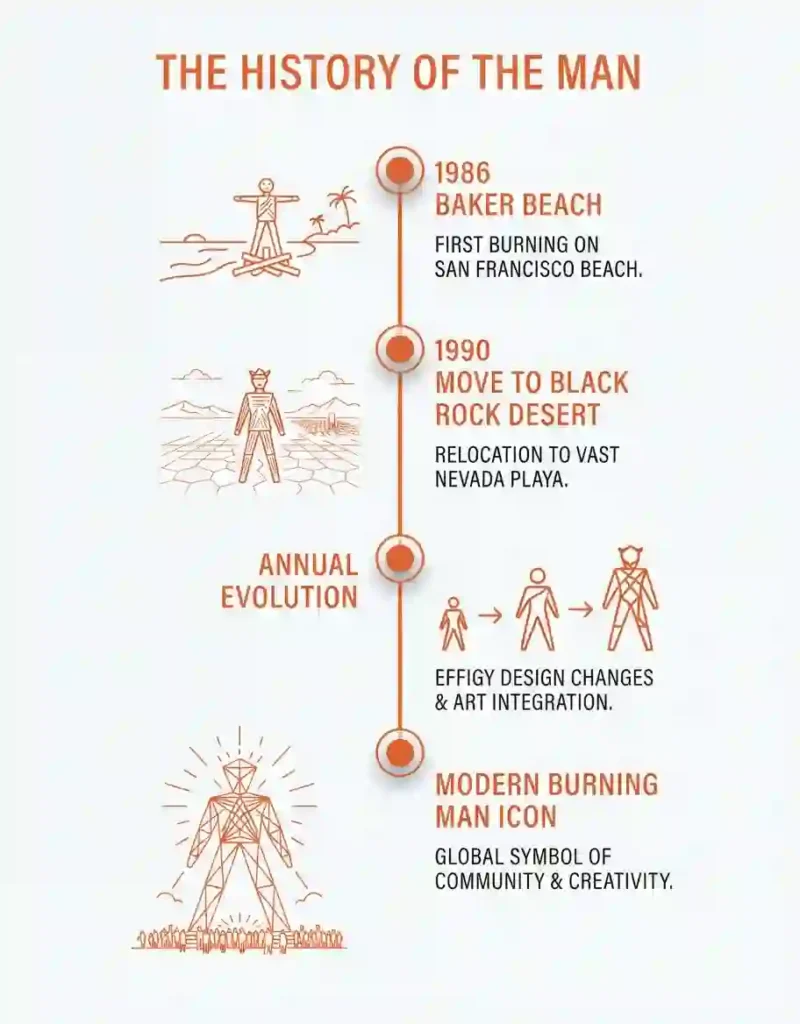
The Man’s story begins before the Nevada desert ever entered the picture. It started on Baker Beach in 1986 as a small, spontaneous act of burning a human-shaped figure, then gradually grew in scale, visibility, and meaning as the event evolved. When Burning Man moved to Black Rock Desert in 1990, The Man moved with it and became the central icon of a much larger temporary city. That history matters because it shows how a simple effigy became the heart of a global cultural event.
The First Burning on Baker Beach (1986)
The first Burn happened on Baker Beach in San Francisco in 1986, when Larry Harvey and Jerry James set fire to an eight-foot wooden man. It was a small gathering by today’s standards, but it carried the seed of what Burning Man would later become. The act was raw, handmade, and unpolished, which is exactly why it felt powerful. It wasn’t trying to be a massive festival moment; it was just a bold artistic gesture that people remembered.
Moving to Black Rock Desert
In 1990, the event shifted to the Black Rock Desert after beach authorities stopped a much larger burn from happening at Baker Beach. That move changed everything, because the desert allowed Burning Man to grow into a full-scale temporary city. Once The Man landed on the playa, it stopped being just a sculpture and became the center of a much bigger experience. The move also gave the event the wide-open space and stark landscape that now define it.
How The Man Has Evolved
The Man has changed in size, style, and presentation over the years, but its role has stayed consistent. Each iteration reflects the event’s growth, its creative ambition, and the evolving energy of the year. Some versions have felt more playful, some more architectural, and some more dramatic, but each one has kept the same core function. The changes keep the tradition fresh without losing its identity.
Memorable Designs Through the Years
Across the decades, The Man has appeared in different forms that reflect the spirit of the year. Those designs are remembered because they mark time in Burner culture the same way albums mark time in music. People talk about “that year’s Man” because it becomes part of the collective memory of the event. The design may shift, but the emotional importance stays intact.
The Man’s Role in Burning Man Culture
The Man is more than a centerpiece; it is a cultural constant that gives Burning Man continuity from one year to the next. For many people, seeing it rise in the desert is the moment the event feels real again. Its annual presence connects old Burners and new arrivals through a shared tradition. That continuity is one reason the event has stayed meaningful even as it has grown.
The Evolution of The Man: From Wooden Structure to Global Icon
| Year/Period | Milestone |
|---|---|
| 1986 | Larry Harvey and Jerry James built and burned the first Man on Baker Beach in San Francisco. |
| 1990 | The event moved to Nevada’s Black Rock Desert. |
| 1990s | The Man grew larger and became the centerpiece of Black Rock City. |
| 2000s | Engineering, lighting, and annual themes became increasingly sophisticated. |
| Today | The Man is recognized worldwide as the defining symbol of Burning Man and participatory art. |
- The Man began as a small Baker Beach burn in 1986.
- It moved to Black Rock Desert in 1990 and became central to the event.
- Its design has evolved, but its symbolic role has remained steady.
- The Man helps connect Burning Man’s past with each new year.
How Is The Man Designed Each Year?
The Man is not simply rebuilt by chance; it is carefully planned to fit the year’s artistic, engineering, and environmental demands. The design process balances symbolism with practical considerations like wind, heat, safety, and desert conditions. Each year’s version has to feel fresh while still being instantly recognizable as The Man. That combination of creativity and discipline is part of what makes it so impressive.
Annual Theme Inspiration
The yearly theme often influences the visual language of the event, including how people think about The Man. While The Man remains iconic in form, its presentation can reflect the mood or ideas shaping that year’s Burning Man. That gives designers a framework without forcing the figure to become something unrecognizable. The result is a balance between consistency and reinvention.
Architectural Planning
Designing The Man takes real architectural thought, not just artistic imagination. The structure has to be scaled correctly, assembled efficiently, and able to withstand the desert environment. That means the shape, proportions, and support system all matter as much as the visual look. A good design has to succeed both as a symbol and as a physical object.
Engineering and Structural Design
The Man must be engineered to stand safely in a harsh and unpredictable setting. Strong winds, shifting weather, and the realities of a temporary build site all create challenges that require practical solutions. The internal structure needs to support the outer form while remaining stable enough for the event’s duration. This is one reason the build process is so respected by Burners who understand what goes into it.
Sustainability and Materials
Material choices matter because Burning Man culture emphasizes responsibility and temporary use. The build has to consider how the structure will behave before the burn and how it will be removed or consumed afterward. That makes sustainability part of the design conversation from the start. The Man is built to be temporary, but the thinking behind it is anything but careless.
Building for Extreme Desert Conditions
The desert is not a neutral backdrop; it actively tests every structure placed on the playa. Heat, dust, dryness, and wind all affect how The Man is built and maintained. Designers and builders have to think about performance in conditions that would challenge almost any large-scale outdoor installation. That harsh environment is part of why the structure feels so legendary once it stands complete.
- The Man is designed with both artistic vision and engineering reality in mind.
- Annual themes can influence its presentation without changing its identity.
- Materials and structure must work in extreme desert conditions.
- Sustainability and temporary use are built into the design process.
How Is The Man Built?
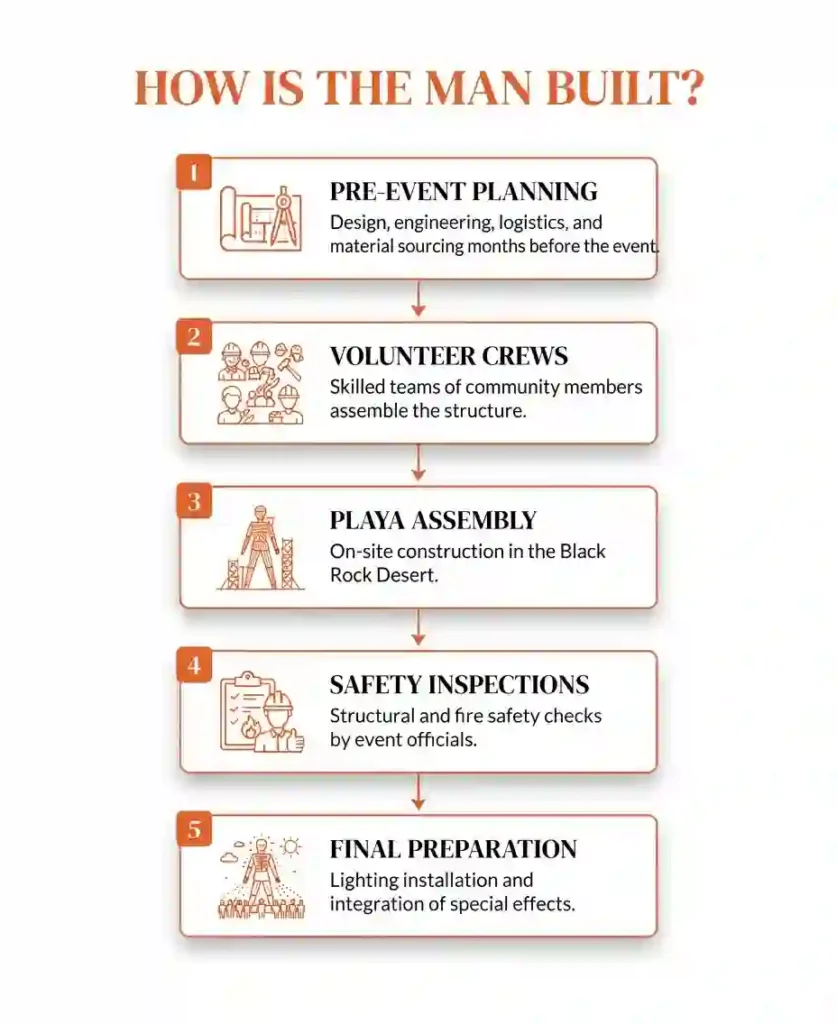
Building The Man is a serious logistical project that begins long before the event opens. It relies on skilled crews, volunteer labor, planning, and safety checks to bring the structure to life on the playa. What looks effortless from a distance is actually the result of careful assembly and coordination. That behind-the-scenes work is a big part of why the final burn feels so meaningful.
Construction Before the Event
Most of the heavy planning and prep happen before attendees ever arrive in Black Rock City. Pieces are designed, tested, and arranged so the build can move quickly once crews are on site. That pre-event stage is where the event’s vision starts becoming physical reality. By the time the public sees it, a huge amount of work has already been done.
Volunteer Builders and Crews
Burning Man depends on people who show up to build, support, and solve problems as the project takes shape. These crews bring practical skills and a strong sense of shared purpose to the job. Their work is part construction, part art installation, and part community service. It is one of the clearest examples of communal effort in action.
Assembly on the Playa
Once on the playa, the structure has to be assembled under desert conditions that are very different from a normal build site. The timing, sequence, and coordination matter because the environment is demanding and the schedule is tight. Every stage has to happen with attention to both detail and safety. The finished result feels simple only because the process is so well managed.
Safety Inspections
Large public structures need checks, and The Man is no exception. Safety reviews help ensure the build meets the requirements of the event and can stand up to the conditions it will face. Those inspections are important because thousands of people gather around the structure. Safety is part of the art, not separate from it.
Final Preparation Before Opening
Before the event fully opens, there is always a final round of finishing work, cleanup, and readiness checks. That’s when everything has to come together: structure, access, lighting, and surrounding flow. It’s a tense and exciting moment because the city is coming alive around a centerpiece that everyone has been waiting to see. Once it’s ready, The Man becomes the visual and emotional center of the week.
- The Man is assembled through extensive pre-event planning and on-site coordination.
- Volunteer crews play a major role in building it.
- Safety inspections and final checks are essential.
- The whole process is designed for a temporary desert city.
Where Is The Man Located?
The Man sits in a central position within Black Rock City, which makes it one of the easiest landmarks to use while navigating the event. Its location is intentional: it gives the city a core and creates a natural meeting point for participants. The space around it is known as The Man Plaza, where people gather to look, photograph, talk, and feel the scale of the event. For newcomers, learning this layout makes the whole city easier to read.
The Man Plaza
The Man Plaza is the open area surrounding the structure, and it acts like a central gathering zone. People meet there, pass through it, and use it as a reference point while exploring the city. Because it is so central, the plaza often feels busy without feeling cramped. It’s one of the places where Black Rock City’s communal energy is easiest to feel.
Position Within Black Rock City
The Man’s placement in the city is part of the overall design of the temporary layout. It helps organize the surrounding streets and gives people a clear point of orientation. Even if you don’t remember every street name, you can usually find your way by thinking in relation to The Man. That is especially useful during busy hours or low-light conditions.
Relationship to The Temple
The Man and the Temple are both central symbols, but they carry different energy and purpose. The Man is typically associated with celebration, public gathering, and the climax of the festival’s burn ritual, while the Temple is more reflective and emotionally quiet. They are often discussed together because both are emotionally important, but they are not interchangeable. Understanding the difference helps first-timers read the event more clearly.
Access During the Event
Visitors can usually approach the area around The Man during the event, but access always depends on conditions, crowd flow, and safety guidance. During peak moments, especially around burn events, the space can become much more controlled. The best approach is to stay aware of signage, volunteer direction, and the movement of the crowd. Respecting boundaries helps everyone enjoy the space safely.
Navigation Tips for First-Timers
If you’re new, treat The Man as your anchor point, not your only destination. Use it to build your mental map of the city, then branch out from there. Go during the day, go at night, and go again when the light changes, because each visit feels different. A few simple orientation habits can save you a lot of confusion on the playa.
- The Man Plaza is the central gathering area around the structure.
- Its location helps organize navigation in Black Rock City.
- The Man and the Temple serve different symbolic roles.
- First-timers should use The Man as a reference point, not just a photo stop.
Why Is The Man Burned?
The burn is the point where art, ritual, and community all come together in one moment. The Man is burned because Burning Man is built around impermanence, participation, and transformation, and fire makes that message visible in a way nothing else can. Watching the structure disappear is part of what gives the event its emotional weight. The burn turns a physical object into a shared memory.
The Symbolism of the Burn
Burning The Man symbolizes change, release, and the temporary nature of all things. The act of burning is not meant as destruction for its own sake; it is part of the event’s deeper artistic language. People come expecting a fire, but what they remember is the feeling behind it. That symbolic layer is what gives the burn lasting power.
Community Celebration
The burn is also a massive communal moment, bringing thousands of people together to witness the same event at the same time. It creates a rare feeling of collective attention in a world where people are usually fragmented. Everyone is sharing the same heat, sound, light, and emotion. That sense of unity is one of the strongest parts of the experience.
Letting Go and Transformation
A lot of Burners connect the burn with personal release, even if they don’t say it out loud. Watching The Man go up in flames can feel like a ritual of letting go, whether that means old habits, old stories, or just the tension of everyday life. The power of the moment comes from what people project onto it. In that sense, the burn becomes personal without losing its collective meaning.
Why The Burn Matters
The burn matters because it captures the event’s core philosophy in one unforgettable scene. It reminds people that the city, the art, and even the experience itself are temporary. That impermanence is not a weakness; it’s the whole point. The burn gives shape to the festival’s emotional and cultural identity.
What Happens After the Fire
After the burn, what remains is memory, ash, and the strange quiet that follows a huge shared moment. The crowd disperses, but the impact lingers in the way people talk about the night afterward. The end of the burn also reinforces the event’s temporary nature. Once The Man is gone, the city enters another phase of its life.
- The burn represents impermanence, release, and shared experience.
- It is both a ritual and a major community gathering.
- The emotional impact often comes from what the burn means personally.
- After the fire, the event enters a quieter, reflective phase.
What Happens on Burn Night?
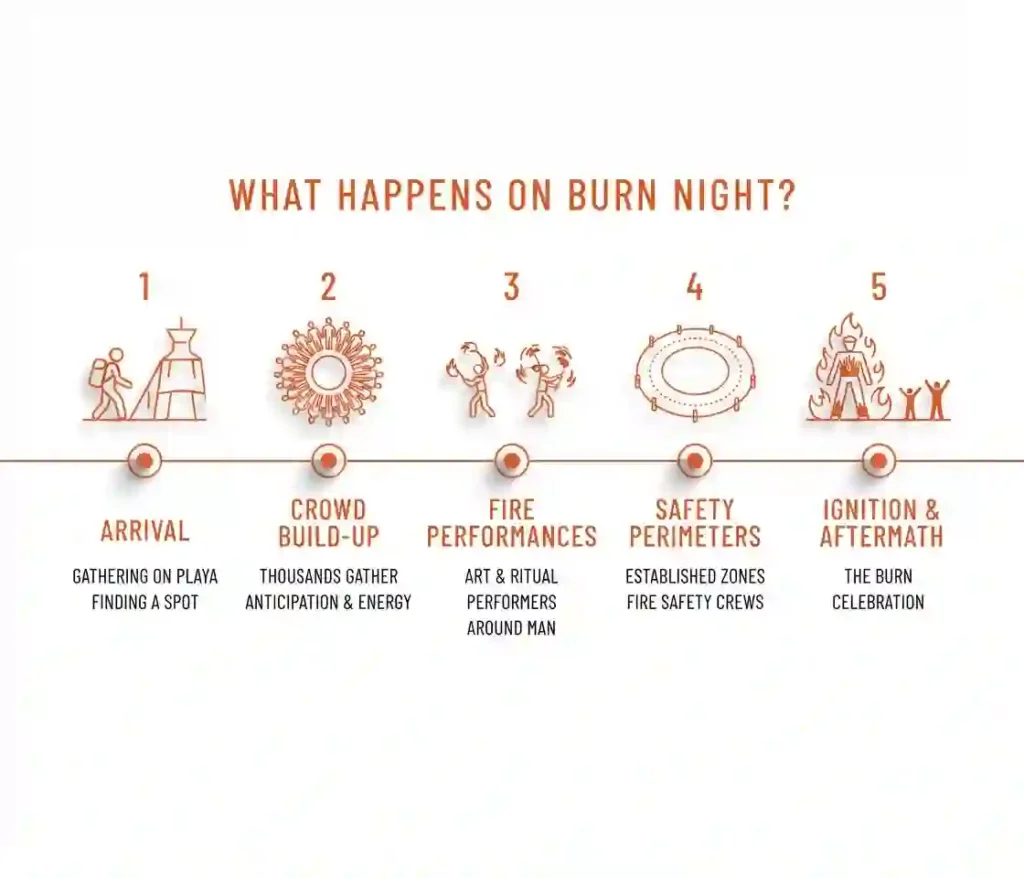
Burn Night is one of the biggest and most anticipated moments of the event. The area around The Man becomes a focal point for crowds, performances, safety management, and the intense build-up to the ignition. It is part spectacle, part ritual, and part logistical choreography. For many attendees, it is the night they had in mind before they ever arrived.
Burn Night Schedule
The schedule can vary, but the structure of the night usually builds toward the fire event itself. People arrive early, settle in, and claim viewing space before the main moment begins. The pacing matters because the atmosphere changes as the crowd grows and the light fades. By the time the burn starts, the feeling is often electric.
Fire Performances
Fire performances often help create momentum before the main burn. They add movement, heat, and anticipation to a night that is already charged with energy. These performances are part of what makes Burn Night feel like an event rather than a simple ignition. They turn waiting into participation.
Safety Perimeters
Safety boundaries are critical because of the size of the crowd and the intensity of the fire. Everyone needs room to move, visibility, and a clear understanding of where they can stand. The best Burner behavior is to follow the guidance, stay aware, and avoid crowding the action. Good safety practice protects the experience for everyone.
Crowd Experience
The crowd on Burn Night is huge, diverse, and deeply attentive. People may be dancing, standing quietly, taking photos, or just watching in silence. That mix is part of the night’s energy because it reflects how differently people connect with the same moment. The crowd becomes part of the ritual.
Watching The Burn Respectfully
Respect matters on Burn Night because the moment is bigger than individual excitement. It helps to arrive prepared, avoid blocking others, and keep your attention on the shared event instead of trying to dominate it. If you’re new, the best move is usually to observe the rhythm of the crowd and follow it. That’s how you experience the burn without getting in the way of it.
- Burn Night is the emotional peak for many attendees.
- Fire performances help build anticipation.
- Safety perimeters keep the experience controlled and respectful.
- The crowd becomes part of the ritual, not just an audience.
What Can Visitors Do Around The Man?
The Man area is not just for burn night; it’s a place to spend time throughout the week. Visitors can walk the plaza, take in the changing light, look at nearby art, and connect with other Burners in a setting that shifts from quiet to crowded depending on the hour. The surrounding space is part of the event’s social heartbeat. It rewards repeat visits more than one quick stop.
Walking Around The Plaza
Walking the plaza gives you a better sense of the scale and atmosphere of Black Rock City. It is one thing to see The Man from a distance and another to move around its base and experience the surrounding space. The walk often reveals details you miss from afar. That slower pace is a good way to absorb the structure’s presence.
Photography Opportunities
The Man is one of the most photographed subjects at Burning Man because it changes dramatically with light and weather. Sunrise, sunset, dust, and night lighting all create different moods. Good photos often come from patience rather than trying to rush the moment. The best shots usually feel like they belong to the playa, not just to a camera roll.
Interactive Art Nearby
The area around The Man is often surrounded by other works that extend the visual experience. Those nearby pieces help frame The Man as part of a larger artistic environment instead of a standalone object. That relationship matters because Burning Man is about the whole city, not one sculpture. The plaza is one of the best places to feel that broader context.
Day vs Night Experience
The Man feels completely different depending on the time of day. In daylight, it can seem stark, structural, and massive against the open desert. At night, it becomes more dramatic, with lighting and shadows changing the mood completely. Visiting both ways gives you a fuller understanding of why it matters.
Meeting Other Burners
The plaza is also a natural place to meet people because so many Burners pass through it. Conversations start easily there because everyone understands they are standing at a shared landmark. You might meet people from your camp, from another continent, or from a completely different Burner background. That mix is one of the most human parts of the space.
- The Man Plaza is worth visiting more than once.
- Photography changes with light, weather, and time of day.
- Nearby art expands the experience beyond the central structure.
- The plaza is a natural meeting place for Burners.
The Man Through the Years
The Man has changed enough over time to keep things interesting, but not so much that it loses its identity. Each year’s version becomes part of the event’s visual memory and helps define that moment in Burning Man history. People often remember the design as much as the burn itself. That’s because The Man is not just a fixture; it is part of the event’s yearly storytelling.
Annual Themes
The yearly theme can influence the broader creative atmosphere around The Man. Even when the structure stays familiar, the theme gives it a new interpretive frame. That is one way Burning Man keeps a long-standing tradition feeling current. It lets people see the same icon through a new lens.
Famous Designs
Some designs stand out more than others because they capture the spirit of a particular year. Burners tend to remember the versions that felt especially bold, strange, or visually strong. Those designs become shorthand for the era in which they appeared. In Burner culture, memory and design are deeply linked.
Memorable Burn Ceremonies
The burn itself is often what makes a design unforgettable. A structure might be visually impressive, but once it burns, the event becomes part of people’s personal history. That emotional memory is why Burn Night stories get told again and again. The fire makes the design matter even more.
Record-Breaking Structures
Over the years, The Man has grown into an enormous piece of festival engineering. Its scale alone helps explain why it draws attention from Burners and outsiders alike. Big structures create big expectations, and The Man usually delivers on both drama and symbolism. That size is part of the awe.
Interesting Historical Moments
Burning Man history is full of moments where The Man became more than a centerpoint and turned into a cultural marker. Those moments are important because they show how the event’s identity has changed while still remaining recognizable. They also help explain why the structure keeps inspiring storytelling. History gives the icon depth.
- Each year’s Man becomes part of the event’s visual memory.
- Annual themes can change how people interpret it.
- The burn often makes a design unforgettable.
- Its scale and history add to its cultural weight.
Interesting Facts About The Man
People love facts, especially when a symbol is as large and famous as The Man. The interesting thing is that the structure feels almost mythic, but it is also made of real materials, real labor, and real planning. The more you learn about it, the more impressive it becomes. The facts do not reduce the magic; they explain why the magic works.
Height and Dimensions
The Man is built on a large scale that makes it visible from a distance and powerful up close. Its height and proportions are part of what makes it an anchor point for the whole city. That size is not arbitrary; it’s designed for impact. A smaller version would not have the same presence on the playa.
Construction Materials
The materials used for The Man have to be practical, durable enough for the build, and appropriate for eventual burning. That means material selection is tied directly to the event’s temporary nature. The structure must look monumental while still being built for impermanence. That tension is part of its design appeal.
Build Time
Building something that large in the desert takes time, coordination, and discipline. The public sees the final result, but the timeline behind it is much longer. Build time includes planning, transport, assembly, checks, and finish work. What looks instant from the outside is actually the end of a long process.
Volunteer Contributions
Volunteer effort is a major part of the story because Burning Man culture values participation. Many hands are involved in making the build happen, and that collective labor reflects the community spirit the event celebrates. Volunteers do more than help; they become part of the artwork’s story. Their contribution is one of the most Burner things about the whole process.
Engineering Facts
The engineering behind The Man has to account for weather, scale, and structural stability. Those details are easy to overlook unless you’ve seen how hard the desert can be on large objects. The fact that the structure stands at all is a testament to careful design. The engineering is part of the art, not hidden behind it.
- The Man’s size is part of its symbolic power.
- Materials and build time are shaped by its temporary nature.
- Volunteers contribute significantly to the process.
- Engineering is essential to making the structure work safely.
Common Myths About The Man
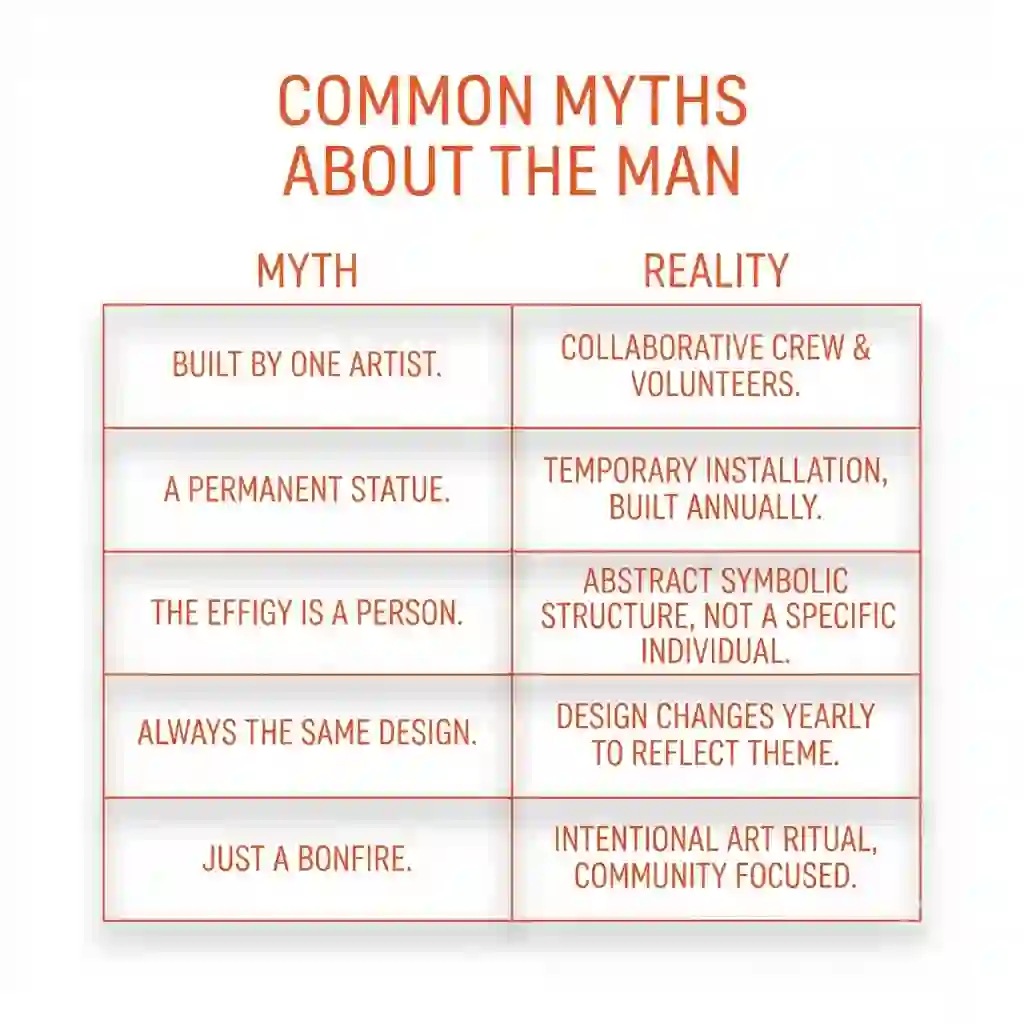
A lot of first-timer confusion comes from hearing simplified versions of what The Man is and how it works. Some of those ideas are harmless, but others can lead to bad expectations or missed experiences. Clearing up the myths helps people understand the event more accurately. It also makes the whole guide feel more grounded in real Burner culture.
Myth: The Man Is Burned on the Final Night
People often assume the main burn happens on the absolute last night of the event, but that’s not the way it always works. The timing is tied to the event schedule and the community rhythm, not just the calendar’s final page. That distinction matters because planning around the wrong night can make newcomers miss the main moment. In Burner culture, timing is part of the experience.
Myth: Visitors Cannot Go Near The Man
Some people think The Man is untouchable or off-limits for the entire event, but that is not true. Access depends on the moment, the crowd, and the safety setup, but the area is meant to be experienced. People gather around it, walk near it, and use it as a central point throughout the week. It is a living part of the city, not a distant monument.
Myth: The Man Is the Entire Event
The Man is hugely important, but it is not the whole experience. Burning Man includes art, camps, music, community interaction, the Temple, mutant vehicles, and much more. Focusing only on The Man gives newcomers an incomplete picture. It is the center, but not the whole city.
Myth: The Design Never Changes
The Man keeps a familiar identity, but that does not mean it looks identical every year. Variation is part of the tradition, and the design evolves enough to keep each year distinct. That flexibility is one reason people keep paying attention. Familiarity and change work together here.
Myth: Only Professionals Build The Man
While the structure requires skill and planning, the build is supported by community effort rather than a single elite crew. Volunteers, makers, and support teams all help bring it to life. That shared labor is part of the culture. It reinforces the idea that Burning Man is built by participants, not just spectators.
- The burn timing is not always what newcomers assume.
- The Man is accessible within safety and event conditions.
- It is central, but not the whole event.
- Community participation plays a real role in its creation.
What Mistakes Do First-Time Visitors Make?
New Burners often make the same predictable mistakes because they underestimate how different the playa really is. The biggest issue is treating The Man like a single photo stop instead of an evolving experience across the week. Another common mistake is ignoring the practical side of crowd flow, lighting, and timing. Avoiding these errors makes the experience better right away.
Waiting Until Burn Night Only
If you only go once, you miss the way The Man changes from day to day. Burn Night is dramatic, but daytime and sunset visits reveal different moods. The best experience comes from seeing it more than once. That repeated exposure is part of what makes the site memorable.
Missing Daytime Visits
Daytime gives you scale, texture, and context that night can hide. The structure feels completely different under direct sun than it does under artificial light or fire glow. First-timers often don’t realize how much the daytime experience matters. It is worth making room for both.
Ignoring Safety Zones
The crowd and the burn environment require respect, patience, and awareness. Safety zones exist for a reason, and ignoring them can ruin the experience for you and others. Following guidance is not just a rule; it’s part of how the event works. Good behavior keeps the event inclusive and manageable.
Forgetting Night Lighting
Black Rock City at night can be beautiful, but it can also be disorienting if you are not prepared. Lighting matters for navigation, comfort, and safety. First-timers often wish they had thought about it earlier. A small amount of preparation goes a long way.
Arriving Too Late for Good Viewing
Waiting too long can leave you stuck far from the best sightlines or in a stressful crowd position. Good Burners plan ahead because they know the most popular moments fill up quickly. Arriving early gives you more control and less stress. That alone can change the whole night.
- First-timers often underestimate how much The Man changes across the week.
- Daytime visits matter as much as Burn Night.
- Safety zones and lighting should never be ignored.
- Early arrival improves the viewing experience.
The Man Key Insight
The Man is the iconic symbol of Burning Man and the focal point of Black Rock City. Every year, a new version is designed, engineered, built, and ultimately burned in a spectacular ceremony that celebrates creativity, impermanence, and community participation.
Key Numbers
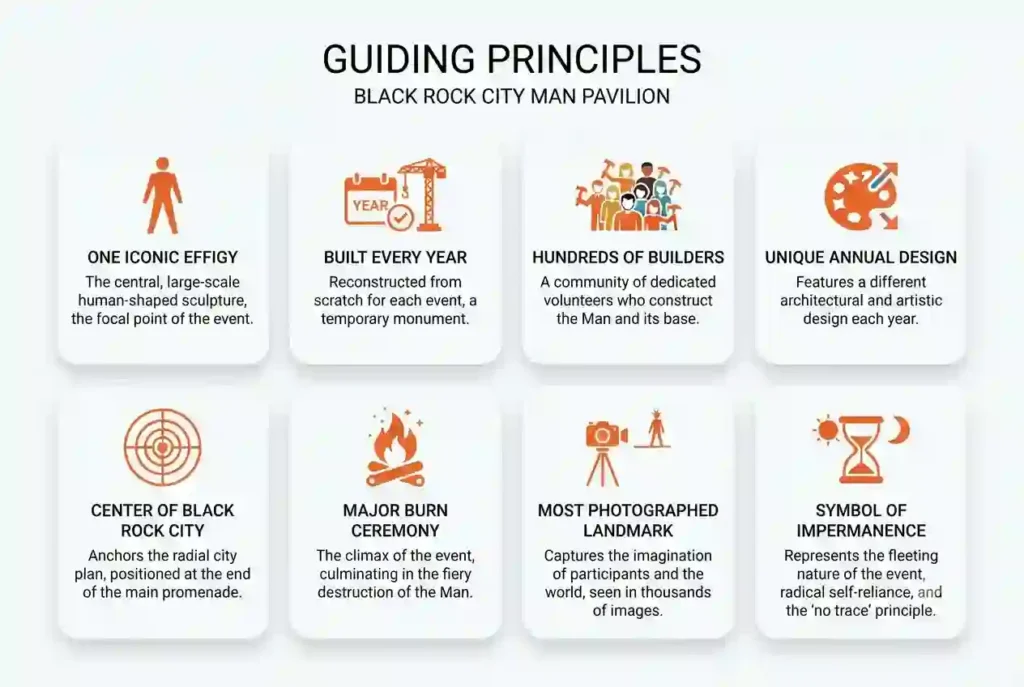
- 🔥 1 Iconic Effigy — A new version of The Man is constructed specifically for each Burning Man event.
- 🏗️ Built Every Year — The structure is designed, engineered, and assembled from scratch annually.
- 👷 Hundreds of Builders & Volunteers — Artists, engineers, carpenters, and volunteers collaborate throughout the construction process.
- 🎨 Unique Design Every Year — Each year’s Man reflects the event theme while maintaining its recognizable silhouette.
- 🌍 Center of Black Rock City — The Man stands at the heart of the city’s circular layout.
- 🎉 One Major Burn Ceremony — Thousands gather to witness The Man Burn on Saturday night.
- 📸 Most Photographed Landmark — The Man is one of the most photographed subjects at Burning Man.
- ❤️ Symbol of Impermanence — The annual burn reminds participants to embrace creativity, participation, and letting go.
Experienced Burner Tips
Once you’ve been to Burning Man, you start realizing that the best experiences usually come from timing, repetition, and patience. The Man is not something to rush through; it’s something to revisit under different conditions. Experienced Burners know that the week has a rhythm, and The Man reveals more of itself when you move with that rhythm. These habits turn a good visit into a great one.
Visit Multiple Times During the Week
Going back more than once lets you notice how the atmosphere shifts. The space around The Man can feel calm in one moment and packed in another. Those contrasts are part of the fun. Repeat visits help you understand the structure as a living part of the city.
Experience Sunrise and Sunset
The changing light around sunrise and sunset can make The Man feel almost like a different object. Those are often the most visually striking moments of the day. The soft light brings out shape and scale in a way midday glare doesn’t. If you want to remember the structure clearly, these are the times to see it.
Explore the Surrounding Art
The Man is strongest when you experience it with the art around it. Nearby installations, playa movement, and the surrounding crowd all deepen the sense of place. Burning Man is built as a whole environment, not a single landmark. Looking beyond the center gives you a fuller picture.
Plan Burn Night Early
Experienced Burners know that Burn Night rewards people who plan ahead. Timing, location, and comfort all matter when the crowd builds. A little preparation helps you stay relaxed instead of scrambling. That calmness can make the whole night more enjoyable.
Respect Fire Safety Instructions
No matter how seasoned you are, fire safety is never optional. The burn is powerful precisely because it is controlled and handled with care. Respecting instructions shows that you understand the event and the people around you. It is one of the simplest ways to participate responsibly.
- Repeated visits reveal more about The Man.
- Sunrise and sunset are especially rewarding.
- The surrounding art adds depth to the experience.
- Fire safety and early planning are essential Burner habits.
The Man Visitor Checklist
A checklist is useful because Burning Man rewards preparation. If you want to enjoy The Man properly, you need to think beyond the moment and plan for the conditions around it. That includes comfort, safety, timing, and awareness of the event’s flow. A good checklist keeps you focused on the experience instead of the stress.
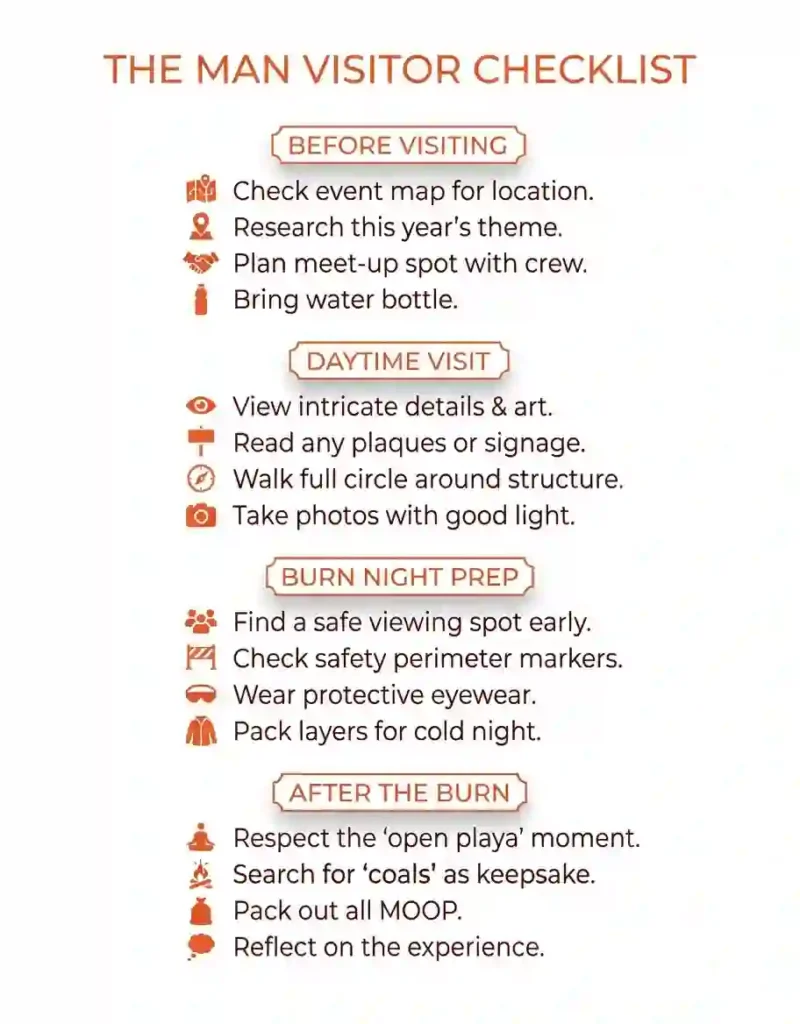
Before Visiting
Before you head out, make sure you know the schedule, your route, and your lighting setup. Wear clothing and gear that works for desert conditions, not for a normal festival. Bring what you need so you are not scrambling once you arrive. Prepared visitors have a much easier time enjoying the moment.
During Daytime Visits
Use daylight to understand the scale, surroundings, and layout. This is the best time for orientation and for taking in details you might miss at night. It also gives you a calmer, less crowded experience. Daytime is where the structure’s physical presence really stands out.
Preparing for Burn Night
Burn Night needs a different mindset because crowd size and emotion both increase. Arrive early, know your viewing position, and respect the event’s safety setup. Keep your essentials simple so you can move comfortably. A little planning makes the night feel far less chaotic.
After the Burn
After the burn, take a moment to process what you saw instead of rushing away. That quiet afterward is part of the experience and often becomes one of the most memorable parts. It gives you a chance to feel the event’s temporary nature. For many people, the emotional echo lasts longer than the fire itself.
- Preparation makes the visit more comfortable and meaningful.
- Daytime and Burn Night require different approaches.
- Safety and timing matter on the playa.
- The post-burn quiet is part of the experience too.
Conclusion
The Man reflects the spirit of Burning Man in a way that feels both simple and powerful. It is a structure, a symbol, a ritual focus, and a shared memory all at once. That is why people keep returning to it, photographing it, talking about it, and building stories around it.
The Man Reflects the Spirit of Burning Man
At its core, The Man captures the event’s mix of creativity, impermanence, and communal energy. It stands for something bigger than itself without becoming vague or abstract. That balance is what makes it so enduring.
More Than a Structure, a Shared Experience
The real meaning of The Man is not just in how it looks, but in how people gather around it. It becomes meaningful through the way Burners experience it together. That shared experience is what keeps the tradition alive.
A Tradition That Continues to Evolve
Even as Burning Man changes, The Man stays central because it can evolve without losing its identity. That makes it both stable and flexible, which is rare for a festival icon. The tradition continues because it still feels alive.
Final Thoughts
The best way to experience The Man is not just on Burn Night, but across the full week, in different light, with different moods, and from different distances. That broader experience gives you a deeper sense of why it matters. It also sets up a strong internal path into your Temple Guide, Mutant Vehicles Guide, Fire Art Guide, Black Rock City Guide, and Burning Man Art Guide.
The Man Checklist
Before Visiting
✅ Learn the history of The Man
✅ Check the event schedule
✅ Bring water and sun protection
✅ Carry your camera respectfully
During Your Visit
✅ Walk around the structure
✅ Explore nearby art installations
✅ Respect safety barriers
✅ Observe without climbing unless permitted
On Burn Night
✅ Arrive early
✅ Follow Ranger instructions
✅ Keep a safe distance
✅ Respect emergency access routes
After the Ceremony
✅ Leave calmly
✅ Pack out everything
✅ Respect Leave No Trace
✅ Reflect on the experience
The Man Through the Event Week
| Stage | What Happens | Visitor Experience |
|---|---|---|
| Construction | Final assembly and inspections | Observe craftsmanship from approved areas |
| Opening Days | Participants gather, explore, and photograph | Great time for relaxed visits |
| Midweek | Art, performances, and community activities nearby | Ideal for detailed exploration |
| Burn Night | The official burn ceremony takes place | Largest crowds and emotional celebration |
| After the Burn | The site transforms following the ceremony | Reflection and transition toward the event’s conclusion |
Frequently Asked Questions About The Man
The Man represents creativity, impermanence, participation, and the shared spirit of the Burning Man community.
Yes. A new version is designed and constructed annually, often inspired by that year’s event theme.
Different countries Professional builders, artists, engineers, carpenters, and volunteers collaborate throughout the construction process.
The Man traditionally burns on Saturday evening during Burning Man, although official schedules should always be confirmed for the current year.
Yes. Participants can visit and explore the area while following current safety guidelines and any restricted zones.
Because it stands at the city’s center, it serves as one of the easiest landmarks for navigation.
The burn celebrates impermanence, artistic expression, community participation, and the temporary nature of Black Rock City.
Yes. It is carefully planned with safety perimeters, fire professionals, Rangers, and emergency services.
Waiting until burn night to visit instead of exploring The Man during the week when crowds are smaller.
Yes. It is one of the most photographed landmarks at Burning Man, but always respect participant privacy and consent.
No. While its recognizable human silhouette remains, its base, engineering, artistic details, and surrounding plaza change from year to year.
- The burn symbolizes impermanence and participation.
- The Man’s size and timing are central to its impact.
- It changes from year to year while remaining recognizable.
- Visibility and access depend on conditions and location.
The Man Pro Tips
🌅 Visit early in the morning for smaller crowds and softer light.
🌙 Return after dark to experience the lighting and nighttime atmosphere.
📸 Walk completely around the structure—you’ll notice details from every angle.
🔥 Watch the burn from a safe location and follow Ranger guidance.
🚲 Lock your bicycle before entering busy gathering areas.
❤️ Experience The Man throughout the week—not just during the burn ceremony.
🎨 Learn the story behind each year’s design to better appreciate its symbolism.
🌍 Use The Man as your primary navigation landmark when exploring Black Rock City.
Why Trust This Guide?
- ✅ Updated for the 2026 Burning Man season.
- ✅ Covers the history and traditions of The Man.
- ✅ Explains its cultural importance beyond Burn Night.
- ✅ Suitable for first-time visitors, photographers, and returning Burners.
- ✅ Links to related art and Black Rock City guides.