
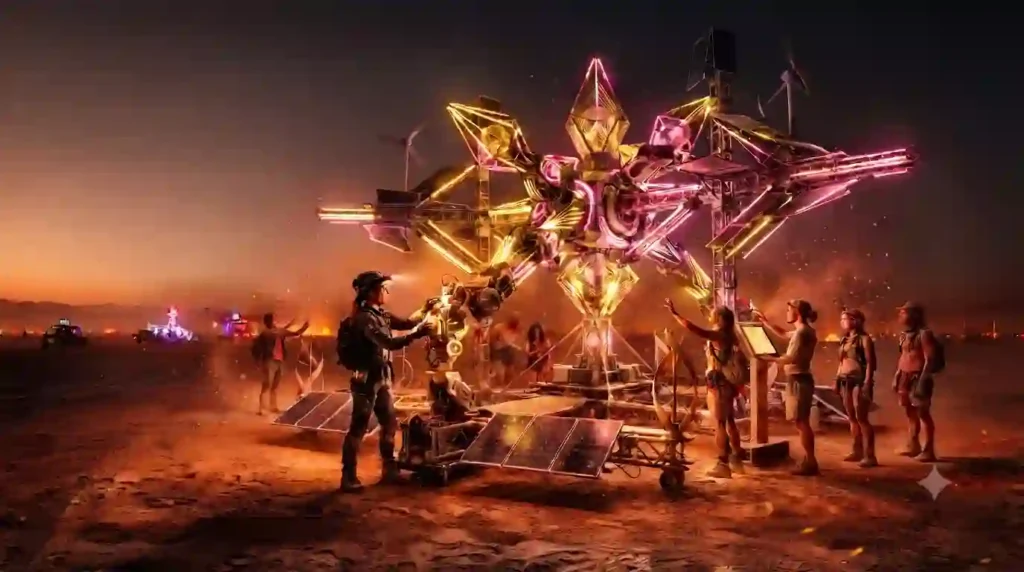
Technology & Innovation Guide 2026: How Burning Man Inspires Creative Engineering
Burning Man is more than an art festival—it is a living laboratory where artists, creative engineers, programmers, designers, makers, and innovators experiment with lighting ,robotics ,technology, renewable power outside commercial constraints on a remarkable scale. Burning Man functions as an unofficial testing ground how that innovation shapes the art you see on playa. Many ideas developed here later influence public art and design elsewhere.
Because Decommodification strips away commercial sponsorship and product placement, Burning Man has become an unusual space where engineers, programmers, architects, and makers experiment with technology purely in service of creative expression rather than a marketable product. Solar power systems keep large installations running without grid access, custom lighting and sound systems bring interactive sculptures to life, and mechanical and robotic elements — often built by volunteers with day jobs in engineering or software — animate everything from mutant vehicles to Temple structures.
This guide explores how this experimentation shapes the art found across Black Rock City each year: renewable energy systems adapted for extreme desert conditions, DIY lighting and sound design that pushes well beyond typical festival production, and mechanical or robotic elements incorporated into large-scale sculptures. It also touches on how ideas first prototyped on playa have occasionally influenced public art installations, product design, and creative technology conversations well beyond the desert, though this influence is best understood as cultural rather than commercial, given the event’s explicit resistance to consumption-driven framing.
For the specific relationship between the technology industry and Burning Man’s community, see the Silicon Valley & Burning Man Guide; for the art these technologies bring to life, see the Burning Man Art Guide.
In This Guide You’ll Learn
- 🤖 Technology at Burning Man
- 💡 Engineering behind installations
- 🔆 Lighting & LED art
- 🔊 Sound and immersive experiences
- 🌞 Renewable energy projects
- ⚙️ Robotics & kinetic sculpture
- 🚀 Experimental design
- 🌍 Innovation beyond Burning Man
- ❤️ Creative collaboration
- ⚠️ Responsible technology
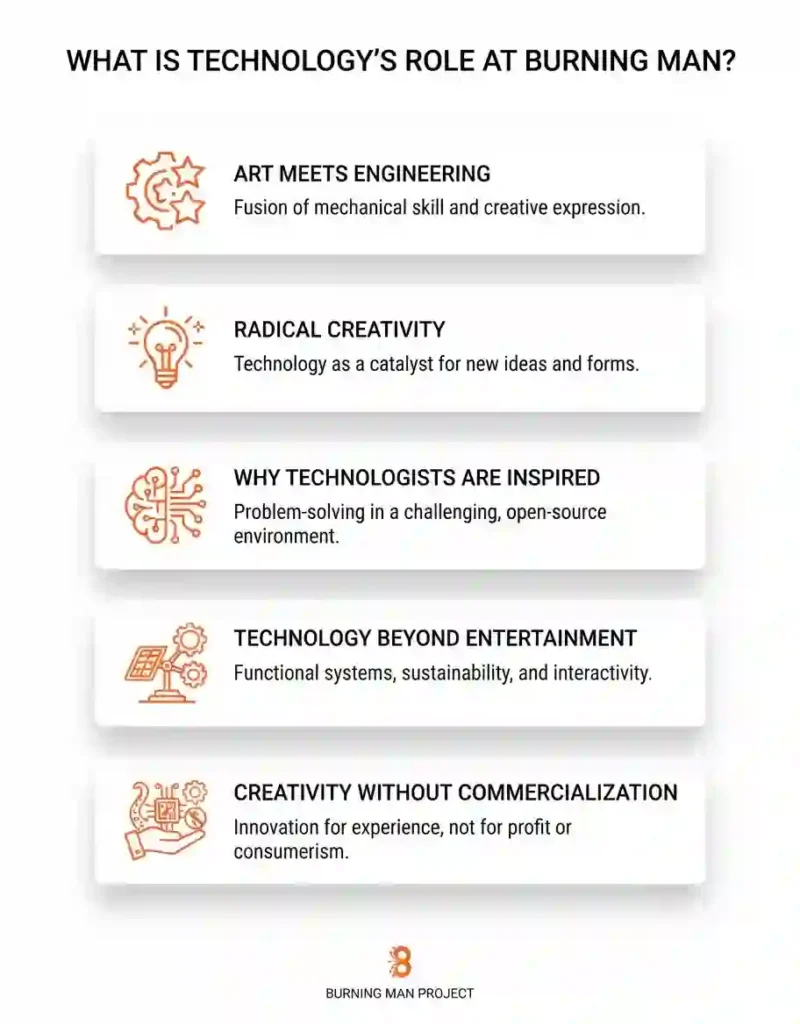
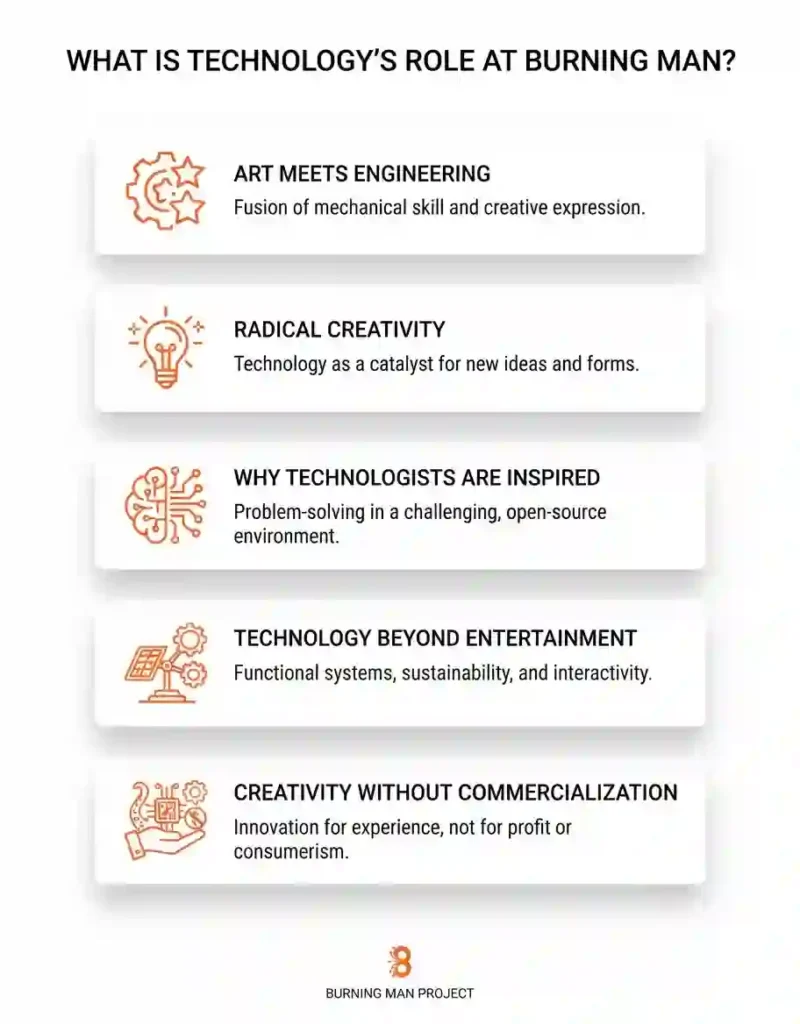
What Is Technology’s Role at Burning Man?
Technology at Burning Man is not a distraction from art; it is often one of the tools that helps art become more immersive, resilient, and expressive. On the playa, technology can support lighting, movement, sound, energy systems, fabrication, and interaction. It can also help artists solve harsh environmental problems in creative ways. What makes it interesting at Burning Man is that it usually serves imagination rather than commercial utility.
Where Art Meets Engineering
Burning Man is where artistic vision and engineering reality meet. A sculpture may look poetic, but behind it there may be structural design, electrical planning, and mechanical systems. That combination is one reason the event attracts makers and builders as much as artists. The strongest work often lives at the intersection of both disciplines.
Innovation Through Radical Creativity
Innovation at Burning Man often begins with a creative problem rather than a product idea. Artists ask how to make something move, glow, respond, or survive the desert. That pressure leads to unusual solutions. The result is innovation shaped by artistic freedom instead of market demand.
Why Burning Man Inspires Technologists
Technologists are drawn to Burning Man because it offers a space where experimentation feels meaningful and public. There is no need to optimize for sales, corporate branding, or conventional utility. That freedom allows people to build things simply because they are interesting, beautiful, or surprising. For many innovators, that is rare and motivating.
Technology Beyond Entertainment
At Burning Man, technology is not only about spectacle. It can also solve practical problems such as power, transport, shade, communication, and safety. That makes it part of the event’s functioning ecosystem as well as its creative output. The most useful technologies often feel invisible because they are so well integrated.
Creativity Without Commercialization
Burning Man values creativity that is not primarily driven by advertising or profit. That does not mean technology is rejected. It means technology is judged by how well it supports artistic, community, or experiential goals. This creates a very different environment from most commercial tech spaces.
- Technology supports both art and practical survival on the playa.
- Burning Man brings together artists, builders, and engineers.
- Innovation is often driven by creative curiosity, not commercial goals.
- Technology is valued when it serves imagination and community.
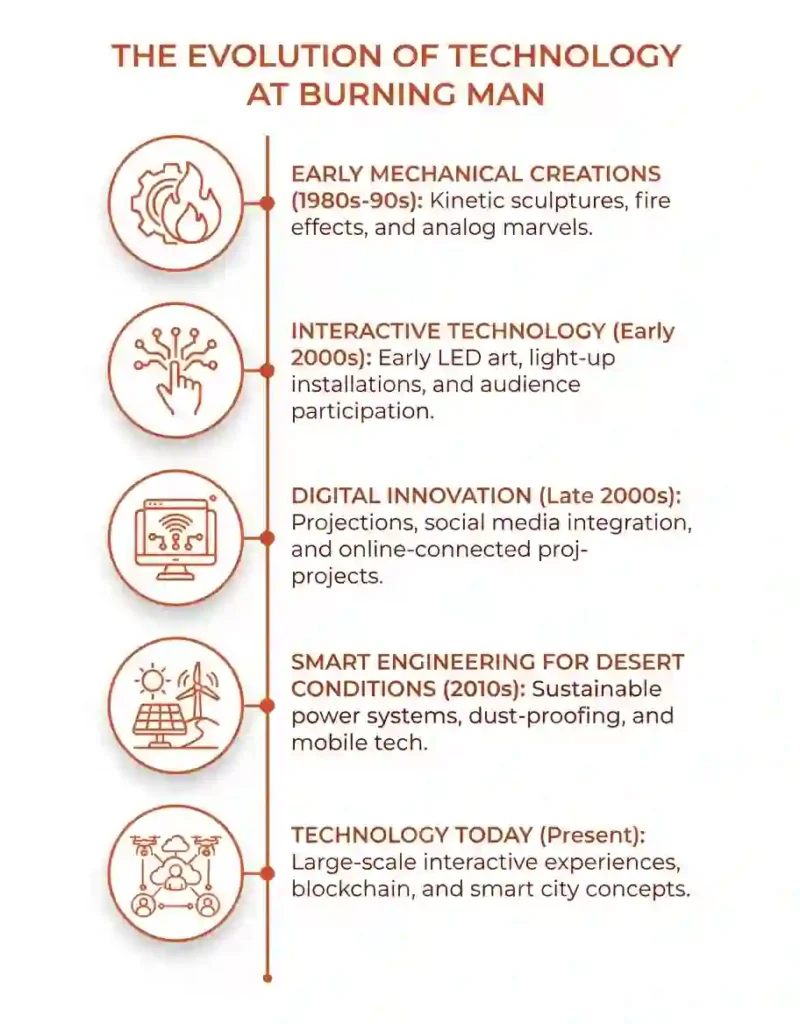
The Evolution of Technology at Burning Man
Technology at Burning Man has evolved from simple mechanical ideas into complex systems that support interactive art, energy solutions, and immersive environments. As the event has grown, so has the technical sophistication of the work. What began as experimentation now includes advanced fabrication, responsive systems, and renewable infrastructure. That evolution reflects the changing ambitions of the artists and builders involved.
Early Mechanical Creations
Early technology on the playa often took the form of mechanical objects, moving parts, and improvised systems. These creations were usually simple by today’s standards, but they set an important precedent. They showed that art could move, react, and function in public space. That opened the door for more complex work later on.
The Rise of Interactive Technology
As artists began to explore participation more deeply, interactive technology became more common. Sensors, switches, lights, and sound systems allowed installations to respond to people in real time. That changed the experience from viewing to engaging. The art became more alive because it could react.
Digital Innovation on the Playa
Digital tools eventually expanded what artists could imagine and build. Computer-driven systems made it easier to coordinate lighting, sound, movement, and projections. This allowed installations to become more layered and precise. Digital innovation helped push the visual and sensory range of the event forward.
Smart Engineering for Harsh Desert Conditions
The desert environment forces artists to think carefully about durability, dust, wind, heat, and transport. Smart engineering is what makes technology survive on the playa. A system that works indoors may fail quickly in the desert if it is not built with conditions in mind. That challenge makes the work more impressive when it succeeds.
Technology Today
Today, technology at Burning Man includes a wide range of systems from simple lighting to advanced interactive environments. It appears in art, vehicles, camps, and infrastructure. The variety shows how broad the category has become. Yet the common thread remains the same: technology is there to enhance experience, not replace it.
- Burning Man technology evolved from mechanical pieces to digital systems.
- Interactive tech helped shift the event toward participation.
- The desert environment demands smart engineering.
- Today’s technology is broad, varied, and still art-centered.
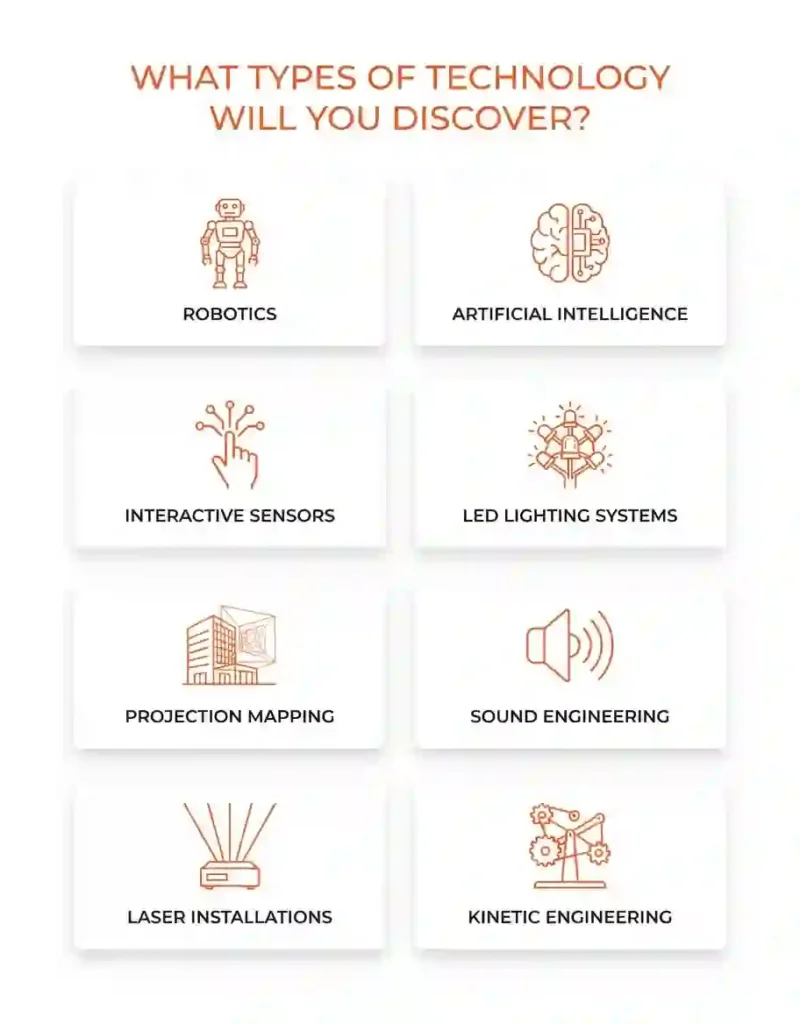
What Types of Technology Will You Discover?
The technology you encounter at Burning Man may be artistic, functional, experimental, or all three at once. Some projects use high-tech systems, while others use simple but clever engineering. That mix is one reason the event feels so creative. Technology here is not a separate category from art; it is often woven into it.
Robotics
Robotics can appear in Burning Man art as movement systems, autonomous features, or interactive mechanical forms. These works often feel surprising because they respond like living objects. Robots are especially effective when they support artistic storytelling. They turn motion into meaning.
Artificial Intelligence
Artificial intelligence may appear in some projects as a tool for interaction, generative behavior, or responsive design. It is not the defining feature of Burning Man, but it can add another layer to certain installations. The most interesting use of AI is usually conceptual rather than flashy. The art still leads.
Interactive Sensors
Sensors help installations react to movement, touch, sound, or proximity. They make art feel aware of the audience. That responsiveness can create a very strong sense of presence. Sensors are one of the most practical ways technology becomes experiential.
LED Lighting Systems
LED systems are common because they are efficient, visible, and adaptable. They can create glow, rhythm, color shifts, and nighttime atmosphere. On the playa, lighting can completely change how an installation feels. LEDs are often central to that transformation.
Projection Mapping
Projection mapping allows artists to place moving imagery onto irregular surfaces. This can make sculptures and structures feel animated or transformed. It is a powerful way to add narrative or visual complexity. Projection often becomes especially dramatic at night.
Sound Engineering
Sound engineering helps artists control how audio is delivered in open environments. It may involve ambient sound, music, directional audio, or reactive sound design. Good sound can make a space feel immersive and emotionally charged. It is one of the most underrated forms of technology at Burning Man.
Laser Installations
Laser installations use precise light to create dramatic visual effects in the dust and darkness. They can add a futuristic quality to an environment. When used well and safely, they become striking focal points. Their precision makes them feel very different from softer forms of light.
Drone Photography
Drone photography may be used where permitted and only in compliance with event rules and safety expectations. It can provide valuable documentation of large-scale works and landscapes. However, it must never interfere with participants or installations. At Burning Man, rules and respect always come first.
Kinetic Engineering
Kinetic engineering focuses on movement through mechanical design. It can include rotating elements, hinged structures, balance systems, or wind-responsive parts. These features make an installation feel alive even when no one touches it. Motion is often part of the art itself.
- Burning Man technology includes robotics, AI, sensors, LEDs, projections, sound, lasers, drones, and kinetic systems.
- Not every project uses high tech, but many use it creatively.
- Interactive systems often make the experience more immersive.
- Safety and event rules shape how technology is used.
Engineering Behind Playa Art
Engineering is what allows creative ideas to survive in one of the harshest event environments in the world. Large art and technical systems need structure, safety, power, and resilience. On the playa, engineering is not hidden support; it is part of the success of the artwork. Without it, many pieces would never function.
Structural Engineering
Structural engineering makes sure artworks stand up safely in wind, transport, and crowds. Even a visually delicate piece needs a strong underlying framework. This is especially important for large installations. Good structure gives the art its confidence.
Mechanical Systems
Mechanical systems bring motion, opening parts, rotation, or moving features into the work. These systems can be simple or highly complex. Their role is to translate idea into action. When they work well, they make the installation feel alive.
Electrical Design
Electrical design supports lighting, controls, sensors, sound, and other powered elements. It must be planned carefully because the desert environment is challenging. Reliable electrical systems help the art function consistently. Safety and weather resistance are essential here.
Wind Resistance Engineering
Wind resistance is a major issue on the playa because strong gusts can affect stability and performance. Artists and engineers must plan for movement, anchoring, and load. Wind can be invisible and unpredictable, so design has to anticipate it. This makes engineering a critical creative discipline.
Safety Testing
Safety testing ensures that an installation behaves as intended before visitors interact with it. Testing helps identify weak points, technical problems, or dangerous conditions. It is part of responsible creation. At Burning Man, good engineering means safe engineering.
- Engineering is essential to making art and tech work on the playa.
- Structural, mechanical, and electrical systems all matter.
- Wind and weather require careful planning.
- Safety testing protects both people and the artwork.
Renewable Energy at Burning Man
Renewable energy is an increasingly important part of Burning Man because it supports sustainability and creative independence. Artists and camps often use solar or battery systems to power lights, sensors, and installations. These solutions reduce reliance on conventional generators and fit the event’s evolving environmental awareness. Renewable energy also invites innovation.
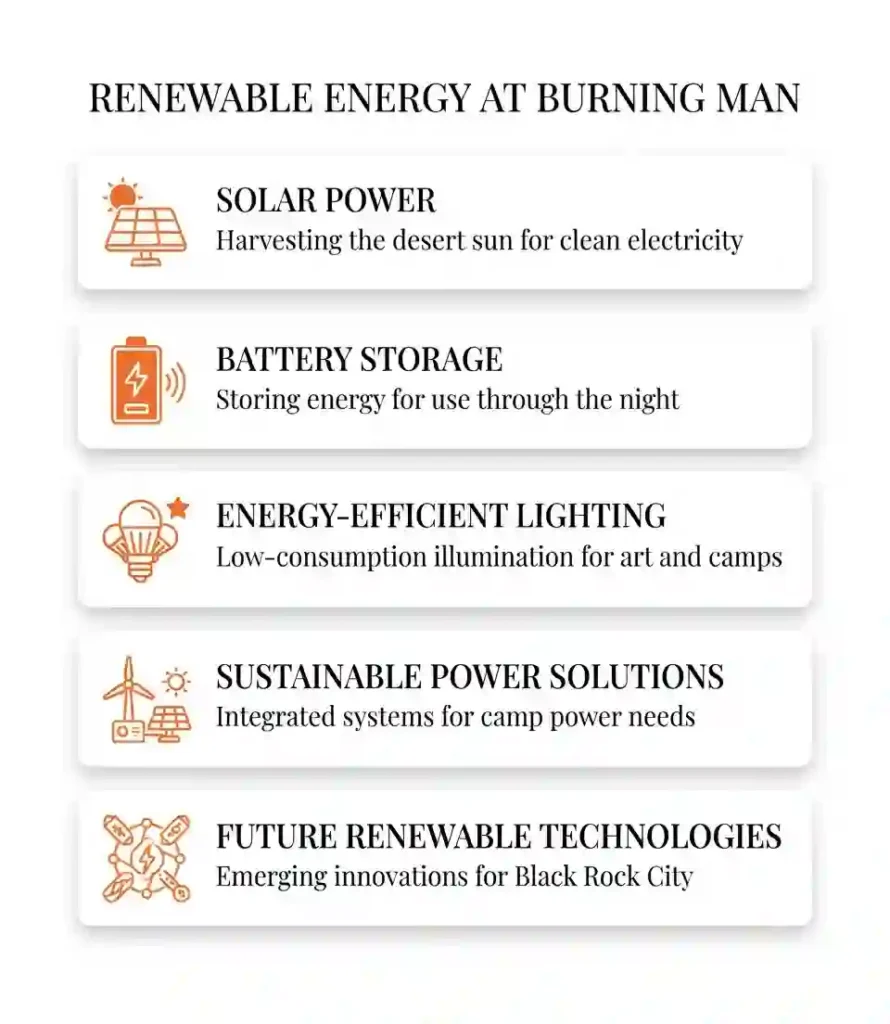
Solar Power
Solar power is one of the most practical renewable energy sources on the playa. It can charge systems during the day and help power art at night. Solar works especially well when paired with efficient design. It also reflects a forward-looking approach to event infrastructure.
Battery Storage
Battery storage makes renewable energy more useful by saving power for later use. This is important because many experiences happen after sunset. Storage allows installations to stay active when solar input is not available. It is a key part of reliable off-grid design.
Energy-Efficient Lighting
Energy-efficient lighting helps reduce power demand while still creating strong visual impact. LEDs are often used because they are bright and efficient. This makes it easier to run installations sustainably. Efficiency is a technical advantage and a creative one.
Sustainable Power Solutions
Sustainable power solutions can include hybrid systems, better energy planning, and lower-consumption design. These approaches help artists and camps create less waste while still producing strong experiences. Sustainability becomes part of the design challenge. That challenge often leads to smarter work.
Future Renewable Technologies
Future renewable technologies may include better batteries, more efficient solar arrays, smarter energy controls, and emerging off-grid systems. Burning Man is a place where these ideas can be tested creatively. The event is not just using the future; it is helping imagine it. That makes renewable energy especially relevant here.
- Solar, batteries, and efficient lighting are key renewable tools.
- Sustainable power helps off-grid art function better.
- Renewable systems support both creativity and environmental responsibility.
- Future energy innovations may find a home on the playa.
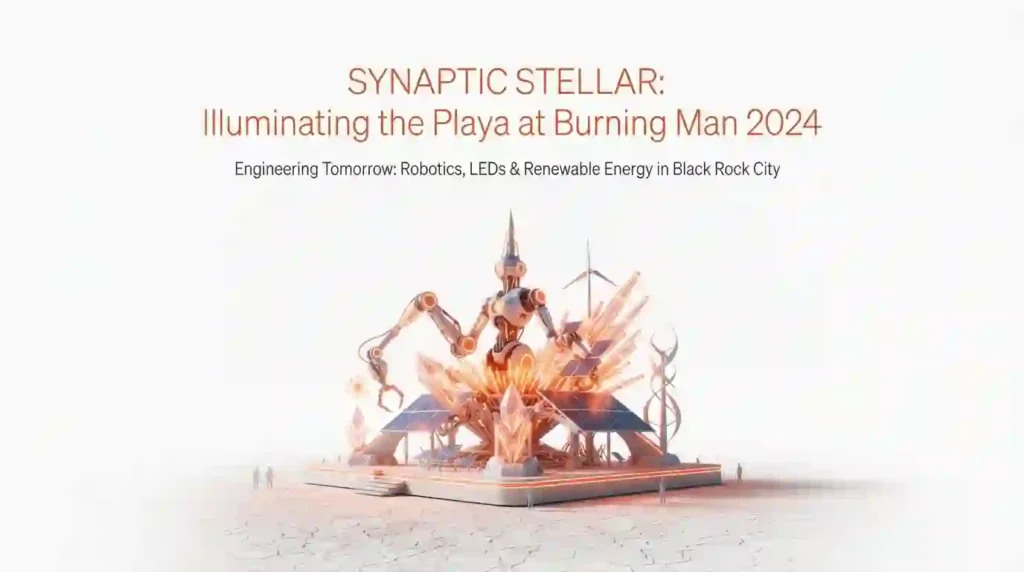
Robotics and Interactive Experiences
Robotics and interactive technology help make installations feel responsive, playful, and alive. These systems can create direct relationships between visitors and the artwork. When used well, they deepen participation without overwhelming the art itself. The goal is interaction with meaning, not just technical novelty.
Motion-Controlled Installations
Motion-controlled installations respond when people move nearby or interact physically. This can create instant feedback and a strong sense of presence. The visitor’s movement becomes part of the piece. That makes the experience feel personal.
Interactive Robots
Interactive robots can serve as performers, companions, or responsive sculptural elements. They often blur the line between machine and artwork. On the playa, that can feel surprising and memorable. The best robotic work tends to have character as well as function.
Programmable Art
Programmable art allows artists to define how a piece behaves over time or in response to input. This creates repeatability while still allowing variety. It can be especially effective in light and kinetic works. Programming gives the artist another creative language.
Automation in Art
Automation can help an installation run consistently without constant manual control. That is useful for large or complex works. But automation only works well when it supports the artistic concept. The technology should serve the experience, not dominate it.
Human–Machine Collaboration
Human–machine collaboration is one of the most interesting ideas in tech-based art because it combines intention, response, and unpredictability. The visitor influences the work, but the machine shapes the reaction. That partnership can feel both futuristic and intimate. It is a powerful artistic relationship.
- Robotics and interactive systems increase participation.
- Motion, programmability, and automation shape the experience.
- The best robotic art feels expressive, not merely technical.
- Human–machine collaboration is central to the concept.
How Artists Use Digital Technology
Digital technology gives artists new tools for planning, building, and presenting their work. It also helps them solve problems that would be difficult with analog methods alone. On the playa, these tools can speed up fabrication and improve precision. Digital systems have become a normal part of contemporary art-making.
Computer-Aided Design (CAD)
CAD helps artists and engineers design structures before they are built. It improves accuracy and helps identify issues early. For large installations, that can save time and money. CAD makes vision more buildable.
3D Printing
3D printing is useful for prototypes, parts, and detailed components. It allows artists to test ideas quickly. Even small printed pieces can support larger works. The technique is especially useful in iterative design.
CNC Fabrication
CNC fabrication helps create precise cuts and forms from digital files. This is useful when artists need accuracy across multiple pieces. It also makes repeated parts easier to produce. Fabrication becomes more efficient and more consistent.
Digital Animation
Digital animation helps artists visualize how a work might move, glow, or transform. It can also be used directly in projections or screens. Animation makes timing and narrative more controllable. It bridges concept and experience.
Projection Technology
Projection technology lets artists turn surfaces into moving visual environments. It can make a sculpture feel alive at night. Projection is especially powerful when combined with sound or light. It transforms static surfaces into active displays.
- Digital tools help artists design and build more precisely.
- CAD, 3D printing, and CNC improve fabrication.
- Animation and projection strengthen visual storytelling.
- Digital technology is a support system for creativity.
Technology by the Numbers
Burning Man is more than an art festival—it’s a living laboratory where artists, engineers, makers, programmers, and innovators collaborate to create groundbreaking installations, kinetic sculptures, renewable energy systems, and immersive experiences that inspire creativity around the world.
The scale of technology at Burning Man can be understood not just through examples but through the number of projects, systems, and collaborators involved. Technology is spread across art, camps, and infrastructure. That makes it a major part of the event’s creative ecosystem. The numbers help make that visible.
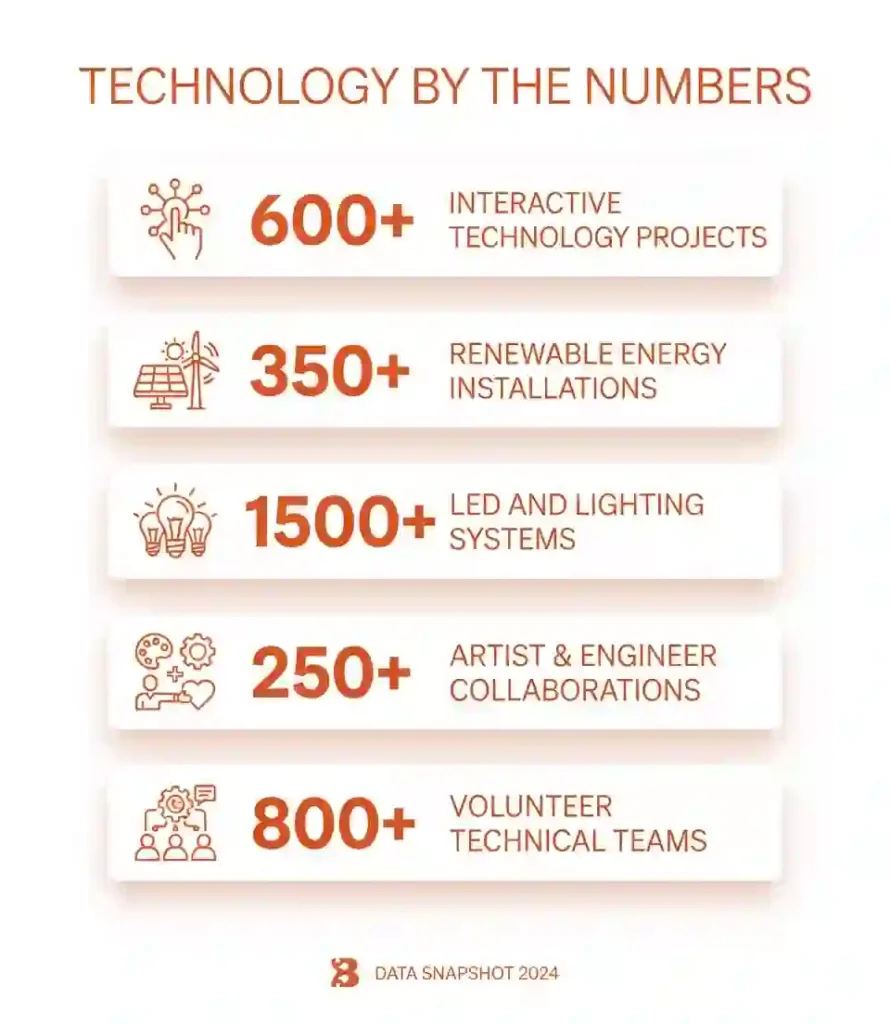
Interactive Technology Projects
Interactive technology projects appear every year in different forms and scales. Some are subtle, some are large, and some are highly experimental. Their presence shows how much the event values participation and responsiveness. Technology has become deeply embedded in the art landscape.
Renewable Energy Installations
Renewable energy installations continue to grow as artists and camps look for better off-grid solutions. These systems support both practicality and sustainability. Their use signals a broader shift toward cleaner event design. The trend is likely to continue.
LED and Lighting Systems
LED and lighting systems are among the most common tech elements because they are effective and efficient. They show up in art, vehicles, camps, and landmarks. Their visual impact is immediate. At night, they often define the experience.
Artist and Engineer Collaboration
Many projects depend on collaboration between artists and engineers. That partnership is a major reason the work can become so sophisticated. Creative and technical minds complement each other well. The collaboration itself is part of the story.
Volunteer Technical Teams
Volunteer technical teams bring essential support to complex builds and installations. They help with wiring, assembly, testing, and repair. Their contribution is often invisible to the casual viewer. But without them, many projects would not work.
Years of Technological Innovation
Burning Man has spent years developing a culture of technical experimentation. That long arc matters because it shows the event is not just using technology casually; it is shaping a tradition around it. Innovation here is cumulative. Each year builds on the last.
Key Numbers
- ❤️ Creativity Comes Before Technology — Technology exists to enhance participation and artistic expression, not replace them.
- 🤖 Hundreds of Technology-Driven Artworks — Interactive installations combine engineering, sensors, lighting, sound, and programming.
- ⚙️ Thousands of Makers & Engineers — Builders, programmers, artists, and fabricators collaborate before and during the event.
- 💡 Renewable Energy Powers Many Projects — Solar energy and battery systems are commonly used for camps and artworks.
- 🎨 Interactive Experiences Everywhere — Visitors activate many installations through movement, touch, sound, or participation.
- 🚲 Innovation Beyond Art — Engineering also improves mutant vehicles, camp infrastructure, and sustainable living.
- 🌍 Global Collaboration — Creators from many countries contribute new ideas and technologies every year.
- 🔬 Real-World Experimentation — Many concepts first tested on the playa later influence design, architecture, and technology projects.
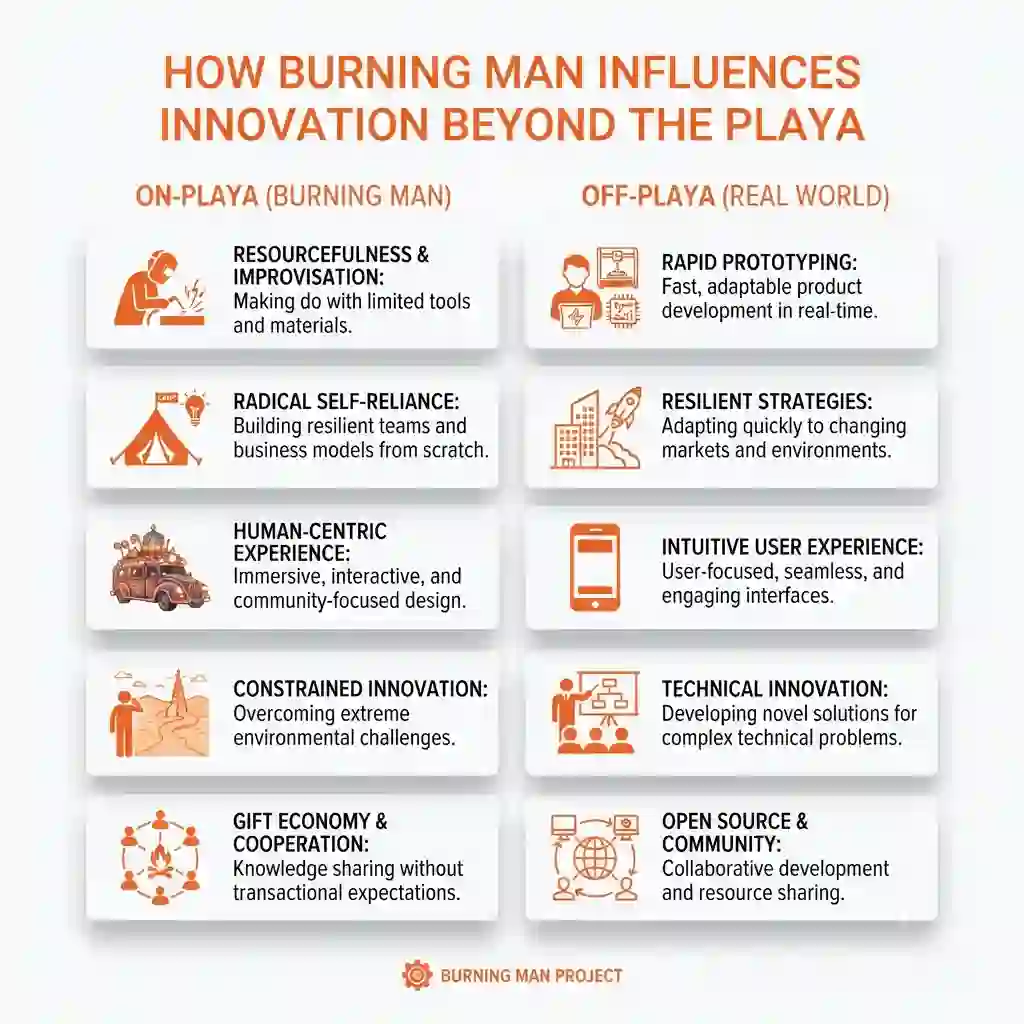
How Burning Man Influences Innovation Beyond the Playa
Burning Man influences innovation beyond the playa because it creates a space where people can test ideas, collaborate openly, and build without commercial pressure. Many participants take those habits back into other creative fields. That includes product design, engineering culture, and startup thinking. The event’s influence is broader than it first appears.
Innovations That Started or Grew at Burning Man
| Innovation Area | Example |
| Interactive Art | Motion-responsive sculptures and immersive installations |
| Renewable Energy | Solar-powered camps and art projects |
| Kinetic Design | Large-scale moving sculptures and mechanisms |
| Digital Fabrication | CNC machining, laser cutting, and 3D-printed components |
| Community Engineering | Collaborative design and open-source building methods |
| Sustainable Living | Off-grid power, water conservation, and resource-efficient camp systems |
Maker Culture
Burning Man strongly supports maker culture because it values hands-on creation and experimentation. People are encouraged to build things themselves or with others. That ethos overlaps with broader DIY and fab-lab communities. Making becomes a form of expression.
Startup Inspiration
Many entrepreneurs and startup founders are inspired by the freedom, collaboration, and problem-solving they experience at Burning Man. The event can spark new ways of thinking about team culture and product development. It also reminds people that creativity can be playful. That can influence how they build outside the playa.
Product Design
Product designers often learn from Burning Man’s emphasis on experience, user interaction, and aesthetic clarity. The event encourages thinking about how a thing feels, not just how it functions. That can lead to better design instincts. Experience is a design principle.
Creative Problem Solving
Creative problem solving is one of Burning Man’s most transferable lessons. Participants often have to improvise and adapt under pressure. That skill translates well into engineering, business, and art. It teaches flexibility in a very practical way.
Open Collaboration
Open collaboration is one of the event’s strongest influences because many projects are built by people sharing knowledge freely. That kind of culture can inspire teams beyond the playa. It encourages transparency, generosity, and co-creation. Those habits travel well.
- Burning Man supports maker culture and hands-on experimentation.
- Entrepreneurs and designers often draw inspiration from the event.
- Problem solving and collaboration are highly transferable skills.
- The influence extends into product, team, and innovation culture.
Common Myths About Technology at Burning Man
Technology at Burning Man is often misunderstood because people expect either total rejection or total domination. In reality, it sits somewhere more interesting in the middle. It is embraced when it supports art, sustainability, and participation. Clearing up myths helps people understand the event better.
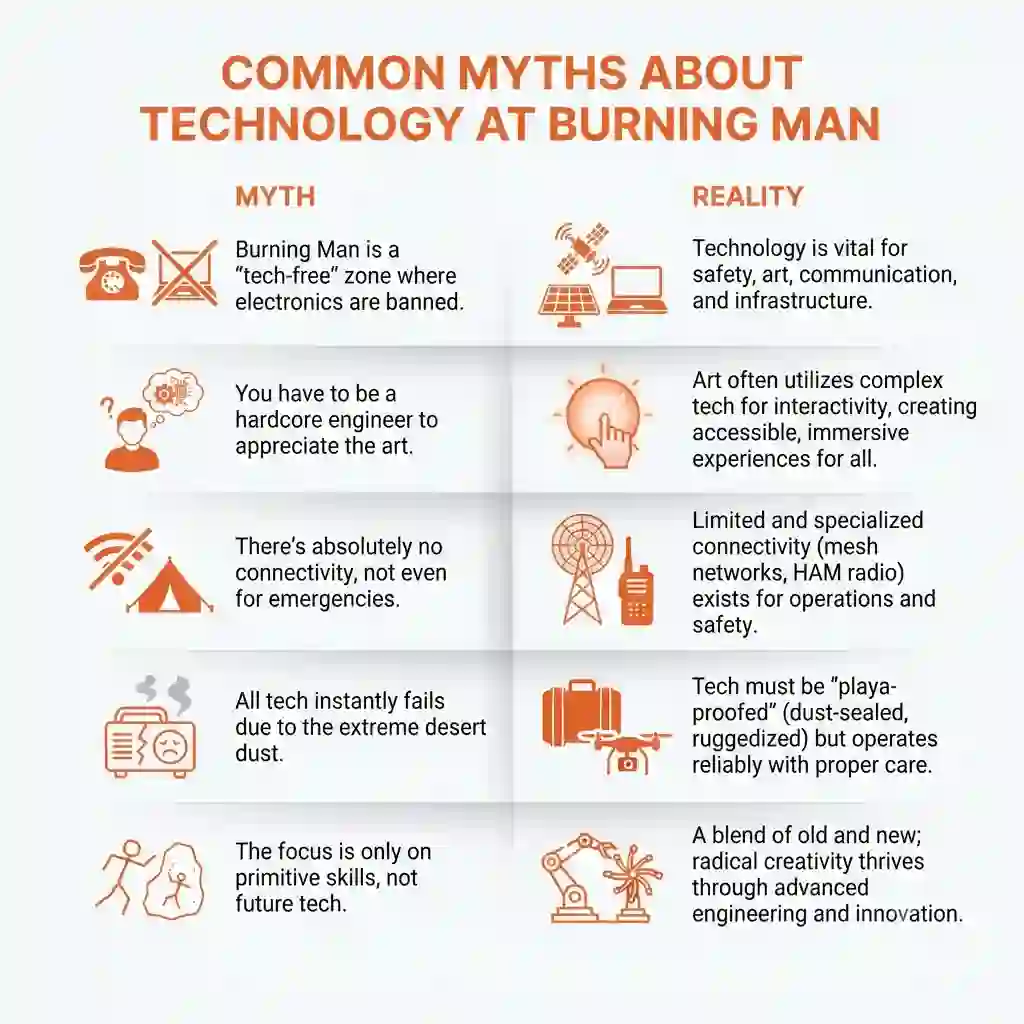
Myth: Burning Man Rejects Technology
Burning Man does not reject technology. It simply uses it differently than commercial culture does. The event values technology that supports creativity and community. That distinction matters.
Myth: Only Engineers Build High-Tech Art
High-tech art often involves engineers, but it also depends on artists, fabricators, volunteers, and designers. The work is collaborative. Engineering is important, but it is not the whole story. Art still leads.
Myth: Technology Replaces Creativity
Technology does not replace creativity; it extends it. A sensor, robot, or light system is only meaningful if it serves a strong artistic idea. Creativity remains the core. Technology is the medium.
Myth: AI Creates Everything
AI may appear in some projects, but it does not define Burning Man. Most artworks are still shaped by human imagination, labor, and collaboration. AI is one possible tool among many. It is not the center of the culture.
Myth: High-Tech Art Is Only for Large Camps
High-tech or digitally driven art is not limited to large camps. Small projects can also use smart tools, lighting, or interactive systems. Scale does not determine relevance. Ingenuity matters more.
- Burning Man does not reject technology.
- High-tech art is collaborative and artist-led.
- AI is a tool, not the defining feature.
- Small projects can be technologically inventive too.
Common First-Timer Mistakes
First-time visitors often miss important technology because they are focused on the biggest, loudest things. That can lead them to overlook subtle interactive systems and behind-the-scenes ingenuity. Technology at Burning Man is often easier to appreciate if you slow down and look more carefully. First-timer mistakes are common but avoidable.
Looking Only for Giant Sculptures
Technology is not only found in giant, obvious pieces. Some of the most interesting work is hidden in lighting, movement, sensors, and camp infrastructure. Looking only for big spectacle means missing a lot. Small systems can be just as impressive.
Missing Interactive Technology
Interactive systems are easy to miss if you do not approach the work actively. Sensors, triggers, and responsive environments often require a bit of curiosity. Once you engage, the experience changes. Participation reveals the tech.
Ignoring Artist Explanations
Artist explanations can help you understand the role of technology in the piece. Without that context, the work may seem simpler than it is. Listening adds depth. It also helps you appreciate the craft behind it.
Assuming Every Device Is Commercial
Not every technological object on the playa is a branded product or commercial device. Many are custom-built, repurposed, or experimental. That makes the experience more creative and less standard. Assumption can hide craftsmanship.
Forgetting Daytime Experiences
Some technology is easier to understand during daylight, especially structural or mechanical systems. If you only explore at night, you may miss important details. Day and night offer different readings of the same work. Both matter.
- Technology is not limited to giant installations.
- Interaction often reveals the most interesting systems.
- Artist context deepens understanding.
- Day and night each expose different aspects of tech-based work.
Experienced Burner Tips
Experienced Burners know that technology is best experienced with curiosity, conversation, and timing. They understand that the playa rewards those who look both closely and widely. Some of the most rewarding discoveries are not the most obvious ones. That is especially true for tech-driven work.
Visit Installations During Day and Night
Technology often looks different depending on lighting conditions. A system that feels subtle by day may become dramatic at night. Re-visiting allows a fuller understanding. The contrast is often part of the art.
Talk With Engineers and Artists
Talking with the people who built the work can reveal the thinking behind it. Engineers explain how it functions, while artists explain why it matters. That combination gives the piece more depth. Conversation is a valuable part of exploration.
Watch Behind-the-Scenes Demonstrations
If a project offers demonstrations or explanations, they are worth paying attention to. These moments show how the technology works in practice. They can make invisible systems visible. Understanding the mechanism often increases appreciation.
Explore Deep Playa Innovation
Deep playa often holds some of the most ambitious experimental work because it gives artists room to build. Exploring farther out can reveal large-scale or technically complex installations. The effort is usually rewarded. Innovation often lives at the edges.
Appreciate Both Low-Tech and High-Tech Creativity
Burning Man is not only about sophisticated systems. Low-tech solutions can be just as inventive and meaningful. The best attitude is to value cleverness in all forms. Creativity does not require complexity.
- Day and night reveal different aspects of tech-based work.
- Conversations with creators add context.
- Deep playa often contains ambitious innovation.
- Low-tech and high-tech solutions both matter.
Technology Explorer Checklist
A checklist helps visitors engage with technology in a way that is curious, safe, and respectful. It also reminds people to pay attention to both the art and the systems behind it. Good exploration balances fascination with responsibility. That is especially important for technical work.
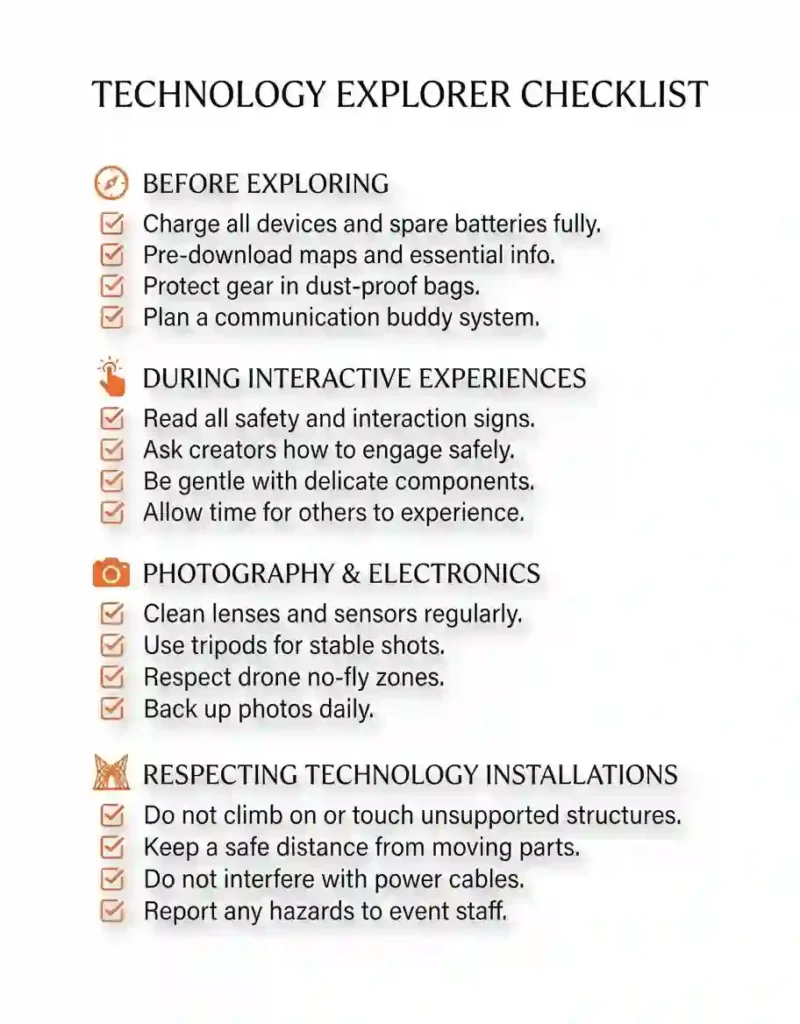
Before Exploring
Before exploring, bring the basics you need to navigate safely and comfortably. Read any available information about the installation or camp. Preparation helps you notice more. It also reduces confusion.
During Interactive Experiences
During interactive experiences, pay attention to the rules and any cues from the artwork. Touch, motion, or sound may trigger changes. Stay aware of how the system responds. Good participation makes the experience better.
Photography & Electronics
Photography is often welcome, but it should not interrupt the work or put devices at risk. Be careful around electronics, cables, and mechanical parts. Respect the setup and the creators’ instructions. A good photo is never worth damaging the piece.
Respecting Technology Installations
Technology installations can be fragile, complex, and expensive to maintain. Respect the boundaries, instructions, and safety measures that come with them. That respect helps the work last longer and function better. It also shows appreciation for the labor behind it.
- Prepare before exploring technical work.
- Follow interaction rules carefully.
- Be mindful around electronics and mechanical parts.
- Respect protects both the art and the people who built it.
How Does Burning Man Inspire the Global Maker Movement?
Burning Man has had a strong influence on the global maker movement because it celebrates building, sharing, and learning through doing. People leave the event with ideas, skills, and confidence that carry into other projects. The maker mindset and Burning Man ethos overlap in meaningful ways. Both value experimentation and hands-on creativity.
Open-Source Collaboration
Open-source collaboration is a natural fit for Burning Man culture because many people share knowledge freely. That helps ideas spread faster and more creatively. It also lowers barriers to entry. Sharing is part of the ecosystem.
DIY Innovation
DIY innovation thrives because participants often build what they need instead of waiting for a finished commercial solution. That resourcefulness creates strong practical skills. It also encourages originality. DIY is central to the maker mindset.
Community Engineering
Community engineering shows up when people solve problems together and share technical labor. Burning Man creates many such situations. That collective approach can inspire long-term collaboration beyond the playa. It is engineering with a social dimension.
Experimental Design
Experimental design is encouraged because the playa gives people room to try unusual ideas. Some experiments succeed, some teach lessons, and some become the basis for future projects. The event is a laboratory for creativity. Failure can still be productive.
Learning Through Building
Learning through building is one of the most important lessons of the maker movement and Burning Man alike. Practical knowledge sticks when people use their hands. The process itself becomes educational. That makes the experience valuable beyond the event.
- Burning Man strongly overlaps with maker culture.
- Open sharing and DIY thinking are central.
- Community engineering and experimentation are encouraged.
- Learning through building is a core takeaway.
Emerging Technologies Shaping Future Burning Man Art
New technologies continue to appear in some Burning Man projects, but they are not the defining feature of the event. They are tools that artists may use to expand what is possible. The most important thing is still the idea behind the work. Technology supports the art rather than replacing it.
Technology You Can Experience at Burning Man
| Technology | How It’s Used | Visitor Experience |
| Robotics | Interactive moving sculptures | Observe or interact when invited |
| Kinetic Engineering | Mechanical artworks and moving structures | Motion activated by wind, motors, or participants |
| LED Lighting | Illuminated art installations | Best experienced after dark |
| Renewable Energy | Solar-powered camps and artworks | Demonstrates sustainable design |
| Sensors & Electronics | Interactive installations | Touch, movement, sound, or light responses |
| Digital Fabrication | CNC, laser cutting, 3D printing | Supports construction of complex artworks |
| Sound Engineering | Immersive audio experiences | Interactive and environmental soundscapes |
Artificial Intelligence
AI may help with generative visuals, interaction, planning, or conceptual systems in some projects. Its role is still selective and project-specific. The most compelling use of AI at Burning Man is usually when it creates new artistic possibilities. It is a tool, not the point.
Augmented Reality
Augmented reality can add layers of digital interpretation to physical spaces. It may allow visitors to experience a work differently through devices or overlays. This can create an interesting blend of real and virtual. It remains an emerging layer rather than a central one.
Virtual Reality
Virtual reality may be used in some artistic or experimental contexts, but it is not typical of the playa experience. It can be powerful for storytelling or pre-visualization. Still, the physical desert remains the core environment. VR is a supplement, not a replacement.
Sustainable Materials
Sustainable materials are becoming more important as artists think about lifecycle, waste, and environmental impact. Better materials can support stronger Leave No Trace outcomes. They also encourage smarter design. Sustainability is likely to remain a growing focus.
Smart Lighting and Interactive Systems
Smart lighting and interactive systems are already among the most visible forms of future-facing technology on the playa. They let artists shape atmosphere, response, and participation more precisely. These tools continue to evolve. They are likely to remain important for years to come.
- AI, AR, VR, and smart systems may appear in some projects.
- These technologies are emerging tools, not the defining feature of Burning Man.
- Sustainable materials are becoming more important.
- Physical experience still remains central.
Conclusion
Innovation thrives where creativity meets community, and Burning Man is one of the clearest examples of that idea in action. Technology at Burning Man is never just about machines or systems; it is about how engineering can serve art, participation, and sustainability. The playa continues to inspire people because it gives them permission to build, test, and imagine the future together.
Innovation Thrives Where Creativity Meets Community
The strongest technical work on the playa usually succeeds because it is socially and artistically grounded. People build together, solve together, and learn together. That shared process is what makes the innovation meaningful.
Technology Serves Art, Not the Other Way Around
Burning Man does not celebrate technology for its own sake. It celebrates what technology makes possible when guided by vision. The art remains the center.
Burning Man Continues to Inspire the Future
The event’s influence reaches far beyond the desert because it changes how people think about making, collaborating, and experimenting. That is why the technology page matters so much. It points toward what creativity can become.
Final Thoughts
The best way to understand Burning Man technology is to see it as part of a larger creative ecosystem that includes art, sustainability, maker culture, and experimental design. This is also the natural place to introduce the final sub-pillar, Silicon Valley & Burning Man, because the connection between innovators and the playa is already visible here. Readers can continue into the Burning Man Art Guide, Art Installations Guide, Interactive Art Guide, Fire Art Guide, Art Grants & Honoraria Guide, and the dedicated Silicon Valley & Burning Man page.
- 🤖 Explore technology with curiosity.
- 💡 Appreciate the engineering behind installations.
- ❤️ Respect artists and builders.
- 🌞 Notice sustainable innovations.
- 🔊 Experience sound and light after dark.
- 🌱 Leave No Trace.
- 🤝 Celebrate collaborative creativity.
- 📖 Continue with the Silicon Valley & Burning Man Guide to discover how this culture has influenced the global technology industry.
Explore the Future of Creative Innovation
Burning Man shows that technology becomes most interesting when it helps people create together. That is the real future this page is pointing toward.
Temple Visitor Checklist
Before Visiting
✅ Learn the purpose of the Temple
✅ Bring water for your visit
✅ Consider what you’d like to leave behind (if anything)
✅ Prepare to respect a quiet environment
During Your Visit
✅ Speak softly
✅ Respect personal space
✅ Ask permission before photographing identifiable people
✅ Leave memorial items respectfully
During the Temple Burn
✅ Arrive early
✅ Follow Ranger instructions
✅ Remain quiet during the ceremony
✅ Respect the emotional experience of others
Before Leaving
✅ Take only your personal belongings
✅ Leave no trace
✅ Reflect quietly before returning to the city
✅ Respect the significance of the space
Frequently Asked Questions About Technology at Burning Man
It brings together artists, engineers, makers, and innovators who build experimental projects that combine creativity with technology.
Projects often feature robotics, kinetic engineering, LED lighting, sensors, renewable energy, programming, and interactive electronics.
Many installations are interactive, but always follow the artist’s instructions and respect any safety restrictions.
Yes. Many camps and artworks rely on solar panels, battery systems, and other sustainable energy solutions.
No. Technology supports artistic expression and participation rather than being the main attraction.
Teams of artists, engineers, programmers, fabricators, architects, and volunteers work together throughout the year.
Absolutely. Many interactive artworks are designed for participants of all experience levels.
Yes. Ideas developed on the playa have influenced art, architecture, sustainability, design, and engineering projects worldwide.
Touching or operating technology installations without permission from the artists or crew.
Many installations are most impressive after sunset when lighting and interactive effects become fully visible.
Many are drawn by the opportunity to collaborate on creative projects, experiment with new ideas, and work alongside artists in a highly participatory environment.
- Technology is encouraged when it supports the event’s values.
- AI appears only in some projects.
- Renewable energy and interaction are common themes.
- Engineers face harsh environmental challenges on the playa.
Where Should You Go Next?
| If You Want To… | Read This Guide |
| Learn about Silicon Valley connections | → Silicon Valley & Burning Man |
| Explore interactive installations | → Interactive Art Guide |
| Discover giant sculptures | → Large-Scale Art Installations Guide |
| Learn about Burning Man art | → Burning Man Art Guide |
| Explore mutant vehicles | → Mutant Vehicles Guide |
Why Trust This Guide?
✅ Links to related technology and art resources.
✅ Updated for the 2026 Burning Man season.
✅ Covers innovation across engineering, design, and creative technology.
✅ Focuses on artistic applications rather than commercial products.
✅ Suitable for artists, engineers, designers, and curious visitors.
Technology & Innovation Pro Tips
- 💡 Visit installations both during the day and at night—they often offer completely different experiences.
- 🤖 Talk to artists and engineers if they’re available; many enjoy explaining how their projects work.
- 🔋 Carry a portable battery for your own devices during long exploration days.
- 🚲 Use your bicycle to explore technology installations spread across the open playa.
- 📷 Photograph the details as well as the overall artwork to appreciate the engineering.
- 🌍 Look for sustainability features such as solar power and energy-efficient designs.
- 🎨 Remember that the most impressive innovation often happens behind the scenes in the design and fabrication process.
- ❤️ Appreciate how technology enhances participation instead of replacing human creativity.