
Burning Man Ticket Types Guide 2026: Compare Every Ticket Option & Choose the Right One
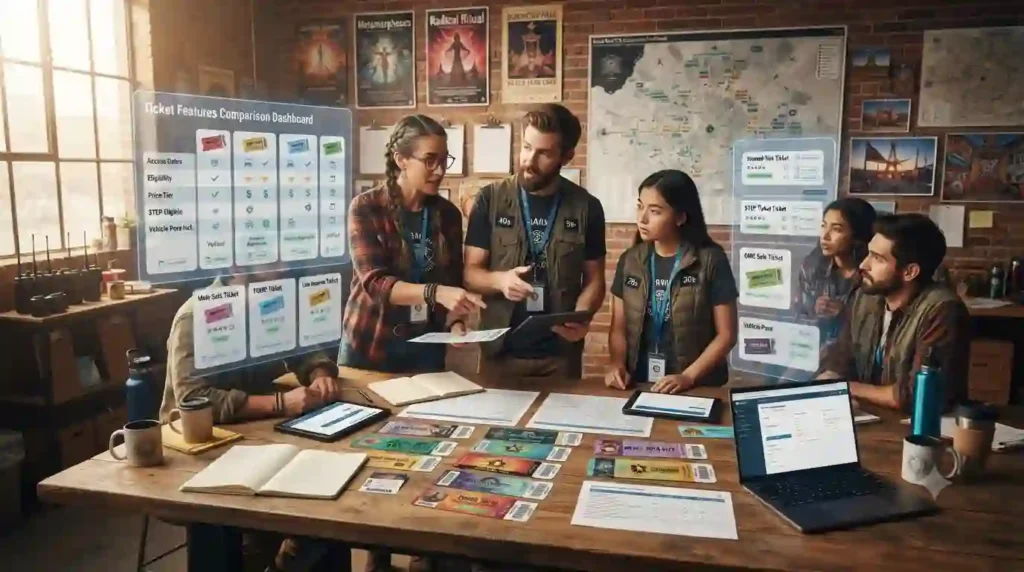
Burning Man runs several distinct ticket sales rather than one general-admission checkout, each with different eligibility and pricing. This guide compares Main Sale, Directed Group Sale, Low Income, and STEP tickets side by side. Use it to decide which sale fits your budget and situation.
With multiple sales running on different dates and different eligibility rules, choosing a ticket path is one of the more confusing parts of Burning Man planning — especially for the roughly one in four attendees arriving for their first Burn. Picking the wrong sale to chase can cost you weeks of waiting for nothing.
This guide compares every official 2026 ticket category: the general Main Sale, the invitation-based Directed Group Sale for theme camps and art crews, the income-qualified Low Income Ticket Program, and STEP, the official post-sale resale exchange. Each is explained with its eligibility requirements and how it fits into the broader sales calendar.
This page is a comparison tool, not a step-by-step purchase guide. For the registration process itself, see the Registration guide; for resale after a missed sale, go to the STEP guide; for income-based pricing, see the Low Income Ticket Program guide.
In This Guide You’ll Learn
- 🎟️ Every official Burning Man ticket type
- 💰 Ticket price categories and what they include
- 👤 Who is eligible for each ticket sale
- 📅 Which ticket sales require prior registration
- 🔄 How invitation-based and public sales differ
- ❤️ Low Income Ticket Program overview
- 🔁 STEP ticket exchange basics
- 🚗 Whether a Vehicle Pass is included
- 💡 Tips for choosing the right ticket
- 🔗 Related guides for every ticket option
What Are Burning Man Ticket Types?
Ticket types are the different admission and access categories Burning Man offers to match people’s roles, budgets, and participation plans. This page explains each kind so you can choose the right ticket before you hunt for a sale.
Understanding the Different Ticket Categories
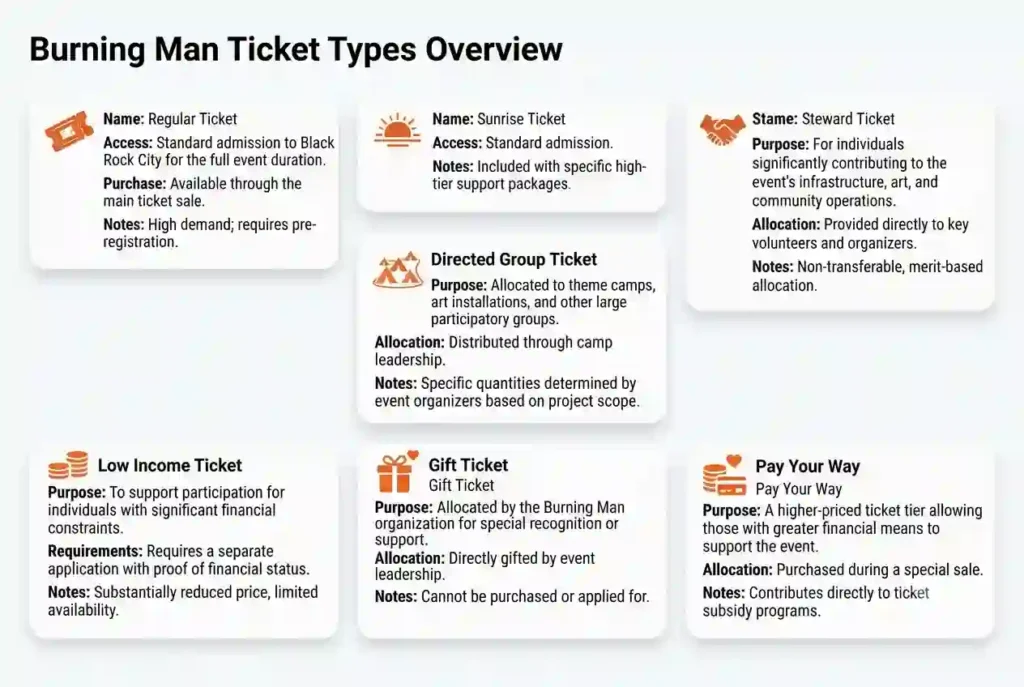
Burning Man segments admission into categories because one-size-fits-all doesn’t work for a participatory city in the desert. The categories include regular (general admission), sunrise or other early-access allocations, stewarding (service-for-ticket), directed group blocks for theme camps and sanctioned projects, subsidized low-income tickets, youth/children tickets, and vehicle passes.
Each type is designed with a purpose: some preserve community functions (steward, directed group), some improve accessibility (low-income), and others manage logistics (vehicle passes). For example, a large art build needs predictable team numbers—hence directed blocks—while a solo traveler without commitments will usually rely on regular tickets and a plan to join a camp or STEP. Knowing each category’s intent helps you avoid buying the wrong product and lets you plan travel, fundraising, or volunteer time accordingly.
Main ticket categories
- FOMO Sale: early access, usually higher cost, and often used by people who want certainty sooner.
- Main Sale: the core ticket sale most Burners watch closely.
- OMG Sale: a later chance for remaining tickets if previous sales do not work out.
- Low Income Program: a reduced-cost option for eligible participants.
- STEP: ticket exchange path that can help people find tickets safely.
- Vehicle Passes: required for all vehicles entering Black Rock City.
- International buyers may need extra planning for timing and payment.
- First-time buyers need a clear, simple step-by-step path.
Why Burning Man Offers Multiple Ticket Types
The event’s operational and cultural goals explain the multiplicity of ticket types. Burning Man is not just a concert; it’s infrastructure, volunteer labor, art grants, and a fragile desert ecology. Multiple ticket types let organizers reserve capacity for artists and volunteers, subsidize access for those with limited means, and limit vehicle load on the playa. Financially, tiered pricing and premium allocations help fund art grants and accessibility programs.
From a community angle, stewarding embeds responsibility into admission—people who sign up contribute to the event’s running. For a reader, the takeaway is practical: if you want to be part of the production or reduce the chance of missing a ticket entirely, target the ticket types aligned with those goals rather than simply chasing the cheapest option.
Who Should Learn About Ticket Types
This guide is for everyone who expects to attend or help others attend: first‑timers figuring out whether to join a camp, theme camp leads balancing rosters, families planning for children, returning burners choosing stewardship, and international travelers who need tickets early for visas.
Even crew leads and coordinators benefit—understanding types reduces confusion when delegating deposits and assignments. If you’re organizing a group, make ticket-type education a short agenda item in your first planning call: it avoids duplicated purchases, late surprises, and friction when payments and roles are discussed.
Choosing the Right Ticket Before Buying
Selecting a ticket type is an early strategic decision. Start by answering three questions: how committed are you to contributing labor or infrastructure, how firm are your travel and schedule constraints, and what’s your budget tolerance?
If you’re volunteering months in advance, stewarding can be cheaper and more reliable. If you’re traveling internationally or coordinating a large group, early allocations (directed blocks or sunrise) reduce uncertainty. If money’s tight, apply for low-income support and combine that with shared camp costs. Making this decision early informs when you should register, which documents to gather, and what backup routes to plan (STEP, camp standby, or FOMO only as a last-resort).
- Ticket types match roles, budgets, and community needs.
- Types exist so the event can fund art, staff safety roles, and maintain accessibility.
- Decide ticket type before chasing sales to avoid mistakes.
- Camps and organizers should brief members on types early.
What Other Burning Man Ticket Types Are Available?
Not every Burning Man ticket comes through the same purchase path. In addition to the main sales and special programs, Burning Man offers several ticket options designed to support different participants, including those who want to pay extra to support the event, purchase at regular face value, or legally give or receive tickets as gifts. Understanding these options helps you choose the right ticket type while avoiding confusion during the buying process.
Ticket Paths: Pay Your Way, Get the Gift, and Give the Gift
Burning Man ticketing is not only about buying a pass to Black Rock City it also reflects different ways people enter the event through money, support, and contribution. Some Burners pay their way through standard sales, while others may get the gift through community support or special access, and some give the gift by contributing labor, service, or participation that helps the event and its camps function.
What Is the Pay Your Way Ticket?
The Pay Your Way Ticket allows participants who are financially able to contribute more than the standard ticket price. By voluntarily paying a higher amount, buyers help support Burning Man’s nonprofit mission, art grants, community programs, and ticket accessibility initiatives. Purchasing a Pay Your Way ticket does not provide VIP benefits or special privileges it simply helps make the event more accessible for others.
- Voluntary higher-priced ticket option
- Supports the Burning Man Project
- Helps fund art, infrastructure, and community programs
- No VIP access or extra event privileges
- Purchased through official ticket sales when available
What Is the Full-Price Ticket?
A Full-Price Ticket is the standard general admission ticket sold at its regular face value. Most participants attending Burning Man purchase this ticket during official sales such as the Main Sale or other designated sales. Full-price tickets provide the same event access as other standard tickets, with no additional perks or restrictions.
- Standard general admission ticket
- Sold at regular face value
- Available through official sales
- Same event access as other standard tickets
- Requires a separate Vehicle Pass if arriving by vehicle
Can You Give a Burning Man Ticket as a Gift?
Yes. Burning Man tickets may be given as gifts, provided the transfer follows the official ticketing rules and platform. Many participants purchase tickets for family members or friends who cannot participate in the original purchase process. Gifting a ticket does not change its validity, but the transfer should always be completed through the official system whenever required.
Best Practices
- Follow the official ticket transfer process
- Verify recipient information carefully
- Keep purchase and transfer records
- Never share ticket screenshots as proof of ownership
- Avoid unofficial transfer methods
Can You Receive a Gift Ticket?
Receiving a gift ticket is perfectly acceptable if the ticket comes from a trusted source and is transferred correctly. Before accepting a gifted ticket, confirm that the transfer has been completed through the official ticket account or authorized transfer process. Buyers should remain cautious of people claiming to offer “gift tickets” while requesting deposits or payment outside official channels.
Safety Tips
- Confirm ownership before accepting
- Verify the official transfer status
- Keep confirmation emails and transaction records
- Be cautious of fake “gift” offers on social media
- Never pay for a ticket advertised as a free gift
Quick Comparison of Ticket Types
| Ticket Type | Purpose | Typical Buyer | Special Benefits |
|---|---|---|---|
| Pay Your Way | Support Burning Man with a higher voluntary payment | Participants who wish to contribute more | Supports nonprofit programs; no VIP benefits |
| Full-Price Ticket | Standard event admission | Most attendees | Regular access to Burning Man |
| Gift Ticket (Giving) | Transfer a ticket to another person | Original ticket holder | Legal transfer when completed correctly |
| Gift Ticket (Receiving) | Accept a transferred ticket | Gift recipient | Same access as any valid ticket |
Key Takeaways
- Pay Your Way tickets help support Burning Man’s nonprofit mission and community initiatives.
- Full-Price Tickets are the standard admission option for most participants.
- Gift Tickets can be legally given or received when transferred through the official process.
- None of these ticket types provide VIP access or special privileges.
- Always use official transfer methods to protect yourself from fraud.
Regular Priced Tickets
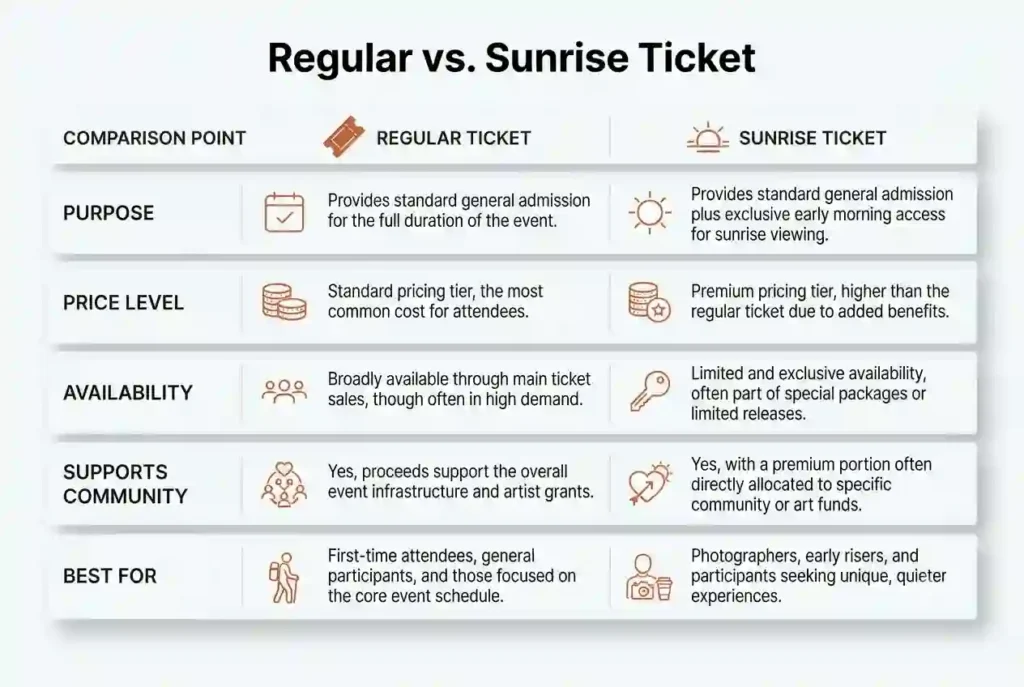
Regular tickets are the standard general‑admission product and the starting point for most attendees. They’re the baseline to compare other ticket options against.
What Are Regular Tickets?
Regular tickets are standard general-admission entries sold in public windows and represent the simplest access model: you buy one ticket per person and that’s your admission. They tend not to include other add-ons like vehicle passes unless a bundle is explicitly offered for that year.
Regular tickets are usually what people buy in the Main Sale or later public releases, and they may be subject to per-account purchase limits to discourage scalping. For many, this is the default path: buy a regular ticket, find a camp or guest spot, and then arrange travel and shared gear. Practical tip: treat a regular ticket like a plane ticket you still need transport, accommodation (camp space), and a gear plan.
Who Can Buy Them?
Generally, regular tickets are available to verified profiles that meet the event’s registration rules. Organizers often require account verification, email confirmation, and possibly identity checks before permitting purchase.
This protects the system from bots and scalpers and ensures tickets go to actual participants. If you’re a first-timer, set up your profile early, link to a camp if you have one, and confirm verification steps are complete well before sale day—many people lose out simply because they missed a small verification step like confirming a phone number.
Ticket Pricing and Availability
Pricing for regular tickets is the base price plus any system fees; yearly fluctuations depend on operational budgets and subsidy programs. Availability is influenced by how many tickets are held back for stewards, directed groups, and low-income allocations. Historically, main sale windows carry the largest quantity of regular tickets, but sellouts can occur within minutes in busy seasons.
To manage expectations, track recent sellout times for main sales and treat any “limited” indicator as a warning: if something shows limited stock, assume it will vanish fast and move to checkout immediately.
Advantages and Limitations
Advantages of regular tickets include simplicity and the broadest availability during main sale windows. You also retain flexibility in choosing a camp or attending solo. Limitations include stiff competition during sales, no special perks or guarantees, and potential disappointment if most tickets are already pre-allocated to other categories.
Another limitation: if you rely on regular tickets but need a vehicle pass or specific camp infrastructure, buying early doesn’t automatically solve those other dependencies—plan those purchases separately.
Who Should Choose Regular Tickets?
Regular tickets suit first-timers, those without camp ties, and flexible attendees who can pivot to STEP or camp guest spots if the main sale doesn’t go their way. They’re also good for local travelers or people who can make last-minute plans. If you’re in a group, designate a single buyer to coordinate purchases and reduce the risk of exceeding per-account limits or triggering fraud holds.
- Regular tickets are the default general-admission option sold in public windows.
- You must verify your profile early to be eligible to buy.
- Expect rapid sellout behavior—prepare payment and backups.
- Ideal for first-timers, solo travelers, and flexible attendees.
Sunrise Sale Tickets
Sunrise tickets provide early access to limited inventory and can ease planning for project leads, returning participants, and other prioritized community members.
What Makes Sunrise Tickets Different?
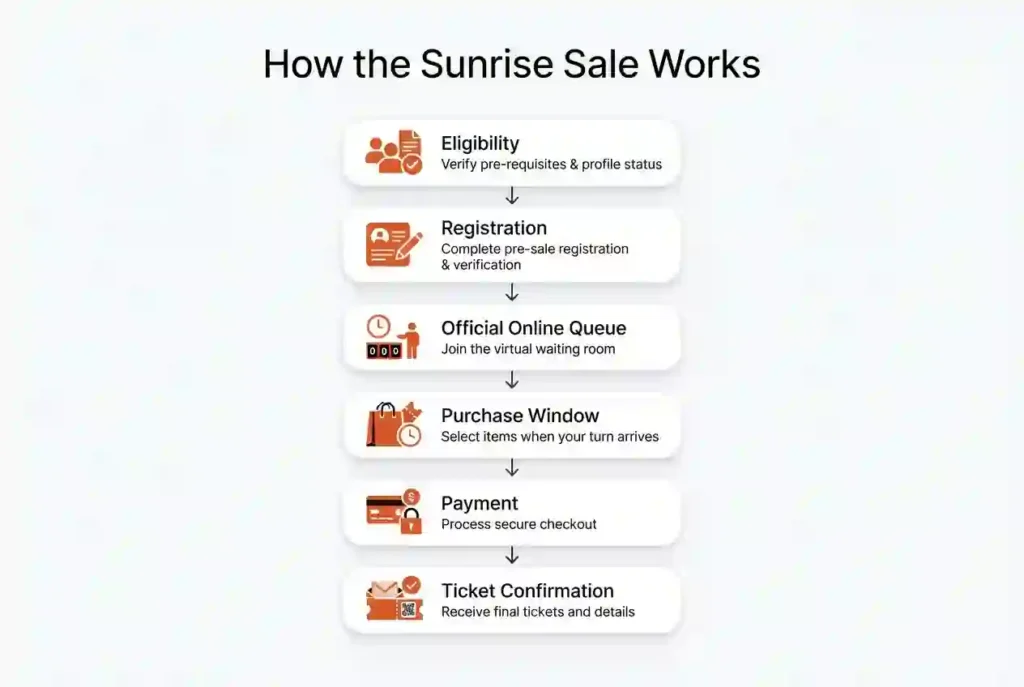
Sunrise tickets are an early-access allocation intended to give priority to those who need logistical certainty—camp leads, artists, or project managers who must secure tickets to coordinate shipping, crew schedules, and build timelines.
Unlike the Main Sale, Sunrise ticket sale supplies are smaller and more targeted; they’re not a guarantee for everyone and usually require proof of eligibility. In practice, Sunrise feels calmer—smaller queues, fewer surprises—but you must meet the criteria to benefit.
Premium Pricing Explained
Sunrise tickets aren’t always more expensive, but sometimes early allocations carry convenience fees or different handling costs depending on how organizers structure revenue. Some years, Sunrise allocations are the same base price as regular tickets but are distributed to a limited eligible pool.
Other years, organizers may apply differential fees to manage demand or redirect revenue to subsidize other programs. Always check the year’s fee structure and whether Sunrise tickets are refundable or transferable, because those rules change and affect real cost and flexibility.
Who Benefits Most From Sunrise Tickets?
Sunrise favors people whose planning depends on early certainty—large art teams, theme camp logistics coordinators, and international travelers who need to confirm flights or visas. For example, if your camp is hauling a 20-foot art installation from across the country, having a block of tickets months in advance prevents last-minute roster surprises and enables locking in transport. If your schedule is flexible and you don’t manage logistics for others, Sunrise might not add value beyond calming nerves.
Advantages and Considerations
Advantages: earlier confirmation, calmer purchasing experience, and alignment with logistics-heavy planning. Considerations: you may need documentation to prove eligibility, Sunrise inventories are limited, and rules (transferability, refund policy) may be stricter. Also, being in Sunrise doesn’t eliminate the need for vehicle passes, camp dues, or other logistical elements; it only secures the admission piece earlier.
Are Sunrise Tickets Worth It?
They’re worth it when the marginal benefit of early confirmation exceeds their extra cost or documentation burden. Calculate the avoided costs—nonrefundable flights, freight deposits, or the value of reduced planning stress—and compare them to any premium you might pay. Many camp leads find Sunrise invaluable because it stabilizes crew lists and budgets; casual attendees with flexible schedules often find Main Sale plus contingencies like STEP is more economical.
- Sunrise gives early access to limited tickets for logistical certainty.
- Eligibility and fee structures can vary—read the rules for the year.
- Best for camp leads, artists, and travelers needing early confirmation.
- Evaluate whether early certainty offsets any premium or limitations.
Steward Sale Tickets
Steward tickets trade service for admission. If you don’t mind rolling up your sleeves and working shifts, stewarding is one of the most reliable and community‑minded ways to secure a Burn ticket.

What Are Steward Tickets?
Steward tickets are admissions allocated to people who sign up for specific operational roles think gate crews, traffic teams, safety, medical support assistants, logistics, and other critical functions. The idea: the event needs people to run safely and smoothly, so in exchange for shifts and training, stewards receive prioritized access or guaranteed tickets.
Steward roles vary in intensity and scheduling: some are full-shift, physically demanding posts; others are lighter, administrative support tasks. When applied well, stewarding creates intimacy with the event’s mechanics—many stewards describe unique backstage moments and deep friendships formed during long shifts.
Who Qualifies For Steward Tickets?
Qualifying typically requires applying to a steward team, passing any role-specific vetting (experience or certifications for medical and safety roles), and agreeing to shift schedules and pre-event trainings. Some steward teams prefer returning members or those with demonstrated track records, while others explicitly recruit new volunteers. Apply early and be honest about your availability; steward coordinators balance skill needs with roster management. Also, check for any prerequisite forms, background checks, or training modules that need completion before your role is confirmed.
How Steward Tickets Support the Community
Stewards are the backbone of the event. They staff gates, direct traffic, assist with lost-and-found, support health and safety operations, and help maintain order in a chaotic environment. By contributing labor, stewards reduce staffing costs and ensure the event’s participatory ethos continues: attendees are not just consumers but contributors. Stewarding often builds community trust and can open doors to future leadership roles in camps and event projects.
Purchase Rules and Limitations
Steward tickets typically tie to the commitment: you may only receive a ticket after you confirm a roster spot or after you complete assigned shifts. Missing shifts or failing to meet training obligations can result in ticket revocation or loss of steward privileges in future years.
Some programs restrict transferability—steward tickets may have name-checks or be non-transferable to discourage casual claims. Read steward program rules carefully: they outline expectations, consequences for no-shows, and how tickets are distributed among team members.
Responsibilities of Steward Ticket Holders
Expect clear, scheduled duties, mandatory pre-event orientations, and accountability. You’ll need to show up on time, represent the organization professionally, and follow safety protocols. Stewarding can be physically demanding (long nights, exposure to dust, standing, and repetitive tasks) and emotionally demanding (dealing with lost or distressed participants).
That said, stewards often get a strong sense of purpose and reward—many say steward shifts create meaningful memories and connections that become the core of their Burn experience.
- Steward tickets are earned through committed shifts and verified roles.
- Eligibility depends on applications, vetting, and training completion.
- Stewards perform essential operational roles and build community trust.
- Missing commitments can lead to ticket revocation or future ineligibility.
Directed Group Sale Tickets
Directed group tickets supply theme camps, sanctioned art teams, and organized projects with predictable ticket blocks so collaborative builds and community installations can be planned and staffed reliably.
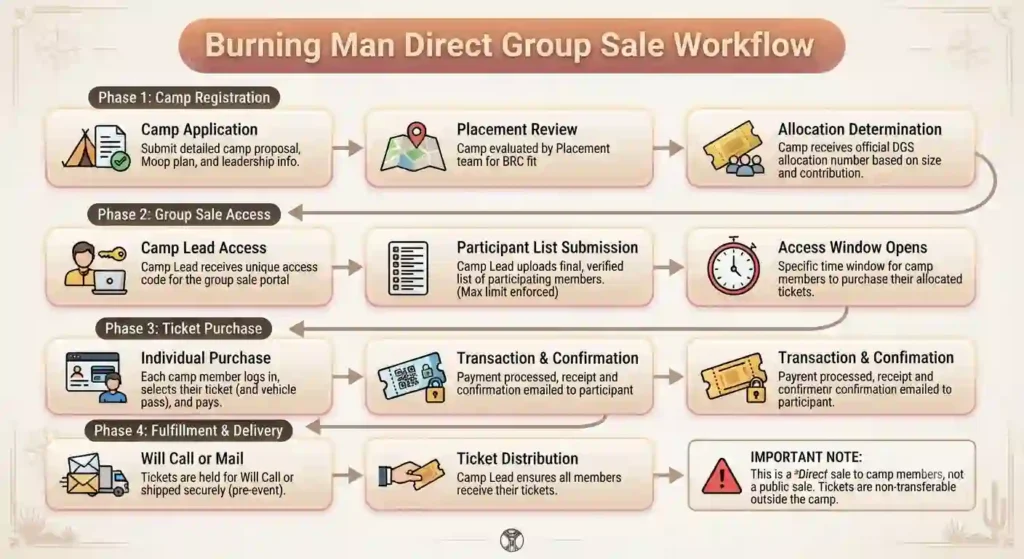
What Are Directed Group Tickets?
Directed group tickets are important because it allows bulk allocations assigned to registered teams theme camps, art projects, production crews—so the group can distribute tickets internally. This makes large projects feasible: a 30-person camp can plan infrastructure, food, and shared transport only when ticket counts are predictable. Directed allocations typically require formal registration of the group and a designated lead who handles distribution and roster management.
How Theme Camps Receive Tickets
Camps apply through the organizer’s camp registration processes and are evaluated on size, track record, safety plans, and community contribution. Leads receive a block based on these factors and may be asked to provide rosters and distribution policies. Camps often collect dues or deposits to manage commitments; those funds help pay for shared infrastructure (shade structures, generators, porta-potties) and reduce last-minute dropouts.
Who Is Eligible For Grouped Tickets?
Eligibility usually goes to established camps with a defined plan, sanctioned projects, and sometimes new camps that meet the criteria. New camps should show a defined leadership structure, a clear contribution to playa culture, and a plan for managing logistics and safety. For fledgling groups, joining a collective or partnering with an experienced camp increases the chance of receiving an allocation.
Group Responsibilities
Camp leads are responsible for accurate rosters, transparent distribution policies, and enforcement of camp rules. Mismanagement—overselling slots, poor communication, or allowing illegal resale—can jeopardize future allocations. Good camps publish an internal policy: who gets priority, payment schedules, and how transfers/refunds are handled. These policies reduce conflicts and ensure reliability in the years to come.
Common Misunderstandings
A frequent false assumption is that directed blocks equal free passes—the lead still controls distribution, and members are expected to contribute time, labor, or dues. Another error is assuming directed tickets are immediately transferrable—some blocks are tied to named rosters or have strict transfer limits. Ask your camp lead about the exact mechanics and deadlines so you can plan payments and travel accordingly.
- Directed group tickets are block allocations for camps and projects.
- Camps must register, justify needs, and manage rosters transparently.
- Leads hold responsibility for allocation, payments, and compliance.
- Clear internal policy reduces no-shows and future allocation risks.
What is Low Income Tickets programm
The Low Income Ticket Program exists to make the Burn more accessible by offering subsidized tickets to people who demonstrate financial need; it’s an essential inclusion tool in the community.
What Are Low Income Tickets?
Low income tickets provide reduced fares or subsidized admission for applicants with financial hardship. They’re not a giveaway but a managed program—people complete an application and supply documents to show need. The program enables wider participation and supports diversity in the community, funded by a mix of donor programs, budgets, and higher-tier ticket revenues in some structures.
Who May Be Eligible For Low Income Ticket Program?
Eligibility generally depends on income thresholds, demonstrated hardship, or other documented circumstances. Each year’s application process defines accepted proof—tax documents, benefit statements, or self-declared need with supporting text.
Applicants should read the program’s requirements carefully and supply honest, clear documentation. Consider timing: application windows close, and late or incomplete applications are typically not considered.
How They Differ From Other Ticket Types
Low income tickets are a programmatic allocation requiring application and often additional administrative steps; they differ from market-driven types (regular, FOMO) and service-driven types (steward). Acceptance into the program may come with conditions limited quantity, non-transferability, and specific pickup or confirmation procedures so plan travel and gear purchases only after your status is confirmed.
Why Low Income Ticket Program Exist?
These tickets are about community stewardship—ensuring the event isn’t only accessible to those with financial resources. They broaden perspectives in the playa community, enabling artists, volunteers, and participants who might otherwise be excluded. Funding for the program often comes from internal budget allocations, donations, or partially from premium ticket revenues—an explicit, community-backed subsidy.
Important Things to Know
The application timeline matters missing deadlines usually disqualifies applicants. Even if accepted, low-income ticket recipients still need to plan for travel, gear, and camp dues. Be prepared for verification steps and know that these tickets sometimes have stricter pick-up or ID procedures. If you plan to apply, gather documents early and prepare a short, honest statement explaining your circumstances.
- Low income tickets increase access via an application-based subsidy.
- Eligibility requires documentation; deadlines are strict.
- Accepted recipients must still plan for travel and camp costs.
- Prepare documents and an honest statement for the application.
Children’s and Youth Tickets
Families and camps with minors need clarity on whether children need tickets, what age rules apply, and how to safely plan for family participation.
Do Children Need Tickets?
Policies vary by event year and organizer. Generally, children above certain ages require tickets, while very young children may be admitted at reduced cost or free. Confirm the event’s current age policy—some years require everyone older than a specified cutoff to hold a ticket, with guardians registering minors under their accounts. If you’re traveling with kids, check whether separate guardian consent forms or emergency medical permission slips are required.
Age Requirements
Age cutoffs can determine ticket costs and are sometimes tied to separate youth pricing bands. For family planners, calculate total costs ahead of time and factor in the logistical impacts of bringing minors—childcare rotations, shade structures, and quieter camp zones. Note that camps vary in whether they accept minors; check camp policies early to avoid last-minute rejections.
Family Ticket Considerations
Beyond tickets, families need safety plans: shade, hydration, a first-aid kit, child-appropriate clothing, and a clear plan for supervision. Camps that accept children usually enforce stricter safety rules and expect parents to be responsible for constant supervision. Factor in additional costs like extra tents, car seats, and family-friendly supplies—these add to the total budget and planning load.
Traveling With Children
Travel logistics with minors require more lead time: passports for international travel, pediatric medical records for healthcare access, and contingency plans for unforeseen illnesses. Consider packing duplicates of critical items and ensuring all caregivers have emergency contact and medical consent information. Also plan for quieter downtime—children need rest away from loud installations and big-night activities.
Important Policies for Families
Organizers typically enforce child-safety rules, and camps may set their own family guidelines. Respect age-restriction policies for certain spaces (e.g., certain art pieces or late-night events). If your camp is family-friendly, coordinate with other families to share childcare duties and create a kid-safe micro-environment within the larger camp.
- Children’s ticket rules vary—confirm current age cutoffs and guardian procedures.
- Families must plan for supervision, safety gear, and extra costs.
- Camps differ in whether they accept minors; confirm ahead of time.
- Bring medical records and consent forms for travel with children.
Vehicle Passes vs Event Tickets
Vehicle passes are separate from event tickets if you plan to bring a car, RV, trailer, or certain service vehicles, you’ll likely need a vehicle pass. This section helps you plan who needs what.
Why They’re Different
Event tickets grant admission to people; vehicle passes grant space and access for a vehicle. Separation is necessary because vehicles impact playa footprint, campsite layout, and environmental management. Vehicle passes help organizers limit the number and type of vehicles on-playa, manage RV-heavy loads, and ensure that infrastructure like vehicle camping zones are properly planned.
When You Need Both
If you arrive in a car or RV with passengers who intend to camp, you need both a ticket for each person and a vehicle pass for the rig. For example, a family driving a minivan to camp would each need individual tickets plus a pass to park and set up. If you’re moving art or heavy gear via truck, you’ll typically need the appropriate vehicle pass and may also need special permits for oversized loads or tow rigs.
When You Don’t Need a Vehicle Pass
If you’ll be arriving by bike, on foot, or being dropped off at the gate (and then walking in), you usually don’t need a vehicle pass. Carpooling with someone who has a pass may work, but confirm official rules about pickups, drop-offs, and shuttle zones—some events limit passenger drop-off areas or require coordinated entry to avoid congestion.
Common Misunderstandings
A major misconception is that one vehicle pass covers multiple vehicles or passengers; it does not. Another is assuming vehicle passes are plentiful—sometimes they sell out separately. Organizers often cap certain vehicle types (RVs, trailers) to control footprint. Also, vehicle passes may have different rules for camping vs. transit; understand whether your pass allows overnight vehicle camping or if it’s transit-only.
Planning Transportation Correctly
Coordinate vehicles with campmates early. Reserve vehicle passes as soon as they are available, and plan for parking, setup time, and vehicle weight limits. If you’re hauling art or large structures, prioritize appropriate permits early and communicate with gate and logistics teams. Finally, build an arrival plan (stagger arrival times, assign drivers) to minimize chaos and stay within the event’s vehicle rules.
- Vehicle passes admit vehicles; tickets admit people—often both required.
- Secure vehicle passes early; they can sell out and have separate rules.
- Pedestrians and cyclists may not need vehicle passes; confirm drop-off rules.
- Coordinate transport, permits, and arrival timing with campmates.
📍 Visual #3 — Ticket vs Vehicle Pass Explained (place after this section)
Which Burning Man Ticket Type Is Right for You?
This block maps common attendee profiles to the ticket types that usually make the most sense—so you can stop second‑guessing and start planning.
Best Ticket for First-Time Burners
First-timers should prioritize regular Main Sale tickets paired with a plan to join a camp or find a confirmed guest spot. The Main Sale gives the broadest access and is where most newcomers secure entry. Practical steps: join camp directories early, volunteer for a small role to become useful, and prepare STEP as a backup.
Anecdote: many first-timers who showed up solo found reliable camps by pitching specific, useful skills (cooking, kid care, shade setup) rather than asking for generic spots—skills make you memorable and welcome.
Best Ticket for Returning Burners
Returning burners should lean on reputation—use camp history, stewarding, or directed allocations if you’re part of an organized crew. Keep your profile current and communicate early with camp leads. If your camp has a block, confirm rosters and deposits on their timeline. Tip: returning burners often get informal priority from camps—offer to coordinate rosters or take on a logistics role to solidify your spot.
Best Ticket for Theme Camp Members
Theme camp members should follow directed group processes: accept the camp’s distribution policy, meet deposit deadlines, and contribute to shared infrastructure planning (shade, power, portos). Good camp governance (published rules, transparent dues, waiting lists) prevents drama and ensures dependable attendance. If you’re a camp lead, run a clear onboarding call for new members and publish the timeline for payments and ticket pickups.
Best Ticket for Budget Travelers
Budget travelers should explore low-income programs if eligible; otherwise, plan shared resources—carpooling, shared gear, and split camp dues. Avoid FOMO unless your financial downside of missing is higher than the premium. Consider volunteer roles that offer reduced-cost tickets or work‑trade opportunities. Financial tip: set up a shared camp spreadsheet with per-person cost breakdowns so no one surprises the group mid-summer.
Best Ticket for International Visitors
International visitors need ticket certainty earlier to secure visas and flights. Aim for directed blocks, stewarding, or budget for FOMO if timing is tight. Buy refundable travel until your ticket is confirmed, and build in visa lead times—consulates can have long processing windows. Travel anecdote: travelers who booked refundable fares and then locked tickets early rarely regret the small fare premium; it saved weeks of stress.
- First-timers: Main Sale + camp or STEP backup; offer specific skills to camps.
- Returners: use history, stewarding, or directed allocations; keep profiles current.
- Camp members: follow camp distribution policies and pay deposits on time.
- Budget travelers: low-income programs, shared costs, or volunteer routes.
- International visitors: secure early, use refundable travel until confirmed.
How Much Do Different Ticket Types Cost?
Ticket price is only part of the expense. This section helps you estimate realistic ranges, what drives price changes, and how to build a total Burn budget.
Understanding Ticket Price Ranges
Expect three broad tiers: subsidized (low-income), base regular price (main public sales), and premium (FOMO, possibly sunrise if fee structures differ). Exact numbers change annually; always quote total price including system fees and taxes. For budgeting, create a conservative estimate (ticket + 15% fees) and an optimistic one (ticket + 10% fees) to account for varying fee schedules.
What Influences Ticket Pricing
Pricing is driven by operating costs (sanitation, safety, infrastructure), subsidy programs (low-income), and demand management strategies (premium pricing to reduce scalping). Organizers may also tweak pricing to fund art grants or environmental programs. Seasonal market factors (post-pandemic demand surges, travel trends) can also affect how aggressively premium pricing is used for FOMO or sunrise allocations.
Budget Planning Tips
Build a spreadsheet with categories: ticket, vehicle pass, travel, camp dues, shared supplies, art/gear, contingency. Assign conservative line items for each—e.g., vehicle pass: $X, camp dues: $Y per person, shared supplies: $Z. Split totals clearly among camp members and set deposit deadlines. Tip: set aside a 10–15% contingency fund for unexpected costs like last-minute FOMO buys, shipping, or equipment failures.
Additional Costs Beyond Tickets
Beyond admission and vehicle passes you’ll likely face camp dues, freight/shipping for large art, generator fuel, ice/water, food, and potential medical or vehicle repairs. Don’t forget insurance for expensive art or vehicles. For international visitors, add visa costs, international travel insurance, and often higher luggage/shipping fees.
Planning Your Total Burning Man Budget
Consolidate all numbers into per-person and total camp budgets, document who pays what and when, and use a shared cloud spreadsheet for transparency. Keep receipts and track reimbursements. Financial friction is the number-one cause of camp disputes; clear documentation and small, enforced deposits solve many headaches.
- Understand three price tiers: subsidized, regular, premium.
- Pricing reflects operational costs, subsidies, and demand strategies.
- Use a shared spreadsheet, assign deposits, and keep a contingency fund.
- Budget for travel, shipping, camp dues, and insurance.
Common First-Timer Ticket Type Mistakes
These are the traps new burners step into—avoid them and you’ll save money, time, and heartache.
Choosing the Wrong Ticket Type
Newbies sometimes buy tickets that don’t match their needs—regular tickets without realizing they need a vehicle pass, or steward tickets without planning to serve. Solution: match your ticket to logistics (vehicle, kids, art), then buy.
Confusing Ticket Types With Ticket Sales
Buying in the wrong sale or missing necessary registration steps is a common pain point. Registration-first, sale-second is the right order. If a ticket type requires an application (low-income) or verification (steward), treat that as the primary deadline.
Assuming Every Ticket Includes a Vehicle Pass
Many people assume admission equals vehicle access—wrong. Vehicle passes are often separate and sometimes limited. If you’re driving, buy the vehicle pass early and coordinate arrival plans with your camp.
Waiting Too Long to Decide
Indecision forces last-minute FOMO which is expensive. Choose a primary plan and a backup, and set a final decision deadline. This prevents panic purchases and keeps the group coordinated.
Ignoring Eligibility Requirements
Low-income and steward tickets have rules—failing to follow them can invalidate applications or tickets. Read guidelines, collect documents early, and follow instructions precisely.
Why Registration Comes Before Choosing Ticket Types
Burning Man registration is the first step toward buying tickets, but registering alone does not guarantee you’ll receive one. Each official sale has its own registration requirements, eligibility rules, and purchasing process.
Before deciding which sale to join, it’s important to understand the different Burning Man ticket types, their pricing, and who they are intended for. Exploring the Ticket Types Guide will help you choose the option that best fits your budget, travel plans, and participation goals before registration opens.
Not Planning the Full Event Budget
Failing to budget for camp dues, shipping, and shared costs is painful. Use a per-person estimate and force small deposits—this aligns incentives and prevents mid-summer dropouts.
- Match ticket type to logistics and read eligibility rules.
- Register and verify before sale day; set decision deadlines.
- Buy vehicle passes separately if driving.
- Budget comprehensively and enforce deposits.
Experienced Burner Tips for Choosing Tickets
These are the tactics seasoned burners use to reduce stress and increase success—straight from the playa trenches.
Match Your Ticket to Your Burn Plan
Be explicit: are you building art, heading to a family-friendly camp, or coming solo? Each path maps to specific ticket types and extras. For builds, prioritize directed blocks; for family camps, confirm child policies and vehicle access.
Understand Every Ticket Option
Read the ticket policy each year—transfer rules, refund windows, and name checks change. Veteran burners keep a short “ticket policy” file so they can reference changes year to year.
Plan for Transportation Costs
Vehicle passes, fuel, shuttles, and parking are a real chunk of budget. If you’re hauling art, check oversized permit requirements early. Consider shared rental trucks to spread costs.
Build a Flexible Ticket Strategy
Layer options—Main Sale first, STEP next, steward or camp standby, then FOMO/OMG as last resorts. Create a decision tree with calendar checkpoints so the group can pivot quickly without panic.
Follow Official Ticket Updates
Official emails and ticket status pages are the authoritative source—bookmark them, and assign someone in your camp to monitor updates. Rumor mills on forums are useful for sentiment but verify via official channels before acting.
- Align ticket choice to your role—builder, family, solo, or camp member.
- Track policy changes and keep a ticket policy file.
- Share transport costs and check oversized vehicle rules early.
- Use a layered strategy and appoint a camp point person for updates.
Burning Man Ticket Types Checklist
A compact checklist to use with your camp. Paste this into your planning doc and check items off as you complete them.
Compare All Ticket Types
Create a simple table comparing regular, sunrise, steward, directed group, low-income, children, and vehicle passes—include cost estimates, eligibility steps, and timelines. Share with camp members so everyone knows the options.
Confirm Eligibility
Verify steward slots, low-income docs, and camp registration early. Collect documents from members and store them in a shared folder. Missing documentation often kills eligibility.
Estimate Your Budget
Sum tickets, vehicle passes, camp dues, shipping, and contingency. Assign deposit and final payment dates. Consider splitting tasks—one person handles travel, another handles financing to streamline organization.
Choose the Right Sale
Decide which sale you’re targeting for each ticket type and set calendar reminders. Assign primary and backup buyers and share credentials securely only with authorized purchasers.
Prepare Before Registration Opens
Create accounts, verify emails/phones, gather IDs, and rehearse the checkout flow. Rehearsing reduces panic and saves seconds that matter during high‑traffic sales.
- Use a shared table to compare options and timelines.
- Collect and store eligibility documents early.
- Assign roles: buyer, finance lead, and camp coordinator.
- Rehearse checkout and set calendar reminders.
FAQs — Burning Man Ticket Types 2026
The Main Sale is usually the most common option, with STEP as a backup if the first round is missed. The best choice depends on budget, timing, and comfort with the process.
FOMO tickets are premium-priced early-access tickets, while Main Sale tickets are the standard public sale option. FOMO gives earlier certainty, but Main Sale is the main route for most Burners.
STEP is Burning Man’s official ticket exchange program for safer buying and selling. It is often used as a backup when the Main Sale or OMG Sale does not work out.
Yes, a Burner can still try other sales if the Low Income Program does not work out. The Low Income option is only one path into Black Rock City.
No, vehicle passes are usually only needed for cars, trucks, and RVs. Bicycles, motorcycles, and some service vehicles may not need one.
DGS stands for Directed Group Sale and usually supports theme camps, art projects, and organized community participation. It is generally tied to contribution rather than open public buying.
Tickets are limited because Black Rock City has a fixed capacity and must follow infrastructure, sustainability, and land-use rules. High demand from the USA and around the world makes the sales more competitive.
A Burner should use official sales, STEP, and verified transfers whenever possible. Fake screenshots, social media fraud, and duplicate tickets are common scam tactics.
Preparation should begin before sale day, well ahead of the ticket windows. This gives time to set up the Burner Profile, understand ticket types, and plan the trip.
A full budget should cover the ticket, fees, vehicle pass, travel, camping supplies, food, water, and survival gear. The ticket is only one part of the real cost of attending.
Where Should You Go Next?
| If You Want To… | Read This Guide |
| Register for ticket sales | → Burning Man Registration Guide |
| Plan Budgeting for burning man | → Budget Guide For Beginners |
| Understand Vehicle Pass requirements | → Vehicle Pass Guide |
| Learn about financial assistance | → Low Income Ticket Program Guide |
| Know about Budget Ticket | → First Timer Ticket Buying Guide |
| Return to the complete overview | → Burning Man Tickets Guide |
Why Trust This Ticket Types Guide?
- ✅ Based on official Burning Man ticket categories and published sale information.
- ✅ Updated for the 2026 event season.
- ✅ Designed for both first-time participants and returning Burners.
- ✅ Explains official ticket options without promoting unofficial resale sources.
- ✅ Links to detailed resources covering registration, exchanges, and ticket security.
Conclusion
Choosing the right ticket type streamlines your logistics and sets a smoother tone for the rest of your Burn planning.
Understanding Ticket Types Helps You Plan Better
Knowing the differences prevents wasted funds and improves coordination—no more surprise fees or missing vehicle passes. This reduces friction and lets you focus on the creative and communal parts of Burning Man.
Choose the Ticket That Matches Your Budget and Goals
Be realistic about time commitments and finances; stewarding or directed blocks can be great but have strings attached. If your priority is flexibility over certainty, regular tickets with backup plans are often the best fit.
Prepare Early for the Best Experience
Early decisions lead to lower stress, better travel deals, and stronger camp cohesion. Use the checklists in this guide, keep shared documents current, and treat ticket selection as the first real camp planning task.
- A smart ticket choice reduces logistical headaches.
- Align type to your goals, budget, and time availability.
- Start early and keep camp documentation up to date.
Final Thoughts
A friendly close and community-minded reminder about tickets and participation.
- 🎟️ Review every ticket type before registration opens.
- 💰 Compare prices, eligibility, and sale requirements—not just availability.
- 📅 Keep track of registration and sale dates for your preferred ticket.
- ❤️ Explore the Low Income Ticket Program if you qualify.
- 🔄 Consider STEP if your preferred sale has ended.
- 🚗 Remember that most participants also need a separate Vehicle Pass.
- 📖 Continue exploring the remaining ticket guides to complete your planning.
Every Burning Man Journey Starts With the Right Ticket
Tickets are the practical and symbolic start of your involvement—treat the process with respect and community awareness. Buying responsibly (through official channels, respecting transfer rules) helps maintain the event’s integrity.
Plan Beyond the Ticket Price
Tickets matter, but your experience is shaped by campmates, supplies, and contributions. Budget and plan for those items to ensure a full, less stressful Burn.
Stay Informed and Buy Through Official Channels
Use official ticket programs, STEP, and sanctioned exchanges. Avoid shady resellers; they risk fraud and invalidation. Keep communication transparent in your camp—shared expectations prevent future disputes.
- Tickets are the gateway—buy responsibly and communicate with your camp.
- Budget and logistics matter more than the ticket itself.
- Use official channels and keep plans transparent.