
Burning Man Ticket Deadlines & Sale Calendar 2026
Burning Man ticket sales occur in distinct phases: Sunrise Sale, Main Sale, Ticket Aid, Stewards Sale, and SHomeTEP. Missing any window means paying more or waiting until next year.
Registration is mandatory before purchase, and the sale access link arrives by email only after completing registration. The Secure Ticket Exchange Program (STEP) is the only safe, face-value resale platform, protecting against scalpers, scams, and inflated third-party prices.
You can pack every gear item, book your RV spot, and plan your camp’s theme—but missing one ticket deadline means you’ll never set foot in Black Rock City. Across the United States—from California and Texas to New York and Florida—and in cities worldwide like London, Toronto, Sydney, Berlin, and Tokyo, thousands of hopeful Burners discover too late that registration closed, sale dates passed, or payment deadlines slipped.
The 2026 Burning Man ticketing process moves fast, involves multiple sales, and demands exact timing, especially when juggling time zones, payment plans, and official resale through STEP. First-timers and veterans alike get confused by Sunrise Sale, Main Sale, Ticket Aid, Stewards Sale, Burner Profile registration, and the Secure Ticket Exchange Program, often missing windows that won’t open again until next year.
This evergreen guide delivers a single, crystal-clear, chronologically ordered master timeline of every ticket deadline, sale date, registration window, payment due date, STEP opening, and critical reminder—built for attendees across all 50 USA states and every corner of the world.
What This Guide Covers
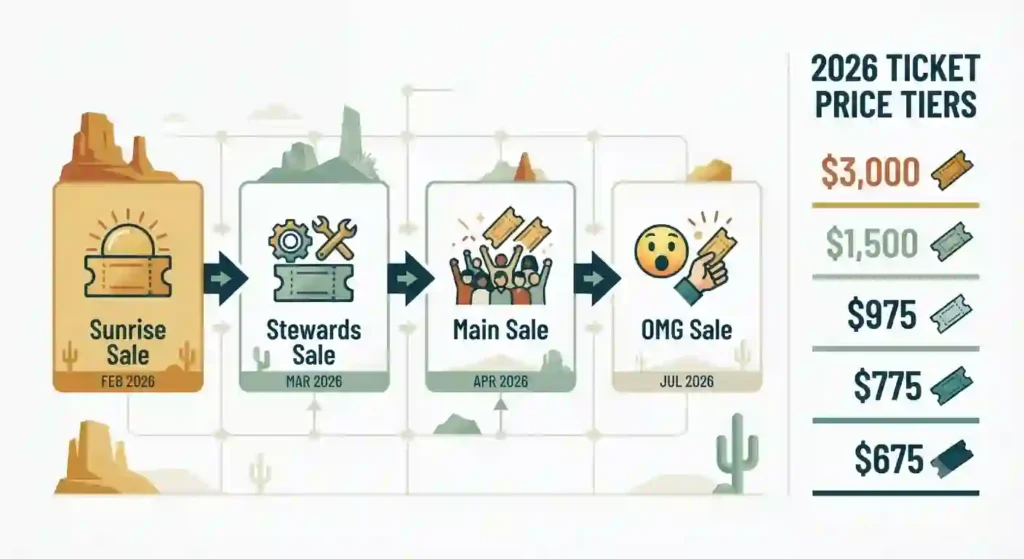
- Sunrise Sale 2026 (early-bird tiered tickets at lowest prices: $675, $775, $975, $1,500, $3,000)
- Main Sale 2026 (general public registration and purchase)
- Ticket Aid & Resilience Program ($250 reduced-price passes for low-income & disaster-affected)
- Stewards Sale (volunteer and theme camp organizer tickets)
- Secure Ticket Exchange Program (STEP) (official face-value resale, opens Mar 18, 2026)
- Burner Profile (account required for ticketing)
- Registration Window (mandatory pre-sale sign-up)
- Sale Date & Time (exact PDT/PST timestamps converted globally)
- Payment Plan Options (installment plans new for 2026)
- Final Payment Deadline (typically July 2026)
- Black Rock City (temporary metropolis in Nevada desert)
- Burning Man Event Dates (August 30 – September 7, 2026)
- Time Zones (PDT/PST for US, EDT/CST/MDT by state, UTC/GMT for Europe, AEST for Australia, JST for Japan)
- MyTickets Portal (account management for typos or changes)
- Face-Value Resale (no scalping, no markup)
- Scalpers & Third-Party Sellers (Craigslist, Facebook, StubHub, Viagogo—high-risk)
- USA States (California, Texas, New York, Florida, Colorado, Oregon, Washington, Nevada, Arizona, Illinois, Pennsylvania, Ohio, Georgia, North Carolina, Michigan, Massachusetts, New Jersey, Virginia, Minnesota, Wisconsin, Missouri, Tennessee, Indiana, Maryland, South Carolina, Alabama, Louisiana, Kentucky, Oklahoma, Connecticut, Iowa, Mississippi, Arkansas, Kansas, Utah, Idaho, New Mexico, Nebraska, West Virginia, Maine, Hawaii, New Hampshire, Vermont, Rhode Island, Delaware, Montana, North Dakota, South Dakota, Wyoming, Alaska)
- International Attendees (UK, Canada, Australia, Germany, France, Netherlands, Japan, Brazil, Mexico, South Africa, New Zealand, Italy, Spain, Sweden, Norway, Denmark, Finland, Switzerland, Austria, Belgium, Ireland, Poland, Portugal, Greece, Czech Republic, Hungary, Romania, Bulgaria, Croatia, Slovenia, Slovakia, Estonia, Latvia, Lithuania, Iceland, Luxembourg, Malta, Cyprus, Uruguay, Chile, Argentina, Colombia, Peru, Ecuador, Venezuela, Costa Rica, Panama, Guatemala, Honduras, El Salvador, Nicaragua, Belize, Haiti, Dominican Republic, Jamaica, Trinidad & Tobago, Bahamas, Barbados, Kenya, Nigeria, Ghana, Egypt, Morocco, Tunisia, Algeria, Saudi Arabia, UAE, Qatar, Kuwait, Bahrain, Oman, Jordan, Lebanon, Israel, Turkey, Iran, Iraq, Pakistan, Bangladesh, India, Nepal, Sri Lanka, Myanmar, Thailand, Vietnam, Cambodia, Laos, Malaysia, Singapore, Indonesia, Philippines, South Korea, Taiwan, Hong Kong, Macau, China, Russia, Ukraine, Belarus, Kazakhstan, Georgia, Armenia, Azerbaijan)
- First-Timers & Veteran Burners (distinct needs for each group)
- RV & Camp Registration (vehicle and group logistics)
- Email Access Link (sale invitation sent post-registration)
- Virtual Queue (online waiting room on sale day)
What Are Burning Man Ticket Sales?
Burning Man ticket sales are the organized process through which event organizers allocate admission to a limited-capacity gathering in the Black Rock Desert. Tickets are distributed across several themed sales windows and allocation methods designed to balance fairness, operational needs, and community priorities.
Understanding the sales system reduces confusion, helps you choose the best path to attendance, and prepares you for the logistical steps registration, verification, purchase, and post-purchase planning that follow.
Understanding the Burning Man Ticket Sale System
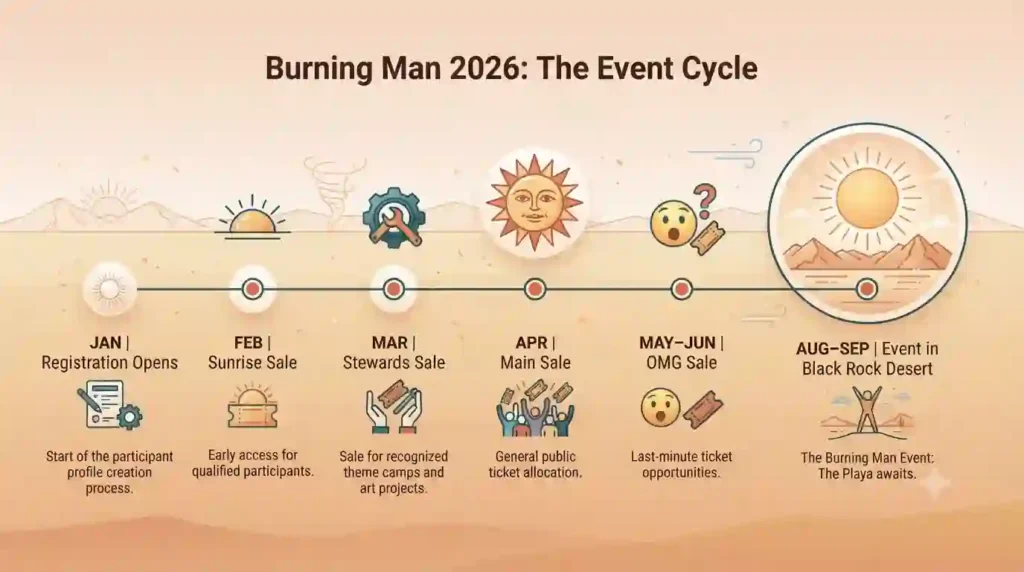
The ticket sale system is a layered mechanism that separates eligibility (registration) from actual purchase opportunities. Organizers use registration to confirm identities, camp affiliations, and community roles, which allows them to reserve allocation blocks and prevent scalping. Sales are run in batches some targeted (stewards, theme camps, directed groups), others open to the public (main sale, OMG) and the infrastructure includes virtual queues, timed purchase windows, and payment verification.
Operationally, this system reduces on-site overcrowding, ensures certain community functions are staffed, and provides predictable revenue to cover safety, sanitation, art grants, and logistics. Practically, this means you must treat registration and account setup as first-order tasks; a missing or incomplete profile can disqualify you from several sales even if you have funds ready on sale day.
Why Burning Man Uses Multiple Ticket & Sales Types
Burning Man operates on a community-first model designed to prioritize accessibility, support artists, theme camps, and volunteers, and ensure fairer ticket distribution across all attendee types. Unlike typical festivals that sell everything in one rush, Burning Man spreads sales across Sunrise Sale, Main Sale, Ticket Aid, Stewards Sale, STEP, and OMG Sale to give low-income attendees, disaster-affected individuals, volunteers, theme camp organizers, and artists priority access.
Multiple ticket type & sale type system prevents scalpers from buying out inventory, reduces bots overwhelming a single sale, and ensures tickets reach the people who actually build Black Rock City not just those with the fastest mouse or deepest pockets.
How Ticket Demand Exceeds Supply
Demand typically outpaces supply because Burning Man enforces a firm cap on attendance to protect the environment and ensure safety. Worldwide interest has expanded over the years: returning participants who prioritize continuity, newcomers drawn by Burning Man’s cultural cachet, and travelers seeking unique festival experiences. Added pressures come from theme camps and art projects that require multiple tickets for teams, and international travelers who need certainty to book flights.
The result: multiple sales sell out quickly, especially the main sale and any early-access events. Recognizing this reality helps you set realistic expectations and motivates contingency planning—register early, align with a camp, and have fallback options like STEP or stewarding.
Who Can Participate in Different Sales
Eligibility varies by sale type. General public sales typically require a completed registration profile and local payment capacity; steward and directed group sales require proof of commitment to shifts or camp roles; theme camp members rely on internal allocations from their camp leads; and premium sales may be open to anyone willing to pay higher prices without strict registration prerequisites.
Important nuances: some sales favor returning burners who have a history with the community, while others create pathways for first-timers through outreach or low-income programs (covered elsewhere). To identify your eligible sales, assemble documentation beforehand camp affiliation emails, volunteer confirmations, and a verified Burner profile and keep copies of confirmations close at hand during sale windows.
Choosing the Right Sale for Your Situation
Choosing means matching your constraints—time, budget, community ties to sale types. If you’re a first-timer with no camp, prioritize the main sale and join online camp directories early. If you’re deeply embedded in a theme camp, follow camp-directed allocations and deadlines. If you need certainty because of international travel, consider stewarding or early allocations even if it requires shift commitments.
Last-minute travelers should weigh FOMO or OMG tickets while budgeting for higher prices. Think in terms of probabilities: some routes (directed group, steward) offer higher certainty but require commitments; others (main, OMG) are more lottery-like. Making a decision tree—your role, deadlines, likely sale choice, backup—improves your chances and reduces wasted time.
- The system separates registration (eligibility) from purchase—both matter.
- Multiple sales balance fairness, finances, and logistics.
- Demand outstrips supply due to caps, returning participants, and group needs.
- Eligibility differs by sale; prepare documentation and verify profiles.
- Match sale choice to your profile, commitments, and travel constraints.
Complete Burning Man Ticket Sale Timeline
A clear timeline is essential because ticket opportunities and requirements unfold over many months. Knowing when to register, when each sale usually occurs, and which deadlines are firm allows you to synchronize travel planning, camp coordination, and financial arrangements. Timelines also reveal natural checkpoints when to confirm camp rosters, when to apply for steward positions, and when to expect potential leftover releases so you can act efficiently rather than reactively.
Registration Periods
Registration periods are windows when you create and verify your Burner profile, add camp affiliations, and upload any necessary documents. These windows are often time-limited ahead of specific sales and may require email or identity verification steps.
Because registration is the gate to most sales, plan to complete it early: pick a stable internet connection day, have a government ID ready if needed, and confirm your email/phone. Some years include “rolling” verification where profiles remain valid across seasons—keep track of whether your profile is current and whether you need to re-verify for the upcoming year.
Sale Dates Throughout the Year
While exact dates change annually, the sale calendar follows a rough cadence: early-year registration and steward sign-ups, a main public sale in late spring, several staggered follow-ups (OMG, FOMO, stewardship confirmations) later in the season, and last-minute releases close to the event.
Regional or directed group sales may occur separately per camp schedules. Bookmark the official calendar and set multiple reminders one month prior, one week prior, and on the sale morning so you’re not caught by surprise. Also monitor community channels; changes to sale dates or added release windows sometimes appear via email or social media before they’re widely noted elsewhere.
Important Registration Deadlines
Deadlines can include registration close dates, deadlines to claim steward shifts, final date to submit camp rosters for directed allocations, and cutoff dates for low-income or accessibility programs. Missing these can disqualify you from preferred sales or shift you into more competitive later windows. Use a shared calendar if you’re coordinating with a camp assign one person to be the timeline keeper and checklists to verify every team member has completed their tasks before deadlines.
Planning Your Ticket Strategy
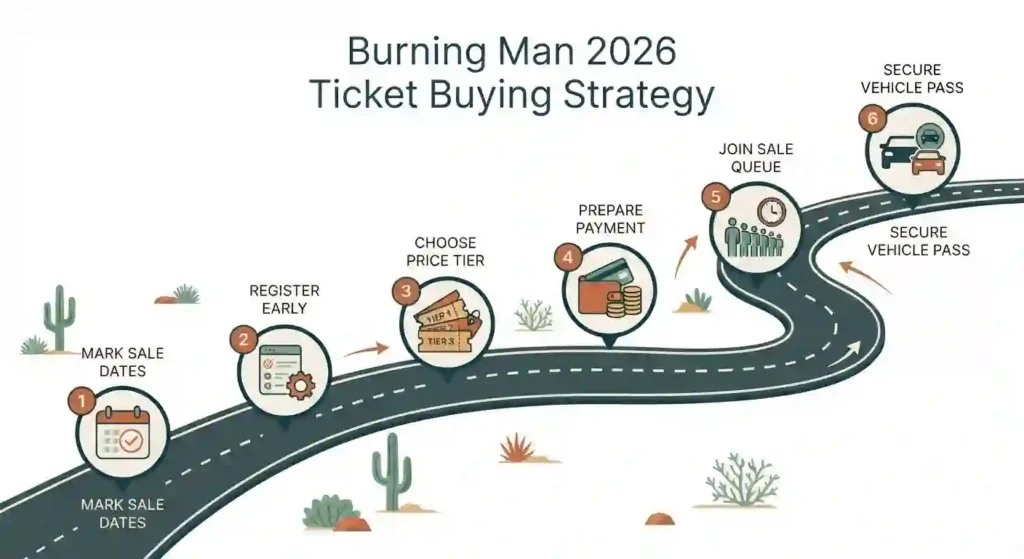
Building a ticket strategy means sequencing actions: register and verify profiles early, coordinate with camp leads on rosters and payments, set financial buffers for premium sales, and prepare a backup plan such as STEP or stewarding. Create a simple spreadsheet with columns for sale type, registration status, required documents, key dates, and a priority ranking (primary, secondary, fallback). Assign deadlines for each step and treat them as non-negotiable. For international travelers, factor in visa timelines and refundable travel bookings until ticket confirmation.
Key Dates to Remember
Evergreen key dates include registration open/close, main sale day, steward sign-up deadline, directed group allocation notification, FOMO/OMG release windows, and vehicle pass sale dates. These anchor points recur in some form each year, even if exact dates shift. Use them to structure your planning months in advance set alerts three months, one month, and one week ahead. Include expected travel and visa lead times in your calendar so ticket decisions feed directly into your logistics planning.
- Timeline awareness prevents missed opportunities and coordination issues.
- Complete registration early and treat verification as crucial.
- The sale year follows a known cadence—track calendar and community channels.
- Use shared calendars and checklists for camp coordination.
- Include travel/visa timelines in ticket planning.
Understanding Burning Man Ticket Sale Terminology
The ticket process includes specific terms that frequently appear in official materials and community conversations. A clear grasp of this vocabulary removes confusion when instructions arrive and helps you interpret live sale events and email updates correctly.
Registration vs Sale Day
Registration is the preparatory step where you create an account, fill in personal info, add camp or volunteer roles, and validate identity or contact methods. Sale day is when the transaction window opens and payments are processed; it may include virtual queues and strict time limits. Missing registration or failing to verify your profile can block you from entering the sale even if you have funds. Think of registration as getting on the guest list; sale day is stepping up to the box office to buy a ticket.
Ticket Queue
The ticket queue is a virtual waiting room that manages traffic during high-demand sales. Queues often assign randomized or prioritized positions, display estimated wait times, and refresh availability in batches. Factors affecting queue position include server load, cookies/session data, and whether you followed pre-sale steps correctly. When in queue, avoid actions that can dislodge your session don’t close the window, avoid heavy manual refreshes, and ensure your device/connection is stable. If the system offers a queue token or time-based hold, record details shown in the interface.
Purchase Window
The purchase window is the short, defined interval when the sale completes transactions. During this time, your cart must be finalized, payment authorized, and any identity checks passed. Payment failures, bank declines, or exceeded credit limits during purchase windows often result in lost tickets, not delayed processing—have backup cards ready and confirm with your bank if large purchases may be flagged. Familiarize yourself with the site’s countdowns and be ready to follow error prompts quickly; often, restarting the transaction may be needed if an auth fails.
Ticket Allocation
Allocation describes how a finite ticket supply is partitioned across categories—public sales, reserved blocks for stewards/camps, holdbacks for organizers, and contingency reserves. Allocation strategies change yearly based on operational needs and community agreements. Understanding allocation helps set realistic expectations: even vigorously prepared buyers may face limited availability if most tickets are pre-allocated. Organizers may release previously reserved tickets in later windows, so keep monitoring, especially during OMG or last-minute drops.
Ticket Availability
Availability displays range from “available” to “sold out” and includes intermediate states like “limited” or “queued waitlist.” Live availability can change rapidly as transactions finalize; conservative approaches assume that “limited” will disappear quickly. Tools like browser alerts, community trackers, and status pages help, but rely primarily on official indicators and confirmations. If a purchase completes, save confirmations immediately and verify your ticket appears in your profile dashboard or email record.
- Terminology clarifies what actions are needed and when.
- Registration gets you eligible; sale day is when funds and payment mechanics matter.
- Queues and purchase windows require technical readiness and calm responses.
- Allocation shows why tickets may be scarce even during public sales.
- Monitor official availability indicators and save confirmation records.
The System Behind Black Rock City Access
Burning Man operates on a community-first model designed to prioritize accessibility, support artists, theme camps, and volunteers, and ensure fairer ticket distribution across all attendee types. Unlike typical festivals that sell everything in one rush, Burning Man spreads sales across Sunrise Sale, Main Sale, Ticket Aid, Stewards Sale, STEP, and OMG Sale to give low-income attendees, disaster-affected individuals, volunteers, theme camp organizers, and artists priority access. This system prevents scalpers from buying out inventory, reduces bots overwhelming a single sale, and ensures tickets reach the people who actually build Black Rock City not just those with the fastest mouse or deepest pockets.
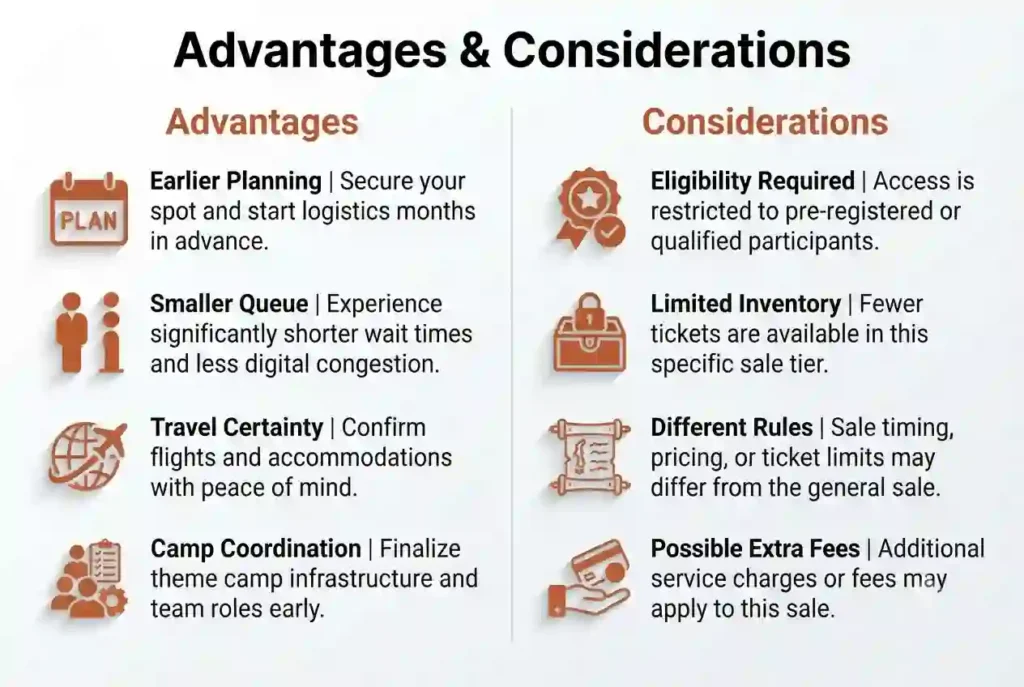
What’s the Real Difference Between Registration and Actually Buying Tickets?
This is the most important beginner explanation for Burning Man ticketing: Registration window = permission phase, Sale date = actual purchase attempt. Filling out registration doesn’t guarantee you a ticket it only grants you permission to enter the virtual queue on sale day. Missing registration means no access link arrives in your email, so you can’t even attempt to buy.
Think of it like your child’s school admission form: filling the form doesn’t mean admission is guaranteed it only allows participation in the process. You still need to wait for the selection, then act fast when your turn comes. For Burning Man, you register first (Jan 26–Feb 3 for Sunrise, Apr 20–29 for Main), then on sale day (Feb 4 or Apr 29), you click the email link, join the queue, and try to purchase. No registration = no link = no ticket, period.
Why Are Burning Man Deadlines Extremely Strict Compared to Normal Event Tickets?
Burning Man deadlines are extremely strict because of the queue system, timed payment links, auto-cancelled carts, ticket transfer deadlines, and shipping restrictions. Once you join the virtual queue, you’re assigned a spot—if you don’t complete purchase within the time limit (usually 10–15 minutes), your cart auto-cancels and the ticket goes to the next person. Payment links are timed and unique, expiring if not used immediately.
Ticket transfer deadlines mean you can’t sell or give tickets after a certain date (typically 30 days before the event). Shipping restrictions mean physical tickets must arrive by a hard deadline no exceptions for delays. Miss a deadline by minutes, and you’re out. This rigidity protects against scalping, bots, and last-minute chaos, but it demands precision from attendees across all USA states (California, Texas, New York, Florida, Colorado, Oregon, Washington, Nevada, Arizona, Illinois, Pennsylvania, Ohio, Georgia, North Carolina, Michigan) and international locations (UK, Canada, Australia, Germany, France, Japan, Brazil, Mexico).
How Burning Man Ticket Sales Actually Work
- Community-first model: Prioritizes artists, theme camps, volunteers, and low-income attendees over profit
- Accessibility goals: 5,000+ tickets at $250 via Ticket Aid, Resilience Program for disaster-affected
- Multiple sales: Sunrise, Main, Ticket Aid, Stewards, STEP, OMG—each serving different groups
- Fairer distribution: Prevents scalpers from buying out inventory in one rush
- Registration ≠ Purchase: Registration grants permission; sale day is the actual purchase attempt
- Real-life analogy: Like school admission form—filing doesn’t guarantee acceptance, only entry to the process
- Missing registration = no access link: You can’t buy without completing registration first
- Queue system: Virtual waiting room assigns spots; no skipping, no early entry
- Timed payment links: Unique, expiring links—must complete purchase within 10–15 minutes
- Auto-cancelled carts: If you don’t pay in time, ticket goes to next person instantly
- Ticket transfer deadlines: No selling/transferring after ~30 days before event
- Shipping restrictions: Physical tickets must arrive by hard deadline, no exceptions
- Target audience: First-timers, veterans, USA attendees (all 50 states), international Burners (UK, Canada, Australia, Europe, Asia, South America)
“Burning Man isn’t bought—it’s earned through preparation. The desert rewards those who respect the system, not those who try to hack it.”
Master Blueprint of Ticket Sales
Burning Man ticketing doesn’t work like normal festivals there’s no walk-up purchase, no ticket booth at the door, and no second chance if you blink. Missing one registration window can block your access entirely, leaving you outside the gates while thousands walk through Black Rock City.
When do tickets actually go on sale, and what happens if you miss even one registration window?
Many first-time Burners confuse registration dates, sale dates, STEP dates, and payment deadlines, assuming they’ll figure it out later. This page acts as a master calendar, planning system, and yearly-updated ticket hub for attendees across the USA from California, Texas, New York, Florida, Colorado, Oregon, Washington, Nevada, Arizona, Illinois, Pennsylvania, Ohio, Georgia, North Carolina, and Michigan to international Burners in the UK, Canada, Australia, Germany, France, Japan, Brazil, Mexico, and beyond.
Why Does This Ticket Deadline Guide Matter More Than Any Other Festival Timeline?
Because Burning Man ticketing works differently from normal festivals. There’s no general admission line, no last-minute availability, and no forgiving grace period. Missing one registration window can block your access entirely you won’t receive the email access link, you won’t enter the virtual queue, and you won’t buy a ticket. Many first-time Burners confuse registration dates (when you sign up), sale dates (when you purchase), STEP dates (when official resale opens), and payment deadlines (when full balance is due). This page acts as your master calendar, planning system, and yearly-updated ticket hub so you never miss a critical moment again.
What Timeline Cover from Start to Finish?
This comprehensive timeline covers every critical sale and deadline: Sunrise Sale (early-bird tiered tickets at $675–$3,000), Main Sale (general public registration and purchase), Ticket Aid Program ($250 reduced-price passes for low-income attendees), STEP resale system (official face-value resale opening Mar 18, 2026), Stewards Sale (for volunteers and theme camp organizers), OMG Sale (opportunistic last-chance sale if tickets remain), Payment plans (new for 2026, final due July 2026), Shipping deadlines (when physical tickets arrive), Will Call dates (when box office pickup opens), Box Office timing (on-site ticket window hours), Registration windows (mandatory pre-sale sign-up periods), Vehicle pass timelines (RV, car, bike passes), and Important email reminders (sale access links, payment confirmations, expiration notic
Why Do International Travelers Miss Deadlines?
Burning Man uses Pacific Time (PT) exclusively specifically PDT (Pacific Daylight Time) during the sale period. Many international travelers and even US attendees from Eastern, Central, or Mountain time zones miss deadlines because of time zone conversion errors. A 12pm PDT sale means 3pm EDT (New York, Florida), 2pm CDT (Texas), 1pm MDT (Colorado, Arizona), 8pm BST (London), 9pm CET (Berlin, Paris), and 5am AEST next day (Sydney, Melbourne). One miscalculation and the registration window closes before you know it.
🔑 Burning Man 2026 Ticket Deadlines
- Burning Man ticketing is unique: No walk-up sales, no door tickets, no forgiveness for missed deadlines
- Registration is mandatory: You must sign up before purchase to receive the email access link
- Five distinct sales: Sunrise Sale, Main Sale, Ticket Aid, Stewards Sale, STEP (plus OMG Sale if tickets remain)
- Time zone matters: All sales use Pacific Daylight Time (PDT)—convert carefully for your USA state or country
- Payment plans available: New for 2026, split costs with final payment due July 2026
- STEP is safest resale: Only official face-value platform, opens Mar 18, 2026, closes ~1 week before event
- Critical deadlines: Registration windows, sale dates, payment due dates, shipping deadlines, Will Call dates, Box Office timing, vehicle pass timelines
- Target audience: First-timers, veterans, USA attendees (all 50 states), international Burners (UK, Canada, Australia, Europe, Asia, South America, Africa)
“The desert doesn’t wait for anyone. In Black Rock City, timing isn’t just everything—it’s the only thing that separates those who experience the magic from those who watch from the sidelines.”
Sunrise Sale First Shot at the Lowest Burning Man Ticket Prices
The Sunrise Sale is the first major ticket sale of the year for Burning Man 2026, offering a tiered pricing model that ranges from $675 to $3,000. This sale exists to support lower-income Burners through cross-subsidization—when someone buys a higher-tier ticket, it helps fund the $675 “Get the Gift” tier for those who need affordability.
⏰ Timing
January (early access phase)
💰 Price
Higher than standard tickets
🎟 Availability
Limited but less competition
👤 Best For
Serious attendees who want guaranteed entry
🔴 Status
Now Closed
For early planners across the USA (California, Texas, New York, Florida, Colorado, Oregon, Washington, Nevada, Arizona, Illinois, Pennsylvania, Ohio, Georgia, North Carolina, Michigan) and international attendees (UK, Canada, Australia, Germany, France, Japan, Brazil, Mexico), this is the best chance to secure tickets at the lowest prices before costs rise in the Main Sale. Missing Sunrise Sale means paying at least $100 more per ticket later.
What Is the Sunrise Sale and Why Does It Exist?
The Sunrise Sale is the first major ticket sale of the year and the only sale with tiered pricing starting at $675. It operates on a cross-subsidization model: higher-tier tickets ($1,500 and $3,000) subsidize lower-cost tickets ($675 and $775), directly supporting lower-income Burners who couldn’t otherwise afford participation.
This sale rewards early planners who register early, prepare payment methods, and act fast on sale day. Unlike normal festivals where prices only go up, Burning Man’s Sunrise Sale offers the best chance for early planners to lock in the lowest prices while simultaneously supporting accessibility. For first-timers, veterans, RV owners, theme camp members, and international Burners, this is the golden window—prices increase in the Main Sale, and no tiered pricing returns afterward.
When Does Sunrise Sale Registration Open and Close for 2026?
Registration is mandatory—you must complete this step before sale day to receive the email access link. The window stays open for 9 days, giving attendees across all USA time zones (PDT, MST, CST, EDT) and international locations (GMT, CET, AEST, JST) plenty of time to sign up. Missing the Feb 3 deadline means you can’t buy in Sunrise Sale—you’ll have to wait for Main Sale registration (Apr 20–29) and pay higher prices. Set a calendar reminder for Jan 26, complete registration immediately, and confirm you receive the confirmation email.
| Event | Date |
|---|---|
| Registration Opens | Jan 26, 2026 |
| Registration Closes | Feb 3, 2026 @ 12pm PDT |
What Time Does the Sunrise Sale Actually Start on Sale Day?
Feb 4, 2026 @ 12 PM PDT (Pacific Daylight Time)
This translates to:
- California, Oregon, Washington: 12pm PST (noon)
- Colorado, Arizona: 1pm MST
- Texas: 2pm CST
- New York, Florida: 3pm EST
- UK (London): 8pm GMT
- Germany, France: 9pm CET
- Australia (Sydney): 5am AEST (Feb 5)
- Japan (Tokyo): 4am JST (Feb 5)
- Brazil (São Paulo): 6pm BRT
- Canada (Toronto): 3pm EST
Mark this in your calendar in your local time, not just PDT. One time zone mistake and the sale closes before you know it.
What Are the Sunrise Ticket Pricing Tiers and Which Should You Buy?
The Sunrise Sale features five pricing tiers designed to support accessibility while offering options for different budgets:
| Tier Name | Price | Who Should Buy |
|---|---|---|
| Get the Gift | $675 | Low-income, first-timers on tight budget |
| Give the Gift | $775 | Base tier, most common purchase |
| Mid-tier Support | $975 | Medium budget, want to support accessibility |
| Higher-tier Support | $1,500 | Comfortable budget, actively subsidizing others |
| Premium Support | $3,000 | High budget, maximizing support for low-income Burners |
The $675 tier (“Get the Gift”) is the absolute lowest price available anywhere in the ticketing system. The $775 tier (“Give the Gift”) is the standard base price. Buying $975, $1,500, or $3,000 directly subsidizes the $675 tickets for low-income attendees. For international Burners dealing with currency conversion (GBP, EUR, AUD, JPY, BRL), the $775 base tier often makes the most sense. For USA attendees in high-cost states (California, New York, Massachusetts), consider the $1,500 tier to support accessibility while locking in early pricing.
How Do Payment Plans Work During Sunrise Sale and Why Do They Help?
New for 2026, installment payments are available starting with the Sunrise Sale. Instead of paying the full amount upfront, you can split the cost into monthly payments with the final payment due around July 2026. This offers budgeting benefits for first-timers, families, RV owners, and anyone on a tight income. The monthly payment concept means you secure your ticket in February but pay over 5–6 months, reducing financial stress.
Why payment plans help international Burners: Currency fluctuations, exchange rate fees, and banking restrictions make large upfront payments difficult for attendees from the UK, Canada, Australia, Germany, Japan, Brazil, and Mexico. Payment plans let them lock in USD pricing early while paying gradually, avoiding sudden exchange rate spikes. For USA attendees in states with high cost of living (California, New York, Florida, Texas), payment plans smooth out expenses across multiple paychecks. Just remember: final payment deadline is typically July 2026—miss it, and your ticket cancels automatically.
What Are the Essential Sunrise Sale Survival Tips to Guarantee Success?
- Fast internet: Use wired Ethernet or strong Wi-Fi (5GHz preferred); avoid public networks
- Multiple devices: Log in on laptop, phone, and tablet simultaneously—more entry points to the queue
- Logged-in Burner Profile: Ensure you’re signed in to your Burner Profile before sale day; test login 24 hours early
- Browser preparation: Use Chrome or Firefox, clear cache, disable extensions, open sale link in 3–4 tabs
- Email monitoring: Watch inbox (and spam folder) for the sale access link sent 24–48 hours before Feb 4
- Time zone double-check: Confirm sale time in your local time (PDT → EDT/CST/MDT/GMT/AEST/JST)
- Payment method ready: Have credit card saved in profile; verify billing address matches card
- Queue patience: Virtual queue can take 30–90 minutes; don’t refresh or close the tab
- Speed at purchase: Once in, complete purchase within 10–15 minutes or cart auto-cancels
- Target audience: First-timers, veterans, USA attendees (all 50 states), international Burners (UK, Canada, Australia, Europe, Asia, South America)
“The Sunrise Sale is where dreams become plans. Those who register early, prepare wisely, and act fast are the ones walking through the archway when the sun rises on Black Rock City.”
Main Sale Your Last Best Chance for General Admission Tickets
What exactly is the Main Sale and why is it the most competitive ticket window for Burning Man 2026? The Main Sale is the largest public sale for Burning Man, offering the most competitive sale environment with thousands of attendees competing for limited tickets. It’s the primary general-admission opportunity for first-timers, veterans, and international Burners who missed Sunrise Sale or need another chance.
Unlike Sunrise Sale’s tiered pricing, the Main Sale starts at $775 base price with fewer discounts. For attendees across the USA (California, Texas, New York, Florida, Colorado, Oregon, Washington, Nevada, Arizona, Illinois, Pennsylvania, Ohio, Georgia, North Carolina, Michigan) and international locations (UK, Canada, Australia, Germany, France, Japan, Brazil, Mexico), this is the make-or-break moment if you miss this, your options shrink to Ticket Aid, STEP resale, or waiting until 2027.
🔥 Main Sale – Key Details
| Feature | Details |
|---|---|
| 📅 Timing | April 29, 2026 (Noon PT – until sold out) |
| 📝 Registration | April 20 – April 27, 2026 |
| 💰 Ticket Price | $575 – $1,500+ (varies by tier) |
| 🚗 Vehicle Pass | ~$150 (required per vehicle) |
| 🎟 Availability | Very high demand, limited supply |
| 🎯 Selection System | Random queue (no guarantee) |
| 👤 Best For | General participants willing to take risk |
| 🔴 Status | Closed (Sold Out) |
What Is the Main Sale and Why Is It So Competitive?
The Main Sale is the largest public sale of the year, open to everyone who registers. It’s the most competitive sale because it attracts the majority of first-timers, international Burners, and those who missed Sunrise Sale. This is the primary general-admission opportunity for people without volunteer status, theme camp affiliations, or low-income certification.
Competition is fierce: the virtual queue can stretch 90+ minutes, tickets sell out in hours, and cart expiration means you lose your spot if you don’t pay within 10–15 minutes. For USA attendees in high-population states (California, Texas, New York, Florida) and international Burners in the UK, Canada, Australia, and Germany, this sale determines whether they walk through Black Rock City in 2026 or wait another year.
When Does Main Sale Registration Open and Close for 2026?
Registration stays open for 9 days, giving attendees across all USA time zones (PDT, MST, CST, EDT) and international locations (GMT, CET, AEST, JST) time to sign up. Registration is mandatory—without it, you won’t receive the email access link and can’t join the queue. Missing the Apr 28 deadline means you’re locked out of Main Sale entirely. Set a calendar reminder for Apr 20, complete registration immediately, and confirm you receive the confirmation email. No Burner Profile needed for Main Sale registration, but a valid email is essential.
| Event | Date |
|---|---|
| Registration Opens | Apr 20, 2026 |
| Registration Closes | Apr 28, 2026 @ 12pm PDT |
What Time Does the Main Sale Actually Start on Sale Day?
Apr 29, 2026 @ 12 PM PDT (Pacific Daylight Time)
This translates to:
- California, Oregon, Washington: 12pm PST (noon)
- Colorado, Arizona: 1pm MST
- Texas: 2pm CST
- New York, Florida: 3pm EST
- UK (London): 8pm GMT
- Germany, France: 9pm CET
- Australia (Sydney): 5am AEST (Apr 30)
- Japan (Tokyo): 4am JST (Apr 30)
- Brazil (São Paulo): 6pm BRT
- Canada (Toronto): 3pm EST
Mark this in your calendar in your local time, not just PDT. One time zone mistake and the registration window closes before you know it.
How Does Main Sale Registration Actually Work Step-by-Step?
- Visit registration page: Go to the official Burning Man ticketing portal (tickets.burningman.org)
- Enter name/email: Provide your full legal name and a valid email address (no Burner Profile required)
- Confirm registration: Submit the form and receive instant confirmation
- Receive access email: Check inbox (and spam folder) 24–48 hours before Apr 29 for the sale access link
- Join queue on sale day: Click the link on Apr 29 @ 12pm PDT, enter the randomized queue, and wait for your turn
Pro tip: Save the access email, add it to contacts, and test the link 1 hour before sale day. If you don’t receive the email by Apr 27, check spam or contact support immediately.
How Does the Main Sale Queue System Actually Work?
The Main Sale uses a randomized queue system—your position isn’t first-come-first-served but randomly assigned when you enter the waiting room. Once in the waiting room, you’ll see a queue timer showing estimated wait time (typically 30–90 minutes).
Browser refresh warnings are critical: don’t refresh, close, or navigate away from the queue page, or you’ll lose your spot. When it’s your turn, you’re redirected to the ticket selection page. Cart expiration is automatic: once you pick tickets, you have 10–15 minutes to complete payment, or the cart cancels and tickets go to the next person. For international Burners in Australia, Japan, and Brazil, the queue often overlaps with overnight hours—set alarms and prepare for all-nighters.
What Are the Main Sale Ticket Limits and Why Do They Exist?
Burning Man enforces strict ticket quantity limits: each person can buy maximum 2 tickets in the Main Sale. Vehicle pass limits match ticket limits—you can only register one vehicle pass per ticket (RV, car, bike). These are anti-scalping measures designed to prevent bots, scalpers, and resellers from buying out inventory.
You can’t buy 10 tickets for your camp; each member must register and purchase individually. For theme camps, this means coordinating group purchases ahead of time. For RV owners, this means securing vehicle passes at the same time as tickets. Violating these limits (e.g., using multiple email addresses) can result in ticket cancellation and permanent ban from future sales.
What Are the Most Common Main Sale Mistakes That Cost People Their Tickets?
- Missing email: Not checking inbox/spam for the sale access link—no link = no queue entry
- Wrong timezone: Confusing PDT with EDT/CST/MDT/GMT/AEST—arriving late or too early
- Weak internet: Using public Wi-Fi, slow connections, or mobile data—causing queue disconnection
- Expired payment card: Credit card declined at checkout—cart cancels, ticket goes to next person
- Joining too late: Entering the queue after sale starts—queue closes when tickets sell out
- Not saving access link: Losing the email link before sale day—can’t recover it easily
- Refreshing browser: Accidentally refreshing the queue page—loses randomized position
- Taking too long: Not completing purchase within 10–15 minutes—cart auto-cancels
- Buying too many tickets: Trying to exceed 2-ticket limit—system blocks or later cancels
- Target audience: First-timers, veterans, USA attendees (all 50 states), international Burners (UK, Canada, Australia, Europe, Asia, South America)
🔑 Main Sale 2026 Key Details
- Largest public sale: Biggest ticket inventory, most attendees competing
- Most competitive sale: Queue times 30–90 minutes, tickets sell out in hours
- Primary general-admission opportunity: Main chance for non-volunteers, non-theme camp members
- Registration Opens: Apr 20, 2026
- Registration Closes: Apr 28, 2026 @ 12pm PDT
- Sale Date: Apr 29, 2026 @ 12pm PDT (convert to your time zone)
- No Burner Profile needed: Only name and email required for registration
- Ticket limits: Max 2 tickets per person, 1 vehicle pass per ticket
- Anti-scalping measures: prevents bots, resellers, bulk buying
- Common mistakes: Missing email, wrong timezone, weak internet, expired card, joining too late
- Critical for: First-timers, international Burners, those who missed Sunrise Sale, budget-conscious attendees
“The Main Sale is the great equalizer. In the queue, everyone waits the same amount. In the cart, everyone has the same time. Preparation—not luck—determines who walks through the gates.”
FOMO Sale
The FOMO Sale is a premium-priced, convenient option for those who prioritize certainty and speed over cost. It’s designed for attendees who need tickets after primary sales or who want to guarantee attendance without relying on uncertain later windows.
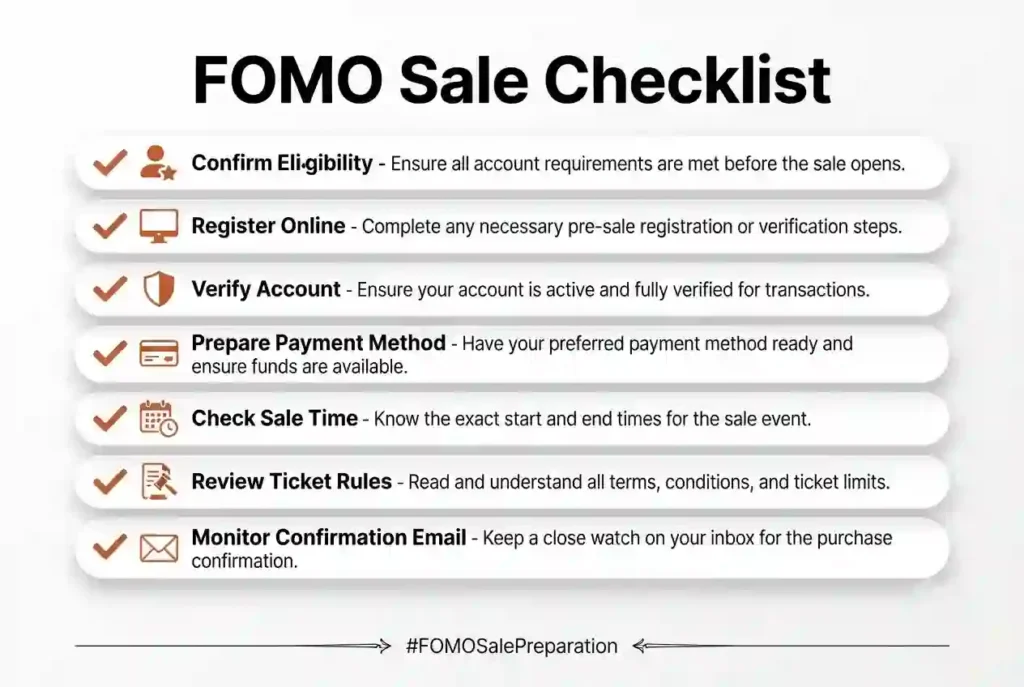
What Is the FOMO Sale?
FOMO tickets are sold at higher prices and sometimes with different refund or transfer rules to discourage speculative buying. The sale provides a direct, often smaller, allocation of tickets for immediate purchase, cutting through queue complexity. Organizers use FOMO as a mechanism to capture demand at higher price points and reduce pressure on primary sales, which can stabilize the overall buying ecosystem.
Why Premium Pricing Exists
Premium pricing reflects market segmentation—some buyers are willing to pay more for certainty, and the higher revenue supports event costs or subsidizes lower-income programs. Additionally, higher prices reduce frivolous purchases and incentivize buyers to make considered choices. From an economic perspective, FOMO acts as a demand dampener and revenue tool, while giving a transparent option for those who need or value fast access.
Who Should Consider FOMO Tickets?
Consider FOMO if you must finalize travel and logistics—especially international travelers who need confirmed tickets for visas or flight bookings—or if you missed primary sales and can afford the premium. FOMO suits attendees who prioritize certainty over cost or who are coordinating non-refundable group expenses that require immediate confirmation.
Advantages and Disadvantages
Advantages: immediate confirmation, reduced stress, and simplified checkout. Disadvantages: higher cost, potential community perception of bypassing the main allocation, and fewer protections for resale or transfer. Evaluate the impact on your budget and community standing; for some, the convenience outweighs costs, while others prefer the more communal approach of earning a spot through standard sales or stewardship.
Is the FOMO Sale Worth It?
That depends on your constraints. If missing the event would cause significant logistical or financial loss (non-refundable travel, critical work leaves, or large group commitments), FOMO can be cost-effective. If you’re flexible or on a tight budget, prioritize Main, steward, or STEP options instead. Run a quick cost-benefit: extra ticket cost versus potential losses from missed travel or work—this practical framing helps decide objectively.
“The FOMO Sale gives a Burner early certainty, but that certainty comes with a price that not every participant will want to pay.”
- FOMO offers immediate access at premium prices and is best for urgency/certainty needs.
- Premium pricing funds event operations and manages demand.
- Use FOMO when travel or financial stakes justify the extra cost.
- Consider community perceptions and resale/transfer rules before buying.
Stewards Sale 2026 Schedule: Reserved Tickets for the People Who Build Black Rock City
What is the Stewards Sale, and why does it matter so much for Burning Man 2026? The Stewards Sale is a reserved allocation system created for the people who actively help build, run, and shape Black Rock City before the gates even open.
It supports theme camps, artists, mutant vehicles, volunteers, playa infrastructure crews, DPW, Rangers, and department teams by giving them a dedicated path to ticket access that is separate from the public sales. For many Burning Man operations, this sale is not a bonus—it is the backbone of planning, staffing, and participation. Without it, the logistics of camps, art, safety, and on-playa work would become much harder to coordinate.

What Is the Stewards Sale and Why Does Burning Man Reserve Tickets for It?
The Stewards Sale is Burning Man’s way of protecting the people who make the event possible behind the scenes and on the playa. It gives reserved ticket allocation to groups that carry major responsibility, including theme camps that create neighborhood experiences, artists who bring large-scale installations, mutant vehicle teams who build iconic moving art pieces, volunteers who staff key functions, and playa infrastructure crews who keep the city functioning.
It also supports core operational groups such as Department of Public Works (DPW) and Rangers, whose work is essential to safety, structure, and daily life in Black Rock City. In short, this sale exists because Burning Man is not just an event—it is a temporary city, and the city needs builders.
What Is the 2026 Stewards Sale Timeline?
The Stewards Sale begins with an application window in late February, which is when eligible groups and leads confirm their need for tickets. After that, the purchase period opens in early March and continues through the end of the month. This gives camp leads, department coordinators, and team organizers time to assign tickets, finalize counts, and keep planning aligned with the rest of the Burning Man 2026 build cycle. Because this sale is tied to internal participation and responsibility, the timeline tends to be much more structured than public sales.
| Event | Date |
|---|---|
| Application Window | Feb 20 – Feb 27, 2026 |
| Purchase Period | Mar 4 – Mar 31, 2026 |
Who Qualifies for Stewards Tickets in 2026?
The Stewards Sale is meant for the people directly involved in making Black Rock City work. Common qualifying groups include:
- Theme Camp Organizers who are responsible for camp placement, structure, and participant coordination.
- Art Installation Teams who design, transport, build, and support major artwork on the playa.
- Department Volunteers who assist with event operations, safety, hospitality, logistics, and community services.
- DPW Crews who support infrastructure, placement, road work, signage, and site setup.
- Rangers who help with community response, safety, and conflict support.
- Mutant Vehicle Teams who design and operate licensed art cars and other mobile creations.
Qualification usually depends on whether the applicant is actively serving in one of these roles and whether their lead or department confirms the ticket need. This is not a general public option, and it is not intended for casual attendees.
What Deadlines Do Camp Leads Need to Watch Closely?
Camp leads carry the biggest responsibility in the Stewards Sale process because they often control allocation acceptance and ticket distribution. Once an allocation is offered, it needs to be accepted on time so the camp or department can move forward with planning. After that, ticket assignments must be handled carefully so every participant knows their status before travel, shipping, and placement planning begin. This timing matters because Stewards tickets are often tied to camp planning synchronization, meaning one delay can affect placement maps, project timelines, volunteer rosters, and final on-playa readiness.
Reserved Tickets for the People Who Build Black Rock City
- Stewards Sale is a reserved allocation system for people who help build Black Rock City.
- It supports theme camps, artists, mutant vehicles, volunteers, DPW crews, and Rangers.
- The application window runs Feb 20–Feb 27, 2026.
- The purchase period runs Mar 4–Mar 31, 2026.
- Camp leads must act fast on allocation acceptance and ticket assignments.
- The sale helps keep camp planning, art production, and volunteer coordination synchronize
“The Stewards Sale is where responsibility meets access—because the people who build the city deserve a clear path into it.”
Ticket Aid Program & Resilience Program Deadlines
Burning Man Ticket Aid is a reduced-price ticket program designed specifically for lower-income participants who couldn’t otherwise afford the $675–$775 base ticket prices. This community accessibility effort reserves 5,000 tickets at $250—far below the standard price—to ensure economic barriers don’t exclude talented artists, dedicated volunteers, and diverse community members from Black Rock City.
For attendees across the USA (California, Texas, New York, Florida, Colorado, Oregon, Washington, Nevada, Arizona, Illinois, Pennsylvania, Ohio, Georgia, North Carolina, Michigan) and international locations (UK, Canada, Australia, Germany, France, Japan, Brazil, Mexico), Ticket Aid represents a lifeline: without it, many would be priced out of the experience entirely.
What Is Burning Man Ticket Aid and Who Is It For?
Burning Man Ticket Aid is a reduced-price ticket program offering tickets at $250—less than half the lowest standard price. It’s designed for lower-income participants who face financial hardship but want to contribute to the event as artists, theme camp members, volunteers, or community builders.
This community accessibility effort reflects Burning Man’s core principle of radical inclusion: no one should be excluded purely due to income. The program isn’t charity—it’s investment in the people who make Black Rock City vibrant. For first-timers on tight budgets, veterans facing economic challenges, international Burners with currency conversion hurdles, and USA attendees in states with high cost of living (California, New York, Massachusetts), Ticket Aid opens doors that would otherwise stay closed.
When Does Ticket Aid Registration Open for 2026?
Ticket Aid Opening Date: Feb 25, 2026
This launches 3 weeks after Sunrise Sale (Feb 4) and before Main Sale registration (Apr 20). The window typically stays open for 4–6 weeks, but quantities are limited and sell out fast. Mark your calendar for Feb 25, set a reminder, and apply immediately—don’t wait. Unlike Sunrise or Main Sale, Ticket Aid doesn’t use a virtual queue, but it does use a first-come-first-served application review system. Once the 5,000 tickets are allocated, the program closes. For international attendees in the UK, Canada, Australia, Germany, and Japan, this timing aligns with late February/early March local time—still February in most time zones.
What Are the Ticket Aid Eligibility Requirements and How Do You Prove Them?
Ticket Aid eligibility requires financial need demonstrated through documentation such as tax returns, pay stubs, benefit statements (SNAP, Medicaid, unemployment), or employer verification letters. The application review process typically takes 5–10 business days, during which Burning Man staff verify income against federal poverty guidelines. International applicants can submit equivalent documents: bank statements, government assistance letters, or employer income verification in their local currency (converted to USD). Key requirements:
- Income below threshold: Typically 150–200% of federal poverty level (varies by household size)
- Valid ID: Government-issued photo ID matching application name
- Email access: Must check inbox regularly for approval/denial and payment instructions
- US or international: Both eligible, but documentation must be legible and verifiable
- One ticket per applicant: Can’t buy multiple Ticket Aid tickets
Incomplete or unclear documentation leads to denial. Upload clear photos/PDFs, double-check all fields, and respond quickly to follow-up requests.
How Much Do Ticket Aid Tickets Cost and What’s Included?
Ticket Aid offers reduced-price tickets at $250—a fraction of the $675–$775 standard price. Limited quantities (5,000 total) mean not every approved applicant receives a ticket; some are placed on a waitlist.
Vehicle pass availability is restricted: Ticket Aid recipients can purchase vehicle passes (RV, car, bike) at standard rates, but these aren’t subsidized. If you need an RV pass ($150–$300) or car pass ($100), budget for that separately. The $250 covers entry ticket only. For international Burners, remember that currency conversion fees may apply when paying $250 USD via credit card. The savings still outweigh standard pricing—$250 vs. $775 = $525 saved.
What Is the Resilience Program and How Is It Different From Ticket Aid?
The Resilience Program is a support for disaster-affected people and those impacted by geopolitical crisis. Unlike Ticket Aid (income-based), Resilience targets individuals displaced by natural disasters (wildfires, hurricanes, floods, earthquakes) or geopolitical conflict (war, persecution, forced migration). This community assistance initiative provides reduced-price tickets similar to Ticket Aid but with different eligibility criteria. For example:
- Wildfire survivors: California, Oregon, Washington residents displaced by 2024–2025 wildfires
- Hurricane victims: Florida, North Carolina, Texas residents affected by 2024–2025 hurricanes
- Geopolitical refugees: Ukrainians, Syrians, Afghans, Palestinians, Venezuelans displaced by conflict
- Documentation required: FEMA letters, insurance claims, refugee status papers, migration documents
Resilience Program tickets are also $250, with limited quantities. Application opens around the same time as Ticket Aid (late February 2026). This program recognizes that some barriers to participation aren’t just financial—they’re catastrophic.
What Are the Most Common Ticket Aid Mistakes That Get Applications Denied?
- Incomplete applications: Missing fields, unsigned forms, skipping required documents
- Missed emails: Not checking inbox/spam for approval notices, payment links, or follow-up requests
- Late payments: Approved but not paying within the deadline (typically 7–10 days)—ticket reallocated
- Wrong documents: Submitting unclear photos, expired IDs, or irrelevant paperwork (e.g., utility bills instead of income proof)
- Underestimating income: Lying about income—discovered during review, results in permanent ban
- Applying too late: Waiting until quantities run out—first-come-first-served after approval
- Using wrong email: Providing email that goes to spam or isn’t monitored regularly
- Not reading instructions: Skipping eligibility guidelines, submitting for wrong program (Ticket Aid vs. Resilience)
- Target audience: Low-income first-timers, disaster-affected veterans, international Burners with financial hardship, USA attendees in states with recent disasters (California, Oregon, Florida, Texas, North Carolina)
🔑Ticket Aid & Resilience Program Key Details
- Reduced-price ticket program: $250 tickets for lower-income participants (5,000 total)
- Designed for lower-income participants: Income below 150–200% federal poverty level
- Community accessibility effort: Radical inclusion principle—no one excluded due to economics
- Ticket Aid Opening Date: Feb 25, 2026
- Financial need: Proven via tax returns, pay stubs, benefit statements, employer verification
- Documentation: Clear photos/PDFs, government-issued ID, household size disclosure
- Application review: 5–10 business days, respond quickly to follow-up requests
- International applicants: Eligible with equivalent documents in local currency
- Resilience Program: Support for disaster-affected people (wildfires, hurricanes) and geopolitical crisis support (refugees, conflict survivors)
- Community assistance initiative: Recognizes catastrophic barriers beyond income
- Limited quantities: 5,000 tickets total, waitlist common, act fast
- Vehicle pass availability: Not subsidized, pay standard rates separately
- Common mistakes: Incomplete applications, missed emails, late payments, wrong documents
- Critical for: Low-income first-timers, disaster survivors, international Burners, USA attendees in disaster-affected states
“Ticket Aid isn’t charity—it’s an investment. The artists, builders, and volunteers who make Black Rock City magical often have the least money. This program ensures talent and passion matter more than bank accounts.”
Directed Group Sale
Directed Group Sales exist to support organized community projects like theme camps, sanctioned art installations, and production teams. These sales give groups a controlled way to secure blocks of tickets for their members so they can plan logistics and project staffing with confidence.
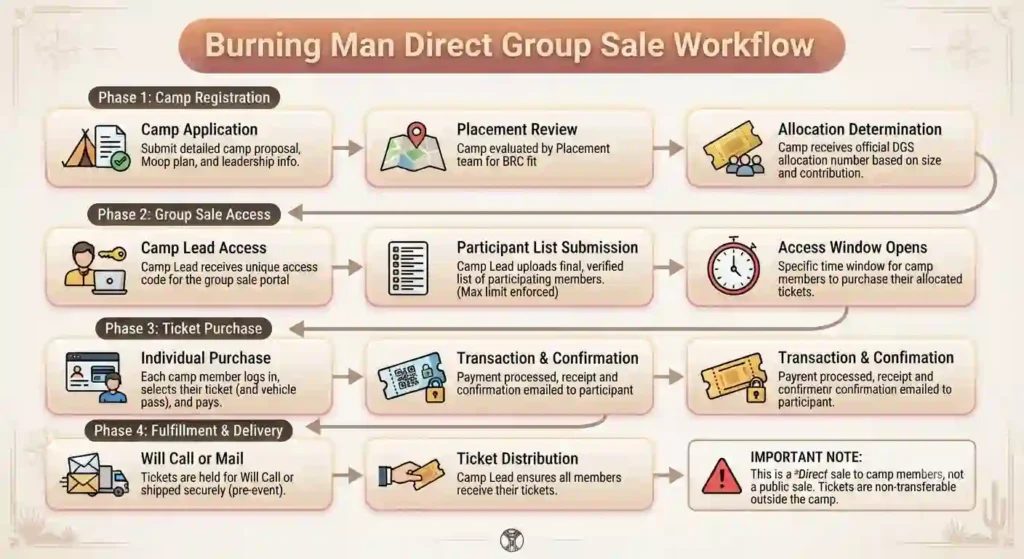
What Is the Directed Group Sale?
Directed Group Sales allocate ticket blocks directly to registered groups—theme camps, art collectives, or sanctioned projects—often via an application or camp registration process. Organizers use this to ensure that collaborative projects, which require predictable participant numbers, can proceed. Directed allocations usually require a camp captain or project lead to apply, justify ticket needs, and accept accountability for distribution and compliance with rules.
Who Is Eligible?
Eligibility typically hinges on formal group registration and a demonstrated plan—camp mission, project scope, and member roles. Established camps with a track record may receive preferential treatment, but new camps can qualify by satisfying application requirements. Groups must designate a lead responsible for roster management and communications with organizers.
Theme Camp Ticket Allocations
Camps receive blocks based on size, infrastructure needs, and the project’s scale. Leads set internal rules for distribution—application processes, dues, and member obligations—and must track ticket usage and transfers. Camps often require deposits or confirmation of member commitments before distributing tickets to avoid last-minute dropouts.
Purchase Rules
Directed-block purchases commonly require the camp lead to provide member names and adhere to transfer policies. Some blocks are transferred as codes redeemable by members; others are purchased wholesale and distributed. Camps must follow rules about resale, transfers, and may be audited to ensure allocations match actual camp participation.
Responsibilities After Receiving Tickets
Camp leads are accountable for ensuring members meet participation expectations, pay dues or fees, and fulfill safety or infrastructure responsibilities. Mismanagement—such as overselling slots or allowing unauthorized resale—can jeopardize future allocations. Documentation, clear internal policies, and confirmed rosters help maintain accountability and community trust.
- Directed groups secure block allocations for predictable planning.
- Eligibility requires formal registration and a project plan.
- Camps must manage rosters, distributions, and compliance carefully.
- Leads are accountable; good record-keeping prevents future issues.
STEP The Official Burning Man Resale Path
What is STEP, and why do so many Burners rely on it instead of public resale groups? STEP stands for the Secure Ticket Exchange Program, Burning Man’s official resale platform and the safest resale method for anyone buying or selling tickets after the main sales end. It exists to keep ticket transfers authentic, face-value, and traceable, so Burners can avoid the chaos of fake listings, scalpers, and last-minute panic buys.
What Is STEP and Why Does It Exist?
STEP is Burning Man’s Secure Ticket Exchange Program, built to handle resale in a controlled and trustworthy way. It is the only resale channel designed by the event itself, which makes it the safest option for both buyers and sellers. Instead of relying on informal swaps, STEP creates a system where ticket availability, transfer timing, and payment handling are all managed through the official process. That structure matters because Burning Man tickets are valuable, limited, and often in demand long after the public sales close.
When Does STEP Open in 2026?
STEP Opening Date: March 18, 2026
That opening date gives Burners a clear starting point for resale access after the early sales phase. Buyers who miss Sunrise Sale, Main Sale, Ticket Aid, or Stewards Sale can use STEP as the official fallback. Sellers who can no longer attend can list their ticket through the same system at face value. For many people, March 18 becomes the day to check, join, and stay ready for matching opportunities.
What Are the STEP Closing Deadlines?
The Aug 28 deadline means auto-purchase ends before the event begins, so buyers can no longer rely on the system to complete new matching as the playa deadline approaches. The Sept 5 deadline is the final closure date, after which STEP is fully shut down for the year. These dates matter because they give a hard boundary for both buyers and sellers, keeping the exchange process orderly and preventing last-second confusion.
| Deadline | Meaning |
|---|---|
| Aug 28 | Auto-purchase ends |
| Sept 5 | Final STEP closure |
How Does STEP Work for Buyers?
Buyers enter a waitlist system and wait for automatic matching when tickets become available. If a seller’s ticket matches a buyer’s request, the system handles the pairing and prompts payment processing. Once payment is completed, the ticket transfer follows the official timing rules set by Burning Man. This makes STEP much less stressful than chasing a random seller online, because the system does the matching and transfer through a verified path.
How Does STEP Work for Sellers?
Sellers use STEP to list tickets at face value, not inflated prices. The transfer is secure, and the ticket moves through the official channel rather than through a private handoff. That helps reduce shipping complications, especially if a physical ticket has already been mailed or if the buyer needs a Will Call-friendly transfer instead. For sellers, STEP is the cleanest way to return a ticket without wondering whether a stranger will pay, show up, or disappear after a DM.
Why Does STEP Pause During OMG Sale?
STEP usually enters a temporary suspension during the OMG Sale period. That pause helps Burning Man manage the final wave of ticket activity without overlapping systems fighting for the same inventory. During the freeze, the queue is held and new matching may stop until the sale window clears. Once the timing allows, STEP resumes so buyers and sellers can continue using the official exchange process.
Why Is STEP Safer Than Facebook or Reddit?
STEP is safer than Facebook groups, Reddit posts, or other informal resale channels because it offers scam prevention, official verification, and fraud protection. A Facebook or Reddit listing can look convincing while hiding fake tickets, double-selling, or non-delivery risks. STEP confirms that the transfer is authentic and handled inside Burning Man’s system, which protects both sides from fraud. For anyone buying from a stranger, the official channel is simply the better bet.
Why do so many Burners rely on it instead of public resale groups?
- STEP = Secure Ticket Exchange Program, Burning Man’s official resale platform.
- It is the safest resale method for buyers and sellers.
- Opening date: March 18, 2026.
- Closing deadlines: Aug 28 for auto-purchase end, Sept 5 for final closure.
- Buyers use a waitlist and automatic matching system.
- Sellers list tickets at face value with secure transfer handling.
- STEP may pause during OMG Sale to manage final ticket activity.
- It is safer than Facebook or Reddit because it reduces scams and verifies transfers.
“When the desert season gets crowded, the official path is still the calmest one.”
OMG Sale The Final Official Chance for Burning Man Tickets
The OMG Sale is the last official Burning Man ticket sale, and it usually serves as the final large ticket release for people still hoping to join Black Rock City. It matters because it can be the last real opportunity to buy through the official system before the event gets too close, and demand is usually intense.
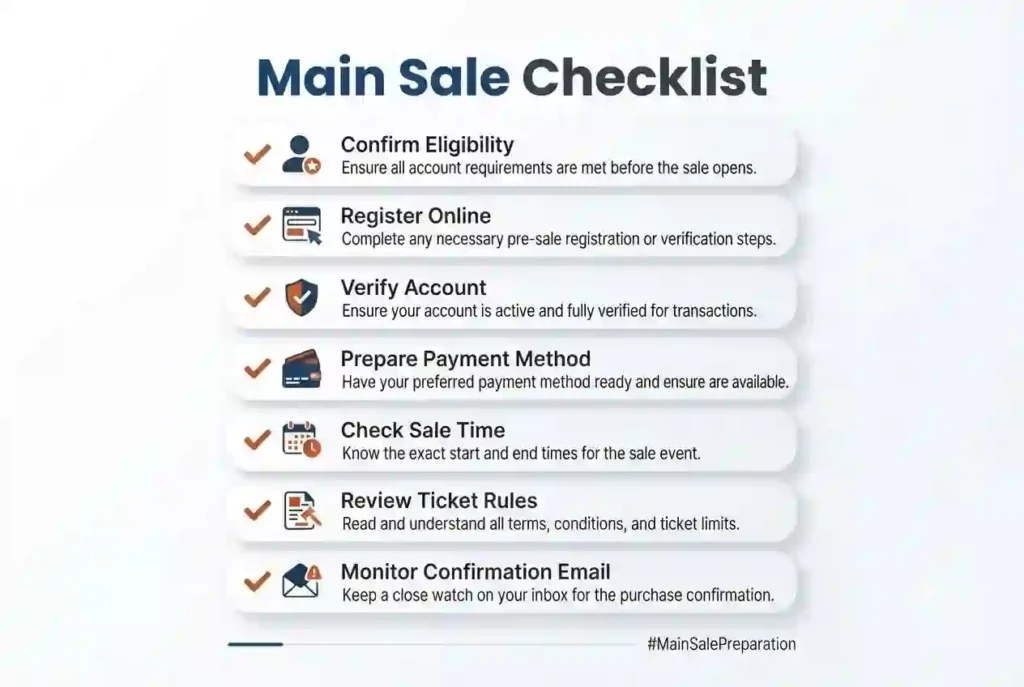
What Is the OMG Sale and Why Does It Matter?
The OMG Sale is Burning Man’s last official ticket sale of the year. It is generally treated as the final large ticket release, which means it is often the last major wave of inventory before the event week arrives. For Burners who missed Sunrise Sale, Main Sale, Ticket Aid, Stewards Sale, or STEP, this sale can feel like the final opening in the door. Because it comes so late in the season, it tends to attract people who are still ticketless and willing to move quickly.
When Is the Expected OMG Sale Timing?
The exact date is usually announced later, because the OMG Sale typically happens close to the event rather than at the beginning of ticket season. That late timing is part of what makes it unpredictable, so Burners usually keep watching for official updates as the event gets nearer. In practical terms, this means planning ahead is still important even if the sale date is not yet locked in. The best approach is to stay ready rather than wait for the announcement to start preparing.
Why Is the OMG Sale So Competitive?
The OMG Sale is usually extremely competitive because the number of remaining tickets is very limited. High traffic can hit the sale page quickly, and that often leads to fast sellouts. Many Burners see it as a last-chance scramble, which means delays, slow connections, or hesitation can cost them the ticket. In other words, the sale is short, crowded, and unforgiving.
What Should Be Ready Before OMG Sale Day?
A strong preparation checklist can make the difference between getting in and missing out:
- Burner Profile ready so account access is not delayed.
- Saved payment method so checkout can happen fast.
- Fast connection to reduce loading problems.
- Logged-in devices so the sale page can be accessed immediately.
Burners who prepare early usually have a better chance of moving through the sale without avoidable mistakes. Since OMG Sale tickets can disappear fast, setup matters just as much as timing.
Why do Burners watch it so closely?
- OMG Sale is the last official Burning Man ticket sale.
- It is usually the final large ticket release.
- The exact date is announced later and typically comes close to the event.
- Competition is extremely high because inventory is very limited.
- Burners should prepare with a ready Burner Profile, saved payment method, fast connection, and logged-in devices.
“When the OMG Sale opens, speed matters more than hope.”
Comparison of All Burning Man Ticket Sales
Think of the different sales like lanes on the playa: each gets you closer but at different speeds and costs. This comparison helps you pick the lane that fits your priorities—certainty, cost, community service, or last-minute luck.
Sunrise Sale — Quick summary
Sunrise is the “early bird” lane for folks who already have skin in the game—camp leads, returning project organizers, and vetted contributors. It’s smaller and less chaotic than the main sale, and when you get in, you can breathe easier knowing your build or logistics are covered. The trade-off is eligibility: if you don’t have documented ties, you won’t qualify. Pro tip: camp leads, confirm your roster and payment plan a week ahead—teams forget details under pressure.
Main Sale — Quick summary
The Main Sale is the big carnival gate: everyone lines up, the traffic is heavy, but there are more tickets to grab. This is the best shot for most first-timers and returning burners who don’t rely on directed blocks. Expect long queues and adrenaline—practice the checkout flow on a test day with your payment method. Tip: use a wired connection if possible and keep a backup browser/device logged in.
FOMO Sale — Quick summary
FOMO is the shortcut you pay for. It’s for people who need to lock things down—international flights, work schedules, or big group plans. Bring the budget and leave the stress at the gate. Insider note: some people treat FOMO as insurance—buy it only when the financial downside of missing the event outweighs the premium.
Steward Sale — Quick summary
If you like serving and want a guaranteed ticket, stewarding is the way. You’ll work shifts, you’ll meet amazing people, and you’ll earn your admission. It’s not glamorous—think long hours and responsibility—but it’s deeply rewarding. Bonus: you get behind-the-scenes stories the tourist queue never will.
Directed Group Sale — Quick summary
Directed groups are how theme camps and sanctioned projects build with confidence. If your camp is organized and you’re on the roster, you’re in the captain’s hands—get your deposit and commitment in early. Camps that document expectations and have a transparent internal process keep members happier and the lead less stressed.
OMG Sale — Quick summary
The OMG drop is the adrenaline spike at the very end—tiny releases, fast fingers win. It’s the most unpredictable route and best for flexible travelers who can pivot. Don’t bank your whole plan on an OMG; treat it like a scratch-off lottery with a sliver of upside.
- Sunrise: early-access for organizers; lower volume, higher certainty if eligible.
- Main: biggest public window; highest competition but most opportunity for average burners.
- FOMO: premium, fast certainty; pay extra for immediate confirmation.
- Steward: service-for-ticket; guaranteed if you fulfill shifts and training.
- Directed Group: camp/project allocations; depends on good camp leadership and policies.
- OMG: last-chance small drops; highly unpredictable, high-adrenaline.
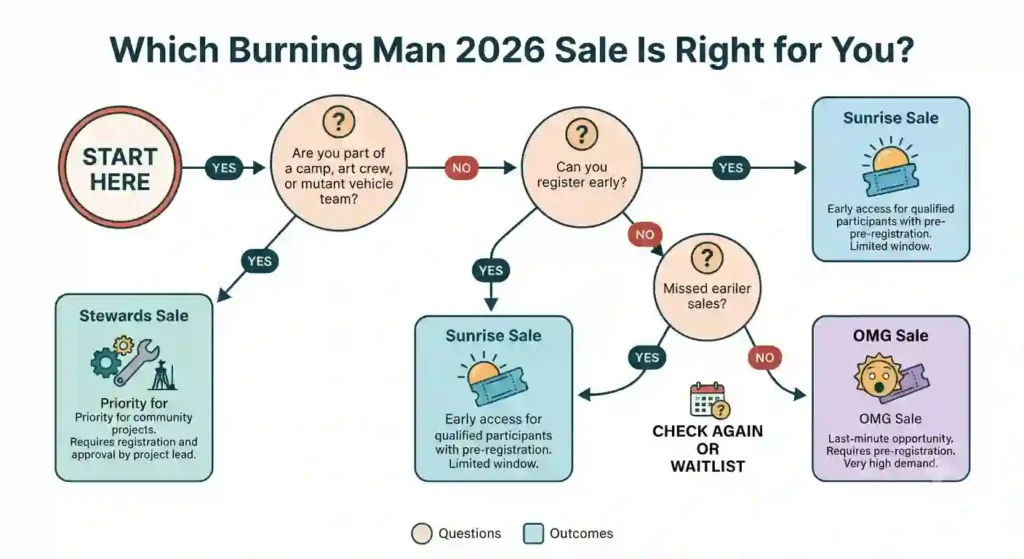
Which Burning Man Ticket Sale Is Right for You?
Let’s be practical—your life, budget, and experience level determine the best lane. Below I lay out profiles and the recommended sale paths so you can match strategy to situation.
Best Option for First-Time Burners
First-timers should focus on the Main Sale and camp-hunting early. Join camp directories, ask to be a guest, or apply to a new camp that takes newbies. If that’s not possible, be ready for STEP and keep an eye on later drops. Tip from the playa: show enthusiasm, be useful, and camps will often find a way to include you if you’re reliable.
Best Option for Returning Burners
Returning burners have an advantage—history. Use it: keep your profile current, note previous camp affiliations, and check if your camp has directed allocations. Consider stewarding if you want guaranteed access and to give back. Anecdote: many veterans swear stewarding led to the best friendships and the best sunrise moments.
Best Option for Theme Camp Members
Camp members should rely on the Directed Group Sale first, then coordinate payment plans internally. The camp lead should publish a distribution timeline and a fallback plan: who gets priority and how refunds/transfers work. Pro tip: camps that require a small deposit reduce no-shows and chaotic last-minute changes.
Best Option for International Travelers
International travelers should aim for the earliest secure path—directed blocks or stewarding if possible—or budget for FOMO if flights need to be booked non-refundable. Plan visas and refundable travel options until tickets are confirmed. Tip: coordinate with consulate timelines and buy refundable fare or book flights with generous change policies.
Best Option for Last-Minute Attendees
Last-minute folks should watch OMG drops, prepare for FOMO if budget allows, and be ready to join camps as standby. Keep a pared-down kit and flexible travel plans—sometimes winning a late ticket is glorious, but it’s rarely convenient.
- First-timers: target Main, join camps, use STEP as fallback.
- Returners: leverage history; consider stewarding for certainty.
- Camp members: directed allocations; clear internal policies reduce stress.
- International: secure early or allocate FOMO budget; prioritize visa timelines.
- Last-minute: OMG/FOMO and camp standby lists; expect flexibility needs.
Payment Plans & Payment Deadlines
Burning Man’s payment plan system gives Burners a way to secure a ticket without paying the full amount upfront. It works like an installment system, where the cost is split into scheduled payments, making budget management easier for people who need more time to cover the ticket price.
Burning Man Payment Plan System
The payment plan is designed to reduce financial pressure while still keeping the ticketing process organized. Instead of one large charge, the buyer pays in monthly payments or similar scheduled installments, depending on the sale and checkout terms. This helps attendees manage travel, gear, vehicle passes, camp dues, and ticket costs at the same time. For many Burners, especially international travelers dealing with exchange rates, this structure makes the trip much more realistic.
Which Sales Offer Payment Plans?
Sunrise Sale and Main Sale are the main places where payment plans are typically available. OMG Sale may offer them only in limited cases, while STEP usually does not use installment options. Because availability can change by year, Burners should treat payment plans as helpful but not guaranteed across every sale.
| Sale | Payment Plan Available |
|---|---|
| Sunrise Sale | Yes |
| Main Sale | Yes |
| OMG Sale | Usually Limited |
| STEP | Usually No |
What Are the Final Payment Deadlines?
Each installment plan comes with due dates that must be met on time. If a payment is missed, the ticket can be canceled and returned to inventory, which means the buyer may lose the chance to attend. Burning Man is strict about this because payment deadlines keep the sales fair and prevent people from holding tickets they cannot actually afford. The safest approach is to set reminders for every due date and keep enough funds available before each charge date.
Credit Card and Banking Tips
Burners using payment plans should prepare for possible international transaction issues, especially if they are paying from outside the USA. Some banks place daily spending limits or fraud blocks on large festival purchases, so it helps to notify the card issuer before checkout. Currency conversion can also cause the final charge to be higher than expected once fees are added. A card that works smoothly for everyday spending may still fail during a ticket purchase, so backup payment methods are wise.
Burning Man Makes Ticket Costs Easier to Manage
- Payment plans split ticket cost into installments, making budget management easier.
- Sunrise Sale and Main Sale usually offer payment plans.
- OMG Sale may have limited availability, while STEP usually does not.
- Missing a payment can lead to ticket cancellation risk.
- International buyers should watch for fraud blocks, daily limits, and currency conversion fees.
“A payment plan can open the door, but only timely payments keep the ticket in hand.”
Ticket Shipping & Delivery Deadlines
Burning Man tickets are typically shipped in late June 2026, giving attendees enough time to receive them before the event planning rush really kicks in. Because ticket delivery can be affected by address errors, postal delays, and international handling, this deadline matters just as much as the sale dates themselves.
When Do Burning Man Tickets Ship?
Burning Man tickets are generally mailed in late June 2026. That timing gives the mailing team a window to process orders, verify addresses, and send tickets out well before travel preparations get intense. For many Burners, this is the moment when the event starts feeling real, because the ticket finally becomes a physical item instead of just a confirmation email. It also means buyers should stay alert around that period in case shipping notifications or tracking updates appear.
Why Is the Shipping Address Deadline So Important?
The shipping address deadline is the point after which address changes become difficult or impossible. Burners should update their mailing details as early as possible, especially if they have moved recently or use a temporary address. International delivery creates extra risk because customs, local postal systems, and long-distance handling can slow the process. Lost mail is another concern, so a correct and stable address is critical before tickets are sent.
Domestic vs International Shipping
Domestic delivery inside the USA is generally simpler and faster, with fewer handoffs and less paperwork. International shipping can take longer because of customs checks, regional postal differences, and limited tracking visibility once the package leaves the USA. That is why international Burners should allow extra time and monitor their shipping details carefully.
| Factor | Domestic Shipping | International Shipping |
|---|---|---|
| Delivery speed | Usually faster | Usually slower |
| Customs delays | Rare | More common |
| Tracking reliability | Often stronger | Can be inconsistent |
What Happens If Burning Man Tickets Are Lost?
If tickets are lost in the mail, the first step is usually to contact support and begin the verification process. Buyers may need to confirm their identity, order details, and shipping information before any replacement path is considered. In some cases, Will Call becomes the fallback option, especially when a physical ticket cannot be recovered in time. Verification requirements help protect against fraud, so the process may take time, but it exists to make sure the ticket goes to the correct attendee.
Burners Receive Their Tickets on Time
- Burning Man tickets are usually shipped in late June 2026.
- The shipping address should be correct before mailing begins.
- International delivery can face customs delays and weaker tracking.
- Domestic shipping is usually faster and more reliable.
- If tickets are lost, support review and Will Call fallback may apply.
“A correct address can save a Burner from a very expensive headache.”
Will Call & Box Office Timeline
Will Call is the on-site ticket pickup system for Burning Man, and it acts as a digital ticket holding system when a physical ticket is not shipped or cannot be delivered in time. It gives Burners a practical fallback right before the event, especially when shipping, transfers, or international logistics become complicated.
What Is Will Call?
Will Call is the process where a ticket is held for pickup at the event’s official box office instead of being mailed in advance. In simple terms, Burning Man keeps the ticket in a secure holding system until the buyer arrives with the correct documents. This option is especially helpful when a ticket was transferred through STEP, when shipping creates stress, or when the buyer prefers to avoid mailing risks. It is a common safety net for attendees who do not want to depend entirely on postal delivery.
When Does the Box Office Open and Close?
| Event | Date |
|---|---|
| Box Office Opens | Aug 24, 2026 |
| Box Office Closes | Sept 5, 2026 |
The Box Office opens on Aug 24 and stays active until Sept 5, which gives Burners a clear pickup window during the event period. That timeline matters because it is the final place to resolve ticket issues, complete pickup, or handle late changes. Attendees should not wait until the last minute, because box office traffic tends to get heavier as the event approaches its final days.
Why Do Many Burners Prefer Will Call?
Many Burners prefer Will Call because it reduces shipping stress and makes ticket handling feel more controlled. It is often easier for STEP transfers, since the ticket can be reassigned without waiting for postal delivery to catch up. International travelers also like it because they do not need to worry about lost mail, customs delays, or missed delivery windows in another country. For people flying in from outside the USA, Will Call can be the most practical way to secure entry.
What ID Is Needed for Pickup?
To pick up a Will Call ticket, Burners usually need a government-issued ID, the confirmation email, and matching ticket information. The name on the ID should match the ticket order details, and the confirmation email should show the correct order or pickup reference. If the information does not match, pickup may be delayed until the buyer can verify ownership. That is why it is important to keep all documents easy to access before arriving at the Box Office.
Section Summary
- Will Call is the on-site ticket pickup system.
- It works as a digital ticket holding system for non-shipped tickets.
- The Box Office opens Aug 24, 2026 and closes Sept 5, 2026.
- Many Burners prefer it because it reduces shipping stress and supports STEP transfers.
- Pickup usually requires a government ID, confirmation email, and matching ticket details.
“Will Call is the safety net that turns ticket uncertainty into a simple pickup.”
Critical Burning Man Deadline Reminders: The Alerts That Keep Burners on Track
Burning Man ticketing moves fast, and the smallest missed alert can turn into a missed ticket, a missed payment, or a missed pickup. Burners who stay organized with calendar reminders, email monitoring, and device prep are far more likely to get through the process without stress.
What Calendar Alerts Should Every Burner Set?
Every Burner should build a simple reminder system that covers the full ticketing timeline. Registration alerts should go off before Sunrise Sale, Main Sale, Ticket Aid, and STEP-related windows so no application deadline gets missed. Sale reminders should be set for the exact day and time of each ticket sale, with a second alert an hour earlier for time zone checks and final prep. Payment alerts are essential for anyone using installment plans, because missing a due date can cancel the ticket. STEP reminders help buyers and sellers stay ready for resale opportunities, especially when tickets become available unexpectedly.
Which Emails Must Burners Never Ignore?
Some Burning Man emails are too important to overlook. Queue access emails contain the link or instructions needed to join the sale line, so they should be treated like a ticket to the ticket sale. Payment confirmation emails prove that the purchase went through and help resolve issues if a charge fails or a ticket disappears. Ticket assignment notices matter for group purchases, camp planning, and any sale that affects multiple people. STEP notifications can be the difference between getting a resale ticket and missing the window entirely, so these messages should never be buried in spam or ignored.
How Should Burners Prepare Their Device and Internet Setup?
A stable connection is one of the most important parts of sale-day preparation because weak internet can interrupt the queue or cause checkout failures. Browser readiness also matters, so Burners should update their browser, clear unnecessary tabs, and avoid last-minute extension conflicts. A backup device strategy is smart, especially if one laptop freezes or a phone connection drops during the sale. Using two ready devices, both logged in ahead of time, gives Burners a better chance of staying in the process if one setup fails.
Section Summary
- Set registration alerts, sale reminders, payment alerts, and STEP reminders.
- Never ignore queue access emails, payment confirmations, ticket assignment notices, or STEP notifications.
- Prepare a stable connection, updated browser, and backup device before sale day.
- Good timing and preparation reduce the risk of missing a deadline or losing a ticket.
“Burning Man rewards the Burner who prepares before the clock starts.”
How Can You Improve Your Chances of Getting Tickets?
This is the practical playbook small prep moves that make a big difference on sale day. Treat it like a performance: rehearsed, calm, and with backups.
Register Before Deadlines
Don’t be the person who registers the morning of the sale. Register weeks early, verify email and phone, and check for any identity verification steps. If there’s an ID match step, have a clean photo ready. A verified profile is the golden ticket to even entering the queue.
Prepare Your Burner Profile
Fill every field accurately, link to your camp or volunteer confirmations, and upload any requested documents. Use the same name and email you use for banking and travel—mismatched names trigger security flags. Include relevant community history in your profile; sometimes organizers weight returning participation.
Be Ready Before the Sale Starts
Practice the flow: open the ticket portal, simulate a cart, and time your process. On sale day, log in early, close unnecessary tabs, and have a simple checklist at arm’s length: cards, ZIP code, phone for two-factor, and a calm caffeine plan. Don’t refresh like a mad rascal—let the queue do its job.
Have Payment Information Ready
Save cards in your browser if site security allows, have a second card ready, and call your bank ahead if buying a large number of tickets might trigger fraud alerts. Check foreign transaction limits if traveling internationally. Keep a backup PayPal or card with enough limit to cover the purchase.
Create a Backup Ticket Strategy
Backup strategies should be layered: camp standby + STEP + stewarding + FOMO as last resort. Create a mini decision tree with deadlines—when will you stop relying on the main sale and switch to FOMO? That prevents panic buys. Pro tip: coordinate one camp point person to manage backups so people don’t duplicate efforts.
- Register and verify weeks early; practice the checkout flow.
- Keep payment methods primed and confirmed with your bank.
- Use a layered backup plan and set decision deadlines to avoid panic buying.
- Keep communication open with your camp’s point person for coordinated attempts.
Common Burning Man Ticket Deadline Mistakes
Burning Man ticketing is unforgiving, and most problems happen long before the playa opens. The biggest mistakes usually come from missing a step, reading the timing wrong, or trusting the wrong source.
Missing Registration Windows
Many Burners assume they can register later, but registration is what unlocks access to the sale itself. If that window closes, the sale email never arrives and the purchase attempt is gone. This is one of the most common reasons people miss Sunrise Sale or Main Sale even when they were otherwise ready.
Confusing STEP With Official Sales
STEP is the official resale path, not the same thing as Sunrise Sale or Main Sale. Some Burners wait for STEP thinking it is just another public sale, then discover the timing, limits, and availability work differently. That confusion can lead to missed chances, especially when people delay buying during the real sales.
Waiting Until Final Hours
Waiting until the last hours creates stress, slower decisions, and more chance of a failed checkout. By then, payment methods may need verification, emails may not be checked, and internet issues become more damaging. Burning Man’s ticket flow rewards early action, not last-minute hope.
Ignoring Time Zone Differences
Burning Man deadlines are set in Pacific Time, and that causes mistakes for Burners across the USA and around the world. Someone in New York, Texas, London, or Sydney can easily log in at the wrong hour if they do not convert the time carefully. A deadline missed by one time zone can mean a ticket lost for the entire year.
Using Wrong Email Address
A wrong or inactive email address can break the entire process from registration to final confirmation. If the sale access email goes to the wrong inbox, the Burner never reaches the queue. This mistake is especially painful because everything may look fine until the moment the email never arrives.
Forgetting Payment Expiration Timers
Payment links and checkout carts do not stay open forever. If a Burner leaves the page too long, the system can cancel the order and move the ticket to someone else. This is why sale-day focus matters so much, especially during high-demand rounds.
Buying From Unsafe Resellers
Unsafe resale sources can lead to fake tickets, double sales, lost money, or entry problems at the gate. Facebook posts, Reddit messages, and random third-party sellers may look convenient, but they do not offer the same protection as the official exchange system. For a limited event like Burning Man, that risk is too high for most Burners to take.
- Missing registration means missing the sale access email.
- STEP is official resale, not a public ticket sale.
- Waiting until the final hours raises the risk of failure.
- Pacific Time deadlines must be converted correctly.
- Wrong email addresses can block the whole process.
- Payment timers expire quickly.
- Unsafe resellers create fraud and entry risks.
“At Burning Man, most ticket mistakes happen because someone assumed they had more time than they really did.”
What Happens If You Don’t Get Tickets?
Missing out hurts, but the playa has many paths. Here’s how to respond calmly and practically—options that often work if you stay connected and persistent.
Join the STEP Exchange
STEP (Secure Ticket Exchange Program) is the official post-sale marketplace where burners resell tickets at face value. Create an alert, list what you need, and be patient—STEP listings appear as people adjust plans. Insider tip: have payment ready and a Plan B date range; sellers often prefer buyers with flexible travel windows.
Watch for Future Ticket Sales
Organizers sometimes release returned tickets or reserve drops closer to the event. Subscribe to official newsletters, follow social channels, and set calendar reminders for likely release windows. Being the first to know drastically improves odds.
Coordinate With a Theme Camp
If you’re camp hunting, talk to leads about standby lists or volunteer swaps—camps sometimes have last-minute openings if members drop out. Be clear about what you can contribute (skills, shifts, gear) and how you’ll cover costs like shared camp dues.
Explore Official Alternatives
Alternatives include work-trade, sanctioned affiliated events, or volunteering with partner organizations that provide access. These avenues require lead time and commitment but can be wonderful ways to participate when tickets are tight.
Avoid Panic Buying From Unofficial Sources
Avoid scalpers and unofficial resellers who inflate prices and risk scams. If an offer looks too good—or too expensive—verify it through official channels, STEP, or your camp lead. Remember: a ticket tied to someone else’s account or purchased through shady channels can be invalidated.
- STEP is the primary legitimate resale option—be patient and prepared.
- Monitor official channels for drops and set alerts.
- Coordinate with camps for standby slots or volunteer trades.
- Avoid unofficial resellers; they risk fraud and invalidation.
Common First-Timer Ticket Sale Mistakes
We’ve all been there—nervous, clicking too fast, missing a small step that costs a ticket. Here are the usual traps and how to avoid them.
Missing Registration Deadlines
Registrations close and reopen on specific schedules—missing these can lock you out. Set calendar alerts, and if you’re part of a camp, assign someone to track deadlines for the whole group.
Confusing Registration With Buying Tickets
Registration gets you in the system; it doesn’t buy tickets. Think of registration as signing up for the lottery and sale day as buying a ticket if you win. Reiterate this to any campmates who assume the two are the same.
Waiting for the Last Sale
Last-sale optimism costs tickets. Make a primary plan and a fallback, but don’t put all hopes on last-minute windows—those are small and unpredictable.
Ignoring Official Burning Man Emails
Important updates (like a last-minute drop or identity verification reminder) are sent by email—don’t let them land unread. Create an email folder or filter to catch all official communications so they don’t drown in promotions.
Buying From Unverified Sellers
Scam risk is real. Verify sellers through STEP or official camp confirmations. If someone pressures you to pay quickly via wire or gift cards, that’s a red flag—walk away.
Not Having a Backup Plan
The single biggest mistake is not having backups. FOMO and OMG exist, but they’re not reliable. STEP, camp standby, stewarding, and donated crew spots are the real contingency toolkit.
- Set reminders and don’t confuse registration with purchase.
- Don’t gamble only on last-minute drops; have layered backups.
- Monitor official emails and avoid unverified sellers.
- Keep contingency options ready and coordinated with your camp.
Experienced Burner Ticket Buying Tips
For folks who’ve done this before and want to shave stress and improve outcomes, here are tactics that actually work—honed by folks who’ve stood in many queues.
Build a Ticket Strategy Months Ahead
Start three to six months out: confirm camp roles, assemble paperwork, set payment limits, and plan your backup method. A spreadsheet with who’s buying is underrated—duplicate purchases and mixed messages kill chances.
Stay Flexible With Multiple Sale Options
Keep options open—if you have camp leadership, you can aim for directed allocations; if not, stewarding offers stability. Some veterans recommend applying for several roles (steward + camp) and deciding later which to commit to once you see all results.
Coordinate With Your Camp Early
Camp coordination is the multiplier—organized camps get better outcomes. Have a clear deposit schedule, an internal waiting list, and a communications channel for sale days (group chat, Slack, or a dedicated coordinator).
Follow Official Ticket Announcements
Use RSS, email, and official social channels. Rumors spread fast in forums—verify through official channels before acting. Sign up for every official notification list you can; early email beats late forum chatter.
Prepare for Unexpected Changes
Tickets and allocations sometimes shift—maybe a transport partner pulls out or a camp member cancels. Keep contingency funds and plan for last-minute adjustments. Keep a minimal, playa-ready kit ready to deploy if you win a late ticket.
- Start planning months in advance and keep a clear buying spreadsheet.
- Maintain multiple options—steward, camp, and fallback routes.
- Coordinate finances and communications within your camp.
- Monitor official announcements and be ready for sudden changes.
Burning Man Ticket Sales Checklist
Here’s a compact, printable-style checklist you can use and share with campmates. Treat it like your pre-flight checklist—do these tasks and cross them off.
Before Registration Opens
Tasks: create and verify your Burner profile, gather ID and camp proof, ask your camp lead for roster policies, set calendar reminders for registration and sale days, and ensure your email uses an address you check daily.
Before Sale Day
Tasks: confirm profile verification, test payment methods with small transactions, make a buyer plan (who will enter the purchase), sync time zones, and rehearse the checkout flow on a different day.
During the Ticket Sale
Tasks: log in early, disable auto-refresh, follow the queue, have backup devices ready, complete payment promptly, save screenshots of confirmations, and inform your camp lead immediately after purchase.
After Buying Your Tickets
Tasks: back up confirmations in email and cloud storage, fill in attendee details, register with your camp, buy travel and vehicle passes as needed, and store receipts for reimbursements.
If You Don’t Get Tickets
Tasks: join STEP, contact camp leads for standby lists, apply for steward roles if available, set alerts for OMG/FOMO drops, and avoid panic purchases from unofficial sources.
- Use the checklist as your single source of truth and share with campmates.
- Cover registration, pre-sale rehearsal, sale-day execution, and post-purchase steps.
- Keep backups and official channels as your trusted sources.
Burning Man 2026 Ticket FAQs
Burning Man tickets usually go on sale in phases, starting with the Sunrise Sale in early February and followed by the Main Sale in late April. Other options like Ticket Aid, Stewards Sale, STEP, and the OMG Sale appear later in the season.
The Sunrise Sale usually has the cheapest standard tickets, especially the lowest tier. Ticket Aid can be even less expensive, but it is limited to eligible applicants with financial need.
Yes, STEP is the safest resale option because it is Burning Man’s official exchange system. It is far safer than buying from strangers on social media or other informal resale channels.
Yes, high-demand sales can move very quickly, and some tickets disappear within minutes. That is why registration, queue readiness, and payment preparation matter so much.
If the Main Sale is missed, the remaining options usually include Ticket Aid, Stewards Sale, STEP, and sometimes the OMG Sale. Availability becomes tighter, so acting fast matters even more.
Yes, payment plans are available for some sales, especially Sunrise Sale and Main Sale. They help Burners split the cost into installments instead of paying everything at once.
Yes, international Burners can use STEP if they meet the platform’s requirements. It is often the safest choice for travelers who want an official resale path.
Tickets are usually shipped in late June. That gives buyers time to receive them before the event gets closer.
Will Call can be better for Burners who want to avoid shipping stress, postal delays, or lost mail. It is especially useful for international travelers and some STEP transfers.
Refunds are generally very limited and depend on the ticketing rules for that year. Most Burners should assume tickets are non-refundable unless the official policy says otherwise.
Where Should You Go Next?
| If You Want To… | Read This Guide |
| Understand every ticket option | → Ticket Types Guide |
| Buy or sell tickets through the official exchange | → STEP Guide |
| Learn about Vehicle Passes | → Vehicle Pass Guide |
| Check Low Income Ticket eligibility | → Low Income Ticket Guide |
| Protect yourself from ticket fraud | → Ticket Scam& Safety Guide |
| Return to the complete ticket overview | → Burning Man Tickets Guide |
Conclusion
Registering successfully is the foundation of the entire Burning Man ticket process. Preparing your Burner Profile, following official registration deadlines, and understanding eligibility requirements significantly improve your chances of participating in ticket sales. By planning ahead and staying informed, you’ll be ready when registration windows open.
You’ve got the roadmap—the rest is practice, preparation, and a dash of playa patience.
Understanding the Ticket Sale System Makes Planning Easier
Knowing how sales are structured (eligibility, allocation, queues) lets you choose the right route and avoid surprises. Treat the system like an event you’re preparing to participate in: documentation, verification, and rehearsal matter.
Early Preparation Increases Your Chances of Success
The single best predictor of ticket success is preparation: verified profile, payment readiness, camp coordination, and clear backups. Start early, keep a simple checklist, and share responsibilities with your camp to reduce stress.
Choose the Sale That Best Matches Your Situation
Don’t force a square peg into a round hole—if you’re a camp lead, use directed blocks; if you’re flexible and want service, stewarding fits; if you need last-minute certainty, FOMO might be worth it. Match approach to constraints and accept that flexibility increases success odds.
- System knowledge reduces friction; plan accordingly.
- Prep early and coordinate with your camp.
- Match sale type to your needs and priorities.
Why Trust This Registration Guide?
- ✅ Based on official Burning Man registration procedures and published ticket sale information.
- ✅ Reviewed and updated for the 2026 Burning Man ticket season.
- ✅ Written for both first-time participants and experienced Burners.
- ✅ Focuses on practical preparation rather than speculation or unofficial advice.
- ✅ Includes links to related ticket resources for a complete understanding of the registration process.
Final Thoughts
A short, encouraging close—tickets are the first step toward a deep experience; how you get them sets the tone for the rest of your Burn.
- 📝 Create and verify your Burner Profile well before registration opens.
- 📅 Mark every important registration and ticket sale date on your calendar.
- 📧 Monitor your email for official updates and confirmations.
- 🔒 Keep your account information secure and up to date.
- 🎟️ Learn about ticket types before choosing a sale.
- 🚗 Check whether you’ll also need a Vehicle Pass.
- 📖 Continue through the remaining ticket guides to prepare for every stage of the buying process.
Every Successful Burn Starts With Smart Ticket Planning
Tickets are the opening chapter of your participation story. Plan well, contribute where you can, and use the ticketing process to build relationships with your campmates and crews.
Stay Flexible Throughout the Ticket Season
Things change—allocations shift, personal plans adjust. A flexible mindset keeps you ready for opportunities and reduces stress if something goes sideways.
Follow Official Burning Man Updates and Plan Ahead
Prioritize official sources over rumor. Subscribe, monitor, and act quickly when announcements drop. Keep communications tidy with your camp and make ticketing a team sport when possible.
- Use ticketing to build relationships and practice participation.
- Flexibility and team coordination are your best allies.
- Rely on official channels and keep shared plans updated.
Downloadable Resources & Planning Tools
A strong Burning Man 2026 plan is easier to manage when everything is saved in one place. This section helps readers stay organized with downloadable resources and the most useful official places to check for ticketing updates.
Free Downloadable Resources
Readers can offer a simple resource pack that supports every stage of ticket planning. A PDF timeline works best for quick viewing and printing, while an Excel/CSV calendar helps with date tracking, reminders, and content planning. A printable checklist is useful for sale-day prep, and a registration reminder sheet helps Burners stay on top of key windows, payment dates, and email alerts.
Recommended Official Resources
The most reliable sources are the official Burning Man ticketing pages and support channels. Burning Man Ticketing should be the first place readers check for current sale windows, ticket policies, and updates. Burner Profile is useful for account access and registration management, while the STEP Portal is the official resale path for buyers and sellers. The Ticket Support Center is the best fallback when someone needs help with access, payment, or ticket issues.
- Offer a PDF timeline for easy viewing and printing.
- Include an Excel/CSV calendar for planning and reminders.
- Add a printable checklist for sale-day preparation.
- Provide a registration reminder sheet for important deadlines.
- Link to Burning Man Ticketing, Burner Profile, STEP Portal, and the Ticket Support Center as official resources.