
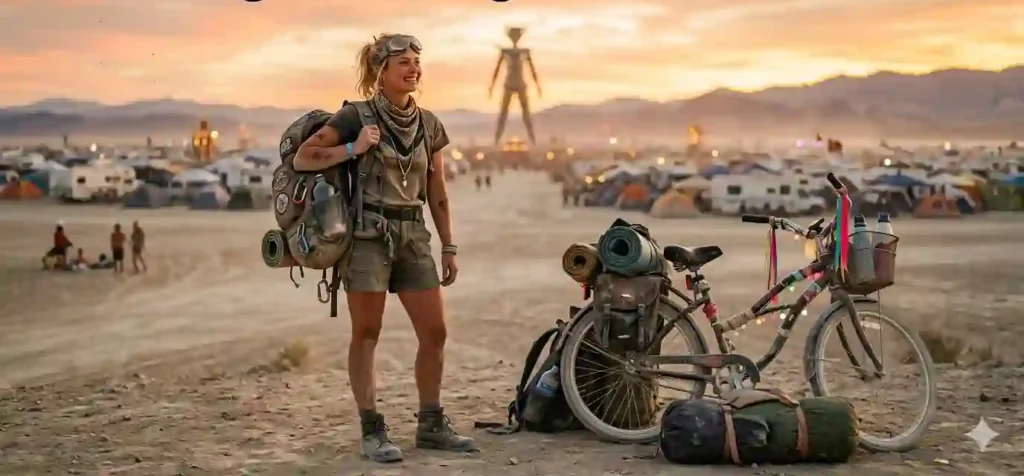
Burning Man Beginner Guide 2026: Everything First-Time Burners Need to Know Before They Go
Burning Man is a self-governing temporary city, not a festival with a stage and lineup, and it runs on ten specific cultural principles that surprise most newcomers. This pillar page introduces the event, Black Rock City, and the culture before you plan tickets, camping, or survival gear. Start here if this is your first Burn.
Roughly one in four people who pass through the gates of Black Rock City each year is attending for the first time, and nearly every one of them arrives with the same realization within a few hours: Burning Man is not a traditional festival. There’s no headlining act, no vendors selling food or merchandise, and no audience in the conventional sense.
Instead, around 72,000 participants build an entire temporary city for a week each year in Nevada’s Black Rock Desert, roughly 100 miles north of Reno, then dismantle it completely and leave no trace behind. Everything you see — the art, the music, the theme camps, the meals being cooked next to you — was made possible by another participant, not a promoter.
This Beginner Guide introduces the concepts that make Burning Man different before you get into logistics. You’ll learn what Black Rock City actually is, who typically attends (the event skews toward an educated, financially comfortable, Democratic-leaning population with an average age around 37 and a roughly even gender split), and the Ten Principles — Radical Inclusion, Gifting, Decommodification, Radical Self-Reliance, Radical Self-Expression, Communal Effort, Civic Responsibility, Leaving No Trace, Participation, and Immediacy — written by co-founder Larry Harvey in 2004 as a reflection of the culture that had already formed.
Whether you’re simply curious or actively planning your first Burn, this guide provides the foundation you’ll need before moving on to tickets, budgeting, camping, survival, transportation, and participation.
In This Guide You’ll Learn
- 🔥 What Burning Man actually is
- 👥 Who attends Burning Man
- 🎨 What makes Burning Man different
- 🤝 The Ten Principles
- ❤️ First-time expectations
- 📖 Where to continue learning
What Is Burning Man Really Like?
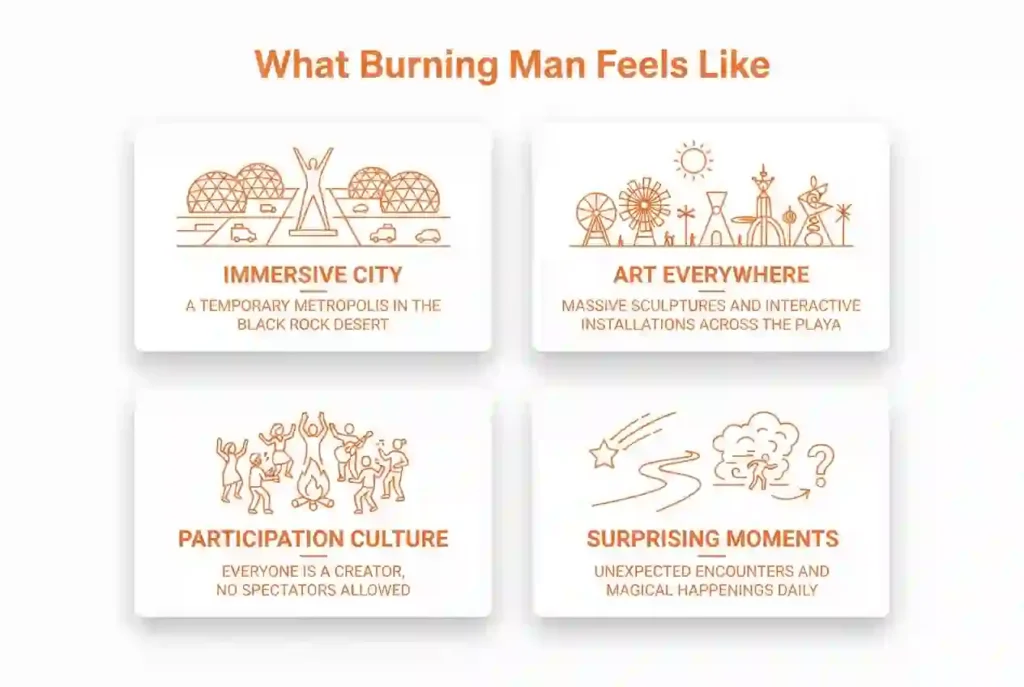
Burning Man is an immersive, participant-led cultural experiment that transforms a remote stretch of desert into a temporary city built around art, community, and radical participation. Over the course of a week, thousands of people from diverse backgrounds create installations, performances, and micro-communities that invite interaction and co-creation. The experience blends deliberate rituals—like major art burns—with countless spontaneous moments, so visitors encounter both planned spectacles and unpredictable social exchanges. Understanding what the event feels like on the ground helps first-timers set realistic expectations about the emotional intensity, social norms, and creative energy they’ll encounter.
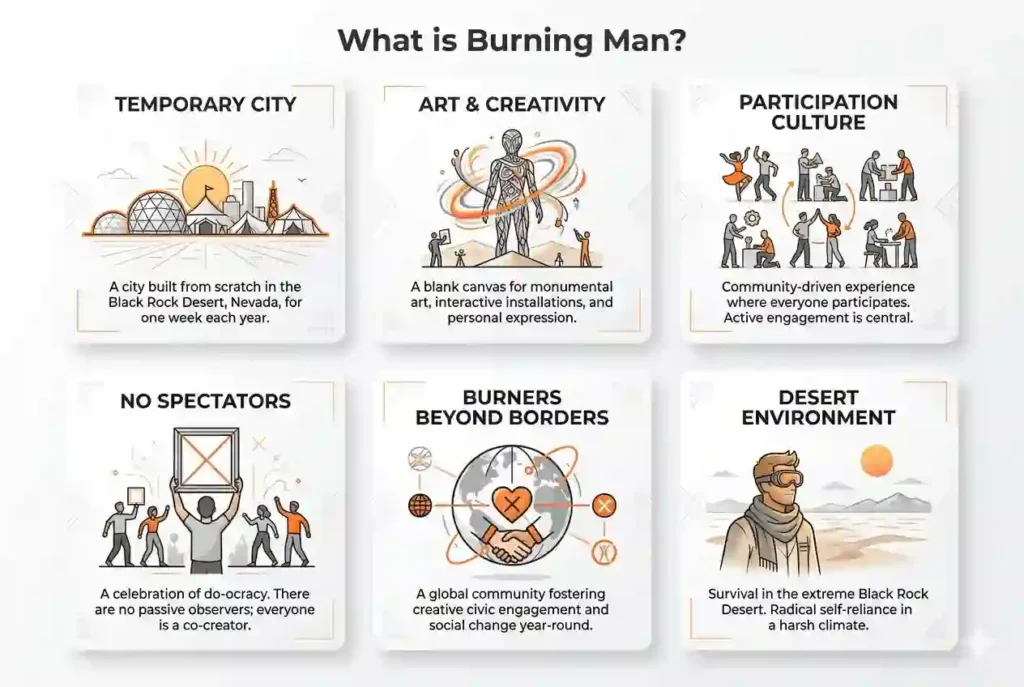
Understanding the Burning Man Experience
Burning Man is a participant-driven cultural event where most art, services, and programming are created by attendees. Daily life alternates between large-scale artworks and smaller, camp-level activities; participants often shift roles from spectator to contributor multiple times a day. That role fluidity creates a dense, varied rhythm of social engagement and meaning.
Why Burning Man Is Different From Traditional Festivals
Traditional festivals sell curated entertainment and vendor experiences; Burning Man asks participants to bring experiences with them through art, gifting, and voluntary programming. The lack of centralized commercial programming reduces some conveniences but opens space for surprising, community-created offerings that vary widely in scale and quality.
- Temporary city
- Participant-created experiences
- No commercial sponsorship
- Interactive art
- Community involvement
- Self-reliance
What Happens During Burn Week?
Burn week includes planned focal events (large art burns, parades) and countless spontaneous activities produced by individuals and camps. Some days feel domestic and low-key, others feel like citywide celebrations; rituals give shared meaning to otherwise fluid daily life and create communal focal points.
Why Every Person Has a Different Experience
Personal choices—camp selection, willingness to participate, social posture, and stamina—shape how the week unfolds. Two people can attend the same event and leave with very different takeaways based on how they engaged and what they prioritized.
What First-Timers Usually Find Most Surprising
Newcomers often notice the strength of gifting and consent norms, the social payoff of small contributions, and how mundane tasks become communal rituals. Those small social investments frequently yield immediate connection and lasting memories.
Burning Man Basics at a Glance
| Topic | Quick Overview |
| Event Type | Temporary city and participatory community. |
| Location | Black Rock Desert, Nevada. |
| Duration | Approximately one week each year. |
| Population | Tens of thousands of participants from around the world. |
| Accommodation | Self-supported camping. |
| Main Values | Participation, self-reliance, gifting, creativity, community. |
| Environment | Remote desert with extreme weather conditions. |
| Goal | Create, contribute, and experience—not simply observe. |
- Understanding the Burning Man Experience: immersive, participant-driven, art-centric.
- Why Burning Man Is Different From Traditional Festivals: community creates the program; no vendor marketplace.
- What Happens During Burn Week: mix of rituals, planned events, and spontaneous moments.
- Why Every Person Has a Different Experience: choices and social posture determine outcomes.
- What First-Timers Usually Find Most Surprising: gifting, consent culture, and communal chores as bonding.
🤔Is Burning Man Right for Beginners?
Deciding whether Burning Man is a good fit requires honest self-reflection about your temperament, physical tolerance, and what you want from the experience. This section helps you evaluate whether to move forward by outlining who typically thrives, who may struggle, and the practical personal questions to ask before committing. It focuses on mindset and fit, not logistics—so you can make a decision based on how the event aligns with your values and limits.
Can Anyone Attend Burning Man?
Practically anyone with the financial means, a ticket, and the physical ability to meet basic on-playa demands can attend; legal, medical, or mobility constraints may limit some individuals. Many camps and groups welcome newcomers, but arriving with honest expectations and the willingness to seek support matters.
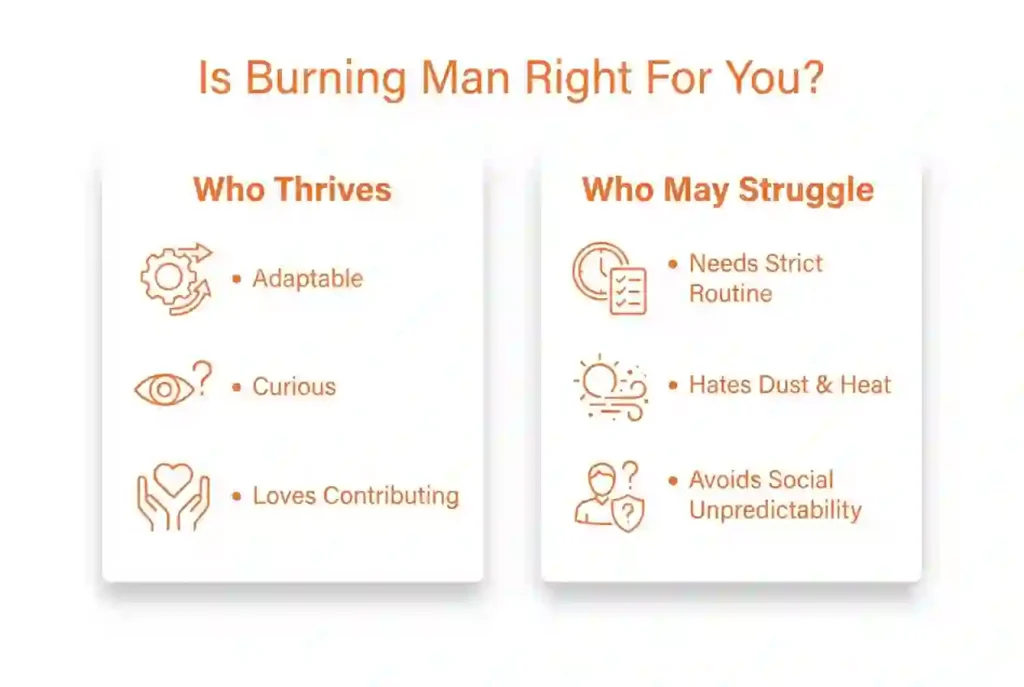
Who Thrives at Burning Man?
People who are adaptable, curious, and willing to contribute tend to thrive. Creative skills, organizing experience, or comfort with social unpredictability amplify satisfaction; those who lean into small acts of service often find the week profoundly rewarding.
- Adventure seekers
- Artists
- Families
- Campers
- Volunteers
- Curious beginners
Who May Find the Experience Challenging?
Those who depend on strict routines, require strong privacy boundaries, or have low tolerance for dust, heat, or crowds may struggle. Chronic health issues that worsen in dusty or extreme conditions require careful consideration before committing.
Is Burning Man Worth It for First-Time Visitors?
“Worth it” is personal: attendees seeking community, creative experimentation, and active contribution often report powerful, memorable experiences; those seeking passive spectacle or convenience may feel frustrated by the effort required. Match expected returns against time, cost, and energy investment.
Questions to Ask Yourself Before Deciding to Go
Do you want to actively create or mainly observe? Can you tolerate sensory extremes and social unpredictability? Are you willing to prepare and contribute to camp life? What outcomes (creative, social, personal) do you want from the experience?
Is Burning Man Right for Beginners?
- Can Anyone Attend Burning Man?: generally yes, with practical caveats.
- Who Thrives: adaptable, curious, contributory people.
- Who May Struggle: routine-dependent, privacy-oriented, or environmentally sensitive people.
- Is It Worth It: depends on goals and willingness to engage.
- Decision Questions: participation intent, physical tolerance, contribution readiness.
Who Can Attend Burning Man?
Burning Man is open to almost anyone who is willing to participate, prepare properly, and respect the community principles. It is not an exclusive club; if you can get a ticket, take care of yourself in the desert, and engage respectfully, you are generally welcome.
Is Burning Man Open to Everyone?
Burning Man does not require membership, status, or a special invitation; anyone can attend as long as they have a valid ticket and follow the event rules. People from all over the world, from many backgrounds and professions, come together to build and experience Black Rock City.
Minimum Age Requirements
Children are allowed at Burning Man, and many families choose to bring kids and camp together on the playa. However, minors must attend with a parent or responsible adult who is fully responsible for their safety, comfort, and wellbeing throughout the event.
Do You Need Experience?
No previous Burn or festival experience is required; thousands of people attend Burning Man for the first time every year. What matters far more than past experience is preparation: reading the guides, understanding the principles, and planning your gear, camp, and travel carefully.
Physical and Mental Readiness
Black Rock City is built in a harsh desert environment with heat, dust, strong sun, wind, and big temperature swings between day and night. Daily life usually involves walking or biking long distances, camping in basic conditions, and managing your own food, water, and shelter with a strong sense of self‑reliance.
Financial Readiness
Attending Burning Man typically requires budgeting for a ticket plus transportation (driving, RV, or flights and shuttles) to and from the desert. You’ll also need to cover camping gear, food, water, clothing, basic survival supplies, and ideally keep an emergency fund for unexpected costs.
Are International Visitors Welcome?
International visitors are absolutely welcome, and each year people travel from dozens of countries to attend Burning Man. They usually need a valid passport and, depending on their nationality, a visa or ESTA to enter the United States, along with extra planning for flights, gear logistics, and transport.
Accessibility and Inclusive Participation
Burning Man offers various accessibility supports, including ADA services, accessible porta‑potties in key areas, and some mobility assistance options. There are also dedicated accessibility resources and community efforts to help people with disabilities and diverse identities participate more fully in city life.
When Burning Man May Not Be the Right Choice
Burning Man may not be a good fit for people who are not prepared for camping, dust, heat, and doing many things for themselves in a remote desert. It can also be challenging for those with serious medical limitations who have not planned carefully, or for anyone expecting luxury accommodations or passive entertainment instead of active participation and shared responsibility.
- Burning Man is open to almost anyone worldwide; no membership or invitation is needed, only a valid ticket and respect for the community principles.
- Families and first-timers are welcome: children can attend with responsible adults, and thousands of people experience their first Burn every year.
- Harsh desert conditions (heat, dust, distance, camping, self-reliance) mean physical and mental readiness and solid preparation matter more than prior experience.
- Financial readiness is important, since you must cover ticket, travel, camping gear, food, water, and an emergency cushion yourself.
- International visitors and people with disabilities regularly attend, supported by visas/passports, travel planning, and ADA-focused accessibility services.
- Burning Man may not be right for those expecting luxury, not prepared to camp or practice Radical Self-Reliance, or unwilling to participate respectfully.
What Makes Burning Man Different From Other Events?
Burning Man isn’t just another festival; it’s an intentionally decommodified experiment in social design where participation, civic responsibility, and creative contribution replace consumer-oriented entertainment. The city operates like an ephemeral municipality with volunteer-led infrastructure, gifting economies, and a strong emphasis on consent and communal norms. This section explains the structural and cultural differences that separate Burning Man from concerts, trade shows, or typical outdoor festivals.
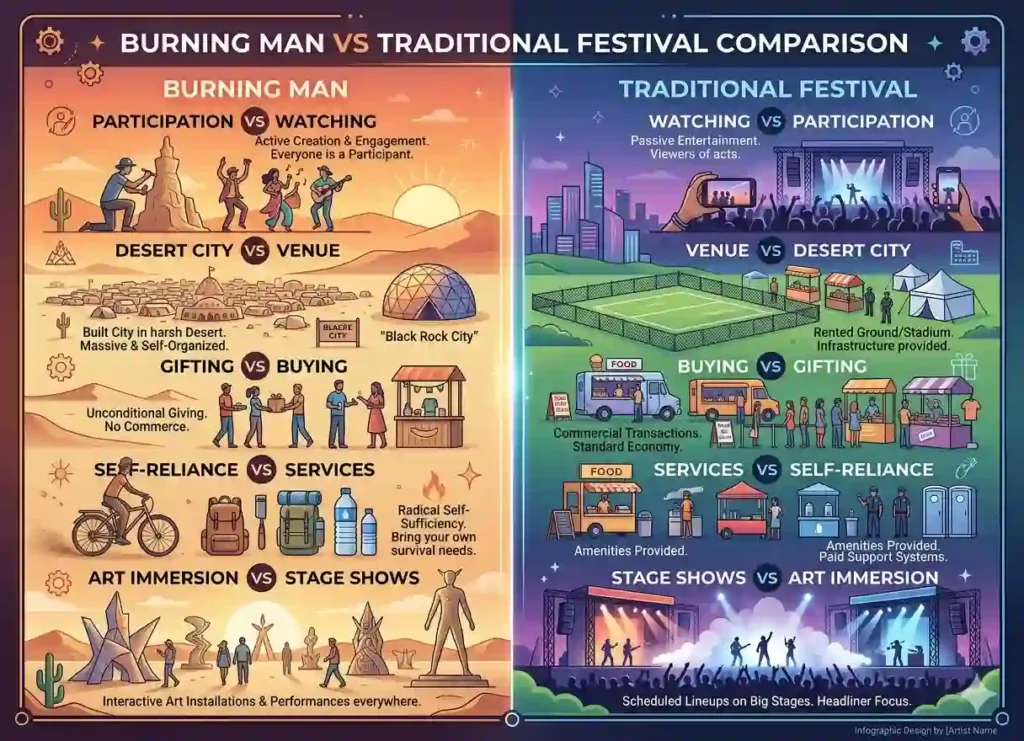
Participation Instead of Spectating
The baseline expectation is contribution: attendees gift time, skills, and experiences rather than primarily consuming pre-packaged entertainment. Meaningful experiences most often come from doing something hosting a workshop, helping a camp, or creating art.
Temporary City Instead of Festival Grounds
Black Rock City functions with streets, departments, volunteer governance, and civic responsibilities that resemble a short-lived municipality. That structure creates social obligations and opportunities for citizens, not just festivalgoers.
Community Before Entertainment
The event prioritizes relationships, cooperation, and shared creative ownership over individual entertainment or commercial transactions. People design offerings for collective benefit rather than profit.
Creativity Without Commercial Advertising
Decommodification means art and activities are funded by participants rather than advertisers; this changes aesthetics, scale, and accessibility and reduces commercial pressure on cultural expression.
Why the Experience Cannot Be Fully Explained Online
The sensory, emergent, and situational aspects unexpected conversations, emotional intensity, and communal rituals don’t translate fully to descriptions; presence and participation reveal subtleties words cannot capture.
What Makes Burning Man Different From Other Events?
- Participation over spectating: attendees contribute rather than only consume.
- Temporary city dynamics: civic systems and volunteer governance.
- Community-first values: cooperation over commercial entertainment.
- Creativity without advertising: participant-funded, ad-free art.
- In-person uniqueness: many elements resist full online explanation.
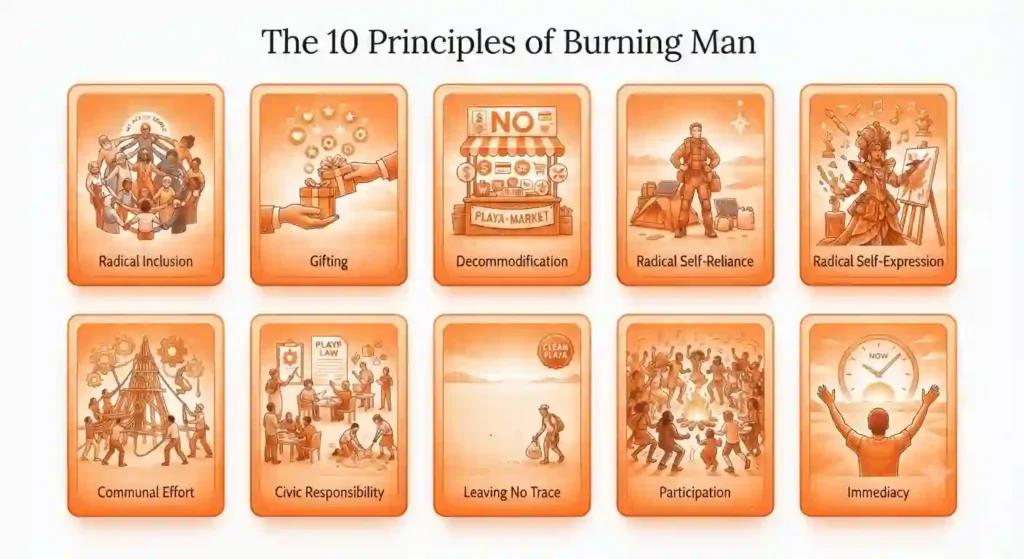
What Are the 10 Principles of Burning Man?
The Ten Principles act as a shared language and interpretive framework rather than strict laws: they guide behavior, camp practices, and expectations across Black Rock City. Knowing them helps newcomers understand why people act the way they do and how to participate ethically and effectively.
Why the Principles Matter
The principles give newcomers tools to interpret community norms and make participation choices. They help resolve confusion about gifting, consent, and civic behavior by providing consistent values that many participants reference in decision-making.
Radical Inclusion
Everyone is welcome without prerequisite; inclusion shapes outreach and camp composition while practical limits like space and safety still apply.
Gifting
Social exchange is based on gifts, not transactions; gifts range from small items to elaborate experiences, always given without expectation of return.
Decommodification
The city resists commercial sponsorship and advertising to keep interactions free from market dynamics and to prioritize creative authenticity.
Radical Self-Reliance
Individuals are expected to prepare to meet their own basic needs, fostering resilience and reducing dependence on centralized services.
Radical Self-Expression
Personal creativity and authentic self-presentation are encouraged; expression should respect consent and communal norms.
Communal Effort
Large projects and daily city life depend on collaboration; shared labor produces infrastructure and fosters social bonds.
Civic Responsibility
Participants are expected to act for the common good, follow safety norms, and participate in governance and public safety.
Leaving No Trace
Environmental stewardship is non-negotiable: everything you bring must leave with you; strict cleanup protocols protect the desert.
Participation
Active involvement—however small—is central; being present and doing something matters more than passive attendance.
Immediacy
Prioritizing direct, unmediated experience encourages presence, reduces mediated filters, and values spontaneous engagement.
What Are the 10 Principles?
- Principles as a whole: Radical Inclusion, Gifting, Decommodification, Radical Self-Reliance, Radical Self-Expression, Communal Effort, Civic Responsibility, Leaving No Trace, Participation, Immediacy.
- They provide shared values and practical guidance for behavior and design across the city.
What Should First-Timers Expect Before Arriving?
Before you arrive, calibrate expectations about the physical, social, and emotional realities of playa life so you’re not surprised by ordinary conditions or the intensity of interactions. This section outlines typical mismatches between romanticized ideas and the grounded realities many participants experience.
Expectations vs Reality
Expect both magical moments and mundane chores: the event produces awe and connection but also long lines, setup work, and small frustrations. Balancing wonder with preparation yields steadier emotional outcomes.
The Physical Environment
The playa is flat, dusty, and exposed to intense sun and wide temperature swings; the landscape amplifies sound and light and rewards shade and wind protection for comfort.
The Social Environment
Social norms emphasize openness, frequent stranger interactions, and consent-based engagement; diverse expressions and experimental rituals are common and can be intense for newcomers.
The Emotional Experience
The week often brings emotional highs and lows—joy, loneliness, overwhelm, and reflection—sometimes shifting perspectives in ways that are subtle and gradual rather than instantaneous.
Keeping an Open Mind
Curiosity, humility, and the willingness to learn turn awkward or challenging moments into opportunities for connection and insight; an open mind is one of the best tools for enjoying the event.
What Should First-Timers Expect Before Arriving?
- Expectations vs Reality: expect myth + mundanity; balance needed.
- Physical Environment: dusty, sunny, temperature-variable.
- Social Environment: open, consent-driven, socially intense.
- Emotional Experience: highs and lows are normal.
- Open Mind: curiosity and humility improve outcomes.
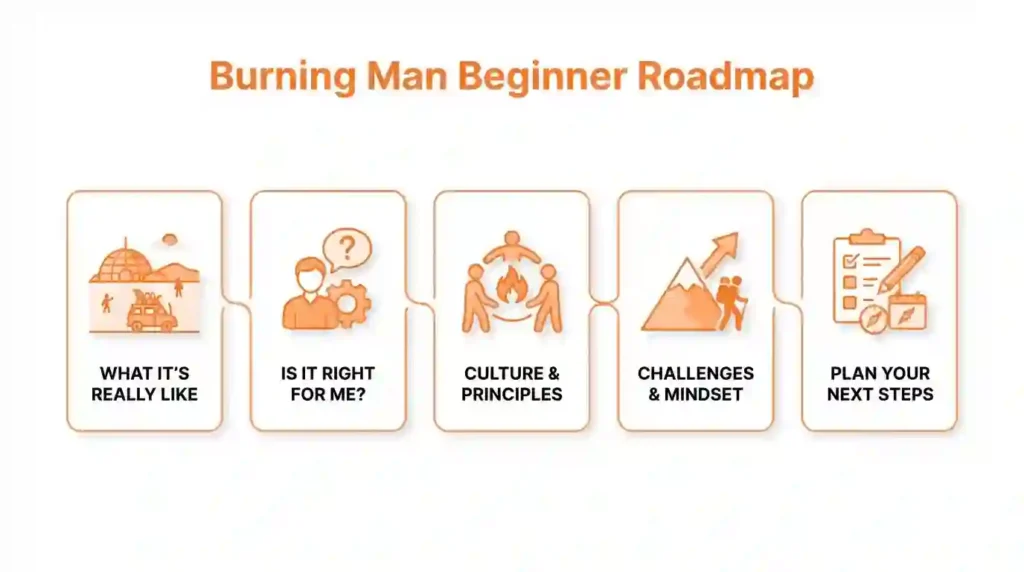
What Should You Learn Next Before Buying Tickets?
Once you decide the experience fits your goals, move to the practical child pages for detailed planning—timelines, budgets, packing systems, camping options, and arrival priorities. These pages convert the mindset established here into executable steps.
Planning Your First Burn
Transition to timelines, ticket pathways, team roles, and milestone planning on the Planning Guide page; early scheduling avoids rushed decisions.
Building Your Budget
Use the Budget Guide to estimate ticket, travel, camp contributions, and contingency expenses so financial surprises don’t derail the experience.
Packing the Right Gear
The Packing Guide translates mindset into systems and lists—focus on durable, redundant solutions rather than single-use items.
Choosing a Camping Style
The Camping Guide explains trade-offs between theme camps, vehicle camping, and solo setups so you can match your social goals to living arrangements.
Preparing for Arrival
Read the Arrival & First 24 Hours Guide for gate expectations and immediate setup priorities so your first hours are calmer and more organized.
🎭 Myths vs Reality
| ❌ Myth | ✅ Reality |
|---|---|
| 🎵 Burning Man is only a music festival. | It is a participatory city centered on art, community, and creativity. |
| 💵 Everything is free. | You must arrive fully prepared with your own supplies. |
| 🎨 Only artists belong there. | People from every background participate. |
| 🏕️ You need an expensive camp. | Good preparation matters far more than expensive gear. |
| 🛒 You can buy anything you forget. | Self-reliance means bringing what you need before arrival. |
| 🚪 It’s just another festival. | Burning Man operates as a temporary city built by its participants. |
- Next reads: Planning, Budget, Packing, Camping, Arrival guides.
- Use those child pages to convert decision into detailed plans.
- Start timelines and role agreements early to avoid last-minute stress.
Common First-Timer Mistakes
Common Misconceptions; These are assumptions many beginners make before arriving.
🎪 “I’ll just watch the event.”
Burning Man is built on participation. Everyone helps create the experience.
🛍️ “I’ll buy what I forget.”
There are no convenience stores for everyday supplies.
📱 “My phone will always work.”
Cell coverage is unreliable and should never be your main plan.
🚿 “Someone else will take care of camp.”
Every participant shares responsibility for camp life.
🎭 “Everything is already organized.”
Much of Burning Man exists because participants build it together.
- Underestimating the desert climate.
- Bringing too little water.
- Forgetting warm clothing for nights.
- Packing cheap equipment that fails.
- Arriving without a camp plan.
- Expecting vendors or convenience stores.
- Ignoring dust protection.
- Sleeping too little.
- Not reading the Ten Principles beforehand.
- Waiting for others to create the experience.
Experienced Burner Tips
Your first Burning Man experience is shaped less by what you bring and more by how prepared, flexible, and willing to participate you are. Understanding the environment, respecting the community, and embracing the spirit of contribution will help you experience Black Rock City with confidence.
- Experienced participants often recommend:
- Arrive with realistic expectations.
- Explore without a strict schedule.
- Participate instead of observing.
- Visit the playa during sunrise and sunset.
- Carry water everywhere.
- Label your bicycle clearly.
- Meet your camp neighbors early.
- Take breaks during the hottest hours.
- Say yes to unexpected experiences (when safe and comfortable).
- Remember that flexibility is one of your greatest tools.
⭐ Beginner Success Checklist
| ✔️ Task | Status |
|---|---|
| 🎟️ Secure your ticket | ☐ |
| 💰 Plan your budget | ☐ |
| 🚗 Arrange transportation | ☐ |
| ⛺ Plan your camp | ☐ |
| 🎒 Pack survival gear | ☐ |
| 💧 Prepare food and water | ☐ |
| 🚲 Ready your bicycle | ☐ |
| 📖 Learn the Ten Principles | ☐ |
| 🌱 Understand Leave No Trace | ☐ |
| 🚑 Review emergency information | ☐ |
Beginner Guide FAQs
Burning Man is a week-long experimental community built in Nevada’s desert where tens of thousands of people (“Burners”) create art, share gifts, and live by principles like radical self-reliance and leaving no trace. The event culminates in the ceremonial burning of a huge wooden effigy called “the Man.”
Yes—first-timers (called “newbies” or “virgins”) are welcome, and many attend their first Burn with no prior experience.
No prior camping experience is required, but you must be prepared to survive in a harsh desert environment with extreme heat, dust storms, and no services.
Absolutely. Many people go solo, and you can camp in open areas or join theme camps upon arrival.
It’s more than a festival—it’s a temporary city and social experiment built on 10 guiding principles, emphasizing participation, gifting, and community rather than performances or vendors.
Begin by reading the official Survival Guide, securing a ticket, planning shelter/water/food, and learning about desert safety and Leave No Trace practices.
After the basics, dive into the official Burning Man Survival Guide and community forums like ePlaya or Reddit’s r/burningman for in-depth tips.
Significant planning—months in advance is ideal—to arrange travel, gear, camp logistics, and physical/mental preparation for extreme conditions.
New Burners are often shocked by the intensity of the desert (dust, heat, wind), the radical generosity of strangers, and how exhausting yet transformative the experience can be.
Yes—anyone who can get a ticket and prepare adequately is welcome, regardless of age, background, or experience (children under 12 enter free).
Yes—you’re free to leave Black Rock City at any time during the event, though re-entry requires your ticket stub, a wristband, and a per-person fee, and you may face long wait times at the gate, especially during peak Exodus days (Sunday night through Monday).
Where Should You Go Next?
| If You Want To… | Read This Guide |
| Plan your trip | → Planning Guide |
| Estimate costs | → Budget Guide |
| Learn about camping | → Camping Guide |
| Understand participation | → Participation Guide |
| Prepare for travel | → Travel & Arrival Guide |
| Return to First-Time Hub | → First-Time Guide |
First-Timer Success Tips
- Read beginner guides before buying gear.
- Start planning early.
- Ask questions in Burner communities.
- Stay flexible.
- Respect the culture.
- Focus on preparation rather than perfection.
Conclusion
Burning Man becomes much easier to understand once you recognize that it is a community experience rather than a traditional event. Learning the basics first allows every later planning decision—from budgeting to camping—to make much more sense.
- 🔥 Burning Man is created by participants—not spectators.
- 🏙️ Black Rock City becomes your temporary home for the week.
- 🤝 Community participation is part of the experience.
- 🎨 Creativity and self-expression are encouraged.
- 🌞 Preparation makes the experience safer and more enjoyable.
- 📚 Learn one topic at a time instead of trying to understand everything at once.
- ❤️ Every experienced Burner was once a beginner.
- 📖 Continue with the First-Time Planning Guide to begin organizing your trip.
What Every Beginner Should Remember
Burning Man is not just a festival; it is a participatory, temporary city built on creativity, Radical Self‑Reliance, and mutual respect. As a first‑timer, the most important things to focus on are preparation, realistic expectations, and a willingness to contribute rather than consume. You do not need to control every detail of your week—arrive prepared, then let the experience unfold.
Building Confidence Before Your First Burn
Every experienced Burner was a nervous first‑timer once, and confidence grows from understanding how Black Rock City works and what it demands of you. By learning the basics, knowing who can attend, and planning your gear, budget, and camp step by step, you turn uncertainty into excitement. The more informed you are before you hit the playa, the more freedom you will feel to explore, connect, and enjoy once you arrive.
Your Next Step in the First‑Timer Journey
Instead of trying to absorb everything at once, move into planning one layer at a time. A natural next step is to continue with your focused guides—starting with the First‑Time Planning Guide, then moving into the First‑Time Budget Guide, Packing & Gear Guide, and Camping Guide. Following these in order gives you a complete path from “Am I going?” to “I’m ready for my first Burn,” without overwhelm.
Final Thoughts
Burning Man Is a Journey, Not Just an Event
Your Burn begins long before you see the Gate and continues long after you leave the playa. Researching, planning, packing, traveling, participating in Black Rock City, and reflecting afterward all become chapters of the same transformative journey. When you treat it as a process instead of a single week, each stage—learning, preparing, arriving, decompression—feels more meaningful and manageable.
- ❤️ Participate instead of spectating.
- 💧 Prioritize your health and hydration.
- 🤝 Treat every interaction with respect.
- 🌵 Prepare thoroughly for desert conditions.
- 🌱 Leave No Trace.
- 📖 Continue with the First-Time Planning Guide to begin organizing your Burning Man journey step by step.
Arrive Curious, Prepared, and Ready to Participate
The best experiences rarely come from sticking to a rigid plan; they come from showing up prepared, then saying “yes” to participation. If you arrive with solid basics covered (water, shelter, food, safety) and an open mind, you create space for art, gifting, conversations, and unexpected moments to change you. Respect the principles, take care of yourself and others, and treat the city like a home you help to build and protect.
Continue Building Your Burning Man Knowledge
| Step | Guide |
| 1 | Beginner Guide |
| 2 | Planning Guide |
| 3 | Budget Guide |
| 4 | Camping Guide |
| 5 | Participation Guide |
| 6 | Travel & Arrival Guide |
| 7 | Survival Guide |
| 8 | Leaving & Post-Burn Guide |
- This Beginner Guide is only the starting point of your learning curve.
- A clear learning path—Beginner Guide → First-Time Planning Guide → Budget Guide → Packing & Gear Guide → Camping Guide → Arrival & First 24 Hours Guide → Survival Guide → Participation & Etiquette Guide → Common Mistakes Guide → Leaving & Post‑Burn Guide—helps you move from curiosity to confident, responsible participation. As you think about your own readers, what emotional note do you want to leave them with at the very end: reassurance, inspiration, or a clear “now go plan this step” call‑to‑action?